



Review Article - (2018) Volume 3, Issue 2
Sports Nutrition: A Perspective
Received Date: Nov 26, 2018 / Accepted Date: Dec 20, 2018 / Published Date: Dec 27, 2018
Copyright: ©Rajasekhar Kali Venkata. This is an open-access article distributed under the terms of the Creative Commons Attribution License, which permits unrestricted use, distribution, and reproduction in any medium, provided the original author and source are credited.
Abstract
Sports nutrition has been getting paramount importance with respect to elite sportspersons training and competition. Sports nutrition is extensively used to protect the health of elite sports persons as the high intensity sports training and competition are highly oxidative and inflammatory in nature. Even for the protection of metabolic status and to get appropriate performances also sports nutrition seems highly helpful. Nutritional supplementation seems to be another area of sports nutrition which may be highly helpful in the elite sportspersons training and securing elite performances in competitions. Also the toxic effects of hyper nutrition like megavitamin doses cannot be undermined in the domains of the training and performances of elite sportspersons. Even the nutrition may show impact on the proprioception and orientation abilities of sportspersons thereby bringing changes in the motor skills. The effect nutrition on the Brain Derived Neurotropic Factor and its signaling in terms of brain metabolism also gets apt importance in sports nutrition. Hence, sports nutrition is also very important domain of the elite sportspersons’ training as well with respect to their elite performances, and this aspect needs to be properly implemented into the training schedules of elite sportspersons to derive appropriate health protection, performance protection and for super compensation purposes.
Keywords
Sports nutrition, elite sportspersons, nutritional supplementation, oxidative stress, inflammatory stress
Introduction
Nutrition seems to be one of the most important elements in sports training and performance, especially for elite sportspersons. Elite sports persons are essentially inclined to maintain the best possible health throughout the competitive season to perform the best. Especially high intensity sportspersons are supposed to monitor their nutrition program during the training and competitive period due to mainly three reasons. To maintain excellent health status, to recover from the rigors of the training with sufficient regeneration and super compensation and to perform the best are the three essential ingredients of any elite sportsperson training. The significant effect of scientific nutrition cannot be undermined apart from scientific training and other recovery methods. It may also be fallacious to just describe only about the physical exertion as the sole performance factor in certain sports like basketball, football etc. wherein the agility, proprioception are also highly requisite factors for extraordinary performances. These factors of performances are mostly dependent on the nervous system and other proprioception mechanisms of the individual along with the physical fitness factors. Hence, it is also equally essential to include the area of skill of the sportspersons while discussing how the nutrition might affect the sportspersons performances and understanding the importance of nutrition for sports performances and training.
Spheres of Sports Nutrition
The three major areas of the effect of nutrition on the elite sportspersons is enfolded here as an outline mechanism. Keeping in view of the intricate relationship of these factors, it may be difficult to discuss these interrelationships of different influencing factors of elite performances; an effort is made to put forth for better and easier understanding.
Nutrition for elite sportspersons
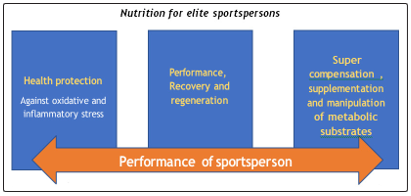
It is very clear that the following three aspects for which the nutrition is essential for elite sportsmen are intricately connected and complex to be presented in vogue and clear terms. They need to be understood properly with scientific rigor and vision. High intensity sports training and competition like marathon, ultra-cycling, triathlons etc. impose severe inflammatory and oxidative stress leading to unfathomable disturbances in the bioenvironmental of the sportsperson. High intensity sustained aerobic physical activities may lead to temporary suppression of immune function, possibly due to suppression of mucosal immunoglobulin’s and other immune proteins during the severe inflammatory stress. Not only gets the suppression in the production and proliferation of the immune bodies but also the antigen presentation by these protein bodies affected too. This could be due to the severe inflammatory stress during the high intensity sustained activity which triggers severe imbalance between the pro and anti- inflammatory status of the body. For elite sportspersons both the training and competition are very intense and highly strenuous and it could lead to lot of oxidative and inflammatory stress. Higher inflammatory stress could lead to tissue damage at various places of the body leading to suppression in immunity or cause for reduced organ function. Even the elite athletes are prone for severe and frequent infections due to this temporary reduced immune strength. Upper respiratory tract infections among elite athletes are a big concern as URTI may lead to reduced lung function and consequent loss in performance in the competition. Successive and high intensity oxidative stress may lead to the cell damage and cell dysfunction, causing severe debilitations to athletes including injuries and oxidative stress related diseases including developing cancers.
There have been several studies which testify this and hence it would be wise to prevent the excessive or high levels of oxidative and inflammatory stress through proper nutrition program for athletes both during their training and during competition. This point of securing health to elite athletes through proper nutrition not only linked to the health to the athletes, also makes them more consistent in their performances. Frequent infections not only derails the training protocols of the sportspersons but also makes them lose their sporting form. Though it may be difficult to quantify the anti-inflammatory and anti-oxidative strengths of the sportspersons, there is every possibility that the sportspersons may be saved from being exposed to the high levels of inflammatory and oxidative stress through excellently formed scientific training sessions with befitting nutrition and recovery techniques.
Another significantly important area of sports nutrition seems to be the nutrition for ongoing training or performance and during the recovery and reconstruction process after an exhausting training or competition bout. Nutrition during the training session or during the exhaustive sustained competitive bout should not be undermined as the performances of the sportspersons is highly linked to the availability of energy and other metabolites for optimal performances of muscular and nervous systems in unison, since, both peripheral and central fatigue are highly deleterious to the performances of sportspersons. There are several nutritional techniques that are adopted by athletes during the training period to gain the desired levels of super compensation of substrates and other metabolites. One such technique predominantly used by athletes is the carbohydrate loading. Some athletes are also favoring the technique of hyper hydration for better thermostat regulation during their high intensity sustained competitive activity like running marathons etc.
All these loading techniques are implemented very cautiously with scientific monitoring of the athlete status. Attaining and maintaining the electrolyte balance is highly essential for excellent biodynamic of the body and for good physical performances. Apart from the nutrition for ongoing training and for ongoing sports performances, nutrition is very remarkably important for recovery, reconstruction of tissues and for super compensation. Post training and post competition bout nutrition seems to be very expropriating in terms of gaining the advantages of training and the severe and exhaustive competitive bout. It is certainly appropriate to have different nutritional elements during the recovery period after the exhausting training session to derive appropriate advantage. Hence, the type of training certainly asserts the type of follow up nutrition program. Post the resistance training program, which certainly enhances the negative protein turnover, needs first class protein after the training session to see that proper regeneration of tissues would take place. As already mentioned, the relevance of nutrition for sportsperson seems to be very widespread and the effect of nutrition seems to have simultaneous cascading effect into the domains of performance, health, recovery and super compensation. Hence, the complexity is very perplexing but highly influencing.
This particular assertion makes the nutrition as one of the very important techniques of sports training especially for elite sportspersons across the globe. The presence of sports nutritionist is seemingly visible in some of the successful sportspersons contingents. In fact the presence of the sports nutritionist is very helpful in designing the sports training of elite sportspersons and also securing constant high level performances for these elite sportspersons during successive competitions. This is achieved through maintaining the health status of the elite sportsperson though exposed to severe high intensity sustained trainings, but also making the sportsperson to be able to deliver the highest possible performance through proper nutrition program. Recovery not only in terms of metabolites for energy, but mainly the essential protein and other essential macro and micro nutrients like minerals, vitamins and other chemical substances which contribute in the reconstruction of the lost tissues and also for the synthesis of several chemical substances that are essential for the endocrinal and nervous system recovery and function. Ideal and essential combination of macronutrients need to be the hallmark of the post exercise nutrition to reinstate the lost homeostasis but also to gain better endocrinal and biodynamic atmosphere in the body.
Carbohydrates, first class proteins, fats should form the post exercise diet for sportspersons, but as per the proportions required suitable for the activity completed and the type of recovery and super compensation expected by the sportsperson. As already indicated, it may be a very complicated affair to identify the suitable proportions of macronutrients for the post exercise recovery and super compensation. The success of the athlete certainly depends on the sports nutrition program of the athletes along with the scientifically planned training protocols.
Another important area of sports nutrition is nutrition supplementation to elite athletes. Nutrient supplementation has become very vogue among the elite athletes and several elite sportspersons take the help of professional sports nutritionists to understand the supplementation necessity and the quantity and type of supplementation. As the science on anti-oxidative and anti-inflammatory stress is still not fully understood the ideal practice for athletes may be to make efforts to prevent the possible negative issues of oxidative and inflammatory effects of high intensity sports activities. Specially prepared supplements though available readily in the market, the difficulty in estimating the contamination and process of synthesis of these substances are making it quite difficult for sports nutritionists to prescribe the correct supplements and also the quantity of supplements to different sportspersons. Supplementation of both macro and micro nutrients is in vogue among the elite sportspersons across the globe. Phytochemical and other anti-oxidative substances supplementation is getting more prominence and importance as the science of sports training and sports endocrinology gets more in-depth in their understanding of the dangers of oxidation of high intensity exercise among elite athletes. Sometimes, supplements may also be consumed to protect and to enhance the muscle contraction physiology. Especially the Vitamin C and Vitamin D supplementation seems logical to protect the bone calcium density and also to control the calcium metabolism and to protect the muscle contraction mechanism in proper intensity. At the same time, excessive supplementation seems very adverse leading to health problems as well the hampering of the physical performances too of elite sportspersons.
Hence, very importantly, the aspect of sports nutrition in terms of health protection to elite athletes, their performances, training etc. are not watertight but very osmotic. Amalgamation of the important effects of nutrition on elite sportsperson is quite difficult and very complex. For example, protein essentiality post the rigorous aerobic and resistance training need not be emphasized, but the importance of protein synthesis post the rigorous training and high intensity sustained oxidative bout to make the immune proteins and other protein cytokines for furtherance of endocrinal and metabolic cascades need to be recognized. This one particular cascade of protein as myofibrillar basis for performance and also as protein molecule immunoglobulin for immune function, protein as cytokines for endocrine like reactions and for anti-inflammatory, anti-oxidative stress of athletes is widely recognized and discussed. This is the one reason, why it may be difficult to quantify the protein requirement of elite sportsmen for want of protein not only for muscle hypertrophy but also for many other metabolic and biodynamic cascades that are also highly essential not only for performance enhancement but also for protecting the health of the elite sportspersons. It is also very tricky and incomprehensible to understand and to quantify the protein requirement of the elite athletes of different sporting activities with different training protocols and different competition requirements that may demand different physical activities.
Another very significantly impacting area for sportspersons performances is about the nervous system and other peripheral nervous system domain and this also is prone for oxidative and inflammatory effects of high intensity sustained exercises. High intensity sports training or bouts of sports competitions may cause severe oxidative damage to different areas of brain including the hypothalamus, hippocampus etc and could cause for neuronal damage and consequent reduction in the neuronal abilities causing reduced proprioception. Sports performances whether it is physically dominating or mentally dominating depend mainly on resisting both the central as well as peripheral fatigue conditions. BDNF signaling which is very important in regulating the neuronal energy metabolism gets affected with the oxidative and inflammatory stress of exercise and could cause for reduced metabolic bio dynamics that may reduce the movement and coordination ability and also the motor abilities of a person. Peripheral proprioceptors which may be existing in different areas of the body like joints, muscles etc. may also get affected by the stress of inflammation and oxidation of exercise. Having the matching anti- inflammatory and anti-oxidative abilities is a prerequisite for any individual to be able to negative or neutralize these ill effects of exercise and be able to perform at the most. The science of sports nutrition is progressively evolving into a full blown science and with clear empirical evidences, how nutrients can help individuals to be able to sustain these negative aspects of severe forms of exercise training and competition.
It is also evident that the excessive nutritional supplementation like mega doses of vitamins and minerals may lead to toxicity and could hamper health as well the performances of elite athletes. Necessary caution is to be heeded by trainers and the elite athletes during their sports nutrition programs. Since, this area of nutritional toxicity is not intended to be included in this article, sufficient material is not included, except this cautionary message [1-28].
Conclusion and Recommendation
Several potential dangers of high intensity exercise training and competition have been identified by several sports science investigators are worth considering in view of possible health effects and reduced performances. The possible identified dangers of high intensity sports participation and training seems to be inflammatory and oxidative stress and these have been considered very debilitating sometimes by some scientific evidences. The advanced sports sciences are seriously contemplating to advise to the trainers and to the elite sportspersons to take proper protective measures through proper scheduling of high intensity training bouts and also the competition bouts and also use all the possible sources of science to prevent any untoward health illnesses and reduced performances. One of the important measures may the use of sports nutrition during both the training and also during the competition of elite sportspersons. Sports nutrition help is highly essential in the areas of health of the athletes and also to secure elite performances consistently. Hence, it is emphasized that any nutritional practice either during the training or during the performance should only contribute for the protection of health and performances [1-28].
References
- Hadzovic-Dzuvo A, Valjevac A, Lepara O, Pjanic S, Hadzimuratovic A, et.al. (2014) Oxidative stress status in elite athletes engaged in different sport disciplines, Bons J Basic Med Sci 14: 56-62.
- Andrea Petróczi,corresponding, Declan P Naughton, Gemma Pearce, Richard Bailey, Andrew Bloodworth, et.al. (2008) Nutritional supplement by elite young UK athletes: fallacies of advice regarding efficacy, Journal of the International society of sports nutrition 5: 22.
- Barros ES, Nascimento DC, Prestes J, Nóbrega OT, Córdova C, et.al. (2017) Acute and Chronic effects of endurance running on inflammatory markets: a systematic review, Front Physiol 8: 779.
- Chou CC, Sung YC, Davison G, Chen CY, Liao YH (2018) Short term high dose Vitamin C and E supplementation attenuates muscle damage and inflammatory responses to repeated Taekwondo competitions: A randomized placebo controlled trial, Int J Med Sci 15: 1217-1226.
- Clauss S, Wakili R, Hildebrand B, Kääb S, Hoster E, et.al. (2016) MicroRNAs as Biomarkers for Acute Atrial Remodeling in Marathon Runners (The miRathon Study--A Sub-Study of the Munich Marathon Study), PLoS One 11: e0148599.
- Colbey C, Cox AJ, Pyne DB, Zhang P, Cripps AW, et.al. (2018) Upper Respiratory Symptoms, Gut Health and Mucosal Immunity in Athletes. Sports Med 48: 65-77.
- Davies RD, Parent EC, Steinback CD, Kennedy MD (2018) The Effect of Different Training Loads on the Lung Health of Competitive Youth Swimmers. Int J Exerc Sci 11: 999-1018.
- Dennis-Peter Born, Christoph Zinner, Billy Sperlich (2017) The Mucosal immune function is not compromised during a period of High-intensity interval training. Is it time to reconsider an old assumption? Front. Physiol 8: 485.
- Galazka-Franta A, Jura-Szoltys E, Smólka W, Gawlik R (2016) Upper Respiratory Tract Diseases in athletes in different sports disciplines, J Hum Kinet 53: 99-106.
- Gmiat A, Mieszkowski J, Prusik K, Prusik K, Kortas J, et.al. (2017) Changes in pro inflammatory markers and leucine concentrations in response to Nordic walking training combined with vitamin D supplementation in elderly women, Biogerontology 18: 535-548.
- Harty PS, Zabriskie HA, Erickson JL, Molling PE, Kerksick CM, et.al. (2018) Multi-ingredient pre-workout supplements, safety implications, and performance outcomes: a brief review, J Int Soc Sports Nutr 15: 41.
- Muwonge H, Zavuga R, Kabenge PA, Makubuya T (2017) Nutritional supplement practices of professional Ugandan athletes: a cross-sectional study, Journal of the International society of sports nutrition 14: 41.
- Ina Garthe, Ronal J Morgan (2018) Athletes and supplements: prevalence and perspectives, International Journal of sport nutrition and exercise metabolism 28: 126-139.
- Jager R, Kerksick CM, Campbell BI, Cribb PJ, Wells SD, et.al. (2017) International society of sports nutrition position stand: Protein and exercise, J Int Soc Sports Nutr 14: 20.
- Arwel W Jones, Daniel S March, Ffion Curtis, Christopher Bridle (2016) Bovine colostrum supplementation and upper respiratory symptoms during exercise training: a systematic review and meta-analysis of randomised controlled trials. BMC Sports Sci Med Rehabil 26: 08-21.
- Kerksick CM, Arent S, Schoenfelt BJ, Stout JR, Campbell B, et.al. (2017) International society of sports nutrition position stand: nutrient timing, J Int Soc Sports Nutr 14: 33.
- Zwetsloot KA, John CS, Lawrence MM, Battista RA, Shanely RA (2014) High intensity interval training induces a modest systemic inflammatory response in active, young men, J. Inflamm Res 7: 09-17.
- Richard B Kreider, Douglas S Kalman, Jose Antonio, Tim N Ziegenfuss, Robert Wildman, et.al. (2017) International society of sports nutrition position stand: safety and efficacy of creatine supplementation in exercise, sport, and medicine. J Int Soc Sports Nutr 14: 18.
- Leal G, Comprido D, Duarte CB (2014) BDNF induced local protein synthesis and synaptic plasticity, Neuropharmacology 76: 639-656.
- Peng J, Deng X, Huang W, Yu JH, Wang JX, et.al. (2017) Irisin protects against neuronal injury induced by oxygen glucose deprivation in part depends on the inhibition of ROS-NLRP3 inflammatory signalling pathway, Mol Immunol 91: 185-194.
- Peterneli TT, Coombes JS (2011) Antioxidant supplementation during exercise training: beneficial or detrimental? Sports Med 41: 1043-1069.
- Pingitore A, Lima GP, Mastorci F, Quinones A, Iervasi G, et.al. (2015) Exercise and oxidative stress: effects of antioxidant dietary strategies in sports. Nutrition 31: 916-922.
- Rodrigo Terra, Sílvia Amaral Gonçalves da Silva, Verônica Salerno Pinto, Patrícia Maria Lourenço Dutra (2012) Effect of exercise on the immune system: response, adaptation and cell signalling, Rev Bras Med Esporte 18.
- Ronald J Maughan, Louise M Burke, Jiri Dvorak, D Enette Larson-Meyer, Peter Peeling, et.al. (2018) IOC consensus statement: dietary supplements and the high-performance athlete, British Journal of sports medicine 52: 439-455.
- Slattery K, Bentley D, Coutts AJ (2015) The role of oxidative, inflammatory and neuroendocrinological systems during exercise stress in athletes: implications of antioxidant supplementation on physiological adaptation during intensified physical training, Sports Med 45: 453-471.
- Teixeira RN1, Dos Santos Leite G1, Gorjao R2, Palmeira P3, Santos CMM, et.al. (2018) Immune and inflammatory response in atopic elite endurance athletes, Int J Sports Med 39: 720-725.
- Vaynman S, Ying Z, Wu A, Gomez-Pinilla F (2006) Coupling energy metabolism with a mechanism to support brain derived neurotrophic factor-mediated synaptic plasticity, Neuroscience 139: 1221-1234.
- Williams NC, Killer SC, Svendsen IS, Jones AW (2018) Immune nutrition and exercise: Narrative review and practical recommendations, Eur J Sport Sci 5: 01-13.