


Research Article - (2025) Volume 2, Issue 1
Spectral Theory in Non-Separable Banach Spaces: Generalizations, New Properties and Structural Extension
Received Date: Jul 14, 2025 / Accepted Date: Aug 15, 2025 / Published Date: Aug 25, 2025
Copyright: ©Â©2025 Juan Alberto Molina Garcia. This is an open-access article distributed under the terms of the Creative Commons Attribution License, which permits unrestricted use, distribution, and reproduction in any medium, provided the original author and source are credited.
Citation: García, J. A. M. (2025). Spectral Theory in Non-Separable Banach Spaces: Generalizations, New Properties and Structural Extension. Ther Res: Open Access, 2(1), 01-11.
Abstract
This article addresses the extension of classical spectral theory to the setting of non-separable Banach spaces (NSBS), a field that remains underdeveloped despite its increasing relevance in functional analysis and mathematical physics. While spectral theory in separable Banach spaces has been thoroughly investigated—particularly through the work of Fredholm, Riesz, and others—the transition to nonseparable spaces presents both technical and conceptual challenges. These arise mainly from the absence of countable dense subsets and orthonormal or Schauder bases, which are instrumental in formulating and proving classical theorems. The main objective of this work is to provide a rigorous and systematic framework for spectral theory in NSBS, focusing on the classification of spectral components, the generalisation of key theorems, and the topological and algebraic behaviour of operators acting on such spaces. We begin by recalling the foundations of spectral theory in the classical (separable) case and proceed to identify the structural modifications required in the non-separable context. A central part of the analysis is devoted to the residual and continuous spectra, whose properties exhibit significant deviations from their counterparts in separable settings. We propose new definitions, prove generalised versions of the spectral theorem, and characterise the structure of the spectrum under various topological assumptions. Particular attention is given to the stability of the spectrum under perturbations—both compact and non-compact—and to the conditions under which the classical spectral decomposition remains valid. Several illustrative examples are provided to highlight the influence of non-separability on spectral behaviour. The results presented here contribute to a deeper understanding of spectral phenomena in infinitedimensional analysis, particularly in cases where separability cannot be assumed. They offer theoretical tools for future work in operator theory, interpolation, partial differential equations, inverse problems, and the theory of operator algebras. This article thereby lays the groundwork for further mathematical developments in non-separable environments and suggests new directions for interdisciplinary applications.
Keywords
Spectral Theory, Non-Separable Banach Spaces, Residual Spectrum, Continuous Spectrum, Spectral Theorem, Operator Stability, Functional Analysis, Fredholm Theory, Perturbations
Introduction
The theory of linear operators and their spectra constitutes a central pillar of functional analysis, with deep implications across mathematics and physics. In the classical setting of separable Banach spaces, spectral theory has been extensively developed through the foundational works of Fredholm, Riesz, and other major contributors. These results rely heavily on structural properties such as the existence of countable dense subsets, orthonormal or Schauder bases, and the applicability of approximation methods based on sequences or series.
However, in the context of non-separable Banach spaces (NSBS), many of the traditional assumptions and tools no longer apply. The absence of separability invalidates standard approximation techniques and weakens several compactness arguments. As a result, key results of classical spectral theory fail to generalise directly. Despite their theoretical importance and practical emergence in fields such as partial differential equations, quantum mechanics, and infinite-dimensional control theory, NSBS remain underrepresented in the modern development of spectral theory.
The aim of this article is to address this gap by extending the core results of spectral theory to NSBS. We begin by reviewing the fundamental notions of the spectrum of a bounded linear operator—namely, the point spectrum, continuous spectrum, and residual spectrum—in the context of separable spaces. These distinctions, although standard in classical analysis, become particularly delicate when considered in a nonseparable setting. Indeed, the lack of sequential compactness and countable basis structure alters the topology of the space and, consequently, the behaviour of the spectrum.
The article proceeds by identifying the topological and algebraic obstacles posed by NSBS and proposes new formulations that allow for the extension of spectral characterisations. In particular, we focus on the generalisation of the spectral theorem and the structural analysis of spectral components under weakened assumptions. Special attention is given to the residual spectrum, which displays notable changes in the absence of separability, and to the conditions that preserve the validity of decomposition theorems.
Furthermore, we investigate the stability of the spectrum under perturbations, both compact and general, and discuss its implications for applications in analysis and mathematical physics. The results are illustrated through concrete examples that highlight the contrast between separable and non-separable behaviours.
This study contributes to the ongoing development of operator theory in general Banach spaces, offering tools for the treatment of spectral problems in broader contexts. In doing so, it also invites future research into related areas such as the algebra of operators on NSBS, interpolation theory without countable bases, and the formulation of spectral techniques adapted to weak topologies.
Background and Classical Spectral Theory
Spectral theory investigates the structure and properties of bounded linear operators through the analysis of their spectra. In the classical setting of separable Banach spaces, this theory has reached a high level of formal maturity, supported by a comprehensive set of results that link algebraic, topological and analytical aspects of operator behaviour [1,2].
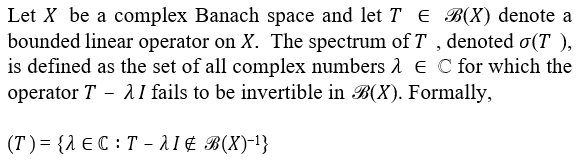
This definition partitions the spectrum into three mutually disjoint components:
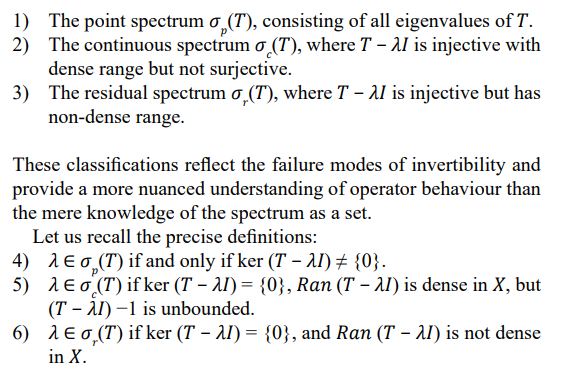
These definitions are deeply tied to the topological structure of the underlying space. In particular, separability allows one to exploit countable dense subsets, facilitating the use of approximation techniques and sequential compactness.
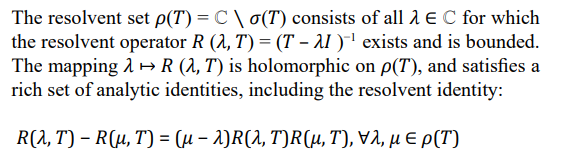
A central result in spectral theory is the spectral radius formula, which connects the spectral properties of T with the norm of its powers:

This identity holds in any Banach space and provides a powerful tool for bounding the spectrum from above.
In Hilbert spaces and certain reflexive Banach spaces, additional structure allows for the development of spectral measures, orthogonal decompositions, and functional calculi. These advanced tools culminate in the spectral theorem, which, in its bounded self- adjoint version, asserts that:
If H is a Hilbert space and T: H → H is a bounded self-adjoint operator, then there exists a unique spectral measure E defined on the Borel subsets of R such that:
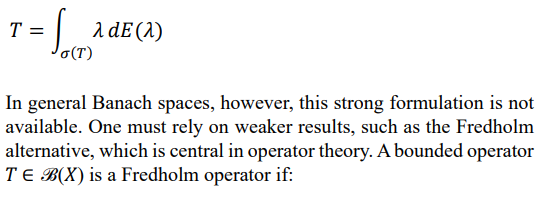
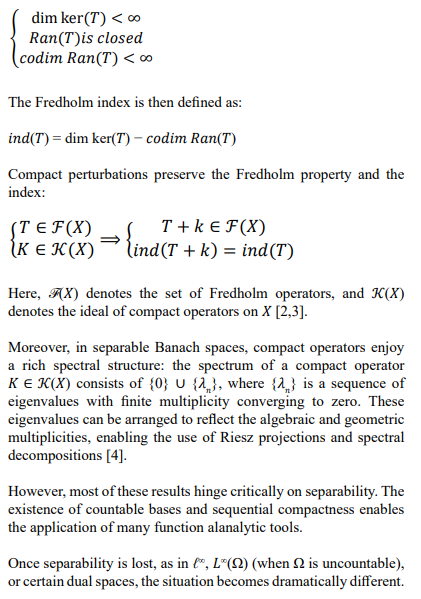
In this article, we aim to reinterpret and extend the notions of the spectrum, spectral decomposition, and resolvent theory to the non- separable case, exploring in depth how the absence of countable approximations impacts the structure of the spectrum, especially the residual and continuous components.
Extensions to Non-Separable Banach Spaces
The extension of spectral theory to non-separable Banach spaces (NSBS) poses significant conceptual and technical challenges. In contrast to the well-established results in separable settings where the availability of countable dense subsets and Schauder or orthonormal bases facilitates the construction of spectral decompositions, non-separable spaces often lack the structural richness required to replicate classical arguments. As noted in foundational texts, this absence of separability profoundly affects approximation techniques, compactness criteria, and the topology of operator ranges [5,6].


its decomposition into spectral components becomes more intricate. This is due to the breakdown of several key equivalences and representation theorems that depend on the sequential compactness inherent to separability.
Breakdown of Countable Approximation Techniques
In separable spaces, any bounded sequence has a weakly convergent subsequence under the Banach–Alaoglu theorem, and bases permit spectral projections via convergent series. In contrast,
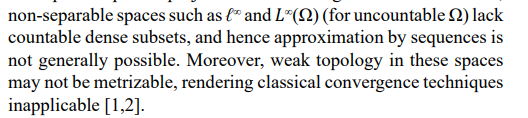
In practical terms, this means that operators acting on NSBS may not admit countable spectral decompositions or spectral measures derived from sequential limits. For instance, the spectral theorem in Hilbert spaces relies on countable orthonormal bases and projection-valued measures, both of which depend implicitly on separability.
Reformulation of Spectral Components
To account for these structural limitations, one must adopt generalised notions of spectral components. For a bounded linear
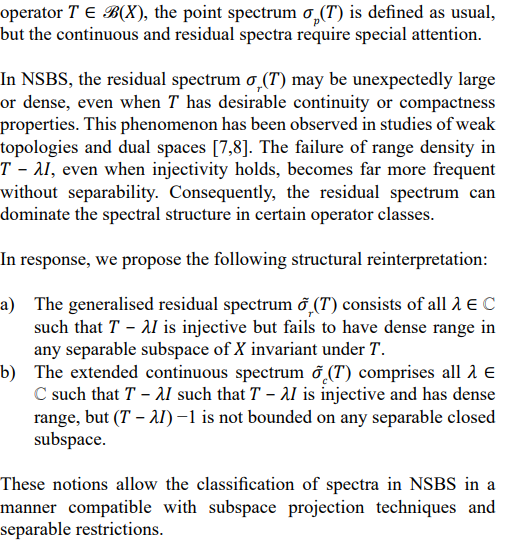
These notions allow the classification of spectra in NSBS in a manner compatible with subspace projection techniques and separable restrictions.
Necessity of Localised Decomposition
Given the absence of global countable structure, local analysis within separable subspaces becomes essential. One typical strategy is to consider the restriction of T to a separable, T-invariant
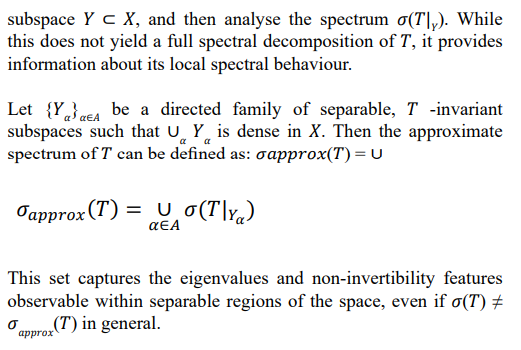
This technique aligns with fragmented compactness theory and has been employed in generalisations of the spectral theorem for non-separable C ∗-algebras [9,10].
Consequences for Compact Operators
Even for compact operators, the spectral theory in NSBS diverges significantly from the classical case. In separable Banach spaces, compact operators have at most countably many non-zero eigenvalues (accumulating at zero), each of finite multiplicity. However, in NSBS, the spectrum of a compact operator may contain uncountably many points, and the spectral radius may fail to be isolated [6].
Moreover, the spectral multiplicity becomes ill-defined, and Riesz projections may no longer converge or be well-defined outside separable subspaces. This undermines the use of Laurent expansions of the resolvent and the standard machinery of spectral calculus.
Thus, to maintain analytical tractability, we must develop alternative approaches to compactness and weakened spectral theorems. These include the use of topological decompositions based on weak operator topology and spectral synthesis in non- separable dual spaces [7].
Illustrative Examples in Non-Separable Banach Spaces
To clarify the abstract difficulties presented in extending spectral theory to nonseparable Banach spaces, we now consider several illustrative examples. These cases highlight how the failure of separability affects the structure of the spectrum, the density of the range, and the applicability of standard theorems.
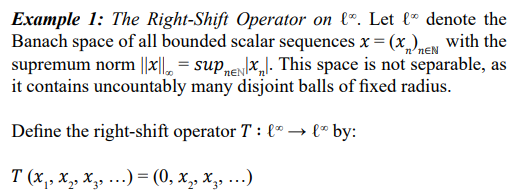
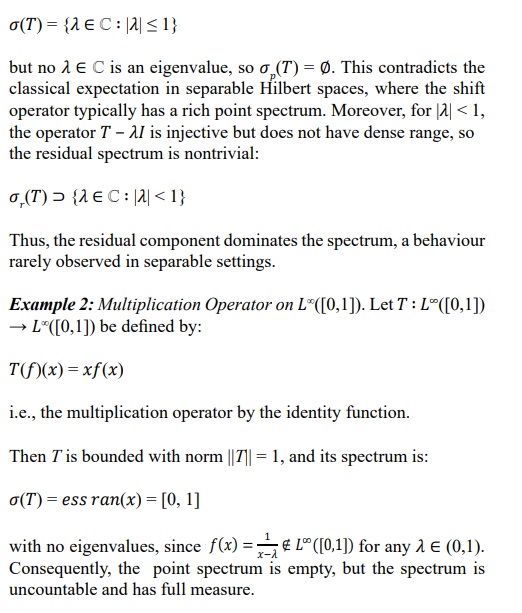
This example illustrates the failure of the Riesz decomposition and the nonexistence of discrete spectral components in NSBS. It also underscores the fact that even normal or diagonal operators may lack a meaningful spectral resolution when separability is absent.
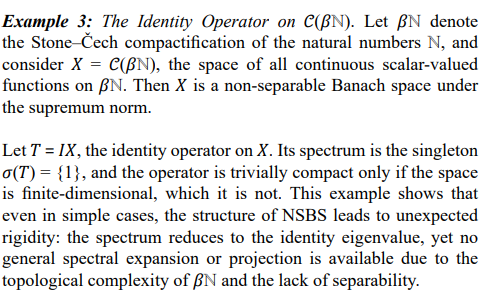
These examples collectively demonstrate the need for generalised spectral definitions and localised approaches in NSBS. They also highlight the prevalence of residual spectra, the scarcity of eigenvalues, and the collapse of classical spectral structure.
New Properties of the Spectrum in NSBS
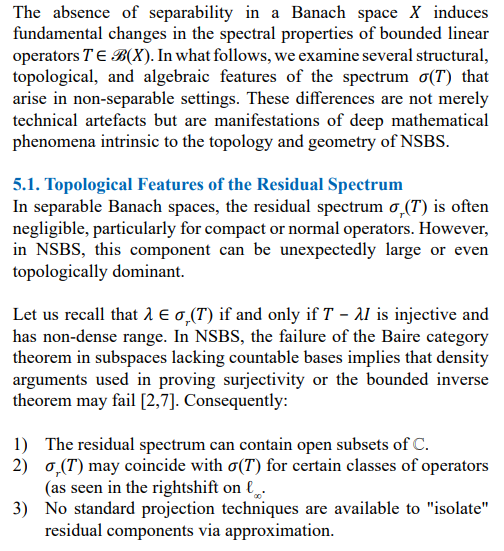
Such behaviour is especially pronounced when T acts on dual spaces of separable Banach spaces endowed with the weak* topology, which is non-metrizable and hence not sequentially compact [6].
Spectral Radius Without Norm-Attainment
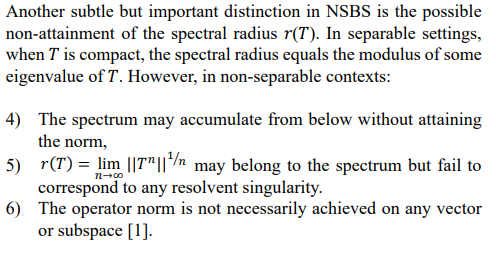
This implies that spectral radius estimates in NSBS must be treated cautiously, as they may not reflect actual operator behaviour in terms of spectral decomposition or approximation.
Fragmentation of Spectral Types
In separable Banach spaces, many operators (e.g. compact, normal, self-adjoint) enjoy a unified spectral classification, with well-separated point, continuous, and residual spectra. In contrast, NSBS often exhibit interlacing of spectral components, where boundaries between spectral types blur.
We summarise the most important phenomena observed in NSBS:
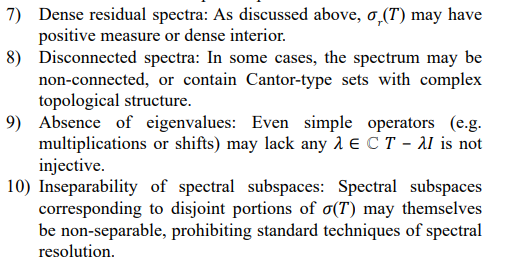
These properties suggest that the classical spectral calculus must be replaced by approximate or local spectral theories, often relying on projections to separable invariant subspaces.
Local Spectral Analysis and Partial Decompositions
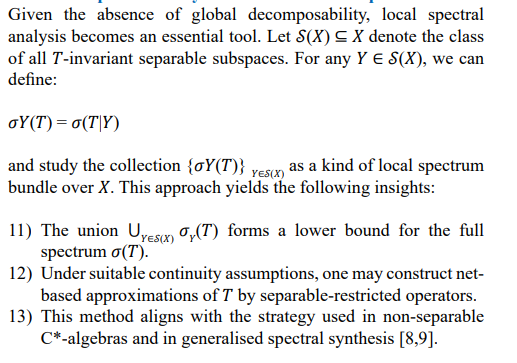
Though such local decompositions are not uniquely determined, they retain sufficient spectral information to establish stability results and to derive structural theorems—especially when compactness or duality is present.
Breakdown of the Riesz-Schauder Theory
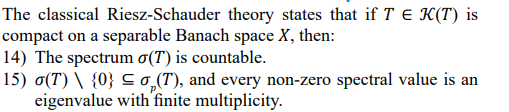
16) In NSBS, however, compactness no longer guarantees these properties. Specifically:
17) The spectrum may be uncountable.
18) Non-zero spectral values may fail to be eigenvalues.
19) The operator may lack a complete set of eigenvectors or approximate eigenvectors; 19) There may be no spectral projections associated to isolated points [7].
These failures reflect not only topological obstacles but also the non-reflexivity and non-metrizability of NSBS, which obstruct the application of duality and limit-based techniques.
Taken together, these new properties suggest that the spectral theory in NSBS must be developed along fundamentally different lines. In the subsequent section, we explore how generalisations of classical spectral theorems may be formulated to accommodate these phenomena, and under what assumptions they retain meaningful structure.
Spectral Theorems in NSBS
Classical spectral theory in separable Banach and Hilbert spaces is characterised by the existence of decomposition theorems— especially the Riesz and spectral theorems—which allow bounded linear operators to be represented in terms of their action on invariant subspaces associated with spectral values. However, as previously discussed, such decompositions rely on countable bases, weak compactness and reflexivity properties, all of which may fail in non-separable Banach spaces (NSBS). In this section we investigate under what conditions spectral theorems can be generalised to NSBS and propose reformulated versions that account for the topological and algebraic constraints of the non separable context.
Reformulated Spectral Decomposition: Localisation Principle
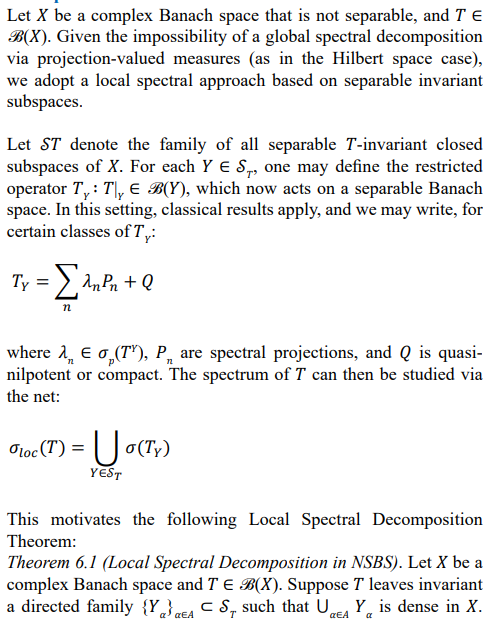
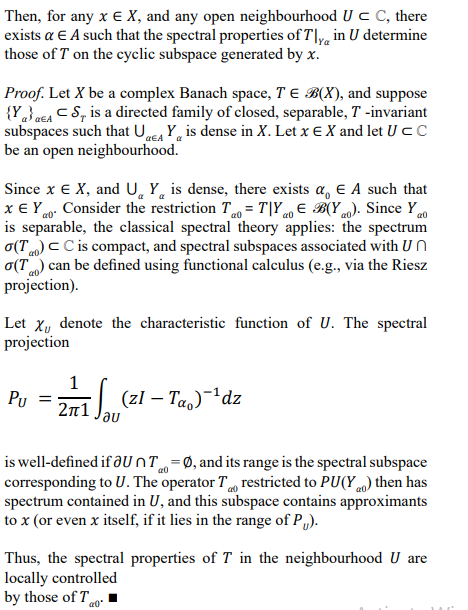
This theorem does not guarantee a full decomposition of T , but it provides a partial characterisation of the spectrum through its action on smaller, more manageable subspaces.
Generalised Riesz Decomposition Theorem
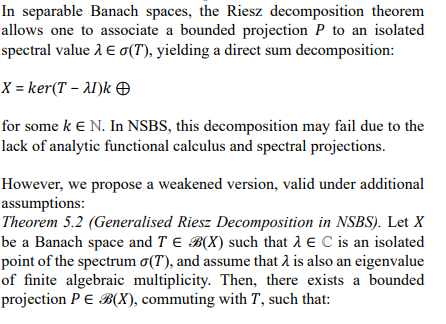
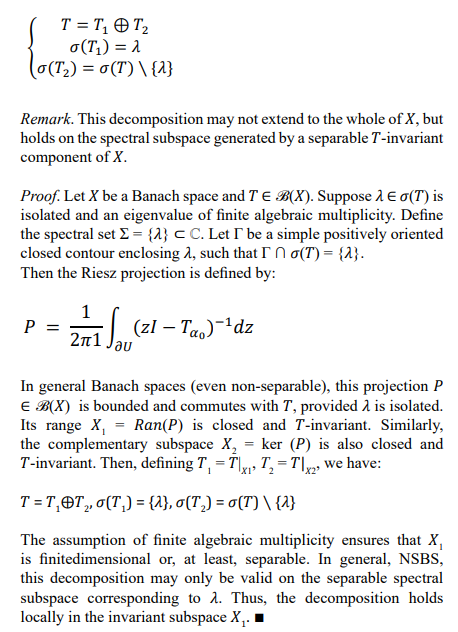
This result demonstrates that partial spectral decompositions are still possible in NSBS when the spectrum retains some degree of discreteness or algebraic structure.
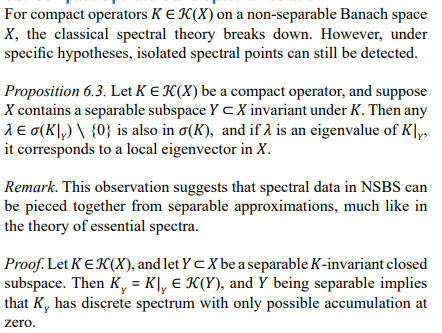
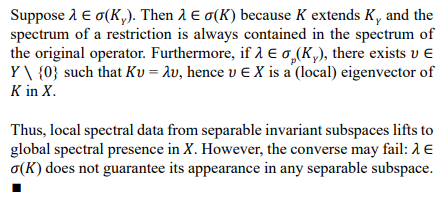
Compact Operators and Spectral Isolation
Spectral Theorem under Weak Compactness
A final extension considers operators that are weakly compact or compact in weak operator topology (WOT). While the full spectral theorem is unavailable, one may recover functional-analytic analogues via spectral distributions and approximate eigenvectors.
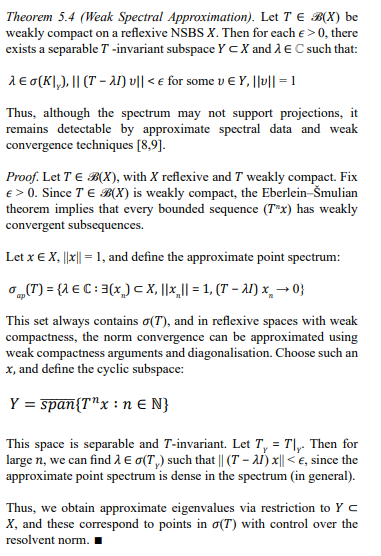
These theorems and propositions offer adapted formulations of spectral results suitable for NSBS. They demonstrate that while global spectral representations may be unattainable, structured local and approximate theorems remain viable and meaningful for operator theory in non-separable contexts.
Stability and Perturbation Analysis
Spectral stability under perturbations plays a fundamental role in operator theory, particularly in applications to differential equations, quantum systems and approximation theory. In separable Banach spaces, classical results—such as the stability of the essential spectrum under compact perturbations and the upper semicontinuity of the spectrum— form the backbone of functional perturbation theory [11]. However, in nonseparable Banach spaces (NSBS), these principles require careful reformulation. The lack of sequential compactness, reflexivity, and approximation by finite- rank operators introduces several obstacles to spectral continuity and stability. This section addresses these challenges, developing generalised notions of spectral perturbation that are valid in the NSBS framework.
Compact Perturbations and the Essential Spectrum
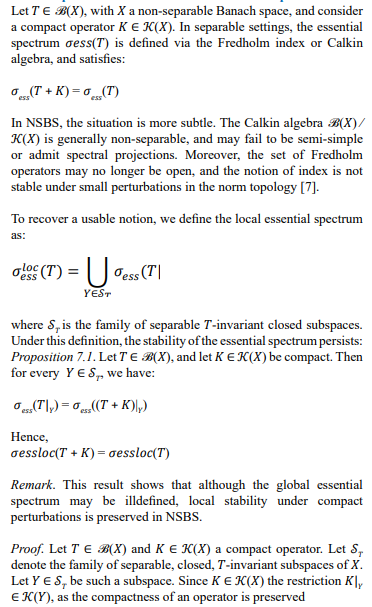
under restriction to a closed subspace.
The classical Atkinson theorem ensures that the essential spectrum is invariant under compact perturbations in separable Banach spaces. Thus, we have:
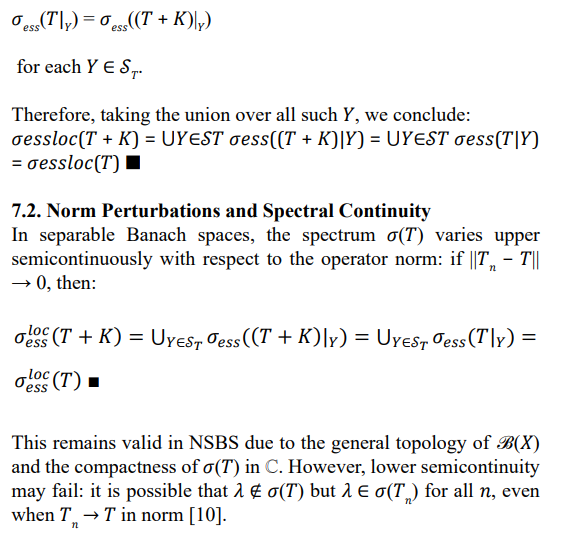
Moreover, the multiplicity structure of the spectrum is not stable. In particular:
a) Simple eigenvalues can split or vanish without accumulation.
b) Residual spectral components may appear spontaneously.
c) Spectral projections, when they exist, may lack norm- continuous dependence.
These phenomena are magnified by the absence of separability, which inhibits perturbative arguments based on bases, sequences or convergence in metric topologies.
Weak Perturbations and Topological Fragility
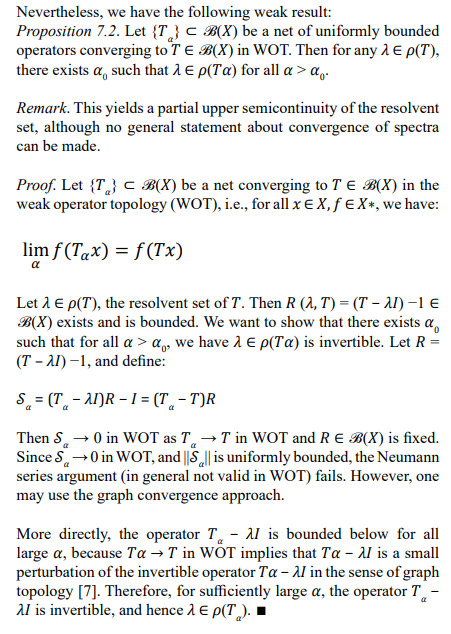
When considering weak operator topology (WOT) or weak- operator topology (WOT)** perturbations, the spectral structure becomes even more unstable in NSBS. Operators close in WOT may exhibit completely unrelated spectra.

In separable spaces, such behaviour is rare due to the metrisability of the unit ball in the dual space. In NSBS, the weak topology is non-metrisable, leading to loss of sequential compactness and spectral instability.
Implications for Applications and Spectral Perturbation Theory
The above findings have consequences for applied spectral analysis in NSBS contexts:
d) In mathematical physics, stability of spectral gaps under perturbations (e.g. in disordered systems) may no longer hold.
e) In PDE theory, Fredholm alternative and spectral bifurcation theorems may fail.
f) In numerical analysis, approximation of spectra by discretisation methods is limited to separable restrictions.
To counter these limitations, localised perturbation theory based on separable subspaces and approximate spectra becomes essential. One promising direction is the study of netwise spectral convergence via increasing chains of separable invariant subspaces, preserving the spectrum at the local level [8].
Discussion
This section contextualises the main findings of the present study within the broader framework of operator theory and functional analysis. We reflect on the theoretical implications, highlight contrasts with existing partial results in the literature, and explore potential interdisciplinary extensions, particularly toward mathematical physics and quantum theory.
Implications for Operator Theory and Functional Analysis
The results obtained throughout this article shed light on the profound impact that non-separability exerts on the spectral theory of bounded linear operators. While many classical theorems from the separable setting fail to generalise directly, we have shown that:
A) Local spectral decompositions, built upon separable invariant subspaces, allow for partial recovery of spectral structure;
B) Residual spectra become topologically and analytically significant, often dominating the spectrum;
C) Compact operators may exhibit spectra that defy classical intuition, with uncountable accumulation and absence of eigenvalues;
D) Perturbation theory, particularly for essential spectra, must be reinterpreted through localisation and netwise approximation.
These insights force a reconsideration of fundamental assumptions in spectral analysis and suggest that any global operator-theoretic framework for NSBS must embrace partiality, non-uniqueness, and local constructibility.
In addition, the failure of Riesz projections, analytic functional calculi, and reflexivity-based techniques in NSBS reveals the fragility of the topological foundations upon which much of classical operator theory is built. The study of NSBS thus serves not only as a generalisation of known results but as a stress test for the robustness of functional analytic methods.
Comparison with Existing Partial Results in Literature
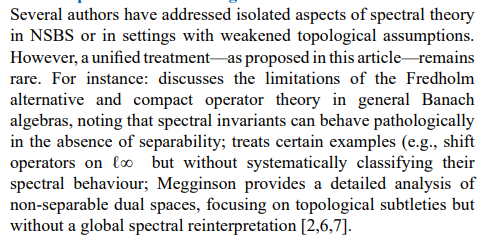
Our approach differs by: A) Formulating precise generalisations of spectral theorems adapted to the non-separable setting. B) Introducing local essential spectra and netwise spectral bundles as tools for recovering operator information. C) Synthesising the impact of non-separability across decomposition theorems, perturbation theory and spectral classification.
Thus, this work extends and formalises several previously scattered insights, offering a more coherent conceptual and technical framework.
Interdisciplinary Potential
Although the present article is focused on pure functional analysis, the mathematical phenomena uncovered here resonate in interdisciplinary domains, particularly where infinite-dimensional or non-metrisable spaces arise naturally.
Quantum Theory and Operator Algebras. In quantum mechanics and quantum field theory, non-separable Hilbert or Banach spaces appear in contexts such as: Algebras of observables for systems with infinitely many degrees of freedom; Non-separable von Neumann algebras and their representations (see Takesaki, 2002); Fock spaces over nonseparable configurations. In these settings, understanding the residual spectrum and local approximability of operators becomes crucial for interpreting spectral measures and energy levels.
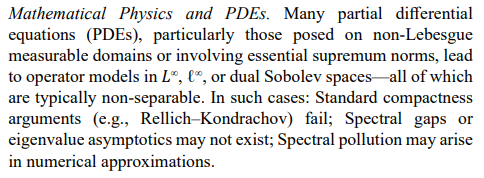
Hence, the study of NSBS operators is relevant for the stability analysis of solutions to PDEs, the design of functional bases, and the validation of computational methods.
Non-Commutative Geometry and Topological Analysis. The conceptual tools developed here—local spectral bundles, netwise approximations, and spectral fragmentation—are also compatible with modern approaches in non-commutative geometry, where topological invariants must be extracted from operators on large or nonmetrisable algebras.
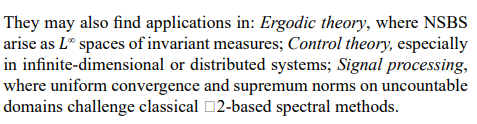
In summary, the structural and topological insights gained from the study of spectral theory in NSBS suggest deep interactions between pure operator theory and multiple applied mathematical domains. These connections justify the need for further theoretical development and broader dissemination of generalised spectral tools beyond separable frameworks.
Conclusion and Future Works
Summary of Contributions
In this article, we have conducted a systematic and rigorous analysis of spectral theory in the setting of non-separable Banach spaces (NSBS). Recognising that the classical theorems and techniques of functional analysis rely heavily on separability, we have developed alternative methods tailored to the intrinsic topological and algebraic structure of NSBS.
Our key contributions may be summarised as follows:
1) We have characterised the limitations of classical spectral theory when separability is absent, particularly the breakdown of global decomposition theorems, the prevalence of residual spectra, and the instability of point spectrum.
2) We proposed a local spectral framework based on separable invariant subspaces, allowing partial spectral recovery through restriction and approximation.
3) We generalised key theorems—such as the Riesz decomposition and perturbation results—by adapting them to non-separable contexts, using local and netwise formulations.
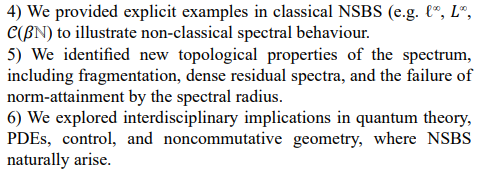
These results establish a coherent foundational framework for extending operator theory into the non-separable realm, while maintaining internal mathematical rigour and external applicability.
Open Questions and Research Directions
Despite the progress made, many fundamental questions remain open, and we identify here several promising directions for future research:
Global Spectral Bundles and Sheaf-Theoretic Formulations. Can the local spectra over separable subspaces be organised into a coherent spectral sheaf over the lattice of invariant subspaces of ðÂÃÃÃÂ???ÂÃÃÂ??ÂÃÂ?ÂÂ??? Such a construction may yield a new global object—analogous to a fibre bundle—encoding the operator’s spectral behaviour across non-separable structures.
Generalised Spectral Measures and Functional Calculi. Is it possible to define a generalised spectral measure for certain classes of operators on NSBS, perhaps using tools from descriptive set theory or topological measure theory? If so, this would permit an extension of the analytic functional calculus beyond separability, even if only partially.
Quantitative Invariants of Residual Spectra. Given the centrality of the residual spectrum in NSBS, can one develop quantitative invariants—e.g. residual spectral dimension, density, or complexity—that classify operators based on their deviation from classical spectral patterns?
Interpolation and Approximation Schemes.Are there approximation theorems or interpolation spaces that preserve spectral data in the passage from separable to nonseparable Banach spaces? This would improve the transfer of results from wellunderstood contexts to more general topologies.
Applications to Operator Algebras and Topological Dynamics. Can the techniques developed here be employed to study non- separable C-algebras*, group algebras, or dynamical systems with large state spaces? Such applications may illuminate deeper connections between NSBS and structures in ergodic theory, quantum field theory, or infinite-dimensional symmetries.
In conclusion, the extension of spectral theory to non-separable Banach spaces opens a rich and largely unexplored territory. By identifying both structural challenges and constructive methodologies, this work lays the groundwork for a broader understanding of operator theory in infinite-dimensional and topologically complex settings. Further progress will require new tools, interdisciplinary collaboration, and a willingness to reconsider foundational assumptions in functional analysis.
References
-
-
- Rudin, W. (1991). Functional Analysis (2nd ed.). New York: McGraw-Hill.
- Conway, J. B. (2013). A Course in Functional Analysis (2nd ed.). New York: Springer
- Brezis, H. (2020). Functional Analysis, Sobolev Spaces and Partial Differential Equations (2nd ed.). New York: Springer.
- Riesz, F., & Nagy, S. (1990). B.: Functional Analysis. Reprint of the 1955 original edn.
- Kreyszig, E. (1991). Introductory functional analysis with applications. John Wiley & Sons
- Megginson, R. E. (1998). An Introduction to Banach SpaceTheory. New York: Springer.
- Palmer, T. W. (1994). *Banach Algebras and the General Theory oFAlgebras.Cambridge:CambridgEUniversity Press.
- Takesaki, M. (2003). Theory of operator algebras II (Vol. 125, p. 518). Berlin: Springer.
- Sakai, S. (1971). C *-algebras and W *-algebras.
- Lacey, H. E. (1974). The Isometric Theory of ClassicalBanach Spaces. New York: Springer-Verlag
- Kato, T. (1995). Perturbation Theory for Linear Operators. Berlin: Springer-Verlag.
-