

International Journal of Media and Networks(IJMN)
ISSN: 2995-3286 | DOI: 10.33140/IJMN
Impact Factor: 1.02



Research Article - (2023) Volume 1, Issue 1
Role of Manet and Artificial Bee Colony Algorithm to Make Smart Campus Model, With Smart Sensors
2AP, Department of Technology, MUIT Lucknow, India
Received Date: Sep 25, 2023 / Accepted Date: Oct 13, 2023 / Published Date: Oct 27, 2023
Copyright: ©Â©2023 Neeraj Verma, et al. This is an open-access article distributed under the terms of the Creative Commons Attribution License, which permits unrestricted use, distribution, and reproduction in any medium, provided the original author and source are credited.
Citation: Verma, N., Varshney, M. (2023). Role of Manet and Artificial Bee Colony Algorithm to Make Smart Campus Model, With Smart Sensors. Int J Media Net, 1(1), 26-39.
Abstract
In the decade of Internet of Thing, Machine Learning and Big data we are ready to accumulate lot of sensors and intelligent devices for making our real world environment more accessible, open, transparent and its records are manageable for future purpose i.e. either just for fetching or analyze for future perspective. In contrast, an institutional campus is also ready for fully automation where all the major participants like students, academician, management and others, should be observed as an entity with their different attributes. Meanwhile those campuses are not functioning in isolation, it depends and Interco- related to some other organizations and modules also, so that they have to synchronized and update their data accordingly. Here the whole scenario views from computer network perspective, where all the participating members observed like node and in whole it creates wireless mobile ad-hoc network i.e. MANET. First will understand the campus functioning in short then look at flow of data in this system, then observes the components and their responsibility to categorized and placing them in MANET based architecture. Finally we will select and design algorithm for the whole digital campus system. This is a concept of implementing intelligent technologies to transform any existing environment into smart, here not only institutional campus but many other also can be upgraded or transform into smart like villages, cities, sports or working flow like census, PDS, Disaster Management system etc.
Keywords
Industry 4.0, Geofencing, Swarm Intelligence, Artificial Bee Colony Algorithm, Intelligent Algorithms.
Introduction
Education plays a major part of any individual life, minimum around two decades of total life they involve in different level of educational activities primary, secondary, skill, higher and many more. Any campus consists lot of members with different responsibilities, there are many disciplines and department, interdisciplinary mechanism is also there, switching from one to another campus is also there and above all campus or institute is affiliated to some university, board and council bodies [1]. This is a simple over view of complexity in any campus; there are more complexity as per size and working function of it, and its increases exponentially accordingly. Last decade revolutionized the educational campuses in a scattered way like teaching with ICT, store the student data on centralized server, digital marketing and students management system portal like that [2].
Even after all this we can’t say that those campuses are smart because for that we have to manage every participating entities, activities manually collecting data from different department with restrictions or different level of authenticity, forwarding consolidated report with approval and consents to higher levels. In contrast it’s not smart until all the activities and data transfer from one level to another is not transparent and self-updated [3,4].
At the same time network analyst and administrators also have to do a lot of work on data collection, transform, and transmission and analyze it as per end user need [5]. In computer network we have to identify different work and then categorized them in different layers according to their functionalities similar like OSI reference and TCP/IP model [6]. Meanwhile all the users are equal, roaming and changeable in term of data creation or accessing so this network will also consist Mobile Ad-hoc network functionalities and architecture [7]. Here we will identify all the functionalities of smart campus system to place them layered architecture of MANET, complete system will understand and design from computer network perspective.
Pedagogy and Paradigm of Smart Campus
In 4th industrial revolution (Industry4.0) all area transforming smart by increasing automation and deployment of smart machines and smart system [8]. Here informed data helps for final production as well as for improvement and effective supply chain actives. This enhances the flexibility to improve the product as per end customer need and feedback, at last organization achieve excellence and improve efficiency. By collecting as much as possible more data from factory floor and co-relate them with organization’s other operational departments data, we can achieve smart factory vision [9].
Educational organizations are also ready to implement industry 4.0 for same goals as other industries or organizations looking for i.e. growth with excellence. As figure 1.1 all the activities of smart institute will look like an enterprise and all the activities will be automated and transparent. Initially a complete

Figure 1.1 Scenario of Smart Campus in Industr 4.0
educational Campus has all level of educational activities (A) like primary (Ape), secondary (Ase), higher (Ahe), research (Ars) ,skill or vocation (Ask), professional (Aps) etc. ,then all level of activities has different disciplines D1,D2,â?¦.Dm,n,o,p,q,r. After that there are three major candidates within the campus who operates the system these are Students (ST), Academicians (AC) and Management or Governing body (MG), outside the system there are Universities, affiliation board and councils (OT) which attached and communicate to campus as Hub and Spoke architectural way [10]. In this way figure 1.2 shows all major components and how that are connected to others how they communicates will show in next section. Now how all the members create, transform and access the data will depends the quality and standard of campus. Here student is the major raw entity for system and how their Academic Credit Bank (Abc) has been created and managed will show complete flow chart of campus phenomena [11]. Same time Faculties utilities (Fut) is also there that how they map to campus in such a way that maximum utilization of them can be achieved. The management (Mgt) is the gateway between outer bodies and campus as well as management, implementation, regulations and co-ordination within campus. This way we can identify all the agents in campus and what are their functionalities over there.

Figure 1.2: Typical Pictorial and Symbolic Representation of Smart Campus
Role of Wireless Manet in Smart Campus
Now we have to observe that how all above participants interact, communicate and transform the data during its day to day functioning. So here we will consider all the students as moving wireless nodes (Snode), All the faculties looks as zone gateway wireless nodes (Fnode) and management behaves like central dedicated node (Mnode) for complete campus. The outside nodes are not playing much role within the campus but they have important functioning to overall execution of campus ruining will act like foreigner nodes (FRnode).The campus (CAMP) will behave like intranet of complete education system architecture and as extranet when it observed from foreign entities [12].
Figure 1.3, Here we consider students as mobile nodes and all the major data has been collected from there [13]. So all the activities of students like daily academic work (ACst) , attendance ( ATst), participation in other activities (ECst), examinations (EXst), credit points (CRst) and report card (RPCst) will be managed and analyze on the basis of daily real time data from IoT or IIoT technologies with the help of wireless MANET network architecture [14]. At the same time faculties nodes will act and perform like zone based root nodes (Fst zone) , which access all the information and data of student nodes as per there department, subjects, activities and disciplines according to need and these collection of attributes decides the zone or cluster of students. This node access and process the student’s data to create weekly, monthly and annually repot progressively (Fstrpt). And this report will finally help to generate student Academic Credit Bank (STabc) , which shared with governing bodies (MG) and outside organizations (OT). There are much more attributes of faculty nodes there like Faculty personal data (PRf), faculty credit points for academic activities (CRf) and faculty resource management system (HRf). At last governing body nodes (MGtrt) which performs all the managerial activities with in a fixed territorial as Geofencing mechanism [15]. This node consists different attributes for students (STa),faculty attributes (Fa) and campus attributes (CAMPa) in such a way that they can make decision, policies and upgradation activates on the basis of this as well as cerate campus’s concise and targeted report as per requiremetn of out-side bodies (CAMPrpt), and all this could be done with in a click to make it smart.

Figure 1.3: Representation of Smart Campus to View it as Different Nodes for Data Accessing and Processing in IoT Environment
Mobile Ad-Hoc Network (MANET)
A wireless or mobile ad-hoc network is decentralized network where there is no central router or node that controls the route for data flow or forwarding data packets [16]. Figure 1.4, Here how the data will flow or forwarded next will be decided dynamically, with the help of dynamic routing algorithm [17].
The main features of MANET are its self-prepared, updated and maintain as per users requirements. But same thing creates a lot of challenges to network administrators and these are dynamic topology, autonomous behavior of network, energy constraints operations, band width constraints and above all limited security features.

Figure 1.4: Typical Mobile Ad-hoc Network Scenario
Internet of Things (IoT)
Different technologies imposition for automation of any area or sector, has enabled organization to improve accessing of data for making there complete functioning more reliable as per end cistomor need. And this automation and data accesing improvement can be achived with the help of IoT or IIoT. So IoT is a network of physical object or entities like Sensors, Actuators which creates intelligently a pool of electronics, software and networking for collecting and exchange of data, in computer science field its known as IoT grid or IoT smart grid [18,21].
As figure 1.5 (a)(b)(c) and (d) shows the complete footprint from macro level to micro level that how


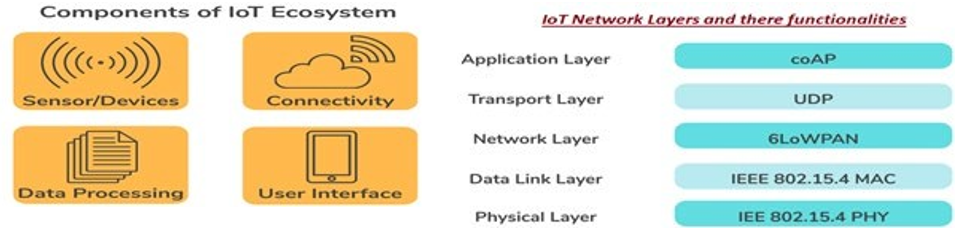
Figure 1.5 (a) IoT implemetion in different field and sectors and connected to others (b)View of IoT imposing in a particular organization (c) Major components for implementing IoT (d) Layers Architecture view of IoT network
IoT imposes from every field to layered architecture of networking. Layered architecture in computer science is very common to identify and view the complex and inter connected functions in isolated way and then mount them layered form in such a way that how they communicate and interact to each other, to make it simple and easy to design in network or software perspective [22, 26,27].
In figure 1.6 we fall into typical computer networking concept i.e. IoT layers Protocols [28]. In computer network analysts initially prepare different layers as per functioning of them, then for each layer they define and derive some set of rules according to which every layers operates their specific task. In future if there is new technology or paradigm has been introduced there then again layers will be defined (as sub layer or merger) and accordingly protocols have been redeveloped. Here in IoT there are five major layer and each layer one or more protocols to define and follow their functionalities.

Figure 1.6: IoT Protocols in Layered Architecture
Logically Design Issues of Layers in Smart Campus Network
As we have already mention above that smart campus has numerous physical and digital entities and segments [29]. So here a lot of data i.e. big data has to be interfaced between different technologies, for that we have created a smart campus layerd architecture to deal with different technologies and interfaces in figure 2.1 [30,35].
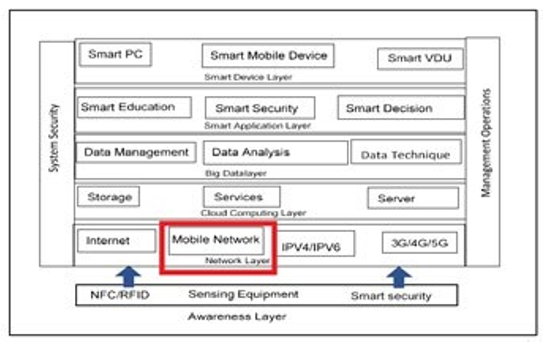
Figure 2.1: Smart Campus Conceptual Layered Model with Different Technologies and Functions
Here we can see that there are many technologies, devices and functionalities are complexly mixed with each other. Even there is a very clearly shown that network layer is the main interface between directly data accessing equipment (awareness layer) and providing services (Cloud computing layer) [36]. So here we concentrate that how different node based smart campus collets the data on the basis of different optimized algorithms to generate smart repot and output. 2.1 Artificial Bee Colony Algorithm For Optimization in Campus Network In computer science field under operational research we study and analyze many real life situations to find out an algorithm to implement it in our organizational optimization strategies intelligently that is known as Swarm Intelligence (S.I.) [37,38]. In S.I. we develop algorithms by study natural inspires activities i.e. Bird, Ant, Fish or Honey Bee, which shows the interaction ,co-operation and synchronization between living organism and natural resources for best and optimal throughput as shown in figure 2.2 with their categories(a) (b) [39].
Here we can see that there are many technologies, devices and functionalities are complexly mixed with each other. Even there is a very clearly shown that network layer is the main interface between directly data accessing equipment (awareness layer) and providing services (Cloud computing layer) [36]. So here we concentrate that how different node based smart campus collets the data on the basis of different optimized algorithms to generate smart repot and output.
Artificial Bee Colony Algorithm For Optimization in Campus Network
In computer science field under operational research we study and analyze many real life situations to find out an algorithm to implement it in our organizational optimization strategies intelligently that is known as Swarm Intelligence (S.I.) [37,38]. In S.I. we develop algorithms by study natural inspires activities i.e. Bird, Ant, Fish or Honey Bee, which shows the interaction ,co-operation and synchronization between living organism and natural resources for best and optimal throughput as shown in figure 2.2 with their categories(a) (b) [39].
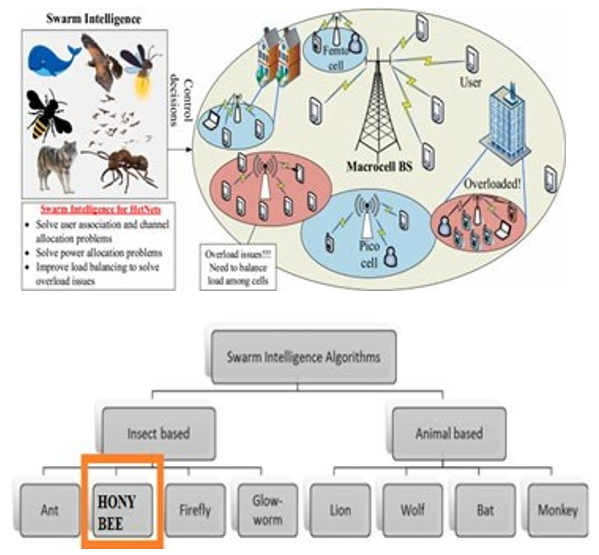
Figure 2.2: (a) Implementation of Swarm Intelligence Methods in Organization System with their Optimization Logic (b) Some Swarm Intelligence Based Algorithms Categories
According to these living species and their intelligence there are many algorithems has been addressed [40].
a) Ant Colony Based Algorithm
Applications Like transporting heavy goods with small units by shortest and multiple paths between its source to destination. With the help of stigmergy phenomena analysts developed Ant Colony Optimization Algorithm (ACOA) [41].
b) Honey Bee Based Algorithm
Here we observe the system in different clusters and then utilize them by dividing our available agents accordingly. At the same time we find more sources with those fixed and limited agents for maximum and optimum utilizations of them. With the help of wiggling technique analysts developed Artificial bee colony based Algorithm (ABC) [42].
c) Firefly and Glow Warm Based Algorithm
Applications where equality or inequality criteria based problems arise can be solved with the help of firefly based algorithms. Here analysts develop algorithms for multi model functions for a system to find out batter efficiency, like FAMA (Firefly Algorithm- Based Mimetic Algorithm) is applicable for electrical load furcating [43].
d) Lion Based Algorithm
The Lion Based algorithem are suitable on those places where non linear system and bilinear system identification process is required. So counter modeling type applications can be solved with the help of Lion Based Algorithm [44,45].
e) Wolf Based Algorithm
The wolf based algorithms used where we have to find fault, error or multi-layer perception estimation solution, based on meta heuristic optimal solution searching and solving. The Grey Wolf Optimization Algorithm (GWOA) approach highly used in defense activities and operations, where initially categorized their agents in rank on the basis of different parameters then assign their responsibility to do any operation accordingly, and step by step they reach to optimum solutions [46,47].
f) Bat Based Algorithm
Here Eco based location prediction mechanism implements to solve the single and multi-objective domain from a fixed and limited set of solutions space. Multi objective Bat Algorithm (MOBA and Directed Artificial Bat Algorithm are some well- known approaches under this [48].
g) Monkey Based Algorithm
This algorithm is effective for solving multi veriant system problem with steps to find globally optimum solution for that. Initially solve the nearest highest problem, then lookup to next relative high problem from this point and then find best solution for that. Iteratively follow this until we reached to top of the overall problem. Asynchronous Climb Monkey Algorithm (ACMA) is used for placing sensor for monitoring in campus or building [49].
The Artificial Bee Colony Algorithm (ABC)
As previous section mention that in bee colony based algorithm do many iteration at same time initialize , search with in space, find optimize solution, new space search, abandoned old spaces etc. for maximum utilization of the whole system with given agents [50]. This way the Artificial Bee Colony (ABC) Algorithm always categorize its all the system’s resources in small group or clusters and all the working candidates or entities into different categories to use those cluster optimally [51].
In typical ABC model the bee’s colony or hive (H) situated in one place and still all the time. Now it has to find out ‘m’ number (m: 1≤ m < N) of food or nectar (F1,2,….m) sources which is situated different distances to hive (FD1,2,3….m), every source had different quantity or amount (FA,1,2,3….m) and different quality (FQ1,2,3….m) of it. To solve this problem there are three categories of bee in their colony, i.e. Employed bees (BE), onlooker bees (Bo)and scout bees(BS):
a) EMPLOYED BEE are those which goes to particular food source ‘m’ take the food and all information about that particular food source fm{D,A,Q} at that particular time tm, back to the hive and dance or woggle for sharing this information to onlooker bees [52] .It has been consider that for one food source there is only one employed bee at a time so here that employed bee for food source m is BEm .
b) ONLOOKER BEE in this scenario are those who always places in hive and continuously access the employed bees dances as information and decide the next what those employed bee will do for optimum utilization of food and all food sources. Here may be onlooker bees can be one or more than one. Numbers of onlooker bees decides how less the system has complexity, as we increases the onlooker bees the complexity of system will reduces exponetialy from previous one [53] .
O(H)= S* elog2BO
Here O(H) = Possible No. of optimal solution selected
H = problem for hive
S = Total number of solutions for problem H
Bo = Number of onlooker bees for problem H
(Bo:1≤ Bo
c) SCOUT BEE is not a collection of other type bees (BS) these are employer bees BEm whose food source has been abounded due to some parametric region fm{D,A,Q} after some specific time Δt and start to search finding new food source [54].
Δt, fm{D,A,Q}
BEm > BS


Figure 2.3: (a) ABC Algorithm's simple steps and iterations, (b)ABC algorithm’s flow chart (c) ABC algorithm’s simple pseudo code representation for programmers’ view.
Figure 2.3 (a),(b)and(c) has been shown systematically that how we start observing the natural eco system, then theoretically conceptualize it which can be true for all the situations and conditions, and finally we prepare a logical sequences and iterations in any language i.e. pseudo, machine, higher which can understand any digital device or unit and collect the raw data , process according to system's need and produce optimal result of report.
Smart Campus With Help of Manet and ABC Algorithm
So now we are almost clear about the smart campus model as well as MANET and its implementation through ABC algorithm. Here we will co-relate and design a model where we, all the active candidates in smart network categorized as employer, onlooker or scout agents as per there functionalities. They collect the raw data, process it as per campus needs to generate optimal performance of the campus.
Assigning the Agents in Smart Campus
Here we have to observe Figure 1.2 and 1.3 parallel to make our campus SMART as figure 3.1. Firstly we consider the students as our main resources (Snode) with in the campus (CAMP) which we have to access and find best output as provide them cutting edge educational
|
S. N |
Agents /Role in ABC |
Attributes/ Parameters |
Discription |
|
1 |
FRnode
(Other hives) |
CAMPrpt |
Forginer or out side nodes which collaborate with campus “A” for effective running in Hub and spoke manner. |
|
2 |
CAMP
(The Hive) |
CAMPa |
Campus “A” Has all the records, reports for all agents and resources present with in the campus. |
|
3 |
MGtrt (Onlook er bee) |
CAMPrpt,CA MPa,PRf ,HRf, STabc and more. |
The main decision makingagent within the campus and out side for campus. |
|
4 |
Zst (Many Food sources near hives) |
A1,A2,A3…An and D1,D2,D3….D m |
Cluster of students on the basisi of institut’s functionalities. |
|
5 |
Fstnode (Employ ed bee) |
Fstrpt, STabc, and more |
Campus has many students clusters which grouped and managed by this. |
|
6 |
Snode (Individ ual food source with different characte ristics ) |
ACts,ATst,ECs t,EXst,CRst,RP Cst |
Collection of students with individual input attributes |
Table 3.1: List of Agents, Attributes and their Description for SMART Campus.
and institutional facilities, these students have a lot of parameters {ACts,ATst,ECst,EXst,CRst,RPCst}. So Students will be grouped or make clusters (Zst) either by themselves or by campus management (MGtrt) for academic activities, institute’s systematic functioning or disciplines based parameters {A1,A2,A3…An and D1,D2,D3….Dm}. This clusters managed or processed locally by a faculty or academician (Fstnode), which consists those participating all students same parameters, faculty parameters {Fstrpt, Stabc}and accordingly these parameters managed and processed by that particular faculty. Then complete campus (CAMP) is also having a lot of parameters {CAMPa, , PRf ,HRf } which managed and processed by management (MGtrt) for the campus and outside candidates (OT) who communicate and interact with campus time to time.
Table3.1 shows and mentioned that those clusters of students are like Food or resource in ABC algorithm. The faculty node who are associated one cluster at a time are like employed bees, they collect the information and data from that students group and forwarded to management who acts like onlooker bee for the entire campus system. Time to time onlooker management agents analyzes and makes decisions for particular, a group or for all students for achieving campus’s optimal goal.

3.1Mapping of a Campus for all the Agents and Resources for Making SMART
Application of Smart Campus Using ABC Algorithm and Sensors
So far we have seen that any institutional campus how can be transformed into smart campus considering and converting all the participating members of it into wireless and smart sensor nodes this is also known as WSN (Wireless Sensor Network) [55]. An institutional area has many parameter and many dependency paradigm in complete educational system of any country, They have always a change of improvement and enhancement of infrastructure, students, academics, human resource management and finance. So this isa best example to make strategies for smarting it. For that we have to prepare the concept of WSN and then identify that which entities should be assign as sensors with how many functionalities. Then which place these will be deployed and how they interact to each other's, this is the most challenging the most challenging task for network manager and analysts. This process and strategies considered to deployment of sensor is call sensor node deployment model (SNDM) [56].

Figure 3.2: No of Connected Devices In IoT World Wide
A lot of research work is undergoing for SNDM, because after identifying wireless sensor nodes it is much important that how they are placed within the system for optimization. Then how they will implement ABC algorithm to achieve their targets is also depend on SNDM, because only here we define and design the roles, responsibilities and functionalities of sensors, for system automation. Then the campus will always smart as well as ready to adapt new changes, addition and up gradation in future.
Projected Global IoT Enabled Sensor Market in 2022
|
S.N Major Types Of Sensors |
Broadly % share in IoT |
|
1 Pressure Sensor |
35 |
|
2 Temperature Sensor |
25 |
|
3 Light Sensor |
17 |
|
4 Chemical Sensor |
10 |
|
5 Notion Sensor |
10 |
|
6 Other Sensor |
03 |
Table 3.2: A Snap Shot of Major Types of IoT Sensor and there Share in Worldwide on year 2022 [57].
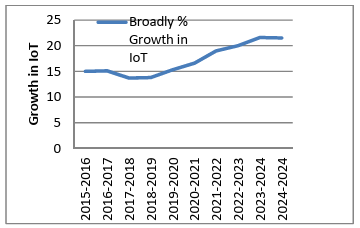
Table 3.2 Shows that how connected sensors and transducers are used in different areas of world wide. Today most of connected sensors are in industrial fields like pressure, temperature, light or chemical etc. But in coming future there are others sensors like Desk sensor, touch, voice heartbeat and data sensor will be more important sensors which will be part of our life for making smart society or campus, which is only 3% at this time (as per table 3.2 ). Again if we further closely observe the growth rate of IoT connected sensors worldwide globally, then its continuously growing more than 15% in this decade as per Table 3.3 and Figure 3.3. The growth chart clearly shows that number of connected sensors will increases rapidly, so itâ??s obvious that daily life sensors participation will grow exponentially.
Projected Global IoT Enabled Sensor Growth in one decade (2015-2015)
|
Financial Year |
Broadly % Growth in IoT |
|
2015-2016 |
15.0 |
|
2016-2017 |
15.1 |
|
2017-2018 |
13.7 |
|
2018-2019 |
13.8 |
|
2019-2020 |
15.3 |
|
2020-2021 |
16.6 |
|
2021-2022 |
19.0 |
|
2022-2023 |
20.0 |
|
2023-2024 |
21.6 |
|
2024-2024 |
21.5 |
Table 3.3 Growth of IoT Sensors from 2015-2025 in percentages
This whole scenario is not only applicable for institutional campuses but also for villages, municipal, cities and enterprises who want to be complete smart in the era of industry4.0.
Future Research Directions
Here we have mentioned a lot of topics and research works, on which either a lot of work is going on or in future its must be explored , like Geofencing, Industry 4.0, MANET protocols, IIoT, SNDM, Swarm intelligence etc. Due to limitation of work all can’t be explained here but these are very interesting and futuristic topics to study. We cants say that those topics come under only engineering, computers or management. Due to multidisciplinary approach we should try to read and work on every topic for society, environment and for living species. Specifically for this work in future there should be high level computer programming language ,either python, omnetcpp or NS3 by which we can simulate the whole smart campus model and take some strategic parametric output [58][62]. After this make a simulation environment where we can see graphic and by animation that how this model implements, in parallel the parameters and agents can be assigned, changed and manipulate as per our systems’ requirements[63].
Next level of this work also concentrated over collecting many those strategic parametric outputs, for designing sensor node deployment model (SNDM). And then also design and prepare simulation environment for that SNDM for that particular system.
Conclusion
The study presents the detailed implementation of ABC algorithm to make an educational campus smart. Before this we have to clarify and understand the working system, culture and complexity of that system. Then we try to understand what ad hoc network is, wireless ad-hoc network their technologies in a very concise way and there feature also. We mentioned then IoT, its technologies, features and trends. After that in brief we have explain the honey bee’s natural way of working, that how they collects the food, hoe select the best quality nectar, hoe searches the flowers and how they manage their work force smartly.
Then we explain and convert this theory of honey bee’s life in a systematic approach, through which we have find the honey bee algorithm. All this has been developed previously in very detailed way, but here we try to implement and transform this concept for institutional camp to make smart. Also collect different research field’s work in one place and place them in a systematic approach is also aim od this study. What must be do in future has been mention but this collective work also explore many more non- mentioned topics and fields for sure, and this is the main objective or vision of this work. And the main outcome to me during this study that nature has all the answer, only what we need to do is patently observe, monitor, and learn from it, and we can do any impossible task just like that.
Acknowledgement
The author would like to acknowledge all the authors and researchers cited in the paper. As well as , the author acknowledge MIUT, Lucknow, India for their support, encouragement and providing research environment for this work. At last but not least want to thank all the faculty colleagues of “Government Polytechnic Nainital Collage” Uttarakhand without who support this work could not be possible.
References
- Muhammad, S., Sapri, M., & Sipan, I. (2014). Academic buildings and their influence on students’ wellbeing in higher education institutions. Social indicators research, 115, 1159-1178.
- Zafar, S. T. (2019). Role of information communication technology (ICT) in education and its relative impact. International Journal of Engineering Research & Technology (IJERT), 7(04), 1-10.
- Polin, K., Yigitcanlar, T., Limb, M., & Washington, T. (2023). The Making of Smart Campus: A Review and Conceptual Framework. Buildings, 13(4), 891.
- Al-Shoqran, M., & Shorman, S. (2021). A review on smart universities and artificial intelligence. The fourth industrial revolution: Implementation of artificial intelligence for growing business success, 281-294.
- Sarker, I. H. (2021). Data science and analytics: an overview from data-driven smart computing, decision-making and applications perspective. SN Computer Science, 2(5), 377.
- P.Ravali “A Comparative evaluation of OSI and TCP/ IP Models”, International General Of Science and Research (IJSR) Volume 4, Issue 7 ,2015 (pp.514-521)ID:SUB155737, July 2015
- Zasad, M. R., & Uddin, J. (2010). Study and Performance Comparison of MANET Routing Protocols: TORA, LDR and ZRP.
- Soori, M., Arezoo, B., & Dastres, R. (2023). Internet of things for smart factories in industry 4.0, a review. Internet of Things and Cyber-Physical Systems.
- IBM, topics, Industry 4.0, “Industry 4.0 is revolutionizing the facilities, and throughput their operations”. An article on how Industry 4.0 technologies are changing manufacturing.
- Akhmetshin, E. M., Kozachek, A. V., Vasilev, V. L., Meshkova, G. V., & Mikhailova, M. V. (2021). Development of Digital University Model in Modern Conditions: Institutional Approach. Digital Education Review, 40, 17- 32.
- Alkhafaji, S., & Sriram, B. (2013). Instructor's Performance: A Proposed Model for Online Evaluation. International Journal of Information Engineering and Electronic Business, 5(4), 34.
- M. Moussa, “Internet, Intranet and Extranet In Organizations: An Integrative Literature Review”, Fllnders University, SIU Journal Of Management, Vol 6, No 1, June 2017.
- Temene, N., Sergiou, C., Georgiou, C., & Vassiliou, V. (2022). A survey on mobility in wireless sensor networks. Ad Hoc Networks, 125, 102726.
- M.Younan, E. H. Houssein, M Elhoseny and A.A. Ali “Challenges and Recommended technologies for Industrial Internet Of Things: A Comprehensive review ”, ELSEVIER Journals and Books in , Measurement, Volume 151, 1071198, February 2020.
- Suganya, V. (2022). Usage and Perception of Geofencing. EPRA International Journal of Economics, Business and Management Studies (EBMS), 9(2), 1-4.
- Lavanya, P., & Ch, S. M. R. (2022, February). Routing in Mobile Ad-hoc Networks-A Comprehensive Research. In 2022 First International Conference on Electrical, Electronics, Information and Communication Technologies (ICEEICT) (pp. 1-8). IEEE.
- Sirika, S., & Mahajan, S. (2016). Survey on dynamic routing protocols. Int. J. Eng. Res. Technol, 5(01), 10-14.
- S. Kirmani, A. Majid, I.A. Khan and M. Abid, “A Survey On IoT Grids: Technologies, Architectures, Applications and Challenges”, Sustainability 2023, 15(1),717, December2022.
- Manoj, P., Kumar, Y. B., Gowtham, M., Vishwas, D. B., & Ajay, A. V. (2021). Internet of Things for smart grid applications. In Advances in Smart Grid Power System (pp. 159-190). Academic Press.
- A. Akkad, G. Wills and A. Rezazadeh, “An Information Security model form an IoT- enabled Smart Grid in Saudi Energy Sector” ELSEVIER contents lists available at Science Direct, Computers and Electrical Engineering, 105 (2023) 108491, 2023.
- Al Rakib, M. A., Rahman, M. M., Rahman, M. A., Chakraborty, S., Shawon, M. A. S., & Abbas, F. I. (2021). IoT based controlling of power grid. European Journal of Engineering and Technology Research, 6(6), 54-57.
- Hussein, A. H. (2019). Internet of things (IOT): Research challenges and future applications. International Journal of Advanced Computer Science and Applications, 10(6).
- Veena, S., Mahesh, K., Rajesh, M., & Salmon, S. (2018). The survey on smart agriculture using IOT. Int J Innov Res Eng Manag (IJRIREM), 5(2), 63-66.
- Chaudhry, J., Saleem, K., Haskell-Dowland, P., & Miraz,M. H. (2018). A survey of distributed certificate authorities in MANETs. arXiv preprint arXiv:1807.03246.
- Alansari, Z., Anuar, N. B., Kamsin, A., Soomro, S.,Belgaum, M. R., Miraz, M. H., & Alshaer, J. (2018). Challenges of internet of things and big data integration. In Emerging Technologies in Computing: First International Conference, iCETiC 2018, London, UK, August 23–24, 2018, Proceedings 1 (pp. 47-55). Springer International Publishing.
- Burhan, M., Rehman, R. A., Khan, B., & Kim, B. S. (2018). IoT elements, layered architectures and security issues: A comprehensive survey. sensors, 18(9), 2796.
- Darwish, D. (2015). Improved layered architecture for Internet of Things. Int. J. Comput. Acad. Res.(IJCAR), 4(4), 214-223.
- Sharma, S., & Kumar, S. (2020, January). A review on IoT: Protocols, architecture, technologies, application and research challenges. In 2020 10th International Conference on Cloud Computing, Data Science & Engineering (Confluence) (pp. 559-564). IEEE.
- Joshi, L. M. (2015). A research paper on college management system. International Journal of Computer Applications, 122(11), 32-44.
- Jurva, R., Matinmikko-Blue, M., Niemelä, V., & Nenonen,S. (2020). Architecture and operational model for smart campus digital infrastructure. Wireless Personal Communications, 113, 1437-1454.
- Kim, T. H., Ramos, C., & Mohammed, S. (2017). Smart city and IoT. Future Generation Computer Systems, 76, 159-162.
- Ardito, L., Ferraris, A., Petruzzelli, A. M., Bresciani, S., & Del Giudice, M. (2019). The role of universities in the knowledge management of smart city projects. Technological forecasting and social change, 142, 312-321.
- Sejzi, A. A., Aris, B., & Yahya, N. (2012). The phenomenon of virtual university in new age: Trends and changes. Procedia-Social and Behavioral Sciences, 56, 565-572.
- Connecting Universities to Regional Growth: A Practical guide. European Commission 2011.
- 3rd generation Partnership Project GPP TS 24.302V16.0.0. (2019). Technical Specification group core network and terminals. Access to the 3 GPP Evolved Packet Core (EPC) via non-3GPP Access networks- Stage 3, 2019.
- Joshi, S., & Kumari, U. (2019). Cloud computing: architecture & challenges. Mody University International Journal of Computing and Engineering Research, 1(1), 6.
- Chopra, D., & Arora, P. (2022). Swarm Intelligence in Data Science: Challenges, Opportunities and Applications. Procedia Computer Science, 215, 104-111.
- Tubishat, M., Ja'afar, S., Alswaitti, M., Mirjalili, S., Idris, N., Ismail, M. A., & Omar, M. S. (2021). Dynamic salp swarm algorithm for feature selection. Expert Systems with Applications, 164, 113873.
- M.F. Amira, A. A. A. Al-Aziz, A.H. Hesham and A.F Ahmed’ “Swarm Optimization Techniques: A survey”, Publish on Reserchgate Publication/326440873, May 2018.
- Chakraborty, A., & Kar, A. K. (2017). Swarm intelligence: A review of algorithms. Nature-inspired computing and optimization: Theory and applications, 475-494.
- Wang, X., Ni, J., & Wan, W. (2010). Research on the ant colony optimization algorithm with multi-population hierarchy evolution. In Advances in Swarm Intelligence: First International Conference, ICSI 2010, Beijing, China, June 12-15, 2010, Proceedings, Part I 1 (pp. 222-230). Springer Berlin Heidelberg.
- Karaboga, D., & Basturk, B. (2007, June). Artificial bee colony (ABC) optimization algorithm for solving constrained optimization problems. In International fuzzy systems association world congress (pp. 789-798). Berlin, Heidelberg: Springer Berlin Heidelberg.
- Zainal, N., Zain, A. M., Radzi, N. H. M., & Udin, A. (2013). Glowworm swarm optimization (GSO) algorithm for optimization problems: A state-of-the-art review. Applied Mechanics and Materials, 421, 507-511.
- Yazdani, M., & Jolai, F. (2016). Lion optimization algorithm (LOA): a nature-inspired metaheuristic algorithm. Journal of computational design and engineering, 3(1), 24-36.
- Rajakumar, B. R. (2012). The Lion's Algorithm: a new nature-inspired search algorithm. Procedia Technology, 6, 126-135.
- Mirjalili, S., Mirjalili, S. M., & Lewis, A. (2014). Grey wolf optimizer. Advances in engineering software, 69, 46-61.
- Kang, Y., Xu, Z., Wang, H., Yuan, Y., Yang, X., & Pu, K. (2022). An improved gray wolf optimization algorithm with a novel initialization method for community detection. Mathematics, 10(20), 3805.
- Shehab, M., Abu-Hashem, M. A., Shambour, M. K. Y.,Alsalibi, A. I., Alomari, O. A., Gupta, J. N., ... & Abualigah, L. (2023). Acomprehensive review of bat inspired algorithm: Variants, applications, and hybridization. Archives of Computational Methods in Engineering, 30(2), 765-797.
- Devi, R. V., & Sathya, S. S. (2017). Monkey behavior based algorithms-a survey. International Journal of Intelligent Systems and Applications, 9(12), 67.
- Hussain, K., Salleh, M. N. M., Cheng, S., Shi, Y., & Naseem,R. (2020). Artificial bee colony algorithm: A component- wise analysis using diversity measurement. Journal of King Saud University-Computer and Information Sciences,32(7), 794-808.
- Chen, W., & Xiao, Y. (2019). An improved ABC algorithm and its application in bearing fault diagnosis with EEMD. Algorithms, 12(4), 72.
- Koenig, P. A., Smith, M. L., Horowitz, L. H., Palmer, D. M., & Petersen, K. H. (2020). Artificial shaking signals in honey bee colonies elicit natural responses. Scientific Reports, 10(1), 3746.
- Johnson, B. R. (2010). Division of labor in honeybees: form, function, and proximate mechanisms. Behavioral ecology and sociobiology, 64, 305-316.
- Ahmad, M., Ikram, A. A., Lela, R., Wahid, I., & Ulla,R. (2017). Honey bee algorithm–based efficient cluster formation and optimization scheme in mobile ad hoc networks. International Journal of Distributed Sensor Networks, 13(6), 1550147717716815.
- Singh, P., Gupta, O. P., & Saini, S. (2017). A brief research study of wireless sensor network. Advances in Computational Sciences and Technology, 10(5), 733-739.
- Bouarourou, S., Zannou, A., Boulaalam, A., & Nfaoui, E. H. (2022, January). Sensors Deployment in IoT Environment. In International Conference on Digital Technologies and Applications (pp. 276-283). Cham: Springer International Publishing.
- Market, G. A. (2020). Market Research Future. Retirado de: https://www. marketresearchfuture. com/sam .
- Åsrud, M. (2017). A Programming Language for the Internet of Things (Master's thesis).
- Sheikh, G. S., & Islam, N. (2016). A qualitative study of major programming languages: teaching programming languages to computer science students. Journal of Information & Communication Technology (JICT), 10(1), 11.
- N.R Ramdas, “Basic Fundamental of Python Programming and the Bright Future”, Ajanta , An International Multidisciplinary Journal (2277-5730) Vol 8, Issue2,(pp,71-16), June 2019.
- Varga, A., & Hornig, R. (2010, May). An overview of the OMNeT++ simulation environment. In 1st International ICST Conference on Simulation Tools and Techniques for Communications, Networks and Systems.
- Campanile, L., Gribaudo, M., Iacono, M., Marulli, F., & Mastroianni, M. (2020). Computer network simulation with ns-3: A systematic literature review. Electronics, 9(2), 272.
- Dooley, K. (2017). Simulation research methods. The Blackwell companion to organizations, 829-848.