

Open Access Journal of Applied Science and Technology(OAJAST)
ISSN: 2993-5377 | DOI: 10.33140/OAJAST
Impact Factor: 1.08

Research Article - (2026) Volume 4, Issue 2
Revised Edition of Mass, Energy and Space-Time: On the Wave-Particle Duality, Planck’s Constant and the Rest Mass of Photon
 , Nawapol Bourin 1 and Pairoj Vajchamanant 2
 2Independent Engineer, Thailand
Received Date: May 20, 2026 / Accepted Date: Jun 26, 2026 / Published Date: Jul 03, 2026
Copyright: ©2026 Chana Pongpothakul, et al. This is an open-access article distributed under the terms of the Creative Commons Attribution License, which permits unrestricted use, distribution, and reproduction in any medium, provided the original author and source are credited.
Citation: Pongpothakul, C., Bourin, N., Vajchamanant, P. (2026). Revised Edition of Mass, Energy and Space-Time: On the Wave-Particle Duality, PlanckâÂÂs Constant and the Rest Mass of Photon. OA J Applied Sci Technol, 4(2), 01-09.
Abstract
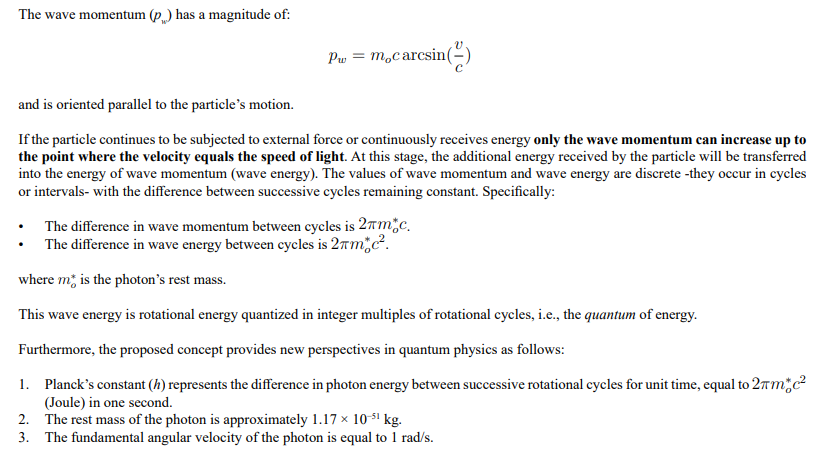
Based on the concept of space–time constraint that space-time itself imposes a constraint on a particle by producing resistive constraint force during the particle motion, it can be noticed that the impulse of the constraint force is in balance with the impulse in velocity-directed or parallel component of the inertial force. With interpretation of the relationship between impulse and momentum change in the context of wave-particle duality, this work proposes a speculative theoretical framework explaining the behavior of a point-mass particle moving at velocity approaching the speed of light. In this framework, the impulse in the perpendicular direction to the velocity will cause the particle an angular momentum along with wave momentum associated with the space-time entity. This wave momentum represents the wave energy transmitted into space-time. For the particle that can travel at speed of light, such as photon, the wave energy occurs in discrete integer cycles, each rotational cycle corresponds to a quantum of energy, which may be identified with Planck’s constant. The coexistence of particle momentum and wave momentum suggests that the particle-like and the wave-like properties manifest simultaneously. In addition, the proposed concept gives new perspectives in quantum physics as follows:
1. Planck’s constant (h) represents the difference in photon energy between successive rotational cycles for unit time, equal to 2πm*0c2 (Joule) in one second, where is the photon rest mass.
2. The photon rest mass is approximately equal to 1.17 × 10−51 kg.
3. The fundamental angular velocity of photon is equal to 1 rad/s.
Keywords
Space-Time Constraint, Wave-Particle Duality, Wave Momentum, Planck’s Constant, Photon Rest Mass
Introduction
In 1924, Louis de Broglie [1] presented his doctoral thesis entitled Research on the Theory of Quanta in fulfillment of his Ph.D. degree. His thesis was based on the conviction that a moving particle must be accompanied by a correlated wave. He explained from Einstein’s photoelectric effect that if light waves can exhibit particle properties, particles should also exhibit wave properties. Therefore, he linked Planck’s electromagnetic wave energy equation with Einstein’s special relativity energy equation, and proposed the relation between wavelength and momentum. This was the foundation of the concept of waveparticle duality, or the matter wave, expressed as:

Here:
• λ is the wavelength,
• p is the particle momentum,
• h is Planck’s constant,
• m0 is the rest mass of the particle,
• v is the velocity of the particle,
• c is the speed of light in vacuum.
Wave–particle duality is one of the most fundamental principles in modern physics. Experimental observations show that entities such as photons and electrons exhibit both wave-like and particle-like properties. Although wave-particle duality has been experimentally confirmed, it is still unclear whether it is two properties appearing simultaneously or a single property depending on observation, that is, when one aspect is observed, the other does not appear.
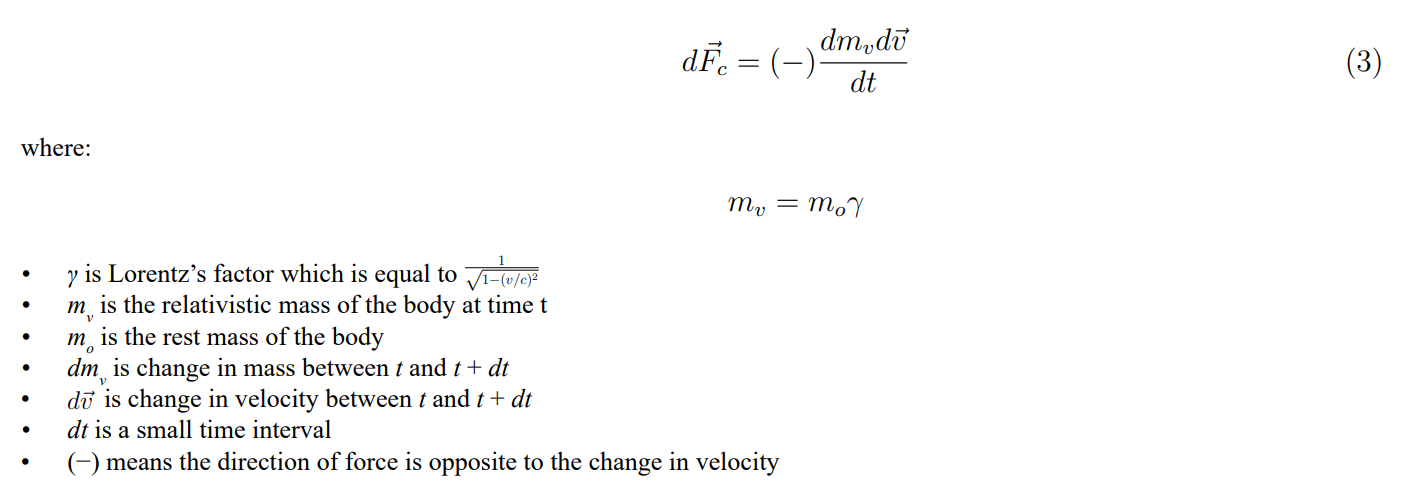
From the previous article “Mass Energy and Space-Time: On the Mass Increase of Moving Matter and Negative Energy Occurrence”of the authors [2], it is proposed that spacetime is not truly empty, but rather an emptiness that interacts with matter and influences motion through the space-time constraint. This gives rise to a resistive constraint force against the motion. The change in this constraint force at any given time;  , equals the product of the changing mass and acceleration, expressed as:
By connecting those two concepts altogether, this article aims at proposing a conceptual framework to find a solution for overcoming the motion limitations of massive particles as their velocity approaches the speed of light.
When the Speed of Light is the Maximum Velocity in the Universe - The Problem with Massive Particles under Continuous Force
It is well established that the speed of light in vacuum (empty space) is the maximum speed in the universe. Particles with rest mass can never reach, only very close to but never equal to, the speed of light. Light, or photons, which possess both wave and particle properties, are considered to have zero rest mass. This limitation suggests that the velocity of a particle will eventually become nearly constant. As a result, both the change in velocity and the change in mass (relativistic mass) will approach zero. This implies that when a particle’s velocity approaches the speed of light, the rate of change of momentum with respect to time will approach zero, meaning the momentum tends to be a constant value as well. But here arises a puzzling question: Why does the velocity or momentum of a particle converge to a constant value even though the apply force, no matter how large it is, continues to act upon it?, apart from the reason that it is due to the increase of particle’s mass.
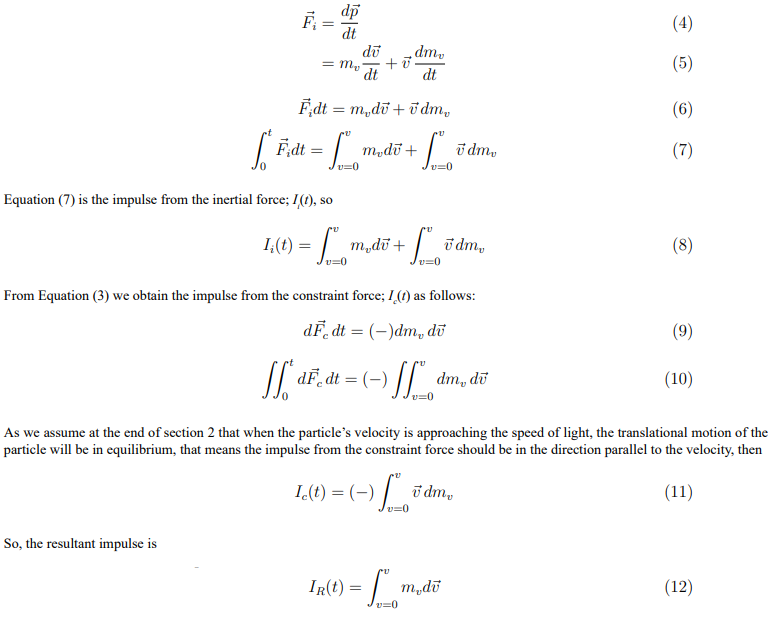
To address this problem, the explanation is built upon the space-time constraint concept under the assumption that when a particle moves in rectilinear motion approaching the speed of light, the particle’s translational motion will be in equilibrium, that is the net force in the direction parallel to the motion becomes zero, and the particle will rotate due to the force remaining in the perpendicular direction to the motion.
Space-Time Constraint and Impulses

Rotational Motion in Space-Time Coupled to Particle Rotating Trajectory
Interpretation of the Relationship between Impulse and Momentum Change in the Context of Wave Particle Duality
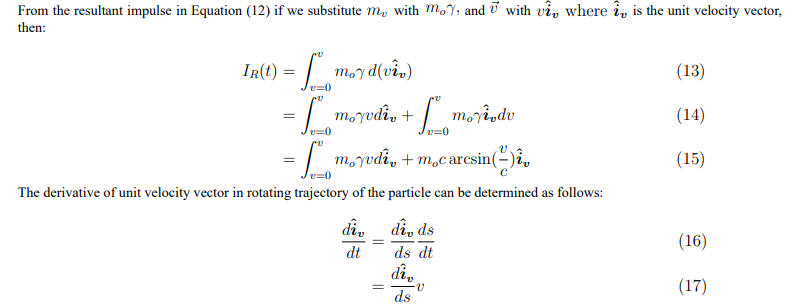
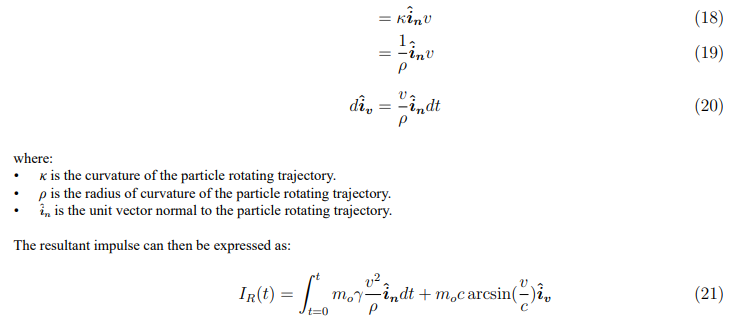
The relationship between impulse and momentum as shown in Equation (21) can be interpreted as follows:
• The first term on the right-hand side of the equation represents the change in angular momentum of the particle itself, which will be referred to as the particle aspect.
• The second term corresponds to the momentum arising within space-time due to the change in the particle’s angular momentum. This momentum manifests in the form of a wave, or what can be called wave-being momentum or wave momentum, which will be referred to as the wave aspect.
Equation (21) itself shows that the particle aspect and the wave aspect manifest simultaneously, wave aspect is the joint component of the particle’s rotating trajectory.
<img src="https://www.opastpublishers.com/scholarly-images/10943-6a7ee354f0330-revised-edition-of-mass-energy-and-spacetime-on-the-wavepart.png" width="600" height="100">
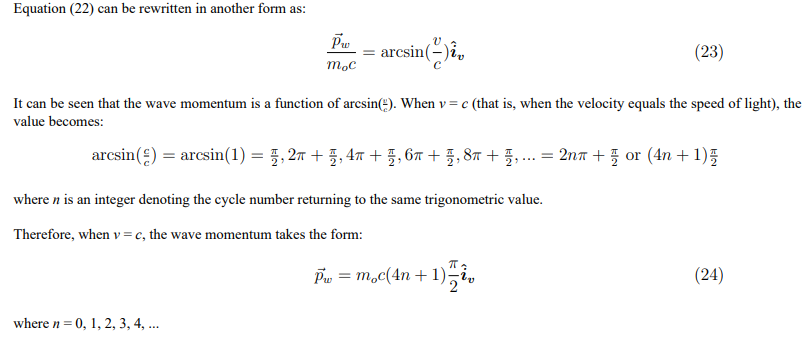
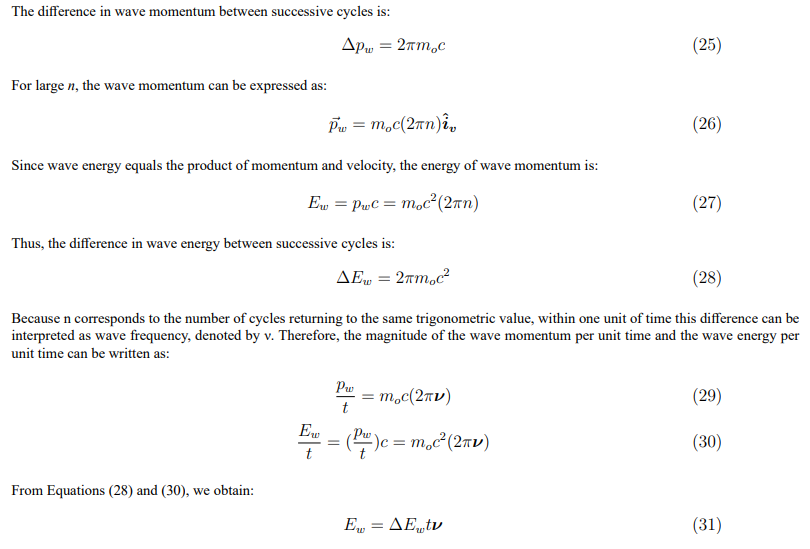
From Wave Momentum to Energy Quantum, Plancks Constant, and the Rest Mass of Photon
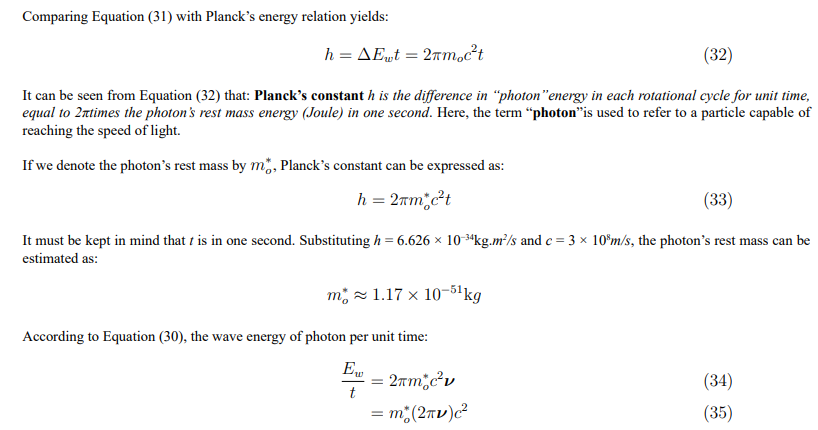
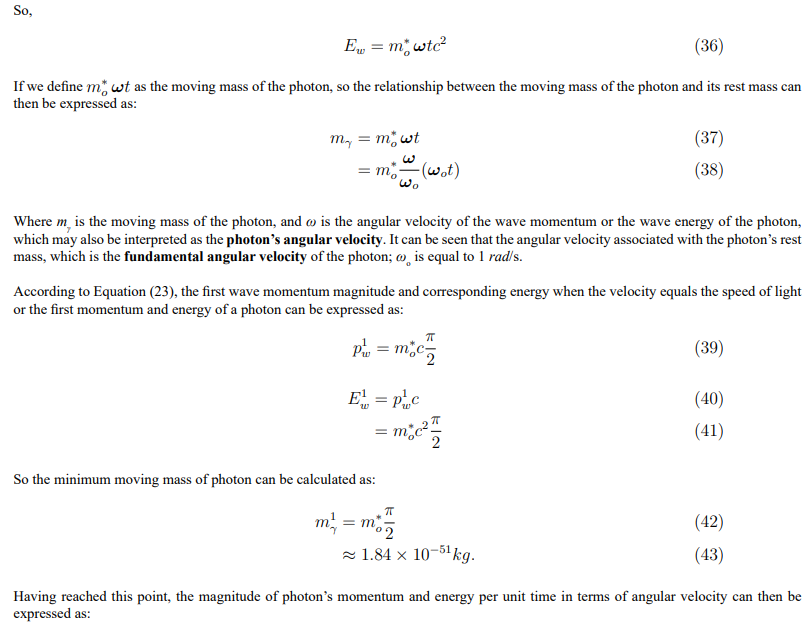
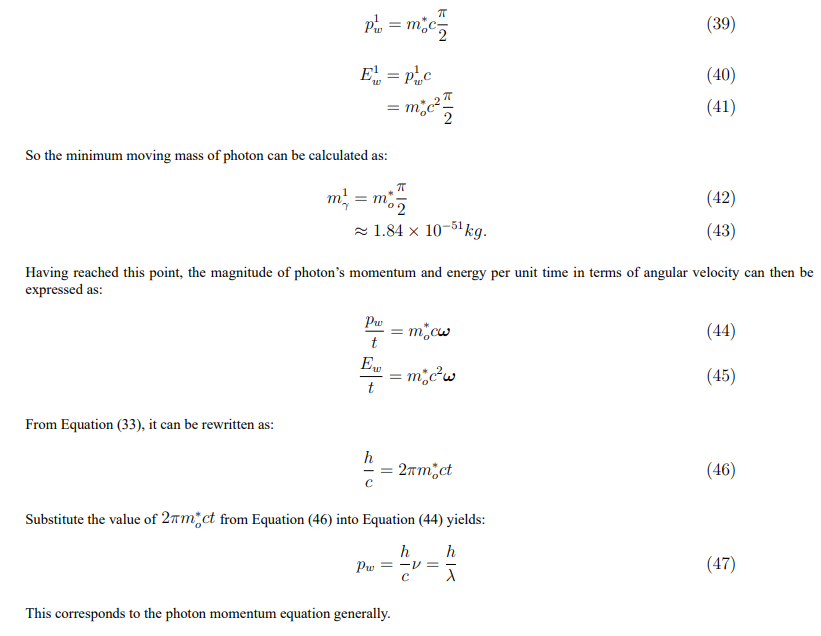
Matter Wave
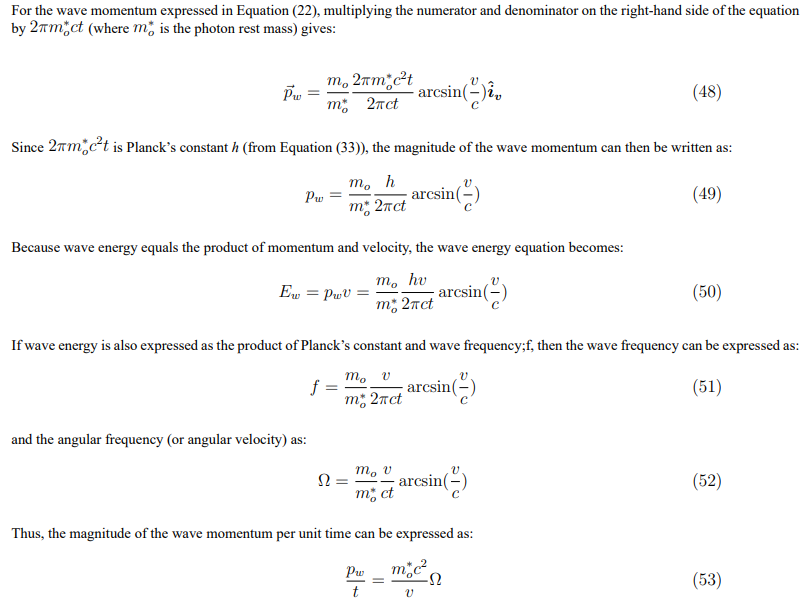
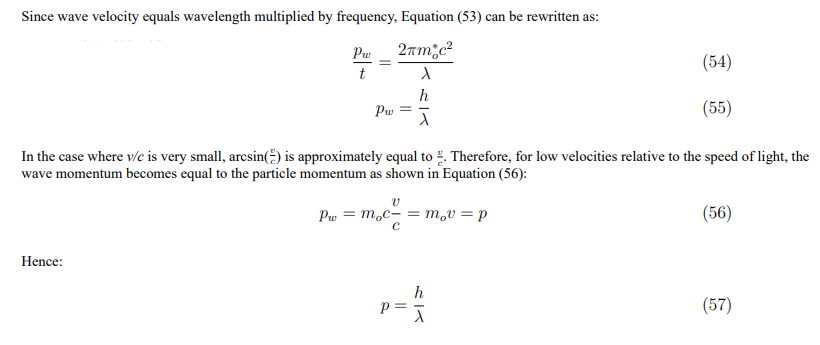
This is precisely the matter wave equation proposed by de Broglie.
If we consider Equation (51), the matter wavelength can be obtained directly as follows:
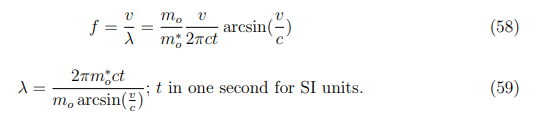
By calculating the matter wavelength using Equation (59) and comparing it with de Broglie’s matter wave equation (as ahown in the examples in Appendix A), the results are nearly identical -essentially yielding the same values. Therefore, it can be concluded that the wave momentum described in Equation (22) can be applied to particle’s motion across all velocity ranges.
Conclusion
By linking the concept of space-time constraint, which generates a resistive constraint force against the motion of matter, with de Broglie’s concept that a moving particle is accompanied by a correlated wave (wave-particle duality), and under the assumption that when a particle moves in rectilinear motion with velocity approaching the speed of light, the particle’s translational motion will be in equilibrium state, while the particle’s rotational motion is taking place, the following understanding can be drawn:
• In such an equilibrium state, the particle’s linear velocity becomes constant.
• The impulse acting on the particle remains only in the direction perpendicular to the motion, causing the particle to undergo rotation.
• This rotation leads to the emergence of wave momentum in space-time, existing alongside the particle’s angular momentum.
• The coexistence of particle momentum and wave momentum suggests that the particle-like and the wave-like properties manifest simultaneously.
Appendix A: Comparative Calculations for Clear Demonstration
In this section, a comparative calculation of the matter wavelength according to de Broglie’s equation and that proposed in this article is performed, by showing two examples as follows:
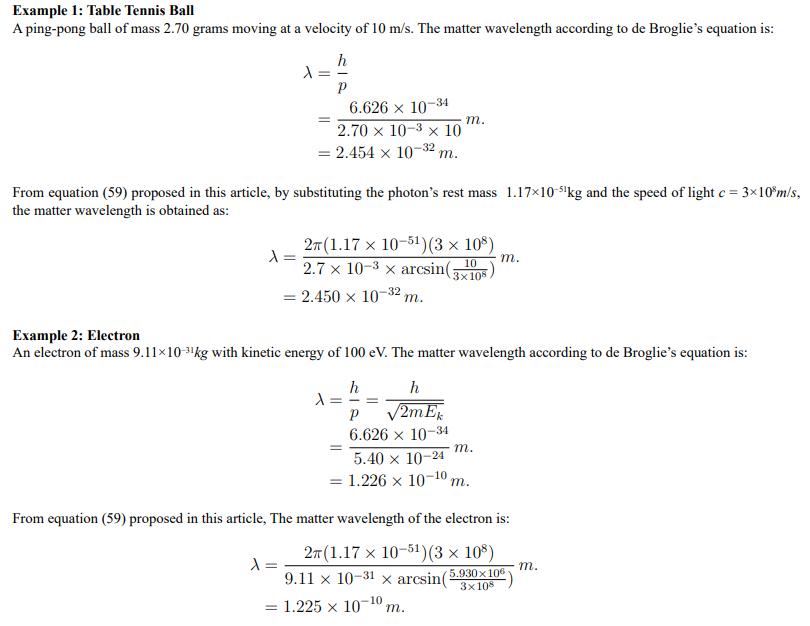
Both examples cleary show that the matter wavelength obtained from Equation (59) gives results that are practically identical to those obtained from de Broglie’s matter wave equation. Therefore, it can be concluded that the wave momentum described in Equation (22) can be applied to the motion of particles at all velocity ranges.
Acknowledgement
The authors would like to express their gratitute to Piyanart Benjakarn Pongpothakul, a kind friend who provided encouragement, listened, shared doubts and critical comments, and assisted in reviewing this article. Our thanks also go to Wisoot Vaeteeprasit, an ex-colleague who offered valuable help in preparing the concise abstract. We also extend our appreciation to all those who contributed to this work and provided assistance that enabled this paper to be successfully published, especially Montri Tangmongkhonwanit for his playful yet inspiring words. For the value of this achievement, we dedicate it with respect and gratitude to our parents, teachers, and the Metropolitan Waterworks Authority.