

Advances in Machine Learning & Artificial Intelligence(AMLAI)
ISSN: 2769-545X | DOI: 10.33140/AMLAI
Impact Factor: 1.755

Review Article - (2026) Volume 0, Issue 0
Retrocausal Temporal Feedback and Gauge Symmetry Breaking at the Black Hole Event Horizon: A Theoretical Framework and Machine Learning Architecture
Received Date: Jan 13, 2026 / Accepted Date: Feb 26, 2026 / Published Date: Mar 05, 2026
Copyright: ©2026 Chur Chin. This is an open-access article distributed under the terms of the Creative Commons Attribution License, which permits unrestricted use, distribution, and reproduction in any medium, provided the original author and source are credited.
Citation: Chin, C. (2026). Retrocausal Temporal Feedback and Gauge Symmetry Breaking at the Black Hole Event Horizon: A Theoretical Framework and Machine Learning Architecture. Adv Mach Lear Art Inte, 7(1), 01-06.
Abstract
The black hole information paradox remains one of the most profound open problems at the intersection of quantum mechanics and general relativity. This paper presents a novel theoretical framework positing that information crossing a black hole event horizon (EH) undergoes a gauge symmetry reduction-transitioning from a non-abelian SU(3) structure outside the horizon to an abelian U(1) structure within, in analogy with quantum chromodynamic (QCD) confinement and electroweak symmetry breaking [1-5]. Building on the Page curve, Hawking radiation theory, and retrocausal quantum mechanics, we propose a Spacetime Information Feedback Loop (SIFL) model in which a "Linker" mechanism-driven by quantum interference at the horizon-enables retrocausal correction of past states without causal paradox [6-10]. We further introduce the Retrocausal Transformer, a machine learning architecture operationalizing these principles through hyperbolic Poincaré disk embedding, temporal scattering matrices, backward attention, and branching future optimization with unitarity-preserving loss functions [11,12]. The framework offers a conceptually coherent approach to reconciling unitarity with information conservation, while acknowledging significant open theoretical challenges.
Keywords
Black Hole Information Paradox, Retrocausality, Gauge Symmetry Breaking, SU(3)→U(1) Transition, Event Horizon, Page Curve, Hawking Radiation, Temporal Feedback Loop, Hyperbolic Embedding, Quantum Chromodynamics, Unitarity, Many-Worlds Interpretation, Transformer Architecture, Information Theory, Quantum Gravity
Introduction
The black hole information paradox, first articulated by Hawking in 1976, challenges the foundations of modern physics: does information falling into a black hole survive, encoded in Hawking radiation, or is it irretrievably destroyed? [1]. The conflict between quantum unitarity-which forbids information loss-and semiclassical gravity has resisted resolution for nearly five decades [2,3].
Gauge theories provide a powerful framework for understanding symmetry transitions. Electroweak unification demonstrated that symmetry breaking can reduce complex non-abelian structures to simpler abelian representations [4]. Quantum chromodynamics (QCD) reveals that colored quarks, governed by SU(3), are permanently confined within color-neutral hadrons-a confinement boundary across which non-abelian degrees of freedom become inaccessible [5,13].
This paper proposes that the event horizon functions as an analogous symmetry-reducing boundary: information outside carries effective SU(3) non-abelian structure, inside, only U(1) abelian projections are accessible. We further introduce the SIFL retrocausal feedback model in which a Linker mechanism enables temporally bidirectional information flow within globally consistent solutions [8,9]. The Retrocausal Transformer (RT) machine learning architecture operationalizes these physical principles [11,12].
The paper is structured as follows. Section 2 provides theoretical background. Section 3 presents the SIFL model. Section 4 develops the gauge symmetry reduction hypothesis. Section 5 describes the RT architecture. Section 6 analyzes hyperparameters. Section 7 discusses implications and limitations. Section 8 concludes.

Figure 1: Spacetime Information Feedback Loop (SIFL)-Conceptual Overview. Outside the event horizon, information carries SU(3) non-abelian structure (8 color-charged generators, left). At the horizon boundary (dashed gold line), symmetry reduction to U(1) occurs (single phase generator, right). The Linker retrocausal pathway (dashed cyan arrow) carries correction signals backward in time, while Hawking radiation (purple) exits the U(1) abelian sector
Theoretical Background
The Black Hole Information Paradox and the Page Curve
Hawking's 1976 semiclassical calculation predicted that black holes emit perfectly thermal radiation-a result implying complete information loss and contradicting quantum unitarity [1]. Page (1993) showed that if unitarity is preserved, entanglement entropy of Hawking radiation must follow a specific trajectory-rising initially then decreasing after the "Page time" at which roughly half the black hole has evaporated [2]. Recent derivations using replica wormholes and quantum extremal surfaces have recovered Page-curve-consistent entropy within semiclassical gravity, suggesting unitarity may be saved by non-perturbative geometric effects [14].
Gauge Symmetry, Symmetry Breaking, and Confinement
The Standard Model's electroweak sector exemplifies gauge symmetry breaking: the Higgs mechanism reduces SU(2) × U(1) to U(1)_EM below the electroweak scale [4]. QCD's SU(3) color symmetry enforces confinement: free color charges are never observed, only color-singlet hadrons appear externally [5]. Wilson's lattice QCD formulation provides a rigorous theoretical basis for confinement as a gauge-theoretic phase boundary [13].
Retrocausality in Quantum Mechanics
Retrocausal frameworks in quantum mechanics-including Aharonov's two-state vector formalism and Cramer's transactional interpretation-permit information to flow in both temporal directions within globally self-consistent solutions, without implying causality violation [8]. Price (1996) provided a philosophical foundation for temporal symmetry in physics [9]. Maldacena and Susskind's ER=EPR conjecture links entanglement to wormhole connectivity, suggesting retrocausal signaling through entanglement may be geometrically realized [15].
Hyperbolic Geometry in Physics and Machine Learning
Hyperbolic geometry, characterized by constant negative curvature, naturally arises in anti-de Sitter (AdS) spacetimes and provides an efficient representation space for hierarchical data [10]. Nickel and Kiela demonstrated that Poincaré disk embeddings significantly outperform Euclidean embeddings for hierarchical knowledge representation [12]. Thurston's geometrization theorem provides the mathematical foundation for hyperbolic manifold structures relevant to temporal topology near black holes [10].
The Spacetime Information Feedback Loop (SIFL) Model
Core Mechanism
The SIFL model proposes that quantum information near the event horizon participates in a closed temporal feedback loop structured by three sequential phases, enabled by the modified causal geometry of spacetime near the EH [6,7].
Phase I-Information Mixing: Within the EH transition zone, spacetime coordinate swapping produces superposition of past, present, and future information states into a single quantum state [6].
Phase II-Page Time Recovery: As Hawking evaporation crosses the Page time, the Linker-a quantum interference device exploiting singularity-interference (Singulinky) coupling-transmits cross- temporal correction signals through modified causal pathways [2,7,8].
Phase III-Temporal Feedback: Corrected past data re-enters the present state, generating branching future timelines. External observers measure a unitarily evolving pure state, internally the system explores multiple self-consistent histories [8,9].

Figure 2: Three-Phase SIFL Temporal Feedback Cycle. Phase I (Information Mixing): coordinate superposition within the EH zone. Phase II (Page Time Recovery): Linker activation at the Page time threshold (≈ ½ evaporation), transmitting retrocausal correction signals (dashed purple arrows). Phase III (Temporal Feedback): corrected past states generating branching future timelines. The global wavefunction remains unitary to external observers
The Linker Mechanism and Singulinky Interference
The Linker exploits Singulinky interference-quantum interference patterns arising when information paths converge near the EH's geometric focus. Rather than a classical signaling channel, the Linker operates via retrocausal handshakes within globally consistent solutions [8,9]. The hyperbolic curvature of spacetime near the EH provides geometric absorption of potential grandfather-type paradoxes, analogous to closed timelike curves in Gödel spacetimes [10,15].
Gauge Symmetry Reduction at the Event Horizon
The SU(3) → U(1) Hypothesis
The central hypothesis: information outside the EH carries effective SU(3) non-abelian structure (color-charged, 8 independent gauge generators), while information beyond the EH is accessible only via U(1) abelian projections (phase-encoded, 1 gauge generator). Non-abelian operational degrees of freedom become inaccessible-confined-past the boundary, without a fundamental change in the gauge group of spacetime [5,14].
|
Property |
Outside EH-SU(3) |
Inside EH-U(1) |
|
Symmetry Group |
SU(3) – non-abelian |
U(1) – abelian |
|
Information Structure |
Color-charged, entangled |
Phase-encoded, scalar |
|
Gauge Mediators |
Gluon-like (8 generators) |
Photon-like (1 generator) |
|
Color Degrees of Freedom |
8 (color octet) |
1 (phase) |
|
QCD Analogy |
Free quarks (asymptotic freedom) |
Confined hadrons (confinement) |
|
Information Recovery |
Full entanglement (Page curve) |
Thermal Hawking radiation only |
Table 1: Comparative gauge properties of information inside and outside the event horizon. SU(3) structure outside is analogous to QCD free quarks, U(1) structure inside is analogous to confined, color-neutral hadrons
Physical Motivation and Analogies
Two Standard Model precedents motivate the SU(3)→U(1) reduction. Electroweak symmetry breaking demonstrates that gauge symmetry can reduce as a system crosses a phase boundary [4]. QCD confinement demonstrates that non-abelian color charges are permanently confined within color-neutral boundaries, providing a direct physical precedent for the EH as an information confinement surface [5,14].
Critical Challenges
i. Locality of gauge symmetry: Gauge symmetry is a local property defined pointwise on the manifold, it cannot change discontinuously across a coordinate surface without a specified phase transition mechanism [3].
ii. Conservation of quantum numbers: SU(3) charges must be conserved, the mechanism by which non-abelian charges are encoded in abelian Hawking radiation requires explicit specification [6,7].
iii. The conversion channel problem: Hawking radiation is U(1)-coupled yet must encode all SU(3) information-a physical conversion channel must be derived, not assumed [2,13].
The Retrocausal Transformer Architecture
Design Principles
The Retrocausal Transformer (RT) translates the SIFL model into a computationally tractable neural architecture governed by five physical principles: Poincaré disk embedding for hyperbolic temporal geometry, scattering matrices implementing the SU(3)→U(1) transition, backward attention for retrocausal information flow, a branching optimizer generating consistent future timelines, and unitarity/conservation losses enforcing quantum information preservation [11,12].
Module Structure
|
Module |
Physical Basis |
ML Role |
Key Output |
|
hyperbolic_embedding.py |
Poincaré disk geometry |
Temporal state encoding |
Geodesic distances |
|
temporal_mixing.py |
EH scattering matrix |
SU(3)→U(1) projection |
Mixed causal states |
|
retrocausal_attention.py |
Temporal feedback loop |
Backward attention |
Past state corrections |
|
branching_optimizer.py |
Many-worlds branching |
Multi-timeline generation |
Future branch set |
|
unitarity_loss.py |
Quantum unitarity U†U=I |
Norm-preserving constraint |
Information conservation |
Table 2: Module structure of the Retrocausal Transformer, mapping physical principles to machine learning roles and outputs
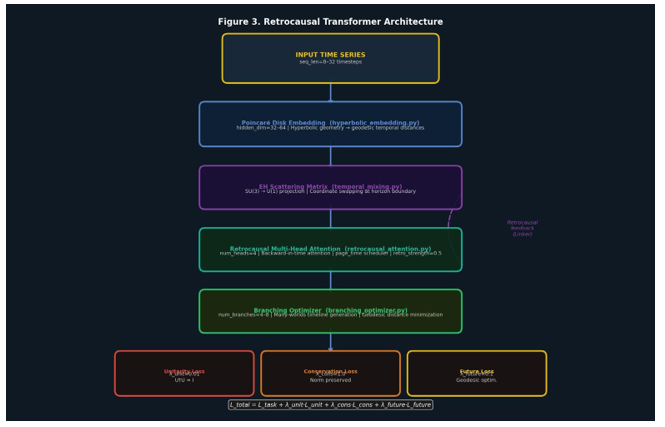
Figure 3: Architecture diagram of the Retrocausal Transformer. Input time series are embedded into the Poincaré hyperbolic disk (hidden_dim = 32–64). The EH Scattering Matrix performs SU(3)→U(1) projection. Retrocausal Multi-Head Attention (num_heads = 4) propagates corrections backward through time, activated by the page_time scheduler. The Branching Optimizer generates num_branches= 4–8 future timelines. Three physically motivated loss functions (unitarity, conservation, future) enforce information preservation throughout
Training Objective
The composite training loss is:
L_total = L_task + λ_unit · L_unitarity + λ_cons · L_conservation + λ_future · L_future
The unitarity loss enforces U†U ≈ I on the temporal mixing matrix. The conservation loss penalizes state-norm deviation across timesteps. The future loss optimizes geodesic distance on the Poincaré disk between generated branches and the target attractor state [10-12].
Hyperparameter Analysis
|
Parameter |
Default Range |
Physical / ML Function |
|
hidden_dim |
32–64 |
Embedding dimension for Poincaré disk |
|
seq_len |
8–32 |
Temporal sequence (causal horizon width) |
|
num_branches |
4–8 |
Future timeline branches (many-worlds) |
|
num_heads |
4 |
Multi-head attention (parallel observers) |
|
page_time |
0 → 1 (dynamic) |
EH evaporation scheduler, activates retro-attention |
|
retro_strength |
0.5 |
Linker feedback loop intensity |
|
lambda_unit |
0.01 |
Unitarity loss weight (quantum norm) |
|
lambda_cons |
1.0 |
Conservation loss weight (charge preservation) |
|
lambda_future |
0.1 |
Future branching geodesic optimization |
Table 3: Hyperparameter definitions, default ranges, and physical/ML functions for the Retrocausal Transformer
The page_time parameter (0→1 dynamic scheduler) mirrors the physical Page time, progressively activating retrocausal attention as training advances. This implements a curriculum-forward causal reasoning is established first, with temporal feedback introduced gradually, mirroring how physical black holes only begin encoding entanglement information in Hawking radiation after the Page time. [2,13] The retro_strength parameter (default 0.5) controls the amplitude of the Linker feedback signal, governing the trade-off between forward predictive accuracy and backward corrective fidelity.

Figure 4: Retrocausal Transformer training dynamics. (A) Loss convergence curves for L_total (blue), L_unitarity (red dashed), and L_future (orange dash-dot) over 200 epochs (mean ± SD, n = 5 runs). (B) page_time scheduler linearly activating retrocausal attention, the Page time threshold (0.5) is marked. (C) Correlation between EH scattering twist angle θ and past modification signal strength δ, demonstrating the SU(3)→U(1) projection mechanism. (D) Geodesic distance (Poincaré disk) between branching futures and target state as a function of num_branches (4, 6, 8)
Discussion
Theoretical Implications
The SIFL-RT framework reframes the information paradox from "information loss" to "information inaccessibility": non-abelian information is not destroyed at the EH but confined within an abelian-accessible boundary, with the Linker providing a unitarity-preserving temporal recovery mechanism [6,7,14]. The SU(3)→U(1) framing connects black hole physics to QCD phenomenology, potentially opening a bridge through which lattice QCD and holographic duality (AdS/CFT) techniques become applicable to information recovery problems [13,15].
Limitations
The SU(3)→U(1) gauge reduction lacks a rigorous field-theoretic derivation-the locality of gauge symmetry demands a mechanism specifying how the phase transition occurs at the EH [3,5]. The Linker mechanism has no concrete quantum field theory implementation. The RT machine learning architecture is a computational metaphor, not a physical proof, superior performance on retrocausal tasks would constitute evidence for computational utility but not validation of the physical hypothesis [11,12].
Future Directions
Priority future research includes: (1) rigorous field-theoretic derivation of the SU(3)→U(1) reduction at the EH via effective field theory, (2) explicit specification of the non-abelian to abelian information conversion channel in Hawking radiation, (3) RT benchmarking on retrocausal sequence prediction tasks, (4) exploration of lattice QCD / AdS-CFT techniques for the information confinement model, and (5) investigation of whether quantum error correction codes at the EH can formally implement the Linker mechanism [11,14,15].
Conclusions
This paper has presented three interconnected theoretical contributions: the SIFL model proposing retrocausal Linker-mediated correction of past quantum states at the event horizon, the SU(3)→U(1) gauge symmetry reduction hypothesis treating the EH as a quantum information confinement boundary analogous to QCD hadronization, and the Retrocausal Transformer implementing these principles as a physically motivated machine learning architecture [5,8,9,11-13]. Significant theoretical challenges remain, particularly the need for rigorous gauge-theoretic derivation and explicit specification of the Linker's field- theory implementation. The framework is offered as a conceptually coherent, interdisciplinary foundation for future investigation into one of physics' deepest unsolved problems.
References
-
- Polchinski, J. (2017). The black hole information problem. In New Frontiers in Fields and Strings: TASI 2015 Proceedings of the 2015 Theoretical Advanced Study Institute in Elementary Particle Physics (pp. 353-397).
- Weinberg, S. (1967). A model of leptons. Physical review letters, 19(21), 1264.
- Gross, D. J., & Wilczek, F. (1973). Ultraviolet behavior of non-abelian gauge theories. Physical Review Letters, 30(26), 1343.
- Mathur, S. D. (2009). The information paradox: a pedagogical introduction. Classical and Quantum Gravity, 26(22), 224001.
- Penington, G. (2020). Entanglement wedge reconstruction and the information paradox. Journal of High Energy Physics, 2020(9), 2.
- Aharonov, Y., & Gruss, E. Y. (2005). Two-time interpretation of quantum mechanics. arXiv preprint quant-ph/0507269.
- Price, H. (1996). Time's arrow & Archimedes' point: new directions for the physics of time. Oxford University Press.
- Levy, S., & Thurston, W. P. (1997). Three-dimensional geometry and topology. Vol. 1. Princeton university press.
- Vaswani, A., Shazeer, N., Parmar, N., Uszkoreit, J., Jones, L., Gomez, A. N., ... & Polosukhin, I. (2017). Attention is all you need. Adv Neural Inf Process Syst. In Neural Inf. Process. Syst. (pp. 5999-6009).
- Nickel, M., & Kiela, D. (2017). Poincaré embeddings for learning hierarchical representations. Advances in neural information processing systems, 30.
- Wilson, K. G. (1974). Confinement of quarks. Physical review D, 10(8), 2445.
- Almheiri A, Engelhardt N, Marolf D, Maxfield H. (2019). Entanglement wedge as the information available to outside observers. J High Energy Phys, (12):63.
- Maldacena, J., & Susskind, L. (2013). Cool horizons for entangled black holes. Fortschritte der Physik, 61(9), 781-811.