

World Journal of Tourism Management(WJTM)
ISSN: 3070-4030 | DOI: 10.33140/WJTM


Research Article - (2025) Volume 1, Issue 1
Reinterpreting Predynastic Egyptian Rulers: King Scorpion I As Huangdi And Narmer As Yu The Great (Nile–Yellow River Parallels)
Received Date: Sep 29, 2025 / Accepted Date: Nov 25, 2025 / Published Date: Dec 05, 2025
Copyright: ©©2025 Guangbao Liu. This is an open-access article distributed under the terms of the Creative Commons Attribution License, which permits unrestricted use, distribution, and reproduction in any medium, provided the original author and source are credited.
Citation: Liu, G. (2025). Reinterpreting Predynastic Egyptian Rulers: King Scorpion I As Huangdi And Narmer As Yu The Great (Nile
Abstract
This article presents a synthesis of evidence proposing that King Scorpion I of Ancient Egypt's Dynasty 0 (circa 3300- 3200 BCE) corresponds to the Yellow Emper or (Huangdi) recorded in Chinese historical tradition. It argues that the foundational narratives of the Chinese Five Emperors period may have originated in the Nile Valley. King Scorpion I, who is credited with the initial unification of Upper and Lower Egypt and whose tomb is located at Abydos, is identified here as the Yellow Emperor. Furthermore, the article contends that Narmer, the founder of Egypt's First Dynasty, represents the historical figure known as Yu the Great, the legendary founder of China's Xia Dynasty. Additionally, it challenges the conventional Egyptological distinction between "King Scorpion I" and "King Scorpion II," suggesting this dichotomy results from modern misinterpretation. All scorpion symbols from the Predynastic Period are accordingly interpreted as references to a single monarch: King Scorpion I, identified herein as the Yellow Emperor. Supporting this identification, the renowned Scorpion Macehead is reinterpreted as a ceremonial object belonging to the Yellow Emperor, with its hieroglyphic inscription proposed to be read as "Emperor Huang."
Keywords
King Scorpion, Scorpion Macehead, Yellow Emperor, Huangdi, Narmer, Yu The Great, Dynasty 0, Xia Dynasty
Identifying King Scorpion as the Yellow Emperor
King Scorpion was a ruler during the early Predynastic Period of Ancient Egypt, an era also designated as Dynasty 0, and is considered one of the first attested rulers in Egyptian history. Conventional Egyptology often posits the existence of two distinct rulers: King Scorpion I and King Scorpion II. The historical figure of King Scorpion I is associated with the U-j tomb, discovered in the Umm el-Qa'ab royal cemetery at Abydos in Upper Egypt—a burial ground for Thinite kings. This tomb, excavated in 1988 by the German Institute of Archaeology in Cairo, stands as the largest and most significant in the Cemetery U area. The artifacts and monuments recovered from U-j predate those found in the southern Cemetery B, which contains the final resting places of First Dynasty pharaohs, thereby solidifying King Scorpion I's position at this crucial juncture in early Egyptian state formation.
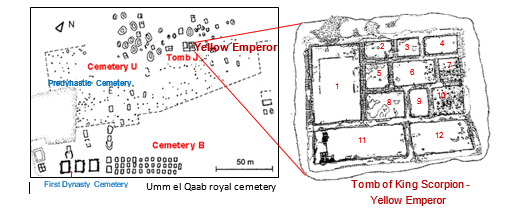
Figure 1: The Tomb of King Scorpion-The Yellow Emperor
The U-j tomb exhibits a structure and scale significantly larger than those of royal tombs from the Naqada II period. Its layout is interpreted as a symbolic representation of a palatial complex, with certain interconnections serving as entrances to various chambers, mimicking the doorways of a royal residence. The tomb features a subterranean structure, and its burial chamber was constructed using mud bricks, suggesting a potential two-phase construction process.
Although the tomb was looted in antiquity, a substantial quantity of burial goods was recovered. These imports include nearly 700 ceramic vessels originating from the Southern Levant (modern-day Palestine/Israel), alongside thousands of containers for wine and beer. Additional fine artifacts, such as obsidian bowls, fragments of furniture, and animal reliefs, were also discovered.
Radiocarbon dating of organic materials, coupled with the analysis of inscribed tags, pottery, and seals, places the tomb around 3200 BCE. Crucially, many of these objects appear to have been made and used during the tomb owner's lifetime. The tomb's monumental scale and the wealth of high-status grave goods imply a period of significant prosperity during the occupant's reign, indicating that the individual interred here achieved major personal accomplishments.
Bone and ivory fragments bearing short inscribed marks were also unearthed from the U-j tomb, representing the earliest known evidence of writing in Egypt. Among the most significant discoveries were 160 bone and ivory tags, each approximately the size of a postage stamp and incised with simple motifs. G. Dreyer of the German Institute of Archaeology in Cairo identified these carvings as the earliest known Egyptian hieroglyphics. The most frequently recurring pictographic symbol among these inscriptions is the scorpion. It is this recurring motif that has led to the tomb's owner being identified and named as "King Scorpion."
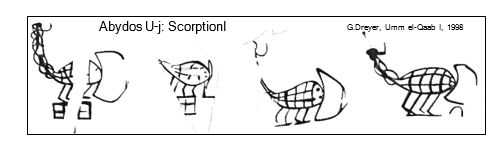
Figure 2: The scorpion Symbol Inscribed on a Bone Tag from Tomb U-J at Abydos, Considered One of The Earliest Known Examples of Ancient Egyptian writing
A number of small ivory plaques were discovered within the tomb, each perforated with a small hole and incised with one or more pictographic symbols. These ivory items are likely to have functioned as tokens of tribute, with the symbols believed to correspond to the cities or regions from which the tributes originated. Two such plaques have been traced to Buto and Bubastis, both located in the Nile Delta, indicating the reach of King Scorpion's influence—or possibly his military presence—into the northern region. It has been proposed that the administration of an expanding territory, including parts of Lower Egypt, under King Scorpion may have stimulated the development of the early Egyptian hieroglyphic script to manage records of goods and obligations.
Some scholars argue that the occupant of Tomb U-j may have ruled over a form of unified Egypt. Supporting this view, a 5,000-year- old rock graffito recorded in 1995 during the Theban Desert Road Survey depicts a scorpion symbol and portrays a victorious scene over another proto-dynastic ruler, potentially the king of Naqada. The defeated entity in the graffito is designated by a "Bull's Head" sign—a motif also attested among the objects from Tomb U-j. This evidence has led to the interpretation that Scorpion I achieved the unification of Upper Egypt through the conquest of the Naqada ruler
Building upon research presented in the author's prior work, Discovering the Xia Dynasty , this study contends that there was only one King Scorpion, who is identified as the Yellow Emperor (Huangdi) recorded in Chinese classical texts. The logic and evidence for this identification are summarized as follows:
• Identity Correspondence: Historical and archaeological evidence indicates that King Scorpion defeated a ruler symbolized by a bull's head, leading to the unification of Upper and Lower Egypt. This event parallels the Chinese historical account of the Huang Emperor defeating the Yan Emperor, whose iconography similarly included a bull-head emblem, resulting in the unification of the Yan and Huang tribal confederacies.
• Chronological Correspondence: Radiocarbon and archaeological dating place the reign of King Scorpion around circa 3200 BCE. This timeframe exhibits a notable convergence with the era traditionally ascribed to the Yellow Emperor in Chinese historiography, which forms the cornerstone of the "5,000-year civilization" narrative.
• Origin of Writing: The inscribed artifacts from the tomb of King Scorpion represent the earliest known hieroglyphic writing in ancient Egypt. This emergence of a complex script during his reign corresponds remarkably with the Chinese tradition that the Yellow Emperor commanded his minister Cangjie to invent writing, marking the beginning of recorded history.
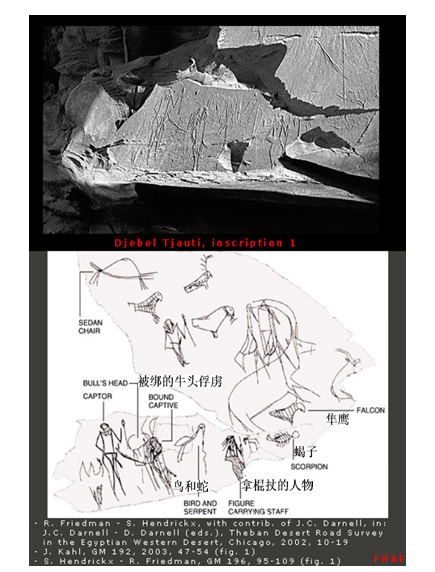
Figure 3: Depiction of the Yan-Huang War, Sourced from the FRANCESCO RAFFAELE Website
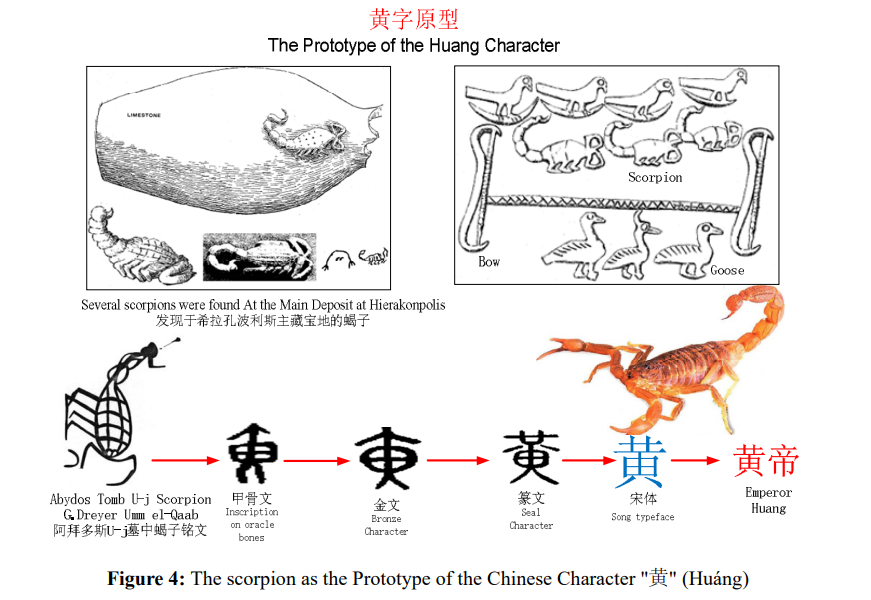
Figure 3 showcases a circa 3200-3000 BCE rock inscription discovered at Djebel Tjauti in the desert west of Luxor, which bears the symbolic identifier of King Scorpion. The scene depicts a defeated ruler, denoted by a bull-horn headdress, with his hands bound behind his back and being led away by a figure holding a rope. A scorpion symbol is prominently featured in the lower right section of the tableau, with a falcon depicted above it. This iconographic composition is interpreted as a likely representation of the conflict between the Huang Emperor (Yellow Emperor) and the Yan Emperor. Adjacent to this scene, a secondary motif of a bird pecking a snake further supports this interpretation. It is posited that this symbolizes the Upper Egyptian group—represented by the falcon (bird) totem and associated with the Yellow Emperor— achieving victory over the Lower Egyptian group, symbolized by the serpent totem and linked here to the Yan Emperor.Comparative textual analysis supports the logical reasoning presented above. The scorpion symbol discovered in the tomb of King Scorpion I bears a striking resemblance to the earliest form of the Chinese character (Huáng, meaning yellow) found in oracle bone inscriptions, suggesting the symbol may be its direct prototype. As illustrated in Figure 4, this connection is evident in the character's evolutionary trajectory. The association with the color yellow finds a plausible origin in the fact that many scorpion species in North Africa exhibit a yellow hue. While some etymological references suggest the bronze inscription form of resembles a locust, a more accurate interpretation aligns it with the morphology of a scorpion. The character's structure distinctly captures the creature's two prominent pincers and a curved tail sting—defining features of a scorpion, which a locust lacks.
Additional rock art associated with King Scorpion has been documented at Gebel Sheikh Suleiman, near the Second Cataract of the Nile in Nubia (modern-day Sudan). One prominent scene carved onto the rock face depicts a large scorpion positioned above a prostrate human figure, who appears to be deceased and has his hands bound. Accompanying this are several human figures: one, distinguished by a ceremonial false beard, a knife at his belt, and a rope in his hand, stands behind the captive. An adjacent figure makes a gesture interpreted as related to archery. Scholars identify the defeated enemies in this tableau as Nubians, based on their depicted attributes—specifically the characteristic feathers and bows—which align with conventional Egyptian iconography for representing Nubian peoples. This scene is thus widely believed to commemorate a military victory of King Scorpion over Nubian forces.
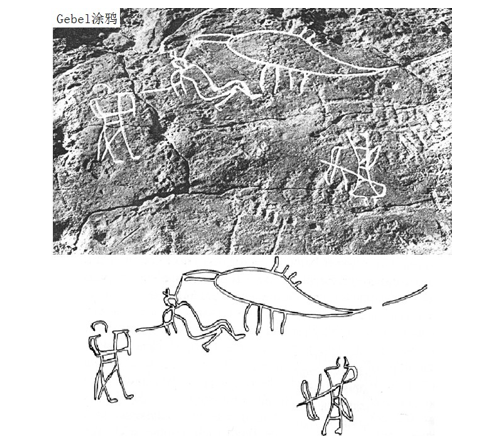
Figure 5: Rock inscription at Gebel Sheikh Suleiman, Sudan
This Nubian rock art may be connected to the historical campaigns against the "San Miao" (Three Miao) tribes, a conflict narrative spanning from the Yellow Emperor's era through the reigns of Yao, Shun, and Yu. In Chinese historical tradition, "San Miao" refers to various ancient tribes situated in the southern regions, also known as "Youmiao" or the "Miao people." Ancient Chinese texts record that the San Miao practiced  (zhua shou), a custom of weaving hemp fibers with hair into distinctive knots. The headdress of the bound captive in the inscription can be interpreted as a representation of this zhuA shou custom.
If the era of the Five Emperors indeed transpired within the Nile River Basin, it is plausible that the "San Miao" conquered during this period correspond to the ancient Nubians. Consequently, the ethnonym "Miao" for certain ethnic groups in Southern China today may stem from a later historical correspondence and migration. Furthermore, this line of reasoning suggests that the long-sought-after Mausoleum of the Yellow Emperor, a subject of enduring interest in Chinese archaeology, may be identified with the U-j Tomb in Abydos, Egypt.
Narmer as Yu the Great
The designation "King Scorpion II" was established by Egyptologists based solely on the scorpion symbol depicted on the so-called Scorpion Macehead—which remains the only known evidence attributed to this hypothetical ruler. This artifact, also referred to as the Major Scorpion macehead, is a decorated ceremonial object discovered by British archaeologists James E. Quibell and Frederick W. Green during the 1897–1898 excavation season. It was found in what they termed the "main deposit" at the Temple of Horus at Hierakonpolis in Upper Egypt and is currently housed in the Ashmolean Museum, Oxford, UK.
The macehead depicts a king wearing the White Crown of Upper Egypt and a bull's tail, standing beside a body of water—likely a canal—while holding a hoe. He is accompanied by two fan- bearers, with a scorpion and a rosette positioned near his head. Facing the king are several figures: one holds a basket, while others carry standards. Along the banks of the canal, numerous individuals appear engaged in agricultural activities. Behind the royal retinue are plants, a group of clapping women, and a small assembly of people facing away from the king. The upper register displays a series of nome standards, from each of which a bird hangs by the neck.
This ritual scene, emphasizing agrarian kingship and territorial control, may be distantly related to the later Chinese tradition of the "Spring-plowing Ceremony"
, in which the sovereign ceremonially tilled the land to symbolize the foundation of agricultural and social order.
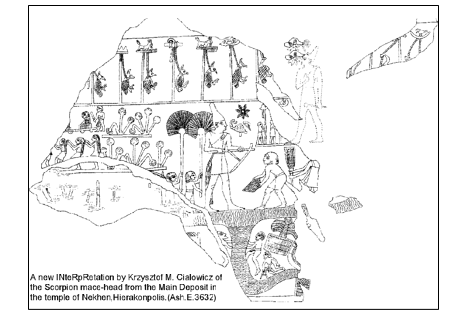
Figure 6: Depiction of the Scorpion Macehead
While additional scorpion symbols have been identified at Hierakonpolis, no tomb definitively attributed to a "King Scorpion II," nor any further evidence substantiating this ruler's existence, has been discovered or conclusively identified to date. This evidentiary gap has led many scholars to question the historical validity of a "King Scorpion II" as a distinct pharaoh. Some researchers have even proposed that references to "King Scorpion II" may in fact pertain to Narmer, the recognized founder of Ancient Egypt's First Dynasty.
Seals recovered from a First Dynasty cemetery at Abydos confirm Narmer's position as the dynasty's founder. His serekh—comprising the glyphs for "catfish" (n‘r) and "chisel" (mr)—is attested across a wide geographical range, from Syria in the north to Nubia in the south, indicating a figure of considerable reach and influence. This broad attestation further argues against equating him with the speculative "King Scorpion II."
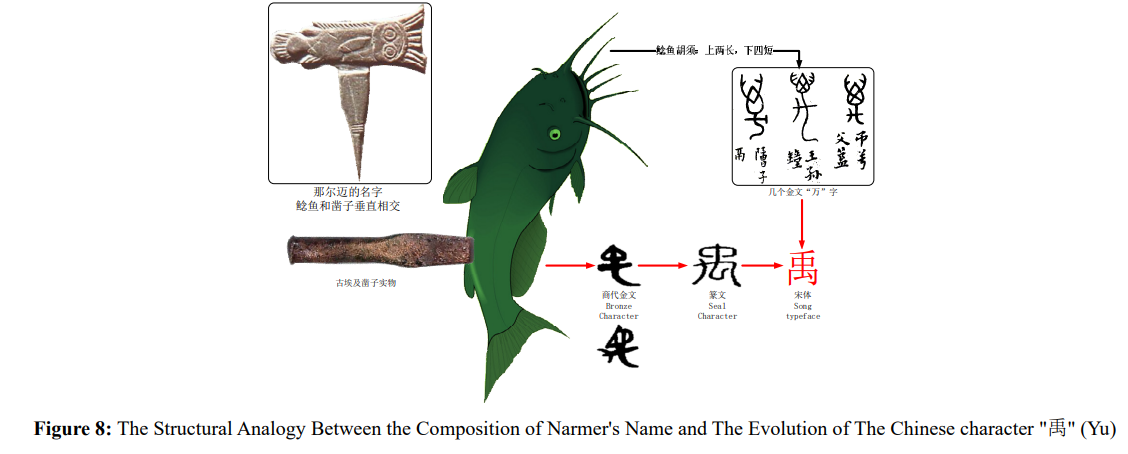
In fact, a more compelling parallel can be drawn between Narmer and Yu the Great, the legendary founder of the Xia Dynasty in Chinese historical records. The structural composition of Narmer's name exhibits a notable similarity to the character for "Yu" 
as found in Shang Dynasty bronze inscriptions. As illustrated in Figure 8, the ancient Chinese character "Yu" is phonetically identical to the word for "fish"  , a connection that may originate from the catfish glyph central to Narmer's royal titulary.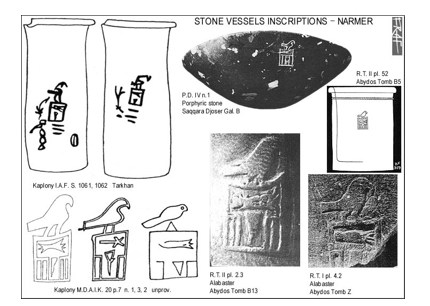
Figure 7: The Horus Name of Narmer, as Documented from Archaeological Findings (source: FRANCESCO RAFFAELE Website)
The Non-Existence of King Scorpion II and the Attribution of the Scorpion Macehead to the Yellow Emperor
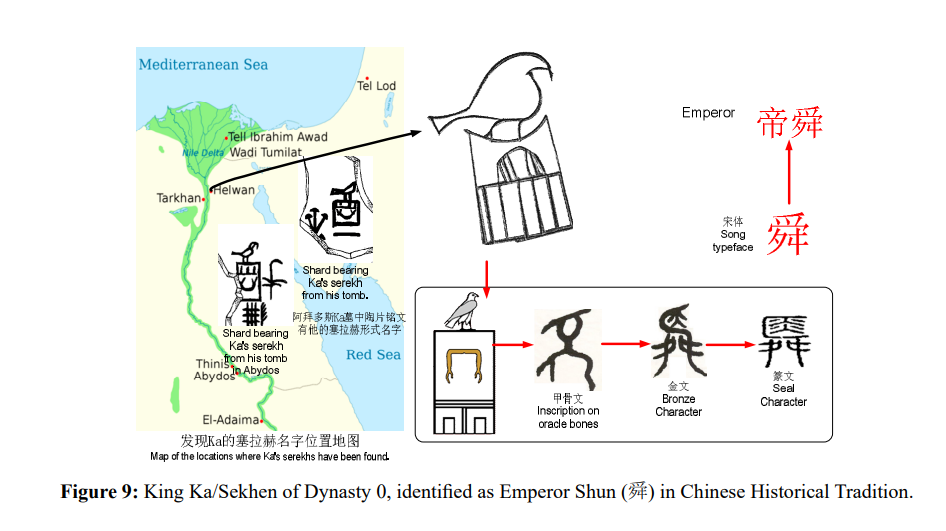
A review of extant evidence reveals no clear association between Narmer's name and the Scorpion Macehead. In conventional Egyptological chronology, the reign of the hypothetical "King Scorpion II" is often positioned between those of King Ka (also referred to as Sekhen) and Narmer. However, based on comparative research introduced in the volume Discovering the Xia Dynasty— which cross-references oracle bone inscriptions with the royal sequence of ancient Egypt's Predynastic Period—it can be argued that the ruler identified as Ka or Sekhen corresponds to the legendary Chinese Emperor Shun 
. Notably, the pronunciation of Ka's alternative name, Sekhen, bears a notable resemblance to the Chinese character "Shun"
, as visually illustrated in Figure 9.
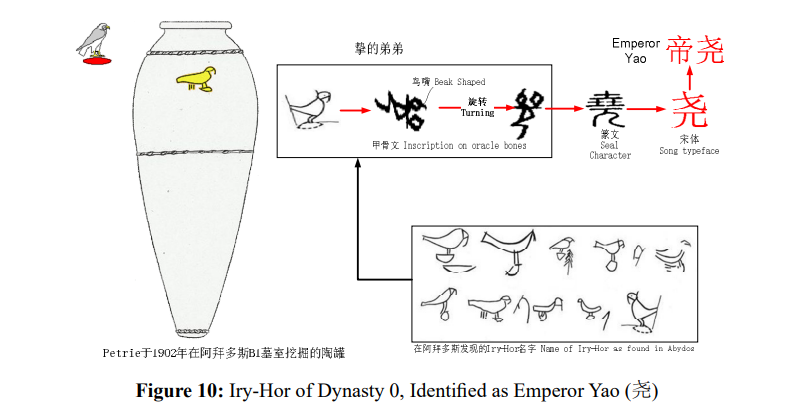
Based on logical deduction and the reconstructed sequence of the Predynastic Period king list, it can be reasonably determined that Iry-Hor, the predecessor of King Ka, corresponds to the figure known in Chinese tradition as Emperor Yao 
. Comparative textual analysis supports this identification. Iry-Hor is also attested under the name "Ro," the pronunciation of which bears a notable resemblance to the Chinese character "Yao"
. This phonological and positional correspondence reinforces the conclusion that Iry- Hor is the historical figure recorded in ancient Chinese documents as Emperor Yao.
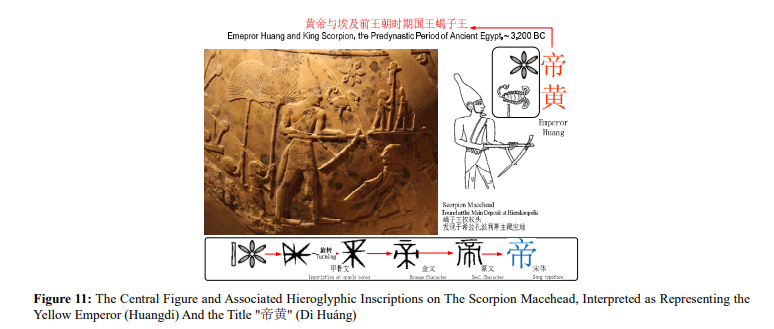
The names "Yao, Shun, and Yu" hold a foundational place in Chinese historical consciousness. According to classical Chinese texts, Shun's authority was transferred directly to Yu, with no intervening ruler between Shun (identified as Ka/Sekhen) and Yu (identified as Narmer). This research prioritizes the accuracy of these Chinese historical records, thereby challenging the conventional Egyptological analysis which posits a "King Scorpion II" reigning between Ka/Sekhen and Narmer. The logical conclusion is that no such king existed. This reassignment inevitably raises the question of the Scorpion Macehead's proper attribution. This article contends that the macehead should be attributed to the Yellow Emperor. It is proposed that all scorpion symbols from the Predynastic Period of Ancient Egypt refer exclusively to the Yellow Emperor, refuting the theory of two distinct Scorpion Kings. On the Scorpion Macehead, three inscribed symbols appear in front of the large carved figure: a rosette (petal), a scorpion, and a vertical staff (or scepter). Egyptologists identify the rosette as the "Golden Rosette," a symbol representing monarchy or high lordship. This circular floral motif, which originated in Mesopotamia, appears frequently in ancient carved artifacts. Critically, the combination of the rosette and the vertical staff forms a composite symbol that corresponds structurally to the oracle bone script character "
" (Dì, ), meaning "Emperor." Meanwhile, the scorpion symbol, as previously established, serves as the prototype for the Chinese character  " (Huáng). Therefore, these three adjacent symbols can be interpreted collectively as the two-character title
(Dì Huáng) — "Emperor Huang." The central figure holding the hoe thus depicts the Yellow Emperor himself. Consequently, the Scorpion Macehead should be rightly identified as the Macehead of the Yellow Emperor, as illustrated in Figure 11.
Based on the cumulative evidence presented, the figure conventionally designated as "King Scorpion II" by some Egyptologists has no historical basis and constitutes a modern misinterpretation of the archaeological record. All scorpion symbolism from the Predynastic Period consistently refers to a single ruler—King Scorpion I—who corresponds to the Yellow Emperor (Huangdi) recorded in Chinese historical tradition. The Scorpion Macehead, accordingly, should be recognized as belonging to this foundational figure.
Open Research
The data and referenced materials utilized in this study are primarily sourced from publicly available academic websites and online encyclopedias. All web resources were accessed between March and June 2024.
Primary Data Sources:
1. Wikipedia Contributors. (Various dates). Wikipedia, The Free Encyclopedia.
• Umm El Qa'ab. Available at: https://en.wikipedia.org/wiki/ Umm_El_Qa%27ab
• Scorpion I. Available at: https://en.wikipedia.org/wiki/ Scorpion_I
• Scorpion II. Available at: https://en.wikipedia.org/wiki/ Scorpion_II
• Scorpion Macehead. Available at: https://en.wikipedia.org/ wiki/Scorpion_Macehead
• Narmer. Available at: https://en.wikipedia.org/wiki/Narmer • Narmer Macehead. Available at: https://en.wikipedia.org/ wiki/Narmer_Macehead
• Narmer Palette. Available at: https://en.wikipedia.org/wiki/ Narmer_Palette
2. Raffaele, Francesco. (Various dates). Late Predynastic and Early Dynastic Egypt.
• Dynasty 0. Available at: http://xoomer.virgilio.it/francescoraf/ hesyra/dynasty0.htm
• Dynasty 00. Available at: http://xoomer.virgilio.it/ francescoraf/hesyra/dynasty00.htm
• King Scorpion II. Available at: http://xoomer.virgilio.it/ francescoraf/hesyra/KingScorpion2.htm
• Horus Narmer (Menes). Available at: http://www. francescoraffaele.com/egypt/hesyra/narmer.html
These online resources provided foundational archaeological data, chronological frameworks, and visual materials essential for the comparative analysis presented in this study.