

Journal of Clinical Review & Case Reports(JCRC)
ISSN: 2573-9565 | DOI: 10.33140/JCRC
Impact Factor: 1.823


Research Article - (2026) Volume 11, Issue 5
Reducing Sibling Fighting Using a Four Step Desensitization and Team Working Intervention in Preteens: A Case Study
Received Date: Apr 02, 2026 / Accepted Date: May 04, 2026 / Published Date: May 20, 2026
Copyright: ©Copyright: ©2026 Douglas H. Ruben. This is an open-access article distributed under the terms of the Creative Commons Attribution License, which permits unrestricted use, distribution, and reproduction in any medium, provided the original author and source are credited.
Citation: Ruben, D.H. (2026). Reducing Sibling Fighting Using a Four Step Desensitization and Team Working Intervention in Preteens: A Case Study. J Clin Rev Case Rep, 11(5), 01-09.
Abstract
Sibling conflict is a common fam.ily concern that can escalate into aggression and disrupt home routines. Studies examining methods of preteen and teen sibling conflict resolution using applied behavior analysis have been extensive but limited. Interventions effectively implement at-the-moment problem solving modalities and spotlight the role of mediator/facilitator as contingency manager. But once the contingency manager’s role fades or self-managed skill applications weaken, fighting rates returns to baseline levels. This case study evaluated the effects of a four step desensitization and team working intervention on daily fighting incidents between two siblings (ages 7 and 9). Multi-causal factors also considered included parental responses, and confounding contingencies in other (generalized) settings. A component of anxiety-avoidance training taught independent sibling conflict resolution without using the parent mediator. Using an ABAB reversal design, parents recorded the number of f ighting episodes per day across baseline, intervention, withdrawal, and reintroduction phases. During intervention phases, the family implemented a structured desensitization sequence consisting of controlled exposure, guided interaction, cooperative team tasks, and generalization to natural routines. Generalization probes across five days in different (high-fight risk) settings offered promising empirical support. Results showed a clear reduction in fighting during intervention phases and a return to higher levels during withdrawal. Implications suggest the functionality of anxiety-avoidance in sibling conflict management within a multicausal framework. Implications discuss further study of multicausal analyses in ABA child behavior research.
Keywords
Applied behavior analysis, Sibling fighting, Conflict resolution, Anger management, Parenting training, Interbehavioral analysis
Introduction
Sibling fighting is a frequent source of stress for families and can interfere with social development, emotional regulation, and household functioning. From a behavioral perspective, sibling conflict is often maintained by attention, access to preferred items, imitation of parental discord, or escape from shared tasks. Research in child behavior analysis unequivocally demonstrate effective interventions to reduce coercive sibling interactions through reinforcement, skill building, and structured routines [1]. Pickering et.al. (2023) evaluated structured parenting intervention targeting sibling comfort and warmth, a more contextual approach. Hastings (2023), a pioneer study, modified the role of social support as mediation to family resolution. Similarly, Bebe & Lapina (2023) used structured compromise among autistic siblings. Replications of mediator-initiated problem solving also showed rapid learning and acceptable rate during generalization when reminder prompts were given by mediators, or surrogates (i.e., grandparents) [2]. The common denominators in these studies include (a) the primary instructional role of a mediator, (b) minimal fading and brief reprisal of mediation role in generalization phases, and (c) teaching the preteen and teens self-managed problem solving to replace the adult mediators.
A negative side-effect of sibling fighting reduction is reliance on the mediator as the primary variable. Tucker et al. identified this as a recurrent flaw in success outcomes [3]. Even in peer-mediator interventions, the neurodivergent or neurotypical children subjects relied on scripts, prompted rehearsals, or other symbolic reminders of the conflict-resolution sequence of behaviors [4, 5]. Interestingly, Recchia et al. found that differential reinforcement of prosocial behavior, structured turn taking routines, and emotion regulation coaching all collectively strengthened sibling cooperation, but with one problem [6]. The external contingencies governing these behaviors relied on parental models or other skill-reminders and less on the rule-governed or "automatic" self-employed skills by the fighting children. Variance among self-monitored skills in the children largely depended on the household context or setting events [7-11]. Wahler & Dumas, forerunners of this systems perspective, particularly highlighted the coercive cycles of parent-child interaction that inadvertently strengthens aggressive sibling fighting [12]. Ruben, echoed this multilinear perspective in his quantitative behavior analysis of avoidance in virtual video gaming [13]. Self-monitoring of virtual gaming, like self-monitoring of sibling fighting abatement, implicated the role of avoidance and escape in learning appropriate behaviors. Avoidance and escape, while possibly motivated by mild social anxiety, may be the controlling variables for siblings to initiate correction of fighting instead of the caretakers, parents, or mediators doing the correction.
Avoidance as the motivating operator, explained behaviorally, is dichotomous. Skinner's conceptual scheme of avoidance (and escape) behavior proportionally varies with casual effects of negative reinforcement [14, 15]. The aversive stimulus, for example, a parent's instruction, is delayed, mitigated, or removed contingent on the child's immediate compliant actions. Compliance stops the parent's repeated instructions, thereby removing the aversive stimulus. The result predicts a child will respond more compliantly in the future. But this linear and unicausal explanation is weak and poorly accounts for significant intervening variables undermining the intensity of the parents' aversive stimuli, or the child's automatic avoidance behavior. Parrot's (1983) analysis drew attention to the variables omitted in a traditional Skinnerian avoidance conditioning paradigm. She showed fundamental similarities and dissimilarities between Skinner's (avoidance) model and Kantor's model of avoidance, arguing this basic difference: Avoidance, according to Kantor, is not purely a reinforced response, but, instead, a reorganization of the entire psychological field in which the organism and stimulus functions participate. Avoidance emerges from changes in stimulus and response functions within a field, not from reinforcement contingencies. Five factors contributing to the integrative field in avoidance include stimulus functions, response functions, setting factors, intebehavioral history, and medium of contact. Consider medium of contact, or the circumstances that allow a behavioral segment to occur between organism and stimulus (e.g.,, light, sound, vibration, etc., cf. [16]). For example, a child's who listens to music by earbuds while instructed by the parent filters, reduces, or blocks the medium of contact (auditory reception) of hearing the parent; sound-blocking earbuds also prevent parents' instruction from eliciting autonomic effects of fear. Similarly, children with tympanostomy tubes (in their ears) may receive less ambient sound (from their parents' voice) from earwax buildup or ear fluid. In both cases, earbuds or tubular implants, that child is less susceptible to the (a) hearing the parent, (b) acute effects of aversive conditioning (autonomic arousal, fear activation, avoidance behaviors), and (c) consequences of negative reinforcement.
A closer examination comparing Skinner with Kantor's models of avoidance is relevant to the current study (Table 1). Table 1 compares Skinner's operant model and Kantor's interbehavioral model across seven conceptual dimensions relevant to the analysis of avoidance behavior in sibling aggression contexts. Skinner's framework emphasizes linear contingency relations maintained through negative reinforcement, whereas Kantor's interbehavioral field theory emphasizes mutual stimulus–response interdependence, setting factors, and accumulated interbehavioral history as co-equal determinants of psychological events. Changes in avoidance, in other words, are due to changes in the field, not changes in internal drives or motivating operations. Field modifications across a progression of settings are multifarious, involve several people, several interacting variables, and no single conditioning process (i.e., negative reinforcement) is responsible for the child's behavior outcome.

Method
Participants
Two male sibling, ages 7 (Child A) and 9 (Child B) participated along with their parents. The families originally sought therapy for chronically aggressive sibling fighting in a private practice operated by author. Both youngsters attended public school in a Midwest metropolitan area that was demographically heterogeneous. They previously underwent psychoeducational evaluations to qualify for Attention Deficit Hyperactivity Disorder (ADHD, combined presentation) with Specific Learning Disabilities (SLD) in oral language; SLD and ADHD (under Otherwise Health Impaired) qualified them for an IEP (special education). However, neither child currently took psychotropic medications nor met with a therapist focused on other individual issues. Both children rotated between a resource and regular classroom. Itinerant support enabled academic grades between A's and B's. The school did not report behavior incidents of fighting or any significant aggression or noncompliance warranting suspensions, detentions, or expulsions. They participated neither in extracurricular nor community activities. Their parents also denied any history of medical, criminal, surgical, or head-trauma experiences. On pre-baseline ratings of sibling aggression, the parents completed the Sibling Relationship Questionnaire (SRQ), and Sibling Relationship Inventory, and shared preliminary behavioral observations [23, 24]. On the SRQ, higher scores on scales of Conflict, Aggression/ Hostility, and Rivalry suggested high frequency and intensity of sibling altercations. Commensurate scores appeared on the SRI scales of Conflict, Aggression, and Dominance. Higher scores predict frequent and severe fighting and coercive interactions despite parental intervention.
Behavior observations included topography and functionality of aggression. Topographical characteristics included (a) verbal aggression (e.g., yelling, name-calling, threatening, mocking, blaming, etc.), (b) physical aggression (e.g., hitting, kicking, pushing, pinching, scratching, hair-pulling), (c) relational/social aggression (e.g., exclusion from play, manipulating rules, ganging up), (d) property related aggression (e.g., breaking toys, throwing or damaging shared items, ripping drawings, etc.), and (e) coercive or dominance-based behaviors (e.g., taking items by force, blocking access to rooms, using size or strength to control, bossing around, etc.). Functional or operational explanations identified antecedents, behaviors, consequences, motivators (motivating operators), setting events, media of contact, and reactional biography (Hayes & Fredericks, 1999; Ruben, 1983) [25, 26]. For example, Child A yelled and scratched Child B, in the dark (medium of contact), when Child B played with his toys (motivating operator), in the family room (setting event), and when both parents rushed in to intercede (consequences). This reactional biography offered a kaleidoscope of past similar behaviors for which similar consequences occurred. Child A struck the dog and cat the same way when the animals inadvertently dragged Child A's toys from his room. Functional variables also included the parents' frequent verbal escalation and repeated intercession during aggressive sibling arguments. Finally, the parents provided informed consent and agreed to collect daily behavior data across baseline and intervention phases.
Procedure
Clinical intervention consisted of a multi-componential behavioral model originally conceptualized by Ruben [21, 22]. Four steps taught to the parents consisted of (a) sibling apology, (b) sibling shared activities, (desensitization), and (c) sibling access to reinforcers (i.e., the pre-existing activity before fighting). Step 1 involved the parent-mediator interceding and asking both Child A and Child B to stand in front of them. Step 2 involved asking each child to apologize to the other following the parental prompt, ''Child A (real name), say you're sorry; Child B (real name), say you're sorry.'' If one child said, ''sorry,'' but the other child did not, parents gave praise to the compliant child and ignored the child not apologizing. If both apologized, both children received praise respectively. Immediate transition occurred to Step 3 regardless of who apologized. Step 3 included the parenting prompting the instruction, ''now, give each other a hug (or handshake).'' If one child extended arms for a hug or handshake, but the child refused, the initiating child received praise, while ignoring the refuser. If both children hugged or shook hands, both received praise. Regardless of hug-compliance, the parent proceeded to the next step. Step 4 involved assignment of a shared activity lasting approximately 15 to 20 minutes. The task entailed repetitive and overcorrective responses. ''Overcorrection'' describes a procedure of excessive response effort under a limited time to produce mild exhaustion or (response) satiation effects [27, 28]. For example, the parent said, ''I would like both of you to pick up 15 pieces of Legos each and put them in the basket.'' Criteria for shared activities were that it (a) can occur in the natural environment, (b) met the children's skill level and past skill mastery (e.g., no new learning needed), and (c) caused mild to moderate fatigue or response effort. If one child completed the task, that child could return to the pre-existing (rewarding) activity before onset of fighting. The noncompliant child could not return for 10 minutes (i.e., similar to time-out). If both children refused to engage in the shared activity, they both waited for 10 minutes in proximity to each other before returning to the pre-existing activity. This exact series of steps and parental verbal prompts were repeated each time fighting incidents occurred.
Independent variables: Independent variables involved the four sequential steps of instructions evoking the children's behaviors (see above). Contingent social reinforcers (praise) occurred for each compliance observed. The parent neither repeated nor escalated in giving the instructions, nor convinced or cajoled the children to comply with each step. During baseline phases, parents withdrew intervention of the steps and allowed the children to resume natural play with minimal guidance.
Dependent variables: Dependent variables of fighting were defined as: (a) verbal aggression (e.g., yelling, name-calling, threatening, mocking, blaming, etc.), (b) physical aggression (e.g., hitting, kicking, pushing, pinching, scratching, hair-pulling), (c) relational/ social aggression (e.g., exclusion from play, manipulating rules, ganging up), (d) property related aggression (e.g., breaking toys, throwing or damaging shared items, ripping drawings, etc.), and (e) coercive or dominance-based behaviors (e.g., taking items by force, blocking access to rooms, using size or strength to control, bossing around, etc.). Parents scored a single frequency count per fighting occurrence (regardless of the category of fighting, e.g, verbal aggression). Recorded scores appeared on a data sheet during baseline observations, and before implementing the procedure during instructional phases. Daily frequency counts were sent by text to the author per day for tabulation. Plotted tabulations (graphs showing positive and negative trends) were sent to the parents by email as feedback on the parents' consistent performance and to reveal progress on the children's behaviors.
Design and Condition Sequence: A single-subject reversal (ABAB) treatment design (Barlow & Hersen, 1984) occurred for both children exhibiting sibling aggression behavior. Two baselines (10 days, 7 days, respectively) preceded the initial and repeated implementation of the treatment components (10 days each). A 5-day generalization phase occurred after the second baseline to assess continuity and maintenance of measured improvements in four different environments: (1) Grandparents' house, (2) grocery store, (3) church, and (4) restaurant. Baseline involved parents' counting the number of sibling aggression incidents during a five-hour period ranging from after school to the child's bedtime. Parents also counted the number of times they interceded or yelled at the children during baseline and subsequent interventions. Similar data collection occurred during the two identical interventions and generalization phase. Generalization steps also did not involve parental instruction as done in the two treatment interventions. In the generalization phase, parents observed and made audio and video recordings of entire transactions between the siblings to show the verbal behavior (rule-governed behaviors) or adaptive problem-solving behaviors negotiated to reduce or prevent parental interruption (Table 2).
Results
Observer Reliability
Interobserver reliability was collected on at least 40% of all observations in each experimental condition by having the parents observe different behaviors independently. Agreement was calculated on occurrences of the behaviors on an interval-by-interval basis. An agreement was scored when both observers scored the target behavior in a given interval. A disagreement was scored when one observer recorded an occurrence and the second observer did not. Interobserver agreement was calculated by dividing the number of agreements by the total number of observations. Observer-reliability results varied from a low of 86% to a high of 100%. The mean reliability for target behavior observations clustered around 90%. Limited reliability checks prevailed outside the training session.
Analysis of Data
Frequency of parent's yelling and interceding significantly decreased from both baseline (A1, A2) to both intervention phases (B1, B2) (Figure 1). High rates of 10 to 15 episodes per day of yelling in A1 and 5 to 9 episodes of yelling in A2 matched similarly high numbers of parents interceding in baseline phases. By contrast, frequency scores of 0 to 2 occurred across both intervention phases (B1, B2). Parents reported deliberately withholding yelling, interceding (mediation) or any other verbal or nonverbal feedback during interventions except for the series of steps in each instructional component.

Figure 1: Depicts frequency of parent self-reported yelling and interceding across baseline and intervention phases.
Deceleration trends in data equally appeared for incidents of sibling aggression (Figure 2). Pretreatment scores of 7 to 10 incidents per day significantly reduced to 2 episodes by the 2nd or 3rd day of intervention (B1) when parents' anecdotal yelling and nonprogrammed interceding ceased. Reduced incidents of sibling fighting persisted into B2 and generalization phases across four vastly different settings (grandparents' house, grocery store, church, and restaurant (Figure 3). Setting events unique to the grandparents' house included (1) their excessive allowance of sibling fighting without correction (i.e., free operants), (2) random food accessibility when arguments occurred (not when both siblings cooperated), and (3) blaming one sibling or the other for instigating the fight. Contingencies unique to the grocery store included (1) unmonitored walking with the parent, (2) other families shopping and looking at the subjects, and (3) uncertainty whether sibling cooperation and compliance earned treats (i.e., candy bar). Contingencies endemic to the church included (1) loudness of sibling fighting heard in sanctuary, (2) uncertainty whether either child might be called on to participate in service, (3) history of parent disapproving of the siblings' noise, and (4) uncertainty of post-church attendance at a restaurant or afterglow. Setting events specific to the restaurant include (1) coloring books to draw in, (2) establishing operation of hunger, (3) parental disapproval of noise from fighting, and (4) staying seated during meal. Parents reported these setting events (contingencies) historically were ineffective at naturally controlling sibling aggression prior to the study.

Figure 2: Shows frequency of sibling fighting incidents across four phases (Baseline, Intervention, Baseline, Intervention).
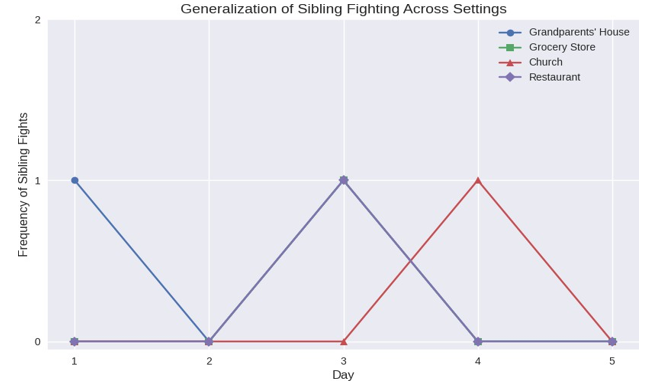
Figure 3: Shows frequency of sibling fighting incidents across five days in four different environments (Grandparents’ house, grocery store, church, and restaurant).
However, generalization data showed 1 to 0 incidents of sibling fighting, correlated with the verbal statements of each sibling regarding the anticipatory anxiety and probable consequences if they re-engage in fighting. Table 2 lists several of these new contingencies reformulated as rule-governed behavior [29, 32]. Responses chronicled during the re-introduced intervention, generalization, and 3-4 weeks beyond generalization phase include mutual (sibling) observations, statements shared among siblings, and their collateral behaviors, all controlled by the motivating operator to prevent or terminate anxiety (anticipation) of aversive consequences. For example, in week one, under ''Avoid Parental Instruction,''siblings begin to notice that when they fight, a parents step in with corrective instruction. This recognition is observed when they say to each other, ''Every time we fight, mom makes us do that boring practice.'' One sibling says to the other, ''Let's just get along so mom doesn't come over here.'' By the 4th week, exchange of rule-governed statements and mutual (cooperative) behavior changes are more ostensible, routine, and self-generative. Siblings say things, for example, like ''We don't even need mom to tell us what to do anymore, we figured it out. We make a great team when we get along.'' Affirming words evoke not only cooperative play, but also solicitation of that civility from their parents. Similarly by the 4th week, under Avoid Activity Interruption,'' siblings say, ''We never lose our free time anymore because we always get along.'' The connection between cooperation and uninterrupted fun is fully ''internalized'' (privately stated to self) and self-reinforcing.

Table 2: Presents verbal and nonverbal transactional behaviors observed among siblings precipitating (probable) sibling fighting incidents during the second intervention, generalization period, and weeks beyond. Transactions cover four weeks in which rule-governed or other behaviors demonstrate (a) avoiding parental instruction, (b) avoiding corrective tasks, (c) avoiding arguments, and (d) avoiding activity interruption.
Conclusion
The applied intervention of multicomponent instructions to induce mild anxiety and avoidance/escape behaviors showed promising experimental effectiveness in the elimination of chronic sibling fighting. Reversal of baseline and intervention demonstrated a significant functional effect of instructions on building (a) repetitive behaviors, (b) rule-governed behavior regarding the repetitive behaviors, and (c) negatively reinforced proactive, or cooperative behaviors. In generalization phases across diversely complex setting events, even the misdirected reinforcing contingencies (i.e., food to stop arguing) were ineffective motivating operators to reverse the children's progress. Multicausal variables such as those observed in the four generalization environments sampled (grandparents' house, grocery store, church, restaurant) are often saboteurs in dismantling newly developed behaviors. Opportunities for competing behaviors (i.e., arguing, hitting, etc.) are plentiful, with accessible and immediate reinforcers. These conflictual conditions are often overlooked, marginalized, or deprioritized compared to the linear, unicasual relationship demonstrated between independent and dependent variables.
From a behavioral perspective, the instructions appeared to function as rule governed stimuli, reorganizing the children's behavior by specifying contingencies in advance and thereby reducing the need for direct contingency shaped learning. The instructions also altered the establishing operations that typically set the occasion for coercive exchanges; by clarifying expectations and consequences before conflict emerged, the procedure reduced the evocative conditions that historically made sibling fighting more probable. Interpreted through Kantor's multicausal interbehavioral model, the behavior change reflects a reconfiguration of the entire interbehavioral field: the instructions, the children's histories, the anticipated consequences, and the immediate social context jointly participated in producing more cooperative interactions.
Although the ABAB design provides strong demonstration of experimental control, the study's reliance on two siblings with ADHD limits generality. Single case evidence cannot determine whether similar mechanisms would operate across broader developmental, diagnostic, or cultural contexts, nor can it isolate which components of the instructional package were necessary or sufficient. Future research should examine the relative contribution of each instructional element, evaluate the durability and generalization of rule governed cooperation, and test whether similar multicausal field reorganizations can be achieved in larger, more diverse samples and in naturalistic family routines.
References
- Dirks, M. A., Persram, R. J., & Recchia, H. E. (2022). Sibling conflict and aggression: A meta analytic review of correlates and intervention targets. Clinical Child and Family Psychology Review, 25, 145–170.
- Cooper, A. N., & McLanahan, S. (2020). Family stress and sibling relationships: A longitudinal analysis. Journal of Family Psychology, 34, 1–12.
- Tucker, C. J., & Finkelhor, D. (2021). Sibling aggression as a predictor of later externalizing behavior: A longitudinal study. Journal of Youth and Adolescence, 50, 475–489.
- Ferraioli, S. J., & Harris, S. L. (2019). Sibling mediated social skills training for children with autism. Behavior Modification, 43, 236–263.
- Shivers, C. M., & Plavnick, J. B. (2019). Sibling involvement in interventions for individuals with autism spectrum disorder: A systematic review. Journal of Autism and Developmental Disorders, 49(9), 3693–3708.
- Recchia, H. E., Wainryb, C., & Pasupathi, M. (2020). Children’s conflict resolution with siblings: A developmental and contextual analysis. Developmental Psychology, 56, 678–692.
- Kiselica, M. S., & Morrill Richards, M. (2018). Sibling maltreatment: A comprehensive review of theory, research, and intervention. Trauma, Violence, & Abuse, 19, 497–512.
- Kretschmer, T., Pike, A., & Deater Deckard, K. (2018). Sibling conflict and externalizing behavior: A genetically informed study. Development and Psychopathology, 30, 1805–1816.
- Wahler, R. G. (1969). Oppositional children: A study of parent training and differential reinforcement. Journal of Experimental Child Psychology, 7, 426–438.
- Wahler, R. G. (1975). Some structural aspects of deviant child behavior. Journal of Applied Behavior Analysis, 8, 27–42.
- Wahler, R. G. (1976). Deviant child behavior within the home: A behavioral ecological perspective. Journal of Applied Behavior Analysis, 9, 13–24.
- Wahler, R. G., & Dumas, J. E. (1986). Maintaining factors in coercive parent–child interactions: The compliance and avoidance hypothesis. Journal of Abnormal Child Psychology, 14, 457–472.
- Ruben, D. H. (2026). Dangers of multiplayer online gaming: A behavioral analysis of impulsive driving and simulation to reality. Journal of Psychology and Mental Health Perspectives, 1, 1-25
- Skinner, B. F. (1953). Science and human behavior. Macmillan.
- Skinner, B. F. (1969). Contingencies of reinforcement: A theoretical analysis. Appleton Century Crofts.
- Kantor, J. R. (1959). Interbehavioral psychology. Principia Press.
- Staats, A. W. (1963). Learning, language, and cognition. Holt, Rinehart & Winston.
- Staats, A. W. (1996). Behavior and personality: Psychological behaviorism. Springer Publishing.
- Bijou, S. W. (1993). Behavior analysis of child development. Reno, NV: Context Press
- Bijou, S. W., Peterson, R. F., & Ault, M. H. (1968). A method to integrate descriptive and experimental field studies at the level of data and empirical concepts. Journal of Applied Behavior Analysis, 1, 175–191.
- Ruben, D.H. (1992). How to Stop Sibling Fighting. In Ruben, DH. Bratbusters: Say goodbye to tantrums and disobedience. NY: Skidmore Roth (reprinted 2002 by Wellness Institute) (pp. 94-97).
- Ruben, D.H. (2009) Sibling fighting reduction training. In Marks, I. & Fullana, M. (Eds.). Common Language for Psychotherapy (CLP) Procedures. Retrieved 8, 20, 2009 from CLP:
- Furman, W., & Buhrmester, D. (1985). Children’s perceptions of the qualities of sibling relationships. Child Development, 56, 448–461.
- Stocker, C. M., & McHale, S. M. (1992). The nature and family correlates of preadolescents’ perceptions of their sibling relationships. Journal of Social and Personal Relationships, 9,179–195.
- Hayes, L. J., & Fredericks, D. W. (1999). Interbehaviorism and interbehavioral psychology. In W. O'Donohue & R. Kitchener (Eds.), Handbook of Behaviorism (pp. 71–96). San Diego, CA: Academic Press.
- Ruben, D. H. (1983). Reactional biography: An interbehavioral analysis. In N. W. Smith & P. T. Mountjoy, and DH Ruben, (Eds.), Reassessment in Psychology: The Interbehavioral Alternative (pp. 145–162). Lanham, MD: University Press of America.
- Foxx, R. M. (1978). An overview of overcorrection. Journal of Pediatric Psychology, 3, 97–101.
- Foxx, R. M., & Azrin, N. H. (1973). The elimination of autistic self-stimulatory behavior by overcorrection. Journal of Applied Behavior Analysis, 6, 1–14.
- Hayes, S.C. (Ed.). Rule-governed behavior: Cognition, contingencies, and instructional control. NY: Plenum.
- Zettle, R.D. (1990). Rule-governed behavior: A radical behavioral answer to the cognitive challenge. ThePsychological Record, 40, 41-49.
- Shivers, C. M. (2021). Sibling relationships and behavior problems in families of children with autism: A meta analysis. Journal of Child Psychology and Psychiatry, 62, 258–275.
- Szabo, T. G., Arciniega, A., & Tarbox, J. (2020). Acceptance and Commitment Training (ACT) to improve sibling interactions in families with autism. Behavior Analysis in Practice, 13, 1–15.