

International Internal Medicine Journal(IIMJ)
ISSN: 2837-4835 | DOI: 10.33140/IIMJ
Impact Factor: 1.02


Research Article - (2026) Volume 4, Issue 2
Public Understanding of Dementia and Modifiable Risk Factors: A Conceptual Public Health Review

Received Date: Jun 29, 2026 / Accepted Date: Jul 28, 2026 / Published Date: Aug 12, 2026
Copyright: ©2026 Peter Carey. This is an open-access article distributed under the terms of the Creative Commons Attribution License, which permits unrestricted use, distribution, and reproduction in any medium, provided the original author and source are credited.
Citation: Carey, P. (2026). Public Understanding of Dementia and Modifiable Risk Factors: A Conceptual Public Health Review. Int Internal Med J, 4(2), 01-10.
Abstract
Dementia is a major global public health challenge characterised by heterogeneous neurocognitive disorders and a growing evidence base for prevention through modifiable risk factors. Public understanding of dementia, however, remains limited, with persistent misconceptions regarding its inevitability, causes, and prevention potential. This conceptual review synthesises evidence on public dementia literacy, focusing on understanding of dementia subtypes and awareness of modifiable risk factors. The available evidence suggests that dementia is widely misperceived as a normal part of ageing, and that awareness of cardiovascular, metabolic, psychosocial, and environmental risk factors remains uneven across populations. Despite epidemiological evidence indicating that approximately 45% of dementia risk, distributed across fourteen established risk factors, is potentially modifiable, public mental models often fail to reflect this preventability. The review highlights a persistent gap between biomedical evidence and public interpretation, shaped by health literacy limitations, fragmented risk conceptualisation, and behavioural constraints. Strengthening dementia prevention communication requires moving beyond awareness-based campaigns toward structurally informed health literacy approaches that integrate interpretation, applicability, and behavioural translation.
Keywords
Dementia Literacy, Modifiable Risk Factors, Dementia Prevention, Health Literacy, Public Understanding, Risk Perception, Behavioural Change, Knowledge Translation
Introduction
Dementia is increasingly recognised as one of the most significant global public health challenges of the twenty-first century, affecting more than 55 million people worldwide and projected to rise substantially with population ageing [1].
Although commonly perceived as a single disease, dementia is an umbrella term encompassing multiple neurocognitive disorders, including Alzheimer's disease, vascular dementia, dementia with Lewy bodies, and frontotemporal dementia (Alzheimer's Society, n.d.), each characterised by distinct pathological mechanisms and clinical trajectories [2].
While epidemiological research increasingly indicates that dementia risk is not entirely predetermined, public understanding of this evidence base remains limited [3]. Population-level dementia literacy appears moderate at best, with persistent misconceptions around prevention and risk factors reported across multiple survey-based studies [4,5]. A particularly widespread misconception is that dementia is an inevitable consequence of ageing, despite decades of public health communication challenging this assumption [6].
This gap between scientific evidence and public understanding is not simply a matter of information deficits; it also reflects structural and cognitive constraints on how health risks are interpreted [3]. Dementia risk accumulates across the life course, yet public mental models tend to oversimplify this by reducing risk either to genetic determinism or to normal ageing [7,8]. This conceptual gap has significant implications for prevention engagement and early intervention [9]. Understanding these interpretive barriers is becoming increasingly important as public health policy shifts from dementia treatment towards primary prevention and population-wide risk reduction.
Scope and Approach
This is a conceptual, narrative review rather than a systematic review, and it does not follow PRISMA reporting standards. It draws on peer-reviewed literature concerning dementia literacy,risk perception, and health behaviour, identified through targeted searches of academic databases (including PubMed and PsycINFO) using terms such as “dementia literacy,” “modifiable risk factors,” “risk perception,” and “health literacy,” supplemented by existing systematic reviews and meta-analyses where available, and by key policy documents, including the WHO risk-reduction guidelines (2019, 2026) and the Lancet Commission reports (2020, 2024) [8,10,11]. The aim is to synthesise recurring thematic patterns in the literature rather than to provide an exhaustive census of all available studies, and conclusions should be read with that scope in mind.
Alignment with the Updated WHO (2026) Dementia Risk-Reduction Guidelines
The second edition of the World Health Organisation (WHO) Guidelines on Risk Reduction of Cognitive Decline and Dementia (2026) reinforces the global shift from dementia treatment towards primary prevention through evidence-based, population-level interventions [11]. Building on the 2019 guidelines, the updated recommendations incorporate emerging evidence on modifiable risk factors, including air pollution; provide stronger recommendations for the management of hearing loss through hearing aids; discourage the routine use of nutritional supplements (e.g., vitamins B and E, omega-3 fatty acids) for dementia prevention in individuals without deficiency; and place greater emphasis on cognitive training, social engagement, and multidomain lifestyle interventions. The guidelines continue to advocate for interventions targeting physical activity, healthy diet, smoking cessation, reduction of harmful alcohol use, and management of hypertension, diabetes, obesity, and other cardiovascular risk factors as central strategies for reducing dementia risk.
The implementation challenges highlighted by the updated WHO (2026) guidelines extend beyond identifying effective dementia risk-reduction interventions to understanding how individuals engage with, interpret, and implement those recommendations within their everyday lives [11]. Although the guidelines provide comprehensive evidence regarding modifiable risk factors and recommended preventive strategies, translating this evidence into sustained behavioural change remains a complex implementation challenge influenced by individual health literacy, contextual circumstances, and broader social determinants of health. Recent conceptual scholarship has therefore begun to explore explanatory approaches that integrate dementia prevention literacy, digital health literacy, implementation science, and realist evaluation to better understand how preventive knowledge becomes meaningful and actionable in practice [12-19]. Collectively, these perspectives complement the WHO recommendations by shifting attention from what interventions should be promoted towards understanding how evidence-based prevention messages are translated into sustained preventive behaviours across diverse populations.
Dementia as a Misunderstood Clinical Category
Alzheimer's disease dominates public perceptions of dementia, often serving as a proxy for all dementias. This simplification masks clinically meaningful distinctions between conditions. Vascular dementia, for instance, is strongly associated with cardiovascular and metabolic risk factors such as hypertension and diabetes [5].
Public awareness of these distinct conditions remains heavily skewed. Frontotemporal dementia and Lewy body dementia are particularly under-recognised in public knowledge structures, which can delay recognition of behavioural and cognitive symptoms; these are often attributed to ageing, stress, or psychiatric conditions rather than neurodegenerative disease [1]. Alongside this under-recognition of specific clinical subtypes, broader public knowledge of overall dementia risk profiles also shows striking variation. Evidence suggests that populations consistently demonstrate lower awareness of cardiovascular and environmental determinants compared with lifestyle-related factors such as physical inactivity [5,6]. This knowledge gap persists globally, including within high-income nations that benefit from well-funded public health campaigns.
To complement this discussion, Figure 1 summarises the principal forms of dementia encountered in clinical and public health practice. Distinguishing between these disorders is fundamental to improving dementia literacy, because each subtype is characterised by distinct pathological mechanisms, clinical presentations, and prevention implications. Presenting dementia as a heterogeneous syndrome, rather than a single disease, provides an essential foundation for interpreting contemporary prevention evidence.

Figure 1: Overview of the Major Forms of Dementia
Note. This figure illustrates the heterogeneity of dementia by summarising the principal dementia syndromes discussed in this review. Recognising that dementia comprises multiple neurocognitive disorders, rather than a single disease entity, is a key component of dementia literacy and supports more accurate interpretation of dementia prevention messages.
Misconceptions Linking Dementia and Normal Ageing
The belief that dementia is a normal part of ageing remains widespread. Survey evidence indicates that a substantial proportion of adults across multiple countries continue to endorse this misconception, although prevalence varies by education and health literacy levels [4].
Australian population data similarly indicate that some adults consider dementia an inevitable part of ageing, despite ongoing national prevention efforts [21]. From a behavioural perspective, this belief matters because it lowers perceived controllability and may reduce engagement in preventive behaviours.
Evidence from behavioural science suggests that reduced self-efficacy and outcome expectancy constrain protective behaviours more broadly [21]. This is consistent with protection motivation theory and social cognitive theory, both of which indicate that behavioural intentions are strongly influenced by personal efficacy [22-25]. Because a significant portion of the public perceives dementia as an inevitable part of ageing, there is a clear need for education on modifiable risk factors and brain-health-promoting behaviours [26].
Public Understanding of Modifiable Risk Factors
A substantial proportion of global dementia risk is potentially modifiable. The 2024 Lancet Commission update estimates that approximately 45% of dementia cases could be delayed or prevented by addressing fourteen specific modifiable risk factors across the life course, an upward revision from the 2020 Commission's earlier estimate of around 40% across twelve factors, reflecting the addition of untreated vision loss and high LDL cholesterol as newly recognised risk factors [2]. These risks span cardiovascular, metabolic, psychosocial, and environmental determinants. However, societal awareness of these factors remains highly uneven and fragmented. Multi-country survey data suggest that community perception is heavily skewed toward individual behavioural choices, while structural or environmental hazards are routinely overlooked. As a result, systemic risk profiles often remain unmanaged, reflecting a widespread public difficulty in connecting everyday ambient exposures to long-term neurocognitive health.
Cardiovascular and Metabolic Barriers
Cardiovascular risk factors, such as midlife hypertension, are particularly under-recognised by the general population as direct threats to brain health. Despite robust epidemiological data linking vascular integrity to cognitive outcomes, the public frequently conceptualises high blood pressure solely as a cardiac or renal issue, reflecting a fragmented understanding of systemic health.
Similarly, metabolic risk factors such as type 2 diabetes and midlife obesity are rarely integrated into public discourse regarding neurodegeneration. While well understood in the context of stroke or heart disease, their neural implications remain obscure to the layperson. This gap persists despite clear evidence that chronic midlife adiposity and glycaemic dysregulation can damage microvascular and macrovascular neural architecture, leaving individuals exposed to largely unrecognised physiological risks throughout midlife.
Psychosocial and Social Hazards
Social risk factors, including chronic depression and social isolation, face similar barriers to recognition. Population studies suggest that communities generally have a limited understanding of how non-lifestyle, internal cognitive and emotional states alter long¬term neurological outcomes. Psychological distress is frequently viewed through an emotional lens rather than as a variable that can accelerate cognitive decline over time. This limited understanding leaves critical windows for early psychosocial intervention underutilised, particularly during midlife transitions where social disconnection can begin to compound broader neurodegenerative risk.
Environmental Threats and Translation Gaps
Environmental exposures, particularly ambient air pollution and traumatic brain injury, remain among the least understood risk variables among the general public. This gap partly reflects their comparatively recent inclusion in epidemiological risk frameworks, and also highlights ongoing challenges in public health communication, where abstract, macro-environmental threats are difficult to translate into immediate, actionable individual choices. Although the evidence base supporting life-course dementia prevention has expanded substantially, translating this evidence into formats that are understandable, relatable, and actionable for the public remains a significant public health challenge. To help illustrate this translation task, Figure 2 brings together major dementia forms, associated modifiable risk factors, and prevention strategies consistent with the updated WHO guidelines, as one example of how such evidence can be organised for a general audience.

Figure 2: Major Dementia Forms, Modifiable Risk Factors, and Evidence-Based Prevention Strategies for Adults Aged 40–65
Note. This infographic organises dementia prevention information across major dementia syndromes, drawing on the WHO (2026) guidelines and the 2024 Lancet Commission risk factors [11]. It is presented here as an illustrative knowledge-translation example rather than as independent supporting evidence, and is not intended as a clinical practice guideline.
Why Knowledge does not Translate into Behaviour
Although awareness of dementia risk factors exists to varying degrees, it does not consistently translate into preventive behaviour. One explanation is behavioural avoidance, given the high emotional threat associated with dementia and its association with loss of identity and autonomy.
Protection motivation theory suggests that fear-based information is only effective when accompanied by high self-efficacy and clear, actionable pathways [22]. Recent empirical evidence in dementia risk communication is broadly consistent with this: while moderate threat can trigger awareness, elevated dementia-related fear can act as a psychological barrier that dampens motivation and encourages cognitive avoidance, unless individuals are also supported with a strong sense of self-efficacy [27,28]. Without clear, low-barrier actionable pathways, individuals may resort to emotion-focused coping and psychological distancing rather than adaptive lifestyle change [29]. Health literacy frameworks further emphasise that functional knowledge alone is insufficient for behaviour change; individuals must also be able to interpret and apply health information within their own social and environmental contexts [30].
Implementation science highlights additional structural barriers, including socioeconomic status, healthcare access, and environmental constraints, all of which shape the feasibility of preventive behaviour in practice [31].
Discussion
Conceptual Implications for Public Health
One important contribution of this review is to reframe the dementia prevention problem, not primarily as a deficit of awareness or resource availability, but as a gap between knowing and acting, shaped by self-efficacy, fear-driven avoidance, and structural constraints on translating knowledge into behaviour.
Taken together, the evidence reviewed here suggests that dementia literacy is not primarily constrained by a lack of information, but by a broader misalignment between biomedical evidence and public mental models [32,33]. Lay conceptual frameworks frequently favour psychological or social explanations over biological ones, which may lead individuals to misinterpret or disengage from epidemiological risk information. Public understanding tends to frame dementia as a single, largely inevitable disease, whereas the scientific evidence describes a heterogeneous and partially preventable syndrome shaped by exposures across the life course.
This misalignment appears to limit the effectiveness of awareness-based prevention strategies on their own. Effective dementia prevention messaging is likely to require:
1. Accurate understanding of dementia subtypes: distinguishing between different aetiologies, such as Alzheimer's disease, vascular dementia, and mixed neuropathologies, to reduce oversimplification or misinterpretation of risk data [7].
2. Clear linkage between systemic health and brain health: explicitly connecting midlife metabolic or cardiovascular conditions (e.g., hypertension, diabetes) to long-term neurodegenerative outcomes [3,34].
3. Translation of risk knowledge into actionable behaviours: providing clear, culturally adapted, and achievable lifestyle interventions rather than abstract epidemiological statements [3,7].
Without this kind of integration, increased public awareness alone seems unlikely, on current evidence, to overcome the cognitive and structural barriers described above or to produce sustained behavioural change [9]. Effective dementia prevention therefore appears to require knowledge translation strategies that bridge the gap between scientific evidence and everyday decision-making, alongside implementation approaches — such as realist evaluation — that can account for how context shapes whether and how individuals act on prevention information.
As an example of this translational approach, an evidence-informed educational infographic based on the concepts discussed in this review has been developed and is provided in Appendix 1, and archived in an open-access repository for use by researchers, educators, clinicians, and community organisations [17]. The resource illustrates how contemporary dementia prevention evidence can be communicated in a format designed to support public understanding, risk reduction, early recognition, caregiver support, and timely help-seeking.
The publication of the second edition of the WHO Risk Reduction of Cognitive Decline and Dementia Guidelines further strengthens the relevance of the present framework [11]. Although the updated guidelines provide comprehensive recommendations regarding modifiable risk factors and preventive interventions, they do not explicitly explain the mechanisms through which individuals engage with, interpret, and implement these recommendations. The Realist-Informed Conceptual Framework addresses this implementation gap by explaining how contextual factors and interpretative engagement influence the translation of evidence-based recommendations into sustained behavioural change.
Importantly, the literature reviewed also reveals several important uncertainties. Much of the available evidence concerning dementia literacy derives from cross-sectional survey research, which provides valuable insights into population knowledge but offers limited understanding of how individuals subsequently interpret or act upon prevention information over time. Cultural differences in dementia beliefs, varying health literacy levels, and differences in healthcare systems further limit the generalisability of findings across populations. Consequently, improving dementia prevention communication will likely require context-sensitive implementation strategies that recognise these broader social and environmental influences rather than relying solely on universal awareness campaigns.
Limitations
This review has several limitations. As a conceptual narrative review, it did not employ systematic search procedures, formal study selection criteria, or quantitative quality appraisal. Consequently, the synthesis reflects thematic interpretation of the available literature rather than a comprehensive systematic assessment of all published evidence.
Although this approach is appropriate for theory development and conceptual integration, future systematic reviews, realist syntheses, and empirical implementation studies are required to evaluate the mechanisms proposed here across diverse populations and healthcare contexts.
Conclusion
Public understanding of dementia remains fragmented and incomplete. Although awareness of dementia as a condition is widespread, understanding of its clinical subtypes and modifiable risk factors is more limited. The evidence reviewed here points to an uneven population-level recognition of cardiovascular, metabolic, psychosocial, and environmental determinants of neurodegenerative risk. Addressing this gap is likely to require a shift away from purely awareness-focused campaigns and toward structurally informed health literacy approaches that prioritise contextual interpretation and behavioural translation, alongside continued efforts to align public mental models with evolving epidemiological evidence.
Future research should move beyond measuring public awareness alone and instead investigate how individuals interpret, personalise, and implement dementia prevention information within their everyday lives. Greater integration of behavioural science, health literacy, implementation science, and realist evaluation offer promising opportunities for developing educational interventions that are not only evidence-based but also contextually meaningful and behaviourally effective. By strengthening the translation of epidemiological evidence into practical public understanding, dementia prevention initiatives may ultimately achieve greater population-level impact.
Declarations
Conflict of Interest: The author declares no financial conflicts of interest. For transparency, several cited works are prior publications by the author, an independent academic researcher, developed as part of a self-directed programme of scholarship undertaken in preparation for a forthcoming doctoral research proposal on digital dementia risk-reduction education, and are cited here to build on that developing body of work [12-17].
Author Contributions: Sole author. Conceptualisation, literature synthesis, and manuscript preparation were undertaken solely by the author.
AI Use: Generative AI tools were used at two stages of this work. OpenAl ChatGPT, GPT-5.5 assisted with visual design and refinement of figures. Claude (Anthropic) was used to assist with manuscript editing, including structural revisions, reference formatting, and prose refinement. All conceptual content, interpretation, analysis, and editorial decisions were made and approved by the author.
Data Availability: No datasets were generated or analysed during this conceptual review. All sources drawn upon are publicly available published literature.
Ethical Approval: Not applicable. This is a conceptual review of published literature and did not involve human participants, animal subjects, or primary data collection.
References
- World Health Organisation. (2023). Global status report on the public health response to dementia.
- Livingston, G., Huntley, J., Liu, K. Y., Costafreda, S. G., Selbæk, G., Alladi, S., ... & Mukadam, N. (2024). Dementia prevention, intervention, and care: 2024 report of the Lancet standing Commission. The lancet, 404(10452), 572-628.
- Siette, J., Taylor, N., Deckers, K., Köhler, S., Braithwaite, J., Valenzuela, M., & Armitage, C. J. (2022). Advancing Australian public health initiatives targeting dementia risk reduction. Australasian journal on ageing, 41(2), e190-e195.
- Cations, M., Radisic, G., Crotty, M., & Laver, K. E. (2018). What does the general public understand about prevention and treatment of dementia? A systematic review of population-based surveys. PloS one, 13(4), e0196085.
- Nagel, A. K., Loetscher, T., Smith, A. E., & Keage, H. A. (2021). What do the public really know about dementia and its risk factors?. Dementia, 20(7), 2424-2440.
- Alzheimer's Disease International. (2023). World Alzheimer Report 2023: Global trends in dementia awareness.
- Anstey, K. J., & Peters, R. (2017). Oversimplification of dementia risk reduction messaging is a threat to knowledge translation in dementia prevention research. The journal of prevention of Alzheimer's disease, 5(1), 2.
- Sambou, M. L., Dobbe, J. H., Albers, E. A., Deckers, K.,Arends, L. R., Ikram, M. A., ... & Wolters, F. J. (2026). Knowledge and perception of dementia risk and protective factors: a systematic review and meta-analysis. The Journal of Prevention of Alzheimer's Disease, 13(6), 100565.
- Dukelow, T., Lawrence, E. G., Jacobson, L., Vassilev, P., Koychev, I., Muhammed, K., & Kennelly, S. P. (2023). Modifiable risk factors for dementia, and awareness of brain health behaviors: Results from the Five Lives Brain Health Ireland Survey (FLBHIS). Frontiers in Psychology, 13, 1070259.
- World Health Organisation. (2019). Risk reduction of cognitive decline and dementia: WHO guidelines. World Health Organisation.
- World Health Organisation. (2026). Risk reduction of cognitive decline and dementia: WHO guidelines (2nd ed.).
- Carey, P. (2026a). Beyond information delivery: Towards a realist-informed conceptual framework for the evaluation of digital dementia education.
- Carey, P. (2026b). Reconceptualising Dementia Education: From Information Transfer to Behavioural and Contextual Change.
- Carey, P. (2026c). A conceptual framework for understanding dementia prevention literacy: Bridging the translation gap between epidemiological evidence and public action.
- Carey, P. (2026d). From dementia prevention literacy to realist-informed digital dementia education: An integrated theoretical perspective. International Journal of Natural Sciences and Interdisciplinary Research, 1(2), 1–7.
- Carey, P. (2026e). Understanding how digital dementia risk-reduction education works: A realist-informed mixed-methods study of engagement, interpretation and behavioural readiness in midlife adults. Biomedical Science and Clinical Research, 5(3), 1–25
- Carey, P. (2026f). Dementia awareness and support in midlife (ages 40–65): Evidence-informed educational infographic [Educational infographic]. Figshare.
- Pawson, R., & Tilley, N. (1997). Realistic evaluation.
- Wong, G., Westhorp, G., Manzano, A., Greenhalgh, J., Jagosh, J., & Greenhalgh, T. (2016). RAMESES II reporting standards for realist evaluations. BMC medicine, 14(1), 96.
- Australian Institute of Health and Welfare. (2024). Dementia in Australia.
- West, R., Michie, S., Rubin, G. J., & Amlôt, R. (2020). Applying principles of behaviour change to reduce SARS-CoV-2 transmission. Nature human behaviour, 4(5), 451-459.
- Rogers, R. W. (1983). Cognitive and physiological processes in fear appeals and attitude change: A revised theory of protection motivation. Social psychology: A source book, 153-176.
- Floyd, D. L., Prentice-Dunn, S., & Rogers, R. W. (2000). A meta-analysis of research on protection motivation theory. Journal of applied social psychology, 30(2), 407-429.
- Preissner, C. E., Kaushal, N., Charles, K., & Knäuper,B. (2023). A protection motivation theory approach to understanding how fear of falling affects physical activity determinants in older adults. The Journals of Gerontology: Series B, 78(1), 30-39.
- Balla, J., & Hagger, M. S. (2025). Protection motivation theory and health behaviour: conceptual review, discussion of limitations, and recommendations for best practice and future research. Health Psychology Review, 19(1), 145-171.
- Heger, I., Deckers, K., van Boxtel, M., de Vugt, M., Hajema, K., Verhey, F., & Köhler, S. (2019). Dementia awareness and risk perception in middle-aged and older individuals: baseline results of the MijnBreincoach survey on the association between lifestyle and brain health. BMC public health, 19(1), 678.
- Lin, R., Bartels, S. L., Batalik, L., & Su, J. J. (2025). The Moderating Role of Dementia-Related Fear in the Relationship Between Perceived Cognitive Decline and Motivation for Dementia Risk Reduction Behaviors in Community-Dwelling Middle-Aged and Older Adults. International Journal of Geriatric Psychiatry, 40(7), e70130.
- Watson, R., Sanson-Fisher, R., Bryant, J., & Mansfield, E. (2023). Dementia is the second most feared condition among Australian health service consumers: results of a cross-sectional survey. BMC Public Health, 23(1), 876.
- Lee, J., Bae, H., & Lee, E. (2024). Adoption of mobile dementia prevention services for middle-aged and older adults: applying the theory of coping strategies for dementia risks. Informatics for Health and Social Care, 49(3-4), 177-189.
- Nutbeam, D., & Lloyd, J. E. (2021). Understanding and responding to health literacy as a social determinant of health. Annual review of public health, 42(1), 159-173.
- Damschroder, L. J., Aron, D. C., Keith, R. E., Kirsh, S. R., Alexander, J. A., & Lowery, J. C. (2009). Fostering implementation of health services research findings into practice: a consolidated framework for advancing implementation science. Implementation science, 4(1), 50.
- Anderson, L. N., McCaul, K. D., & Langley, L. K. (2011). Common-sense beliefs about the prevention of Alzheimer's disease. Aging & Mental Health, 15(7), 922-931.
- Jorm, A. F. (2012). Mental health literacy: empowering the community to take action for better mental health. American psychologist, 67(3), 231.
- Lennon, M. J., Lipnicki, D. M., & Sachdev, P. S. (2024). A new focus on hypertension and dementia. Medical Journal of Australia InSight+, 38, 1–3.
- Alzheimer's Society. (n.d.). Types of dementia. Alzheimer's Society.
Appendix
Appendix 1. Educational Infographic
The infographic below (Carey, 2026f) is provided in full for reference and reviewer accessibility. It is also permanently archived in an open-access repository at https://doi.org/10.6084/m9.figshare.32888588
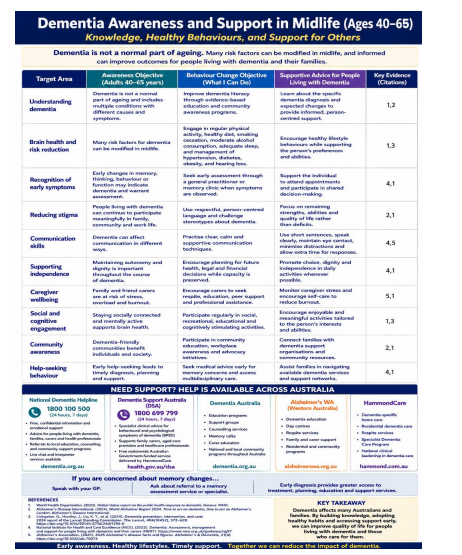
Education Resource: Dementia Awareness and Support in Midlife (Ages 40–65): Knowledge, Healthy Behaviours, and Support for Others. Reproduced from Carey (2026f).
Appendix 2. Programme of Scholarship: Conceptual Impact Summary
This Figure provides a conceptual overview of the wider programme of scholarship (Carey, 2026a-2026e) from which the realist-informed framework discussed in this review is drawn, summarising the underpinning research framework, the context–mechanism–outcome–impact chain, and the associated publication outcomes. The framing question “what works, for whom, in what circumstances, and why?” reflects the foundational formulation of realistic evaluation (Pawson & Tilley, 1997).
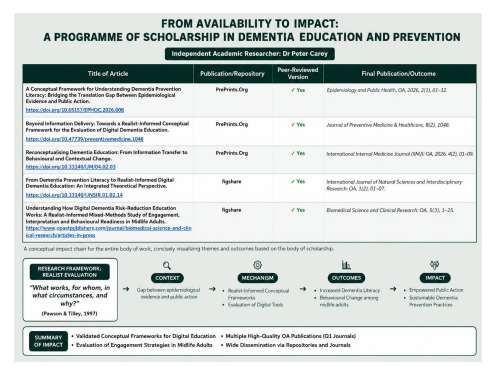
Figure: From Availability to Impact: A Programme of Scholarship in Dementia Education and Prevention. Conceptual impact chain summarising the realist evaluation framework, publication outcomes, and dissemination pathways underpinning Carey (2026a–2026f). The realist evaluation framing question is drawn from Pawson and Tilley (1997).