

Journal of Educational & Psychological Research(JEPR)
ISSN: 2690-0726 | DOI: 10.33140/JEPR
Impact Factor: 1.4

Research Article - (2026) Volume 8, Issue 2
Psychosocial Support and Learner Engagement as Correlates of Academic Achievement among Form Three Students in Gantsi Region, Botswana
 and Lucy Mawang
 Received Date: May 01, 2026 / Accepted Date: May 25, 2026 / Published Date: Jun 10, 2026
Copyright: ©2026 Keitumetse Basadi Dikgomo, et al. This is an open-access article distributed under the terms of the Creative Commons Attribution License, which permits unrestricted use, distribution, and reproduction in any medium, provided the original author and source are credited.
Citation: Dikgomo, K. B., Mutisya, E., Mawang, L. (2026). Psychosocial Support and Learner Engagement as Correlates of Academic Achievement among Form Three Students in Gantsi Region, Botswana. J Edu Psyc Res, 8(2), 01-12.
Abstract
University students represent a nutritionally vulnerable group due to increased independence in food Academic performance remains a central indicator of student success and a key determinant of future aspirations. However, persistent low achievement among Form Three students in the Gantsi Region of Botswana has raised concern, particularly during this critical transition phase from junior to senior secondary education. Despite ongoing efforts by the Botswana Ministry of Education to enhance educational quality, gaps in performance persist. Notably, limited research has examined the role of psychosocial support and learner engagement in this region. This study investigated the joint predictive influence of psychosocial support and learner engagement on academic achievement among Form Three students. Guided by Social Support Theory by Don Drennon-Gala and Cullen (1990), alongside the Transactional Model of Engagement, a correlational research design was employed. Data were collected from 288 students (155 girls, 133 boys) across three junior secondary schools using questionnaires and academic records. Descriptive statistics, independent samples t-tests, and multiple regression analysis were used for data analysis at α = 0.05. Findings revealed significant positive relationships between psychosocial support and academic achievement (r = .61, p < .001), and between learner engagement and academic achievement (r = .57, p < .001). Female students reported higher levels of psychosocial support and engagement than males, with statistically significant differences. Regression results showed that psychosocial support (β = 0.426) and learner engagement (β = 0.362) significantly predicted academic achievement, jointly explaining 45.1% of the variance (R2 = 0.451). The study concludes that strengthening psychosocial support systems and enhancing learner engagement are critical for improving academic outcomes. It recommends policy reforms focusing on school-based psychosocial programs, learner-centered pedagogies, gender-responsive strategies, and integration of social-emotional learning in teacher training.
Background: Academic achievement, measured through tests, coursework, and grades, shapes education systems, career prospects, and socio-economic development. Despite its importance, low performance persists globally, with international and regional assessments revealing significant disparities in learning outcomes. Countries have adopted interventions such as counselling, inclusive pedagogies, and curriculum reforms to address these gaps. In Africa, challenges including limited resources, weak engagement, and socio-economic constraints continue to hinder progress. Evidence highlights psychosocial support and learner engagement as critical determinants of performance, though research gaps remain. This study examines these factors, including gender differences, to better understand their influence on academic outcomes.
Materials and Methods: This study employed a correlational research design to examine relationships between psychosocial support, learner engagement, and academic achievement among Form Three students in Botswana’s Gantsi Region. A quantitative approach was used, with structured questionnaires and academic records providing data. The target population was 1,100 students, with a sample of 313 selected through stratified and simple random sampling. Validated tools (PROMIS-SR and CAADE) ensured reliable measurement. Data was analyzed using SPSS Version 29 through descriptive and inferential statistics, including Pearson correlation, t-tests, and multiple regression. Ethical approval and informed consent were obtained, ensuring confidentiality and voluntary participation throughout the study process.
Results: A total of 313 questionnaires were administered, with 288 valid responses (92.1% response rate), indicating strong representativeness. Gender distribution showed higher participation among girls (95.1%) than boys (88.7%). Assumption testing confirmed suitability for parametric analyses: data were normally distributed (Shapiro–Wilk p > .05), homogeneity of variance was met (Levene’s p > .05), residuals were independent (Durbin–Watson = 1.97), and no multicollinearity was detected (VIF = 3.508). Gender differences in psychosocial support and learner engagement were not statistically significant (p > .05). Engagement positively predicted academic achievement (r = .53, p < .001), with cognitive engagement comparatively lower than emotional and behavioural dimensions.
Keywords
Academic Achievement, Psychosocial Support, Learner Engagement, Secondary Education, Gender Differences, Educational Policy, Botswana
Introduction
Academic achievement refers to the extent to which learners attain established educational outcomes, typically measured through standardized tests, coursework, and overall grades. It plays a critical role in shaping education systems, informing career pathways, and enhancing employment opportunities, ultimately contributing to societal development through a skilled and knowledgeable workforce [1]. However, low academic performance remains a persistent global concern due to its implications for both individual success and broader socio-economic progress.
International assessments such as the Programme for International Student Assessment (PISA) have consistently revealed disparities in student achievement across countries, emphasizing the need for targeted interventions. For instance, Sweden has implemented inclusive educational strategies such as individualized learning plans, counselling services, and interactive pedagogies to address the fact that a significant proportion of students fail to meet minimum proficiency levels [2]. Similarly, Norway has adopted national guidelines promoting counselling, peer support, and extracurricular engagement to improve academic outcomes and social integration, particularly among low-achieving students [3].
In Kenya, concerns about declining academic performance are increasing, with students facing challenges such as attention difficulties and mental health issues [4]. In response, the government has integrated life skills and mental health education into school curricula and established guidance and counselling units, as well as mentorship programs, to support learners [5,6]. These interventions aim to enhance retention and improve examination performance by addressing students’ psychosocial needs. Across Southern Africa, regional assessments indicate persistent gaps in foundational skills, particularly in mathematics and literacy. In South Africa, Trends in International Mathematics and Science Study (TIMSS) results reveal that many students struggle with basic mathematical concepts, prompting curriculum reforms, teacher training, and targeted support initiatives [7]. Botswana faces similar challenges, where academic progression is closely tied to Junior Certificate Examination performance. Despite government efforts to improve outcomes through teacher deployment and exam preparation, overall performance remains low, with only 37% of candidates achieving grade C or higher in 2023 [8,9].
The Gantsi Region of Botswana demonstrates particularly poor academic outcomes compared to other regions, largely due to socio¬economic disadvantages, inadequate educational resources, and ineffective teaching methods [10]. While previous interventions have focused on improving infrastructure and teacher capacity, limited attention has been given to learners’ psychosocial well¬being and motivation. This gap underscores the need to examine psychosocial support and learner engagement as key determinants of academic performance among Form Three students in the region.
Psychosocial support encompasses the emotional and social assistance learners receive from their environment, enabling them to cope with stress and enhance well-being. It includes social support such as care and understanding from parents, teachers, and peers and emotional support, which involves empathy and validation of learners’ experiences [11]. These components are essential in building resilience and fostering academic success [8]. Despite its importance, existing research often suffers from methodological limitations, including small sample sizes and lack of longitudinal data, limiting understanding of how different forms of psychosocial support influence academic outcomes.
Empirical evidence highlights the positive impact of psychosocial support on student learning. Studies show that interventions such as mindfulness training, mentoring, and social-emotional learning programs significantly improve engagement and reduce dropout rates [12,13]. In the United States, access to counselling services and peer support has been associated with increased resilience, reduced anxiety, and improved academic performance [14]. In Africa, similar findings emerge, with research in Nigeria and Kenya indicating that structured counselling, mentorship, and parental involvement enhance emotional stability, reduce absenteeism, and improve academic outcomes [4,15].
This study builds on existing literature by examining three dimensions of psychosocial support: emotional, informational, and instrumental. Emotional support enhances motivation, self-esteem, and psychological well-being, while informational support provides guidance and feedback essential for academic decision-making [16]. Instrumental support involves tangible resources such as learning materials and financial assistance, directly influencing students’ ability to engage in learning activities. These dimensions are particularly relevant in under-resourced contexts like Gantsi, where socio-economic challenges significantly impact educational outcomes [17,18].
In addition to psychosocial support, learner engagement is identified as a critical predictor of academic achievement. Engagement is conceptualized as comprising behavioral, cognitive, and affective dimensions, all of which influence learning outcome [19]. High levels of engagement are associated with deeper learning, improved problem-solving skills, and sustained academic success [17]. Effective engagement requires interactive and inclusive teaching approaches, including student-centered pedagogy, digital learning tools, and personalized instruction [20].
Global studies demonstrate that learner engagement significantly enhances academic performance. For example, inquiry-based learning in Japan has been shown to improve critical thinking and motivation, while the use of interactive technologies in Australia has increased student participation and academic outcomes [21,22]. However, in many African contexts, traditional teacher-centered approaches limit student participation and engagement [23]. Research in Ghana and Botswana indicates that co-curricular activities, instructional interaction, and questioning techniques positively influence engagement, yet systemic constraints such as overcrowded curricula and limited resources hinder effective implementation [23-25].
In Botswana, challenges such as limited parental involvement, weak school leadership, and examination-oriented teaching further constrain learner engagement [26,27]. Evidence suggests that cognitive engagement, in particular, is a strong predictor of academic success, highlighting the need for strategies that promote active intellectual participation [28].
Gender is also considered an important intervening variable in this study. Research indicates that male and female students respond differently to psychosocial support and learning environments. Female students tend to benefit more from emotional support, while male students may require additional behavioral support and are less likely to seek help for emotional challenges [29-31]. Socio-economic hardships further exacerbate gender disparities in academic participation and achievement, necessitating targeted interventions [32].
Study Problem
Between 2020 and 2024, Form Three students in Gantsi Region, Botswana, have persistently recorded low academic achievement, with rates of 21.74% (2020), 20.76% (2021), 27.98% (2022), 25.56% (2023), and 26.20% (2024), according to Ministry of Education data. Despite interventions such as provision of instructional materials, teacher support, and additional resources, performance has not significantly improved, suggesting a mismatch between implemented strategies and learners’ contextual needs. This indicates underlying factors, including limited learner engagement and inadequate psychological support, remain insufficiently addressed. If unresolved, these challenges may lead to adverse outcomes, including student disengagement, delinquency, and diminished aspirations for higher education and careers among learners aged 15–16 years. At the family level, persistent poor performance may result in parental frustration, while at the community level, increased school dropout rates and stress-related behaviors could heighten risks of substance abuse and crime. This study therefore examines the role of learner engagement and psychosocial support in improving academic achievement.
Purpose
This study explored how psychosocial support and engagement levels correlate with the academic performance of Form 3 students in Gantsi. By evaluating these variables through a gender-sensitive lens, the research aims to provide a basis for targeted policy reforms. The ultimate goal was to bridge achievement gaps and establish more equitable learning environments within the regional school system.
The objectives of this study were to:
i. To find out the relationship between psychosocial support and academic achievement among Form 3 students in Gantsi Region, Botswana.
ii. To establish the relationship between learner engagement and academic achievement among Form 3 students in Gantsi Region, Botswana.
iii. To examine gender differences in psychosocial support and learner engagement among Form 3 students in Gantsi Region, Botswana.
iv. To determine the relative predictive weight of psychosocial support and learner engagement on academic achievement among Form three students in Gantsi Region, Botswana.
Theoretical Framework
This study was grounded on the Social Support Theory (Drennon-Gala & Cullen, 1990) and the Transactional Model of Engagement to examine the relationship between student welfare and academic involvement [33]. The integration of these theories provides a comprehensive lens for understanding how social and psychological factors interact to influence learners’ academic outcomes.
The Social Support Theory (Drennon-Gala & Cullen, 1990) emphasizes the role of social relationships in enhancing psychological well-being, resilience, and adaptive behavior. It posits that individuals who are embedded in strong social networks are better equipped to manage stress and are less likely to engage in maladaptive behaviors. Social support is conceptualized as the perception or experience of being cared for, valued, and part of a supportive network, which may include family, peers, teachers, and community members. It is categorized into emotional support (empathy, care, and trust), instrumental support (tangible assistance such as financial or material aid), and informational support (advice, guidance, and knowledge sharing) [34]. The theory further distinguishes perceived support, received support, and social integration, all of which influence individual well-being and functioning. In educational contexts, social support has been shown to enhance learner engagement, motivation, and academic performance by strengthening resilience, attendance, and self-efficacy, particularly in disadvantaged settings [16,18].
The Transactional Model of Engagement conceptualizes student engagement as a dynamic process shaped by interactions between learners, learning environments, and individual characteristics [33]. It identifies three dimensions of engagement: behavioral engagement (participation, attendance, and task completion), cognitive engagement (mental effort, critical thinking, and self-regulation), and emotional engagement (interest, belonging, and affective responses to learning). The model asserts that positive school experiences and supportive learning environments foster sustained engagement, which in turn enhances academic achievement. Empirical studies confirm that higher levels of behavioral participation and emotional involvement are strongly associated with improved academic outcomes [30, 35].
Conceptual Framework
The conceptual framework posits psychosocial support and learner engagement as predictors of academic achievement, with gender as an intervening variable. Both predictors are expected to enhance achievement, while gender may moderate their relationship differently for boys and girls across contexts.
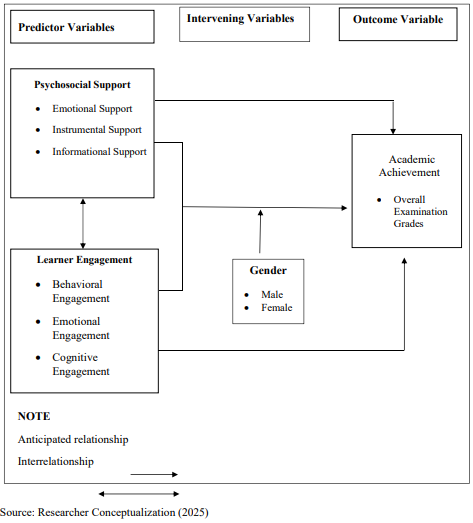
Figure 1: Conceptual Framework
Review of Related Literature
Research consistently demonstrates a strong association between psychosocial support and academic achievement, although the underlying mechanisms remain insufficiently explored. Zhang and Qian established that academic achievement is significantly correlated with social support among middle school students in China, with self-efficacy and learning engagement acting as key mediating factors [36]. Similarly, Lakins et al., in a study of 1,500 junior secondary students, found that school transition periods negatively affected self-confidence and peer integration, indicating weaknesses in emotional support systems [37]. Luan et al. further confirmed that emotional, informational, and instrumental support significantly influence learner engagement and academic outcomes among 800 students [16]. Despite theoretical alignment with Social Support Theory, most studies emphasize outcomes rather than mechanisms, and there is limited cross-cultural validation, methodological transparency, and analysis of gender differences and predictive strength of psychosocial variables.
African-based evidence also supports these findings. Ogunmakin et al. reported that Nigerian students with strong psychosocial well-being and social skills performed better academically [38]. Okongo et al. similarly found that family and community support positively influenced academic performance among Kenyan students [39]. However, both studies are limited by small samples and restricted contextual coverage. Mojeremane and Lesitaokana further identified that low parental involvement, weak school resources, and poor teaching strategies contribute to poor academic performance in Botswana, although their study lacked explanatory depth and broader generalizability [40]. Overall, there remains a gap in understanding the combined influence of psychosocial support and learner engagement, particularly in rural contexts such as Gantsi District, which this study addresses through a correlational design.
Global literature highlights learner engagement as a strong predictor of academic success. Dias found that behavioral, cognitive, and affective engagement significantly enhance academic performance among American secondary students [41]. Tao et al. similarly demonstrated that emotional engagement improves academic outcomes in interactive learning environments [42]. However, these studies remain geographically limited and often fail to examine interactions between engagement dimensions and psychosocial support systems.
In Africa, Anyichie observed that Nigerian students with strong social integration and engagement performed better academically [43]. Kiburi et al. in Kenya reported that collaborative learning and peer interaction positively influence academic performance [4]. Mogapi and Phiri in Botswana confirmed that affective, behavioural, and cognitive engagement are strongly linked to achievement, with classroom participation being a key predictor [44]. Nonetheless, most studies rely on correlational data and do not adequately integrate psychosocial and engagement frameworks, limiting explanatory power.
Globally, research suggests that psychosocial support benefits both genders, though access patterns differ. Matud et al. found similar benefits for boys and girls in the U.S., but boys were less likely to seek support due to social norms [45]. In Nigeria, Sidamo et al. reported that girls receive more emotional support, enhancing their academic performance, although methodological and contextual limitations restrict generalization [46]. Adebayo et al. and Kamau et al. further highlight the importance of support systems but overlook gendered analysis and rural applicability [6,47]. In Botswana, Motsamai and Phiri identified weak parental involvement and limited instructional quality but did not address gender disparities, creating a contextual gap [48].
Regarding engagement, reform et al. found that girls are more collaborative and internally motivated, while boys are more competitive but less emotionally expressive [49]. Yu et al. and Ratsie et al. similarly show gendered engagement patterns influenced by cultural expectations, particularly in Botswana, where masculine norms may reduce boys’ classroom participation [50,51].
Studies confirm that both psychosocial support and learner engagement jointly predict academic success. Hoyt et al. and Lee et al. found that supportive relationships and active participation enhance performance in the U.S. and China [52,53]. Sanni et al. further demonstrated that combined support systems and engagement improve academic outcomes in Nigeria [54]. However, most studies lack advanced statistical modelling to determine relative predictive strength. In Botswana, Jele et al. and Furrer et al. highlight the importance of support and engagement but do not adequately explore interaction effects in rural contexts [10,55]. Tomasik and Helbling and Schunk and DiBenedetto extend findings to university settings but limit generalizability to secondary learners [56,57].
Material and methods
This study adopted a correlational research design, selected for its suitability in examining relationships among variables without manipulation. As noted by Kothari, correlational designs are essential when the objective is to determine the strength and direction of associations between constructs [58]. In this study, psychosocial support and learner engagement were examined as antecedent variables influencing the academic achievement of Form Three students in Botswana’s Gantsi Region.
Structured questionnaires were used to collect quantitative data, ensuring consistency in measurement across all respondents. The design enabled systematic testing of hypotheses and statistical analysis of relationships among variables. However, while correlational designs can establish the existence and strength of relationships, they do not infer causation. This approach was appropriate for assessing how psychosocial support and learner engagement relate to academic achievement. Similar applications of correlational design have been reported by Ngunu (2019), Otanga (2016), and Wara et al. in secondary school studies in Kenya, confirming its effectiveness in educational research contexts [59]. The study involved independent, dependent, and moderating variables. Learner engagement and psychosocial support, measured on interval scales, were the independent variables. Academic achievement, determined using students’ mean examination scores, served as the dependent variable. Gender was introduced as a moderating variable to assess possible differences between male and female learners and was measured on a nominal scale.
A quantitative research methodology was applied to examine relationships among academic achievement, learner engagement, and psychosocial support. This approach was appropriate because it allows numerical data collection and statistical analysis to establish relationships among variables. Structured questionnaires were used to collect primary data, while academic performance data was obtained from first-term 2025 examination records maintained by class teachers.
The study was conducted in the Gantsi Region of Botswana, one of the country’s ten administrative regions. Despite its large geographical size (117,910 square kilometres), it has a low population density of 56,555 people (2022 census). The region is predominantly rural and faces educational challenges, including higher dropout rates and lower academic performance compared to urban regions [60].
National examination data indicate persistently low academic performance in Gantsi compared to other regions (Botswana Examinations Council). For instance, Junior Certificate pass rates ranged from 20.74% to 27.98% between 2020 and 2024 significantly lower than regions such as South East and North East. This poor performance, combined with limited research attention in the region, informed the selection of Gantsi as the study area [61].
The target population comprised 1,100 Form Three students from three secondary schools in Gantsi Region. One of the four schools was excluded due to its use in pilot testing. Form Three students were selected because they have sufficient exposure to secondary education to provide informed responses regarding psychosocial support and engagement, unlike Form 1 and Form 2 students who are still adapting to the school environment.
A multi-stage sampling approach was used. One school was randomly selected for pilot testing, while the remaining three were purposively included in the main study. Stratified sampling was applied to group students by gender, followed by simple random sampling within each stratum to ensure representation. The sample size was determined using Krejcie and Morgan (1970), which recommended 285 participants from a population of 1,100. To account for non-response, an additional 10% (28 respondents) was added, following Dillman et al. [62]. Therefore, the final sample consisted of 313 respondents.
Data was collected using structured questionnaires and academic records. The questionnaire included demographic items, psychosocial support scales, and academic engagement measures, while academic performance data was extracted from school records. The PROMIS Social Relationships Short Form (PROMIS-SR) by Cai et al. measured emotional, informational, and instrumental support across 12 items [63]. It demonstrated high reliability (α = 0.90–0.94), and in this study, Cronbach’s alpha exceeded 0.70, confirming reliability. The CAADE scale by Martínez and Pérez-Fuentes (2024) measured academic engagement across cognitive, emotional, and behavioural domains using 17 Likert-scale items. Scores ranged from 17 to 85, classified as low, moderate, or high engagement.
A pilot study involving 40 students was conducted to refine instruments. Content validity was assessed by educational psychology experts, while face validity was confirmed through peer review. Reliability was tested using Cronbach’s alpha (≥0.70 threshold). PROMIS-SR and CAADE showed strong reliability (α = 0.94 and α = 0.96 respectively in pilot testing), consistent with prior studies. Data was coded and analyzed using SPSS Version 29. Descriptive statistics (frequencies, means, and standard deviations) and inferential statistics were applied. Pearson correlation assessed relationships, t-tests examined gender differences, and multiple regression determined predictive effects of psychosocial support and engagement on academic achievement (α = 0.05). Approvals were obtained from Kenyatta University, Botswana Ministry of Education, and Gantsi regional authorities. Participants provided informed consent, were assured of confidentiality, and participation was voluntary with the right to withdraw at any time. Data was anonymized and used strictly for research purposes.
Result
Response Rate
A total of 313 questionnaires were administered to Form Three pupils across three junior secondary schools, with 288 valid responses returned, yielding a high response rate of 92.1%. Of these, 25 questionnaires (7.9%) were excluded due to incompleteness or damage. Gender distribution showed higher participation among girls (95.1%) compared to boys (88.7%). According to Don A. Dillman et al., response rates above 70% are acceptable and above 80% strong, while Stedman et al. (2019) affirm that rates above 80% support generalization [62]. Thus, the achieved response rate enhances representativeness and internal validity (John W. Creswell & J. David Creswell, 2018).
|
Category |
Administered |
Returned |
Percentage (%) |
|
Boys |
150 |
133 |
88.7% |
|
Girls |
163 |
155 |
95.1% |
|
Total |
313 |
288 |
92.01% |
|
Source: Field Data |
|||
Table 1: Overall Response Rate and Gender Distribution
Assumptions Testing for Parametric Analyses
Prior to conducting Pearson correlation, independent-samples t-tests, and multiple regression analyses, key statistical assumptions were evaluated to ensure the validity and robustness of the findings. The assumptions tested included normality, homogeneity of variance, independence of errors, and multi collinearity.
Normality of data distribution was assessed using the Shapiro–Wilk test, which is appropriate for sample sizes below 2000. Results indicated that Academic Achievement (W = .986, p = .064), Psychosocial Support (W = .982, p = .071), and Learner Engagement (W = .988, p = .089) were normally distributed, as all p-values exceeded the .05 threshold. Visual inspections through histograms and Q–Q plots further confirmed approximate symmetry with no significant skewness or kurtosis. Additionally, the relatively large sample size (N = 288) satisfied the Central Limit Theorem, reinforcing the suitability of parametric tests.
Homogeneity of variance was examined using Levene’s Test in the context of independent-samples t-tests for gender differences. The results were non-significant for Psychosocial Support, F (1, 286) = 1.82, p = .178, and Learner Engagement, F (1, 286) = 2.11, p = .147, confirming that equal variances could be assumed. Independence of errors was tested using the Durbin–Watson statistic in the regression model. The obtained value of 1.97 fell within the acceptable range (1.5–2.5), indicating no autocorrelation and confirming that residuals were independent.
Multi collinearity diagnostics were conducted using Variance Inflation Factor (VIF) and tolerance values. Both predictor variables (Psychosocial Support and Learner Engagement) had VIF values of 3.508 and tolerance values of .285, which fall within acceptable limits (VIF < 5, tolerance > 0.1). This indicates absence of multicollinearity and confirms that each predictor contributes uniquely to the model.
|
Assumption |
Test Used |
Key Results |
Decision |
|
Normality |
Shapiro–Wilk Test |
p > .05 for all variables (W ≈ .982–.988) |
Normality satisfied |
|
Homogeneity of Variance |
Levene’s Test |
p = .178, .147 (non-significant) |
Equal variances assumed |
|
Independence of Errors |
Durbin–Watson |
DW = 1.97 (within 1.5–2.5 range) |
Independence confirmed |
|
Multi collinearity |
VIF & Tolerance |
VIF = 3.508 (<5), Tolerance = .285 (>0.1) |
No multi collinearity detected |
Table 2: Summary of Assumptions Testing Results
This section examined gender differences in psychosocial support and learner engagement among Form 3 students in the Gantsi Region, Botswana, using descriptive statistics and independent-samples t-tests. Descriptive findings indicated marginal differences between male and female students. Boys reported slightly higher psychosocial support (M = 3.57, SD = 1.06) compared to girls (M = 3.45, SD = 1.10). Similarly, learner engagement was marginally higher among boys (M = 3.38, SD = 0.65) than girls (M = 3.32, SD = 0.69). However, these differences were minimal, suggesting broad similarity across gender.
Inferential analysis using independent-samples t-tests confirmed that these differences were not statistically significant. For psychosocial support, the results showed t(286) = 0.84, p = .401, while learner engagement yielded t(286) = 0.62, p = .536. Since both p-values exceeded the significance threshold of α = .05, the null hypothesis (H03) was not rejected. This indicates that gender does not significantly influence psychosocial support or learner engagement among the sampled students.
The findings suggest that both male and female learners experience comparable levels of psychosocial support and demonstrate similar engagement in learning activities. This implies that school-based support systems and engagement strategies are implemented equitably across genders. The results align with Matud et al., who reported no significant gender differences in social support within educational contexts, and partially agree with Sidamo et al., although the latter found higher perceived support among girls in Nigeria [45,46]. In contrast, the current findings indicate balanced support across genders, possibly reflecting contextual and cultural differences (Mothibe, 2024).
|
Variable |
Gender |
N |
Mean |
Std. Deviation |
Std. Error Mean |
|
Psychosocial Support |
Boys |
133 |
3.57 |
1.06 |
0.092 |
|
|
Girls |
155 |
3.45 |
1.10 |
0.088 |
|
Learner Engagement |
Boys |
133 |
3.38 |
0.65 |
0.056 |
|
|
Girls |
155 |
3.32 |
0.69 |
0.055 |
|
Source: Field Data (2025) |
|||||
Table 3: Gender Differences in Psychosocial Support and Learner Engagement
A one-way repeated measures ANOVA examined differences in behavioral, emotional, and cognitive engagement among 288 students. Descriptive results (Table 3) show emotional engagement (M = 3.53, SD = 0.62) was highest, closely followed by behavioral engagement (M = 3.52, SD = 0.60), while cognitive engagement was lower (M = 3.15, SD = 0.71). The ANOVA indicated a statistically significant difference across dimensions, F(2, 574) = 28.47, p < .001 (Table 4). Bonferroni post hoc comparisons (Table 5) revealed no significant difference between behavioral and emotional engagement (p = .536), but both were significantly higher than cognitive engagement (p < .001). These findings suggest students exhibit strong participation and emotional connection to learning, yet comparatively weaker cognitive involvement, particularly in higher-order processes such as self-regulation and strategic thinking. This pattern aligns with the multidimensional perspective of engagement, where components are distinct yet interrelated.
Further, Pearson correlation analysis (Table 6) showed a significant positive relationship between learner engagement and academic achievement, r(286) = .53, p < .001. The null hypothesis was rejected, indicating engagement is a meaningful predictor of academic performance. Students with higher engagement levels tend to achieve better academic outcomes, supporting theories emphasizing active, emotionally invested, and cognitively driven learning (Source: Field Data, 2025).
|
Engagement Dimension |
Mean (M) |
Standard Deviation (SD) |
|
Behavioural Engagement |
3.52 |
0.60 |
|
Emotional Engagement |
3.53 |
0.62 |
|
Cognitive Engagement |
3.15 |
0.71 |
|
Source: Field Data (2025) |
||
Table 3a: Descriptive Statistics for Learner Engagement Dimensions (N = 288)
|
Source |
F |
df (Within) |
df (Error) |
Sig. |
|
Engagement Dimension |
28.5 |
2 |
574 |
< .001 |
|
Source: Field Data (2025) |
||||
Table 4: Repeated Measures ANOVA for Learner Engagement Dimensions
|
Comparison |
t |
p-value |
Significant |
|
Behavioural vs Emotional |
0.62 |
0.536 |
No |
|
Behavioural vs Cognitive |
6.11 |
< .001 |
Yes |
|
Emotional vs Cognitive |
6.48 |
< .001 |
Yes |
|
Source: Field Data (2025) |
|||
Table 5: Bonferroni Pairwise Comparisons of Learner Engagement Dimensions
|
Variable |
Statistic |
Academic Achievement |
|
Learner Engagement |
Pearson Correlation |
0.530 |
|
|
Sig. (2-tailed) |
0.001 |
|
|
N |
288 |
|
Source: Field Data (2025) |
||
Table 6: Relationship between Learner Engagement and Academic Achievement
Discussion
The study established a significant positive relationship between psychosocial support and academic achievement. Students who reported higher levels of emotional and social support from teachers, parents, and peers demonstrated improved academic outcomes. This suggests that emotional safety, recognition, and supportive relationships enhance motivation, concentration, and self-confidence, thereby improving performance. The findings align with prior studies indicating that supportive environments foster student motivation and engagement.
Additionally, a strong positive association was found between learner engagement and academic achievement. Students who actively participated in academic activities, attended classes consistently, and showed commitment to learning achieved higher scores, highlighting the importance of active involvement in promoting persistence and success.
Gender differences emerged, with female students reporting higher levels of psychosocial support, engagement, and achievement. Regression analysis further revealed that psychosocial support and learner engagement jointly explained 45.1% of academic achievement, with psychosocial support being the stronger predictor.
Conclusion
The study examined factors influencing academic performance among Form Three pupils in Gantsi Region, Botswana, and reached four key conclusions aligned with its objectives. First, psychosocial support significantly enhances academic achievement. Learners who reported strong emotional and social support from teachers, parents, and peers demonstrated higher performance, indicating that a supportive environment fosters motivation, confidence, and academic success. Second, student engagement was found to have a strong positive relationship with achievement. Pupils who actively participated in learning activities, completed assignments, and showed interest in their studies achieved better outcomes, highlighting engagement as a critical driver of learning success. Third, notable gender differences emerged, with female students outperforming males in psychosocial support, engagement, and academic achievement, suggesting that gender influences access to and utilization of support systems. Finally, psychosocial support and student engagement jointly predicted academic performance, accounting for 45.1% of performance variation, with psychosocial support exerting a slightly stronger influence, underscoring its importance in enhancing overall student achievement [64-79].
Recommendations
The study recommends integrated policy and research actions to enhance students’ academic achievement through psychosocial support and engagement. At the policy level, the Ministry of Education and school leaders should institutionalize comprehensive psychosocial support programs addressing students’ emotional, social, and psychological needs, including mentorship and teacher training in emotional sensitivity. Educators are encouraged to adopt learner-centered pedagogies such as collaborative and project-based learning to strengthen engagement and intrinsic motivation. Policies should also promote gender-responsive interventions, particularly supporting male students through mentorship and emotional literacy initiatives. Strengthening parent–teacher partnerships is essential to align home and school support systems. Additionally, education authorities should embed psychosocial well-being and student engagement indicators within school evaluation frameworks to promote holistic education.
For future research, scholars should examine broader determinants of academic performance, including school climate, teacher effectiveness, and peer dynamics. Comparative studies across regions and countries are recommended to test contextual consistency. Longitudinal designs are needed to capture long¬term effects, while qualitative approaches can provide deeper stakeholder perspectives. Further inquiry into digital learning and social-emotional learning integration is also encouraged.
References
- Basabe, G. B., & Galigao, R. P. (2024). Enhancing career opportunities through equal access to quality education. PANTAO (INTERNATIONAL JOURNAL OF THE HUMANITIES AND SOCIAL SCIENCES)
 ¸:Hollyfield Publishing Services.
 - Thomas, C. L., & Allen, K. (2021). Driving engagement: investigating the influence of emotional intelligence and academic buoyancy on student engagement. Journal of Further and Higher Education, 45(1), 107-119.
- Hansen, K. G., & Barene, S. (2025). Exploring the associations between school climate and mental wellbeing: Insights from the MOVE12 pilot study in Norwegian secondary schools. European journal of investigation in health, psychology and education, 15(4), 46.
- Kiburi, J. M. (2024). Influence of career guidance practices on career adaptability of public secondary school students in Kiambu County, Kenya.
- Ndetei, D. M., Mutiso, V. N., Musyimi, C. W., Alietsi, R. K., Shanley, J. R., & Bhui, K. S. (2022). The feasibility of using life skills training in primary schools to improve mental health and academic performance: a pilot study in Kenya. BMC psychiatry, 22(1), 131.
- Kamau, J., & Coauthor Initials. (2022). Family and community support systems and academic achievement: A cross-sectional study of Kenyan secondary students.
- NIC SPAULL, P. C., & QVIST, J. (2022). Mathematical stunting in South Africa: An analysis of Grade 5 mathematics outcomes in TIMSS 2015 and 2019. Early grade mathematics in South Africa, 15.
- Alshammari, M. K., Othman, M. H., Mydin, Y. O., & Mohammed, B. A. (2023). Examining the role of social support in promoting psychological Well-Being and reducing stress among international students. Egyptian Academic Journal of Biological Sciences. C, Physiology and Molecular Biology, 15(1), 245-250.
- Shonhe, L., & Kolobe, M. (2023). A glimpse into Botswana’s AI readiness landscape. JeDEM-eJournal of eDemocracy and Open Government, 15(2), 37-67.
- Jele, L. C. (2023). Factors influencing academic performance of pupils in the primary school leaving examination results for agriculture in Botswana (Doctoral dissertation, Botswana University of Agriculture & Natural Resources).
- Asgeirsdottir, B. B., & Sigfusdottir, I. D. (2021). Positive youth development and resilience among youth in Iceland: The importance of social context and self-esteem for life satisfaction. In Handbook of positive youth development: Advancing research, policy, and practice in global contexts (pp. 203-218). Cham: Springer International Publishing.
- Carter, P. J. (2022). Effecting Well-being Improvements in Educational Settings with Positive Psychology Interventions. Bangor University (United Kingdom).
- Tindle, R., Abo Hamza, E. G., Helal, A. A., Ayoub, A. E. A., & Moustafa, A. A. (2022). A scoping review of the psychosocial correlates of academic performance. Review of Education, 10(3), e3371.
- Simbolon, R., & Purba, W. (2022). Evaluating the impact of school counseling programs on student well-being and academic performance in the educational environment. Jurnal Ilmu Pendidikan Dan Humaniora, 11(2), 118-137.
- Eleje, G. U., Ikwuka, D. C., Nwosu, K. C., Eleje, L. I.,Ikwuka, O. I., Sani, N., ... & Nwobodo, E. O. (2025). Effects of intra-class peer mentorship intervention programme on the academic performances of academically underperforming medical students in Nigeria. BMC Medical Education, 25(1), 135.
- Nariman, S., Alzhanov, A., & Doguchaeva, S. (2023). Teaching the CLIL technology to rising IT teachers. Interactive Learning Environments, 31(9), 5601-5613.
- Sadoughi, M., & Hejazi, S. Y. (2021). Teacher support and academic engagement among EFL learners: The role of positive academic emotions. Studies in Educational Evaluation, 70, 101060.
- Disele-Pitso, L. (2023). Towards a Decolonial Feminist Performance Praxis: An Exploration of Performance and Women's Leadership in Botswana.
- Beatson, R., Quach, J., Canterford, L., Farrow, P., Bagnall, C., Hockey, P., ... & Mundy, L. K. (2023). Improving primary to secondary school transitions: A systematic review of school-based interventions to prepare and support student social-emotional and educational outcomes. Educational Research Review, 40, 100553.
- Estévez, I., Rodríguez-Llorente, C., Piñeiro, I., González-Suárez, R., & Valle, A. (2021). School engagement, academic achievement, and self-regulated learning. Sustainability, 13(6), 3011.
- Nakamura, Y., & Jones, T. (2022). Enhancing behavioral engagement through digital learning platforms: Implications for academic success. Journal of Educational Technology Research, 34(4), 178-194.
- Daniel, K., Msambwa, M. M., Antony, F., & Wan, X. (2024). Motivate students for better academic achievement: A systematic review of blended innovative teaching and its impact on learning. Computer Applications in Engineering Education, 32(4), e22733.
- Mutuna, M., & Iloanya, J. (2025, December). Evaluating the Implementation Realities of Learner-Centred Methodology in Botswana Secondary Schools. In Botho University International Research Conference (BUIRC 2025) (pp. 471-482). Atlantis Press.
- Mensah, F., & Boateng, J. (2022). Teacher support and academic achievement: The mediating role of student motivation. International Journal of Pedagogical Studies, 19 (1), 102-118.
- Sichinga, K. T., Mfuni, J. H. C., Nenty, H. J., & Chakalisa,P. (2016). Teacher questioning behaviour and student participation in mathematics classes in senior secondary schools in Botswana. International Education and Research Journal, 2(10).
- Ramothonyana, O., Tsayang, G. T., & Bulawa, P. (2024). Learner performance in Botswana and beyond: A critical reflection. Mosenodi Journal, 27(1).
- Dube, V. R., & Jotia, A. L. (2017). Democratic Engagements in the Social Studies Classroom: Perceptions from four junior secondary schools in Kgatleng region of Botswana. Mosenodi, 20(2), 49-64.
- Moji, R., Mutua, J., & Kigen, E. Cognitive Engagement as Correlate of Academic Achievement among Form Four Students in the South East Region, Botswana.
- Ahmed, R., Coauthor, A., & Coauthor, B. (2021). Assessing the reliability of educational measurement instruments. Journal of Educational Research, 114(3), 245-258.
- A. Fredricks, J. (2022). Measuring Student engagement with observational techniques. In Handbook of research on student engagement (pp. 617-627). Cham: Springer International Publishing.
- Morales-Rodríguez, F. M., Espigares-López, I., Brown, T., & Pérez-Mármol, J. M. (2020). The relationship between psychological well-being and psychosocial factors in university students. International journal of environmental research and public health, 17(13), 4778.
- Republic of Botswana. (2020). National report on education and gender inequalities. Government Printer.
- Fredricks, J. A., Blumenfeld, P. C., & Paris, A. H. (2004). School engagement: Potential of the concept, state of the evidence. Review of educational research, 74(1), 59-109.
- Zikic, J., & Klehe, U. C. (2021). Going against the grain: The role of skilled migrants' selfâ?ÂÃÂ?ÂÂregulation in finding quality employment. Journal of Organizational Behavior, 42(8), 1023-1041.
- Wijns, N., Purpura, D., & Torbeyns, J. (2023). Stimulating preschoolers’ repeating patterning ability by means of dialogic picture book reading. Journal of Educational Psychology, 115(5), 732.
- Zhang, X., & Qian, W. (2024). The effect of social support on academic performance among adolescents: The chain mediating roles of self-efficacy and learning engagement. PloS one, 19(12), e0311597.
- Lakins, M. (2022). How Certified K-8 Teachers Describe Their Experience with Student Death (s): A Qualitative Analysis. Capella University.
- Ogunmakin, A. O., & Akomolafe, M. J. (2021). The impact of psychosocial adjustment on student motivation and academic performance in Nigerian schools. West African Journal of Educational Research, 25(3), 210-228.
- Okongo, C. O. (2021). Influence of psychological issues on students academic performance in public secondary schools in Migori county, Kenya (Doctoral dissertation).
- Mojeremane, S., & Lesitaokana, M. (2022). Parental involvement and access to educational resources in Botswana: Implications for student achievement. Southern African Journal of Educational Studies, 28(3), 122-140.
- Dias, P. (2024). The impact of student engagement on academic achievement: A global perspective. International Journal of Learning and Development, 52(1), 78-95.
- Tao, Y., Meng, Y., Gao, Z., & Yang, X. (2022). Perceived teacher support, student engagement, and academic achievement: A meta-analysis. Educational Psychology, 42(4), 401-420.
- Anyichie, A. (2024). Relationship between psychosocial adjustment and academic achievement of students at secondary level. African Journal of Psychology and Education, 17(2), 89-104.
- Mogapi, T., & Phiri, K. (2023). The role of emotional and cognitive engagement in enhancing student performance. African Journal of Learning and Development, 29(2), 78-95.
- Matud, M. P., Ibáñez, I., Fortes, D., & Bethencourt, J. M. (2024). Adolescent stress, psychological distress and wellbeing: A gender analysis. Child & Youth Services, 45(3), 300-323.
- Sidamo, N. B., Kerbo, A. A., Wado, Y. D., Koyira, M. M., & Gidebo, K. D. (2024). Factors associated with perceived social support among adolescents in Gamo Zone, Southern Ethiopia: a community-based cross-sectional study. Frontiers in Psychiatry, 15, 1429886.
- Adebayo, P. T., & Coauthor Initials. (2021). Parental, peer, and teacher support as predictors of academic achievement among junior secondary students in Lagos State, Nigeria [Unpublished manuscript].
- Motsamai, L., & Phiri, T. (2022). Psychosocial support, parental involvement, and learner outcomes in Botswana Junior Secondary Schools [Unpublished manuscript].
- Nakkula, M., & Toshalis, E. (2025). Student engagement, motivation, and assessment: A critical triad requiring critical reform. In Culturally Responsive Assessment in Classrooms and Large-Scale Contexts (pp. 34-51). Routledge.
- Yu, J., McLellan, R., & Winter, L. (2021). Which boys and which girls are falling behind? Linking adolescents’gender role profiles to motivation, engagement, and achievement. Journal of youth and adolescence, 50(2), 336-352.
- Ratsie, S. (2021). Perceptions of initiation instructors and parents on the role of initiation (bogwera le bojale) in character building of adolescents: a case of Mochudi village, Kgatleng district in Botswana (Doctoral dissertation, The University of Zambia).
- Hoyt, J. E. (2023). Student connections: The critical role of student affairs and academic support services in retention efforts. Journal of College Student Retention: Research,Theory & Practice, 25(3), 480-491.
- Lee, W. W. S., & Yang, M. (2023). Effective collaborative learning from Chinese students’ perspective: a qualitative study in a teacher-training course. Teaching in Higher Education, 28(2), 221-237.
- Sanni, A. B. (2024). Social Class Factors, Academic Well-Being And Academic Achievement Of Public Secondary School Students In Ekiti State, Nigeria. University of Ibadan.
- Jeno, L. M., Nylehn, J., Hole, T. N., Raaheim, A., Velle, G., & Vandvik, V. (2023). Motivational determinants of students’ academic functioning: The role of autonomy-support, autonomous motivation, and perceived competence. Scandinavian Journal of Educational Research, 67(2), 194-211.
- Tomasik, M. J., & Helbling, L. A. (2023). Psychosocial factors and academic success: A longitudinal analysis of student support systems. Journal of Educational Psychology, 115(2), 341-358.
- Schunk, D. H., & DiBenedetto, M. K. (2021). Self-efficacy and human motivation. In Advances in motivation science (Vol. 8, pp. 153-179). Elsevier.
- Kothari, C. R. (2004). Research methodology: Methods and techniques. New Age International.
- Wara, E., Aloka, P. J., & Odongo, B. C. (2018). Relationship between cognitive engagement and academic achievement among Kenyan secondary school students. Social Sciences, 9(2).
- Mashabile, E. (2023). A capability-informed policy analysis of higher education access for rural youth in Botswana (Doctoral dissertation, University of Pretoria (South Africa)).
- Bulala, T. (2023). Analysing the psychometric properties of the Botswana Junior Certificate Examination Agriculture multiple-choice items using item response theory (Doctoral dissertation, University of Cape Coast).
- Dillman, D. A., Smyth, J. D., & Christian, L. M. (2014). Internet, phone, mail, and mixed-mode surveys: The tailored design method. Indianapolis, Indiana, 17.
- Xu, H., Yuan, Y., Gong, W., Zhang, J., Liu, X., Zhu, P., ... & Jiao, J. (2022). Reliability and validity of the Chinese version of Oldenburg Burnout Inventory for Chinese nurses. Nursing open, 9(1), 320-328.
- Moore, K. A., & Lippman, L. H. (Eds.). (2005). What do children need to flourish?: Conceptualizing and measuring indicators of positive development (Vol. 3). Springer Science & Business Media.
- Liu, S., Liu, S., Liu, Z., Peng, X., & Yang, Z. (2022).Automated detection of emotional and cognitive engagement in MOOC discussions to predict learning achievement. Computers & Education, 181, 104461.
- Martínez, B. M. T., & del Carmen Pérez-Fuentes, M. (2024). Design and validation of the general scale of academic engagement for Spanish adolescents (CAADE). Heliyon, 10(1).
- Mekki, O. M., Ismail, A. M., & Hamdan, D. M. (2022). Student engagement in English language classes: An evaluative study. Sohag University International Journal of Educational Research, 6(6), 15-52.
- Moalosi, W. T. S. (2012). Teacher efficacy: Is student engagement essential in Botswana junior secondary schools. International Journal of Scientific Research in Education, 5(3), 207-213.
- Moya, M. N., Tomasik, M. J., & Schunk, D. H. (2022). Psychosocial support and student engagement: A longitudinal study of adolescent learners. Journal of Youth and Adolescence, 51(4), 712-729.
- Ntoiti, A. K., Kigen, E. M., & Kinai, T. K. Psychosocial Support as Determinant of Academic Achievement among University Students in Kenya.
- ODOFIN, T., & AGAMUGORO, P. A. (2023). Social support, coping strategies and academic adjustment among junior secondary school boarders in Ughelli North Local Government Area, Delta State, Nigeria. KWASU International Journal of Education (KIJE), 6(1), 47-52.
- Procidano, M. E., & Heller, K. (1983). Measures of perceived social support from friends and from family: Three validation studies. American journal of community psychology, 11(1), 1-24.
- Chuderski, A. (2016). Fluid intelligence and the cross-frequency coupling of neuronal oscillations. The Spanish Journal of Psychology, 19, E91.
- Sharif, M., Zaidi, A., Waqas, A., Malik, A., Hagaman, A., Maselko, J., ... & Rahman, A. (2021). Psychometric validation of the multidimensional scale of perceived social support during pregnancy in rural Pakistan. Frontiers in Psychology, 12, 601563.
- Suaib, S. (2024). Dynamics of social interaction, social support, and psychological well-being in urban communities: Social support theory perspective. International Journal of Religion, 5(11), 4786-4803.
- Taber, K. S. (2018). The use of Cronbach’s alpha when developing and reporting research instruments in science education. Research in science education, 48(6), 1273-1296.
- Ahmed, W., Minnaert, A., van der Werf, G., & Kuyper, H. (2010). Perceived social support and early adolescents’ achievement: The mediational roles of motivational beliefs and emotions. Journal of youth and adolescence, 39(1), 36-46.
- Yusuf, H., & Chang, Z. (2023). Problem based learning and cognitive engagement: A review of empirical studies. Journal of Advanced Educational Strategies, 33(4), 267-284.
- Yusuf, T. (2023). Teacher-student interaction and learner engagement in secondary schools in Nigeria. Journal of Advanced Educational Strategies, 37(2), 109-124.