

Advances in Theoretical & Computational Physics(ATCP)
ISSN: 2639-0108 | DOI: 10.33140/ATCP
Impact Factor: 2.6

Research Article - (2025) Volume 8, Issue 4
Principle of Energy Equilibrium Shift and Relative-Absolute Spacetime View
Received Date: Aug 04, 2025 / Accepted Date: Sep 02, 2025 / Published Date: Oct 15, 2025
Copyright: ©2025 Runsheng Tu. This is an open-access article distributed under the terms of the Creative Commons Attribution License, which permits unrestricted use, distribution, and reproduction in any medium, provided the original author and source are credited.
Citation: Tu, R. (2025). Principle of Energy Equilibrium Shift and Relative-Absolute Spacetime View. Adv Theo Comp Phy, 8(4), 01-14.
Abstract
If the law of conservation of energy can be broken under certain conditions, this condition and the reason why it works is the principle of energy conservation state change. Its value lies in its ability to serve as a criterion for theoretical correctness. One of its contents is that as long as the relativistic effect coefficients of the two forms of energy are different, changing the relative motion state of the observer can disrupt the energy balance between these two forms, thereby deviating from the energy conservation state. Based on examples and quantitative methods, it is proven that this principle is valid, and the principle of narrow relativity cannot withstand the test of this criterion. According to the meaning of "time and space change due to absolute motion", a relative-absolute spacetime view can be established. The case study has shown that "compared to the relative spatiotemporal view, the relative-absolute spatiotemporal view has the advantage of fewer contradictions and stronger practicality"; the relative spatiotemporal view is an approximation of the relative-absolute spatiotemporal view. As long as the experimental data of V. et al. is reliable, according to the new spatiotemporal view, it can be predicted that the absolute velocity of the Earth is 0.0005c.
Keywords
Principle of Special Relativity, Principle of Conservation of Energy, Principle of Change in State of Conservation of Energy, Relative-Absolute Spacetime View, Superior Data, Inherent Energy, Absolute Velocity of The Earth
Preliminary Knowledge
In order to make the statement more concise and easy for readers to understand, we have used several new nouns or expressions, or the content of "what used to remain in people's minds has now been expressed". It is necessary to introduce some preliminary knowledge first.
Free Photon
Free photon: A photon that moves freely in a vacuum after being detached from a light source. It is an independent individual. It is similar to "electrons that move freely in a vacuum after being detached from the electron gun".
Natural Frequency of Free Photons
Natural frequency of free photons: The frequency of photons emitted by a stationary light source. The frequency obtained by subtracting the Doppler shift from the frequency of free photons after the relative motion velocity between the light source and the observer is known. If a light source for a free photon cannot be found (without information on the light source), the "corresponding light source for the free photon" can be determined by comparing it with the spectral data system of the stationary light source, and the inherent emission frequency of the free photon can be determined. Within the framework of special relativity, the energy of free photons received by observers is the total energy of free photons.
The Absolute Axiom of "Existence of Events that Have Occurred"
The existence of events that have occurred is objective or absolute, and can be recognized or even observed by observers of all motion states. For example, once a photon decay event occurs in a system, observations in other inertial frames must acknowledge that the event did indeed occur. Otherwise, it must be assumed that the newly generated positive and negative electron pairs in the event can be eliminated by changing the observer's motion state. This is an axiom in nature.
Principle of Variation of the Conservation of Energy (Principle of Energy Balance Shift, Abbreviated as Energy Balance Principle)
The output energy is equal to the input energy; the energy lost by a thing is equal to the energy generated by a new thing; in the energy transfer chain, the energy of the previous section is equal to the en- ergy of the following section; the energy before the form conver- sion is equal to the energy after the form conversion. In a certain sense, energy conservation means that energy reaches equilibrium, and a variation in energy conservation state means that energy balance moves. Once the energy balance within some systems is disrupted, the energy within the system becomes none conserved. Alternatively, once the original energy balance is disrupted and moved and a new energy balance is not reached, energy conservation is disrupted. Therefore, the principle of energy balance move- ment is also known as the principle of energy conservation state variation. The reason why this law can be a meaningful principle is because its connotation is the law of "in the absence of energy exchange between the system and the environment, simply (only) changing things unrelated to the isolated system (such as theories or concepts or the motion state of observers, etc.) will destroy the principle of energy conservation". It is not an "inverse condition" that guarantees the conservation of energy, but an independent law. It can become an important basis for judging the correctness of theory. Principles are objective laws. One of the laws of energy balance shifting is that when the energy relativistic effect coefficients of form A and form B are different, changing the observer's motion state can result in unequal amounts of energy changes in these two forms, and the energy balance or energy conservation state will inevitably be disrupted. The theory that can affect the conservation of energy in a system in the way of 'non energy ex- change' must be problematic. Therefore, the principle of energy balance shifting (the principle of energy conservation state vari- ation) can serve as a basis for judging the correctness of theory.
As long as the relative view of time and space cannot withstand the test of this principle, it will definitely prompt us to search for other views of time and space. The relatively absolute view of time and space is highly likely to be targeted.
Relativity and Absoluteness Can Coexist Harmoniously and Be Mutually Compatible
Relativity and absoluteness can coexist harmoniously and mutually compatible. In other words, it can be achieved recognizing both relativity and absoluteness. It is possible to acknowledge both relativity and absoluteness. When the system is absolutely stationary, spacetime remains unchanged like Newton said; when the system is absolutely in motion, spacetime changes like Einstein said. In addition, 'relative' is relative to 'absolute' (if chosen, one 'relative' is relative to another 'relative', which is a bit confusing in logic). The relativity of physical quantities refers to their changes due to motion, and it cannot be ruled out that there is an absolute value as the starting point and quantitative reference for "variation". We can have other options. However, the best reference entity (or the most reliable starting point) for "transformation" is a unified and absolute physical object. That is to say, even if is the superior inertial frame exists, we can also acknowledge that physical quantities change due to absolute motion. The specific approach is to believe that objects in absolute motion will have relativistic motion effects. The concept of “the spacetime of absolute motion will have relativistic motion effects" includes the relative-absolute space- time view. The similarity between the relative absolute spacetime view and Newton's absolute spacetime view is that both acknowl- edge a superior system; the difference is that in non superior sys- tems, time and space are not related to other things. The former acknowledges that they are related, while the latter acknowledges that they are not. The similarity between the concept of relative absolute spacetime and Einstein's concept of relative spacetime is that both acknowledge that spacetime in the system is related to motion. Relatively absolute spacetime view: it is the spacetime view that acknowledges the existence of absolute spacetime while also acknowledging that the absolute motion of spacetime produc- es a relativistic motion effect. It is not exactly the same as the pure absolute space-time view and the pure relative space-time view, but it can be compatible with both absolute space-time view and relative space-time view.
Superior Data and Non-Superior Data
If an absolute stationary system exists, then that absolute station- ary frame is a superior inertial system, and other non absolute stationary frames are not superior inertial frames. The data observed (or acknowledged) by the observer in a non superior inertial system is also known as non superior data. The motion laws of things described by observers in non superior inertial systems using relative motion are not superior physical laws (at most they can only approximate or hold true under special conditions). Non superior data is not fully trustworthy, can only be used as a reference and cannot be fully trusted. The reason is that there is probably an apparent (superficial) measurement effect inside. From another perspective, once an observer acknowledges that they are engaged in absolute motion, the relative motion effect and the absolute motion effect must not be completely the same under the premise that "things that acknowledge absolute motion will undergo relativistic motion effects". This is like 'observing the eight planets in the so- lar system, their motion trajectories conform to Newton's theory, while the relative motion trajectories of these planets and the sun observed on Earth do not conform to Newton's theory'. As long as the heliocentric theory is correct, standing on Earth must also acknowledge that the Earth revolves around the sun and cannot acknowledge that the sun revolves around the Earth.
Relative Reference and Absolute Reference
In special relativity, the reference of a physical quantity that changes due to motion is a physical quantity in a system at rest relative to the observer. According to this principle, a relative reference is selected. In this rule, although the selection criteria for reference objects are unified, the entities of reference objects in different systems are different (for example, observing in a third- party inertial system, the mass of stationary electrons on the moon and on Earth is different). More specifically, there are three inertial frames K1, K2, and K3, with K2 moving forward relative to K1, and K3 moving forward relative to K2. Now, we will discuss the variation of electronic mass in each system due to motion. No matter in which inertial frame one observes, the masses of electrons stationary in those three inertial frames are not the same (Although the static mass values of these relatively stationary electrons are the same, the actual mass is not the same. Moreover, 'the value of quality is the same' is subjectively determined, not a logical conclusion, nor is it a measured result). This mass is then used by observers stationary in the K2 system as a reference and starting point for the electron mass increase due to motion (i.e, γ2m0 is used as the new stationary mass of electrons (m0′′). Observing in K1, the electron mass at rest in the K3 system is γ3m0. This mass is then used by observers stationary in the K3 system as a reference and starting point for the change in electron mass due to relative motion (i.e., γ3m0 is taken as the mass of another new stationary electron (m0′′′). In fact, no matter which inertial frame you observe, the speed υ in γ2m0 and γ3m0 are all different. The key issue is, i2m0_= m0′′ and γ2m0 = m0′′′, and both of them are numerically equal to m0 (i.e. 0.511 MeV/c2), which are artificially specified (subjectively selected) and never actual measurement results. The fact is that people have always only measured the relative mass of electrons on Earth, without measuring the relative stationary mass of electrons elsewhere. Even though it can be done in the space station, people do not measure the relative stationary mass of electrons there. It is not difficult to see that within the framework of the principle of relativity, observers in various systems are self centered and only believe in 'seeing is believing' (Believe only what you see. Only believe in the phenomena seen by one's own eyes and neglecting the essence). This is also a replica of the problem of geocentric theory. If there exists an absolute stationary frame (or a superior inertial frame), the reference entities of each physical quantity that change due to absolute motion are identical (the reference entities that measure "change" are unified and all are physical quantities of the stationary entities in the absolute stationary frame). This is the ideological method of heliocentric theory.
Introduction
Previously, people only focused on the learning, dissemination, and application of relativistic mechanics, with little attention paid to the conservation of energy within the framework of special rel- ativity. Not violating the law of conservation of energy is the most fundamental requirement for theory. Special relativity must also undergo strict testing in this regard. If the reader has never done the test mentioned here, please read on (as this article has under- gone this test). Many people want to know how to measure the absolute velocity of the Earth (with the aim of verifying new and old spacetime views). But up to now, no principles or methods have been found. This article conducts research in this area to meet their wishes.
I don't know if you have noticed that the coefficient of the relativistic energy effect between photons and particles with stationary mass is different. Taking electrons as an example, the energy relativistic coefficient of the kinetic energy (Ek = 0.5γm0 υ2) of a moving electron is γ. The energy relativistic coefficient of photon energy (E = hν) is not always γ but (1 + c cos θ)γ. The cosθ in the equation indicate that the energy of the photons emitted by the moving light source received by the observer is also related to the observer's orientation. In this case, if energy is conserved during the process of converting from electronic form to photon form in a stationary system, the observer changes the state of motion, and the changes in relative energy between these two forms are not synchronized, the original energy balance (or original energy conservation state) in the system will be disrupted. This is an important factor that is extremely unfavorable to special relativity (referred to as unfavorable factor 1). After discovering this qualitative conclusion, we immediately began quantitative analysis.
The above is a qualitative analysis conclusion. Through quantita- tive analysis of actual cases, this conclusion still holds. For con- venience, we refer to the law that determines this conclusion as the "principle of energy balance movement" or the "principle of energy conservation state variation". This is a significant new dis- covery in the process of using both qualitative and quantitative methods to focus on energy conservation issues within the frame- work of relativity. If we only acknowledge relative energy, we can definitely find cases of energy non conservation. It can be seen that the "energy balance movement principle" is a narrow relative dis- advantage factor (for convenience, we refer to it as "disadvantage factor 1"). The existence of 'Adverse Factor 1' has been quantita- tively verified by case studies (special relativity cannot withstand the test of the principle of energy balance shifting). Don't worry about the calculation being incorrect, as the difference between the calculated results and the results required for energy conservation is significant. We quantitatively analyzed three cases and found the same conclusion. The analyzed cases are the cases of hydro- gen atom luminescence where photons undergo energy transfer (or variation in energy form) with atoms or electrons, and the cases of high-energy photons decaying into positive and negative electron pairs. In order to verify whether "Adverse Factor 1" is truly caused by the use of the principle of relativity, we assume the existence of an absolute stationary system, and prioritize the recognition of ab- solute energy, so that the energy non conservation phenomenon in the listed cases disappears. It can be seen that the aforementioned 'Disadvantage Factor 1' is a dark cloud above special relativity.
In the analysis process described above, we found that considering more energy variation factors (such as the increased kinetic energy caused by electron or hydrogen atom acceleration caused by photon momentum) is actually more detrimental to maintaining energy conservation in the system. It can be said that this is another dark cloud over modern physics.
Since unfavorable factor 1 is caused by the principle of special relativity (or relative spatiotemporal view), we have to seek new spatiotemporal views that are compatible with relative spatiotemporal views. By thinking about the question 'What would happen if spacetime changes due to absolute motion?', we quickly found the 'relative absolute spacetime view'. The compatibility state between relative and absolute spacetime views can be explained as follows: if the system is absolutely stationary, the spacetime within the system remains unchanged as Newton said; if the system moves absolutely, the spacetime within the system will change due to motion, as Einstein said. After the compatibility of relative and absolute spatiotemporal views, it must be a relative-absolute spatiotemporal view. Relatively and absolutely harmonious coexistence and mutual compatibility can be achieved logically and practically by changing established concepts. We introduced the application method of relative absolute spacetime view and found the quantitative differences in the application of these two spacetime views through this method. Through dozens of calculation cases, the law of this difference was found, and a method for measuring the absolute velocity of the Earth was derived. It is predicted that the absolute speed of the Earth may be 0.0005 times the speed of light (i.e. approximately 150 km/s). This is the first time humans have found a principle and method for measuring the absolute speed of the Earth.
Special relativity can provide us with many conveniences in the theoretical principal velocity. But there are some unresolved issues in terms of logical reasoning. Therefore, the conclusion of this article prompts people to consider developing special relativity and narrowing its scope of application, while using relative absolutism within a more formal scope.
Examples of Different Relativistic Coefficients of Energy
Energy Relativistic Effects and Their Coefficients in the Emission of Photons from Hydrogen Atomic Light Sources
The energy eigenvalue solution of the Schrödinger equation for hydrogen atoms is [1]


charge of the electron, and n is the principal quantum number. En in the Equation (1) is the non relativistic energy of the hydrogen atom. If the hydrogen atom moves relative to the observer, then the reduced mass μ in equation (1) will become into mass γμ due to the relativistic effect. This is a simple relativistic correction of the energy of hydrogen atoms. In the analysis process of this article, it can meet the requirements. The energy eigenvalue of the hydrogen atom after correction is the product of μ and the molecule on the right side of the above equation. A hydrogen atom with electrons in motion at an n = 2 level emits a photon and returns to the n = 1 level. The energy released by the hydrogen atom (which is also the energy of the emitted free photon) is
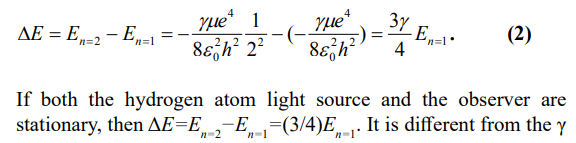
times of equation (2). The relativistic effect coefficient of energy caused by motion is γ.
The Energy Relativistic Effect of Photon Received by Observer and Its Coefficients
Under Einstein's view of spacetime, the energy or frequency of photons received by observers satisfy the Doppler effect. When the observer is stationary, the Doppler frequency shift formula under Lorentz transformation is [2]

In the equation, υ It is the velocity of the observer relative to the light source, viewed from the observer's perspective, θ is the angle between the speed of the light source and the speed of photons, and the speed of the light source is parallel to the extension direction of the X-axis. Also, ν is the frequency. For photons, E = hν. By organizing the above formula, we have

rigorously and quantitatively analyze this issue using specific events. For situations where the relative velocity between the light source and the observation is not known, it can be found in the light graph library based on the spectrum of the received free photons.The energy relativistic effect coefficient reflected by Equation (4) can be calculated using the following method: ΔE=E−E0=[γ+(υ/c) cosθ−1]E0. The coefficient before energy E0 is the relativistic effect coefficient of photon energy received by the observer when they move relative to the light source. It is inconsistent with the "energy relativistic effect coefficient derived from Equation (2)". An intuitive prediction is that this "inconsistency" can lead to energy transfer between hydrogen atoms (or electrons) and photons in a system where the energy balance is disrupted due to observer motion, making energy conservation difficult to maintain. In the next section, we will conduct a rigorous quantitative analysis. If only relative energy is recognized, it will lead to energy non conservation during the occurrence of events in some isolated systems The cosθ in the Equation (4) determines that the relative energy of the photons emitted by the photon motion light source is related to the observer's orientation. Observers from different directions in the same inertial frame observe the same free photon, but the energy measurement results are inconsistent, which determines that only recognizing relative energy makes it difficult to maintain covariance in the laws of physics related to electromagnetic wave energy for moving bodies. Observing in different inertial frames makes it even more difficult to maintain covariance in the laws of physics related to electromagnetic wave energy of moving bodies. The first to bear the brunt is the law of conservation of energy.
Using Examples to Quantitatively Illustrate the Law of Energy Balance Shift
This is also the behavior of verifying the principle of energy bal- ance shift. Our first question is, have readers noticed the differenc- es in the relativistic effect coefficients of different forms of energy? If the answer is no, we will tell you now that the relativistic motion effect coefficient of the total energy of electrons is γ. For the photons generated during the electronic transition process and the positron electron annihilation process, their energy relativistic motion effect coefficients are not all γ. Only when a horizontally moving light source emits photons longitudinally, there is only a lateral Doppler shift, and this coefficient is γ, in other cases, it is not). Our second problem is that if an electron in an atom tran- sitions and emits photons, some of the energy of the electron or atom becomes theenergy of the phoon. During this process, if the observer's motion state changes will the energy conservation state of the isolated system composed of light sources and photons change? The answer to the second question is below (the prelim- inary knowledge in the preface has already predicted the answer. The following is only a more detailed analysis).
Example 1, In the Same Inertia, Observers from Different Directions Observing A Hydrogen Atom Light Source Emitting A Photon
In this example, the light source (hydrogen atom) is in the same isolated system as the target photon it emits. The inertial frame A is a very long system, with two observers A1 and A2 stationary at both ends of the system. A2 is in the front (with a higher x value at the site), and A1 is in the back (with a lower x value at the site). There are two light sources side by side (both are excited hydrogen atoms, one labeled as light source 1 and the other labeled as light source 2), moving from A1 to A2 at a speed of 0.8660c (at this time γ = 2. See Figure 1). The luminescence principle of these two light sources is that electrons at n = 2 levels return to the ground state and emit a target photon. However, light source 1 emits a photon to A1 (denoted as photon 1), and light source 2 emits a photon to A2 (denoted as photon 2).
In this example, observers A1 and A2 observed that the energy loss of hydrogen atoms is the same [All calculated based on Equation (2)]. Both A1 and A2 acknowledge that the energy (including internal energy and overall kinetic energy) of these two hydrogen atom light sources are the same. However, the energy of photon 1 received or measured by A1 is different from that of photon 2 received or measured by A2 [see equations (3) or (4) for details]. According to the preliminary knowledge (4) on energy balance and its relationship with energy conservation, it can be seen that at least one of the observed results of A1 and A2 violates the law of energy conservation (the energy balance is disrupted simply by changing the observer's orientation). From the equations (2) and (4), it can be intuitively seen that the relativistic effect coefficient of energy lost when a moving hydrogen atom emits a photon is different from the relativistic effect coefficient of the energy of a photon received by an observer. Changing the observer's state can indeed disrupt the energy balance, and the principle of energy balance movement is correct. We can see if the calculation results can verify the "energy balance principle". Below, we will also conduct a specific quantitative analysis of this example to see if the calculation results can verify the "Energy Balance shift Principle".

Figure 1. Different observers in the same inertial frame observe the light emitted by the same light source, and the Doppler shift is related to the observer's orientation: A1 is relatively far away from the relative light source S, resulting in a red shift; A2 is relatively close to S and undergoes a blue shift.
The energy loss of electrons in hydrogen atoms recognized or observed by A1 and A2 as light sources is γ×13.606×(3/4) (eV)=10.2045γ eV=20.409 eV [taking into account the relativistic effect generated by the uniform linear motion of the reduced mass (relativistic mass) of electrons and atoms]. The energy of photons observed or received by A1 is calculated according to Equation (4), and the result is 5.470 eV (at this point, cosθ = −1). In A1's view, the energy lost by a hydrogen atom is not equal to the energy of the photon 1 it emits. In an isolated system, energy is not con- served during the emission of photon 1 by hydrogen atoms (There is an energy gap of 14.939 eV between 20.409 eV and 5.470 eV. We made corrections later, but the qualitative conclusion remained unchanged). Correction was made later, and the qualitative conclu- sion remains unchanged. Let's discuss the second scenario again: the hydrogen atom light source, which now emits a photon with the same frequency as photon 1 towards A2 (target photon 2). At this point, the energy lost by the hydrogen atom light source ob- served by A2 is still 20.409 eV, while the energy received by photon 2 is 76.166 eV (Because the frequency of target photon 2 has significantly shifted blue), which is not equal to the energy lost by the hydrogen atom of 20.409 eV. In A2's view, energy is not con- served during the emission of photon 2 from a hydrogen atom light source in an isolated system (There is an energy gap of 55.757 eV between 20.409 eV and 76.166 eV). Let's consider more factors to correct the above calculation.
Readers may have noticed that when a hydrogen atom light source emits a photon, it can receive a recoil force (this is still under debate). This recoil force can change the momentum of hydrogen atoms. Now, I take this factor into account.
Only relative energy is recognized. According to the law of mo- mentum and impulse, when a moving light source emits photons, the photons can give the light source a recoil force, thereby caus- ing the light source to change its motion state. According to the law of conservation of momentum, it can be observed that the mo- mentum of photons observed in A1 and A2 transmitted to the light source is p = h/λ = hν/c. The amount by which the speed of the
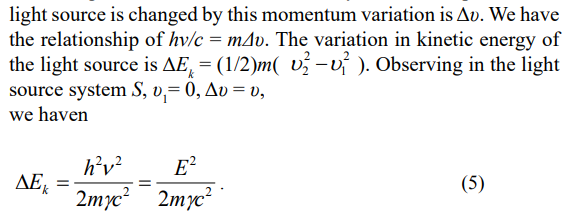
Where, m is the mass of the atom, which is precisely the reduced mass of the atom. We assume that the hydrogen atom is a deuterium atom. In this example, ν0 = (20.409 eV)/h (or E = hν = 20.409 eV), m = (1836×0.511 MeV)/c2, c≈3.00×10⁻⁸m/s. υ = 0.866c, γ = 2. Substituting these values into Equation (5), we can obtain ΔEk =5.7×10⁻⁸ eV. Taking this correction value into account cannot change the qualitative conclusion above. Therefore, the correction according to equation (5) can be ignored.
The second correction method is to consider the variation in ki- netic energy caused by a variation in the mass of the hydrogen atom after the hydrogen atom light source emits a photon. During the process of emitting a photon from a hydrogen atom, the mass loss of the hydrogen atom is Δm = hν/c2 = (20.409eV)/c2. ΔE = (1/2) (Δm)υ2. When υ = 0.866c, this value is 7.653 eV, which is not enough to compensate for the energy gap above. This calibration method itself is under debate. The reason is that when a hydro- gen atom loses mass (which can be equivalent to the lost energy) during its motion, it will increase its forward speed by satisfying the conservation of momentum, thus keeping its kinetic energy al- most unchanged.
This example specifically reflects energy conservation of moving bodies with photon Participation related to the direction of observation (A1 and A2 observe the same moving body and the photons emitted from it from different directions). The above thought ex- periment reveals the contradiction brought about by the principle of relativity. It is not difficult to see that when the recoil force gen- erated by the emission of photons from the light source is disre- garded, the problem of energy non conservation caused by only admitting relative energy can still be quantitatively reflected. If ob- served in a light source system, the energy lost by the light source and the total energy of the photons emitted by it are both 10.2045 eV, indicating energy conservation during the photon emission process. If the S-system is the absolute stationary system, the situ- ation is the same. If we consider the correction based on Equation (5), it actually leads to energy non conservation. This is another mystery or another dark cloud over theoretical space.
The above quantitative analysis indicates that the principle of nar- row relativity cannot withstand the test of the principle of energy balance movement. This is a dark cloud above special relativity. It is caused by only believing in relative energy. It's easy to think of finding new spatiotemporal views that are compatible with relative spatiotemporal views. Literally speaking, the relative absolute spa- tiotemporal view must be compatible with the relative spatiotem- poral view. Let's first take a look at whether this relative absolute space-time view has advantages in solving energy conservation problems. If the light source system is absolutely stationary and we have A1 or A2 observe the hydrogen atom light source and the target photons emitted by it, then based on preliminary knowledge (6), it can be seen that the data observed by A1 or A2 is not superior to the data observed in the light source system (Such data is unreli- able and has a high possibility of deviating from objective reality). In this case, A1 or A2 acknowledges that they are doing absolute motion and acknowledges the relativistic motion effects that occur on themselves. In short, as long as the absolute stationary system really exists and is an S system (light source system), even when observing at A1 and A2, the observation data of the observer in the S system must be recognized first. 20.409 eV is the energy of photons emitted by the hydrogen atom light source in absolute motion and recognized by A1 and A2, as well as the energy lost by the light source due to the emission of a target photon. Here we use the concept of relative and absolute harmonious coexistence of spacetime −− the energy eigenvalue of atoms in absolute motion increase, and the energy of photons emitted also increases [corre- sponding to the changes in spacetime caused by absolute motion. Please refer to the preliminary knowledge (5)]. Under this view of time and space, the relationship between Newton's theory and relativity is no longer "qualitatively completely mutually exclusive, but quantitatively approximate and precise". By utilizing this new spatiotemporal perspective, the energy conservation problem mentioned above can be avoided (this is a major advantage of the relative absolute space-time view). It is not difficult for readers to find that using this new concept of time and space, there are fewer theoretical contradictions (for example, using the relative absolute space-time view to solve problems such as the twin paradox appears more reliable).
The above quantitative analysis results validate the "energy balance principle". If you have any questions about the above analysis results, please refer to the case study below.
Example 2, Observing the Decay Process of Free Photons in A System with Relative Light Source Motion
In this case, we arrange the free photon and its decayed electrons and anti-electrons in the same isolated system. We quantitatively analyze whether the factors involved in energy exchange with this isolated system can truly be ignored.
In the inertial system A, people in the A system are called A-people (A-person, or A-observer, or observer A). A-observer manipulated a photon decay experiment. We integrate a free high-energy pho- ton (known as target photon) and an electron and an antielectron generated by their decay into an isolated system. A light source emits a photon that is sufficient to undergo decay in this system {i.e. a high-energy target photon with a frequency exceeding the photon decay valve frequency [(1.022 MeV)/h]}, and the high-en- ergy target photon decays when it passes over a heavy nucleus, producing an electron and an antielectron (their centroid is station- ary in the A-system) [3,4]. A-person discovered that this photon decay event actually occurred. What observers in the A system have found is that the energy of a high-energy photon with an en ergy of 1.022 MeV decays into a positive and negative electric pair, which is (2×0.511 MeV). In this photon decay process, energy is conservational (Note 1: The changes in the kinetic energy of heavy nuclei before and after photon decay and the influence of the electromagnetic field of heavy nuclei on the energy of photons before decay are ignored here. If we consider these two energies, it will actually make the energy in the system unequal before and after decay occurs. As we mentioned earlier, this is a mystery that requires new theories to explain). There is also an inertial system B that moves at a speed of 0.866c relative to the A frame (the direction of velocity is away from the free high-energy target pho- ton). We label the observers in the B-system as B-people (or B-ob- server). B-observer must also admit that the photon decay event has already occurred. The reason is that the positive and negative electron pairs generated in the event objectively exist and cannot disappear due to the observer changing their motion state [See Pre- paratory Knowledge (3) for details]. The same conclusion can be drawn based on the axiom of absolute or objective occurrence of events. The B-observer observed that the energy of the free target photon was 0.274 MeV (the energy received by the observer B was only so much. E = hν = 0.274 MeV is obtained by Substitute the speed of the light source υ= 0.866c, cosθ = −1, E0 = hν0 = 1.022 MeV into Equation (3). It is also obtained based on the Doppler shift formula). The velocity of the newly electron-antielectron pair relative to B-observer is also 0.866c. The kinetic energy of the electron-antielectron pair observed by B-observer relative to the B-system is 2×0.511 MeV + 0.766 MeV = 1.788 MeV [Note 2: The total kinetic energy of an electron-antielectron pair is (γm0) υ2=0.766MeV. Where, m =(0.511MeV)/c2 is the electronic mass, γ = 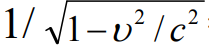
=2]. Overall, in the eyes of B-observer, a free photon with a relative energy of only 0.274 MeV has transformed into a pair of electron-antielectron with energy of up to 1.788 MeV. This requires a significant amount of energy supplementation in the sys- tem before decay occurs, or a significant amount of energy loss in the system after decay occurs. However, neither of these situations seems to have occurred, and we are most likely to prioritize the explanation of 'non conservation of energy during this decay pro- cess'. This is also a big black cloud over physics. I will also give it a try later to see if using the concept of relative absolute spacetime can dispel it.
There are two possible factors that affect the conservation of en- ergy in the isolated system mentioned above: firstly, the residual electromagnetic field in the heavy nucleus changes the energy of photons before decay; secondly, the momentum of photons before decay is transmitted to the heavy nucleus, causing it to change its kinetic energy. It should be noted that electrically neutral me- dia such as cloud chambers can provide extremely limited energy for high-energy photons, which is the energy variation of electro- magnetic waves in the potential field, which is multiple orders of magnitude smaller than 1 MeV and can be ignored. Assuming the momentum of the target photon loss is p = hν/c. All the momentum of p is transferred to a nucleus with a mass of Mnucleus. We have relationship of p =Mnucleusυ and υ2 = p2 /M . Observing in the laboratory system (with the cloud chamber stationary within the laboratory system), the increase in kinetic energy of the atomic 
ΔEk=2.5 eV. It is 5 orders of magnitude different from 0.274 MeV, which can also be ignored. Even if this term is not ignored, the energy of this term can only be added to the decay energy 2×0.511 MeV and can note added to the energy before decay 0.274 MeV, resulting in a greater energy difference before and after the decay of free photons. If the light source system is an absolute station- ary system, the energy conservation problem above will no longer exist (the energy of free photons before and after decay is 1.022 MeV). Observing in other systems, as long as absolute motion and absolute energy (or the inherent energy before Doppler shift oc- curs) is recognized, the aforementioned problem of energy con- servation does not exist. For example, observed in the B-system and acknowledge the absolute motion of the light source (this is the choice of relative absolute spacetime view), compared with equation (2), the emission energy of free photons is 2.044 MeV, instead of receiving energy of 0.274 MeV. The newly generated electron and antielectron have a velocity of 0.866c relative to the light source in the absolute stationary system, and have energy of 2.044 MeV. The conservation of energy during this decay process. The problem mentioned in Note 1 also exists in this example. It can be said that 2.044 MeV in the previous sentence is also a result of the relative-absolute spacetime view, which takes advantage of the fact that the clock of absolute motion slows down, the space contraction of absolute motion corresponds to an increase in the mass of absolute motion particles, and the inherent energy of photons emitted by absolute motion light sources increases. This example also confirms that if only relative motion is recog- nized, the state of energy conservation is related to the inertial frame (or spatiotemporal view) chosen by the observer (right choice, energy conservation, wrong choice, energy non conserva- tion).
From "Note 1" in Section 4.2, it can be seen that considering the two energy changes that follow will actually affect the system's adherence to the law of energy conservation (considering these two energies, the situation will be even worse). Without considering this factor, the conservation of momentum in the center of mass system poses a threat. It can be seen that the two factors that can slightly change the energy of the system cannot change the situation where energy conservation is disrupted (originally, humans have not yet confirmed whether a recoil velocity can be given to the light source when it emits photons through electronic transitions). We have the conclusion that if we only acknowledge relative energy and change the observer's motion state, energy is not conserved during photon decay. Special relativity determines that we can only acknowledge relative energy, otherwise it violates the principle of relativity. From the perspective of covariation of the laws of physics, Case 2 also reflects the disruption of energy balance by the principle of relativity: "Photons with energy reach- ing the valve frequency can decay into positive and negative elec tron pairs under suitable conditions" is a natural law. However, in the eyes of B people, this natural law does not hold true - photons with relative energy that does not reach the valve frequency can also decay into positive and negative electron pairs. It can be seen that both non-interference judgment methods result in extremely unfavorable conclusions for special relativity.
The Degree of Compatibility Between Relative-Absolute and Relative Spacetime View & The Necessary and Sufficient Conditions for Maintaining the Advantages of Relative Absolute Spacetime View
The statement 'the mass of absolute motion increases' acknowledg-es conceptually that the relative-absolute spacetime view is com- patible with the relative spacetime view. If the experimental meth- od proves that "the mass of absolute motion increases," then it is confirmed that the relative absolute spacetime view is compatible with the relative spacetime view. This article is temporarily unable to conduct experiments in this area. However, we can analyze pre-vious relevant experiments and provide quantitative calculations with examples to find data with the function of "verifying this level of compatibility".
The above two sections discussed the theoretical advantages of using the relative absolute spacetime view to handle changes in en- ergy conservation states. This advantage requires to be maintained by certain conditions (which are sufficient and necessary condi- tions). One of these necessary and sufficient conditions is that the experimental results also support the relative-absolute spatiotem- poral view. The second is to use the relative absolute space-time view and corresponding theories, which have fewer contradictions and higher value. The following is only a quantitative discussion of the experimental support for the principle of energy balance movement. If the necessary and sufficient conditions for maintaining the advantage of relative absolute spatiotemporal view can be met, then almost all experiments conducted on the ground can sup- port both relative and absolute spatiotemporal views (especially experiments related to increasing the mass of motion, the clock slows down due to motion, and transverse Doppler shift of photons emitted by the moving light source).
In order to facilitate the drawing and understanding of Table 1 and Tables 1-3, we will first explain the method and purpose of tabulation.
Both electrons are moving in an absolute stationary system, with velocities of υ1 and υ2, respectively. In the eyes of an absolutely stationary observer, the dynamic masses of these two electrons are γ1me and γ2me. The ratio of the dynamic masses of these two elec- trons is: m2/m1 = γ2me/γ1me = γ2/γ1. If an absolute stationary system really exists (or if we acknowledge the relative-absolute spacetime view), this ratio is absolute, and the observer observing electron 2 on electron 1 also acknowledges this ratio. In this case, transform- ing the expression of this ratio yields we can obtain m2= (γ2/γ1) m1. Within the framework of special relativity (i.e. only admitting the relative spatiotemporal view and the absolute spatiotemporal view can be reflected in the difference in the coefficient of motion effect (in the formulas, m1= me is the static mass of the electron). We will quantitatively calculate the magnitude of this difference for over 30 different scenarios (situations). The judgment method is that the smaller the difference, the better the compatibility between the relative absolute spatiotemporal view and the relative spatiotem- poral view.

coefficients of two clocks (record as clock 1 and clock 2. The corresponding inertial frames are K1 and K2, respectively) moving in the same straight line are respectively γ1 and γ2. Standing on clock 1 and observing clock 2, the slowing down factor of clock 2 is (γ2 /γ1 ) [5].
When the Earth is in absolute motion, within a small time interval, the Earth's surface is an approximate inertial frame in motion, with an absolute velocity of υ1. Observing the motion effect of the mass of high-speed electrons (or the motion effect of a high-speed atom- ic clock) on Earth, the absolute velocity υ2 of the observed object is the combined velocity of υ1 and this relative velocity u [Calcu- lated according to equation (6) or (7)]. A new physics concept that requires more evidence and needs to be tested is to simultaneously acknowledge the following three aspects: acknowledging that the relative absolute spacetime view is compatible with both the rel- ative spacetime view and the absolute spacetime view; Admitting that the physical quantities of matter in the motion system will undergo changes "as Einstein said"; The coordinate transformation between a system of absolute motion and an absolute stationary system conforms to the Lorentz transformation. Below, we prvide quantitative evidence for the "compatibility" and "availability of new physics concepts" mentioned here through the calculation results of some examples. The transformation of velocity under the Lorentz transformation in vector form [6] is
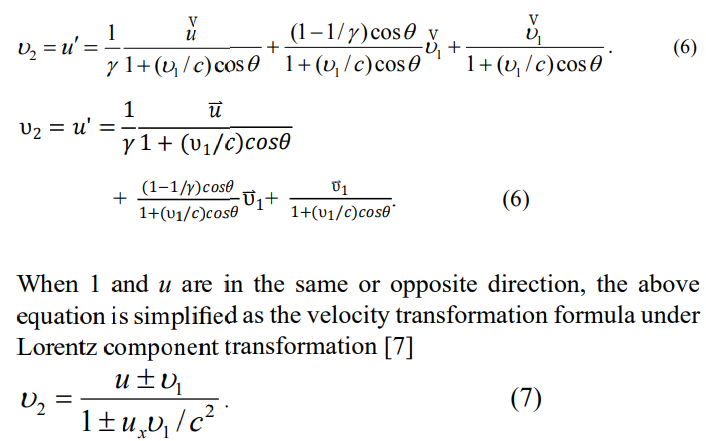
The smaller the difference, the better the compatibility between the relative-absolute spatiotemporal view and the relative spatiotemporal view).When the directions of υ2 and u are the same, "±" in equation (7) is taken as "+", and when their directions are opposite, "±" is taken as "−". We take the Earth's revolution speed and the speed of the Sun in the Milky Way as υ1, and then select several representative relative velocities u to calculate. After calculated υ2, we calculate γ2= (1-)-0.5 and (γ2/γ1). Final we calculate the difference between γ= (1-u2/c2)-0.5 and γ2 /γ1 . This difference reflects the degree of compatibility between the "relative spatiotemporal view" and the "relative absolute spatiotemporal view" (It is the degree of compatibility in terms of application. The difference is smaller, the degree of compatibility is higher).
|
u, c |
u 2, c |
γ2= (1 -u 2 / c2 2 |
)-0.5 |
γ= (1 - u 2 / c2 )-0.5 |
(γ2/γ1)** |
Errors*,% |
|
0.0001 |
0.000199999998 |
1.000000020 |
1.000000005 |
1.000000015 |
10−6 |
|
|
0.001 |
0.00109999999 |
1.000000605 |
1.00000050 |
1.00000060 |
10−5 |
|
|
0.01 |
0.01009999 |
1.000051 |
1.000050 |
1.000051 |
10−4 |
|
|
0.1 |
0.100098999 |
1.00504787 |
1.0050378 |
1.0050479 |
0.001 |
|
|
0.5 |
0.500074996 |
1.154758279 |
1.1547005 |
1.154758 |
0.004 |
|
|
0.866 |
0.8660250 |
1.999997 |
1.999824 |
1.999997 |
0.02 |
|
|
0.99 |
0.990002 |
7.08951 |
7.088812 |
7.089510 |
0.01 |
|
|
0.999 |
0.9990002 |
22.3685065 |
22.366272 |
22.368510 |
0.02 |
|
|
0.9999 |
0.99989998 |
70.705376 |
70.712446 |
70.705375 |
0.7 |
|
Table 1: Error Caused by Replacing Absolute Velocity with Relative Velocity
(the direction of u is the same as that of υ1)
*The error here refers to the difference between [γ = (1 - u2 / c2)-0.5] and (γ2 /γ1 ). It is the error between the calculation results also the same. 2 1 using the relative spatiotemporal view and the relative-absolute spatiotemporal view. The meaning of "error" in Tables 2 and 3 is also the same.
**When υ1=0.0001c, γ1 is 1.000000005. Table 2 also uses these two numbers.
|
u, c |
u2, c |
γ2= (1 -u 2 / c2 )-0.5 2
|
γ= (1 - u 2 / c2 |
)-0.5 |
γ2/γ1 |
Errors, % |
|
0.0001 |
0 |
1 |
1.000000005 |
0.999999995 |
10−6 |
|
|
0.001 |
0.000900000 |
1.000000405 |
1.00000050 |
1.00000040 |
10−5 |
|
|
0.01 |
0.00990001 |
1.0000490087 |
1.000050 |
1.000051 |
2×10⁻⁴ |
|
|
0.1 |
0.099900999 |
1.0050277699 |
1.00503782 |
1.00502776 |
0.0001 |
|
|
0.5 |
0.499924996 |
1.154758279 |
1.1547005 |
1.1547583 |
0.005 |
|
|
0.866 |
0.86597499 |
1.99965085 |
1.999824 |
1.999651 |
0.02 |
|
|
0.99 |
0.9891979 |
7.08811029 |
7.08881205 |
7.08811026 |
0.01 |
|
|
0.999 |
0.9989998 |
22.3685065 |
22.3640378 |
22.3685065 |
0.02 |
|
|
0.9999 |
0.99989998 |
70.7053758 |
70.7124460 |
70.7053754 |
0.7 |
|
Table 2: Error Caused by Replacing Absolute Velocity with Relative Velocity
(the direction of u is the same as that of υ1)
When u is perpendicular to B or at other angles, the error is between the corresponding data in Tables 1 and 2
|
u1, c |
γ1 |
u, c |
u2, c |
æ u 2 ö-0.5 γ2= ç1 - c 2 ÷ |
-0.5 γ= æ u 2 ö è c 2 ø |
γ2/γ1 |
Errors, % |
|
0.002 |
1.0000020 |
0.0001 |
0.001900004c |
1.000001805 |
1.000000005 |
1.00000180 |
0.0002 |
|
0.002 |
1.0000020 |
0.002 |
0 |
1 |
1.0000020 |
0.999998 |
0.04 |
|
0.002 |
1.0000020 |
0.1 |
0.0980196 |
1.0048388 |
1.005038 |
1.004837 |
0.02 |
|
0.002 |
1.0000020 |
0.99 |
0.9899601 |
7.074783 |
7.088812 |
7.074769 |
0.2 |
|
0.002 |
1.0000020 |
0.999 |
0.998996 |
22.321629 |
22.36627 |
22.32158 |
0.2 |
|
0.002 |
1.0000020 |
0.9999 |
0.9998996 |
70.57118 |
70.71245 |
70.57104 |
0.2 |
|
0.01 |
1.000051 |
0.9 |
0.8980827 |
2.273624 |
2.294157 |
2.273508 |
0.9 |
|
0.02 |
1.000200 |
0.99 |
0.989594 |
6.949844 |
7.088812 |
6.948454 |
2 |
|
0.1 |
1.0050378 |
0.99 |
0.987791 |
0.987791 |
7.088812 |
6.387020 |
10.5 |
|
0.2 |
1.021048 |
0.99 |
0.985037 |
5.802460 |
7.088812 |
5.682845 |
20.4 |
|
0.5 |
1.1547005 |
0.01 |
0.492462 |
1.148985 |
1.000050 |
0.995050 |
0.5 |
|
0.5 |
1.1547005 |
0.999 |
0.997003 |
12.92609 |
22.36627 |
11.19432 |
66.5 |
|
0.001 |
1.0000005 |
0.99 |
0.9899801 |
7.0817977 |
7.088812 |
7.081794 |
0.1 |
|
0.0005 |
1.0000001 |
6×10⁻⁶ |
4.94×10⁻⁴ |
1.000000122 |
1.000000000 |
1.00000002 |
2×10⁻⁶ |
|
0.0004 |
1.00000008 |
0.99 |
0.9899920368 |
7.0860054 |
7.088812 |
7.08600488 |
0.04 |
|
0.0006 |
1.00000018 |
0.99 |
0.9899880529 |
7.08460257 |
7.088812 |
7.0846013 |
0.06 |
|
0.0005 |
1.0000001 |
0.99 |
0.989990 |
7.085304 |
7.088812 |
7.085303 |
0.05 |
|
0.005 |
1.000013 |
0.99 |
0.989900 |
7.053811 |
7.088812 |
7.053721 |
0.5 |
|
0.005 |
1.0000125 |
0.9994 |
0.999394 |
28.72860 |
28.87184 |
28.72824 |
0.5 |
Table 3: Error Caused by Replacing Absolute Velocity with Relative Velocity
(the direction of u is the same as that of υ1)
From the data in Tables 1-3, it can be seen that only when the absolute velocity of the Earth υ1 is below 0.005c or when υ1=0.5c and the relative velocity u of the observed object is less than 0.01c, the error in experiments using relative velocity instead of absolute velocity on the Earth's surface is relatively small. (γ2/γ1) is approximately equal to γ = , indicating that within a certain degree of approximation, relative velocity can replace absolute From the data in Tables 1-3, it can be seen that only when the absolute velocity of the Earth υ1 is below 0.005c or when υ1=0.5c and the relative velocity u of the observed object is less than 0.01c, the error in experiments using relative velocity instead of absolute velocity on the Earth's surface is relatively small. (γ2/γ1) is approx- imately equal to γ = , indicating that within a certain degree of approximation, relative velocity can replace absolute approximately the same calculation effect].
The data in third to last row of Table 3 (i.e., a set of data for υ1 = 0.0005c and u = 0.99c) indicates that even if an absolute sta- tionary system exists and the electron mass increases due to ab- solute motion, the error between using relative velocity and absolute velocity is only 0.05%. In 1940, M. M. Rogers et al.'s experiment demonstrated with 1% accuracy that the relationship between electron mass and velocity follows the Lorentz-Einstein mass velocity relationship. Subsequently, the measurement results of fine structure splitting of atomic spectral lines proved the cor- rectness of the Lorentz-Einstein mass velocity relationship with an accuracy of 0.05% [8]. In 1963, V. Meyer et al. measured the mass of high-speed electrons with u≈0.99c by comparing relativ-istic and non relativistic electrons, and the results were consistent with the Lorentz-Einstein mass velocity relationship with an ac- curacy of 0.04% [9]. If the measurement uncertainty of the experimental results of these individuals is less than ± 0.002%, their experiments have already proven that the absolute velocity of the Earth is around 0.0005c (the absolute velocity of the Earth is about 0.0005c is a prediction in this article. If the Lorentz Einstein mass velocity relationship is absolutely reliable, the confidence level of this prediction can reach 95%). The experiments of W. Bertozzi, Ji Hao, and others on the increase in electron mass due to motion all measured significant errors [10, 11]. If the accuracy of these experiments is high enough and reliable, we will find a method to mea- sure the absolute velocity of the Earth's motion. In fact, humans have high-precision experiments, such as GPS satellite positioning and timing processes. Even if errors are found in GPS positioning and timing work, people rarely use physical concepts beyond the framework of relativity to explain them.
In summary, the data in these tables can indicate that as long as the difference between the absolute velocity υ1 and the relative velocity u is large enough (relative to their average), the difference between the calculated results using the relative spatiotemporal view and the relative-absolute spatiotemporal view is small enough (this is also the case when both relative and absolute velocities are small). For example, the data from the sixth to last row in Table 3 indi- cates that conducting a bidirectional round-the-world experiment with an atomic clock on Earth is also valuable (as long as it is well controlled). The tolerable conditions for errors in these three tables are precisely the conditions for the approximation of special rela- tivity to apply. The zero result of the Michelson Morey experiment itself cannot deny the existence of an absolute stationary system; it denies the existence of the ether. Moreover, the Michelson Morey experiment can be explained by the statement that "the wind in the Earth's gravitational field can pull photons 100%". The concept of relative absolute spacetime is a product of the development of special relativity.
There are many other issues with special relativity [12-18]. How- ever, the consensus among orthodox scientists on these issues is to temporarily ignore them. Adhering to the law of conservation of energy is a mandatory requirement for any theory. This determines the importance of this article.
Discussion
The speed of the Earth relative to the solar system is approximately 0.0001 times the speed of light. The speed of motion of the solar system relative to the Milky Way is approximately 230 km/s (approximately 0.0008 times the speed of light). The speed of the Milky Way relative to the total galaxy is approximately 600 km/s (0.002 times the speed of light). The expansion of space can also give the Milky Way a velocity. Therefore, the absolute velocity of the Earth is a complex composite velocity. We predict that the absolute speed of the Earth is about 0.0005 times the speed of light (150 km/s). This is possible. The cycle of the solar system's revolution is approximately 220 million years. We cannot expect to measure the effects of changes in the absolute velocity of the Earth through changes in the direction of the solar system's revolution. The data from the last lines 4 and 5 of Table 3 indicate that the maximum difference in absolute velocity measurements caused by the rotation of the Earth's four seasons is 0.02%. If the absolute direction of Earth's motion happens to be parallel to the plane of Earth's orbit, we can distinguish this difference by conducting the same experiment in different seasons. If the absolute direction of Earth's motion is perpendicular to the Earth's orbital plane, there is no seasonal difference in conducting corresponding experiments on Earth. Thinking in both positive and negative directions, through this principle and repeated comparison, can determine the direction of the absolute velocity of the Earth. If the experiments of M. M. Rogers and V. Meyer et al. are repeated in different seasons, the measurement error cannot be reduced to below 0.02% in any case, and the measurement errors in each experiment are basically the same in different seasons, it is possible that the absolute velocity of the Earth is perpendicular to the plane of the Earth's orbit. If the same experiment is conducted during a different season, and the variation in error is exactly 0.02%, and the average value of the error remains stable, it indicates that the absolute direction of Earth's motion is parallel to the plane of Earth's orbit. These are all predictions about the absolute speed of the Earth in this article, which can be used as topics for discussion.
It is not difficult to see that in the framework of relativity, we have discovered the principle that can lead to energy non conservation: the energy relativistic effect coefficient of non zero stationary mass particles is inconsistent with the energy relativistic effect coefficient of photons, which determines that "changing the observer's motion state can disrupt the original energy balance and energy conservation state". This principle was verified through careful quantitative analysis. A concise and crucial leading conclusion in the above analysis process is: "For photons emitted by moving bodies, their relative energy is not only related to the observer's motion state, but also to the orientations of different observers in the same inertial system; And this in turn determines that the process of photons emitted by moving light sources is difficult to ensure energy conservation. The more complex and detailed quantitative analysis confirms the guiding conclusion above, and the following comprehensive conclusion is drawn: if only relative energy is recognized, the law of energy conservation may not be guaranteed in certain situations (related to the selection of inertial frames, and even to the observer's orientation). This is a very serious theoretical problem (it can be said to be a large dark cloud over special relativity). Due to the fact that the Lorentz transformation is a quantitative embodiment of the principle of relativity and the principle of light source invariance, the factors that lead to this serious theoretical problem can only be the narrow principle of relativity (qualitative) and the Lorentz transformation (quantitative). The correctness of this inference can be verified by assuming that the light source system in the above examples is an absolute stationary system. This assumption ensures energy conservation and eliminates this serious theoretical problem. Other quantitative corrections cannot eliminate this problem.
There are several areas worth discussing. Firstly, is the natural fre- quency of a free photon its absolute frequency? Secondly, can we recognize both relative energy and absolute energy (or invariant energy or inherent energy)? For the first point, what we want to say is that the inherent frequency of free photons in vacuum is the inherent emission frequency of the light source. For a stationary light source, it is independent of the relative motion state of the observer and can be said to be a constant frequency. For a moving light source, it is the remaining frequency after deducting the Doppler shift from the received frequency, and it is the inherent emission frequency of the moving light source, which is related to the type of light source. It is necessary to deduct the relativistic effect of the light source in order to become the inherent emission frequen- cy of a stationary light source. It can be seen that only a portion of the inherent emission frequency is the absolute frequency of a stationary light source. If there is an absolute stationary system, at least some invariants can also be called absolute quantities. For the second point, we are certain that readers can be brave enough to discuss without fear. For the second point, our conclusion is af- firmative and readers can participate in the discussion. The reason is that we can admit that objects in absolute motion undergo some changes (For example, the clock of motion slows down, mass in- creases due to motion, energy changes due to motion, and other relativistic effects). This is a typical recognition of both absolute and relative (i.e., relative and absolute are not mutually exclusive, but can coexist).
Although this article is short, it is of great significance for humans to understand nature and transform existing physics theories. Be- cause the state of energy conservation is related to the selection of inertial frames, it violates the principle of special relativity, and the "state of energy conservation is related to the selection of inertial frames" is precisely obtained based on the principle of special rel- ativity. Therefore, this article demonstrates that narrow relativity is not self sufficient.
Does the phrase 'the clock of absolute motion slow down and the ruler of absolute motion shorten' connote the idea of a relative ab- solute view of time and space? After the birth of relativity, people gradually set Einstein's relative spacetime view against Newton's absolute spacetime view. Do we continue to make them stand against each other? If there is no absolute time and space, what should be the reference for the transformation of time and space due to motion? Can invariants in physics serve as such a refer- ence? If we recognize the concept of relative absolute space-time logically or ideologically, can we establish the theory of relativi- ty-absolutism? These are all worth discussing.
Outlook
The clock that acknowledges absolute motion slows down, the space of absolute motion shrinks, and the mass of absolute motion increases. This is a revolutionary concept of relative and absolute peaceful coexistence (relative-absolute space-time view), which can guide the direction of the scientific revolution. If relativity ab- solutism were born, the above two sentences should be the essence of the theory of relativity-absolutism. The compatibility of relative and absolute spacetime views determines the birth of relative-absolute spacetime, and the compatibility of relative absolute space- time views with relative spacetime views. Finally, it was deter- mined that the theory of relative-absolutism was compatible with the theory of relativity. Why don't we try to establish a new theory — theory of relativity-absolutism? I believe readers can easily find that in many situations, there is almost no difference in the effec-tiveness between using relativity and using relative absolutism. At least this is the case on the surface of the Earth. The above discussion has already shown that using a relative absolute spacetime view is less contradictory and more practical than using a relative spacetime view (for example, phenomena that can be explained by a relative absolute-spacetime view can also be explained by using a relative absolute spacetime view; using a relative-absolute spacetime view can explore the absolute motion state of the Earth and make some predictions).
Annotation 1 reveals a strange problem that, considering more possible energy exchanges, Case 1 deviates further from the law of energy conservation. The use of existing theories cannot solve this problem. The reason for this phenomenon is not related to whether to acknowledge relative energy or inherent mass, but rather to oth- er unknown factors (because even if the Galilean transformation is used to calculate energy transformation, this strange phenomenon still exists). Annotation 1 reveals a strange problem that, consider- ing more possible energy exchanges, Case 1 deviates further from the law of energy conservation. The use of existing theories cannot solve this problem. The reason for this phenomenon is not relat- ed to whether to acknowledge relative energy or inherent mass, but rather to other unknown factors (because even if the Galile- an transformation is used to calculate energy transformation, this strange phenomenon still exists).
We hope that people can make rapid progress in exploring the issues worth discussing introduced in the previous section after the publication of this article.
References
- Ka, X. (2001). Advanced quantum mechanics (3rd ed.). Higher Education Press.
- Landau, L. D., & Lisschitz, E. M. (2012). Field theory. Higher Education Press.
- Golden Hoe Head Library. (2019). Introduction to nuclear and particle physics.
- Xu, Z. (2009). Introduction to nuclear and particle physics.China University of Science and Technology Press.
- Tu, R. (2019). Sound the clarion call scientific revolution.Golden Light Academic Publishing.
- Gao, Y., & Yu, X. (2014). Exploration of the mathematical foundations of special relativity. Mathematics in Practice and Theory, 44(3), 211–216.
- Landau, L. D., & Lisschitz, E. M. (2012). Field theory. Higher Education Press.
- Rogers, M. M., et al. (1940). Phys. Rev, 57, 379.
- Meyer, V., et al. (1963). Helv. Phys. Acta, 36, 981.
- Bertozzi, W. (1964). Am. J. Phys, 32(7), 551–555.
- Mei, X. (2011). The significance and explanation of the experiment on energy and orbital anomalies during high speed motion of charged particles. Frontier Science, 5(1), 86–89.
- Tu, R. (2015). Some experiments supportive of relativity theory contain data that does not support the theory. Infinite Energy, 123, 35–43.
- Mei, X. (2006). Absolute space-time theory with variable space-time and gravitational theory established in flat space- time. arXiv.
- Tu, R. (2012). Relativity principle brings about trouble for electrodynamics. Infinite Energy, 101, 53–54.
- Mei, X. (2023). The truths of space-time contractions ofspecial relativity. Applied Physics Research, 15(2), 36–51.
- Tu, R. (2023). Upgrade theory of relativity from version 1.0 to version 2.0. International Journal of Scientific Reports, 9(6), 192–198.
- Mei, X. (2021). The precise calculations of the constant terms in the equations of motions of planets and photons of general relativity. Physics Essays, 34(2), 183–192.
- Tu, R. (2022). Relativistic effect of non rigid in motion: Volume contraction in all directions; space around it warped. Physical Science International Journal, 26(2), 34–46.
Supplementary Material A:
Main Context and Significance of This Article This Article
summarizes the "principle of energy conservation state variation" using logical analysis methods. So, with the core of "qualitative and quantitative verification of this principle through case analy- sis", we completed the writing work of this paper by pulling out three main lines [see (1) - (3) below]. At the same time, this article also demonstrates that relative and absolute can coexist harmoniously. They can coexist, which in turn gives the "relative-absolute space-time view" a chance to be chosen. Finally, the theoretical and practical advantages of this new concept of time-space were discussed.
(1) Summarize the Law of Energy Conservation State Changes and Quantitatively Verify It Through Case Studies
The author has summarized the "Law of Energy Conservation State Variation" (also known as the Energy Balance Movement Principle, abbreviated as the Energy Balance Principle). The rea- son for the deterioration or variation of the energy conservation state identified is that the relativistic motion effect coefficients of the two types of energy before and after the form variation are different, resulting in the destruction of the original energy balance after changing the observer's inertial frame or motion state. It is easy to discover (find) cases where the energy relativistic coeffi- cients of different forms of matter are different. For example, the relativistic effect coefficient (motion effect coefficient) of electron energy is different from the relativistic effect coefficient of pho- ton energy. The former is γ (whether it is electron transition or free electron motion, this coefficient is γ). The latter is achieved through the relation of E=hν to be determined by Doppler shift. In this way, the process of electrons transitioning and emitting pho- tons will inevitably disrupt the original energy balance (the state of energy conservation will inevitably change). The variety law of energy conservation state is as important as the maintenance law of energy conservation state, and it can serve as an important theo- retical basis for "judging the correctness of theory". The principle of special relativity cannot pass the test of the "principle of energy balance movement". This is a big dark cloud that can block out the sky and the sun above special relativity.
(2) Introduced the Concept of Relative-Absolute Spacetime And Its Relationship with The Concept of Relative Spacetime
Before the birth of relativity, we had two options for the view of time and space: firstly, the clock of relative motion slowed down and the space of relative motion contracted (this is a pure view of relative time and space); Secondly, the spacetime of absolute motion undergoes the same changes (this is the relative absolute spacetime view where relative and absolute coexist harmonious- ly). After the birth of relativity, people completely opposed rel- ative and absolute, without considering the concept of time and space where relative and absolute coexist peacefully. After Ein- stein's choice of relative spacetime view, he excluded Newton's pure absolute spacetime view, but did not exclude the relative-ab- solute spacetime view. Now, we choose the second view of time and space, although it is too late, we can see what the consequenc- es are (whether it should be completely ruled out or there is a rea- son to choose it). Since no one has ever done this kind of work, doing it can make humans more firmly believe in the relative view of time and space, or doubt the relative view of time and space and favor the relative absolute view of time and space. Choosing a relative-absolute space-time view that can describe "the clock of absolute motion slows down and the ruler of absolute motion shortens" can be achieved theoretically and logically. We can also test the correctness of this choice in practice. Logically, we need to find a reliable and unchanging comparison object (or starting point of "variation") for the "variation" caused by relative motion. We cannot search for comparison objects like the geocentric theory, but should search for them like the heliocentric theory. We must abandon thinking method of self centered and that only focuses on appearances, and adhere to the principles of minimizing con- tradictions and being truthful and objective. The preferred com- parison object and starting point for "change" in this way must be the corresponding object in the absolutely stationary space. The relative-absolute space-time view will definitely become the pre- ferred choice.
(3) Calculate the Absolute Velocity of The Earth Based on The Quantitative Differences Between the Relative and Absolute Spatiotemporal Views and Previous Experimental Data
With a relatively absolute spacetime view to choose from, if the error between the electron mass velocity relationship experiment at 0.99c speed and the Lorentz Einstein transformation prediction cannot be eliminated regardless of improving experimental accura- cy, it can be explained that the Earth has an absolute velocity with a value of approximately 150 km/s. This result provides a method for measuring the absolute velocity of the Earth and can also verify the correctness of special relativity. It can also satisfy the curiosity of many people and interest many people (including researchers from different professions, science enthusiasts, and the general public). The reason is that a large number of people are dissatisfied with the special relativity of the geocentric-theory-style thinking method thinking method, and "measuring the absolute speed of the Earth's motion while testing the special relativity" is a long-term dream of humanity. When the absolute velocity of the Earth is low, the difference in results between using relative velocity calculation and using absolute velocity calculation is very small, indicating that special relativity is approximately applicable on Earth.
The main line of this article (1) is to reveal the contradiction of special relativity through the principle of energy conservation state change; The second main line is to introduce the relative absolute spatiotemporal view with the opportunity to be selected; The main line (3) is to verify the new and old spatiotemporal views and compare the application effect of the new and old spatiotemporal views. Special relativity is the foundation of modern physics, and the principle of special relativity is the cornerstone of special relativity. Therefore, the author's efforts have made the cornerstone of modern physics a bit loose. The conclusion of this article is that special relativity must be developed and its scope of application must be narrowed.
The content of this article is undoubtedly the fuse of the scientific revolution of the century.