

Advances in Theoretical & Computational Physics(ATCP)
ISSN: 2639-0108 | DOI: 10.33140/ATCP
Impact Factor: 2.6

Research Article - (2025) Volume 8, Issue 4
Primacohedron, Riemann Hypothesis, and abc Conjecture
Received Date: Sep 10, 2025 / Accepted Date: Nov 13, 2025 / Published Date: Nov 24, 2025
Copyright: ©Ã?©2025 Sandi Setiawan. This is an open-access article distributed under the terms of the Creative Commons Attribution License, which permits unrestricted use, distribution, and reproduction in any medium, provided the original author and source are credited.
Citation: Setiawan, S. (2025). Primacohedron, Riemann Hypothesis, and abc Conjecture. Adv Theo Comp Phy, 8(4), 01-07.
Abstract
The Primacohedron provides a unifying adelic framework in which numbertheoretic, spectral, and geometric structures arise from prime-indexed resonance modes. Building on its interpretation of the non-trivial zeros of the Riemann zeta function as the spectrum of a Hilbert–Pólya–type operator, this work extends the construction to Diophantine geometry and the abc conjecture. We show that radicals and height functions naturally correspond to spectral-energy sums of prime resonances, while the abc inequality emerges as a curvature-stability condition on an underlying adelic manifold. Within this spectral–Diophantine duality, violations of RH or abc manifest as curvature singularities of a unified spectral–height geometry. We further introduce an adelic operator pair (H spec ,H ht ) encoding L-function zeros and arithmetic heights simultaneously, propose a curvature-anomaly correspondence linking analytic and Diophantine pathologies, and outline a programme suggesting how a completed Primacohedron—extended to motivic L-functions and Vojta theory—could imply both RH and abc through a single geometric regularity principle. This synthesis positions the Primacohedron as a candidate framework for an arithmetic spacetime whose curvature governs both the analytic behavior of zeta and L-functions and the Diophantine behaviour of rational points, offering a geometric route toward long-standing conjectures in number theory [1-5].
Keywords
p-adic String Theory, Dedekind Zeta Function, Riemann Hypothesis, Random Matrix Theory, Hilbert–Pólya Conjecture, Emergent Geometry, Black-Hole Entropy, Holography, Complexity–Action Duality, Cosmology, Arithmetic Quantum Chaos, abc Conjecture
Spectral Diophantine Duality: Primacohedron, RH, and the abc Conjecture
The Primacohedron has so far been developed as a spectral framework in which spacetime emerges from prime-indexed resonances, and the non-trivial zeros of the Riemann zeta function arise as the spectrum of an adelic Hilbert–Pólya-type operator Hζ, in the spirit of the Hilbert–Pólya paradigm and its modern reformulations [6,7]. On the analytic side this connects to the classical explicit formula and the extensive literature on the Riemann zeta function and its zeros [1,2,8]. In this section we extend the picture to Diophantine geometry and articulate a conjectural duality between:
• Spectral coherence, encoded by the distribution of zeros of zeta and related L-functions (Riemann Hypothesis and its generalizations), and
• Diophantine coherence, encoded by height bounds and radical inequalities (the abc conjecture and Vojta-type statements).
We will interpret the radical rad(abc) as a spectral-energy sum over prime resonances, relate abc to curvature constraints in the adelic manifold, and describe a roadmap by which an eventual proof of RH inside the Primacohedron could, in an extended motivic setting, also imply abc.
The abc Conjecture as A Prime-Energy Constraint
Let a, b, c ∈ Z be non-zero, pairwise coprime integers satisfying a + b = c. The abc conjecture asserts that for every∈µ > 0 there exists a constant K(∈) such that

This conjecture, independently formulated by Masser and Oesterlé and related closely to Vojta’s conjectures, has far-reaching consequences for Diophantine equations and Diophantine geometry [3,4, 9-11].
The quantity rad(abc) keeps track of which primes divide a, b, c but ignores their multiplicities. In our framework, each prime p defines a local resonance with frequency

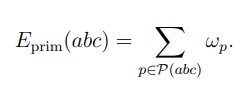
is naturally interpreted as the total prime-resonance energy of the triple (a, b, c).
Equation (1.1) can therefore be rewritten as

which states that the additive amplitude ln |c| cannot grow faster than the prime-resonance energy budget Eprim(abc) up to a factor (1 + ∈) and a bounded error. In the Primacohedron, this becomes a curvature stability condition: no Diophantine configuration is allowed to inject more “geometric amplitude” into spacetime than is supported by the activated prime modes.
Spectral Side: Explicit Formula and RH Revisited
On the spectral side, the Primacohedron encodes primes in the oscillatory part of the spectral density of Hζ. The explicit formula takes the schematic form

so that primes appear as periodic orbits with action Spm ∼ m ln p, as in the classical explicit formulae of Riemann, Weil, and their modern developments [1,2,8]. Under the Hilbert–Pólya paradigm, t is an eigenvalue of Hζ and (1.5) expresses the spectrum as an interference pattern of prime resonances, in line with the quantum-chaotic interpretations of Montgomery, Odlyzko, Berry, Keating, and Katz–Sarnak [5,12-14].
RH in this language asserts that all non-trivial zeros lie on the critical line, Re(s) = 1½ , which in the Primacohedron corresponds to the requirement that the spectral manifold has no curvature anomalies: the local curvature proxies extracted from spacing statistics remain finite and compatible with GUE universality [5,12,13]. Deviations from the critical line would appear as spectral curvature singularities, forbidden by the adelic consistency conditions that glue the local p-adic sectors into a smooth global spacetime.
Thus:
RH ⇐⇒ no curvature singularity in the spectral manifold associated with Hζ.
Diophantine Side: Heights, Radicals, And Curvature
On the Diophantine side, one typically studies heights rather than raw integers. For a rational point P on an algebraic curve, the (logarithmic) height h(P) measures arithmetic complexity, aggregating contributions from all places v of Q ,

where λv is a local height at v [15,16].
In the Primacohedron, each place v is already present as either the Archimedean sector or a p-adic sector. The adelic sum of local resonance energies

is then a natural arithmetic analogue of the total curvature of the spectral manifold. The radical rad(abc) is a particularly simple height- like quantity: it records precisely which primes contribute to the local energies, in line with the standard height interpretations of the abc conjecture and its relation to Vojta theory [3,4,11].
The abc inequality (1.4) can therefore be read as

with a small exponent overhead. A violation of abc would require an additive configuration whose emergent amplitude |c| is “too large” for the available prime energy—in the emergent-geometry picture, this is a Diophantine curvature anomaly.
Spectral–Diophantine duality diagram
The duality can be summarized qualitatively as follows. Imagine adelic Primacohedron sits at the center, encoding the operator Hζ, zeta zeros, GUE statistics, and emergent curvature of the spectral side on the left, and radical and height data for triples (a, b, c) and more general rational points, with inequalities such as abc and Vojta’s conjecture of the Diophantine side on the right [1,4,5,9-13].
Adelic coherence forbids anomalies in both directions. Spectral anomalies correspond to off-critical zeros; Diophantine anomalies correspond to height/radical configurations violating abc. The Primacohedron suggests that both kinds of anomalies are different facets of the same geometric obstruction in the adelic spectral manifold.
Towards A Joint Operator Framework for RH and abc
The most ambitious step is to embed both phenomena into a single adelic operator. On the spectral side, we have the Hilbert–Pólya-type operator Hζ and its generalizations to Dedekind and automorphic L-functions [8,17]. On the Diophantine side, heights and radicals are encoded by local contributions of primes to archimedean and non-archimedean metrics [15,16].
Definition 1.1 (Spectral–height operator). A spectral–height operator for an arithmetic object (e.g. a curve, variety, or motive) is a pair (Hspec, Hht) acting on a common adelic Hilbert space, where:
i. Hspec has spectrum related to zeros of the relevant L-function(s).
ii. Hht encodes logarithmic heights and radical-like quantities as expectation values or eigenvalues.
The Primacohedron suggests identifying Hspec with a suitable extension of Hζ and constructing Hht as an operator whose spectral measure is supported on the prime-resonance energies ωp = ln p, with multiplicities determined by Diophantine data.
Conjecture 1.2 (Curvature anomaly correspondence). Within the Primacohedron, offcritical zeros of L-functions and violations of abc correspond to curvature singularities of a unified spectral–height manifold. In particular, if the manifold admits a smooth adelic metric with bounded curvature, then both RH (for the relevant L-functions) and abc (for the corresponding Diophantine data) hold.
This conjecture formalizes the idea that the Primacohedron simultaneously controls analytic and Diophantine pathologies via a single geometric regularity condition, in the spirit of Vojta’s dictionary between value-distribution theory and Diophantine approximation [4,11].
A Toy Model: Radical Bounds from Spectral Constraints
To illustrate how spectral constraints might lead to radical bounds of abc-type, consider a simplified setting in which the prime-resonance energies ωp obey a spectral density ρ(ω) derived from the eigenvalues of a finite-dimensional approximation H (N), analogous to finite- rank random-matrix models [18,19]. Suppose that for a given triple (a, b, c), the primes dividing abc occupy a subset P (abc) of the spectrum with total energy
Assume further that emergent geometry imposes a constraint of the form

where A is a geometric observable proportional to the effective “size” of the configuration induced by (a, b, c) (for example, a boundary area or a curvature-integrated measure). If we can relate A to the additive amplitude via
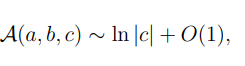
then (1.9) becomes a logarithmic abc-type inequality.
While this toy model suppresses many subtleties (heights on curves, dependence on number fields, etc.), it indicates a plausible mechanism: geometric bounds on curvature and area, when translated into the language of prime- driven spectral energies, become Diophantine bounds on radicals and heights, in the spirit of the height-inequality philosophy of Vojta [4,11].
Roadmap from Primacohedron to abc
We conclude this section with a concrete programme:
1. Complete RH for Hζ and its generalizations. Establish the self-adjointness and spectral completeness of Hζ and extended operators for Dedekind and automorphic L-functions, showing that all non-trivial zeros lie on their critical lines [5,8,17].
2. Construct an adelic height operator. Define Hht whose local components encode logarithmic heights and radicals (e.g. via expectation values associated with local padic and archimedean metrics) [15,16].
3. Couple spectral and height operators via curvature. Introduce a unified information-geometry metric on the space of joint spectral– height distributions and derive curvature flow equations ensuring bounded curvature, inspired by ideas from information geometry and random-matrix theory [18,19].
4. Identify abc as a curvature bound. Show that violations of abc would force curvature singularities in the joint manifold, contradicting the existence of smooth solutions to the spectral–height flow. This would upgrade the toy inequality (1.9) into a rigorous Diophantine theorem, in the spirit of Vojta’s conjectural framework [4,11].
5. Extend to Vojta’s conjecture. Generalize the argument to global height inequalities on curves and higher-dimensional varieties, interpreting Vojta-type inequalities as global curvature-balance conditions on the adelic Primacohedron [4,11,15,16].
In summary, the Primacohedron suggests that RH and abc are not isolated conjectures but complementary projections of a single adelic regularity principle. The next section develops the motivic and Vojta-geometric aspects of this principle in more detail.
Motivic Extensions and Vojta Geometry
The Primacohedron has so far been developed primarily for the Riemann zeta function and its Dedekind generalizations. In order to fully capture the Diophantine complexity encoded by abc and Vojta’s conjecture, we must extend the framework to motivic L-functions and their associated height theory. This section sketches such an extension, motivated by the Langlands programme and the theory of motives [17,20-22].
Motivic L-Functions in An Adelic Operator Setting
Let M be a pure motive over Q (or a suitable approximation, such as an algebraic variety endowed with a compatible cohomology theory). The associated motivic L-function L(s,M) is expected to factor as an Euler product over primes,
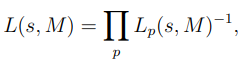
where Lp(s, M) encodes the Frobenius action on the local cohomology of M at p. The Langlands programme suggests that, in favourable cases, L(s, M) should match an automorphic L-function L(s, π) for a cuspidal automorphic representation π on a reductive group [17,21,23].
In the Primacohedron, the local Frobenius eigenvalues contribute additional primeindexed resonances atop the basic zeta-resonance ωp = ln p. Thus, each motive M defines a refined adelic operator
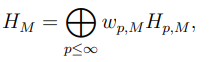
whose spectrum is conjecturally related to the zeros of L(s, M), paralleling the conjectural spectral interpretations of motivic L-functions [20,21].
Height Curvature and Vojta’s Dictionary
Vojta’s conjecture relates the distribution of rational points on varieties to height functions and discriminants, providing a far-reaching generalization of classical results such as the Mordell conjecture. Roughly, it asserts that certain height inequalities—involving canonical heights, discriminants, and local contributions—govern the structure of Diophantine sets [4,11].
In the Primacohedron, heights may be understood as curvature densities on the adelic manifold. For a rational point P on a variety X, we associate a spectral–height profile ρP (H) whose moments encode:
• spectral data from HM (zeros of L(s, M)), and
• height data from the local contributions of P [15,16].
The Fisher–Rao metric on the space of such profiles induces an information-geometric curvature tensor whose components correspond to second-order variations of both spectral and height quantities. Vojta-type inequalities can then be interpreted as conditions that prevent curvature from blowing up along Diophantine directions, in line with his dictionary between Nevanlinna theory and Diophantine approximation [4,11].
Towards A Motivic Primacohedron
We may summarize the desired structure as follows:
1. To each motive M (or variety X) we associate a motivic Primacohedron, an adelic spectral manifold encoding both the zeros of L(s, M) and the height distribution of rational points on X [4,11,20,22].
2. The geometric data of the Primacohedron (curvature, entropy, complexity) controls both the analytic behaviour of L(s, M) and the Diophantine behaviour of rational points.
3. Global regularity of the motivic Primacohedron (bounded curvature, absence of singularities) implies RH-type statements for L(s, M) and Vojta-type inequalities for heights on X [3,4,11,16].
In this motivic setting, the abc conjecture appears as the simplest instance of a Vojtatype inequality for X = P1 minus three points, while RH appears as the simplest instance of a spectral regularity statement for the Riemann zeta function. The Primacohedron unifies these cases by viewing them as different shadows of the same adelic informationgeometry object.
Outlook: From Number Fields to Arithmetic Spacetime
The extension to motives suggests a broader perspective: the Primacohedron should not be seen solely as a model for the physical spacetime of general relativity, but also as an arithmetic spacetime whose points correspond to motives and whose curvature encodes both analytic and Diophantine complexity. In this picture:
• RH and its generalizations enforce spectral regularity of arithmetic spacetime [1,5].
• abc and Vojta’s conjecture enforce Diophantine regularity of the same spacetime [3,4,9-11].
• The absence of curvature anomalies in this arithmetic spacetime is the unifying principle behind both kinds of conjectures.
A complete theory of the motivic Primacohedron would thus constitute not only a spectral route to RH, but also a geometric route to abc and Vojta’s conjecture, all embedded in a single adelic information-geometry framework.
Appendix: Radicals as Spectral–Energy Sums of Prime Resonances
In the Primacohedron, each prime p corresponds to a fundamental resonance mode with frequency

The logarithm of the radical is therefore

which is naturally interpreted as the total spectral energy of the prime resonances activated by n. We formalize this by defining the prime- resonance energy of n,
img src=" https://www.opastpublishers.com/scholarly-images/9950-692d5816e5a94-primacohedron-riemann-hypothesis-and-abc-conjecture.png" width="500" height="100">
Equation (A.2) then shows that

For an abc-triple (a, b, c) with a + b = c and (a, b, c) = 1, the abc conjecture may be written as as

in Eq. (1.4). In the emergent-geometry interpretation, the quantity Eprim(abc) measures the total prime-resonance energy available to support the configuration (a, b, c), while ln |c| captures the effective geometric amplitude induced by the additive relation, in line with the height-theoretic viewpoint on abc [3,4,11,24].
A violation of abc would therefore correspond to a configuration whose geometric amplitude exceeds the admissible range allowed by the prime-resonance energies. In the Primacohedron, such a configuration would induce a curvature singularity in the adelic manifold. The abc conjecture can thus be viewed as the statement that no such Diophantine curvature singularities exist, mirroring the role of RH in forbidding spectral curvature singularities [1,5,12,13].
References
- Edwards, H. M. (1974). Riemann’s zeta function. New York, NY: Academic Press.
- Titchmarsh, E. C. (1986). The Theory of the Riemann Zeta-Function (2nd ed., revised by D. R. Heath-Brown). Oxford, UK: Oxford University Press.
- Silverman, J. H. (1994). Advanced Topics in the Arithmetic of Elliptic Curves. New York, NY: Springer.
- Vojta, P. (1987). Diophantine approximations and value distribution theory. In Value Distribution Theory and Its Related Topics (pp. 111–124). Basel: Birkhäuser.
- Katz, N. M., & Sarnak, P. (1999). Random Matrices, Frobenius Eigenvalues, and Monodromy. Providence, RI: American Mathematical Society.
- Connes, A. (1999). Trace formula in noncommutative geometry and the zeros of the Riemann zeta function. Selecta Mathematica, New Series, 5(1), 29–106.
- Berry, M. V., & Keating, J. P. (1999). H= xp and the Riemann zeros. In Supersymmetry and trace formulae: chaos and disorder (pp. 355-367). Boston, MA: Springer US.
- Iwaniec, H., & Kowalski, E. (2004). Analytic Number Theory. Providence, RI: American Mathematical Society.
- Masser, D. W. (1985). Open problems. In Proceedings of the Symposium on Diophantine Problems (Informal problem list introducing the abc conjecture).
- Oesterlé, J. (1987–1988). Nouvelles approches du théorème de Fermat. Séminaire Bourbaki (Exposé 694, pp. 165–186).
- Vojta, P. (1997). Diophantine Approximations and Value Distribution Theory. Berlin, Germany: Springer.
- Montgomery, H. L. (1973). The pair correlation of zeros of the zeta function. In Proceedings of Symposia in Pure Mathematics, Vol. 24 (pp. 181–193). American Mathematical Society.
- Odlyzko, A. M. (1987). On the distribution of spacings between zeros of the zeta function. Mathematics of Computation, 48(177), 273–308.
- Berry, M. V., & Keating, J. P. (1999). The Riemann zeros and eigenvalue asymptotics. SIAM review, 41(2), 236-266.
- Silverman, J. H. (1986). The Arithmetic of Elliptic Curves. New York, NY: Springer.
- Bombieri, E., & Gubler, W. (2006). Heights in Diophantine geometry (No. 4). Cambridge university press.
- Gelbart, S. (1975). Automorphic Forms on Adele Groups. Princeton, NJ: Princeton University Press.
- Mehta, M. L. (2004). Random Matrices (3rd ed.). Amsterdam: Elsevier.
- Forrester, P. J. (2010). Log-Gases and Random Matrices. Princeton, NJ: Princeton University Press.
- Deligne, P. (1979). Valeurs de fonctions L et périodes d’intégrales. In Automorphic Forms, Representations and L-Functions – Part 2 (Proc. Sympos. Pure Math., Vol. 33, Part 2, pp. 313–346). American Mathematical Society.
- Borel, A. (1979). Automorphic L-functions, In: Automorphic forms, representations and L-functions. In Proc. Sympos. Pure Math.(Vol. 33, pp. 27-61). Amer. Math. Soc., Providence.
- Scholl, A. J. (1990). Motives for modular forms. Inventiones Mathematicae, 100(2), 419–430.
- Langlands, R. P. (1970). Problems in the theory of automorphic forms. In Lectures in Modern Analysis and Applications III (pp. 18–61). Springer.
- Silverman, J. H. (2006). Integral points on curves and surfaces. In Number Theory: Proceedings of the Journées Arithmétiques held in Ulm, FRG, September 14–18, 1987 (pp. 202-241). Berlin, Heidelberg: Springer Berlin Heidelberg.