
Review Article - (2026) Volume 9, Issue 2
Post-Traumatic Stress Disorder After Cardiac Tamponade and Emergency Sternotomy: A First-Person Account in Prose and Musical Compositions of Autonomic Injury, Medical Trauma, and the Long Arc of Recovery

Received Date: Apr 13, 2026 / Accepted Date: May 08, 2026 / Published Date: May 20, 2026
Copyright: ©2026 Bruce H. Knox. This is an open-access article distributed under the terms of the Creative Commons Attribution License, which permits unrestricted use, distribution, and reproduction in any medium, provided the original author and source are credited.
Citation: Knox, B. H. (2026). Post-Traumatic Stress Disorder After Cardiac Tamponade and Emergency Sternotomy: A First-Person Account in Prose and Musical Compositions of Autonomic Injury, Medical Trauma, and the Long Arc of Recovery. Adv Neur Sci, 9(2), 01-05.
Abstract
Background: Life-threatening medical events increasingly are recognised not only as physiological crises but as existential ruptures. Post- traumatic stress disorder (PTSD) may follow myocardial infarction, intensive care admission, or emergency surgery; yet PTSD arising from cardiac procedural catastrophe remains under-examined within cardiology and surgical literature.
Case Narrative: This article presents a first-person account of PTSD following catheter ablation for left ventricular outflow tract premature ventricular contractions complicated by acute cardiac tamponade and emergency sternotomy (15 October 2021). Psychological symptoms emerged gradually and evolved alongside persistent autonomic dysfunction, including orthostatic hypotension, chronotropic impairment, gastrointestinal dysmotility, and reduced stress tolerance. Over four years, recovery unfolded through trauma-informed medical care, autonomic stabilisation, relational repair, and somatically attuned rehabilitation.
Discussion: This narrative argues that medical PTSD is not solely psychological but neurobiologically coherent. Catastrophic haemodynamic collapse may produce convergent autonomic, inflammatory, and fear-conditioning cascades that entangle body and memory. The case illustrates how iatrogenic crisis can fracture trust, how dysregulated physiology can perpetuate traumatic encoding, and how healing requires restoration of both bodily regulation and relational safety.
Conclusion: Survival marked the beginning rather than the end of recovery. Recognition of medical PTSD as a legitimate and embodied consequence of procedural catastrophe may reduce secondary harm and promote integrative care.
Keywords
Medical Trauma, Post-Traumatic Stress Disorder, Cardiac Tamponade, Autonomic Dysfunction, Iatrogenic Injury, Neurovisceral Integration, Trauma-Informed Care, Narrative Medicine
Introduction: When Survival Is Not the End
Modern cardiology routinely rescues patients from the brink of death. Yet survival does not guarantee restoration. For some, the body heals while the nervous system does not. Post-traumatic stress disorder (PTSD), as defined in the DSM-5-TR, follows exposure to actual or threatened death or serious injury. While historically associated with combat or interpersonal violence, medical trauma increasingly meets Criterion A when sudden loss of bodily control, invasive intervention, and perceived inevitability of death converge. Cardiac tamponade complicated by emergency open-heart surgery represents one such convergence. The literature acknowledges postoperative depression and anxiety, yet persistent PTSD remains under-recognised and often misattributed to fragility, maladaptive coping, or somatisation. The humanistic dimension—the meaning of surviving harm that occurred during an attempt to heal— remains insufficiently explored. This article offers a first-person account of PTSD following procedural catastrophe, interwoven with current understandings of autonomic neurobiology. It asks not only what happened to the heart, but what happened to the person who experienced it.
Integrating Narrative Medicine and Musical Expression
This manuscript is presented in two parallel but interdependent forms:
(1) a clinical–scientific narrative describing autonomic injury and post-traumatic stress, and
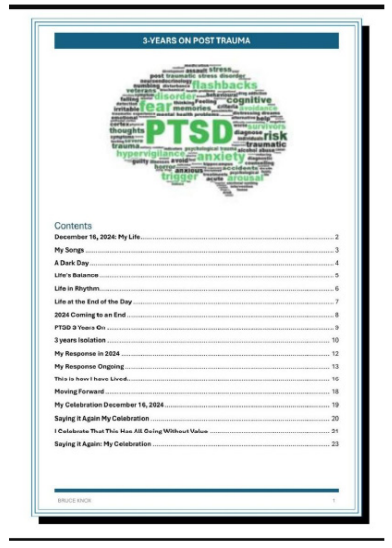
(2) a structured collection of original musical compositions (Appendix A). These are not separate artefacts. They represent two modes of observing the same phenomenon. The scientific narrative seeks to describe mechanisms: haemodynamic collapse, autonomic dysregulation, neurovisceral integration, and trauma encoding. It translates experience into concepts that can be measured, compared, and situated within existing literature. The musical narrative, by contrast, captures what precedes and exceeds measurement. It expresses the felt experience of dysautonomia, fatigue, fear, isolation, recovery, and meaning-making—often in ways that language alone cannot adequately convey. The songs emerged not as retrospective embellishments, but contemporaneously with the lived experience of illness and recovery. They functioned as a form of self-regulation, narrative reconstruction, and emotional processing. In this sense, they may be understood as embodied records of autonomic and psychological states across time.
Together, these two modalities—scientific and musical—create a more complete account of illness:
• The body as measured (blood pressure, heart rate, physiology)
• The body as experienced (fatigue, fear, instability, hope) Neither alone is sufficient.
The Songs as Reflective Clinical Data
The following artistic works are presented as reflective data— subjective yet structured expressions that correspond to identifiable physiological and psychological states.
Across the collection, recurring themes align closely with known features of autonomic dysfunction and PTSD:
• Fatigue and orthostatic intolerance
• Hypervigilance and threat anticipation
• Loss of bodily trust and identity disruption
• Isolation and relational rupture
• Gradual re-regulation and recovery
For example:
• Songs such as “A Dark Day” and “Life at the End of the Day” reflect profound autonomic exhaustion and multi-system dysregulation.
• “PTSD 3 Years On” captures persistent hyperarousal and fear conditioning.
• “My Response in 2024” and “My Response Ongoing” illustrate adaptive strategies consistent with trauma-informed recovery.
• “My Celebration” represents reintegration, meaning-making, and physiological stabilisation.
Importantly, the temporal structure of the songs mirrors the longitudinal trajectory of recovery, offering insight into how symptoms evolve—not just clinically, but experientially.
Why Music Matters in Medical Trauma
Severe medical events disrupt not only physiology but narrative coherence. In trauma, memory is often encoded somatically and fragmentarily. Patients may struggle to articulate their experience in linear, clinical language. Music provides an alternative pathway:
• It allows non-linear expression, consistent with how trauma is encoded
• It supports emotional regulation through rhythm and repetition
• It enables integration of body sensation and meaning
• It restores a sense of agency and authorship
In this case, musical composition functioned as:
• A regulatory tool during periods of autonomic instability
• A narrative bridge between fragmented memory and coherent understanding
• A means of communicating lived experience to others Thus, the inclusion of music is not decorative—it is methodologically relevant.
Reading This Manuscript
The reader is invited to engage with this work in one of three ways:
1. Clinically – focusing on the physiological and neurobiological narrative
2. Experientially – engaging with the songs as expressions of lived illness
3. Integratively – moving between both to understand how body and experience interact
Appendix A contains the full musical collection, presented as a structured “book within the paper.” A digital flipbook version is also available for audio-visual engagement .
The Event: A Body in Collapse
On 15 October 2021, I underwent a planned catheter ablation for symptomatic left ventricular outflow tract premature ventricular contractions. During the procedure, hypotension developed abruptly. Within minutes, cardiovascular collapse followed.
Echocardiography confirmed acute cardiac tamponade.
Pericardiocentesis was attempted but insufficient. Emergency sternotomy and open surgical repair were undertaken under cardiopulmonary bypass.
The subjective experience was not cinematic but visceral: a rapid erasure of control, an overwhelming bodily surge, the certainty that death was imminent. Time narrowed. Language dissolved.
The body entered survival.
The surgery saved my life. Yet something within the regulatory architecture of that life had changed.
The Slow Emergence of Trauma
PTSD did not declare itself immediately. In the months following discharge, I focused on physical healing. Only later did intrusive phenomena surface.
Intrusive Memory Without Narrative
Re-experiencing was predominantly sensory and somatic rather than visual. It manifested as autonomic flashes: sudden internal surges, fragmentary bodily recall, physiological re-enactments unaccompanied by coherent narrative memory. Hospital sounds, cardiac monitor rhythms, even subtle fluctuations in blood pressure acted as triggers. Contemporary trauma research suggests that extreme stress impairs hippocampal contextualisation, leaving memory encoded in sensory fragments. My experience mirrored this model: the body remembered before language did.
Hyperarousal as Physiology
Persistent hyperarousal emerged—sleep fragmentation, exaggerated startle, vigilance toward bodily sensation. Yet these symptoms overlapped profoundly with concurrent autonomic instability. Orthostatic hypotension, blunted chronotropic response, gastrointestinal dysmotility, and blood-pressure lability persisted long after surgical healing. Each autonomic fluctuation was interpreted by my nervous system as renewed threat. Physiology reinforced fear, fear amplified physiology. This reciprocal loop blurred distinctions between psychiatric and cardiologic sequelae.
Autonomic Injury and Neurobiological Coherence
The prevailing view of PTSD as a disorder of memory is incomplete. Increasingly, it is conceptualised as a disorder of threat detection and regulation. Peri-procedural haemodynamic collapse and cardiopulmonary bypass likely triggered intense sympathetic discharge, inflammatory cascades, and subsequent parasympathetic dysregulation. Clinical features suggested baroreflex impairment—an inadequate heart-rate response to hypotension, signalling persistent vulnerability. According to the neurovisceral integration model, diminished prefrontal inhibition of limbic circuits allows exaggerated autonomic reactivity. In practical terms, my nervous system learned danger too well and struggled to relearn safety. Thus, PTSD in this context was not an abstract psychological reaction. It was embodied, sustained by dysregulated afferent signalling from a cardiovascular system no longer predictably buffering stress.
Surgical Misadventure as Dual Trauma
Two traumas occurred.
The first was physiological: cardiac tamponade and near death. The second was relational: harm occurred within a healthcare setting presumed safe.
Iatrogenic injury carries existential weight. Trust in medicine— an implicit covenant—fractures when life-saving intervention becomes life-threatening crisis. Even when clinicians act heroically, the experience may encode as betrayal at a neurobiological level. Re-entering medical environments activated conditioned responses through sensory cues: antiseptic smell, monitor tones, procedural language. These were not cognitive decisions but embodied reflexes.
Trust, once disrupted, required deliberate rebuilding.
Management: Relearning Safety
Recovery unfolded over years rather than months.
Trauma-Informed Reframing
A pivotal shift occurred when symptoms were reframed as biologically coherent survival responses rather than psychological weakness. Psychoeducation reduced shame and secondary injury. Safety, predictability, transparency, and restoration of agency became foundational therapeutic principles.
Autonomic Stabilisation
Gradual cardiovascular stabilisation—improved blood-pressure buffering, enhanced heart-rate variability—paralleled reduction in hyperarousal. As baseline physiological noise diminished, intrusive phenomena attenuated organically.
Somatically Attuned Integration
Formal psychotherapy was supportive but not central. Emphasis rested on:
• Nervous-system-safe pacing
• Breath regulation
• Interoceptive tolerance Gentle re-exposure to previously threatening contexts Recovery did not mean erasing memory, it meant contextualising it.
Outcome: The Long Arc
Four years after the event, intrusive symptoms have resolved. Medical settings no longer provoke threat responses. Autonomic symptoms persist intermittently but are manageable.
The memory remains, but it is integrated rather than invasive.
Survival was immediate. Restoration was gradual.
Discussion: Medicine, Meaning, and the Body That Remembers
This case underscores several implications for medical humanities and clinical practice:
• Medical PTSD is real and under-recognised.
• Autonomic injury may sustain trauma responses long after structural repair.
• Physiological dysregulation and psychological distress are interwoven rather than separate domains.
• Trauma-informed care is not optional in procedural medicine—it is essential.
In technologically advanced medicine, attention naturally gravitates toward what can be measured: ejection fraction, troponin levels, surgical repair integrity. Yet what lingers may be invisible—encoded in autonomic reflex arcs and conditioned fear circuits.
The body remembers collapse even after it stands again.
Conclusion: Survival as Beginning
On 15 October 2021, emergency surgery preserved my life. The years that followed required relearning how to inhabit that life within a nervous system recalibrated toward danger.
Recovery was not linear. It unfolded on neural timescales measured in years. It required relational repair as much as physiological stabilisation.
If this narrative contributes to earlier recognition of medical PTSD, to gentler postoperative conversations, or to more integrative cardiology practice, then its telling serves a purpose.
In medical humanities, story restores what data cannot.
In trauma recovery, integration restores what survival alone cannot.
Appendix A - Introduction
The Book of Songs: A Musical Narrative of PTSD, Autonomic Injury and Recovery
This appendix presents a curated collection of original songs composed over the course of recovery following cardiac procedural catastrophe and subsequent autonomic dysfunction. These works are not ancillary to the manuscript—they are integral to it.
They represent a longitudinal, first-person record of illness as lived, capturing dimensions of experience that are often inaccessible to conventional clinical description.
The Origin of the Songs
The songs emerged organically during periods of instability, reflection, and gradual recovery. They were written not with publication in mind, but as a means of:
• Processing overwhelming physiological sensations
• Making sense of fragmented traumatic memory
• Regaining a sense of internal coherence
• Expressing states for which clinical language was insufficient In this sense, the songs functioned as both coping mechanism and observational record.
Music as a Mirror of the Autonomic Nervous System
Across the collection, musical elements reflect underlying physiological states:
• Rhythm mirrors cardiac and autonomic variability
• Repetition reflects looping patterns of hypervigilance
• Tone and imagery correspond to states of fatigue, instability, or recovery
• Structure evolves alongside improving regulation Periods of dysregulation are often characterised by:
• Fragmented imagery
• Repetitive phrasing
• Themes of instability, collapse, or fear
Later compositions demonstrate:
• Greater coherence
• Forward movement
• Emergence of hope and integration
Thus, the songs can be read as an externalisation of internal physiological and psychological states over time.
Thematic Structure of the Collection
The songs may be broadly understood across four phases:
• Collapse and Disorientation
(e.g., “A Dark Day”, “December 16, 2024: My Life”)
These works capture the immediacy of dysfunction—fatigue, confusion, loss of control, and the overwhelming burden of symptoms.
• Recognition and Struggle
(e.g., “PTSD 3 Years On”, “3 Years Isolation”)
Themes of hypervigilance, fear, uncertainty, and isolation dominate. The body is experienced as unreliable and threatening.
• Adaptation and Response
(e.g., “My Response in 2024”, “My Response Ongoing”)
These songs introduce recovery strategies: breathing, pacing, movement, relational support, and medical guidance.
• Integration and Meaning
(e.g., “My Celebration”, “This is How I Have Lived”)
Later works reflect resilience, acceptance, and the re-establishment of identity. The narrative shifts from survival to meaning.
Music as Communication
A recurring theme within the collection is the sense that these songs were initially “unheard”:
“These songs are mine, but no one hears…”
This reflects a broader clinical reality: patients with autonomic dysfunction and medical trauma often struggle to have their experiences recognised or understood.
By presenting these works within a formal manuscript, the intention is to:
• Give voice to that experience
• Bridge the gap between patient and clinician understanding
• Contribute to the field of medical humanities
How to Engage with Appendix A
Readers may approach this collection in different ways:
• As poetry and music, engaging emotionally and reflectively
• As clinical insight, identifying symptom patterns within the lyrics
• As longitudinal data, observing progression over time There is no single correct reading. The value lies in the interplay between interpretation and recognition.
Closing Reflection
If the scientific narrative explains what happened,
These songs reveal what it felt like.
Together, they form a more complete account of illness—
one that honours both the measurable and the lived.
Please click on the following flipbook link, and the musical repository will open. Click on the bottom right-hand corner, and the page will turn, and the music for each song will play.
https://heyzine.com/flip-book/94ce3b7bd1.html