

Journal of Electrical Electronics Engineering(JEEE)
ISSN: 2834-4928 | DOI: 10.33140/JEEE
Impact Factor: 1.2


Research Article - (2026) Volume 5, Issue 2
Physical Phenomena are Created and Controlled by Nature
Received Date: Feb 16, 0026 / Accepted Date: Apr 13, 2026 / Published Date: Apr 27, 2026
Copyright: ©2026 Viktar Yatskevich. This is an open-access article distributed under the terms of the Creative Commons Attribution License, which permits unrestricted use, distribution, and reproduction in any medium, provided the original author and source are credited.
Citation: Yatskevich, V. (2026). Physical Phenomena are Created and Controlled by Nature. J Electrical Electron Eng, 5(2), 01-30.
Abstract
Contemporary physics relies extensively on mathematical formalisms to describe natural phenomena, often achieving remark- able predictive success. However, the relationship between mathematical description and physical explanation remains a sub- ject of ongoing debate. In many cases, mathematical models are treated not only as tools for representation but also as implicit substitutes for the underlying physical mechanisms, which can obscure questions of causality and physical origin.
This article examines this methodological issue using two fundamental physical phenomena—gravity and the tunneling effect— as representative examples. Both phenomena are commonly described by highly successful mathematical frameworks, namely general relativity and quantum mechanics, yet their physical interpretations remain incomplete or debated. The work argues that predictive accuracy alone does not necessarily constitute a full physical explanation and that mathematical consistency should be complemented by physically grounded mechanisms based on observable properties of matter and interaction.
Alternative descriptions of gravity and the tunneling effect are proposed, grounded in experimental observations and established physical properties of matter at macroscopic and microscopic scales. These descriptions aim to clarify the physical processes underlying the phenomena while remaining compatible with empirical data. The proposed framework does not reject existing theories but seeks to supplement them by addressing conceptual gaps related to causality, physical mechanism, and interpreta- tion. Such an approach may contribute to a more physically transparent understanding of fundamental phenomena and provide new directions for theoretical and applied research.
Keywords
Physical Phenomena, Mathematical Model, Physical Theory of Gravitation General Theory of Relativity (GTR), Electromagnetic Field, Pulsating Electric and Magnetic Fields, Tunnel Effect, Potential Barrier, Coulomb Barrier, Classical Physics, Quantum Mechanical Process, Uncertainty Principle, Local Area, Microparticle, Energy
The Problem of Describing Physical Phenomena
Modern physics investigates a wide range of natural phenomena and establishes relationships between observable processes and fundamental physical principles. These relationships are commonly expressed in the form of physical laws or mathematical equations. In its most general form, a causal relationship may be represented as a logical implication,
X ⇒ Y, (1)
meaning that the occurrence of event X leads to outcome Y. Physical processes are typically characterized by chain causality, in which the result of one interaction becomes the cause of the subsequent one.
X1 → X2 → X3 → X4. (2)
Examples of such causal chains include field–particle interactions (field → force → motion → change in potential), thermodynamic processes (heating → expansion → pressure variation), and phenomena such as tunneling (particle energy → interaction with a potential barrier → transmission or reflection).
All physical phenomena arise within a unified natural framework and are governed by the same fundamental principles, regardless of scale. The motion of galaxies and planets, nuclear reactions in stars, and microscopic processes within atomic nuclei are manifestations of this unity. The primary distinction between phenomena lies not in their origin, but in the scale at which they occur and, in the methods traditionally used to describe them.
A physically meaningful explanation of a phenomenon should therefore relate observable events to changes in matter and energy using established physical concepts. Empirical investigation provides experimental data, from which regularities are identified and subsequently expressed in mathematical form. Mathematical modeling plays an essential role in this process by enabling quantitative predictions and comparison with experimental results.
From a methodological perspective, contemporary research approaches to physical phenomena may be broadly grouped into three categories:
(i) Observation, measurement, and explanation based on experimentally verified physical laws, such as classical mechanics, electrodynamics and thermodynamics.
(ii) Explanations that invoke additional physical assumptions or entities whose direct experimental verification remains limited, including concepts such as spacetime curvature or wave–particle duality.
(iii) Descriptions based primarily on mathematical formalisms, where the mathematical structure itself provides the main explanatory framework, as is often the case in quantum mechanics.
Difficulties arise when explanations relying on approaches (ii) and (iii) are interpreted as complete physical accounts rather than effective descriptions. In such cases, the mathematical model may acquire conceptual priority over the physical processes it represents. While mathematical models are highly successful in predicting experimental outcomes, they do not necessarily reveal the underlying physical mechanisms responsible for the observed phenomena.
This situation can lead to a methodological inversion, in which effects appear to determine causes, and physical interpretation becomes secondary to formal consistency. As a result, theoretical research may focus predominantly on refining mathematical structures rather than clarifying the physical origin of interactions. Contemporary efforts to construct theories such as quantum gravity illustrate this tendency, where mathematical unification is often pursued despite unresolved conceptual tensions.
The purpose of mathematical modeling is to describe observed dependencies without replacing the physical content of the phenomenon itself. When the distinction between description and physical explanation becomes blurred, the mathematical model risks being identified with the phenomenon rather than serving as its representation. This issue is examined in the present work using gravity and the tunneling effect as illustrative examples, where successful mathematical theories coexist with ongoing debates regarding their physical interpretation [1,2].
Gravitation
Problems of Modern Theories of Gravitation
In classical physics, gravitational interaction is described by Newton’s law of universal gravitation, which successfully accounts for a wide range of macroscopic phenomena. This law establishes a quantitative relationship between interacting masses and accurately predicts gravitational forces under many conditions. However, while Newtonian gravity characterizes gravitational interaction phenomenologically, it does not specify a physical mechanism responsible for the generation and transmission of the gravitational field:

where G is the gravitational constant 6.67430•10−11 m³/(kg•s²).
The essence of this theory of gravity is that the ability to generate a force field in the surrounding space, called a gravitational field, is considered a property inherent in every particle that has mass. However, this law, like subsequent works, does not reveal the physical basis of gravity and does not explain the mechanism of gravitational interaction between material bodies [3].
Modern theories of gravitation can be broadly divided into two principal groups.
The first group interprets gravity as a geometric effect associated with the properties of spacetime, as formulated in general relativity (GTR) and related approaches. In this framework, gravity is not treated as a force in the conventional sense but as a manifestation of spacetime curvature produced by mass–energy. Einstein’s field equations relate spacetime geometry to the energy–momentum tensor, providing a mathematically consistent and empirically successful description of gravitational phenomena on astrophysical and cosmological scales [4].
Conceptually, Einstein's equations can be represented as an equality between geometry (left side) and energy (right side):
Rμυ – ½ R qμυ = 8 π G Tμυ/C4 (4)
where Rμυ is the Ricci tensor, qμυ is the metric tensor, Tμυ is the energy-momentum tensor.
The task of solving equations (2) is to find an explicit form of the metric tensor qμυ that fully characterizes the geometry of space-time based on the energy-momentum tensor Tμυ and initial conditions. Gravity is identified with the metric tensor of Riemannian space in general relativity, which leads to the rejection of the gravitational field as a physical field with a transition to the geometry of space with curvature of geodesic lines. GTR does not explain how the mass of matter curves space, which is fundamentally inconsistent with quantum mechanics. Attempts to represent space as discrete in a few other complementary theories also have no physical explanation.
Despite its remarkable predictive power, general relativity remains a geometric description. The physical origin of spacetime curvature and the mechanism by which mass–energy produces such curvature are not specified within the theory itself. Moreover, the reconciliation of this geometric framework with quantum descriptions of matter continues to present conceptual and theoretical challenges.
The second group includes alternative gravitational theories— relativistic, quantum, covariant, and phenomenological models— that treat gravity as a physical field propagating in flat or weakly curved spacetime. These approaches typically introduce additional assumptions, such as hypothetical interaction carriers, effective media, modified dynamical laws, or vacuum structures. While such theories provide valuable perspectives and sometimes recover known experimental results within certain limits, their physical interpretation and experimental verification remain subjects of ongoing investigation [3-7].
Key Points
Despite significant conceptual differences, existing theories of gravity share a common methodological feature: they describe observable gravitational phenomena primarily through mathematical formalisms. In this sense, they may be regarded as effective models that successfully reproduce experimental and observational data within specific domains of applicability.
However, the reliance on mathematical consistency and predictive success can obscure unresolved questions concerning physical mechanism and causality. In many cases, gravitational phenomena are described without a clear physical picture of how gravitational interaction arises or how it propagates between material bodies. As a result, gravity is often understood through its mathematical representation rather than through an explicit physical process.
This situation reflects a broader methodological tendency in contemporary theoretical physics, in which mathematical description is sometimes interpreted as a complete physical explanation. The distinction between physical mechanism and mathematical representation may thereby become blurred, leading to an implicit inversion of explanatory priority.
The task of mathematical modeling in physics is to describe observed regularities and dependencies without replacing the physical content of the phenomena themselves. When a model is treated as the essence of a phenomenon rather than as its representation, conceptual difficulties arise. These difficulties are particularly evident in attempts to unify gravitational theory with quantum mechanics, where mathematical unification is often pursued despite unresolved questions concerning physical interpretation.
In the present work, gravity is examined as an example of a fundamental physical phenomenon for which highly successful mathematical descriptions coexist with ongoing debates regarding physical origin, mechanism, and causality.
General Relativity as a Description of Gravity
General relativity (GTR) is currently the most widely accepted theoretical framework for describing gravitational phenomena. Within this theory, gravity is interpreted as a manifestation of spacetime geometry, where the presence of mass–energy determines the curvature of spacetime, and material bodies follow geodesic trajectories in this curved geometry. This approach represents a profound conceptual shift from classical force-based descriptions to a geometric formulation of gravitation [8].
Mathematically, Einstein’s field equations establish a relationship between spacetime geometry and the distribution of energy and momentum. Solutions of these equations successfully account for a broad range of gravitational phenomena, including planetary motion, gravitational lensing, time dilation, and the dynamics of compact astrophysical objects. The predictive success of general relativity has been confirmed by numerous experimental tests and astronomical observations.
At the same time, general relativity provides a geometric description rather than a physical mechanism for gravitational interaction. The theory does not specify how mass–energy physically produces spacetime curvature, nor does it describe gravity as a field with identifiable carriers or local dynamical processes in the conventional physical sense. In this regard, gravity in general relativity is represented through mathematical structure rather than through an explicit interaction mechanism.
This feature highlights an important methodological distinction: general relativity explains gravitational phenomena by means of geometric relations, not by identifying a physical process responsible for gravitational interaction. While this geometric interpretation is internally consistent and empirically successful, it leaves open questions concerning the physical origin of spacetime curvature and the nature of gravitational interaction at microscopic scales.
The geometric formulation of gravity also introduces conceptual challenges when considered alongside quantum theory. In quantum mechanics, physical interactions are typically described in terms of fields, quanta, and local dynamical processes, whereas spacetime geometry in general relativity is treated as a continuous classical entity. The absence of a clear physical mechanism for gravity complicates attempts to reconcile these two frameworks within a unified theory [9].
From a methodological perspective, general relativity exemplifies a broader tendency in modern physics in which a highly successful mathematical model is often treated as a complete physical explanation. In this context, the mathematical description of spacetime geometry becomes identified with the physical nature of gravity itself. While such identification is operationally effective, it may obscure alternative physical interpretations that seek to describe gravity as a physical field or process.
Thus, general relativity can be regarded as a powerful and precise mathematical description of gravitational phenomena, while the question of the physical mechanism underlying gravity remains open. This observation motivates the exploration of complementary approaches that aim to retain the empirical success of general relativity while providing a physically motivated description of gravitational interaction.
All theories describe the manifestations of gravity using various mathematical methods and can be interpreted as mathematical models.
Current Understanding of the Physical Processes of the Tunnel Effect
Tunnel Effect
The tunnel effect is a phenomenon that manifests itself in the ability of an elementary particle to penetrate a potential barrier formed by the force field of other particles. The tunnel effect means that a certain part of charged particles, like electrons or protons, can pass (tunnel) through a potential barrier that's higher than the total energy of these particles [10,11].
The tunnel effect explains many observed phenomena and underlies many processes in atomic and molecular physics, atomic nucleus physics, solid state physics, chemistry, etc. [12].
Modern physics considers the tunneling effect to be a phenomenon of an exclusively quantum nature, impossible in classical mechanics and even completely contradicting it. According to these ideas, if the energy of microparticles is insufficient to overcome the potential barrier, then there is a probability of their appearance in the region of space beyond the Coulomb barrier without expending energy.
Formation of the Coulomb Barrier
The properties of the tunnel effect are governed by the Coulomb barrier, which is created by the electric fields of charged particles and their interactions with other charged entities. The Coulomb barrier is formed by a single charged entity, such as the nucleus of a hydrogen atom, or by a system of identically charged microparticles [12].
For example, the Coulomb barrier of the nucleus is defined as the energy barrier that must be overcome by a positively charged particle to penetrate the nucleus. This concept is crucial for understanding processes such as nuclear fusion, where charged particles must surmount this barrier to interact with the nucleus. A charged microparticle experiences a repulsive force in accordance with Coulomb's law when it approaches a Coulomb barrier. However, at very small distances on the order of 1 femtometer (10-15 m) - the nuclear forces between the particles become stronger than the Coulomb forces and result in mutual attraction. As a result, the total interaction potential between the microparticles as a function of distance exhibits a maximum, corresponding to the top of the Coulomb barrier. At this point, two regions of space (denoted as regions 1 and 2) are separated by the potential barrier. A distance functionary defines the minimum energy required for the microparticles to overcome the Coulomb barrier as a result, the total interaction potential between the microparticles as a function of distance exhibits a maximum, corresponding to the top of the Coulomb barrier. At this point, two regions of space (denoted as regions 1 and 2) are separated by the potential barrier. The height of this barrier defines the minimum energy required for the microparticles to overcome the Coulomb barrier (Figure 1).

Figure 1: Approximate dependence of the total interaction potential of nuclei on distance has a maximum (the top of the Coulomb barrier) at some distance, and the two regions of space 1 and 2 are separated by a potential barrier
At large distances, Coulomb forces result in repulsion (region 2), whereas at small distances (region 1), nuclear forces dominate, leading to attraction. The magnitude of the potential barrier Umax is directly proportional to the charges of the interacting nuclei. For a strong nuclear interaction to occur and bind the nuclei together, they must attain sufficiently high velocities to overcome the Coulomb barrier (region 2) and enter the nuclear attraction region (region 1). For instance, two protons must overcome Coulomb barrier with a height of approximately 1.1 MeV, which corresponds to a temperature of nearly 1.3.109 °C, allowing them to approach distances on the order of 10−14 meters [13,14].
The Coulomb barrier of a nucleus is characterized by its height U and width a, which depend on the energy of the interacting particles and are determined by the entry and exit points of the barrier. The potential energy of Coulomb repulsion for identically charged particles outside the nuclear force region is given by the equation:
U(R) = Z1• Z2/ R, R > r0 (5 )
where: Z1 and Z2 are the charge numbers of particles (Zi = Z. e,
Z - is the atomic number), R - is the distance between particles, r0 is the radius of action of nuclear forces.
The height of the Coulomb barrier of the nucleus U corresponds to the electrostatic energy of interacting particles at a distance approximately equal to the sum of their nuclear radii:
U =1,44·Z1· Z2/R, (6)
where: Z1 and Z2 are charge numbers of particles, U - in MeV, R -in fermi ( 1f = 10 -15 m).
The Problem with the Explanation of the Tunnel Effect
According to classical mechanics, the tunnelling of particles through a potential barrier is considered impossible. The laws of classical mechanics state that any material body, such as an elementary particle (e.g., an electron or a proton), with total energy E= p2/2m + U (x, y, z) can overcome a potential barrier of height U0 only if their energy E exceeds the height of the barrier, i.e. E > U0. If the total energy is lower than the barrier height (U0 > E) the particle cannot surpass the barrier and will instead be reflected from it, in accordance with the principle of energy conservation (Figure 2) [15,16].

Figure 2: Potential Barrier in the Framework of Classical Mechanics
This principle also applies when a particle is within a potential barrier and has total energy E lower than the barrier height, i.e., U0 > E. In classical mechanics, a particle can only exist in spatial regions where its potential energy U does not exceed its total energy. Tunnelling beyond the barrier would require the particle to possess negative kinetic energy, which contradicts classical physics, since momentum p = mV must always be a real quantity. Therefore, if two spatial regions are separated by a potential barrier, only classical over-barrier penetration of a charged particle is possible. The transmission of a charged particle through a barrier when its total energy E, is lower than the barrier height U0 is impossible in the case of an ideal barrier [17,18].
Quantum-Mechanical Explanation of the Tunneling Effect
• Explanation Based on the Heisenberg Uncertainty Principle:
In modern physics, the tunneling effect is considered a purely quantum mechanical phenomenon, providing direct evidence of the wave-particle duality of elementary particles [19].
The physics of quantum tunneling is fundamentally based on the Heisenberg uncertainty principle and the wave-like nature of particles
• Confining a microparticle within a narrow region of the barrier increases the uncertainty in its momentum, thereby increasing the probability of its transmission through the potential barrier due to energy redistribution.
• The particle exhibits wave-like properties, and its wave function is never entirely localized within a single region of the barrier. As a result, a portion of the wave function extends beyond the barrier, allowing the particle to tunnel through it (Figure 3).

Figure 3: View of Ψ-functions (de Broglie waves) for different regions when microparticles pass through the potential barrier (ψ1 - de Broglie wave with frequency f and amplitude A1, ψ2 ≠ 0, ψ3 - de Broglie wave with frequency f and amplitude A3 < A1).
The tunneling effect can be understood in terms of the Heisenberg uncertainty principle, which states that the position and momentum of a particle cannot both be precisely determined simultaneously: Δx•Δp ≥ h, where Δx represents the uncertainty in the particle's position, and Δp represents the uncertainty in its momentum. This relation implies that localizing a quantum particle within a confined spatial region (i.e., decreasing Δx) leads to greater uncertainty in its momentum (Δp). If a particle encounters a potential barrier of width a, its positional uncertainty is approximately Δx ≈ a. Consequently, the uncertainty in its momentum satisfies: Δp > h/a which can be large enough that the total energy of the particle E exceeds the barrier height U0 [19].
As a result, even if the classical energy of the particle is less than U0, quantum mechanics allows the particle to penetrate the barrier with a certain probability. This probability increases as the particle's mass decreases, the barrier width a decrease, or the energy deficit (U0 − E0) decreases. Importantly, while the probability of penetration depends on these factors, the average energy of the transmitted particle remains unchanged. This approach provides an explanation of the tunnelling effect based on the Heisenberg uncertainty principle.
• Explanation Based on the Schrödinger Equation: The quantum-mechanical description of the tunnelling effect is because the wave function of a particle does not vanish abruptly in regions where the potential energy exceeds the particle’s total energy. In the presence of a potential barrier, the time-independent Schrödinger equation,

with h−denoting the reduced Planck constant, m−the particle mass, vx−the potential energy, E− the total energy, and  − the wave function, yields exponentially decaying but non-zero solutions in the classically forbidden region where
This mathematical property results in a finite probability of locating the particle “on the far side” of the barrier. The wave- function amplitude under the barrier decays exponentially, and the standard semiclassical (WKB) approximation provides the well-known tunnelling (transmission) coefficient:
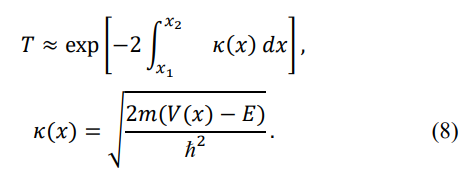
In quantum mechanics, tunneling is therefore a probabilistic phenomenon. The mathematical solution gives the probability of transmission but does not supply a physical mechanism describing how the particle crosses the barrier or what path (if any) it follows inside the classically forbidden region. The wave function is a statistical description, not a representation of a real trajectory [19].
Conclusion
• Quantum mechanics does not specify the physical mechanism responsible for tunnelling; it only yields a probabilistic prediction of barrier penetration.
• The quantum-mechanical description is a model rather than a physical mechanism: it accurately predicts observable statistical behavior but does not assert that a particle “physically travels through” a potential barrier in the classical sense. This reflects the inherently probabilistic nature of quantum theory [19].
Analysis of Quantum Mechanical Explanations of the Tunnelling Effect
(i) The existence of the tunnelling effect, which allows a particle to penetrate a potential barrier even when its energy is lower than the barrier height, can only be explained within the framework of quantum mechanics.
A fundamental quantum mechanical explanation of the tunnelling effect is based on the Heisenberg uncertainty principle. From this perspective, as the particle passes through the barrier, its energy E appears to increase by the amount:

where: Δp2 = h /4 .a2 - represents the minimum momentum dispersion of the particle.
However, it is important to note that the energy of the transmitted particle remains unchanged, meaning that no net energy is expended in the tunnelling process.
Key Considerations Regarding this Explanation Include:
• The uncertainty relation Δx ⋅ Δp ≥ h was originally formulated to define the limits of precision in measuring the position and momentum of quantum particles. While the uncertainty principle is essential in the statistical interpretation of quantum experiments, it does not directly explain the physical mechanism of tunneling.
• Planck’s relation E = h • ω, where ω = 2 • π • ν is the circular frequency of radiation, applies to quantized electromagnetic transitions at the atomic and nuclear levels and does not directly relate to the tunneling effect.
• Explaining tunnelling solely based on the uncertainty principle provides a mathematical model of the effect but does not fully describe the physical process of quantum particle transmission through a barrier.
(ii) Amore detailed quantum mechanical interpretation of tunneling relies on the wave properties of microparticles, specifically the de Broglie wave function. In this view, the amplitude of the de Broglie wave is treated as a probabilistic characteristic. The probability of locating a particle in a particular region of space is given by the square of the wave function amplitude |ψ(x)|2.
As a quantum particle encounters a potential barrier, its wave function exhibits exponential decay inside the classically forbidden region. However, the frequency and total energy of the wave remain constant. The probability of transmission through the barrier is determined by the square of the residual wave amplitude beyond the barrier.
Key Points Regarding this Approach:
• The de Broglie wave provides a mathematical representation of the tunneling effect rather than a direct physical mechanism.
• The Schrödinger equation, which governs the evolution of the wave function ψ(x), is used to determine the probability |ψ(x)|2 of finding a particle in each region. While this equation predicts tunneling behavior, it does not explicitly explain the physical process behind it.
Currently, the tunnel effect is described using quantum mechanics equations, which explain its nature and manifestation under different conditions. This demonstrates a fundamental shift in the understanding of causality in physics: from a physical cause (a charged particle penetrates a potential barrier) to a mathematical back into a particle).
The paradox of the tunnel effect lies in the fact that the physical nature of the effect is explained on the basis of a mathematical model of quantum mechanics, because this model predicts reliable statistical parameters. Thus, there is an inversion of cause-and-effect relationships—the quantum mechanical model explains and determines the physical properties of the tunnel effect.
Why Mathematical Models Describe Physical Phenomena
Research into physical phenomena has led to a wide range of practical applications, enabling the development of technologies in electronics, optics, nuclear energy, and other fields. At the same time, physical research plays a fundamental role in identifying the laws of nature and advancing our understanding of the structure and evolution of the Universe.
In this context, a natural methodological question arises: why do mathematical models provide descriptions of physical phenomena such as gravity and the tunneling effect? The answer lies not in the exclusive explanatory power of mathematics itself, but in the role mathematical models play within the scientific method.
First, the mathematical frameworks of general relativity and quantum mechanics demonstrate predictive accuracy. These theories reliably reproduce experimental results and observational data across wide ranges of conditions, which has led to their widespread acceptance as standard tools for describing gravitational and quantum phenomena.
Second, in both cases, mathematical models have historically preceded the development of physically transparent mechanisms. In the absence of complete physical explanations grounded in experimentally accessible processes, mathematically consistent formalisms have served as effective descriptions that capture observable regularities. As a result, predictive success has often been treated as a sufficient criterion for theoretical adequacy [20].
This situation is particularly evident in the study of gravity and the tunneling effect. Despite extensive theoretical efforts, gravity continues to be described primarily through geometric or phenomenological frameworks, while the tunneling effect remains predominantly interpreted within quantum-mechanical formalism since 1926. In both cases, the underlying physical mechanisms responsible for these phenomena remain subjects of ongoing investigation and debate. There are no physical theories of gravity and the tunnel effect today.
It is important to emphasize that this circumstance does not reflect a lack of scientific progress but rather highlights the complexity of the phenomena involved and the limitations of current theoretical approaches. Mathematical models provide powerful tools for prediction and calculation, yet they do not necessarily exhaust the physical content of the phenomena they describe [21].
At present, a substantial body of experimental and observational data exists concerning the structure of matter, the properties of atomic and nuclear systems, and their interactions with physical fields. These data provide a foundation for exploring alternative, physically motivated descriptions of gravity and the tunneling effect that aims to complement existing mathematical frameworks.
In the following sections, new descriptions of gravity and the tunneling effect are proposed based on established physical properties of matter and experimentally observed interactions at macroscopic and microscopic scales. These descriptions seek to clarify the physical mechanisms underlying the phenomena while remaining consistent with empirical evidence.
New Descriptions of Gravity and the Tunneling Effect
Main Points of the New “Physical Theory of Gravity”
(i) The proposed “Physical Theory of Gravity” represents a phenomenological physical model aimed at explaining the nature of gravitational interaction and the mechanism by which gravitational fields act on material bodies, considering modern concepts of matter structure. The theory is not intended to replace geometric approaches to gravity but rather to complement them by introducing a physically motivated description that may serve as a basis for further development of a general theory of gravity. The main concepts of the theory have been presented in several earlier publications
The central postulates of the theory are as follows:
• The gravitational field is a physical field of electromagnetic nature.
• The gravitational field is not a conventional electromagnetic field; however, it arises because of electrodynamic processes within matter, including the motion, oscillation, and rotation of charged particles in atomic, nuclear, and plasma structures [25-28].
• Each atom and charged particle generates a gravitational field that can be represented as a superpositions of independently propagating radially pulsating electric and magnetic fields (“E” and “H” fields) with discrete frequency spectra determined by the quantum structure of matter [29-31].
• The resulting gravitational field of a macroscopic body exhibits a radial multimode structure formed by the superposition of such pulsating fields emitted by all atoms and particles composing the body.
In the present model, gravity is not associated with longitudinal electromagnetic waves in the conventional sense. Instead, it is related to independently propagating radially pulsating electric and magnetic fields, considered as non-radiative field configurations rather than coupled electromagnetic waves. These fields do not require the presence of transverse components and do not form a Poynting vector or electromagnetic momentum transport [32,33].
The characteristic frequency scales of these pulsations are comparable to those of the X-ray and gamma ranges (approximately 1019–1023 Hz), however, the proposed fields are not photon-mediated radiation and do not produce ionizing effects. Their high penetrating ability is associated with the absence of induced charge redistribution and eddy currents in conductive materials [14,15].
(ii). The proposed Physical Theory of Gravity is formulated as a phenomenological framework aimed at providing a physically motivated description of gravitational interaction and its coupling to matter. The primary objective of this approach is not to replace existing geometric descriptions of gravity, such as general relativity, but to complement them by introducing explicit physical mechanisms associated with the internal structure and dynamics of matter.
In contrast to purely geometric interpretations, the present framework treats gravity as a real physical field arising from electrodynamic processes occurring within matter at atomic, nuclear, and plasma scales. These processes include the motion, oscillation, and rotation of charged constituents, which collectively generate time-dependent field configurations extending into the surrounding space.
According to the proposed model, each atom and charged particle contributes to the gravitational field through the emission of independently propagating, radially pulsating electric and magnetic field components. These components are not interpreted as conventional transverse electromagnetic waves, but as non-radiative field configurations associated with localized energy oscillations. Their characteristic frequencies are determined by the quantum and nuclear structure of matter and form a discrete multimode spectrum.
The gravitational field of a macroscopic body is described as a superposition of such radially pulsating field contributions emitted by all constituent particles. This superposition results in a structured, multimode field exhibiting radial symmetry on average, while allowing for local temporal and spatial variations. Within this interpretation, gravitational interaction emerges as a collective effect of microscopic electrodynamic processes rather than as a purely geometric property of spacetime.
An important feature of the proposed theory is the distinction between gravitational fields and conventional electromagnetic radiation. Although the gravitational field is associated with electric and magnetic components, it does not involve energy transport in the form of propagating electromagnetic waves and does not generate a Poynting flux. As a result, these fields exhibit high penetrating ability and weak interaction with matter in comparison to ordinary electromagnetic radiation.
The proposed framework seeks to preserve the empirical successes of existing gravitational theories while addressing conceptual gaps related to physical mechanism, causality, and interaction at microscopic scales. In this sense, the Physical Theory of Gravity should be regarded as a complementary physical interpretation that may serve as a basis for further theoretical development and experimental investigation.
Mechanism of Gravitational Interaction with Matter
(i) When matter is exposed to an external gravitational field represented by a multimode superposition of radially pulsating “E” and “H” fields, atoms and particles acquire additional energy through interaction with these fields. The pulsating electric component induces polarization of electric systems, such as shifts of electron clouds relative to atomic nuclei. The pulsating magnetic component acts on magnetic moments associated with orbital and spinning angular momentum.
Atoms and particles possessing angular momentum and magnetic moments may be treated as microscopic gyroscopes [34,35,36]. The external pulsating fields modify their torque, inducing processional motion analogous to Larmor precession. The collective processional response of atomic and subatomic systems results in a directed macroscopic displacement of the center of mass toward the source of the gravitational field. In this interpretation, gravitational attraction emerges as a macroscopic manifestation of the collective gyroscopic response of matter to radially pulsating fields.
The equivalence of inertial and gravitational mass is explained by the identical nature of matter’s response to external action. The difference lies in the primary mechanism: under mechanical action, the nuclear structure of matter is displaced first, whereas under gravitational influence, the electromagnetic structure of atoms is initially affected, with the nuclear framework providing resistance. In fact, inertial and gravitational masses act as identical proportionality coefficients in two variants.
From a quantum-mechanical perspective, the external gravitational field breaks the central symmetry of the intra-atomic potential. As a result, the electron wave function becomes anisotropic and non-stationary, in a manner analogous to known perturbative effects such as the Stark effect [37,38]. The induced anisotropy of probability density leads to precession of the magnetic moment and, consequently, to an effective attractive force acting on the center of mass.
(ii) Within the proposed Physical Theory of Gravity, gravitational interaction is interpreted as the response of matter to an external multimode field formed by radially pulsating electric and magnetic components. These field components originate from the collective electrodynamic activity of charged constituents in surrounding matter and act on atomic and subatomic systems without direct energy transport in the form of electromagnetic radiation.
When matter is placed in such an external gravitational field, its internal electric and magnetic structures interact with the time-dependent field components. The pulsating electric field induces polarization of bound charge systems, leading to periodic displacement of electron clouds relative to atomic nuclei. Simultaneously, the pulsating magnetic component interacts with magnetic moments associated with orbital and spin angular momentum of charged particles.
Atoms, nuclei, and subatomic particles possessing angular momentum can therefore be treated as microscopic gyroscopic systems. Under the influence of external time-dependent fields, these systems experience torques that modify their processional motion. This response is analogous to well-known effects such as Larmor precession in magnetic fields, but here it arises from a superposition of electric and magnetic field pulsations rather than from a static external field.
At the macroscopic level, the collective processional response of a large number of atomic and subatomic systems leads to a net directed force acting on the center of mass of a body. This force is oriented toward the source of the external gravitational field and manifests as gravitational attraction. In this interpretation, gravity emerges as a cumulative effect of microscopic field–matter interactions rather than as a fundamental force acting instantaneously at a distance.
The equivalence of inertial and gravitational mass is naturally explained within this framework by the identical physical response of matter to external action. Inertial forces arise when matter resists acceleration due to mechanical disturbance, while gravitational forces arise when matter responds to external pulsating fields. In both cases, the magnitude of the response is determined by the same internal structural properties of matter, leading to proportionality between inertial and gravitational mass.
From a quantum-mechanical perspective, the presence of an external gravitational field perturbs the internal symmetry of atomic and nuclear potentials. This perturbation leads to anisotropy of the corresponding wave functions and modifies the distribution of probability density. Such effects are analogous to known perturbative phenomena, including the Stark and Zeeman effects, where external fields induce shifts and splitting of energy levels.
The induced anisotropy of charge and current distributions results in modified angular momentum dynamics and contributes to the effective force acting on matter. Thus, gravitational interaction can be understood as a physically grounded process involving polarization, precession, and collective response of matter to structured external fields, rather than as a purely geometric or abstract interaction.
Variation of the Gravitational Field as Amplitude Modulation
Currently in the theory of gravity it is thought that gravitational waves are emitted by moving masses and that they present themselves as changes in the gravitational field which propagate through space like waves. Indeed, the motion of a mass in relation to the observation point causes a change in the gravitational force. For example, when two massive bodies (black holes) travel through the universe and gravitational waves propagate from them with a frequency of their rotation. There are known examples when gravitational forces change due to the movement or oscillation of a body in space (for example, the rotation of the Moon).
In contemporary gravitational physics, variations of the gravitational field are commonly interpreted in terms of gravitational waves emitted by accelerating or orbiting masses. Within general relativity, these waves are described as propagating perturbations of spacetime geometry that carry energy and angular momentum and are detected through their influence on the relative motion of test masses.
In the framework of the proposed Physical Theory of Gravity, temporal variations of the gravitational field are interpreted in a different, though complementary, manner. Rather than treating gravity as a propagating geometric disturbance, changes in gravitational interaction are associated with amplitude modulation of an underlying multimode field formed by radially pulsating electric and magnetic components.
From this perspective, the motion, oscillation, or rotation of massive bodies does not generate a new type of propagating wave distinct from the gravitational field itself. Instead, such motion modifies the amplitude, phase, and spectral composition of the existing pulsating field emitted by matter. These modifications propagate through space as variations of field intensity, analogous to amplitude modulation in classical wave systems.
In this interpretation, the information about the dynamics of the source—such as orbital motion or rotational frequency— is encoded in the temporal modulation of the field amplitude rather than in the emission of independent transverse waves. The observed effects attributed to gravitational waves correspond to time-dependent changes in the local gravitational field experienced by matter, arising from the collective modulation of microscopic field contributions.
Importantly, this approach does not contradict existing experimental observations of gravitational-wave phenomena. The detected signals, including characteristic frequencies and amplitudes associated with astrophysical sources, can be interpreted as manifestations of large-scale amplitude modulation of the gravitational field generated by coherent motion of massive systems. The measurable strain observed in detectors reflects the response of matter to these modulated field configurations.
A key distinction of the proposed interpretation lies in the physical nature of the field variation. While general relativity describes gravitational waves as geometric perturbations of spacetime, the present framework attributes observed gravitational-field variations to physical modulation of an underlying field structure associated with matter. In this sense, gravitational waves are not treated as independent carriers of energy but as dynamic states of the gravitational field itself.
This viewpoint emphasizes continuity between static gravitational interaction and its time-dependent variations. Such an interpretation provides a physically intuitive picture of gravitational variability while remaining consistent with empirical observations.
From the point of view of the new theory, changes in gravity are equivalent to amplitude modulation of the wave, i.e., changes in the amplitude of the wave by means of a control signal.
Capabilities and Perspectives of the Proposed Physical Theory of Gravity
The proposed Physical Theory of Gravity offers a complementary perspective on gravitational interaction by emphasizing physically motivated mechanisms associated with the internal structure and dynamics of matter. While the present formulation remains phenomenological, it provides a coherent framework for interpreting gravitational phenomena across different physical scales.
One of the principal capabilities of this approach lies in its ability to establish a direct conceptual link between microscopic processes in matter and macroscopic gravitational effects. By associating gravitational interaction with collective electrodynamic activity of charged constituents, the theory offers a unified physical interpretation of gravity that does not rely exclusively on geometric abstraction. This feature may facilitate the analysis of gravitational phenomena in systems where conventional geometric descriptions encounter conceptual or interpretational limitations.
The proposed framework also provides a natural context for examining the equivalence of inertial and gravitational mass, as both are interpreted as manifestations of the same underlying physical response of matter to external influence. This interpretation offers a physically transparent explanation of the equivalence principle and suggests new avenues for exploring its limits under extreme or non-equilibrium conditions.
Another important perspective concerns the interpretation of time-dependent gravitational phenomena. By treating variations of the gravitational field as amplitude modulation of an underlying physical field, the theory establishes continuity between static gravitational interaction and its dynamic manifestations. This viewpoint may contribute to alternative interpretations of gravitational-wave observations while remaining compatible with existing experimental data.
The Physical Theory of Gravity does not aim to replace established theories such as general relativity, which remain indispensable for precise quantitative predictions. Instead, it seeks to supplement these theories by addressing conceptual questions related to physical mechanism, causality, and interpretation. In this sense, the proposed framework may serve as a basis for further theoretical development, numerical modeling, and targeted experimental investigation.
Finally, the physical interpretation introduced here provides a natural methodological bridge to other areas of fundamental physics where similar conceptual challenges arise, particularly in the description of quantum phenomena that are currently treated primarily through mathematical formalisms. This connection motivates the application of the same methodological principles to the analysis of the tunneling effect, which is examined in the following section.
Capabilities and Perspectives of the New Theory
The Proposed Physical Theory of Gravity:
• Offers a physically motivated mechanism for the emergence of gravitational fields and their interaction with matter.
• Allows an interpretation of the carrier of gravitational interaction in terms of quanta of radially pulsating fields (gravitons) [39,40].
• Introduces a phenomenological concept of possible time discreteness through a minimal characteristic interval (chronon) [41,42].
• Provides a framework for phenomenological descriptions of gravity at the quantum level.
• Explains gravitational anomalies (ball lightning, expansion of the universe, etc.);
• Explains the presence of so-called “dark energy” in outer space, which is gravitational fields, i.e., pulsating electromagnetic fields in the X-ray and gamma-ray frequency ranges from 1019 to 1023 Hz.
• Proposes possible interpretations of certain astrophysical and cosmological phenomena related to gravitational interaction.
• Demonstrates potential compatibility between quantum mechanics and gravitational interaction.
• May serve as a basis for further studies toward unification of fundamental interactions.
New Explanation of the Tunnel Effect
Purpose and Results of the Study
The primary aim of this study was to investigate the physical mechanisms underlying the tunnelling effect, as the conventional quantum mechanical description does not provide a direct understanding of the real physical process involved. The key result of the study is an alternative explanation of the tunnelling effect based on classical physics.
The main result of the study is that tunnelling occurs due to localized reductions in potential the Coulomb barrier, enabling individual microparticles to traverse the barrier in these local regions. The formation of such low-potential regions is attributed to the intrinsic properties of charges that generate the Coulomb field. This explanation resolves the so-called “paradox” of the tunnelling effect by eliminating its contradiction with classical physics. Moreover, the estimated parameters of the tunnelling process derived from this model qualitatively align with the results of quantum mechanical calculation.
The Study Revealed the Following Mechanism of Microparticle Barrier Penetration
Microparticles can overcome the potential barrier under the following conditions:
• The total energy E of a microparticle exceeds the height of the potential barrier U0, the microparticle classically overcomes the barrier: E > U0.
• The potential barrier decreases in a localized region and the effective barrier height Umin (x, y, z, t) is reduced, allowing the microparticle to pass through if: E > Umin.
The Probability of this Effect Depends on:
• The characteristics of the potential field responsible for the fluctuating barrier.
• The coincidence of a microparticle’s approach with the moment of barrier reduction.
• Specific values of energy, mass, spatial orientation, and concentration of microparticles.
Key Conclusion
(i) The research shows that tunnelling effect can be interpreted exclusively as a mechanism above barrier transmission where microparticles pass through localized regions of reduced potential rather than violating classical energy conservation. Notably, the study suggests that the total energy of microparticles decreases as they pass through the barrier, a phenomenon previously overlooked because instantaneous potential reductions within the barrier were not accounted for.
(ii) The quantum mechanical tunnelling model assumes that a microparticle can penetrate a potential barrier that exceeds its total energy. However, this study argues that such a process does not actually occur in nature. Instead, the misunderstanding arises from the oversimplification of the real spatial and temporal structure of the potential barrier. Errors in the quantum mechanical interpretation of tunnelling - the potential barrier U (x, y, z, t) is assumed to be static, ignoring spatial and temporal variations that create localized potential reductions.
The Coulomb potential is treated as a time-independent electric field generated by point charges, overlooking the complex field interactions that may form radial channels of lower potential. For instance, the electric field of a proton or hydrogen isotope nucleus is often represented as an idealized point charge +e, leading to oversimplified barrier models.
(iii) Application of the quantum mechanical model to explain the nature of the tunnel effect: The Heisenberg uncertainty principle and the Schrödinger equation are used to describe tunnelling through a constant potential barrier U0, disregarding its dynamic nature.
Quantum mechanics models the Coulomb barrier electrostatically, while simultaneously treating moving microparticles as both waves and particles, which does not provide a coherent understanding of the physical transmission process.
The widespread idealization of the Coulomb barrier parameters represents a fundamental error in modern tunnelling descriptions. This leads to an apparent contradiction with classical physics, although quantum mechanical models still provide mathematically valid solutions.
According to our study, tunnelling occurs due to short-term reductions in the potential barrier within localized regions, enabling the transmission of low energy microparticles. This approach aligns with the law of conservation of energy in classical physics while introducing a probabilistic aspect, as a microparticle can only pass through if it arrives at the barrier precisely when the potential reduction occurs.
This revised interpretation challenges the traditional view of tunnelling and offers a new framework for understanding microparticle interactions in dynamic Coulomb fields. Indeed, a microparticle can overcome the potential barrier if the barrier level U in the local region is lower than the total energy E of the microparticle during its passage through the region (Figure 1). Such effect does not contradict the law of conservation of energy in classical physics, and the possibility of microparticles getting into the local region of the barrier now of a short-term decrease in the potential in this region has a probabilistic character.
It is important to highlight that the possibility of over the barrier tunnelling due to “tunnel barrier oscillations” has been previously suggested in scientific literature. These works propose that fluctuations in the atomic nucleus field can reduce the potential barrier, increasing the probability of a low-energy particle passing through the barrier at the instant of its oscillation minimum. A proposed cause of barrier oscillations is the dynamic fluctuation of charge density, which forms the Coulomb field. These fluctuations may arise from oscillations and rotations of atomic nuclei. However, well-known studies did not quantify the parameters of barrier oscillations and their exact effect on microparticles, nor did they indicate more significant factors contributing to the localized decrease of the Coulomb barrier height [43,44].
Physical Nature of the Tunnelling Effect
• Field Explanation of the Tunnel Effect: A dynamic, field-based explanation of the tunnelling effect is proposed within the framework of classical electrodynamics. In this interpretation, the key mechanism responsible for barrier penetration is the formation of transient local reductions of the Coulomb potential inside the nuclear field. The Coulomb barrier is therefore treated not as a fixed function, but as a dynamic, nonlinear field configuration that fluctuates due to nuclear structure and internal electric-field dynamics.
The proposed model describes the tunnelling phenomenon as a nonstationary classical process. A particle crosses the Coulomb barrier at moments when temporary low-potential channel emerges along its direction. This channel correspond to what quantum theory formalizes as “non-zero probability of finding the particle beyond the barrier.”
The essence of the proposed classical mechanism of the tunnel effect is that the penetration process is explained by the temporal dynamics of the Coulomb field itself, rather than by the “seepage” of particles in the quantum sense:
• There are temporal and spatial inhomogeneities in the real Coulomb field of the nucleus.
• Short-lived radial local areas of reduced potential, or “channels,” form inside the barrier.
• Through these areas, individual microparticles (e.g., α-particles, protons, low-energy electrons) can pass through the barrier without violating the laws of classical physics.
This approach relies on established nuclear-structure properties and differs fundamentally from both the quantum-mechanical and semiclassical WKB descriptions. Local Potential Reductions in the Coulomb Barrier: Short-lived local regions of reduced potential within the barrier arise due to the dynamics of the atomic nucleus.
The Primary Mechanisms are:
(a) Nucleon Charge-Density Oscillations and Nuclear Deformation
Oscillations of the internal charge distribution modulate the external Coulomb field. These oscillations may be caused by collective nucleon motion, deformation modes, meson-field oscillations (π-meson cloud). As a result, the instantaneous Coulomb potential Vavg(r,t) decreases relative to its static value V0 (r), often approaching the mean level:
Vavg(r,t) < V(r) (10)
An important feature of this model is that the total energy remains conserved. The kinetic energy of the particle decreases as it passes through the channel, and this energy is transferred for the reconfiguration of the Coulomb field. Thus, there is no violation of conservation laws [16,17].
Formation of Local “Volume Channels” in the deuterium Coulomb field
Electric Field of the Deuterium: At sufficiently large distances, the electric field of the deuteron nucleus is determined solely by its net charge q, because: the proton has charge q, the neutron has zero net charge.
Therefore, at long distances:


Figure 4 : The electric field of the nucleus without considering the influence of the neutron is a point charge field: the center of the proton is located at axis 0, the center of the neutron is located on axis 2.0, the boundary of the nucleus is at a distance x/R ≈ 3.5...4.
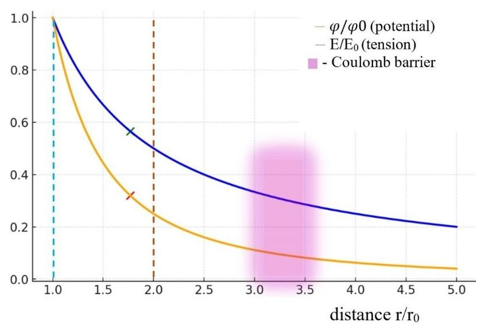
Figure 5: Graph showing the dependence of the field strength and potential of a deuterium nucleus, without considering the influence of the neutron, on the distance along the axis connecting the centers of the proton and neutron: blue line - potential (decreases slowly), orange line - field strength decreases faster).
These relations describe the asymptotic (monopole) field configuration assumed in quantum-mechanical treatments [18].
The Atomic Nucleus as the Basis for the Coulomb Barrier
The atomic nucleus is the central part of the atom in which almost all its mass and positive electric charge are concentrated. Atomic nuclei consist of protons p and neutrons n bound together by nuclear interaction. The area of action of nuclear forces is limited to a size of ~10-15 m. The nuclear forces acting between a proton and a neutron, as well as between two neutrons, are assumed to be the same. The proton and neutron have finite sizes and an internal structure consisting of fundamental particles (Figure 6).

Figure 6: Structure of nucleons (simplified version): proton consists of two top quarks U with charge +2/3 e and one bottom quark d with charge -1/3 e, neutron consists of two lower quarks d and one upper quark U, the radius of the proton and neutron Rpn ~ 4.5616 •10-16 m.
Most nuclei have a shape close to spherical. The size of the nucleus is characterized by the radius of the nucleus, which has a conditional meaning due to the blurred boundary of the nucleus. The radius of the nucleus can be approximated by the formula:
R ≈ 1.3 - 1,7 ·10-15 A1/3 M (13)
where A - is the number of nucleons (total number of protons and neutrons) in the nucleus.
Nuclei with a low number of nucleons have diameters on the order of 10-15 m. For example, the radius for a proton is about 4.5616 .10-16 m., and a small fraction of the mass is outside this radius. The radius of the neutron is ~4.5616 .10-16 m., and the outer limit of the neutron is 4.3913 .10-16 m. from the center of the particle. The nuclei of most chemical elements contain more neutrons than protons, because for the symmetry of the structures, there must be neutrons between the protons.
Modern research shows that the proton and neutron have the following properties:
• The electric charge of the proton is positive and modulo the electron charge with high precision

• The electric field of the proton is similar to that of a point charge +e, but has differences related to the dynamics of the proton motion, the change in the charge density on the surface, and the interaction with the neutron in the nucleus;
• The potential and electric field strength of the proton at the far-field point are equal:
where +e - elementary electric charge, ε0 - electric constant, n - unit vector from the proton center in the direction of the observation point, R - distance from the proton center to the observation point, R > Rp,n.
- the neutron structure creates a permanent magnetic field and an internal permanent electric field, which is formed by a spirit of distributed parallel symmetric ring electric charges +0.75e and -0.75e of mean radius re, located at a distance s:
re = 1,0626 · h/m0 · c
s = 0,85 · L· h/ m0 · c (15)
The neutron's constant electric field is dipole-like, analogous to the field of two distributed parallel electric charges of equal magnitude and opposite sign, since the neutron's electric charge is zero. The electric field of the neutron is practically imperceptible at larger distances because of mutual compensation of the fields of both signs of charge, but it influences interactions with the proton and other neutrons at distances of the order of the neutron radius [46,47].
An important property of the neutron is its weak permeability to external electric fields. It is known that when the neutron is placed in an external electric field E0, its structure is deformed, as a result of which the center of the positive charge distribution is shifted along the field and the center of the negative charge distribution is shifted against the field, and the nonpolar structure of the neutron turns into a dipole whose axis is parallel to the electric field direction, and the length of the dipole is determined by the field strength. At the same time, on its surfaces there arise bound electric charges that create inside and on the surface of the neutron an electric field E' directed opposite to the external field E0. The resulting field strength E is less than E0, i.e., E = E0 - E' < E0, in addition, structural changes lead to internal energy losses. As a result, the external electric field strength passing through the neutron decreases in the shadow region by a factor of about 10 (- 20 dB).
Thus, the main properties of nucleons as part of atomic nuclei are the charge and magnetic moment of the proton, the magnetic moment of the neutron, the neutron's lack of electric charge, and its ability to introduce attenuation into an external electric field. However, in reality, the dynamics of the interaction of quarks in the proton leads to dynamical changes in the surface charge density of the proton:
σi ≈ +e/4πR2 +/- Δσi, (16)
where Δσi is the maximum amplitude of the charge density change.

Figure 7: Interactions of quarks U and d in the proton structure lead to a periodic change in the charge density Δσi on the proton surface and a change in the external electric field strength ΔE, respectively.
As a result of changes in the charge density on the proton surface, the external electric field pulsates in the radial direction: the field strength increases above the region of increasing charge density and decreases above the region of decreasing density (Figure 8).

Figure 8: Cross section of the proton's electric field E at a distance of the Coulomb barrier (changes in the surface charge density of the proton lead to oscillation of its electric field).
In addition, the configuration of the electric field E is affected by the dynamics of proton motion in the atomic nucleus (Figure 9).

Figure 9: Oscillatory and rotational motions of the proton in the nucleus lead to additional fluctuations of the electric field E of the proton.
Changes in the surface charge density and masses of the proton, its rotation, and oscillations lead to multimode pulsations of the electric field strength ΔE, resulting in randomly occurring short-lived regions with different heights of the Coulomb barrier along the outer boundary of the nucleus, with the electric field oscillating with a maximum amplitude modulation coefficient of up to 30%.
These fluctuations of the proton electric field strength lead to shorttterm radial jumps of the potential both in height and in minimum and, consequently, to deviations of the Coulomb barrier value from the average U value. The oscillating electric field of the proton around the nucleus is shown in Figure 10.

Figure 10: The electric field E of the proton pulsates due to changes in surface charge, mass densities and proton motion
Input: The electric field of the proton propagates radially, forming in space a region with an oscillating potential barrier: the amplitude modulation coefficient of the field strength is up to 30%, the relative change in the spatial potential ΔU/ Umax = ΔR/Rq = 0,5, the frequency of multimode oscillations of the field is in the ranges of nuclear transformations and dynamic displacements 1021 - 1023 Hz.
The changes in the magnitudes of the electric field of the proton, as compared to the field of point charge, are explained by the following:
• Dynamically changing surface charge density σ ≈ +e/4πR2+/-Δσi;
• Periodic changes in the proton mass density.
• The dynamics of proton motion within the atom.
Influence of the Neutron on the Proton’s Electric Field
The neutron strongly affects the near-field electric structure of the deuteron, although electrically neutral [20].
This Can Be Explained as Follows:
(a) Screening due to Meson-Cloud Deformation: The neutron’s internal pion cloud (virtual π-mesons) interacts with the proton’s field: distorting near-field lines, absorbing part of the field energy, reducing the potential along the proton–neutron axis.
This produces a localized suppression of the Coulomb barrier on scales of ~1–2 fm.
(b) Electric Polarizability and Induced Dipole Moment:
• Electrical Polarizability of the Neutron: The action of the proton's electric field leads to the electrical polarizability of the neutron and the formation of a dipole moment of the order of its structure, leading to an asymmetric attenuation of the external field of the nucleus in the near zone. The neutron does not have a full electric charge (qn = 0), although it consists of three charged quarks: one up quark (+2/3 e) and two down quarks (−1/3 e) each. The internal structure of the neutron is asymmetrical and, on average, creates a charge distribution that can be described by multipole moments. This property allows the neutron to weaken or “absorb” the external electric field. When exposed to an external electric field, the internal up (+2/3 e) and down (−1/3e) quarks shift, creating an induced dipole moment:


This induced dipole creates a counter field opposite the external field of the proton, i.e., the neutron partially compensates (absorbs) the field near itself.
Thus, the neutron acts as a miniature “region with negative polarizability,” providing local suppression on one side of the nucleus in the near zone, but as the distance increases, this effect decreases, and the monopole term remains
(c) Magnetic and Strong-Interaction Contributions
Magnetic coupling between the nucleons and QCD-based near-field interactions further modify the local electric structure, though the dominant contribution is from induced dipoles and meson-cloud deformation.
• Conclusion (Neutron Influence):The near-field configuration of the deuteron is significantly modified by neutron-induced effects. The neutron acts as a barrier to electric field lines, producing attenuation of the proton’s field, deformation of the local potential, and formation of directional low-potential zones. At long distances r→∞, the monopole field is restored. This screening is an important stabilizing factor in nuclei, mitigating proton–proton repulsion in larger nuclei.
• Estimate of Field Suppression: The suppression effect can be modelled as a local attenuation along the proton–neutron axis. Let the external field be approximated by:
E(x) = E0 (1 − k(x)), 0 ≤ k(x) ≤ 1, (18)
where k(x) is the attenuation coefficient determined by neutron structure and polarizability.
A study of the electrical model of the deuterium nucleus shows that there is a local weakening of the nuclear electric field. The neutron weakens the electric field of the proton in the axial radial direction of the nucleus and creates a local weakening of the field in the near and middle zones along the axis connecting the centers of the two nucleons (Figure 11).

Figure 11: Field Attenuation Profiles Inside the Neutron and Along the Axis Behind the Neutron
The Influence of Neutrons on the Electric Field of Protons in the Nuclei of Deuterium
• Experimental Data: Direct experimental evidence of the influence of neutrons on the electric field of protons in the deuterium nucleus is based on the following studies:
• Nuclear Interactions: Experiments with neutron scattering on nuclei have shown that the presence of neutrons significantly modifies the nature of interactions between nucleons.
• Neutron Polarizability: Measurements of the electrical polarizability of neutrons scattered on lead atoms confirmed their ability to influence the distribution of the electric field.
• Thermonuclear Fusion Using the Spin Polarization Method: Researchers at Princeton Plasma Physics Laboratory (PPPL) have developed and tested a method for optimizing hydrogen isotope fuel mixtures using nuclear spin polarization. The new method involves aligning the spins of hydrogen isotopes, which significantly increases the likelihood of them entering a fusion reaction. Spin polarization of part of the fuel mixture, combined with an increase in the proportion of deuterium, increases the efficiency of tritium combustion by up to ten times [48].
The Key Research Methods are as Follows:
• Neutron Scattering: Studying the processes of slow neutron scattering on nuclei allows us to determine the nature of their interaction with the electric field of the nucleus.
• Measurement of Dipole Moments: The electric diploma (EDM) of a neutron is a measure of the distribution of positive and negative charges inside the neutron [49].
Experiments determine the EDM of a single neutron have shown that the centers of distribution of positive and negative charges in the neutron practically coincide, which confirms its shielding role. However, in the atomic nucleus of deuterium, the neutron is subjected to a very strong electric field of the proton with an intensity of about 108 V/cm, and its induced EDM increases to a value of p ≈ 10–35 C m.
The Theoretical Basis is Confirmed by:
• The proton-neutron model of the nucleus proposed by Ivanenko, Chadwick, and Heisenberg.
• Yukawa's theory of nuclear forces, which explains the interaction between nucleons through the exchange of π mesons.
• Quantum mechanics, which describes the behavior of nucleons in the nucleus.
Analogies of Local Field Changes
• Plasma channels-similar structures form in plasma when there's a local field concentration.
• Field effect in attoelectron emission-lowering the barrier under the influence of a strong field (Schottky effect).
• Soliton solutions in nonlinear fields-localized potential deformations that preserve the structure.
• Macroscopic phenomena in superconductors-formation of low-potential paths for Cooper pairs.
Effects of Neutron Properties on the Near-Field Electric Potential are shown in table 1.
|
Neutron Property |
Physical Origin |
Effect on Near-Field Potential |
|
Electrical neutrality |
Net charge = 0 |
No monopole field contribution |
|
Electric polarizability |
Quark displacement |
Counter-field; partial screening |
|
Induced dipole moment |
Internal charge asymmetry |
Local suppression of E(x), φ(x) |
|
p=-α_E E |
QCD π-meson dynamics |
Redistribution of near-field charge and potential |
|
Meson-cloud deformation |
Combined effects k ≤ 1 |
Reduces E(x) and φ(x) along the proton–neutron axis |
|
Effective attenuation k |
|
|
Table 1: Effect of Neutron Properties on Near-Field Electric
Conclusion
A local channel with low potential in the Coulomb field of nucleus provides a tunneling effect. Suppression of the proton's electric field in the near zone due to the action of the neutron leads to the formation of a local low-potential channel inside the Coulomb barrier. Particles with energy below the nominal barrier height but above the potential level of the local channel can pass through this channel [46,47].
Key Points:
• The channel is a spatial radial region of reduced potential - an analogue to "tunneling paths."
• The channel arises due to neutron-induced deformation of the Coulomb field and internal charge structure.
• The mechanism of formation of the electric field of the nucleus is consistent with classical electrodynamics and nuclear field theory. of neutron polarizability, and our simulations all support this interpretation.
Thus, classical field dynamics provides a physical mechanism capable of explaining barrier penetration without relying on quantum probability.
Results of Modelling Neutron Attenuation of the Electric Field of the Deuterium Nucleus
Model 1. (constant «shadow» EA (x)=E0 (x)[1-(k)],x>2R.)
Description: A proton–neutron pair in contact is modeled as spheres of equal radius R. The proton center is at x/R = 1, and the neutron center at x/R = 3. The model demonstrates the weakening of the potential and intensity of the electric field of the nucleus in the near zone, caused by shielding and partial absorption of the field by the neutron (Figure 12).

Figure 12: Deuterium Nucleus Model for Estimating the Electric Field and Potential Effective Attenuation Function:
A(x) = 1 − k• exp [− (x − 3R) ² / (2σ²)] • exp [−(x − 3R)/λ], for x ≥
3R; A(x) =1 for x < 3R.
Field and potential along axis:
E(x) = E°(x)•A(x), where E°(x) =1/x²; φ (x) = φ ° (x)•A(x), where φ ° (x) =1/x
|
Parameter |
Meaning |
Values |
|
k |
Attenuation coefficient |
0.2 ... 0.6 |
|
σ |
Shadow width (in radii R) |
2R |
|
λ |
Field recovery length |
4R |
Parameters:
Illustration 1:
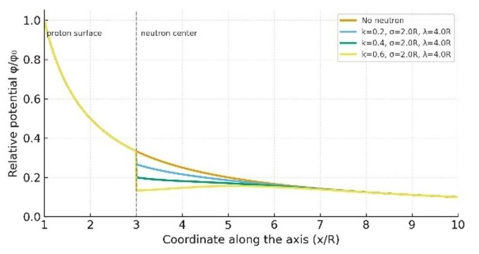



Illustration 2:
Figure 14: The electric field potential of the nucleus U/U0 is weakened due to absorption and shielding by the neutron: a “shadow zone” with low potential forms to the right of the neutron: a) weak influence; b) strong suppression; c) over-weakening; d) optimal
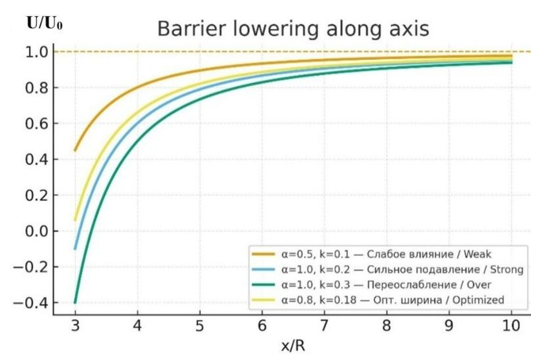
Figure 15: Decrease in the electric field potential of the nucleus U/U0 under different neutron influence factors: U/U0 = 1 means that the field is the same as that of a single proton
U/U0 < 1 - weakened field, U/U0 > 1- strengthened field, U/U0< 0 - the potential has changed sign (the field intensity has changed direction)
Conclusions Based on Simulation Results
The study shows that there is a local weakening of the electric field of the nucleus. The neutron affects the electric field of the proton in the nucleus of the atom and creates a local weakening of the field in the near and middle zones along the axis connecting the centers of the two nucleons.

Figure 16: The field strength of the “proton + neutron” system returns to Coulombic


Figure 17: General diagram of the formation of a low-potential channel in the Coulomb field of the nucleus (shadow region) due to the influence of a neutron: red circle - proton (field source); blue circle - neutron (polarizable, uncharged); arrow lines show the direction of the resulting field; on the right, you can see the “shadow zone”, where the field is weakened and partially reversed.
The attenuation of the core field potential in the near zone is 10 dB (point x = 4R).
Key Conclusions
The tunnel effect is a manifestation of the dynamic structure of the electric field of the nucleus, in which a local region of reduced potential arises, allowing particles to overcome the barrier without violating classical laws.
The local channel is formed in the Coulomb field of the deuterium nucleus due to the loss of electric field energy in the neutron structure and its polarization. The field strength of the proton at nuclear distances is about 576 GV, which ensures the formation of an induced dipole in the neutron structure with a large electric polarization coefficient αE ≤ 1. This ensures the formation of a local channel in the Coulomb barrier of the nucleus with a potential reduction of up to 10 dB compared to the field of a single proton.
The differences between the proposed explanation of the tunnel effect and the quantum interpretation are shown in table 2.
|
Indication |
Quantum mechanical interpretation |
Classic field interpretation |
|
Nature of the barrier |
Static potential |
Dynamic fluctuating potential |
|
Mechanism of penetration |
Probabilistic “leakage” of the wave function |
Actual passage of a particle through a local lowered potential |
|
Role of uncertainties |
Heisenberg's fundamental principle |
Arise from fluctuations in the field and spatial position |
|
Energy conservation |
Statistical |
Strict |
|
Physical picture |
Absent, no coordinates or trajectories |
There are an explanation and a real trajectory of the particle through the channel |
Table 2: Comparison of Explanations for the Tunnel Effect
Research and experiments confirm that neutrons have a shielding effect on the electric field of protons in the deuterium nucleus, which is one of the key factors in the stability of this nucleus. At the same time, in the external Coulomb field of the deuterium and tritium nuclei, a low-potential channel is formed along the line connecting their centers, allowing other particles or nuclei to penetrate the Coulomb barrier and enter a fusion reaction.
Features of the Formation of the Coulomb Field by a Proton and a Neutron (The Nucleus of a Deuterium Atom)
The magnitude and configuration of the electric field of the deuterium nucleus are determined by the electric properties of the proton and neutron, their mutual location, and their motion within the nucleus. It is known that nuclear forces acting between the nucleons forming the nucleus are much larger than the Coulomb repulsion forces between protons. A characteristic feature of these forces, in addition to their large magnitude, is their limited radius of action, approximately ≈10-15 m. These forces arise only between a proton and a neutron, which are practically close to each other.
The Peculiarity of Nuclear Forces is as Follows:
• The nuclear forces are charge independent, i.e., they are non-electric in nature.
• The nuclear forces depend on the mutual orientation of the spins of the interacting proton and neutron.
• Nuclear forces are not central, i.e., they act along the line connecting the centers of interacting with nucleons.
The formation of the level and configuration of the electric field strength of the nucleus is influenced by the following factors:
(a) Mechanical Imbalance of the Rotating Masses of the Proton and Neutron in the Nucleus: The imbalance results in the procession of the proton and neutron rotation axes, and along with the rotation of the proton itself, relative vibrational and rotational motions of the proton and neutron also arise. This leads to additional changes in the amplitudes and frequencies of the electric field of the proton field (see ii above) and creates a compulsory of the potential in the spatial region of the Coulomb barrier. As a result, regions with different heights of the Coulomb barrier appear along the outer boundary of the nucleus.
(b) Shielding of An Electric Field with a Neutron: It is known that neutrons have a low permeability of electric fields, i.e., in fact, a single neutron is a local shield that weakens the electric field in the shadow region by a factor of about 10 (- 20 dB). The neutron shields the electric field of the proton in the atomic nucleus, which leads to the formation of a Coulomb field in the form of divergent spatial rays with one failure along the axis of the neutron location. As a result, shortlived local regions with low potential appear around the nucleus during its motion [49].
The electric field of the deuterium nucleus because of factors (a) and (b) is formed as oscillating radial beams with one local region of low potential. This electric field rotates with the nucleus around the x, y, z axes and simultaneously oscillates in amplitude and frequency. This leads to the formation of short-lived low-potential channels in the Coulomb field volume of the nucleus, which can provide a probable passage of external microparticles into the nucleus (Figure 18).

Figure 18: The electric field of the deuterium nucleus oscillates and forms one local low potential region that rotates with the nucleusaround the x,y,z axes
(the arrow shows the direction of entry into the radial low-potential channel, 2.2• Rn is the diameter of the channel in the local region, where Rn = 4.5616 •10 m. - neutron radius)
Features of The Formation of the Coulomb Field by A Proton and Two Neutrons (The Nucleus of a Tritium Atom)
The configuration of the electric field of the tritium nucleus is determined by the electric properties of the proton and two neutrons, their mutual location, and their motion within the nucleus. It is known that nuclear forces act between the nucleons forming the nucleus, with the proton inside the group and the neutrons adjoining it, or one is displaced to a shell of a higher level. Such a system of nucleons is synchronized by their fields in the nucleus, is in rotational and vibrational motion, and has the characteristics of the atomic nucleus.
The electric field of the proton propagates in the surrounding space in radial directions and is partially shielded by neutrons in radial directions (a, b). The electric field of the proton can be secondarily shielded by the second-shell neutron in a different variant of the nucleus structure (c). (Figure 19):

Figure 19: The structure of a tritium nucleus formed from a proton and two neutrons leads to the formation of spatial regions with low potential in the electric field of the proton:
• Two neutrons are located on both sides at the outer level coaxially with the proton. • Two neutrons are located at the outer level along the radii of the nucleus.
• Two neutrons are located on one side at the outer level coaxially with the proton.
* In the space of the oscillating Coulomb field of the nucleus, short-lived low-potential channels are formed, which provide a probable passage of external microparticles into the nucleus;
** The arrows show the direction to the radial channel for the probable passage of microparticles, (S is the area of the entrance section of the radial channel of the local region).
The formation of the electric field of the nucleus is influenced by the following factors:
(a) Mechanical Imbalance of the Rotating Masses of the Proton and Two Neutrons in the Nucleus
The imbalance results in precession of the rotational axes of the proton and the two neutrons, and electrical dipole and quadrupole oscillatory motions occur simultaneously. In addition, random fluctuations of nucleons occur in the nucleus. Nucleons are weakly bound and relatively free in the outer shell of nuclei, so conditions arise for their fluctuations in their general rotational motion around the spin axis of the nucleus. Fuctuations of protons in the outer shell of the nucleus lead to jumps of the potential both in height and in minimum. Superimposed randomly on the Coulomb barrier oscillations, they increase the deviations of the Coulomb barrier value from the average value. This leads to changes in the amplitude of the electric field of the nucleus and, folding with the oscillation of the proton field, creates a multimode pulsation of the Coulomb barrier potential. As a result, short-lived regions with different Coulomb barrier heights appear along the outer boundary of the nucleus.
(b) Shielding of the Electric Field by Neutrons
It is known that neutrons have a low permeability of electric fields, i.e., in fact, a single neutron is a local dielectric shield that weakens the electric field in the shadow region by an order of magnitude (- 20 dB). This is due to the polarization of the neutron's internal structure and losses of the electric field passing through it. The neutron shields the electric field of the proton in the nucleus, resulting in the formation of a nonuniform Coulomb field of the nucleus in the form of spatial rays with one (- 20 dB) or two dips (-40 dB) in the ADD. Thus, short-lived local regions with low potential appear around the nucleus and rotate with the nucleus (figure 20).

Figure 20: Low-potential channels are formed in the Coulomb field of the tritium nucleus and provide probable passage of microparticles into the nucleus:
(a) Two local areas of low potential (- 20 dB),
(b) One local area of low potential (- 40 dB).
*The arrows show the direction into a low-potential radial channel with the channel entrance cross-sectional area S = π• (1•1• Rn)2, where Rn = 4.5616 •10-16 meters - neutron radius)
• Input: The electric field of tritium nucleus propagates radially, oscillates with amplitude modulation factor up to 30% in the frequency range of 1021... 1023 Hz. Two neutrons shield the electric field of the proton, resulting in the formation of the Coulomb field in the form of divergent spatial rays. Around the nucleus, two local regions (a,b) with a drop in the electric field strength of up to -20 dB or one region (c) with a lower level of up to - 40 dB relative to the mean value of the Coulomb field of the nucleus appear in space. These regions change their angular position in space and create an opportunity for external low-energy microparticles to pass into the nucleus when they enter the channel cross section (Figure 20).
Results of the Study
The Process of Coulomb Barrier Formation by Atomic Nuclei
(i) At present, the Coulomb barrier of the nucleus is regarded as a continuous energy barrier characterized by a height U and a width a, defined for a given energy by the points of entry into and exit from the barrier. The passage through the barrier of low-potential microparticles, such as protons, is explained solely by their quantum mechanical properties and is called the tunneling effect. On this basis, the possibility of overcoming the barrier by positively charged particles with energies less than 100 times the barrier is explained exclusively by mathematical methods, without a physical explanation of the nature of this effect.
(ii) The considered features of the electric field formation by atomic nuclei require a different understanding of the formation of the Coulomb barrier and an assessment of its influence on the penetration of charged particles.
Our Study Has Shown That the Formation of the Electric Field is Based on the Following Properties:
• The electric field of the proton in the atomic nucleus propagates radially and oscillates with an amplitude modulation factor of up to 30% in the frequency range of 1021... 1023 Hz.
• Neutrons in the atomic nucleus shield the electric field E of protons, resulting in the formation of the Coulomb field of the nucleus in the form of divergent spatial rays with the formation of local regions in the form of radial channels with a low level of the potential barrier.
• The height of the Coulomb barrier U in the local regions decreases in comparison with the average value of the barrier potential by a factor of 10….100 or more for a small number of neutrons and protons in the structure of the nucleus and increases for nuclei as their atomic number increases. In this case, the area of the entrance cross section of the radial channels is comparable to the area of the neutron cross section, i.e., approximately S = π • (1.2• Rn)2, where Rn = 4.5616 • 10-16 meters - neutron radius.
• Local low-potential regions in the form of radial channels are formed in the Coulomb field of the nucleus, rotate with the nucleus, and create the possibility of probable passage of external low-energy microparticles into the nucleus when they fall into the cross section of radial channels (figure 18,19);
The height of the Coulomb barrier is defined as the electrostatic energy of interacting charged particles taking into account the configuration of their electric fields determined by amplitude directional diagrams (ADD):
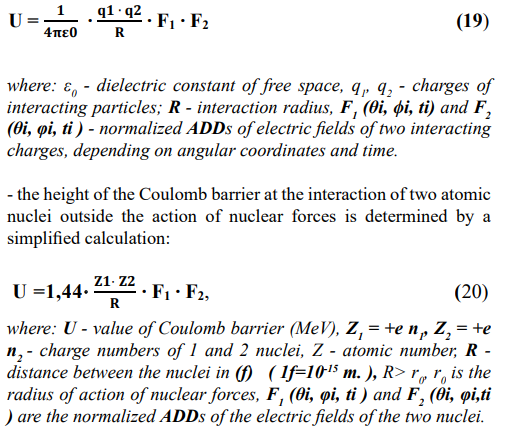
• Normalized ADD (Fi / Fmax ≤ 1) is a three-dimensional surface defining the spatial distribution of the Coulomb field of the nucleus at an equidistant distance at a specific moment of time (Figure 20):
• The height of the potential barrier U for two interacting nuclei is determined by the magnitude of the charges, the structure, and the spatial orientation of the nuclei at the moment of approach. The estimation of the potential barrier U for four variants of interacting charges is presented in Figure 21.

Figure 21: Cross section of normalized ADD Fa, Fb, and Fc electric fields of different nuclei at equidistant distance R from the centers of the nuclei:
Fa - ideal characteristics of the proton electric field (point charge).
Fb - the electric field of the proton is an oscillating multimode electric field with a modulation coefficient of 30%.
Fc - deuterium electric field is an oscillating multimode electric field with a modulation coefficient of 30% and one low - potential channel.
R - is the average value of the radius of the spatial region of the Coulomb barrier.

Figure 22: The height of the potential barrier Umax of interacting nuclei depends on their structures and spatial orientation at the moment of approach
A - Convergence of two protons as point charges (ideal variant).
B - Convergence of two protons with oscillating electric fields.
C - Convergence of two deuterium nuclei (proton + neutron) with a counter direction of low potential channels in the electric field of the two nuclei.
D - Convergence of two tritium nuclei (proton + two neutrons) with the counter direction of low-potential channels in the electric field of two nuclei.
A Comparison of the Umax Potential Barrier Levels for the Variants of Interacting Nuclei Shows the following:
• For two protons with an electric field equivalent to that of point charges, the maximum value of the potential barrier level is approximately equal to ≈ 1 MeV (variant A);
• Two protons with oscillating electric fields need to overcome the Coulomb barrier of about ≈ 500 keV. (option B). For two protons at in-phase coincidence of half-waves of oscillation of their electric fields the barrier decreases to ≈ 250 keV (variant B).
• When two deuterium nuclei approach each other along the axis of low-potential channels, the potential barrier is ≈ 5 keV (option C).
• When two tritium nuclei with a linear structure (figure 22 ) approach, the potential barrier in the channel is ≈ 50 eV. (option D), i.e., about 104 times the known accepted barrier level for protons at present.
The atomic nuclei must have sufficient energy of motion to overcome the Coulomb barrier Umax, approach to the distance of the nuclear forces, and enter into a nuclear reaction.
The expression (27) allows us to determine the potential barrier Umax for interacting nuclei depending on the spatial orientation and to estimate the possibility of penetration into the nucleus of a charged particle due to the supra barrier transition. For example, two tritium nuclei can converge to a distance of 10-15 m and get into the zone of action of nuclear forces under the condition of convergence by the inputs of radial channels with low potential. For this purpose, it is sufficient for the nuclei to have a kinetic energy of about 50 eV to overcome the Coulomb barrier (option D).
Thus, the presence of low-potential channels in the Coulomb field of nuclei actually allows nuclei to overcome the Coulomb barrier, the average value of which is much higher than the energy of these particles. This shows that the overcoming of the Coulomb barrier by low-energy particles occurs in localized zones due to the supra barrier transition. This explains the true nature of the tunneling effect from the position of classical physics.
Qualitative Estimation of the Probability of Passage of Charged Microparticles Through the Potential Barrier of the Coulomb Field of the Atomic Nucleus
The energy of microparticles must always exceed the height of the Coulomb barrier along the trajectory of motion. High-energy microparticles can overcome the Coulomb barrier in any direction due to their kinetic energy, and low-energy particles can overcome the Coulomb barrier only through its localized regions with a certain probability.
Our study has shown that the nature of the tunnel effect is explained by the presence of low-potential radial channels in the Coulomb field of nuclei, which allow charged particles through these channels to overcome the Coulomb barrier, the average value of which is much higher than the energy of these particles.
The probability of overcoming the barrier by low-energy microparticles is determined by the spatial orientation of the interacting particles, the width of the Coulomb barrier, and the kinetic energy of the nuclei.
Spatial Orientation of Interacting Particles
Charged microparticles, such as atomic nuclei, can get into the low-potential channel of the Coulomb barrier with a certain probability. The probability of microparticles passing through the barrier is determined by the angle and position of the axes of the radial channels of the interacting particles. This probability can be determined from geometrical relations. For example, for two particles having each in its Coulomb field local regions with low-potential channels (i) and the case when only one particle has such a local region (ii), the probability of such a coincidence depends on the ratio of areas:
P1 = Sc1 /Sq1 • Sc2 /Sq2 (i)
P2 = Sc1/Sq1 (ii) (21)
where: Sc1 and Sc2 are the areas of the entrance cross section of radial channels in the electric field of two particles (Sc1 ≈ Sc2 ≈ Sc = π . (1,1. Rn)2, where Rn = 4.5616 . 10-16 m. - is the radius of the neutron), Sq1 and Sq2 are the area of the spatial sphere of the Coulomb barrier (Sq1 ≈ Sq2 ≈ Sq =4 .π .Rg , where Rg is the radius of the spatial area of the Coulomb barrier, Rg ≈ 4 . Rn)
For example, for two interacting particles (i), the probability of axial convergence by low potential channels is about P1 ≈ 1/256, and the probability of one particle hitting the radial channel of the other (ii) is about P2 ≈ 1/16.
The Width of the Coulomb Barrier and the Speed of Movement of Microparticles
The probability of overcoming the Coulomb barrier by an atomic nucleus is greater the smaller the barrier width and the greater the
kinetic energy. This is explained by the dynamics of the motion of nuclei in space, leading to changes in the electric fields with localized regions during the passage of microparticles through them. The time of change in the spatial position of radial channels in localized regions should be longer than the time of microparticle passage through these channels:
T > a / V (22)
where: T - is the minimum interval of change in the spatial position of the electric field of the nucleus (≈ 10-20 sec.), a is the thickness of the potential barrier (≈ 10-15 m.), V - is the average velocity of the nuclei in the radial channel of the Coulomb field (V = √2 · E/m ).
It follows from (30) that the velocity of the nuclei for passing the radial channel should be more than V > 105 m/sec, which corresponds to the kinetic energy of low-energy protons E > 50 eV.
The Probability of Microparticles Getting into the Zone of Action of the Nuclear Forces of the Nucleus
As a result of charge interactions, a proton must enter a region of about 10-15 m in size to be captured by the nuclear forces of the nucleus. Well-known calculations show that the probability of nuclear interaction between particles turns out to be a small value because of the small values fusion reaction cross sections, in units of barns (1 barn = 10-28 m2). For example, the maximum fusion reaction cross section of deuterium and tritium nuclei at a deuteron energy of 100 keV is about 5 barns (5.10-28m2). The distance between atoms is approximately 1.2.10-10 m. at temperature (100 keV =1.16.109 K), and the radius of the nuclear force zone is 10-15 m. This means that the distance between atoms is about ≈ 105 times larger than the area where protons must get to pass the Coulomb barrier, i.e., the probability of protons getting into the region of the nuclear force should be a small value of the order of 10-5 . In practice, it turns out that this probability is much higher, as evidenced by the process of fusion on the Sun (T≈ 2 . 106 K and P ≈ 4.5. 108 atm). There is currently no explanation for this phenomenon.
Our study shows that the higher probability of protons hitting atomic nuclei is explained by the action of the Coulomb field of nuclei and its form in the form of divergent spatial rays with low levels of electric field strength in local regions. Around each nucleus there arise radial local regions with low potential, in which the proton enters and then continues to move radially toward the nucleus according to the principle of least resistance. Thus, the electric field of the nucleus with diverging beams increases the effective cross section of the fusion reaction by approximately 10... 100 times, which increases the probability of protons entering the nuclear force region to values of the order of ≈10-3 ... 10-4.
Conclusion
In this work, a methodological and physical analysis of the relationship between mathematical description and physical explanation of natural phenomena has been presented. Using gravity and the tunneling effect as representative examples, it has been shown that the predictive success of mathematical models does not necessarily imply a complete understanding of the physical mechanisms underlying the observed phenomena.
Modern physics relies extensively on mathematical formalisms, which have proven to be extraordinarily effective in reproducing experimental and observational data. However, when mathematical models are treated as substitutes for physical explanation, questions of causality, mechanism, and physical origin may remain unresolved. This methodological shift has been identified as a central issue in the interpretation of both gravitational and quantum phenomena.
The analysis demonstrates that gravity and the tunneling effect, despite their successful mathematical descriptions, continue to lack universally accepted physical mechanisms grounded in experimentally accessible processes. This situation does not diminish the achievements of existing theories such as general relativity and quantum mechanics but rather highlights the distinction between mathematical representation and physical interpretation.
To address this distinction, new physically motivated descriptions of gravity and the tunneling effect have been proposed. These descriptions are based on established properties of matter, electrodynamic interactions, and experimental observations at macroscopic and microscopic scales. The proposed frameworks aim to complement existing theories by introducing explicit physical mechanisms while preserving empirical consistency.
A key result of the present study is the demonstration that physically transparent interpretations can be developed without rejecting successful mathematical models. Instead, mathematical formalisms may be understood as effective tools that describe observable regularities, while physical theories seek to explain the origin and nature of the underlying processes.
The approach presented here emphasizes the unity of physical phenomena across scales and the central role of matter and interaction in shaping observable effects. By restoring the distinction between physical cause and mathematical description, this framework contributes to a more coherent understanding of fundamental phenomena and opens new directions for theoretical and experimental research.
• New Physical Theory of Gravity: Today, there are enough objective scientific observations and experimental data to explain the physical nature of gravity. The fundamentals of the «Physical theory of gravity» eliminate critical gaps in the understanding of gravity and laying the foundation for a theory that explains the genesis of gravitational fields and the dynamics of gravitational interactions between material bodies, while incorporating established scientific concepts about the structure of matter.
The foundations of the «Physical theory of gravity» reveal the genesis of gravitational fields and the dynamics of gravitational interactions between material bodies, while integrating established scientific concepts about the structure of matter. The theory not only utilizes numerous experimental results and observable phenomena but also reconciles gravitational theory with quantum mechanics.
The new physical theory offers convincing explanations for a variety of gravitational anomalies spanning micro- and macroscopic scales.
The concept of the new theory of gravity can be considered as an alternative to the mathematical model of GR, eliminating a critical gap in the understanding of the nature of gravity. This theory may become the basis for a general theory of gravity in the future.
• New Theory of the Tunnel Effect: This work is a new explanation of the physical processes of the tunnel effect. It is established that the overcoming of the Coulomb barrier by low energy microparticles occurs exclusively supra barrier through a radial channel in the Coulomb barrier with a low potential level. The formation of local regions in the form of radial channels in the Coulomb barrier is related to the properties of atomic nuclear power and their electric field. This explanation is in full agreement with the results of nuclear physics and removes the contradiction of the tunnel effect with the laws of classical physics.
The results of this work allow us to consider that not only the physical nature of the tunnel effect itself has been established, but also many parameters and characteristics of its manifestation have been explained (the level of potentials in the Coulomb barrier and its local regions for different nuclei, the parameter of oscillations of elemental field strengths, the probabilistic characteristics of hitting and passing of microparticles through the barrier depending on the spatial orientation of nuclei, etc.).
A comparative evaluation confirms the correctness of these results and their coincidence with numerous experimental data and phenomena in the tunneling effect. In particular, the understanding of the physical processes of the tunnel effect explains the growth of the transparency coefficient of the Coulomb barrier and the increase in the reaction cross section at the controlled spatial orientation of interacting atomic nuclei in the corresponding medium. These processes explain the results of several known experiments on low-temperature nuclear fusion and show the real possibility of nuclear fusion reactions, for example, the fusion of two tritium nuclei at an average temperature of about 104 K. For example, considering the tunnel effect phenomenon from the perspective of classical physics allows for a deeper understanding of the new method of spin polarization of nuclear fuel for thermonuclear fusion. It is known that the prospects for the development of polarization in nuclear fusion are linked to increasing the energy efficiency of thermonuclear fusion.
The new explanation of the physical processes of the tunnel effect has an important practical significance, first, for solving energy problems. Understanding the physical processes of this phenomenon opens the possibility of using the tunnel effect control mechanism to create future energy plants and obtain unlimited energy resources.
References
- Butterfield, J., & Earman, J. (Eds.). (2007). Philosophy of physics (Vol. 2). Elsevier.
- Rosen, R. (1978). Fundamentals of measurement and representation of natural systems.
- Will, C. M. (1945). Theory and experiment in gravitational physics. American history, 1861(1900).
- Einstein, A. (1915). The field equations of gravitation. Proceedings of the Royal Prussian Academy of Sciences, 844-847.
- R. M. Wald, General Relativity (University of Chicago Press,Chicago, 1984).
- Weinberg, S. (1989). The cosmological constant problem.Reviews of modern physics, 61(1), 1.
- Rovelli, C. (2004). Quantum gravity. Cambridge university press.
- Einstein, A. (1916). Die Grundlagen der allgemeinen. Relat. Teorie Ann. Phys, 49, 769-822.
- Landau, L. D., Lifshitz, E. M. (1975). The Classical Theory of Fields 4th ed. (Pergamon Press, Oxford).
- Bohm, D. (1951). Quantum Theory. (Prentice-Hall, New York).
- Schiff, L. I. (1968). Quantum Mechanics. 3rd ed. (McGraw–Hill, New York).
- Gamow, G. (1928). On the quantum theory of the atomic nucleus. Journal of Physics, 51(3), 204-212.
- Lamarsh, J. R., & Baratta, A. J. (2001). Power Reactors and Nuclear Steam Supply Systems. Introduction to Nuclear Engineering, 3rd ed.; Prentice Hall: Upper Saddle River, NJ, USA, 136-185.
- Wesson, J., & Campbell, D. J. (2011). Tokamaks (Vol. 149).Oxford university press.
- Landau, L. D., Lifshitz, E. M. (1976). Mechanics. 3rd ed. (Pergamon Press, Oxford).
- Goldstein, H., Poole, C., & Safko, J. (2002). Classical Mechanics. Addison-Wesley, San Francisco.
- Griffiths, D. J., & Schroeter, D. F. (2018). Introduction to quantum mechanics. Cambridge university press.
- Razavy, M. (2013). Quantum theory of tunneling. World Scientific.
- Cohen-Tannoudji, C., Diu, B., Laloë, F. (1977). Quantum Mechanics. Vol. 1 (Wiley, New York).
- Atsyukovsky, V. A. (2012). Critical Analysis of the Foundations of the Theory of Relativity (Scientific World, Moscow).
- Will, C. M. (2014). “The confrontation between general relativity and experiment.” Living Rev. Relativ. 17, 4.
- Yatskevich, V. (2020). “Antenna model of the atom.”
- Yatskevich, V. (2024). “The new physical theory about gravitational time dilation.”
- Yatskevich, V. (2024). “Future technology launching space rocket using gravitational shielding.”
- Heaviside, O. (1893). “A gravitational and electromagnetic analogy.” The Electrician 31, 281–282.
- Haisch, B., Rueda, A., & Puthoff, H. E. (1998). Inertia as a zero-point-field Lorentz force. Physical Review A, 49(2), 678.
- Rohrlich, F. (2007). Classical charged particles. World Scientific.
- Wheeler, J. A., & Ford, K. W. (2000). Geons, black holes, and quantum foam. WW Norton & Company.
- Bohm, D., & Pines, D. (1953). A collective description of electron interactions: III. Coulomb interactions in a degenerate electron gas. Physical Review, 92(3), 609.
- Whittaker, E. T. (1903). “On longitudinal electric waves.”Proc. R. Soc. Lond. A 70, 333–355.
- Jackson, J. D. (1999). Classical electrodynamics. John Wiley & Sons.
- Landau, L. D., Bell, J. S., Kearsley, M. J., Pitaevskii, L. P., Lifshitz, E. M., & Sykes, J. B. (1984). Electrodynamics of continuous media (Vol. 8). elsevier.
- Rohrlich, F. (1998). “Interaction of charged particles with electromagnetic fields.” Am. J. Phys. 66, 1109–1117.
- Lanczos, C. (1986). The variational principles of mechanics.Courier Corporation.
- Landau, L. D., & Lifshits, E. M. (1977). Quantum mechanics 3rd edition.
- Sakurai, J. J., & Napolitano, J. (2017). Modern quantum mechanics. Cambridge university press.
- Landau, L. D., Lifshitz, E. M. (1977). “The Stark effect,” in Quantum Mechanics: Non-Relativistic Theory (Pergamon Press, Oxford), Chap. VIII.
- Messiah, A. (1962). Quantum Mechanics. Vol. 2 (North-Holland, Amsterdam).
- Feynman, R. P., Morinigo, F. B., and Wagner, W. G. (1995). Feynman Lectures on Gravitation (Addison-Wesley, Reading, MA,).
- Weinberg, S. (1972). Gravitation and Cosmology (Wiley, New York).
- Caldirola, P. (1956). A new model of classical electron. Il Nuovo Cimento (1955-1965), 3(Suppl 2), 297-343.
- Wheeler, J. A. (1968). “Superspace and the nature of quantum geometrodynamics,” in Battelle Rencontres (Benjamin, New York).
- Negele, J. W., Vogt, E. (1986). Advances in Nuclear Physics.Vol. 17 (Springer, New York).
- Salpeter, E. E. (1954). Electrons screening and thermonuclear reactions. Australian Journal of Physics, vol. 7, p. 373, 7, 373.
- Purcell, E. M., Morin, D. J. (2013). Electricity and Magnetism,3rd ed. (Cambridge University Press, Cambridge).
- Shirokov, Y. M., Yudin, N. P. (1972). Nuclear Physics (Nauka, Moscow).
- Krane, K. S. (1987). Introductory nuclear physics. John Wiley & Sons.
- Parisi, J. F., Diallo, A., & Schwartz, J. A. (2022). Simultaneous enhancement of tritium burn efficiency and fusion power with low-tritium spin-polarized fuel. Nuclear Fusion, 64(12), 126019.
- Zeldovich, Y. B., Popov, V. S. (1963). “Electrostatic fields in the presence of nuclear forces,” Sov. Phys. JETP 16, 427–435.