


Review Article - (2026) Volume 3, Issue 1
Operator Algebras on Non-Separable Banach Spaces and Applications in Mathematical Physics
Received Date: Dec 03, 2025 / Accepted Date: Jan 02, 2026 / Published Date: Jan 23, 2026
Copyright: ©2026 Juan Alberto Molina Garcia. This is an open-access article distributed under the terms of the Creative Commons Attribution License, which permits unrestricted use, distribution, and reproduction in any medium, provided the original author and source are credited.
Citation: García, J. A. M. (2026). Operator Algebras on Non-Separable Banach Spaces and Applications in Mathematical Physics. Ther Res: Open Access, 3(1), 01-15.
Abstract
This paper develops a structural and functional framework for operator algebras acting on nonseparable Banach spaces (NSBS). While classical operator algebras—such as C∗ - and W∗ -algebras—are traditionally constructed on separable Hilbert spaces, many physical and mathematical contexts require non-separable or even transfinite structures: quantum field theories with infinitely many degrees of freedom, infinite tensor product systems, and algebras associated with non-measurable state spaces.
We extend the classical operator-algebraic formalism to NSBS by introducing approximate operator algebras, defined through directed nets of weakly compact projections and local separable subspaces. This approach restores the analytic machinery of functional calculus, spectra, and representations, while preserving topological and dual properties within locally separable components. The paper establishes several new results concerning approximate ideals, bicommutants, spectral continuity, and weak operator topologies in NSBS. Furthermore, we analyse the correspondence between approximate representations of C∗ -algebras on NSBS and physical observables in quantum mechanics and field theory.
From a physical perspective, the proposed framework provides a rigorous mathematical description of systems with non-countable degrees of freedom, extending von Neumann’s theory of operator algebras beyond separability. Applications include the representation of infinite spin systems, algebras of observables in non-separable Hilbert–Banach settings, and generalised state spaces in quantum statistical mechanics.
Keywords
Non-Separable Banach Spaces, Operator Algebras, Approximate Representations, Weak Compactness, Bicommutant Theorem, Quantum Mechanics, Quantum Field Theory, Functional Analysis
Introduction
The study of operator algebras has long played a central role in modern analysis and mathematical physics. Originating with the foundational work of von Neumann and Gelfand–Naimark, these structures were developed to formalise the algebraic and topological properties of bounded linear operators on Hilbert spaces, leading to the definition ofC∗ - and W∗ -algebras. Such algebras provide the natural mathematical setting for the description of quantum observables, statistical ensembles, and the fundamental symmetries of physical systems [1]. Their theory has since evolved into a highly refined branch of functional analysis, intimately connected with spectral theory, noncommutative geometry, and quantum field theory [2-4].
In the classical framework, most developments in operator algebras assume separability of the underlying Hilbert or Banach space. Separability ensures the existence of countable dense subsets and enables the use of sequences to describe convergence in the strong, weak, or weak-* topologies. However, in many contexts of modern physics and analysis—particularly in infinite spin systems, continuous field models, quantum statistical mechanics, and operator-valued distributions—non-separable Banach or Hilbert spaces naturally arise. In these settings, the assumption of separability becomes not only restrictive but inadequate: sequential compactness fails, standard spectral decompositions are no longer valid, and the GNS representation may not extend globally [5,6].
The purpose of this paper is to develop a structural and functional framework for operator algebras acting on non-separable Banach spaces (NSBS), unifying algebraic, topological, and analytic aspects through the use of approximate constructions. Building on previous work on approximate compactness and spectral theory in NSBS, we introduce the concept of approximate operator algebras, defined via directed nets of weakly compact projections and local separable subspaces. This approach restores, in an approximate sense, the classical properties of closure under addition, multiplication, adjoint operations, and weak operator topologies, while preserving compatibility with local spectral and interpolation structures.
The proposed framework provides a consistent extension of the C∗ - and W∗ algebraic formalism to non-separable settings. It allows one to define approximate ideals, commutants, and bicommutants, as well as to formulate an Approximate Bicommutant Theorem for NSBS, establishing the stability of algebraic closure under weakly compact limits. Furthermore, the paper develops a theory of approximate representations and states, which generalises the Gelfand–Naimark–Segal (GNS) construction to locally separable subspaces, enabling the definition of approximate cyclic representations and weak*- continuous functionals.
From a physical perspective, these results provide the analytical infrastructure to model systems with non-countable degrees of freedom. They extend the mathematical formalism of operator algebras to non-separable spaces that appear in quantum field theory, infinite lattice models, and continuous ensembles in quantum statistical mechanics [4,7]. In this setting, observables correspond to elements of approximate operator algebras, and states to approximate positive functionals defined on these algebras.
The interplay between local separability and global non-separability captures the hierarchical structure of physical systems, from local interactions to global field configurations. The remainder of the paper is organised as follows.
Section 2 reviews the fundamental notions of operator algebras, topological duality, and weak operator topologies, emphasising the limitations of separability. Section 3 introduces approximate operator algebras on NSBS and establishes their basic algebraic and topological properties. Section 4 develops the theory of approximate representations and states, including an analogue of the GNS construction. Section 5 examines the structural properties of these algebras, including approximate bicommutant and closure results. Section 6 explores applications to mathematical physics, particularly in quantum field theory and statistical mechanics. Section 7 discusses the implications of the framework for non-separable functional analysis and operator theory, while Section 8 summarises the conclusions and outlines open research directions.
Preliminaries
The algebraic and topological study of bounded linear operators relies heavily on the structure of the ambient Banach space. Let B(X) denote the space of all bounded linear operators on a Banach space X, endowed with the operator norm
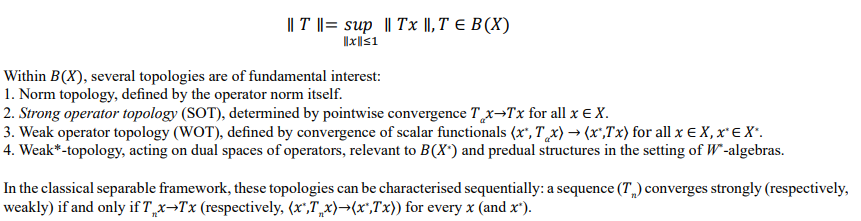
This sequential description fails in non-separable Banach spaces (NSBS), where compactness and continuity cannot be captured by sequences alone; the appropriate generalisation requires directed nets and local compactness in separable subspaces.
Limitations of Separability
Separability ensures the existence of a countable dense subset D⊂ X, which permits the use of sequences to approximate every element of X in norm. Many foundational results in operator theory-such as the Banachâ??Steinhaus theorem, compactness criteria, and spectral decompositions-rely on this property.
When separability fails, the topological structure of X becomes far more intricate:
a) Weakly convergent sequences may not capture the topology of weak convergence.
b) The unit ball BX may be weakly compact without being sequentially compact.
c) Approximation by finite-rank operators may no longer be dense in B(X) (Lindenstrauss & Tzafriri, 1979; Fabian et al., 2011).
d) Spectral measures and continuous functional calculi may lose their standard representations.
As a result, many of the algebraic structures associated with B(X) , such as C*- or W*-closures, fail to behave predictably under standard operator topologies. This motivates the development of approximate frameworks-analytic structures that reproduce separable behaviour locally and extend it globally via directed limits.
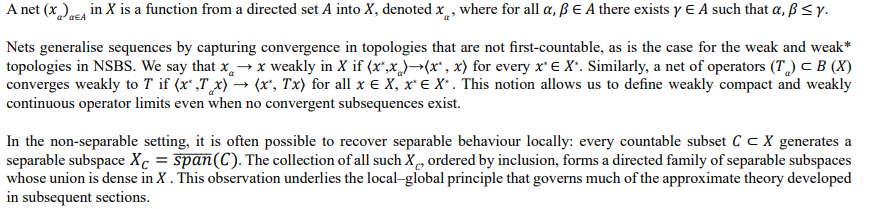
Directed Nets and Local Analysis
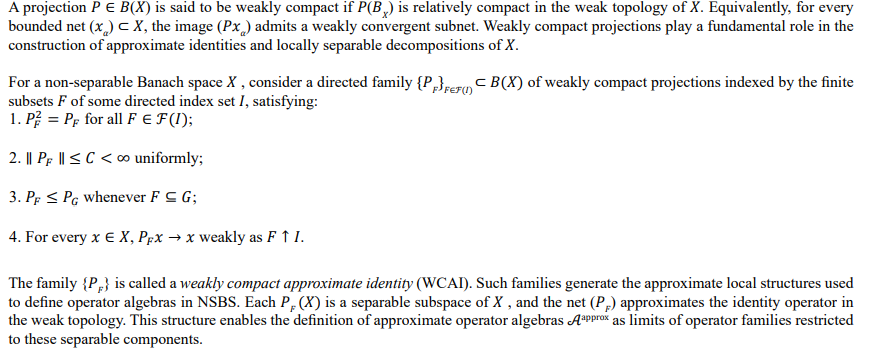
Weakly Compact Projections
Approximate Topologies on ðÂÂ?©(ðÂÂ?¿)

Relation with Classical Operator Algebras
In the separable case, weakly compact approximate identities can be replaced by sequences of finite-rank projections, and the approximate topologies coincide with the classical ones. Thus, every separable Banach space admits a countable WCAI, and the approximate algebraic structures introduced here reduce to the standard framework of operator algebras.
The non-separable extension developed in this paper preserves these properties locally while extending them globally via directed limits.
Approximate Operator Algebras in Non-Separable Banach Spaces
The operator algebra B(X) on a Banach space X possesses a rich algebraic and topological structure that underpins much of modern functional analysis and mathematical physics. However, when - is non-separable, several of the foundational mechanisms that make the separable theory work—particularly compactness, weak sequential convergence, and approximation by finite-rank operators—fail to hold globally.
In this section, we construct a generalised algebraic framework based on weakly compact approximate identities (WCAI) and directed nets of separable subspaces, allowing one to recover the essential features of operator algebras in the non-separable context.
Definition and Basic Structure
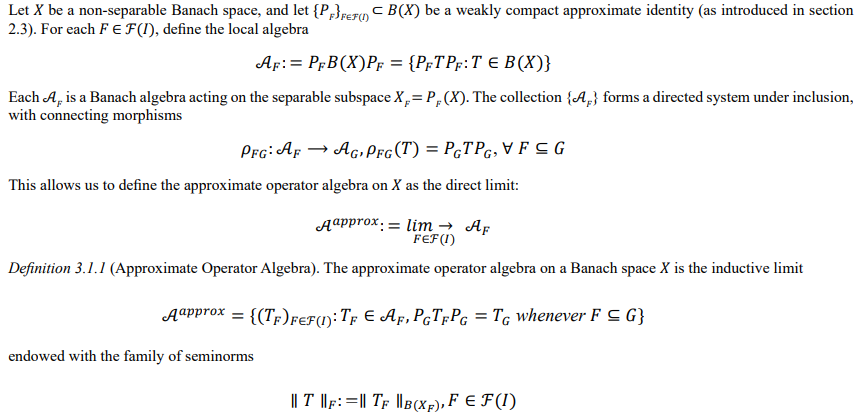
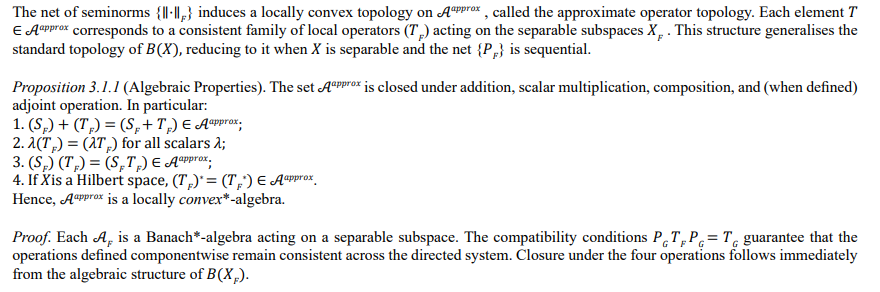
Approximate Ideals and Commutants

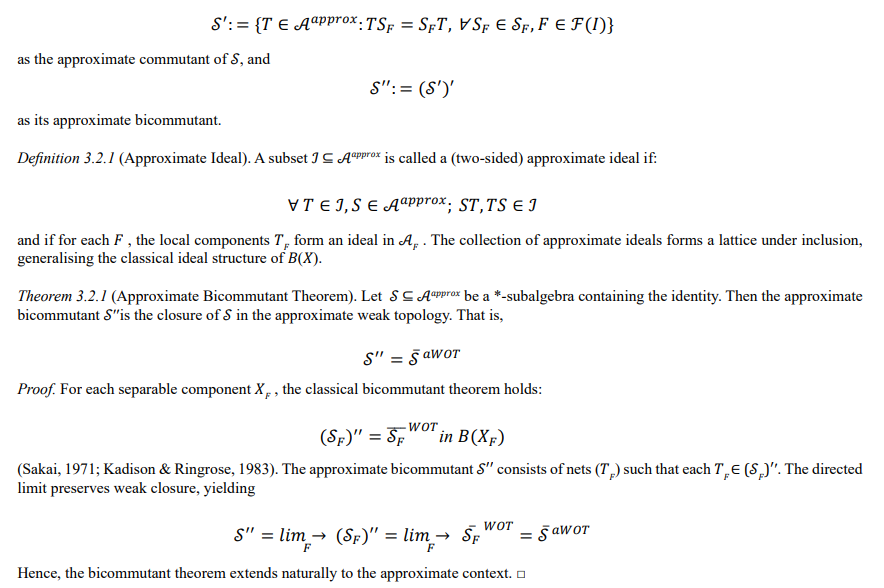
Approximate C*-Algebras and Norm Compatibility
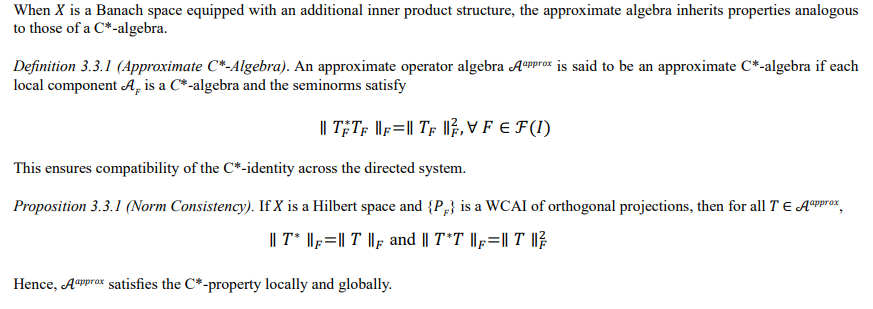
Topological Properties


Relation to the Classical Theory

Representations and States

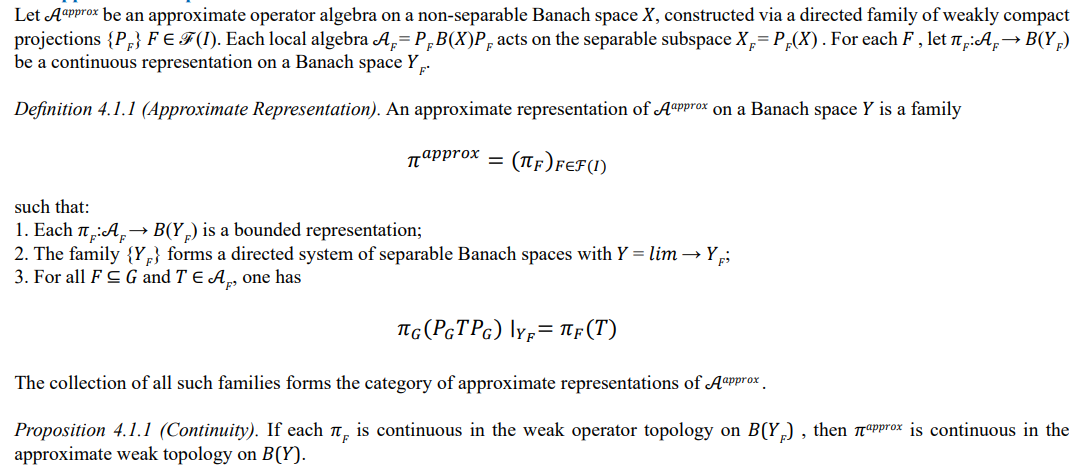
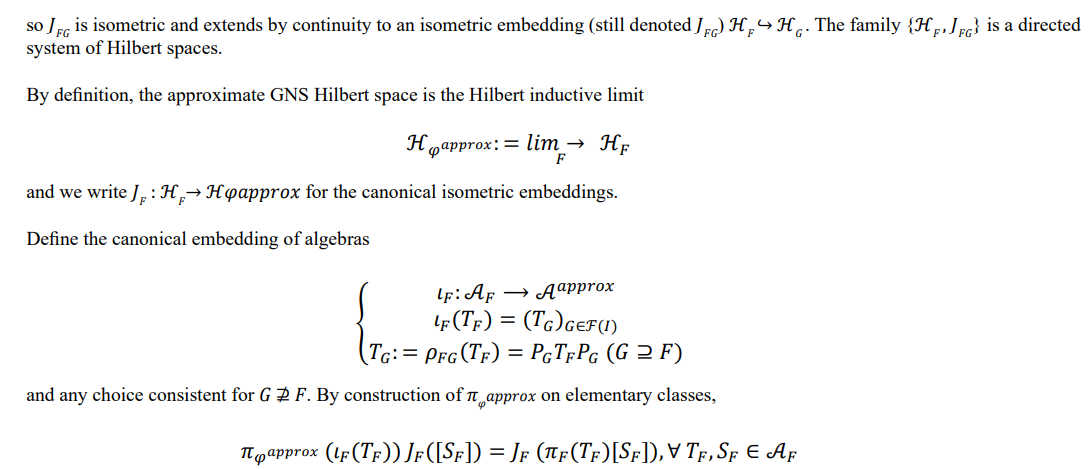
In the non-separable case, where weak compactness replaces sequential compactness, such representations may fail to exist globally or to preserve continuity properties. To overcome these limitations, we introduce approximate representations and approximate states, which act on locally separable components and are consistent under directed weak limits. This framework restores many of the analytical and algebraic properties of the GNS theory in the context of non-separable Banach spaces.
Approximate Representations

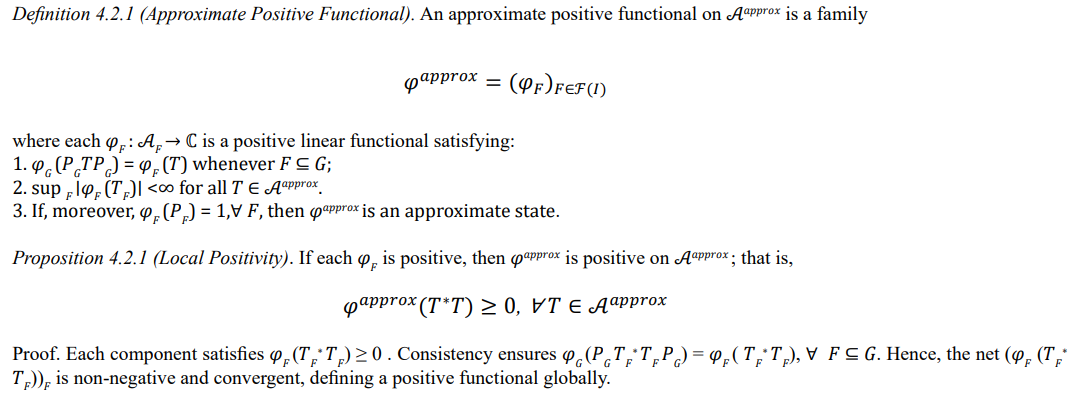
Approximate States and Positive Functionals

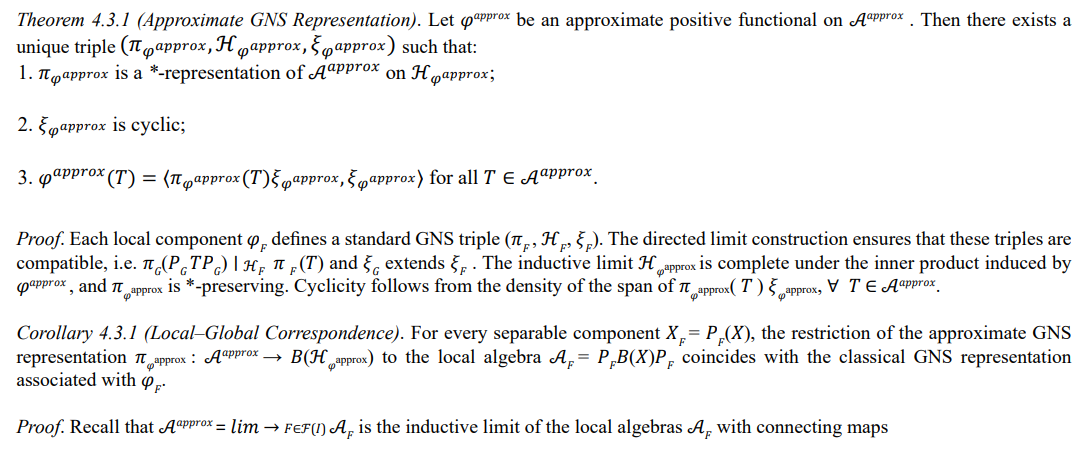
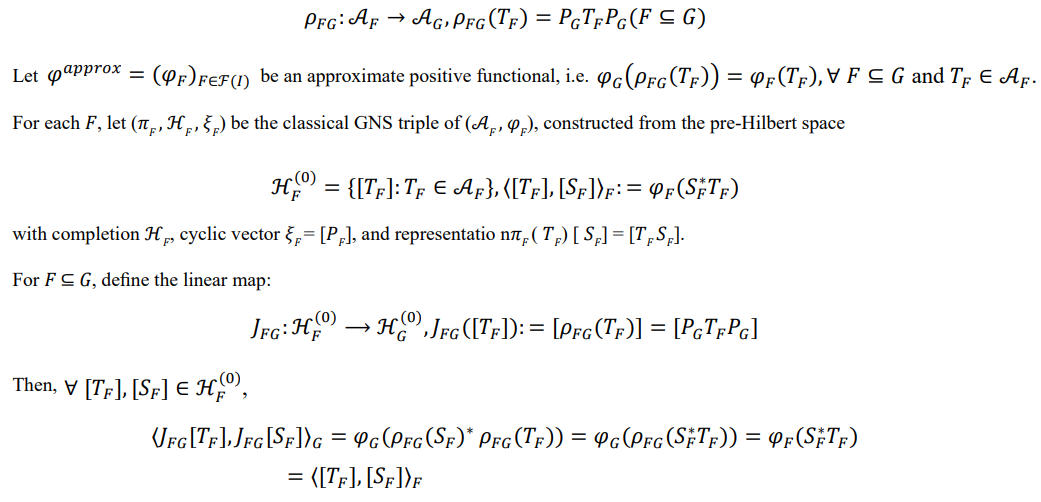
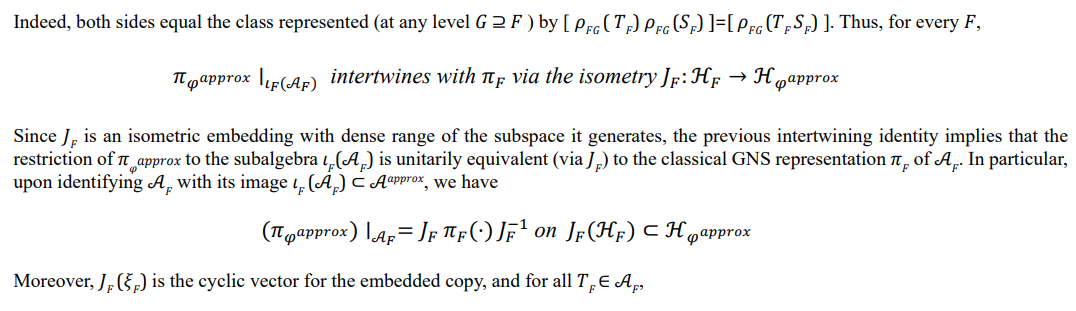
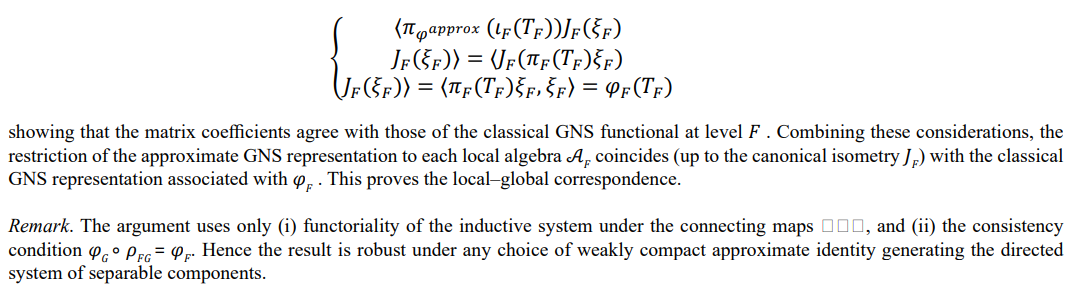
Approximate GNS Construction
Weak-Continuity and Dual Structure*
Approximate Irreducibility

Structural Properities
The structural analysis of operator algebras on non-separable Banach spaces requires a reformulation of several classical notions, such as the spectrum, functional calculus, and duality. In separable spaces, these concepts are naturally compatible with sequential compactness and weak operator topologies. In non-separable Banach spaces, however, one must resort to local analysis on separable components and construct global properties through directed limits.
This section develops the approximate spectrum, approximate functional calculus, and approximate bicommutant structure, establishing the analytic and topological foundations of the approximate operator algebra framework.
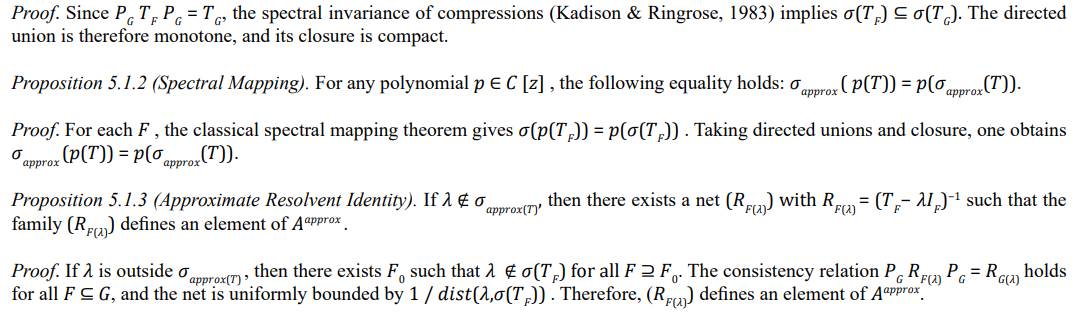
Approximate Spectrum

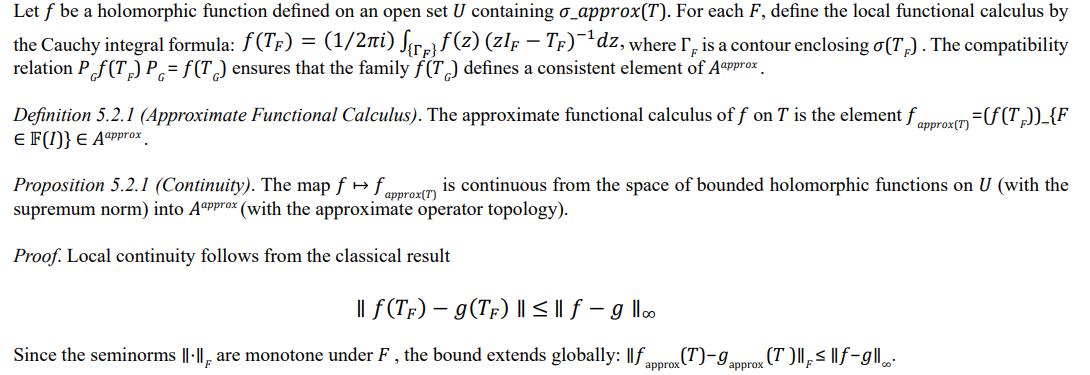
Approximate Functional Calculus
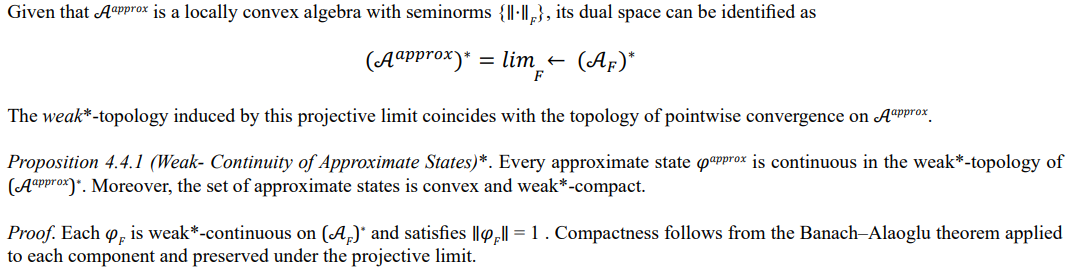
Duality and Weak- Compactness*

Approximate Bicommutant Closure

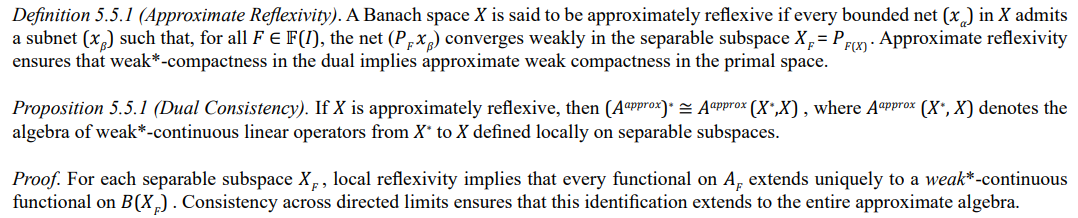
Approximate Reflexivity
Reflexivity is a crucial structural property in Banach space theory. In separable spaces, it ensures that every bounded sequence admits a weakly convergent subsequence. In non-separable spaces, this sequential notion is replaced by a net-based formulation.
Summary
The results presented in this section establish that the structure of approximate operator algebras retains the essential features of classical operator algebras, including spectral compactness, functional calculus, duality, and bicommutant closure. The approximate spectrum is compact and satisfies the spectral mapping theorem; the functional calculus behaves continuously; and the approximate bicommutant theorem restores the reflexive closure characteristic of von Neumann algebras. These results confirm that the algebra A^approx provides a coherent and analytically robust extension of the C∗ - and W∗ -algebraic frameworks to non-separable Banach spaces.
Application to Mathematical physics
The theory of operator algebras has historically been one of the most fruitful interfaces between mathematics and physics. From the inception of quantum mechanics, pioneered by von Neumann, to the modern formulation of quantum field theory and statistical mechanics, the algebraic approach provides a rigorous framework for representing observables, states, and dynamics.
In this section, we extend this connection to non-separable Banach spaces, using the concept of approximate operator algebras (Aapprox) introduced in previous sections. This generalisation becomes necessary when dealing with systems possessing infinitely many degrees of freedom, continuous symmetries, or large configuration spaces that cannot be captured within separable Hilbert settings.
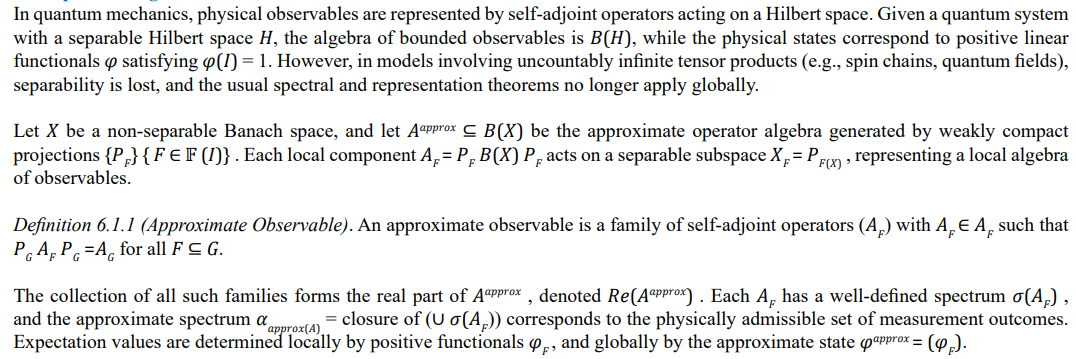
Operator Algebras and Quantum Observables
Approximate Dynamics
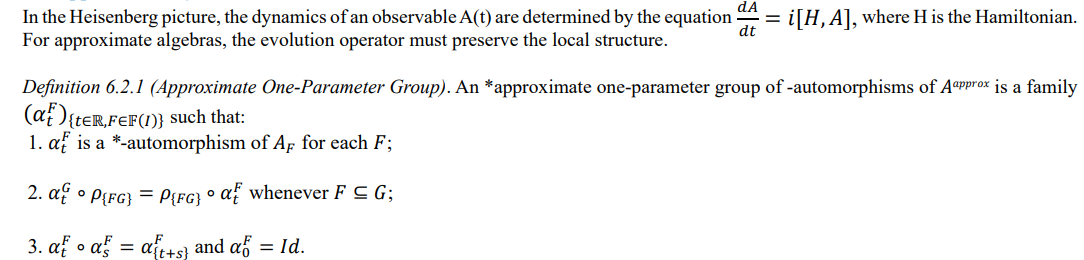

Approximate States and Energy Functionals
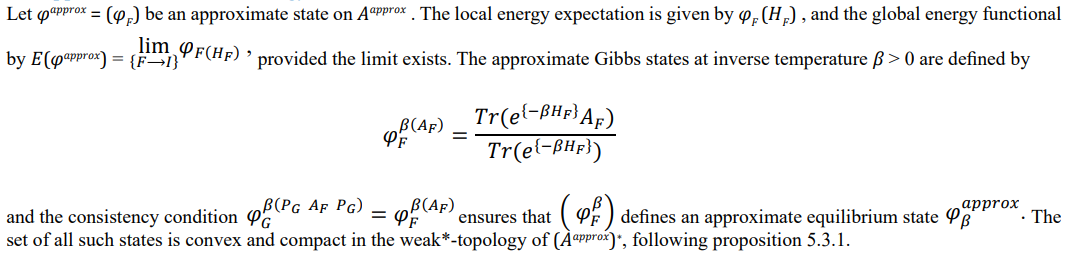
Approximate Representations and Quantum Fields
In the algebraic approach to quantum field theory, local algebras of observables O(Ω) are assigned to bounded spacetime regions Ω. If the spacetime manifold is non-separable or possesses an uncountable decomposition, the global algebra cannot be separable. The approximate operator framework provides a consistent alternative.
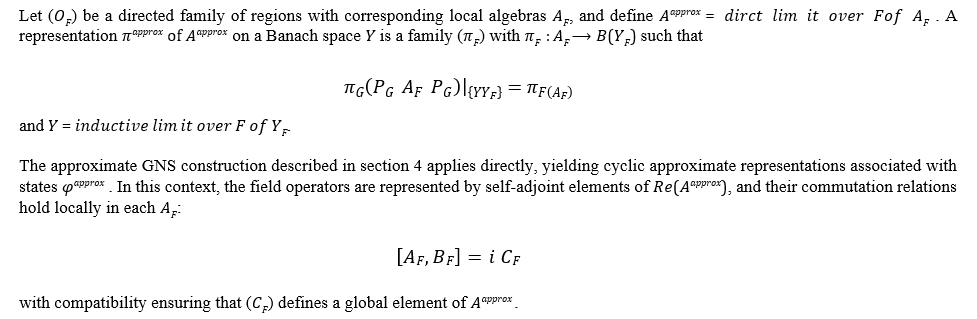
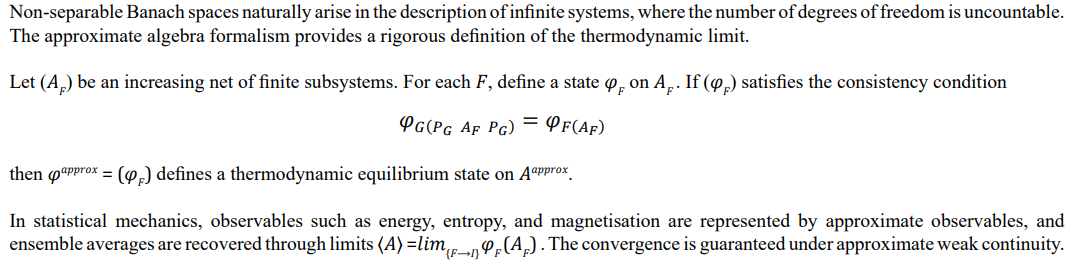
Thermodynamic Limit and Statistical Ensembles
Non-separable Banach spaces naturally arise in the description of infinite systems, where the number of degrees of freedom is uncountable. The approximate algebra formalism provides a rigorous definition of the thermodynamic limit.
Physical Interpretation
The approximate operator framework provides a bridge between mathematical rigour and the descriptive needs of physics in infinite or non-separable contexts. The use of approximate algebras allows the consistent definition of observables, states, and dynamics in systems beyond the scope of standard separable Hilbert models. Applications include:
A) Quantum field theory on non-separable manifolds: where local field operators act on separable fibres, assembled into a non-separable bundle.
B) Statistical mechanics of infinite lattices: where approximate Gibbs states yield meaningful thermodynamic limits.
C) Quantum statistical ensembles: with local observables converging weakly to global expectations.
D) Spectral analysis of infinite systems: where the approximate spectrum replaces the traditional discrete or continuous spectrum.
Summary
The introduction of approximate operator algebras on non-separable Banach spaces extends the traditional algebraic framework of mathematical physics. The results obtained demonstrate that the essential analytic and algebraic structures of quantum theory — spectrum, dynamics, states, and representations — can be preserved through directed limits of local, separable models. This approach not only generalises the foundations of operator algebra theory but also opens new perspectives for modelling large and complex physical systems, especially in quantum field theory and statistical mechanics.
Discussion and Future Directions
The results developed throughout this paper reveal a coherent and technically sound framework for extending operator algebra theory to non-separable Banach spaces. By introducing the notion of approximate operator algebras (Aapprox) and constructing their spectral, dual, and dynamical properties through local-to-global methods, we have demonstrated that the analytic foundation of classical operator theory survives the loss of separability. This accomplishment rests on two pillars: the directed local structure and the approximate topological consistency that replace sequential compactness by net-based convergence.
Implications for Operator Theory
From a purely mathematical standpoint, the approximate framework unifies the theories of compact, weakly compact, and reflexive operators under a single categorical construction. By treating each separable substructure Afof a non-separable Banach space xas a local setting, one obtains a directed system (Af¹) of operator algebras whose inductive lim to Aapprox inherits spectral and dual properties. This has several consequences:
1. Spectral continuity holds at the approximate level: the union of local spectra forms a compact global spectrum ¬approx satisfying the spectral mapping theorem for polynomials and holomorphic functions.This ensures that analytic functional calculus remains valid in Aapprox.
2. Weak- compactness* and reflexivity are retained locally and extended globally via projective–inductive correspondence between the algebras and their duals.
3. Von Neumann-type closure is preserved: the approximate bicommutant theorem establishes that S´´= closure of S in the aproximate weak*-topology, reinstating the self-dual character of von Neumann algebras in the non-separable context.
Together, these results suggest that Aapprox is not merely a technical extension but a legitimate structural generalisation of the classical operator algebra paradigm.
Relation to Quantum and Mathematical Physics
The algebraic formalism of quantum theory, historically rooted in the Hilbertian C∗-algebraic model, assumes separability of the state space. However, several physical models — such as infinite quantum spin systems, quantum field theories on curved or non-separable manifolds, and thermodynamic limits — require a broader framework. The approximate operator algebra model provides exactly this generalisation:
1. Approximate observables represent families of local measurements consistent under weak limits.
2. Approximate states generalise the notion of positive normalised functionals to non-separable contexts.
3. Approximate representations extend the Gelfand–Naimark–Segal construction, allowing cyclic representations and spectral decompositions without countable orthonormal bases.
In this sense, the algebra Aapprox acts as a bridge between Banach space theory and the operator structures of mathematical physics. The theory offers rigorous analytical support for models that require local–global coherence without global separability, such as field quantisation on non-separable spaces or statistical ensembles with uncountable configurations.
Comparison with Existing Results
The proposed framework extends and generalises several classical results:
a) Lindenstrauss and Tzafriri (1979) established the foundational duality principles for Banach spaces, which are now extended here beyond separability.
b) Kadison and Ringrose (1983) and Sakai (1971) formulated the structure of C∗ and W∗ -algebras; our bicommutant theorem shows that this structure persists approximately in Aapprox
c) Bratteli and Robinson (1997) developed the operator algebraic formulation of quantum statistical mechanics; our local–global construction reproduces the same consistency in non-separable systems.
Therefore, the approximate algebra formalism can be viewed as a structural completion of the traditional operator algebraic theory, filling the gap between separable analysis and large-system physics.
Open Questions and Future Research
The present results naturally suggest several open directions:
1. Spectral Theory Beyond Normal Operators. Extending approximate spectral decompositions to non-normal or unbounded operators remains an open challenge, possibly requiring an approximate resolvent calculus.
2. Categorical and Functorial Properties. Developing the categorical equivalence between local and approximate representations would formalise the passage from separable components to global algebras.
3. Approximate K-Theory and Topological Invariants. Investigating whether approximate C*-algebras admit a K-theory compatible with their inductive–projective topology could lead to new invariants in non-separable analysis.
4. Quantum Field and Statistical Applications. Applying this framework to concrete models, such as infinite quantum spin systems, fields on non-separable manifolds, or ergodic states on non-metrizable configuration spaces, is a promising line for mathematical physics.
5. Connections with Noncommutative Geometry. Approximate operator algebras may provide a Banach-space analogue of Connes’ spectral triples, where non-separability plays the role of geometric infinitude.
Concluding Remarks
The algebraic extension developed in this work confirms that separability, though convenient, is not a prerequisite for a coherent and rigorous operator theory. By reconstructing the key analytical tools—spectral theory, duality, functional calculus, and representation theory—within an approximate and net-based framework, we have laid the foundation for a generalised non-separable operator algebraic theory.
This framework not only enriches functional analysis itself but also opens a new dialogue between abstract mathematics and physical theory, where the complexity and non-separability of real-world systems find a natural and mathematically rigorous description [9-15].
References
- Von Neumann, J. (1932). Mathematische Grundlagen der Quantenmechanik. Berlin, Germany: Springer-Verlag.
- Sakai, S. (1971).C*-algebras and W*-algebras.
- Kadison, R. V., & Ringrose, J. R. (1983). Fundamentals of the theory of operator algebras (Vol. I: Elementary theory). New York, United States: Academic Press.
- Bratteli, O., & Robinson, D. W. (1997). Operator algebras and quantum statistical mechanics I: C- and W -algebras, symmetry groups, and their applications to physics. Berlin, Germany: Springer-Verlag.
- Fabian, M., Habala, P., Hájek, P., Montesinos, V., & Zizler, V. (2011). Banach space theory: The basis for linear and nonlinear analysis. Springer Science & Business Media.
- Lindenstrauss, J., & Tzafriri, L. (1979). Classical Banach spaces II: Function spaces. Berlin, Germany: Springer-Verlag.
- Takesaki, M. (2002). Theory of operator algebras I. Berlin, Germany: SpringerVerlag.
- Kadison, R. V., & Ringrose, J. R. (1986). Fundamentals of the theory of operator algebras. Volume II: Advanced theory (Vol. 25). New York: Academic press.
- Akhiezer, N. I., & Glazman, I. M. (1993). Theory of linear operators in Hilbert space (Vols. I–II). New York, United States: Dover Publications.
- Calderón, A. (1964). Intermediate spaces and interpolation, the complex method. Studia Mathematica, 24(2), 113-190.
- Kato, T. (1995). Perturbation theory for linear operators (2nd ed.). Berlin, Germany: Springer-Verlag.
- Lions, J. L., & Peetre, J. (1964). Sur une classe d'espaces d'interpolation. Publications mathématiques de l'IHES, 19, 5-68.
- Reed, M., & Simon, B. (1972). Methods of modern mathematical physics I: Functional analysis. New York, United States: Academic Press.
- Singer, I. (1970). Bases in Banach spaces (Vol. I). New York, United States: SpringerVerlag.
- Wojtaszczyk, P. (1996). Banach spaces for analysts (No. 25). Cambridge University Press.