

Advances in Theoretical & Computational Physics(ATCP)
ISSN: 2639-0108 | DOI: 10.33140/ATCP

Research Article - (2026) Volume 9, Issue 3
On the Wave Equation
Received Date: May 20, 2026 / Accepted Date: Jun 26, 2026 / Published Date: Jul 10, 2026
Copyright: ©2026 Uchida Keitaroh. This is an open-access article distributed under the terms of the Creative Commons Attribution License, which permits unrestricted use, distribution, and reproduction in any medium, provided the original author and source are credited.
Citation: Keitaroh, U. (2026). On the Wave Equation. Adv Theo Comp Phy, 9(3), 01-05.
Abstract
This paper presents a structural reinterpretation of the wave equation based on the interplay among second-order hyper- exponential functions, Hamilton’s quaternions, and a geometric model of revolution around a line segment. Owing to the natural compatibility between these hyper-exponential functions and quaternions, the proposed framework yields a decomposition of the solution into two distinct terms. The main result is that, under this hyper-exponential representation, the d’Alembertian operator admits a quaternionic decomposition into two mutually cancelling components. This reformulation provides a new perspective on the underlying structure of partial differential operators.
Introduction
A wave function satisfying the wave equation has been previously derived using second-order hyper-exponential functions defined on the real domain, which satisfy F¹(V)′′ = F(V)F¹(V). When F(V) ∈ Cw(R), the solution F(v) of the differential equation is also real analytic. In this paper, we extend this framework by incorporating Hamilton’s quaternions alongside the hyper-exponential functions to explore whether new mathematical insights can be obtained. The real analyticity of F(v) ensures compatibility with the quaternionic differential operators developed in the subsequent sections. Under this condition, the solution exists as a real analytic function, allowing the wave equation and the d'Alembert operator to be treated naturally within an analytic framework.
The conventional method is outlined below
Revolution around a Line Segment
Considering a line segment embedded in three-dimensional space, a revolution around it can be established a priori. Thus, by placing a line segment perpendicular to a plane, one can define the angle of rotation θ around the segment, measured from a reference direction on the plane starting at the intersection point.
Based on this concept, we consider a vector of zero magnitude originating at the foot of the segment and associate the rotation angle θ with it. The positive direction of rotation is defined as the direction in which a right-handed screw advances along the segment in accordance with θ. Finally, we place the origin at the center of the line segment, designating its endpoints as a and -a .
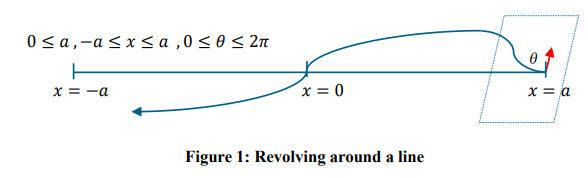
Figure 1: Revolving around a line
As shown in Table 1, we assume a full revolution around the line segment. Therefore, we set x = a cosθ.

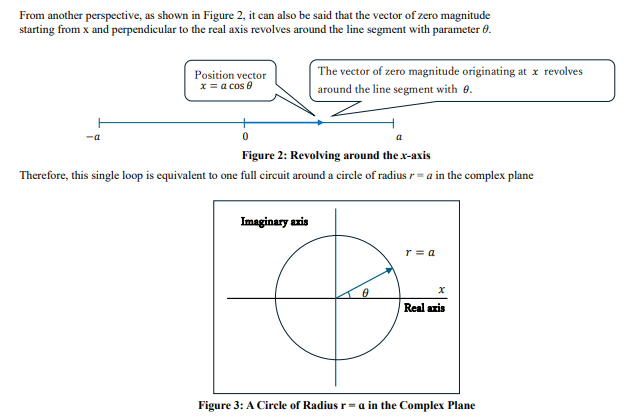
That is, a single revolution of the vector of zero magnitude around the line segment corresponds to one full circuit around a circle of radius r = a in the complex plane. This suggests that the structure associated with the line segment may be identified with that of the complex plane.
The Wave Equation and the d"Alembertian Operator
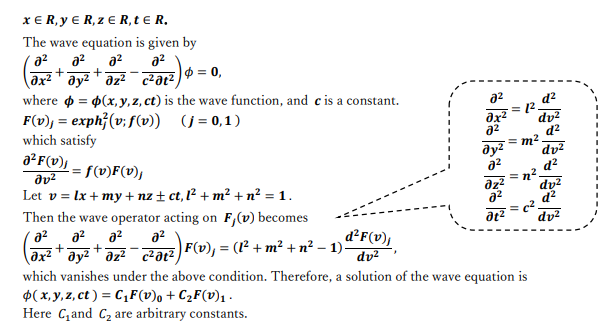
Let us consider the wave equation again.
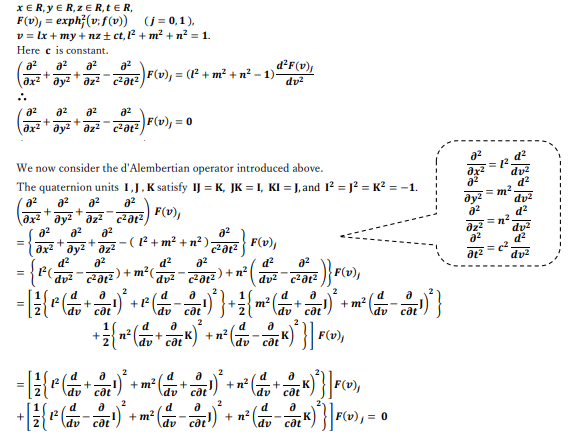
That is, when second-order hyper-exponential functions are used as a solution, it follows that the quaternionic d'Alembertian operator can be decomposed into the sum of two distinct partial differential operators associated with opposite directions in the complex plane.
An Example
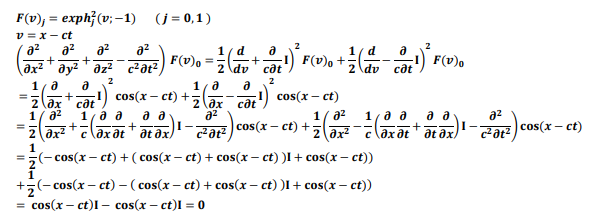
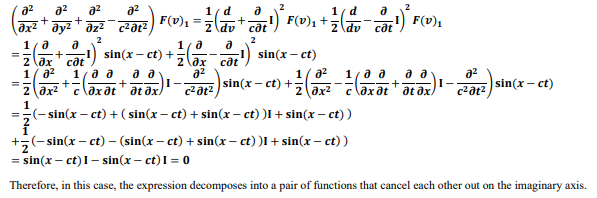
Based on the preceding discussion, we present the following examples.
Case 1: f (v) = −1
Let us consider the case, where l = 1, m = n = 0 .
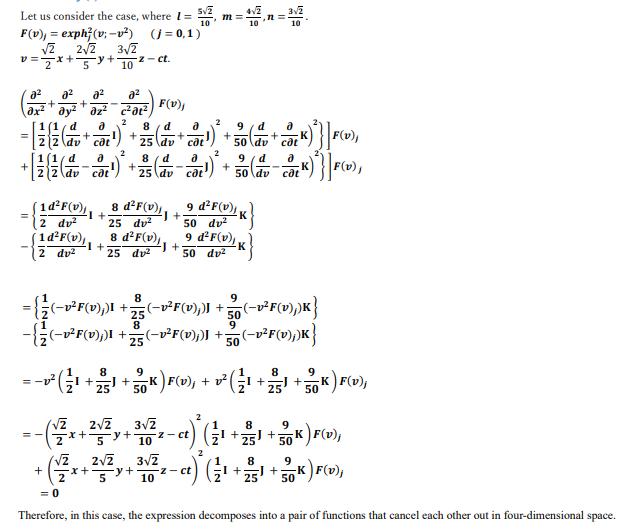
Case 2: f (v) = −v2
Conclusion
The proposed solution form for the wave equation can be decomposed into the sum of two functions. It has been demonstrated that the d'Alembertian operator can be naturally reformulated using second-order hyper-exponential functions and quaternions. This research confirms that our proposed approach offers a novel perspective on conventional methods for solving the wave equation. As described above, second-order hyper-exponential functions are naturally compatible with Hamilton's quaternions, and further application to partial differential equations may be possible.
Acknowledgments
The authors would like to note that this paper was drafted based on the first author's original ideas and subsequently reviewed and polished by multiple AI systems.
References
- Kumahara, K., Saitoh, S., & Uchida, K. (2009). Normal solutions of linear ordinary differential equations of the second order.International Journal of Applied Mathematics, 22(6), 981–996.
- Uchida, K. (2017). Introduction to hyper exponential function and differential equation (Rev. 1st ed.). eBookland. (In Japanese).
- Uchida, K. (2018). Hyper exponential function. Adv Theo Comp Phy, 1(3), 1–3.
- Uchida, K. (2019). How to generate the hyper exponential functions. Adv Theo Comp Phy, 2(1), 1–2.
- Uchida, K. (2022). How to execute repeated integral to generate hyper-exponential functions. Adv Theo Comp Phy, 3(3), 218–219.