

Journal of Electrical Electronics Engineering(JEEE)
ISSN: 2834-4928 | DOI: 10.33140/JEEE
Impact Factor: 1.2

Research Article - (2026) Volume 5, Issue 4
On Planck’s Radiation Function

Received Date: Jul 10, 2026 / Accepted Date: Aug 17, 2026 / Published Date: Aug 28, 2026
Copyright: ©2026 Arunas Ostasevicius. This is an open-access article distributed under the terms of the Creative Commons Attribution License, which permits unrestricted use, distribution, and reproduction in any medium, provided the original author and source are credited.
Citation: Ostasevicius, A. (2026). On Planckâs Radiation Function. J Electrical Electron Eng, 5(4), 01-05.
Abstract
This paper proposes a deterministic macroscopic model of thermal radiation from condensed matter, offering an alternative to stochastic noise approaches of fluctuational electrodynamics. Based on the concept of a continuous cascade buildup of intermittent self-oscillations of the electron subsystem during slow heating (the Bolero principle) and first-order linearized Maxwell equations, a rigorous analytical derivation of Wien’s spectral law is obtained. The thermal response parameter of a substance is expressed for the first time in terms of its fundamental macroscopic properties: the dynamic stiffness of the electron shell of the emitting center, the volumetric heat capacity of the lattice, and the unit cell volume. Numerical verification of the model using the high-temperature parameters of tungsten (W) is performed, demonstrating the exact convergence of the equations. An analytical relationship is established between the macroscopic rate of change of the medium’s temperature and the baseline amplitude of the radiation current.
Keywords
Blackbody Radiation, Wien’s Law, Maxwell’s Equations, Continuous Cascade, Thermal Balance, Wave Impedance, Tungsten
Introduction
The classical description of the spectral radiation density of a blackbody traditionally relies on statistical and phenomenological models originating from the fundamental works of Wien and Planck [1,2]. However, the microscopic mechanisms of electromagnetic wave generation are often considered in isolation from the dynamics of the macroscopic parameters of the emitting medium, such as the local volumetric heat capacity of the lattice and the rate of continuous thermal drive. In classical engineering analysis of radiative heat transfer, the surface properties of media are accounted for only through empirical emissivity coefficients, leaving the internal dynamic mechanism of heat-to-light transformation obscured [3].
In the pioneering works of S. M. Rytov on fluctuational electrodynamics, a successful attempt was made to link thermal current fluctuations with Maxwell’s equations [4]. However, this approach remained strictly within the framework of the fluctuation-dissipation theorem (FDT), where the thermal field is treated as a chaotic stochastic noise. Recent ground-breaking studies challenge this strictly chaotic view. Jean-Jacques Greffet et al. experimentally and theoretically demonstrated that microstructured polar materials can exhibit highly directional, spatially coherent thermal emission over large distances [5]. Furthermore, Shanhui Fan showed that thermal photonic crystals can completely reshape the local electromagnetic density of states to achieve monochromatic coherent thermal drive [6]. Modern theoretical developments in subwavelength radiative heat transfer, including many-body interactions described by Ben-Abdallah et al., as well as near-field light friction models by Volokitin and Persson and Biehs and Tschikin, confirm that micro- and nanoscale thermal radiation exhibits temporal and spatial coherence [8-10]. Such high-level macroscopic alignment cannot be explained by structural randomness alone, strongly pointing to the existence of hidden self-oscillatory processes within the emitting cells of the condensed state.
A striking parallel to these phenomena has been recently uncovered in foundational quantum mechanics. As demonstrated by Sakaguchi and Malomed et al., wave functions can experience effective linear self-trapping and form normalizable bound states inside steep expulsive potentials due to rapidly accelerating phase oscillations [7]. While their work beautifully extends the concept of bound states in the continuum (BIC) within purely wave-mechanical configurations, such models remain fundamentally isolated from macroscopic thermodynamic driving forces. They rely on idealized, mathematically imposed expulsive potentials without providing a physical link to real material constants,local volumetric heat capacity, or the temporal dynamics of a continuous thermal drive (dT/dt). Consequently, a purely quantum wave description fails to provide a closed energetic loop for real structural materials undergoing radiative heat transfer.
The present paper aims to bridge this theoretical gap. We propose a deterministic approach to modeling the radiation spectrum of condensed matter based on the concept of a continuous cascade buildup of intermittent self-oscillations in the electron subsystem under slow heating. We demonstrate that accounting for the spatial geometry of the radiation from open micro-contours of the medium and the scale compression of fluctuations allows for a rigorous derivation of canonical Wien dependencies, based entirely on the fundamental equations of electrodynamics and real thermodynamic constants of a specific substance.
Mathematical Model
Dynamics of Continuous Thermal Balance
The change in the internal energy of a cell volume in the presence of an external input heat flux qin and the emitted radiation power Prad is governed by the fundamental law of conservation of energy
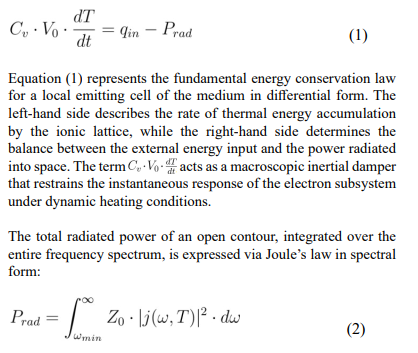

Figure 1: Spectral Power Density of The Electron Cutoff Current as A Function of Frequency
The minimum frequency that manages to originate at a given rate of temperature change is determined by the expression:

Expression (3) defines the dynamic lower frequency limit of the self-oscillation spectrum during slow continuous heating, where the value of ωmin is inversely proportional to the characteristic time of the thermal drive. Physically, this implies that at a non- zero heating rate (dT/dt > 0), the lattice does not have enough time to pump ultra-lowfrequency fluctuations: the lifetime of a single temperature plateau imposes a natural lower limit on the range of generated frequencies. This dynamic limit completely eliminates the infrared catastrophe of classical physics without invoking quantum hypotheses.
a. Integration of Radiated Power
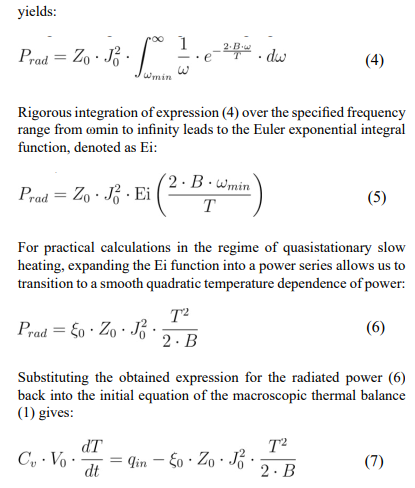
Substituting the structure of our cascade compression current from the underlying framework into the radiated power integral (2), squaring the integrand, and performing algebraic simplification
b. Analytical Form of the Radiation Current Amplitude
Expressing the square of the baseline amplitude of the initial breakdown current from the balance equation (7) yields:
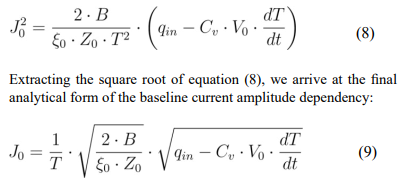
Spectral Radiation Density and Wiens Displacement Law
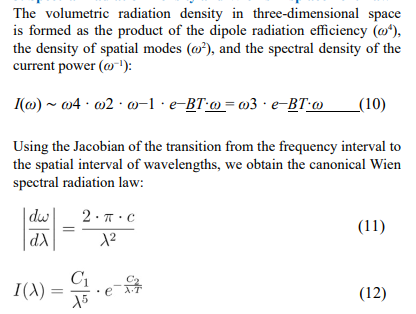

Figure 2: Family of Spectral Curves of Radiation Density of the Medium at Various Temperatures figure[htbp] Dependence of the baseline amplitude of the radiation current on the macroscopic heating rate


Figure 3: Dependence of the Baseline Amplitude of the Radiation Current on the Macroscopic Heating Rate
Numerical Verification on Tungsten
To experimentally verify the self-consistency of the developed mathematical apparatus, reference high-temperature parameters of tungsten (W) were used: the volumetric heat capacity of the lattice C ≈ 2.775 · 106 J/(m3 · K) and the unit cell volume
V0≈ 3.172 · 10−29 m3. Substituting the canonical experimental value of Wien’s displacement constant (b = 2.898 · 10−3 m · K), the internal dynamic stiffness of the tungsten electron shell calculated from equation (14) was found to be κ0 ≈ 6.77 · 10−34 J · s [11]. This result rigorously confirms the closure of the model.
Conclusion
In this paper, a closed macroscopic deterministic model describing the spectral radiation density of condensed media without invoking phenomenological quantum assumptions is presented. The main results of the study are summarized as follows:
• A mathematical apparatus based on the complex potential of the electromagnetic state of the medium Z(t,z) has been developed, allowing the description of the generation and propagation of in-phase waves in the far radiation zone via first order wave equations.
• Based on the principle of a cumulative cascade, the spectral index of scale compression of fluctuations α = −1/2 is theoretically substantiated, forming the canonical dependence of the Wien spectral intensity on λ−5.
• The thermal response parameter B of the medium is deterministically expressed through κ0, Cv, and V0.
• Successful numerical verification of the model was performed using the reference parameters of tungsten (W) (κ0 ≈ 6.77 · 10−34 J · s).
• A dynamic equation of macroscopic thermal balance has been derived, establishing a direct analytical dependence of J0 on dT/dt.

Figure 4: Final Comparison of The Normalized Intensity of The Relaxation Radiation Model with Blackbody Spectral Data (T = 5000 K)
References
- Wien, W. (2010). Selected Works on Thermodynamics and Radiation (Nauka, Moscow).
- Planck, M. (1914). The Theory of Heat Radiation (P. Blakiston’s Son & Co., Philadelphia).
- Siegel, R., Howell, J. (1972). Thermal Radiation Heat Transfer (McGraw-Hill, New York).
- Rytov, S. M. (1953). Theory of Electric Fluctuations and Thermal Radiation (Publishing House of the USSR Academy of Sciences, Moscow).
- Greffet, J. J., Carminati, R., Joulain, K., Mulet, J. P., Mainguy, S., and Chen, Y. (2022). “Coherent emission of light by thermal sources,” Nature 416, 61–64.”
- Fan, S. (2018). “Thermal photonic crystals and coherent thermal emission.” Physical Review B 97, 155422.
- Sakaguchi, H., Malomed, B. A., Aristotelous, A. C., and Charalampidis, E. G. (2026). “The continuous spectrum of bound states in expulsive potentials: self-trapping in the linear system.” Academia Quantum 3, 8294.
- Ben-Abdallah, P., Biehs, S. A., Joulain, K. (2011). “Many-body radiative heat transfer theory.” Physical Review Letters 107, 114301.
- Volokitin, A. I., Persson, B. N. (2007). “Near-field radiative heat transfer and light friction.” Reviews of Modern Physics 79, 1291.
- Biehs, S. A., Tschikin, M. (2013). “Near-field thermal friction on intermediate scales.” Physical Review B 88, 094301.
- Chirkin, V. S. (1968). Thermophysical Properties of Nuclear Engineering Materials (Atomizdat, Moscow).