




Research Article - (2026) Volume 4, Issue 9
Numerical Investigation on the Effect of Prandtl Number on Isotherms, Streamlines, and Entropy Generation due to Fluid Friction, Heat Transfer, Pressure Gradient, and Magnetic Influence
 , Dawda Charreh 1 , Shaiza Talib 2,3 , Bakary L. Marong 1 and Yusupha Bah 1
 2College of Civil and Transportation Engineering, Shenzhen University, Shenzhen, 518060, China
3Institution of Urban Smart Transportation & Safety Maintenance College of Civil, and Transportation Engineering, Shenzhen University, Shenzhen, China
Received Date: Aug 01, 2026 / Accepted Date: Aug 27, 2026 / Published Date: Sep 02, 2026
Copyright: ©2026 Bai Mbye Cham, et al. This is an open-access article distributed under the terms of the Creative Commons Attribution License, which permits unrestricted use, distribution, and reproduction in any medium, provided the original author and source are credited.
Citation: Cham, B. M., Charreh, D., Talib, S., Marong, B. L., Bah, Y. (2026). Numerical Investigation on the Effect of Prandtl Number on Isotherms, Streamlines, and Entropy Generation due to Fluid Friction, Heat Transfer, Pressure Gradient, and Magnetic Influence. Eng OA, 4(9), 01-13.
Abstract
This study presents a comprehensive numerical study of the effect of the Prandtl number on thermal and fluid flow behavior, and entropy generation, in magnetohydrodynamic flows. The study analyzes the interaction between isotherms, streamlines, and entropy generation caused by fluid friction, heat transfer, pressure gradient, and magnetic forces within a two-dimensional computational domain. The governing equations for mass, momentum, and energy conservation are solved using the finite element method. The study takes into account the impact of various Prandtl numbers from low to high thermal diffusivity to identify their impact on flow structure and thermal behavior. The entropy generation rates are taken into account based on their components, such as thermal irreversibility, viscous dissipation, and magnetic effects. The findings indicate a remarkable variation in isothermal patterns, streamline structures, and entropy distribution with varying Prandtl numbers. Higher values of Prandtl numbers improve heat retention near thermal boundaries and reduced values facilitate thermal diffusion. The interaction of the magnetic field with fluid flow contributes an additional source of entropy generation, which competes with viscous forces and thermal gradients. This study provides valuable information for the optimization of thermal systems where fluid properties and magnetic fields are important considerations, examples of which may be observed in cooling systems, energy storage, and magnetohydrodynamic applications.
Keywords
Prandtl Number, Fluid Friction, Pressure Gradient, Magnetic Forces, Thermal Irreversibility
Introduction
The study of heat and fluid dynamics in systems influenced by different physical phenomena plays a vital role in the development of technologies pertaining to energy systems, material processing, and thermal management. One such basic dimensionless parameter that affects the behavior of such systems is the Prandtl number (Pr), which is defined as the ratio of momentum diffusivity and thermal diffusivity. The magnitude of this parameter proves the significance of fluid flow compared to heat conduction and its impact on the considered hydrodynamic and thermal processes. More specifically, the analysis of the impact of the Prandtl number change on the isotherms, streamlines, and entropy generation serves in the details towards the functional and structural optimization of the thermal systems. The Prandtl number is also known in mechanical engineering for fluid dynamics and heat transfer for its impact on flow and thermal phenomena. Historically, Darrigol examined the development of hydrodynamics, highlighting Prandtl's significant contributionsto boundary layer theory, which transformed fluid mechanics. Garaud concentrated on low-Prandtl-number situations, investigating double-diffusive convection and its effects on astrophysical and geophysical systems, emphasizing distinct flow characteristics in these contexts [1-3]. Kerr and Herring utilized direct numerical simulations to explore the relationship between Prandtl and Nusselt numbers, uncovering important interdependencies in convective heat transfer [4]. Dipprey and Sabersky offered experimental findings on heat and momentum transfer across a range of Prandtl numbers in both smooth and rough tubes, establishing essential correlations for engineering applications [5]. Collectively, these studies highlight the vital role of the Prandtl number in influencing flow structures, thermal diffusion, and energy transport in a variety of physical systems.
Entropy generation is irreversibility in a heat transfer dependent thermodynamic process and fluid friction and dissipation of other forms. In fluid flow processes, the entropy generation distribution provides significant information on efficiency and viscous effect-type losses and thermal gradient-type losses and where there are electromagnetic forces to be considered with magnetic effects. Electrically conducting fluids in magnetic field interaction create complexity in the form of Magnetohydrodynamic (MHD) flows. The Lorentz force that results from the magnetic field's flow affects the flow dynamics and the thermal characteristics of the fluid, thus raising the total entropy. These effects are important in many fields in engineering, ranging from electronic cooling systems, nuclear reactors, and even energy storage systems. As a measure of irreversibility for a thermodynamic system, entropy generation has gained more attention in research efforts to maximize energy transfer rate and system performance in as many physical environments as possible. Saleem et al. investigated entropy generation in double-diffusive Marangoni convection and quantified the effect of chemical conversion and electrically conducting fluids in confined spaces [6]. Charreh et al. expanded this work to a non-Darcy porous cavity, exploring the interaction between thermal radiation and viscous dissipation in influencing entropy generation and identifying the importance of such influences in porous media [7]. Cham et al. explored entropy production in MHD flows, emphasizing the roles of thermal radiation and viscous dissipation in porous media [8]. In recent studies, Cham et al. described unsteady MHD inputs to Casson fluid flow over hot cylindrical bodies with particular emphasis on intricate thermal and viscous interactions [8,9]. Charreh et al. also applied the lattice Boltzmann method to examine entropy generation for MHD-driven natural convection in porous media and provided computational findings on entropy generation for MHD-driven natural convection for a wide range of regimes, uncovering the energy dissipation nature.
Streamlines, isotherms, and entropy generation in magnetohydrodynamic (MHD) flows have been of much interest in recent years due to their theoretical as well as practical importance. Isotherms are temperature distributions and streamlines are the flow patterns in the system. The effect of the Prandtl number on such patterns, especially when a magnetic field is present, is of interest. High heat transfer concentrations and steep temperature profiles are connected with high Prandtl numbers, typical in oils. Flat temperature profiles are due to low Prandtl numbers, which are common in gases due to elevated thermal diffusivity. It is of maximum importance in cases where precise thermal control and flow rate control are needed. Other than that, entropy generation in porous flow and MHD systems has been of particular concern since it plays a vital role in evaluating irreversibilities in fluid and energy flow processes. Ibáñez analyzed entropy generation in magnetohydrodynamic (MHD) flows through a porous channel with hydrodynamic slip and convective boundary conditions [10]. The research focused on how these boundary conditions affect the systems' irreversibilities. From this study, Rashidi et al. analyzed entropy generation in MHD and slip flow along a rotating porous disk with non-uniform properties [11]. Their work presented better information on the thermal and flow parameters that affect energy dissipation. In a broader study, Rashidi et al. examined entropy generation in peristaltic waves induced nanofluid MHD blood flow and proved the feasibility of such phenomena in biomedical models [12]. In their turn, Zahor et al. wrote a comprehensive review of models for entropy generation in nanofluid MHD flow through porous media and presented a new point of view on the multidimensional interactions within such systems [13,14]. Abbas et al. examined the thermal radiation impact on entropy generation of magnetohydrodynamic (MHD) flow in a vertically positioned porous channel with emphasis put on the thermal radiation impact on flow behavior subject to the presence of a magnetic field.
Though significant work has been accomplished on MHD flows and entropy generation, the specific contributions of the Prandtl number in such conditions are not highly investigated, particularly in conditions where a mix of various sources of irreversibility, such as fluid friction, pressure gradients, and magnetic influence, occur simultaneously. By studying thermal, viscous, and magnetic irreversibilities, the study endeavors to acquire a greater understanding on the impact of fluid properties in making the system exhibit thermal and hydrodynamic response. The role played by the Prandtl number in magnetohydrodynamic (MHD) flows is a concern it poses more since it affects boundary layers, dynamics in the flow, and the conduction of heat. Liu et al. tested the Prandtl hypothesis experimentally in MHD boundary layers and formulated the mathematical basis of the hypotheses used to model MHD flows, which greatly improved the understanding of fluid and thermal behavior in the systems [15,16]. Khan et al. analyzed the interaction of MHD Prandtl fluid flow with stratification and heat generation, highlighting the influence of the Prandtl number on stability control and efficiency in heat transfer within stratified fluid systems under the effects of magnetism. Numerical simulations were conducted by Hasanpour et al. to examine the Prandtl effect on MHD flow through a porous lid-driven cavity and illustrated how the Prandtl number variation influences heat transfer and flow structure within porous confined media [17,18]. Awais et al. carried out comprehensive research on the MHD Prandtl melted fluid flow along a cylindrical surface and enriched our understanding of heat transfer and fluid flow dynamics in the scenario of high thermal gradients and magnetic fields [19]. Kefayati et al. applied the Lattice Boltzmann Method to analyze natural convection MHD in an open cavity and emphasized the importance of the Prandtl number in governing flows behavior and heat transfer performance in a thermal driven MHD systems.
Conservation equations of mass, momentum, and energy are solved numerically by the most appropriate finite element method (FEM) when encountering complex geometry and coupled physics. The research considers a wide range of Prandtl numbers to adequately capture the transition from the flow-dominated to the thermally dominated regimes. Entropy generation is evaluated for the purpose of giving a quantification of heat transfer, fluid friction, and magnetic irreversibilities. The outcome from the investigation is to be used in aiding in the optimization of the fluid and thermal systems and making design suggestions for engineering applications requiring a maximum energy efficiency and minimum loss. There has also been more recent research on the effect of Prandtl numbers on fluid flow that has looked at new numerical methods such as the finite element method (FEM) for flow simulation, heat transfer, and solute transport in several systems [20]. Hafeez et al. applied a modified finite element method to investigate Prandtl liquid flow, heat transfer, and solute transport on a heated plate and contributed greatly to the study of Prandtl fluid dynamics in real-world heat transfer processes [21]. Tabata et al. applied a stabilized finite element method for solving the Rayleigh–Bénard equations for Prandtl numbers up to infinity in spherical shells to verify the performance of the approach towards convection issues in challenging geometries [22]. Irfan et al. applied finite element analysis along with solar energy matters for Prandtl nanofluid heat transfer, envisaging future potentials for nanofluids toward clean energy technology solutions [23]. Rana et al. conducted finite element computations to investigate unsteady magnetohydrodynamic transport processes on a stretching sheet in a rotating nanofluid for the influence of magnetic field, fluid flow, and heat transfer under dynamic conditions. On large scales, Basak et al. employed finite element methods to study natural convection in isosceles triangular enclosures under uniform and non-uniform heating conditions and hence shed further light on thermal fluid dynamics in confined geometries [24].
In the subsequent sections, a detailed overview of the mathematical model, numerical methods, and boundary conditions is presented. The findings and discussions emphasize the effect of different Prandtl numbers on isotherms, streamlines, and entropy generation giving insightful information about the physics at play and engineering implication of the results shown. The novelty of this work could be seen from its comprehensive numerical exploration of the Prandtl number effect on isotherms, streamlines, and entropy generation taking into account combined effects of fluid friction, heat transfer, pressure gradients as well as magnetic fields. Unlike earlier research that investigates these phenomena in isolation, this work integrates several physical processes into a single framework and enhances our knowledge of the impact of Prandtl number variation on thermal and flow behavior in magnetohydrodynamic systems. Through the analysis of the interactions between these factors, particularly the contributions of MHD effects and entropy generation, this study provides new insights into the irreversibility-induced efficiency losses, which are critical for the optimization of heat exchangers, cooling systems, and other applications with MHD flows.
Problem Statement and Mathematical Model
The study investigates a two-dimensional domain featuring unsteady fluid flow within a square cavity of length H, which is bordered by cold walls maintained at a temperature of Tc. Within this domain, three cylindrical obstacles, designated as C1, C2, and C3, are situated in a porous medium. These cylinders are evenly spaced at intervals of Z∗, each having a diameter of 0.1 cm and a length of 0.15 cm. The opposing walls of the cavity are uniformly heated to a constant temperature of 373.15 K. The analysis is directed by the conservation equations governing mass, momentum, and energy. A uniform magnetic field impacts the flow dynamics via its inclusion in both the x and y momentum equations. To address the buoyancy effects induced by temperature variations around the heated cylindrical obstacles, the Boussinesq approximation is applied. This method simplifies the density changes in the fluid, except for the buoyancy term, making it especially suitable for low-speed flows with moderate temperature gradients. Additionally, radiative heat transfer within the fluid is accounted for using the Rosseland approximation, which effectively represents the thermal radiation effects within the porous medium. A schematic diagram of the system, along with all the assumptions made, is illustrated in Figure 1 [25].

Figure 1: The Schematic Diagram Illustrates the Phenomena Under Investigation [25].
Mathematical Equation
The dimensionless form of governing equation as shown in Eq. (2)-(4), have been derived by using the dimensionless variables from Eq. (1) to the dimensional equations.
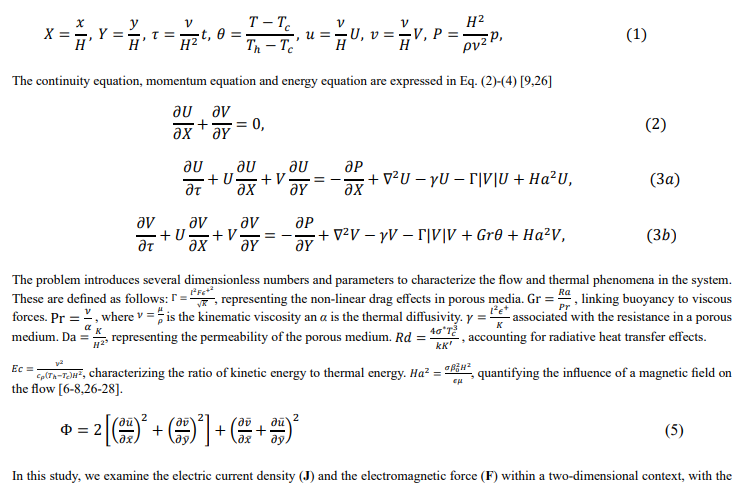
velocity vector V depicted as follows: V = uex + uey . Here, u and v denote the velocity components along the x and y axes, respectively, while ex and ey are the unit vectors in these principal directions. The flow is characterized by magnetic field (uniform), defined as: B = Bx ex + By ey where Bx and By represent the magnetic field components in the coordinate axes, respectively. For the sake of simplicity, we assume the cavity walls to be non-electrically conducting boundaries. This leads to the electric potential becoming constant at the boundaries. As a result, the induced currents remain confined to the fluid domain, and the governing equations for the electromagnetic characteristics are derived from Maxwell's equations and Ohm's law, aligned with the constraints of the system.
The equations for the electric potential and its impact on the flow, as indicated in Eqs. (6) and (7), guarantee a precise interaction between electromagnetic effects and the motion of the fluid. These assumptions streamline the analysis by eliminating any current leakage or the effects of external electric fields at the boundaries (see refs. [6,26] )

Boundary Condition
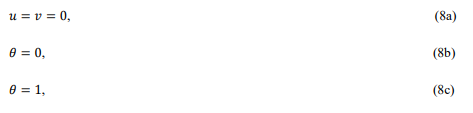
The boundary conditions are outlined in Equation (8). The velocity profiles at the walls of the cylindrical obstacles, the assumptions regarding the cavity walls, and the thermal conditions at the boundaries of the obstacles (obstacles) are all clearly defined [9,26].
Entropy Generation
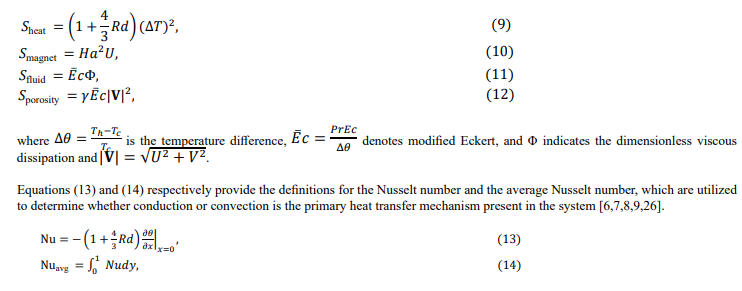
The mathematical expression for the rate of entropy generation in the system is formulated by taking into account multiple contributing factors. These include heat transfer, the effects of the magnetic field, fluid friction (viscous dissipation), and the porosity of the medium, which are presented in equations (9) to (12) [6,7,8,9,26].
Code Validation
To properly study the two-dimensional, time dependent magnetohydrodynamic (MHD) flow involving cold walls and heated obstacles (cylindrical), the governing equations namely the Navier-Stokes (NS) and energy equations are discretized using the Finite Element Method (FEM). Implicit time-stepping schemes are utilized to capture the unsteady dynamics, while appropriate boundary conditions are enforced to ensure physical accuracy. FEM was preferred in this problem because it has a better capability to deal with intricate geometry and boundary conditions, which are essential for a proper understanding of the physics of the problem under investigation. In contrast to FDM, which necessitates structured grids, flexible meshing is possible with FEM, hence preferable for dealing with irregular domains. The code is checked numerically by comparing calculated results like the maximum stream function with benchmark results from Charreh et al. [7] and Cham et al. [26] under constant parameters conditions. The validation also involves the verification of conservation, solution, and sensitivity analysis to ensure that the code is accurate and robust in simulating this coupled MHD system. error=|Current paper-published paper|, (15)
|
ψmax |
|||||
|
Ra |
Charreh et al.[7] |
Cham et al. [26] |
current |
error [7] |
error [26] |
|
103 |
0.0776 |
0.0759 |
0.0779 |
0.0003 |
0.0020 |
|
104 |
0.0769 |
0.0787 |
0.0789 |
0.0020 |
0.0002 |
|
105 |
0.0439 |
0.0480 |
0.0485 |
0.0046 |
0.0005 |
Table 1: Comparison of the Maximum Stream Function with the works of Charreh et al. [7] and Cham et al. [26] with current work.
Results and Discussions
The study provides an examination of isotherms, entropy generation, streamlines, and the Nusselt number across different Prandtl numbers. The simulations were carried out with control parameters that reflect laminar flow conditions. These parameters include the Rayleigh number, Hartmann and others. Additionally, the spacing distances were defined as well. The simulation outcome, illustrated in Figures 2–8, emphasize the impact of these parameters on the flow and thermal characteristics of the system.
Prandtl Number Variation Effects on Isotherms and Streamlines
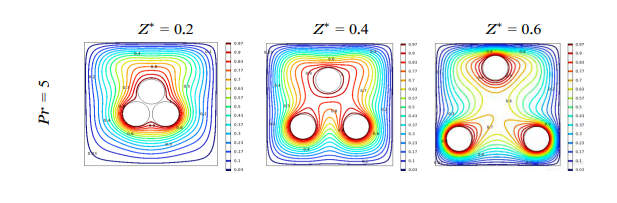
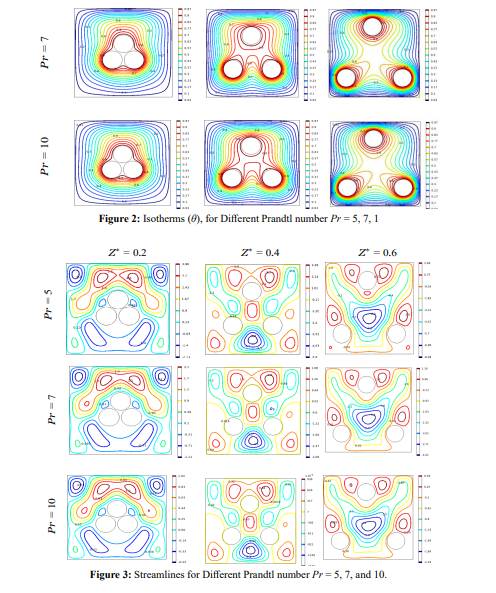
Figure 2 shows the isotherms (θ) at varying Prandtl numbers Pr = 5, 7, and 10, and at spacing distances Z* = 0.2, 0.4, and 0.6. The plotted isotherms of the variable Prandtl numbers and spacing distances give insights about the thermal distribution in the domain as shown in Figure 1. With the lower Prandtl numbers, thermal diffusion leads to the larger spread of the isotherms and to less steep gradients. Conversely, when the Prandtl number is greater, the thermal boundary layer is more pronounced, with steeper gradients and more clustered isotherms close to the walls, suggesting less thermal diffusion than momentum diffusion. The thermal field is also influenced by the spacing distance Z*; increasing Z* causes a reorganization of thermal gradients, relocating isotherm density to regions with higher spacing. This interaction emphasizes the thermal field sensitivity to fluid characteristics (Pr) and geometric limitations (Z*) [9,10]. This figure provides significant information on how heat propagates in fluids of different thermal properties and the impact of geometric separation on temperature distribution, which is relevant to optimizing thermal management in engineering applications.
Figure 3 depicts the Pr effect on streamlines. Streamlines provide the fluid flow structure at different Prandtl numbers and spacing distance. Smaller Pr values have larger circulation zones as there is lesser viscosity due to which momentum diffusion happens at a higher speed. While increasing Pr, the flow patterns become more restricted with tighter recirculation near the boundaries and stronger focus on core areas, bringing into focus the effect of viscous forces. The Z*spacing distance introduces a geometric component, with larger Z* facilitating more dispersed streamlines and, potentially, more complex flow patterns, and smaller Z* creating more intense flow tracks. These patterns represent the coupled impacts of thermal and momentum transport within the flow field [29].
Prandtl Number Effect on Entropy Due to Fluid Friction, Heat, Pressure and Magnet
Entropy generation resulting from fluid friction at varying Prandtl numbers Pr = 5,7, and 10 was represented in Figure 4. Entropy generation based on fluid friction, the gauge of momentum transfer irreversibility, differs depending on Prandtl number as well as separation distance. The entropy generated under low Pr conditions is seen to be high within regions involving maximum velocity gradient by virtue of viscous dampening being minimum in these places. With the increase in Prandtl number, the effect of viscosity becomes more pronounced, suppressing velocity gradients and resulting in a decrease in entropy due to friction. The spacing distance Z* also influences the distribution; higher values of Z* allow for larger velocity variations across the domain, causing higher entropy production in the boundary layer [29,30]. These findings emphasize the opposing influences of the Prandtl number and geometric considerations on viscous dissipation and corresponding entropy generation
Figure 5 illustrates the entropy due to heat, taking various Prandtl numbers and spacing distances into account. The creation of entropy because of heat transfer is directly related to the thermal gradients in the system. When the Prandtl numbers are lower, meaning that the thermal boundary layers are less strong, the entropy generation is more evenly distributed but is at lower levels. Conversely, increased Prandtl numbers increase thermal gradients near the walls and produce localized spikes in entropy generation. The Z* spacing distance also has an additional role to play in modifying these effects as for larger Z* its seen to enables more gentle thermal transitions, which reduces entropy production slightly. These findings reinforce the significance of thermal conductivity and geometric spacing to the distribution of thermal irreversibilities within the system [29,30].
Figure 6 shows the pressure-induced entropy for different Prandtl numbers. The pressure-induced entropy generation represents the irreversible conversion of mechanical energy. For smaller Prandtl numbers, the motion of the fluid is more vigorous, leading to increased pressure gradients and higher entropy generation. For larger Prandtl numbers, the viscous damping effect lowers the pressure gradients and hence the entropy generation. In addition, the spacing distance Z* plays a significant role; near spacing restricts fluid motion, causing steeper pressure gradients and more entropy, while larger spacing decreases these effects by permitting smoother pressure distributions. The interaction between these parameters underscores the intricate dependence of pressure-related entropy on thermal and flow conditions.
Figure 7 illustrates the entropy generated due to magnetic effects with constant parameters and variable Prandtl. The entropy generated because of the magnetic effects, initiated by the imposed magnetic field (Ha = 25), depends on fluid conductivity and flow dynamics. At lower Prandtl numbers, the coupling between fluid velocity and magnetic forces becomes more dominant, resulting in higher entropy production in regions where magnetic effects are predominant. On the other hand, higher Prandtl numbers, with weaker velocity fields, reduce entropy generation due to magnetic effects. In addition, the spacing gap Z* alters the impact of the magnetic field; tighter spacing intensifies magnetic forces in the restricted space, whereas broader spacing decreases this effect by distributing the effects of the field [9]. These results point to the intricate interactions among electromagnetic forces, temperature conditions, and geometric parameters within the system.
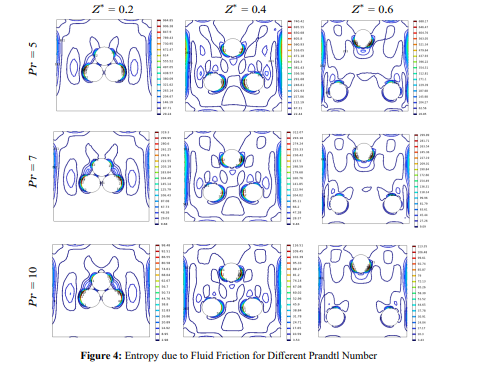
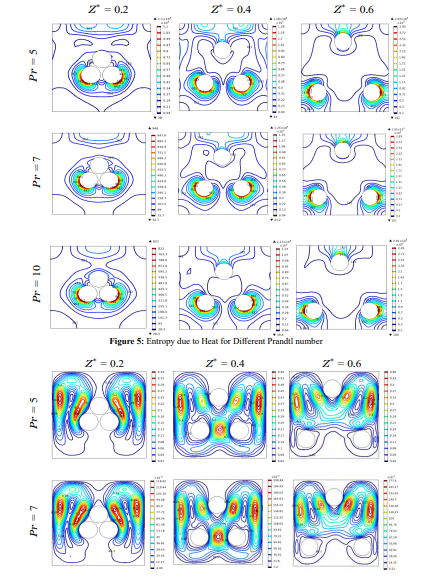
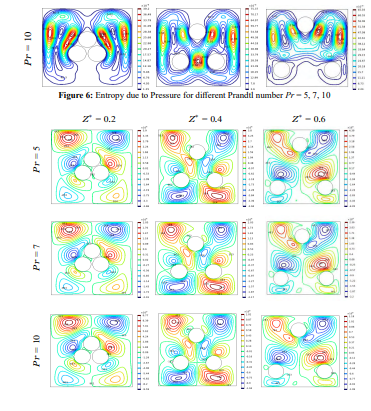
Figure 7: Entropy due to Magnet for different Prandtl Numbers
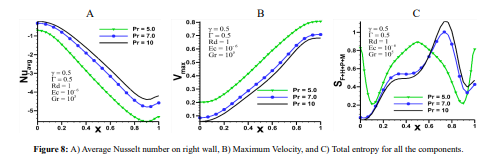
Figure 8 shows the key performance parameters of a fluid flow and heat transfer system. The average Nusselt number along the right wall in Figure 8A represents the efficiency of convective heat transfer; high values imply better heat transfer, perhaps resulting from enhanced turbulence or larger temperature gradients. Figure 8B illustrates maximum velocity in the system, reflecting the flow dynamics and fluid motion in the domain; increased velocities are typically associated with turbulent flows that achieve maximal heat transfer. Figure 8C illustrates total entropy generation, which reflects a quantification of the system irreversibility with increased entropy referring to more dissipation of energy due to mechanisms like viscous friction or gradients in temperature. These collectively offer a crucial image of the flow of fluids and thermal behavior, showing how the distribution of temperature and velocity affect heat transfer effectiveness and system irreversibility [9,10].
Conclusions
This research has shown the crucial role of the Prandtl number in thermal and fluid dynamics of magnetohydrodynamic systems. The analysis demonstrated that variation in the Prandtl number has the capability to help modify the pattern of isotherm and streamline distribution as a result representing varied thermal diffusion and flow behavior. Steep thermal gradients and focused heat retention are characteristic of high Prandtl numbers, while low Prandtl numbers enhance broad and as well better thermal diffusion. An entropy generation analysis always shows that thermal irreversibility dominates at high Prandtl numbers whereas viscous and magnetic effects are important in low Prandtl number cases. The magnetic field also influences entropy production by altering flow patterns and increasing irreversibilities. These findings stress the importance of selecting fluid properties and magnetic parameters for better thermal and flow performance in engineering design. Future studies may explore three-dimensional effects and interaction of other dimensionless parameters to generalize these results. The research also assumes a homogeneous magnetic field and incompressible fluid properties, while real systems can undergo spatial and temperature-dependent variations. The effect of chaotic flow movement is also not considered, which the authors believed may have a significant influence on high Reynold number flows.
Additional Information
No additional information is available for this paper.
CRediT authorship contribution statement
Bai Mbye Cham: Writing – review & editing, Writing – original draft, Visualization, Validation, Software, Methodology, Investigation, Formal analysis, Conceptualization. Dawda Charreh: Writing – original draft, Formal analysis, Conceptualization. Shaiza Talib: Writing – review & editing, Writing – original draft, Visualization, Validation, Software, Methodology, Investigation, Formal analysis, Conceptualization. Bakary .L. Marong: Writing – review & editing, Writing – original draft, Software, Methodology, Investigation, Formal analysis, Conceptualization. Yusupha Bah: Writing – review & editing, Visualization, Validation, Methodology, Formal analysis, Conceptualization.
Declaration of Competing Interest
We also declare that there is no conflict of interest regarding the publication of this paper.
Data Availability
Data will be made available on request.
Funding Declaration
The authors declare that no funds, grants, or other financial support were received for the research, authorship, and/or publication of this article.
Acknowledgments
The authors acknowledge the efforts of the research team from all the affiliated universities for a successful collaboration.
References
- Darrigol, O. (2005). Worlds of flow: A history of hydrodynamics from the Bernoullis to Prandtl. Oxford University Press.
- Garaud, P. (2018). Double-diffusive convection at low Prandtl number. Annual Review of Fluid Mechanics, 50, 275-298.
- Kerr, R. M., & Herring, J. R. (2000). Prandtl number dependence of Nusselt number in direct numerical simulations. Journal of Fluid Mechanics, 419, 325-344.
- Garaud, P. (2021). Journey to the center of stars: the realm of low Prandtl number fluid dynamics. Physical Review Fluids, 6(3), 030501.
- Dipprey, D. F., & Sabersky, R. H. (1963). Heat and momentum transfer in smooth and rough tubes at various Prandtl numbers International Journal of Heat and Mass Transfer, 6(5), 329-353.
- Saleem, M., Hossain, M. A., & Saha, S. C. (2014). Double diffusive Marangoni convection flow of electrically conducting fluid in a square cavity with chemical reaction. Journal of heat transfer, 136(6), 062001.
- Charreh, D., & Saleem, M. (2023). Entropy generation and natural convection analyses in a non-Darcy porous square cavity with thermal radiation and viscous dissipation. Results in Physics, 52, 106874.
- Cham, B. M. (2023). Numerical study of second law analysis using magnetohydrodynamics on natural convection in a porous medium with thermal radiation and viscous dissipation. Petro Chem. Indus. Intern., 6, 296-312.
- Cham, B. M., Saleem, M., Talib, S., & Ahmad, S. (2024). Unsteady, two-dimensional magnetohydrodynamic (MHD) analysis of Casson fluid flow in a porous cavity with heated cylindrical obstacles. AIP advances, 14(4).
- Charreh, D., Islam, S. U., Saleem, M., Cham, B. M., & Talib, S. (2023). Numerical study of entropy generation with magnetohydrodynamics on natural convection in a porous medium using lattice Boltzmann method. Eng OA, 1(2), 75-89.
- Ibáñez, G. (2015). Entropy generation in MHD porous channel with hydrodynamic slip and convective boundary conditions.International Journal of Heat and Mass Transfer, 80, 274-280.
- Rashidi, M. M., Kavyani, N., & Abelman, S. (2014). Investigation of entropy generation in MHD and slip flow over a rotating porous disk with variable properties. International Journal of Heat and Mass Transfer, 70, 892-917.
- Rashidi, M. M., Bhatti, M. M., Abbas, M. A., & Ali, M. E. S. (2016). Entropy generation on MHD blood flow of nanofluid due to peristaltic waves. Entropy, 18(4), 117.
- Zahor, F. A., Jain, R., Ali, A. O., & Masanja, V. G. (2023). Modeling entropy generation of magnetohydrodynamics flow of nanofluid in a porous medium: a review. International Journal of Numerical Methods for Heat & Fluid Flow, 33(2), 751-771.
- Abbas, Z., Naveed, M., Hussain, M., & Salamat, N. (2020). Analysis of entropy generation for MHD flow of viscous fluid embedded in a vertical porous channel with thermal radiation. Alexandria Engineering Journal, 59(5), 3395-3405.
- Liu, C. J., Xie, F., & Yang, T. (2019). Justification of Prandtl ansatz for MHD boundary layer. SIAM Journal on Mathematical Analysis, 51(3), 2748-2791.
- Khan, I., Hussain, A., Malik, M. Y., & Mukhtar, S. (2020). On magnetohydrodynamics Prandtl fluid flow in the presence of stratification and heat generation. Physica A: Statistical Mechanics and its Applications, 540, 123008.
- Hasanpour, A., Farhadi, M., Sedighi, K., & Ashorynejad, H. R. (2012). Numerical study of Prandtl effect on MHD flow at a lid-driven porous cavity. International Journal for Numerical Methods in Fluids, 70(7), 886-898.
- Awais, M., Bilal, S., Ur Rehman, K., & Malik, M. Y. (2020). Numerical investigation of MHD Prandtl melted fluid flow towards a cylindrical surface: comprehensive outcomes. Canadian Journal of Physics, 98(3), 223-232.
- Kefayati, G., Gorji, M., Sajjadi, H., & Domiri Ganji, D. (2012). Investigation of Prandtl number effect on natural convection MHD in an open cavity by Lattice Boltzmann Method. Engineering Computations, 30(1), 97-116.
- Hafeez, M. B., Krawczuk, M., Jamshed, W., Kaneez, H., Hussain, S. M., & El Din, E. S. M. T. (2022). Improved finite element method for flow, heat and solute transport of Prandtl liquid via heated plate. Scientific Reports, 12(1), 19681.
- Tabata, M., & Suzuki, A. (2000). A stabilized finite element method for the Rayleigh–Bénard equations with infinite Prandtl number in a spherical shell. Computer Methods in Applied Mechanics and Engineering, 190(3-4), 387-402.
- Irfan, M., Khan, W. A., Hussain, Z., Abas, S. S., Zubair, M., & Rashid, M. (2024). Finite Element Analysis and Aspects of Solar Energy for Prandtl Nanofluid with Heat Transfer. Scientia Iranica.
- Rana, P., Bhargava, R., & Bég, O. A. (2013). Finite element simulation of unsteady magneto-hydrodynamic transport phenomena on a stretching sheet in a rotating nanofluid. Proceedings of the Institution of Mechanical Engineers, Part N: Journal of Nanoengineering and Nanosystems, 227(2), 77-99.
- Basak, T., Roy, S., Babu, S. K., & Balakrishnan, A. R. (2008). Finite element analysis of natural convection flow in a isosceles triangular enclosure due to uniform and non-uniform heating at the side walls. International Journal of Heat and Mass Transfer, 51(17-18), 4496-4505.
- Cham, B. M., Islam, S. U., Majeed, A. H., Ali, M. R., & Hendy, A. S. (2024). Numerical computations of magnetohydrodynamic (MHD) thermal fluid flow in a permeable cavity: a time dependent based study. Case Studies in Thermal Engineering, 61, 104905.
- Ali, L., Wu, Y. J., Ali, B., Abdal, S., & Hussain, S. (2022). The crucial features of aggregation in TiO2-water nanofluid aligned of chemically comprising microorganisms: A FEM approach. Computers & mathematics with applications, 123, 241-251.
- Ali, B., Hussain, S., Abdal, S., & Mehdi, M. M. (2020). Impact of Stefan blowing on thermal radiation and Cattaneo–Christov characteristics for nanofluid flow containing microorganisms with ablation/accretion of leading edge: FEM approach. The European Physical Journal Plus, 135(10), 821.
- Ahmad, S., Liu, D., Cham, B. M., Xu, W., & Yang, S. (2025). Optimization of heat transfer efficiency of electronic device through conjugate heat transfer using Darcy-Forchheimer modelled base plate: 2D versus 3D computations. Applied Thermal Engineering, 265, 125535.
- Talib, S., Cham, B. M., Charreh, D., & Marong, B. L. (2024). Thermal radiation effects on entropy generation in porous media with Casson fluid via FEM insights. Eng OA, 2(5), 01-11.