

Journal of Oil and Gas Research Reviews(JOGRR)
ISSN: 2993-3617 | DOI: 10.33140/JOGRR
Impact Factor: 0.7

Research Article - (2025) Volume 5, Issue 1
New Origin of Thalassinoides Burrows (Gastropod Dwelling Structures) in the Qamchuqa Formation (Lower Cretaceous), Kurdistan Region, Northeastern Iraq
2Sulaimanyah Oil and Minerals Directorate Ministry of Natural Resources, Iraq
3Micro Pro GmbH, Gommern, Germany
Received Date: Aug 02, 2025 / Accepted Date: Sep 03, 2025 / Published Date: Sep 08, 2025
Copyright: ©Â©2025 Arzu Javadova, et al. This is an open-access article distributed under the terms of the Creative Commons Attribution License, which permits unrestricted use, distribution, and reproduction in any medium, provided the original author and source are credited.
Citation: Ghafor, I. M., Tahir, Z. S., Javadova, A., Karim, K. H. (2025). New Origin of Thalassinoides Burrows (Gastropod Dwelling Structures) in the Qamchuqa Formation (Lower Cretaceous), Kurdistan Region, Northeastern Iraq. J Oil Gas Res Rev, 5 (1), 01-16.
Abstract
This study documents the first significant occurrence of Thalassinoides ichnofossils in the Lower Cretaceous Qamchuqa Formation of northeastern Iraq. Preserved in coarse detrital limestones, terrigenous carbonates, and mixed sediments, these burrows are associated with coastal to shallow-marine ichnofacies, particularly Skolithos and Cruziana. Extensive burrow networks—horizontal tubes with vertical or inclined shafts—show features like eccentric swellings at branch points and smooth walls, ranging from 5 to 20 mm in diameter. The burrows exhibit backfill structures, indicating active construction by tracemakers. Decapod crustaceans, possibly crayfish like Hoploparia, are the likely producers. Notable findings include crab trackways and gastropod trails up to 0.5 m long, among the longest invertebrate cursorial traces known. The presence of lateral movement features suggests the emergence of crab-like sideways locomotion during the Cretaceous. This discovery marks the first recorded presence of Thalassinoides in Iraq and adds new insight into Cretaceous trace fossil assemblages in the region.
Keywords
Ichnofossils, Thalassinoides, Lower Cretaceous, Qamchuqa Formation, Ichnofacies, NE Iraq
Introduction
The Early Cretaceous period in Iraq is marked by the development of a widespread carbonate platform system across the northeastern margin of the Arabian Plate. This platform played a pivotal role in the regional sedimentary and tectonic evolution, and it is primarily represented by a thick succession of shallow marine carbonates. These carbonates are predominantly composed of reefal limestones and dolomites, and they constitute some of the most important hydrocarbon reservoirs in the Middle East. In Iraq, the key formations associated with this platform include the Qamchuqa, Shuaiba, Mauddud, and Garagu formations, while their equivalents in western Iran are the Fahliyan, Dariyan, and Sarvak formations [1-3].
The Qamchuqa Formation, in particular, occupies a central position within the Early Cretaceous stratigraphy of northeastern Iraq. This formation, dated from the Hauterivian to Albian stages, was first described in detail by [4]. It was originally recognized as a thick carbonate unit, with an estimated type section thickness of approximately 650 meters. Wetzel described the formation as an alternation of massive grey dolomite and light grey limestone, indicative of deposition in a high-energy, shallow marine environment. Subsequent stratigraphic revisions by subdivided the Qamchuqa Formation into two major units based on fossil assemblages and lithological differences: a lower Barremian– Aptian unit and an upper Albian unit [5-7]. These were later formally renamed the Shuaiba Formation (lower) and the Mauddud Formation (upper) by primarily in central and southern Iraq [8]. These subdivisions correspond to the Dariyan Formation (Aptian) and the Albian section of the Sarvak Formation in the stratigraphy of southwestern Iran.
Despite the economic and stratigraphic significance of the Qamchuqa Formation, most previous research has focused on sedimentological, tectonostratigraphic, and petroleum geological aspects of the unit. Important contributions in this regard include works by and others [9-13]. These studies have examined depositional environments, platform evolution, tectonic uplift events, and diagenetic features such as karstification and dolomitization. However, there remains a significant gap in the ichnological understanding of this formation. Specifically, trace fossil assemblages-such as the morphologically distinctive and environmentally diagnostic Thalassinoides burrow systems have received limited attention in the geological literature of this region.
The Qamchuqa Formation exhibits a lateral facies transition into the Balambo Formation toward the north and northeast. This change reflects a deepening gradient from shallow carbonate platform environments to deeper marine hemipelagic settings. In the northeastern parts of the Kurdistan Region of Iraq, particularly within the High Folded Zone, the Qamchuqa Formation is well exposed and represents a classic example of an inner to mid-ramp reefal facies belt. The formation is particularly well developed in areas around Dokan, Ranyia, Surdash, Bingird, and northwestern Sulaimaniyah, where thick reefal limestone successions dominate the stratigraphic record.
To investigate the ichnological and sedimentological characteristics of the Qamchuqa Formation in this region, two key stratigraphic sections were selected for detailed study (Figure 1):
Asos Section: Located at coordinates 35° 04′ 40.14″ N and 45° 04′ 30.35″ E.
Sekanyian Section: Located at coordinates 35° 53′ 02.31″ N and 45° 08′ 42.47″ E.

Figure 1: Illustrates the tectonic context of the Arabian Plate and highlights the study area, adapted from Al-Husseini, 2000; Ziegler, 2001; Haq & Al-Qahtani, 2005
Wetzel’s initial type section, located approximately 7 km east of Dokan town, near Qamchuqa village, remains the reference locality for the formation. This section consists of alternating massive and well-bedded dolomite and limestone units, indicating a complex depositional history influenced by marine chemistry, sea-level fluctuations, and biogenic activity. Originally assigned a broader age range to the formation (Valanginian to Albian), but later revisions by reassigned the Valanginian interval to the underlying Balambo Formation [5,6]. The refined biostratigraphy and correlation with adjacent regions provided further resolution, leading to the recognition of widespread time-equivalent carbonate platforms in both Iraq and Iran.
Additional lithostratigraphic and paleoenvironmental insights have been provided by researchers such as, who reported the presence of shallow neritic orbitolinid microfacies within the lower Qamchuqa carbonates in the Kirkuk region [14]. Estimated a pre-compaction thickness of nearly 1000 meters in some areas [15]. Diagenetic features such as vuggy porosity, karstification, and stylolitization have been extensively documented, suggesting complex post- depositional processes that may affect reservoir quality [15].
Although substantial work has been conducted on the sedimentology, tectonics, and hydrocarbon potential of the Qamchuqa Formation, trace fossils and bioturbation features-especially those related to Thalassinoides burrows-have not been systematically investigated in this formation across northeastern Iraq [16-21].
This study seeks to address this gap by conducting a detailed ichnological and sedimentological analysis of the Qamchuqa Formation in the Asos and Sekanyian sections. These sections lie within an area of approximately 500 km², covering parts of Asos, Sekanyian Gorge, and the northern to northwestern outskirts of the Sulaimaniyah Governorate. The geographic layout forms a northwest–southeast trending belt across the northeastern edge of the Arabian Plate (see Figure 2 for location and geological maps).
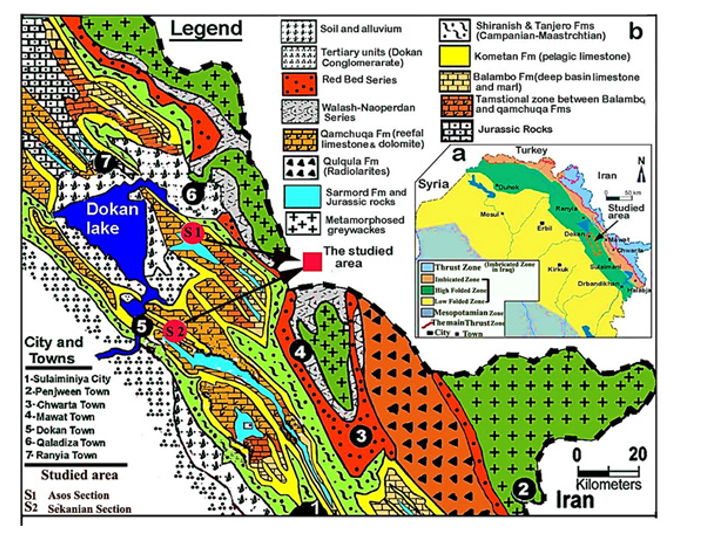
Figure 2: (a) Location map of the study area on the tectonic map of northern Iraq. (b) Geological map of the study area
The Qamchuqa Formation in the study area consists primarily of hard, dense, grey to dark-grey massive limestones, often containing a rich assemblage of biogenic components such as corals, stromatolites, ooids, pelecypods, and gastropods. Multiple unconformities and erosion surfaces are identified within the sequence, some of which are marked by basal conglomerates, karstic voids, and solution collapse breccias, indicating periods of exposure and subaerial weathering (Figure 3). reported a complete absence of ostracods in the examined sections of this formation, suggesting specific paleo environmental conditions during deposition [22].

Figure 3: Lithostratigraphic column of the Qamchuqa Formation.
Objective of the Study
The primary objective of this study is to document and interpret the occurrence and distribution of Thalassinoides trace fossils and associated bioturbation structures within the reefal carbonate facies of the Qamchuqa Formation in northeastern Iraq. The findings aim to provide new insights into the paleoenvironmental conditions, depositional settings, and early diagenetic processes of this important Cretaceous unit.
Geologic Setting
The studied area lies directly southwest of the Main Zagros Thrust Fault, which, according to marks the boundary of the Zagros Fold-Thrust Belt [23]. During the Early and Middle Cretaceous, this region formed part of the northeastern passive margin of the Arabian Plate and was occupied by a shallow carbonate platform known as the Qamchuqa Formation. This platform was situated adjacent to the deep-water Neo-Tethys Ocean to the north and northeast, where deeper marine deposits such as the Balambo Formation and Qulqula Radiolarian Formation were laid down [24].
The Qamchuqa Formation is time-equivalent to, and represents a lateral facies transition from, the Balambo Formation. Reported over 200 meters of laminated and graded detrital limestones and limestone conglomerates within the Qamchuqa Formation [25]. These deposits were interpreted as calciturbidites of the Balambo Formation, derived from the erosion of the Qamchuqa platform carbonates [26,27].
Structurally, the area is marked by a series of high-amplitude anticlines, where the eroded cores frequently expose soft sediments of the Sarmord Formation and underlying Jurassic units. The limbs of these anticlines are dominated by the more erosion-resistant Qamchuqa and Kometan formations. In contrast, intervening synclines are filled with softer formations, particularly the Shiranish and Tanjero formations (Figure 4) [28-35].
=
Figure 4: Stratigraphy of the Haladin-Yakhsamer valley (eroded anticline), indicating the location of the unconformity in the lower part of the Qamchuqa Formation.
Prominent anticlines in the region include distinguish two categories of folding within the Qamchuqa Formation: major and minor folds. Notably, the axes of the minor folds are rotated approximately 20° northward relative to the major fold axes. This angular deviation is attributed to two main factors:
A facies shift from massive reefal carbonates to well-bedded deep- marine limestones of the Balambo Formation.
Tectonic influence from the uplifted and mechanically rigid Mawat Complex, situated northeast of the study area (Figure 5).

Figure 5: Deviation (~20°) of minor anticline axes (orange arrows) from major fold orientations (red arrows) due to facies variation and tectonic influence from the Mawat Complex
The stratigraphic position of the Qamchuqa Formation within the regional geologic framework of northern and northeastern Iraq is presented in Figure 6, based on the works of [36,37]. The Cretaceous successions have been the subject of extensive studies [24,26,27,29,38-46].
Similarly, the Paleogene formations have received significant scholarly attention [13,22,47-58]. The transitional Cretaceous– Paleogene boundary units have also been investigated in detail [28,30,32-34,59-62].
Furthermore, Neogene units have been extensively documented [42,56,63-75]. Oligocene–Miocene sequences are considered equivalent to the Asmari Formation of Iran, as identified by [3,45,61,76-78].

Figure 6: Stratigraphic correlation chart showing the placement of the Qamchuqa Formation and related units across southern, western, and northern Iraq (Kurdistan Region), based on Harland et al. (1990) and El Diasty et al. (2016). Modifications applied to the Kurdistan area.
Materials and Methods
This study focuses on the lower part of the reefal Qamchuqa Formation, a stratigraphic unit of the Early Cretaceous Arabian Platform. The formation is characterized by a thick succession of detrital limestone, conglomerates, erosional surfaces, and evidence of paleokarstification. To better understand its geological features, we also examined its time-equivalent deep marine unit the Balambo Formation.
Fieldwork was conducted in the study area where these formations are well exposed, particularly in deep valleys, gorges, and along rugged mountain slopes. Extensive in-situ observations and sampling were carried out to document sedimentological and ichnological features, with particular attention given to the trace fossil Thalassinoides. For accuracy, only those occurrences of Thalassinoides found in situ within the Qamchuqa Formation were considered.
Two key field sections were selected for detailed study: the Ass and Seykanian sections (Figure 7). These locations were chosen due to their representative stratigraphy and accessibility to well- preserved exposures. However, both sites present significant logistical challenges due to their rugged terrain, including narrow, steep-sided gorges and high elevations.
Representative rock samples were carefully collected from both sections for further laboratory analysis. These samples were selected based on their visibility of trace fossils, lithological variation, and stratigraphic significance. Thin sections were later prepared for petrographic study to supplement field observations and support paleo environmental interpretations.

Figure 7: Google Terrain Image showing the geographic locations of the Ass and Seykanian sections studied in this work
Results and Discussion
Thalassinoides Burrow Systems
The ichnogenus Thalassinoides represents one of the most characteristic biogenic structures attributed to arthropods in the marine sedimentary record [79]. This holds true not only for the present study but also for comparable calcareous and siliciclastic successions in the Portuguese Mesozoic (e.g., Neto de Carvalho, pers. obs.) [80].
In the studied sections, a dense network of Thalassinoides burrows has produced prominent ichnofabrics, imparting a nodular texture to the exposed strata. These biogenic structures are most often observed as predominantly horizontal tunnels, typically preserved at bedding plane interfaces and commonly appearing as convex hyporeliefs.
The burrows vary considerably in width-some exceeding 110 mm- and can extend over lengths greater than 1 meter. They exhibit characteristic Y-shaped branching patterns with acute-angle bifurcations and localized expansions at branching points, which likely functioned as turning or resting chambers. The burrow cross-sections are generally elliptical, with the major axis aligned parallel to bedding planes, reflecting the effects of post-depositional compaction. The burrow walls are smooth and unlined, suggesting passive filling, and their internal fill is notably distinct from the surrounding host matrix. This difference is attributed to more intense carbonate cementation within the burrow fill, which may consist of coarse sandy, bioclastic, or lime mud sediments (Figure 8).
Thalassinoides burrow systems dominate the ichnofabric of the Qamchuqa Formation and serve as strong evidence for the ecological success of mecochirid decapods-believed to be the primary trace makers-during the Early Cretaceous. Despite this, the fossil record of decapods remains sparse and taphonomically biased [81]. This scarcity is often explained by the taphonomic model proposed by, which suggests that the delicate cuticular structures of decapods decay rapidly and are rarely preserved, resulting in a low preservation potential [82].
Interestingly, all fossilized decapods observed in association with these burrow systems are preserved in lateral view and in a state of rigor mortis, deviating from the typical exuvial (ecdysis) positioning often seen in molted specimens [83]. This pattern may reflect specific environmental or burial conditions that rapidly immobilized and preserved the organisms before significant decomposition could occur.

Figure 8: Thalassinoides burrow walls are smooth, unlined, and exhibit passive infill. The burrow fill differs markedly from the host limestone or fine sandstone matrix due to enhanced carbonate cementation
Asos Mountain Section
The Asos section is located on the northeastern flank of Asos Mountain (an anticline structure) along the northern boundary of the Dokan Reservoir. This stratigraphic section is notable for its abundance of paleokarst features, erosional surfaces, and oolitic limestone beds. One of the key intervals, approximately 5 meters thick, is characterized by laminated and bedded bioturbated limestone as well as the presence of hardgrounds. Bioturbation in this section is predominantly horizontal, suggesting formation through either current-induced disturbance or biological reworking, indicative of an omission surface (Figure 9).

Figure 9: Limestones of the lower part of the Qamchuqa Formation at Asos Mountain showing: (a) partially karstified, fine-grained limestone (dark gray) with cavities filled by detrital and oolitic limestone; (b) oncoidal floatstone directly underlying karstified layers at coordinates 35°04′40.14″N and 45°04′30.35″E.
The laminated bioturbated layer exhibits clear features of Thalassinoides burrows, many of which occur within an omission surface setting. This surface exposes brief interruptions in sedimentation and is marked by multiple overprinted excavations, burrow fills, and boring structures, consistent with the descriptions of [84]. These burrows are closely associated with thin dolomitized conglomeratic floatstone layers. The clasts within these floatstones show poor sorting and irregular margins, further supporting the interpretation of episodic reworking (Figure. 11c).

Figure 10: A 5-meter-thick bioturbated interval in the lower Qamchuqa Formation, densely populated with Thalassinoides burrows.
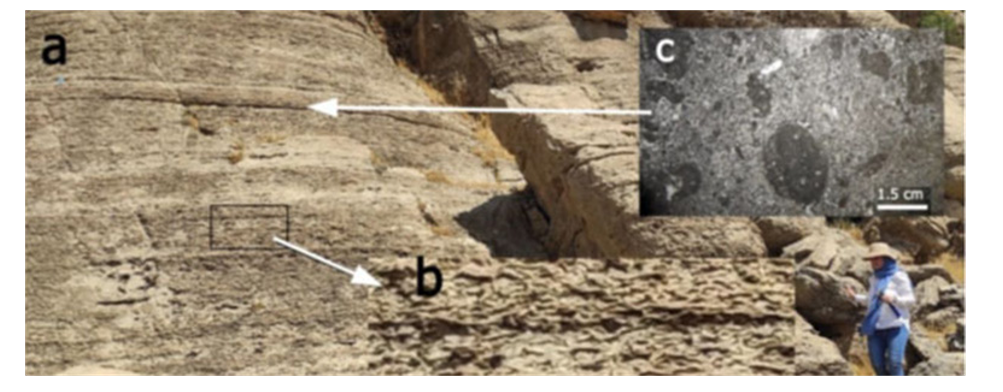
Figure 11: (a) Bioturbated interval (same as Figure 10); (b) Close-up view of the rectangular zone showing Thalassinoides details; (c) Thin section photograph highlighting the hardground marked by a white arrow
In most cases, bioturbation is manifested as elongated dark patches composed of coarse-grained dolomite. These structures range from 4–8 cm in length and 1–3 cm in thickness. In outcrop, the burrows exhibit positive relief and are commonly cylindrical or irregular in shape, with visible necking and widening along their lengths (Figure 12a, b). When compared with documented morphologies, these traces are confidently assigned to the ichnogenus Thalassinoides [85-87].
Figure 12: Lower Qamchuqa Formation in the Asos section showing: (a) hardground surfaces, horizontal bioturbation, and erosionalcontacts; (b) erosional surface underlying a bioturbated horizon.
Dolomitization of the burrow fill is interpreted as a result of preferential fluid flow through the more permeable burrow- associated sediments, which acted as conduits for early diagenetic alteration. According to the literature, Thalassinoides are horizontal, branching burrow systems that connect to the sediment- water interface via vertical or inclined shafts. Swellings-often eccentric occur at branching points and are believed to result from active infilling by the burrowing organism.
Typical Thalassinoides tubes range from 5 to 20 mm in diameter and possess smooth walls. However, observed shaft and tunnel diameters from 15 mm up to 60 mm, further illustrating the variability in these structures [88]. These burrows are typically found in coarse-grained terrigenous, carbonate, or mixed sediment settings, and are associated with ichnofacies indicative of shallow- marine and coastal environments, including Skolithos and Cruziana assemblages.
Although many previous studies have interpreted Thalassinoides as crustacean produced burrows, in this study, associated macrofauna are limited to small gastropods and pelecypods. Crustaceans are notably absent from the host rocks, suggesting that the observed burrows in the Qamchuqa Formation were more likely formed by these mollusks or similar invertebrates.
In the Sekaniyan Gorge, where the strata of the Qamchuqa Formation are exposed vertically, two distinct Thalassinoides- rich horizons with associated hardgrounds are observed. The first occurs approximately 20 meters above the formation’s base and is about 1 meter thick, while the second is found near the top of the lower Qamchuqa interval and is approximately 4 meters thick (Figure 9).
Sekanian Section
The Sekanian section is situated in the northeastern part of Asos Mountain (anticline), along the northern boundary of the Dokan Reservoir. This section is particularly significant due to a 5-meter- thick interval of bedded and laminated bioturbated limestone associated with hardground surfaces (Figure 13). 
Figure 13: Limestones of the lower Qamchuqa Formation in the Sekanian section showing partially karstified fine-grained limestone (dark), with cavities filled by detrital and oolitic limestone.
Bioturbation within the Sekanian section is predominantly horizontal, likely resulting from a combination of biological reworking and current activity. These burrows are commonly associated with omission surfaces that indicate short interruptions in sediment deposition (Figure 14).
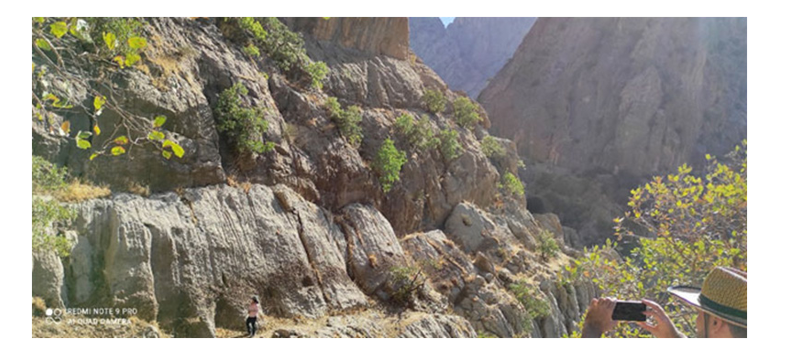
Figure 14: Bioturbated succession in the lower Qamchuqa Formation, densely populated with Thalassinoides burrows
In the Sekaniyan Gorge, the Qamchuqa Formation is exposed in nearly vertical strata, where two distinct ichnological horizons are observed. The first horizon, located approximately 20 meters above the formation's base, is about 1 meter thick. The second horizon occurs at the top of the lower Qamchuqa unit and is 4 meters thick. Both horizons display well-developed Thalassinoides networks and hardground surfaces (Figure 15).

Figure 15: (a) Nearly vertical strata of the Qamchuqa Formation in the Sekaniyan Gorge exhibiting Thalassinoides; (b) Close-up of Thalassinoides and associated hardground; (c) Detailed view of branching and swollen burrows at coordinates 35°53′02.31″N and 45°08′42.47″E.
The omission surfaces in this section reveal multiple phases of biogenic activity, shown by superimposed borings, burrow infill, and reworking. These surfaces are commonly linked to thin dolomitized conglomeratic beds (floatstone facies), characterized by poorly sorted clasts with irregular boundaries (Figures. 16–18). Associated lagoonal biofacies-composed of nerineids, naticids, Exogyra, and other gastropods-further support a shallow-marine depositional environment (Figures. 17, 18).

Figure 16: Panels (a–f): Examples of Thalassinoides burrows from the vertical exposures of the Qamchuqa Formation in SekaniyanGorge.

Figure 17: Panels (a–e): Lagoonal biofacies with nerineids, naticids, and clustered Exogyra.
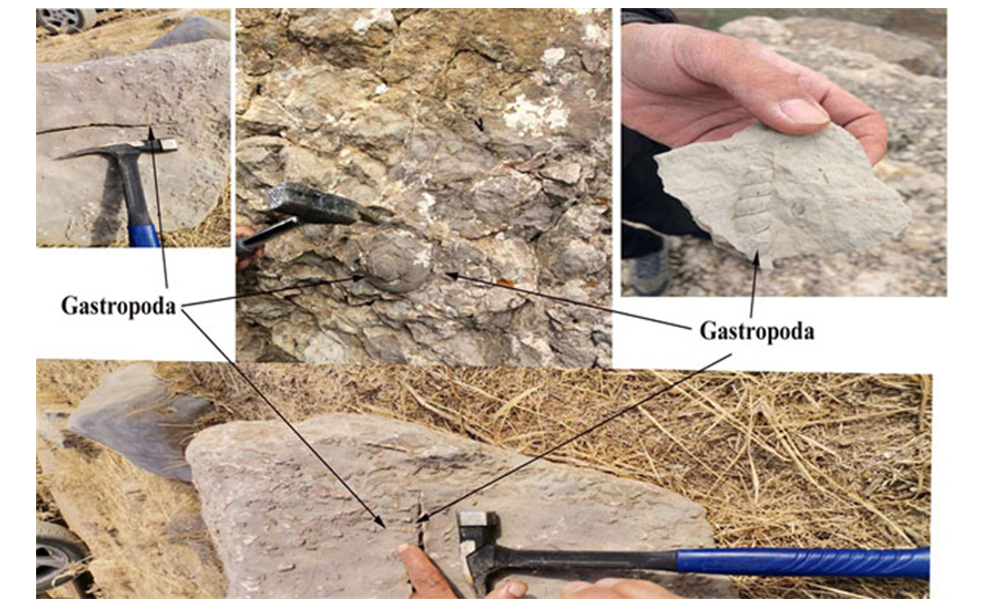
Figure 18: Panels (a–e): Continued examples of lagoonal fauna with nerineids, naticids, and clustered Exogyra.
At both the Sekanian and Asos sections, Thalassinoides burrows can extend vertically and horizontally, often forming dense networks that define entire bedding planes. These burrow walls are occasionally lined, indicating they functioned as dwelling structures. While some Thalassinoides morphologies resemble Ophiomorpha, they differ by lacking fecal pellets in their walls. This transitional morphology is expected, as both structures are commonly attributed to burrowing shrimp or closely related arthropods.
Similar burrow systems have been documented in both muddy and sandy sediments within the shallow-marine deposits of the San Joaquin Basin. The comparison supports the interpretation that these trace fossils reflect well-established, low-energy marine conditions favorable for long-term colonization by burrowing organisms (Figure 19).

Figure 19: A complex Thalassinoides burrow network from the Asos section, showing vertical and horizontal branching. Lined burrow walls suggest a dwelling function. While morphologically similar to Ophiomorpha, the absence of fecal pellets supports attribution to Thalassinoides. These structures are typical of burrowing shrimp activity in shallow-marine environments.
Conclusion
1. Exceptional Preservation of Decapods Within Thalassinoides Burrow SystemsThe study documents a significant finding of fossil decapod populations, exceptionally preserved within well-developed Thalassinoides burrow networks. This association provides critical ichnological and paleoecological evidence of crustacean behavior in Early Cretaceous marine environments
2. High-Quality Preservation of Mecochirus Rapax SpecimensHundreds of fossilized Mecochirus rapax carapaces were recovered, many exhibiting complete appendages and delicate morphological features, including saw-toothed crests and granulated textures. This exceptional preservation suggests rapid burial and minimal post-mortem transport.
3. Obrution by Flooding Events in a Shallow Lagoonal SettingThe widespread preservation of these decapods is interpreted as resulting from obrution—rapid burial during high-energy storm or flooding events. These episodic influxes of coarse, sandy mud into shallow back-reef lagoons likely occurred repeatedly during the lower Barremian, facilitating fossilization in situ.
4. Focused Ichnological Analysis of the Qamchuqa FormationThis study centers on the Qamchuqa Formation in the Sulaimaniyah Governorate, aiming to characterize and interpret Thalassinoides trace fossils. Their abundance and complexity reflect significant bioturbation and support interpretations of a low-energy, shallow-marine depositional environment.
5. Unconformity and Diagenetic Features in the Lower Qamchuqa Interval the lower part of the Qamchuqa Formation reveals a prominent unconformity marked by paleokarst surfaces, conglomeratic layers, erosional truncations, Thalassinoides traces, chert nodules, and hardground surfaces. These features collectively indicate subaerial exposure, periods of non- deposition, and early diagenetic modification, emphasizing the complex paleoenvironmental history of the formation [89- 101].
References
- Nairn, A. E. M., & Alsharhan, A. S. (1997). Sedimentary basins and petroleum geology of the Middle East. Elsevier.
- Jassim, S. Z., & Goff, J. C. (2006), Geology of Iraq, Dolin,Prague and Moravian Museum.
- Rashidi, R. F., Sajadi, S. H., & Ghafor, I. M., 2022, Biostratigraphy and paleoecology of the early-middle Miocene (Mishan Formation), Bandar Abbas, South Iran. Mediterranean Geosci Union, Conference.
- Bellen, V. R. C., Dunnington, H. V., Wetzel, R., & Morton,D. M. (1959). International Stratigraphic Lexicon: Asia. Iraq. Tertiary. Mesozoic and Palaeozoic. International Geological Congress.Stratigraphy Commission. National Centre for Scientific Research, Paris, v. 3, p. 333, (in French).
- Hudson, R. G. S. (1954). A new lower Cretaceous stromatoporoid, Bekhmeia wetzeli from northern Iraq. Journal of Paleontology, 47-51.
- Dunnington, H. V. (1959). Generation, migration, accumulation, and dissipation of oil in Northern Iraq. In: (Weeks L.G., ed.) Habitate of Oil, Symposium. American Association of Petroleum Geologists, 1194-1251.
- Chatton, M., Hart, E., (1960). Revision of Tithonian Albian stratigraphy of Iraq. Manuscript report, Geosurv, Baghdad.
- Buday, T. (1980). Regional geology of Iraq Stratigraphy and paleo- geography. In: (Ismail I.M. Kassab, Saad Z. Jassim, eds.). State Organization for Minerals, Directorate General for Geological Survey and Mineral Investigations, Baghdad, Iraq, 1, 445.
- Sadooni, F. N., & Alsharhan, A. S. (2003). Stratigraphy, microfacies, and petroleum potential of the Mauddud Formation (Albian–Cenomanian) in the Arabian Gulf basin. AAPG bulletin, 87(10), 1653-1680.
- Ameen, B. M. (2008). Lithostratigraphy and sedimentology of Qamchuqa Formation from Kurdistan region, NE-Iraq (PhD Thesis). University of Sulaimani.
- Karim, K. H., & Ameen, B. M. (2009). Facies analysis of Early Cretaceous Arabian platform from Northeastern Iraq, Kurdistan region, Proceeding of the geologic conference of the Middle East and North Africa (GERMENA-3), 5. Cairo, Egypt.
- Al-Fattah, A. N., Al-Juboury, A. I., & Ghafor, I. M. (2020). Paleocene-Eocene Thermal Maximum Record of Northern Iraq: Multidisciplinary Indicators and an Environmental Scenario. Jordan Journal of Earth & Environmental Sciences, 11(2), 126-145.
- Ghafor, I., & Muhammad, H. (2023). New contribution to the biostratigraphy of Naopurdan limestone unit (Eocene), Bulfat area, Sulaimaniyah, Kurdistan Region, NE Iraq. 1, 1-25.
- Abawi, T. S., & Hassan, Z. M. (1993). Stratigraphy and microfacies of the Lower Qamchuqa Formation, Lower Cretaceous, northern Iraq. (represented by the subsurface section of the Khabaz well nor. 14, Kirkuk area). Neues Jahrbuch für Geologie und Paläontologie. Monatshefte, 1993(9), 545-552.
- Al Shdidi, S., Thomas, G., & Delfaud, J. (1995). Sedimentology, diagenesis, and oil habitat of Lower Cretaceous Qamchuqa Group, northern Iraq. AAPG bulletin, 79(5), 763-778.
- Ameen, B. M., & Karim, K. H. (2008). New Sedimentologic And Stratigraphic Characteristics of The Upper Boundary of Qamchuqa Formation (Early Cretaceous) In Ne Erbil, Kurdistan Region, Ne Iraq. Iraqi Bulletin of Geology and Mining, 4(2), 1-13.
- Kamal, H. K., & Zardasht, A. (2009). Tectonical history of Arabian platform during Late Cretaceous An example from Kurdistan region, NE Iraq. Iranian Journal of Earth Sciences, 1(1), 1–14.
- Al-Zaidy, A. A. H., Gayara, A. D. & Al-Beyati, F. M. (2013). Facies architecture and basin development of the Qamchuqa succession, NE- Iraq. Arab J Geosci.
- Al-Qayim, B., Hussein, S., Qader, F. M., Al-Hakari, S. H., Shukor, B., Sardar, Z., ... & Abdullah, H. (2016). Integrated stratigraphic study of the Cretaceous petroleum-potential succession, Sulaimani area, Kurdistan, Iraq. Journal of Zankoy Sulaimani, Special Issue, GeoKurdistan II, 395-428.
- Daoud, H. S. (2021). Microfacies analysis, depositionalsetting, and microfossil assemblages of Qamchuqa Formation (Early Cretaceous) in Piramagroon mountains, Sulaymaniyah Governorate, northeastern Iraq. Arabian Journal of Geosciences, 14(8), 662.
- Tahir, Z. S. (2022). Sedimentologic and stratigraphic evidences of unconformities inside the Qamchuqa Formation in Sulaymaniyah Governorate, Kurdistan Region, NE Iraq, M.Sc. thesis, University of Sulaimni, Kurdista region, Iraq. (Unpublished).
- Al-Fattah, A. N., Al-Juboury, A. I., & Ghafor, I. M. (2020). significance of foraminifera during the paleocene–eocene thermal maximum (petm) in the aaliji and kolosh formations, north and northeast iraq. Iraqi Bulletin of Geology and Mining, 16(2), 33-50.
- Koyi, H. (1988). Experimental modeling of the role of gravity and lateral shortening in the Zagros Mountain belt, AAPG Bulletin, 72, 1381–1394.
- Ghafor, I. M., & Baziany, M. Q. (2009). Larger foraminifera (Alveolinidae, Soritidae and Nummulitidae) from the Former Qulqula Conglomerate Formation, Kurdistan Region, Northeastern Iraq. Iraqi Journal of Earth Sciences, 9(1), 35- 54.
- Karim, K. H. (2020). Early Cretaceous calciturbidites facies from Zagros Fold–Thrust belt: a key to paleogeography and environment of northeast Arabian Platform Passive Margin, examples from Kurdistan Region, Northeast Iraq. Carbonates and Evaporites, 35(1), 19.
- Ghafor, I. M., & Mohialdeen, I. M. (2016). Fossils distribution from Garagu Formation (Early Cretaceous), diversity and Paleoennvironmental conditions, Kurdistan Region, North Iraq. North Iraq. J Zankoy Sulaimani, JZS GeoKurdistan II (Special Issue), 139-150.
- Ghafor, I. M., & Mohialdeen, I. M. (2018). Early cretaceous microfossils associations (foraminifera, ostracoda, calcareous algae, and coral) from the Garagu Formation, Duhok Area, Kurdistan Region, Northern Iraq. Arabian Journal of Geosciences, 11(15), 407.
- Ghafor, I. M. (1988). Planktonic Foraminifera and Biostratigraphy of the Aaliji Formation and the Nature of its Contact with the Shiranish Formation in Well Tel-Hajar No. 1. Sinjar Area, Northwestern Iraq. Unpublished. Thesis. Department of Geology, Salahaddin University, Iraq.
- Ghafor, I, M. (1993). Planktonic foraminiferal ranges in the balambo Formation (Albian-Turonian) in Sulaimmaniyah, Kurdistan Region, Northeastern Iraq, Zanco, special issue, procceding of second Scientific conference, University of Salahaddin, Erbil, 24–25, April, 1993in Erbil Kurdistan.
- Al-Shaibani, S. K., Al-Hashimi, H. A., Ghafor, I. M. (1993). Biostratigraphy of the Cretaceous-Tertiary boundary in well Tel-Hajer No-1, Sinjar area, northwest Iraq. Iraqi Geological Journal, 26, 77-97.
- Bakkal, K. K., Ghafor, I. M., & Kassab, I. I. M. (1993). Biostratigraphy of shiranish formation inHijran area northeastern Iraq. Journal of Science and Nature, 2, 34-39.
- Ghafor, I. M. (2000). Spores and pollen of upper cretaceous lower tertiary in Higran area, Kurdistan, Iraq. Zanco Journalof Pure and Applied Science, 12, 47-62.
- Sharbazheri, K. M., Ghafor, I. M., & Muhammed, Q. A. (2011). Biostratigraphy of the Cretaceous/Paleogene boundary in Dokan area, Sulaimaniyah, Kurdistan Region, NE Iraq. Iraqi Bulletin of Geology and Mining, 7(3), 1-24.
- Al Nuaimy, Q. A., Sharbazheri, K. M., Karim, K. H., & Ghafor,I. M. (2020). Cretaceous/Paleogene Boundary Analysis by Planktic Foraminiferal Biozonation in the Western Zagros FoldThrust Belt (Smaquli valley), Sulaimani Governorate, NE-Iraq. Kirkuk University Journal for Scientific Studies, 15(3).
- Ghafor, I. M., Mustafa, A. I., Mohialdeen, I. M., & Mansurbeg, H. (2024). High-resolution biostratigraphic zonation across the Cretaceous/Paleogene (K/Pg) boundary from the Sulaymaniyah area, Kurdistan Region, Northeastern Iraq. Aro-The Scientific Journal of Koya University, 12(1), 207-223.
- Karim, K. H., Khanaqa, P. A., Kharajiani, S. O., Taha, Z. A., & Baziany, M. M. (2020). Depositional and erosional features of Oligocene paleokarsts in the Kirkuk Group, Kurdistan region, Northeast Iraq. Arabian Journal of Geosciences, 13(6), 270.
- Harland, W. B. (1990). A geologic time scale 1989. Cambridge University Press.
- Kassab, I. I. M. (1976). Planktonic foraminiferal ranges in the type Kolosh Formation (Middle-Upper Paleocene) of NE Iraq. J. Geol. Soc. Iraq, 11, 54-99.
- Kassab, I. I. (1979). The genus Globotruncana Cushman from the upper cretaceous of Northern Iraq. Geol. Soc. Iraq, 2, 27- 127.
- Ghafor, I. M. (2004). Biometric analysis of Lepidocyclina (Nephrolepidina) and Miogypsinoids from Baba and Azkand formations (Oligocene–Miocene) in Kirkuk area, Iraq. Unpub. Unpublished Ph. D. Thesis., College of Science. University of Sulaimani, Iraq, 170.
- Ghafor, I. M., Karim, K. H., & Baziany, M. M. (2012). Age determination and origin of crenulated limestone in the eastern part of Sulaimaniyah Area, Kurdistan Region, NE Iraq. Iraqi Bulletin of geology and Mining, 8(2), 21-30.
- Ghafor, I., Javadova, A., & Rashidi, R. (2023). Benthic Foraminifera as A Tool for Indication of Microfacies, Bio- stratigraphy, and Depositional Environment of the Baba Formation (Late Oligocene), Kirkuk Oil Field, Northeastern Iraq. J Oil Gas Res Rev, 3(2), 83-98.
- Rajabi, P., & Ghafor, I. M. (2024). Stratigraphy, microfacies, paleoenvironments and paleoecology of Asmari Formation (Oligocene-Miocene), Zagros basin, Western Iran. The Iraqi Geological Journal, 210-229.
- Ghafor, I. M., & Kareem, K. H. (1999), Biostratigraphy of Upper layers of the Kolosh Formation from Sartaq- Bamo Northeastern Iraq. JDU (Sci)-Special Issue: The first Scientific conference of Dohuk University 27- 29 April, 2, 493–510.
- Al-Fattah, A. N., Al-Juboury, A. I., & Ghafor, I. M. (2017). Paleocene-Eocene Thermal Maximum (PETM) of Northern Iraq. Lambert Academic Publishing. Mauritius, 212 p.
- Al-Fattah, A. N., Al-Juboury, A. I., Ghafor, I. M. (2018). Rock magnetic properties during the Paleocene-Eocene Thermal Maximum (PETM): Record from P/E boundary sections (Sinjar, Shaqlawa) in Iraq. Iraqi National Journal of Earth Sciences, 18, 55-74
- Al-Taee, N. T., Al-Juboury, A. I., Ghafor, I. M., Zanoni, G., & Rowe, H. (2024). Depositional environment of the late Paleocene-early Eocene Sinjar Formation, Iraq: Implications from facies analysis, mineralogical and geochemical proxies. Heliyon, 10(4), 1-27.
- Al-Taee, N. T., Al-Juboury, A. I., Ghafor, I. M., & Rowe,H. (2024). Mineralogical and Geochemical Variations Across the PaleoceneEocene Sinjar Formation, Dokan Area, Northeastern Iraq. Iraqi National Journal of Earth Sciences, 24(2), 125-139.
- Al-Taee, N. T., Ghafor, I. M., Al-Juboury, A. I., & Dettman,D. L. (2024). Biostratigraphy and paleoecology of the Sinjar Formation (Late Paleocene-Early Eocene) in the Dokan and Sinjar Areas, Iraq. The Iraqi Geological Journal, 221-249.
- Al-Qayim, B., Ghafor, I., & Jaff, R. (2014). Contribution to the stratigraphy of the Walash Group, Sulaimani area, Kurdistan, Iraq. Arabian Journal of Geosciences, 7(1), 181-192.
- Ghafor, I. M., & Al-Qayim, B. (2021). Planktic Foraminiferal biostratigraphy of the upper part of the Damlouk member, ratga formation, western desert, Iraq. Iraqi National Journal of Earth Sciences, 21(2), 49-62.
- Karim, K., & Ghafor, I. (2021). Updated stratigraphy, tectonics and boundary conditions of the mawat and bulfat ophiolite complexes, kurdistan region, NE-Iraq. The Second International and the Fourth Scientific Conference of College of Science, Tikrit University.
- Al-Qayim, B., & Ghafor, I. (2022). Biostratigraphyand Paleoenvironments of Benthic Foraminifera From Lower Part of the Damlouk Member, Western Desert, Iraq. Iraqi Journal of Science, 4799-4817.
- Ghafor, I. M., & Muhammad, H. F. (2024). New contribution to the biostratigraphy of Naopurdan Limestone Formation (Eocene), Sulaimaniyah, Kurdistan Region, Northeastern Iraq. J App Mat Sci & Engg Res, 8(3), 01-16.
- Ghafor, I. M., & Muhammad, H. F. (2022). Biostratigraphy of Eocene Sediments from Naopurdan Group, Chwarta Area, Kurdistan Region, NE Iraq: Paleogeographic Implication. Iraqi National Journal of Earth Science, 22(2), 192-208.
- Ghafor, I. M., & Muhammad, H. F. (2025). Large Benthic Foraminiferal Assemblages from the Naopurdan Limestone (Eocene); Paleoenvironmental Reconstruction, Kurdistan Region, North-Eastern Iraq. Iraqi Bulletin of Geology and Mining, 21(1), 187-206.
- Kassab, I. I. M., Al-Omari, F.S. & Al-Safawee, N. M. (1986). The Cretaceous Tertiary boundary in Iraq (represented by the subsurface section of Sasan well No. 1, N.W. Iraq). J. Geol. Soc. Iraq, 19, 129-167.
- Ghafor, I. M. (2020). Crustacean. In Crustacea; IntechOpen:London, UK.
- Sharbazeri, K. M., Ghafor, I. M., & Muhammed, Q. A., (2009). Biostratigraphy of the Cretaceous-Paleogene boundary, Dokan area, Kurdistan Region, Iraq. Third International Conference on Geo-Resources of the Middle East and North Africa, Cairo University, Egypt, 21-24.
- Rashidi, R. F., Sajadi, S. H., & Ghafor, I. M. (2024). Foraminiferal biostratigraphy across the eocene–oligocene transition, in the Zagros Basin, southern Iran. Carbonates and Evaporites, 39(3), 86.
- Ghafor, I. M. (2010, March). Systematic Description of Larger Foraminifera from Oligocene-Miocene in Different Oil Field, Kirkuk Area, North Iraq. In GEO 2010 (pp. cp-248). European Association of Geoscientists & Engineers.
- Ghafor, I. M. (2011). Microfacies and biostratigraphy of Baba Formation (late Oligocene) in Bai Hassan, oil well-25, Kirkuk Area, central north Iraq. Iraqi Bulletin of Geology and Mining, 7(3), 25-32.
- Ghafor, I. M. (2014). Biometric analysis of Lepidocyclina (Nephrolepidina) from Baba Formation (Late Oligocene) in Bai-Hassan Well-25, Kirkuk area, Northeast Iraq. Science Research, 2 (5): 111-118.
- Ghafor, I. M. (2015). Evolutionary aspects of Lepidocyclina (Nephrolepidina) from Baba Formation (late Oligocene) in Bai-Hassan well-25, Kirkuk area, Northeast Iraq. Arabian Journal of Geosciences, 8(11), 9423-9431.
- Ghafor, I. M. (2022). Systematic, microbiostratigraphy and paleoecology of the Bajwan Formation (Late Oligocene) in the Kirkuk Well-160, northeastern Iraq. Carbonates and Evaporites, 37(3), 45.
- Ghafor, I. M., & Muhammed, Q. A. (2005). Evolutionary aspects of Lepidocyclina (Nephrolepidina) from Baba and Azkand Formations (Oligocene-Miocene) in Kirkuk area. Iraqi Journals of Earth Sciences, 5, 19-31.
- Ghafor, I. M., & Muhammed, Q. A. (2006). Evolutionary aspects of Lepidocyclina (Nephrolepidina) from Baba and Azkand Formations (Oligocene –Miocene) in Kirkuk area, Northern Iraq. GAW8 - 8th International Conference, On the Geology of The ARAB World-13th to 16th February 2006 Cairo, Egypt, Special Issue.
- Ghafor, I. M., Ahmad, P. M. (2019). Biostratigraphy and paleoecology of Anah Formation in the Pungalla village, Sangaw area, Sulaimaniya, Northeastern Iraq. Iraqi Bulletin of Geology and Mining, 15, 1-15.
- Ghafor, I. M., & Ahmad, P. M. (2021). Stratigraphy of the Oligocene-early Miocene successions, Sangaw area, Kurdistan region, NE-Iraq. Arabian Journal of Geosciences, 14(6), 454.
- Ghafor, I. M., & Najaflou, S., (2022). Biostratigraphy, Microfacies and Depositional Environment of Oligocene (Late Rupelian-Early Chattian) Baba Formation at the Kirkuk Well-19 section, Kirkuk area, Northeastern Iraq. Carbonate and Evaporates, 37, 1-15.
- Ghafor, I. M., Karim, K. H., Sissakian, V. (2014). Biostratigraphy of Oligocene succession in the High Folded Zone, Sulaimani, Kurdistan region, Northeastern Iraq. Arabian Well-19 section, Kirkuk area, Northeastern Iraq. Carbonateand Evaporates, 37, 1-15.
- Rashidi, R. F., Ghafor, I. M., & Javadova, A. (2023), Benthic foraminifera as a tool for indication of biostratigraphy and paleoecology of the Guri Member (Mishan Formation) Bandar Abbas, South Iran. In: Materials of VII International Scientific and Practical Conference (on March 31, 2023). 1, 37-53.
- Ghafor, I. M., & Muhammad, H. F. (2025). Large Benthic Foraminiferal Assemblages from the Naopurdan Limestone (Eocene); Paleoenvironmental Reconstruction, Kurdistan Region, North-Eastern Iraq. Iraqi Bulletin of Geology and Mining, 21(1), 187-206.
- Ghafor, I., Javadova, A., & Rashidi, R. (2023). Benthic Foraminifera for indication of microfacies, biostratigraphy, and depositional environment of the Baba Formation (Late Oligocene), Kirkuk Oil Field, Northeastern Iraq. Journal of Azerbaycan Geoloqu (Azerbaijan Geologist–Scientific Bulletin of The Azerbaijan Society of Petroleum Geologists), (26), 36-56.
- Qafor, I°., Javadova, A., Fanati, R. (2025). Baba Formasiyasinin (Oliqosen) Karbonatçöküntüleri Ve Paleoekoloji Mühitin Xüsusiyyetleri, Kerkük Rayonu, Zaqros Hövzesi, simal-serqi Iraq. Stratigraphy, petroleum sedimentology, geochemistry, 1, 11-32.
- Seilacher, A. (1986). Evolution of Behavior as Expressed. Evolution of animal behavior: Paleontological and field approaches, 62.
- Fürsich, F. T. (1981). Invertebrate trace fossils from the Upper Jurassic of Portugal. Comunicaçoes dos Serviços geológicos de Portugal, 67(2), 153-168.
- Plotnick, R. E. (1990). Paleobiology of the arthropod cuticle.Short Courses in Paleontology, 3, 177-196.
- Stempien, J. A. (2005). Brachyuran taphonomy in a modern tidal-flat environment: Preservation potential and anatomical bias. Palaios, 20(4), 400-410.
- Feldmann, R. M., Crisp, G., & Pirrie, D. (2002). A new species of glypheoid lobster, Pseudoglyphea foersteri (Decapoda: Astacidea: Mecochiridae) from the Lower Jurassic (Pliensbachian) of Raasay, Inner Hebrides, UK. Palaeontology, 45(1), 23-32.
- Bromley, R. G. (1975). Trace fossils at omission surfaces. In The study of trace fossils: A synthesis of principles, problems, and procedures in ichnology (pp. 399-428). Berlin, Heidelberg: Springer Berlin Heidelberg.
- Sheehan, P. M., & Schiefelbein, D. J. (1984). The trace fossil Thalassinoides from the Upper Ordovician of the eastern Great Basin: deep burrowing in the early Paleozoic. Journal of Paleontology, 440-447.
- Ekdale, A. A., Bromley, R. G., & Knaust, D. (2012). The ichnofabric concept. In Developments in Sedimentology (Vol. 64, pp. 139-155). Elsevier.
- Gingras, M. K., Baniak, G., Gordon, J., Hovikoski, J., & Konhauser, K. O., et al. (2012). Porosity and permeability in bioturbated sediments. In Developments in Sedimentology (Vol. 64, pp. 837-868). Elsevier.
- Yanin, B. T., & Baraboshkin, E. Y. (2013). Thalassinoides burrows (decapoda dwelling structures) in lower cretaceous sections of southwestern and central Crimea. Stratigraphy and Geological correlation, 21(3), 280-290.
- Ghafor, I. M. (2019, November). Biostratigraphy and microfacies of azkand formation in qarah chaugh-dagh section, kirkuk area (northeastern Iraq). In Conference of the Arabian Journal of Geosciences (pp. 251-256). Cham: Springer International Publishing.
- Tunisia, (2019). In: Çiner A. et al. (eds) Recent Research on Geomorphology, Sedimentology, Marine Geosciences and Geochemistry. Book chapter, Springer, 2022b, 251-256.
- Ghafor, I., Ahmad, P., & Khafaf, A. A. (2023). Biostratigraphy and paleoecology of the Anah formation in Kurdistan region, Iraq. Iraqi Bulletin of Geology and Mining, 19(1), 17-28.
- Ghafor, A., Javadova, R., Rashidi, (2025). The carbonate sediments and paleoenvironmental consideration from the Baba Formation (Oligocene), Kirkuk area, Zagros basin, Northeastern Iraq, Stratigraphy, petroleum sedimentology, geochemistry, 1, 11-32.
- Ghafor, I. M., Javadova, A., Rashidi, R. F. (2025). The carbonate sediments and paleoenvironmentalconsideration from the Baba Formation (Oligocene), Kirkuk area, Zagros basin, Northeastern Iraq, Stratigraphy, petroleum sedimentology, geochemistry, 1, 11-32.
- Henson, F. R. S. (1950). Cretaceous and Tertiary reef formations and associated sediments in Middle East. AAPGBulletin, 34(2), 215-238.
- Haq, B. U., & Al-Qahtani, A. M. (2005). Phanerozoic cycles of sea-level change on the Arabian Platform. GeoArabia, 10(2), 127-160.
- Karim, K. H., & Khanaqa, P. A. (2016). Lithology and Stratigraphy of the Cenomanian/Turonian Boundary in Zagros Orogenic Belt Examples from Kurdistan Region, Northeastern Iraq. The Iraqi Geological Journal, 73-90.
- Karim, K. H., & Khanaqa, P. A. (2017). Stratigraphy and structure of the southeastern part of Piramagroon anticline, Sulaimani area, Northeast Iraq. Bulletin of the Mineral Research and Exploration, 154(154), 27-39.
- Taha, Z. A., & Karim, K. H. (2009). New ideas about Gulneri Formation (Early Turonian) in Dokan area, Kurdistan Region, NE Iraq. Iraqi Bulletin of Geology and Mining, 5(2), 29-39.
- Kassab, I. I. M. "Planktonic foraminiferal of the subsurface lower tertiary of northern Iraq." Journal of the Geological Society of Iraq 11 (1978): 119-159.
- Kassab, I. I. (1979). The genus Globotruncana Cushman from the upper cretaceous of Northern Iraq. Geol. Soc. Iraq, 2, 27- 127.
- Martin, R. E. (1999). Taphonomy: A Process Approach:Cambridge University Press, Cambridge, 395.
- Sharbazheri, K., Ghafor, I., & Muhammed, Q. (2009). Biostratigraphy of the cretaceous/tertiary boundary in the Sirwan Valley (Sulaimani Region, Kurdistan, NE Iraq). Geologica carpathica, 60(5), 381-396
- Van Bellen, R. C. (1956). The stratigraphy of the ‘Main Limestone’of the Kirkuk, Bai Hassan and Qarah Chaugh Dagh structure in the north Iraq. Journal of the Institute of Petroleum, London, 42, 233-263.