

World Journal of Forest Research(WJFR)
ISSN: 2994-5569 | DOI: 10.33140/WJFR



Research Article - (2026) Volume 5, Issue 1
New Global Environmental Organization, to Head United Nations, and Embrace Present Failings and Shortcomings, for Protection, Care and Maintenance of our Planet
Received Date: Feb 18, 2026 / Accepted Date: Mar 24, 2026 / Published Date: Apr 06, 2026
Copyright: ©2026 Robert Kempton. This is an open-access article distributed under the terms of the Creative Commons Attribution License, which permits unrestricted use, distribution, and reproduction in any medium, provided the original author and source are credited.
Citation: Kempton, R. (2026). New Global Environmental Organization, to Head United Nations, and Embrace Present Failings and Shortcomings, for Protection, Care and Maintenance of our Planet. World J Forest Res, 5(1), 01-32.
Abstract
There is a pressing need for a comprehensive ‘Protocol for a Global Organization’, designed to supersede existing fragmented legal systems that are shaped by diverse cultures, religious influences, and national boundaries. The principal objectives should address major global concerns and Environmental Social Governance, including climate change, population growth, and the development of a universal framework of environmental principles and laws applicable to all earthborn1 creatures. This would facilitate responsible anthropogenic initiatives focused on the care, maintenance, and management of life on Earth.
The establishment of a World Body with Tier 1 status, senior to the United Nations, and grounded in the principles of Biological Diversity —as exemplified by the Protocol on Environmental Protection to the Antarctic Treaty—is recommended, and to be based on the five major continents. Such a world body should incorporate a structured suite of Environmental Impact Assessment master handbooks, serving as effective tools for monitoring and controlling global environmental processes. Crucially, this organization must address current gaps in United Nations responsibilities, including the failings and shortcomings. It must embrace the creation of a comprehensive, structured Total Renewable Energy Master Plan for the long-term sustainability of the planet, to be used for peaceful purposes, as per Chapter 1 of the UN Charter.
This strategy must embrace Earth’s Environmental Mechanisms and empower humanity to responsibly manage the stewardship of our unique world.
Keywords
Earthborn dominance, Environmental Impact Analysis (EIAA), Global Environmental Legislature, Total Renewable Energy Security, Project Management Services Solutions (APMS)
Introduction
The United Nations was established on 24 October 1945 by 51 Countries, shortly after the end of the second World War, and was formed to maintain peace through the cooperation of its member countries2.
The 4 main Purposes3 of the United Nations are classified under Article 1 of the Charter as:
I. to maintain international peace and security,
II. to develop friendly relations among nations,
III. to achieve international co-operation,
IV. to be a centre for harmonising the actions of nations.
It is most important to take account and digest the full wording of each of these important sub-articles, particularly 1.3 which emphasises, ‘without distinction as to race, sex, language, or religion’. See Appendix1 – Facts Sheet: UN Charter.
The 7 main Principles are furnished in Appendix 1, together with other important Articles of the complete 111 Articles, comprising the 19 Chapters of the Charter.
In the 80 years since its foundation, the United Nations has maintained its purpose and the related Policies, though in recent years doubts and questions have risen. Indeed, the United Nations now has a complex legacy4, compared to the earlier years’ remarkable successes in peacekeeping, human rights and global cooperation5, the world is once again focused on its significant failures6.
Over these years, UN multidimensional peacekeeping missions have failed in Somalia, Rwanda, Angola and Bosnia7. Now, in just the last 12 months, the top policies furnished in the main Articles 1 and 2, have been ignored by permanent members of the ‘Big Five’.
On June 13, 2025, Israel launched devastating strikes against military targets in Iran and assassinated several of the country's top nuclear physicists. This was followed days later, on June 21, when the United States escalated the crisis further by striking Iran's nuclear facilities at Fordow, Natanz, and Isfahan. Under the convention these strikes by the United States on Iran amount to an unprovoked and unlawful assault on a sovereign nation. They were not authorised by the UN Security Council and are unlawful against the UN Charter, indeed they were totally ignored8.
Similarly, in the last decade, Russia’s invasion of Ukraine and Isreal’s continuing occupation of Palestinian9 territories represent a breakdown of the international legal order that the UN10 was founded upon in 1945.
The most difficult decision for the United Nations was one inherited from [Anthropogenic] history and the League of Nations transition of powers to the United Nations. In 1947 the UN did initially have the intention to recognise11 the single state of Isreal within the footprint of the land of Palestine, though no final decision was taken. The failure to endorse this decision has affected the history of the UN throughout its tenure, and its decision-making process must be examined.
It is now time for a 1st Tier Global Organization, based on Environmental Principles to be established, with the necessary powers to protect and care for our small planet12.
Global Structure Framework
A founding Global Environmental Organization, requires a comprehensive Environmental Structure Plan to be set out as a basic framework13, established and then developed for all earthborn creatures on our small planet, based on three principal limbs for our common future, and targeted at ‘successful long-term sustainability’: these being Environmental Impact Analysis (EIA) / Legislative Regulations / Financial Services Structure.
To be classified as First Tier status, senior to the anthropogenic ‘United Nations’, and founded on the principles and main objective of the highly successful Antarctic Treaty originated in Washington on 1 December 195914, which entered into force in 1998. It designates Antarctica as a “natural reserve, devoted to peace and science”.15
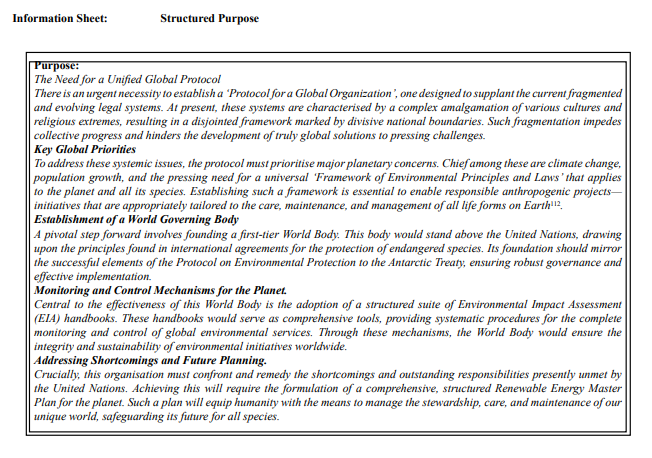
The Structure Plan to be subdivided to embrace the two main fields of responsibility namely: ‘Anthropogenic’ / ‘Non-Anthropogenic’’. The main Purposes are listed in Appendix 2, and must be absent of all influences of cultures, religions and unrealistic anthropogenic boundaries.
To embrace the present framework of the UNFCCC ‘Conference of Parties’(COP), and Biological Diversity (BD) of life on Earth (earthborn), at all levels – genetic, population, species, habitat, and ecosystem, it requires two main responsibility spines:
• for ESG governance principles to be legal framework for the anthropogenic side, and,
• the Biological Diversity framework for the legal services in CBD Convention.
The Global ‘Size’ and ‘Decision-Making Process’ to embrace the present structure, and performance, including all successes / failings:
Anthropogenic
Global Size: The COP is attended by all Countries that have signed and ratified the Convention, and 198 countries participated is one of the largest multilateral bodies recorded in the UN systems (1 Apr 2025). Immediately upon returning to ofice, President Trump initiated the withdrawal of the United States from the World Health Organization the Paris Climate Agreement, resulting in 197 Countries. (7 Jan 2026)
Decision Making Process: A Completely new approach is required, caused by the initial failure to reach the correct decision in 194716, and recent major failings of the UN Stewardship. (Period: 2022 / 26.)
Non-Anthropogenic: To embrace major environmental priorities
The Convention on Biological Diversity (CBD) signed by nations at the Earth Summit at Rio de Janeiro in Brazil on June 5, 1992, came into force on December 29, 1993.
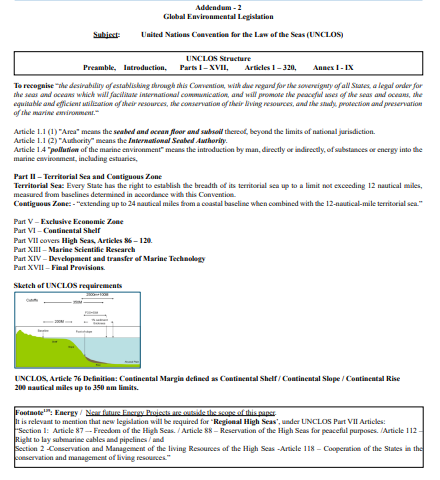
The 1982 United Nations Convention on the Law of the Sea (UNCLOS), which came into force on November 16, 1994, is an international treaty that provides a regulatory framework for the use of the world's seas and oceans, inter alia, to ensure the conservation and equitable usage of resources and the marine environment.
Earth’s Surface is covered by over 70% water, with the main boundary between land and water being defined as the coastal transition zone.
The atmosphere above the surface is controlled by earth’s environmental mechanisms through the radiant heat from the Sun. Pollution legislative controls demand careful legislature.
Global Atmosphere Management Structure Framework
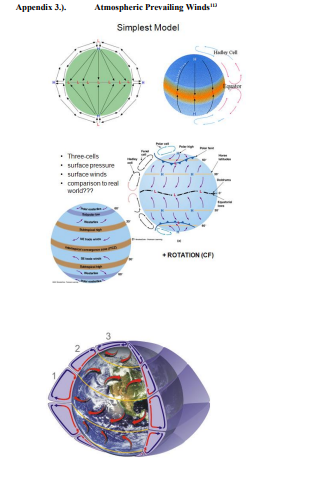
The environmental mechanisms17 on earth allows the air to rise at the equator and flow to the 30O latitudes, creating three cells for each hemisphere, (Hadley / Ferrel / Polar). [see Appendix 3 –Atmospheric Prevailing Winds.
A global atmospheric organizational plan proposes embracing Mans Science’s Fluid Mechanics18 to manage elastic fluids without boundary conditions in Earth's atmosphere. Legislation must be continent based to regulate air pollution between land masses, enabling effective legal processes. The framework to be governed through transitional coastal plan zones of the five20 main continents—two in the northern hemisphere and three in the southern hemisphere.
The importance of the boundary condition Coastal Transition Zone is paramount for anthropogenic reasons, to allow mankind to perceive a boundary condition tool, to be able to monitor / record / control the movement of elastic fluids in Earth’s atmosphere, and the main continents may be used for this environmental management plan.
The concept for integrated Coastal Zone Management (ICZM) was first introduced at the national policy scale in the Coastal Zone Management Act (CZMA) enacted by the Congress of the United States in 1972; Master Plans for regional coastal management around the globe then evolved and developed around the globe. A Convention on Coastal Management took place in the UK21 in September 2025, with the theme ‘Creating a Climate for Change’.
A Global ‘Environmental Coastal Management Plan Model’22 is now required for our unique planet, to embrace, develop and manage several important tasks including, Oceans Plastics Pollution / Ocean total renewable Energy facilities / Global Atmospheric Pollution (monitor, recording, controls) / Climate Change, as well as the Beaches, Rivers, Coastal areas normally identified.
Anthropology
Climate Change
The International Court of Justice (ICJ): On 23 July 2025, the ‘advisory opinion’ marks the first time that the ICJ, the United Nations’ principal judicial organ, has examined the international legal framework applicable to climate change.
The International Court of Justice (ICJ) opinion23 largely rejects the arguments put by major emitters of greenhouse gases (historical and current), including the UK. The 15 judges adopted an expansive interpretation of states’ obligations. Despite being non-legally binding, the advisory opinion has significant implications for national climate policies and international climate negotiations. It also opens new pathways for international and domestic litigation against governments.
This briefing presents the origins of the proceedings, summarises the ICJ’s key findings and outlines domestic and international reactions.
UN Failings
A major United Nations failing in 1947 may have resulted from their fragmented set of rules , stipulated under Article 27, which allows special status for the five Countries who created the Charter, and with the omission of linkage to proper legislative powers and lacking specialist primary courts endorsing correct decisions.
Indeed, the UN General Assembly prepared sound findings in 1947, with resolution 181(ii) for establishing Arab and Jewish States in Palestine, with an international regime in Jerusalem, yet this was never endorsed. These are two proud Nations, each with hundreds of years history, and unfortunately, the proud Palestinian people, who were under the Ottoman rule for over 400 years, did not receive any ‘State’ acceptance.
Recently in the last few years the UN authority has been totally ignored by members of the big 5, following the war in Ukraine, now in its 4th year, and the attacks on Iran by the USA and Isreal.
For these important failings, a new Global Organization is now urgently required, structured under a fresh approach to that of the UN Charter, with a different voting system to that under Article 27, together with a completely different decision-making process25. (See Appendix 1).
Specialised Courts
There is a relatively long history of criticism of the existing arrangements for access to justice on environmental matters in the UK26. However, Environmental Courts and Tribunals are now found on every inhabited continent, under democratic and nondemocratic regimes, in rich developed nations and the poorest least developed nations alike27.
“The judiciary has a role to play in the interpretation, explanation and enforcement of laws and regulations. … Increasingly, it is being recognized that a court with special expertise in environmental matters is best placed to play this role in the achievement of ecologically sustainable development.”28
New Zealand have adopted environmental courts for several years. which involves their Resource Management Act 1991. The court largely deals in matters which involves the Resource Management Act 1991. The court largely deals with appeals about the contents of regional and district plans and appeals, arising out of applications for resource consents the Environment Court sits in several courthouses in different parts of the country.
Environmental Harm, Embracing Climate Change
Air Pollution
UK Air pollution legislation has evolved over the last 30 years with Part 1 of the EPA 1990 seeking prevention of Air pollution through permit-based control, leading to the Environmental Permitting Regulations for England and Wales and progressive amendments. This was followed by the Clean Air Act 199329 to address vehicle emissions. The Environment Act 1995 created the establishment and operation for ‘GHG’ emissions trading scheme, embracing the importance of transboundary effects around the globe. After Brexit, the Environment Act 202130 recalled the importance of Air Quality and smoke control regulations in England and Wales.
Pollutants causing concern are carbon monoxide, nitrogen oxide and ozone . Fine particles in vehicle emissions, each less than 10 micrometres across, ‘PM10’, cause respiration problems by entry of chemicals into the lungs. Ozone at ground or at tropospheric levels is a highly corrosive pollution, based on reaction between sunlight / NO2 / volatile organic compounds (VOCs) causing summer problems in cities, and ‘photochemical smog’, comprising micro particles of VOCs/ NOx.
The Secretary of State’s Guidance Note 6/9 (04)31 issued conditions for emissions into the air and guidance on Best Available Techniques (BAT) not entailing excessive cost.
Defra’s ‘Air Pollution in the UK 2019’33 was issued in September 2020, as the UK was required to report air quality data on an annual basis under various34 EU Directives. The Report provides background information on pollutants covered by various EU Directives and UK’s Air Quality Strategy: covering the sources / effects / monitoring networks / UKs modelling methodology. The pollutants covered in the report are SO2 / NO/ NO2 /PM10 & PM2.5 particles/ Benzene/ 1,3-Butadiene CO / Metals/ PAH/ O3.
Sulphur dioxide is another major pollutant produced by chemical plants and not effectively controlled under earlier legislation of the 1950s. The method of control was to discharge at height over the surroundings which dispersed over a wide area and fell as acid rain harming freshwater and terrestrial ecosystems in UK and beyond into Europe indicating incompleteness.
The earth’s wind pattern forces35 change, North / South, at 30o and 60o latitudes along ‘fronts’, while rotational deflections travel great distances around East / West hemispheres in what is called the ‘Coriolis’36 effect over the surface, spreading man’s pollution. Careful global organization from all cultures is now urgently required. Reference Appendix 3.
The fragmented progress of UK Air Pollution legislation has lacked structure and remains incomplete, also lacking any unified co-ordinated directive from the global stage. It is now essential to restructure an intelligent approach towards setting out a UK structured framework for ‘air pollution’ controls based upon ‘common but differential responsibility’.37
Water Pollution
The EU ‘Water Framework Directive’ (WFD) is a complex and particularly elaborate measure which is unusually difficult to understand’.38 In the case C-461/13 Bund fur Umwelt und Naturschutz Deutschland, Advocate General Jaaskinen said ‘The WFD is a complex and particularly elaborate measure which is unusually difficult to understand’.
However, the EU WFD does cover all the main aspects relating to Water Pollution control.
In the UK, the Water Framework Directive (WFD) regulatory controls were transposed in 2003 and updated in 201740. It focuses target performance41 (for member states) to undertake to achieve ‘good status’42, whereas regulatory controls based on specification standards to harness nutrient controls appears to be the preferred choice for ‘protecting the water, soil and air.43
Agricultural Pollution
After Brexit there is an opportunity for UK policy and regulatory control to give greater emphasis to specification and process standards, followed by performance targets, through a clearer programme of measures44 for ‘River Basin Management Plans’ (RBMP) for nutrient control defined standard levels.
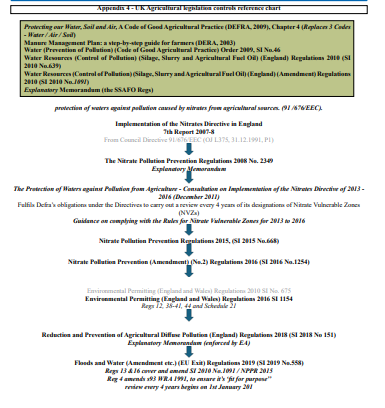
A comprehensive updated co-ordinated planned framework is required to embrace the ‘UK Implementation of the Nitrates Directive in England’. This, with the follow up ‘Explanatory Memorandum’ of NPPR 200846 and ‘Consultation Guidance’47, together with ‘several important Nitrate Pollution Regulations' (NPPR 201648, RPADPR 201849, FW (EU Exit) R 201950).
Following exit from the EU, an approach to reference these important pieces of legislation in a ‘reference Chart for environmental legislation for agricultural nutrient controls chart’ would be a useful tool, Reference, Appendix 4 – Agricultural Legislation Controls Chart51. This coordinated structure plan approach requires as a starting point a particular ‘environmental impact analysis tool mechanism for managing UK Water Pollution’ which would embrace a UK Common Agricultural Policy (CAPUK), good agricultural and environmental conditions for UK farms (GAECUK)52
Plastics Pollution
The ‘Resolution adopted by the United Nations Environment Assembly’ on 2 March 2022, to ‘End plastic pollution’53, recalled the United Nations Environment Assembly resolutions 1/6, 2/11, 3/7, 4/6, 4/7 and 4/9.
They affirmed the urgent need to strengthen global coordination, cooperation and governance to take immediate action towards the long-term elimination of plastic pollution in marine and other environments, and to avoid detriment from plastic pollution to ecosystems and the human activities dependent on them54.
“The Intergovernmental Negotiating Committee to develop an internationally legally binding instrument on plastic pollution, including in the marine environment”, noted with concern the high and rapidly increasing levels of plastic pollution, including in the marine environment.55
The draft ‘Chair’s Text’56, stated, in December 2024, the objective of this Convention is to protect human health and the environment from plastic pollution.57
Major quantities of plastic accumulate in our Oceans, particularly in huge subtropical oceanic areas called gyres. – these are massive circular currents that trap floating debris for decades. [See, Appendix 5 – File Note: Plastic Pollution.]
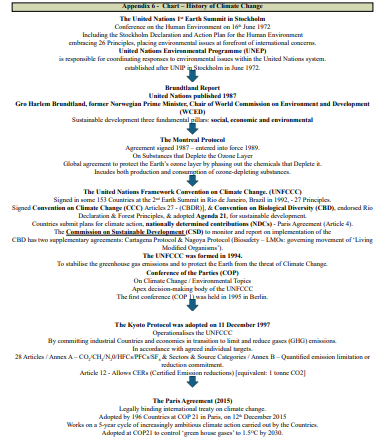
Climate Change [Reference Chart on History of Climate Change]
Over a decade ago, the UK put into force the Climate Change Act (CCA) 200858, setting targets for a reduction of Greenhouse Gases by 2050, to provide for a system of carbon budgeting59 for the purpose of limiting GHG from the atmosphere. The Act established ‘The Committee on Climate Change’60 (CCC) to assist in ‘carbon management’, to monitor, advise and report with ‘carbon budgets’ and on ‘monitoring / control’ procedures towards the ‘2050 target’ 61 for reduction of GHG.
Under general ancillary powers62 the committee may exercise its duties to take action to ensure it carries out its functions under the guidance of National Authorities and the Secretary of State. The British Standards Institute (BSI) fast tracked their Specification for ‘Carbon management in Infrastructure’63 in May 2016, to enable accuracy, transparency, consistency, relevance and completeness of carbon management and GHG emissions quantification. The scope of PAS 2080 is about Carbon management as part of wider climate change mitigation; it is not about wider environmental or sustainability issues64.
Under the specification the management of ‘whole life carbon’ in UK infrastructure is defined as embracing the ‘transport’, ‘energy’, ‘water’, ‘waste’’ and ‘communication’ sectors65, and the management services covers the assessment, removal and reduction of GHG emissions measured as ‘carbon dioxide equivalent’, which relates and covers for the 6 gases quoted in the Kyoto protocol66.
The methodology control procedures for the ‘practitioner’ calculating Infrastructure GHG emissions, is covered in the specification,67 which were responsible for over half of the UK’s GHG consumption in 2010 emissions, a total: 981 million tonnes Mt CO e68 and a programmed emissions target of 178 Mt CO e 2 2 3.. in 2050. CO2e is a unit for comparing the radiative forcing of a greenhouse gas to carbon dioxide69 and is calculated using the mass of a given GHG multiplied by its global warming potential. ‘GWP’ which is the factor describing the radiative forcing impact of one mass-based unit of a given greenhouse gas relative to an equivalent unit of CO2 over a given period70. In 2019 the Climate Change Committee (CCC) Report, ‘Net Zero - The UK’s contribution to stopping global warming’ 71, led to the (CCC) committing the UK Government by law to reduce greenhouse gas emissions by at least 100% of 1990 levels by 2050, which relates to ‘net zero’.
The ‘Office of Environmental Protection’72 (OEP) is responsible for Environmental governance, including environmental targets, environmental improvement plans, environmental monitoring and importantly to embrace compliance with the five main environmental principles73 recorded in the Environment Act 2021.
Following Brexit, and the one-year transition period, the ECJ responsibility as the supreme court in UK ceased. This is now the opportunity for the UK to set out a new structure plan framework for climate change, based on CCA 2008 and augmented to include relevant latest global ‘climate change’ targets all as set out under the UNFCCC on climate change74. It is important to ensure comprehensive environmental analysis on climate change is included in a suite of EIA handbooks.
Deep Sea Mining Debate

The International Seabed Authority (ISA)75 is the regulating body that controls and grants exploration licences.
In April 2025 U S A President Trump signed executive orders instructing the National Oceanic and Atmospheric Administration, to allow permits for Companies to mine in International and US waters, under the 1980 Deep Seabed Hard Minerals Resource Act.
In July 2025, a request was made for the ISA Secretariat to investigate whether deep-sea mining companies applying for licenses and permits under the United States' mining code are at risk of violating existing ISA exploration contracts76. UNCLOS prohibits mining activities, and mining companies may have their exploration contracts revoked, if found to have violated such action, and this may prevent mining companies from carrying out such mining in international waters.
The International Seabed Authority (ISA) was set up by the U.N. in 1994, and the organization granted the first license for exploring polymetallic nodules to our subsidiary Nauru Ocean Resources Inc. (NORI) in 201177. The Metals Company now holds certain rights to exploration contracts granted by the ISA through two subsidiaries: NORI, sponsored by the Republic of Nauru; and TOML, sponsored by the Kingdom of Tonga78.
Potential climate impacts: The ocean is the world's largest carbon sink, absorbing around 25% of all carbon dioxide emissions79. Microscopic organisms play a critical role in this climate-regulating system, helping to sequester carbon in the deep sea and reduce emissions of other planet-warming gases (such as methane) from seabed sediments. The loss of deep-sea biodiversity following mining activity could impact the ocean's carbon cycle and reduce its ability to mitigate the global temperature rise.
While the deep sea was at one time considered to be devoid of life80, we now know that it is the largest habitable place on the planet and home to an awesome array of species81. Indeed, there are thousands of species already identified, and, in the Clarion-Clipperton Zone, which is a key area of interest for deep-sea mining, researchers have recently identified thousands more species that were entirely new to science.82
Social and governance risks: When extraction occurs offshore, deep-sea mining industry will need shoreline facilities for processing and trans-shipment of material. This must be embraced in a global Coastal Management Plan.
This Science Brief on Deep-sea Mining83 (DSM) covers an introduction to the technology, a discussion of recent developments, direct and indirect risks of mining on the seabed, and key considerations. DSM involves extracting minerals from the ocean. These resources are critical for renewable energy technologies, fuelling growing interest in commercial exploitation.
Non-Anthropogenic Priorities
UNCLOS
The United Nations (UN) Convention on the Law of the Sea was signed84 in December 1982 and its present separate legalised marine areas are Internal Waters, Territorial Sea, Contiguous zone, Exclusive Economic Zone85 and the High Seas, at present 72% of earth’s surface. It is the transitional zone boundary condition between land and sea. It is an international framework that governs the use on management of the world’s oceans, including navigation rights, territorial waters and resource exploitation, and is crucial for maintaining security, environmental protection, and fair resource sharing among nations.
UNCLOS86 had been ratified by 168 parties (167 States less Palestine), as well as the UN and the Cook Islands and Niue (Appendix 3). The United States, one of the big 5, objected to Part XI of the Convention on several grounds, arguing that the treaty was unfavourable to American economic and security interests.
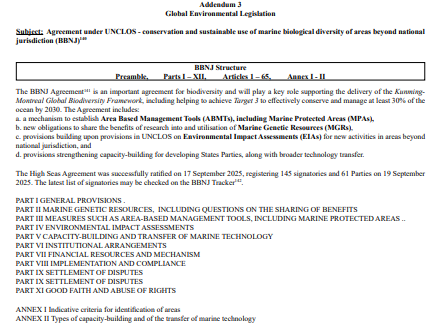
The High Seas Treaty87: (BBNJ): The Agreement Under the United Nations Convention on the Law of the Sea, on the Conservation and Sustainable use of Marine Biological Diversity of Areas Beyond National Jurisdiction. It was open for signature by all States and regional economic integration organizations, under the fast-track ratification process88 from 20 September 2023 to 20 September 2025 and entered into force on 17 January 2026.
It is a legally binding instrument for the conservation and sustainable use of marine biological diversity of areas beyond national jurisdiction.
Coastal Zones
The concept for Integrated Coastal Zone Management (ICZM) was first introduced at the national policy scale in the Coastal Zone Management Act (CZMA), enacted by the Congress of the United States in 1972.
In UK, Coastal resource management (CRM) is one of the major strategies to address the varied, wide-ranging and often interconnected issues that impact coastal areas. One such strategy around the UK coastal area is termed a Shoreline Management Plan, and England alone has twenty89 SMPs.
An SMP provides a management policy for a section of the coast defined by the geography of the area and coastal processes, 4 typical aims for: Hold the Line, Managed Realignment, No Active Intervention and Advance the Line. Other important strategies are to reduce the risk of flooding in identified areas, dissipate wave energy wherever necessary and hold back waves.
Soft Engineering Coastal Management techniques adopt ‘Soft engineering works in tandem with nature’, and these include maintaining mangroves, forests to mitigate tropical storm impacts, and beach nourishment to enlarge a beach using sediment from other locations.
It is also important to identify Maritime zones and how they are determined90.
A Long-term sustainability Strategy is essential, and now urgent, to combat climate change and other harmful anthropogenic effects, which cause serious harm to the footprints of the continental shelves, their margins and the less saline coastal waters91. A Global Environmental Coastal Structure Plan is required to embrace all climatic and anthropogenic effects, and most important, to include for measures to accommodate the near future infrastructure projects92 for the harnessing of the massive quantities of kinetic energy resulting from the perpetual motion of earth’s oceans.
Biodiversity Convention
The Convention on Biological Diversity (CBD) endorsed the Rio Declaration & Forest Principles, and adopted Agenda 2193, for sustainable development, which was an integral part of the 2nd Earth Summit in 1992. At this summit, the United Nations Commission on Sustainable Development (CSD) was established by the UN General Assembly to ensure effective follow-up of the United Nations Conference on Environment and Development (UNCED).
The United Nations Framework Convention on Climate Change (UNFCCC) was formed in 1994, to stabilize the greenhouse gas emissions and to protect the earth from the threat of Climate Change. The Conference of the Parties (COP) followed, as the UNFCCC Apex decision-making body, under two distinct limbs:
• [COP – Biodiversity]: CSD Strategy meets in two-year cycles, to monitor and report on the implementation of the CBD. This includes two supplementary agreements: Cartagena Protocol & Nagoya Protocol, embracing Biosafety and LMOs (governing movement of Living Modified Organisms).
• [COP – Climate Change]: In 1995 the first ‘Conference of the Parties’ (COP 1) commenced on an annual basis to fully monitor, discuss, evaluate, evolve and plan on matters of Climate Change and all Environmental Topics.
The evolving UN approach towards discussions to cover all forms of life from microscopic viruses to the largest living species, was targeted at COP15 for Kunming, China. Due to the protracted delays associated with COVID19 pandemic, it was split in two parts, and ended in Montreal Canada, on 19 December 2022 with the landmark agreement, known as the ‘Kunming Declaration’94. This was to guide local action on nature to 2030.
This UN Biodiversity Conference was Chaired by China and hosted by Canada, which had representatives from 188 governments in Montreal over the 2-week period, and resulted in the adoption of the Kunming-Montreal Biodiversity Framework (GBF).
COP15 [Biodiversity] aims to protect and restore the Earth’s biodiversity processes, such as the carbonaceous and nitrogenous cycles, which are not possible without a variety of organisms at every stage, while ecosystem services such as pollination and flood prevention are inextricably linked with life on Earth, as part of the biogeochemical mechanisms.
COP16 [Biodiversity] took place from 21st October to 1st November 2024, in Cali, Colombia, and was the first nature COP since the adoption of the Kunming-Montreal Global Biodiversity Framework95. COP16 had an ambitious agenda, covering a wide range of critical topics to halt and reverse biodiversity loss by 2030.
The Protected Planet Report 202496 is the first report to fully assess the global status of protected and conserved areas in the context of Target 397 of the Kunming-Montreal Global Biodiversity Framework.
Fragmented Environmental Legislation Unlike structured Contract Law, (such as FIDIC98), the ever-evolving environmental international law legislation regulations remain unconsolidated and lacking any structured framework. The approach to a structured framework of integrated Environmental Laws must lead the way, through a new specialised World Body Environmental Court, and must be exempt from the influences of present religious and cultural ideals.
Innovative Ideas / Methods for Longterm Sustainability Projects.
Global Long-term Sustainability Project (embracing environmental mechanisms):
At last, Man has the knowledge to develop new innovative methodologies required to harness earth’s natural energy resources99. Vast kinetic energy reserves are available in the high seas, which cover over 70% of the surface of earth.
An early example of Man’s Innovative ideas, was recorded in the late 60s, following research work into ‘fluid mechanics’ relating to ‘thick liquids’ for municipal sewage sludges.
Research studies100 were successfully carried out on site101 to ascertain the effective range of ‘kinematic viscosity’ of ‘thick liquid’ municipal sludges, embracing the importance of ‘boundary conditions’, and ‘shear stress’ mechanisms within a fluid (Table I. The kinematic viscosity of water was recorded at 0.000012 ft2/ sec. See Table 1.
A research paper102 was presented to the UK, Institution of Civil Engineers in 1971 and awarded recognition in July 1972. The results were adopted in the Leicester City Corporation’s Sludge Disposal Project design works, to replace temporary facilities with a permanent structure, adjacent to their Compost Plant, and was successfully completed in 1970.

Range of Kinematic Viscosity values for Municipal Sludge
– Wanlip STW Sludge Project, 1971
(Imperial Units)
Table 1
Following ratification of the ‘Biodiversity Before National Jurisdiction’ (BBNJ)103 Agreement, important amendments to legislation are now required to additional methodologies for harnessing the natural kinetic energy storage in the Regional High Seas.
New legislation must include the regional areas of the High Seas for coastal nations, and to be linked to UNCLOS ‘high seas sections’104, to embrace the methodologies for harnessing natural kinetic energy storage zones, using environmental mechanisms related to elastic fluid mechanics.
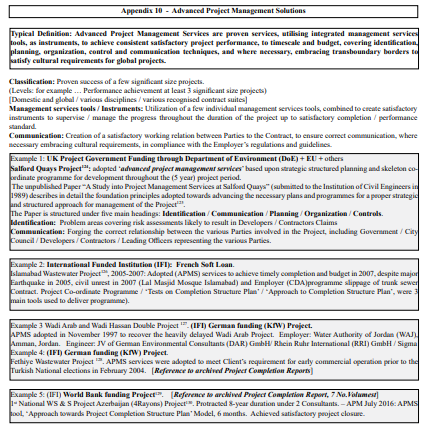
Advanced Project Management Services Solutions (APMS)105
[APMS] Proven projects are those which have been completed to satisfactory performance levels both in the UK, and Internationally, and carried out under Contract Law procedures, with the use of ‘advanced project management services’ solutions (APMS), in line with and supported by fiscal government policy, which may be defined as:
“Advanced Project Management Solutions (APMS) are an integrated set of project management tools, which have been used in an integrated and co-ordinated way and proven on several major Projects to achieve good performance standards over several years. See Appendix 10.
Summary: The Way Forward106
A Global Environmental Structure Plan must now be set out and established for our common future, to enable near future anthropological Total Renewable Energy Projects to be built, as the bridge for future generations, to achieve successful long-term sustainability.
A structured framework of integrated Environmental Laws must lead the way to meet the challenge of ‘climate change’ and all other adverse conditions harmful to our environment. The approach to be through a new specialised World Body Environmental Court, to be exempt from the influences of present religious and cultural ideals.
A Comprehensive Management Structure system to be set out to co-ordinate and develop all anthropogenic Projects. Integrated Strategic Plans and Programmes to be adopted, together with proven ‘advanced project management solutions.
A comprehensive Suite of Handbooks to be developed to manage the strategic ‘Environmental Impact Assessment’ (EIA) process, to tackle climate change and other adverse harmful effects on the environment.
A lead Tier Global Organization to be set out and developed for the care, maintenance and protection of Earth. To be developed based on five main Continents, for peaceful purposes, without religious / cultural influences.
A new structured ‘Coastal Management Master Plan’ to be developed for all continents, to tackle pollution, together with embracing the boundary conditions for the vast total green renewable energy supplies available in, on and under the ‘High Seas’ and Oceans. ‘Long-term sustainability’ to be the principal target.
For the UK, as an Island State, a ‘Total Renewable Green Energy Plan’ to be developed to embrace ‘Ocean Energy’, include Tidal Energy, and to be included within the present ‘British Energy Security Strategy’ for long-term Sustainability.
Present Water Pollution policy in the UK needs to address and include for improvement to present Agricultural Legislation Control procedures, as present run-off control procedures within the Rivers Basins areas requires major change.
The global atmospheric organizational plan to propose embracing Mans Science’s ‘Fluid Mechanics’ to manage ‘elastic fluids’ without boundary conditions in Earth's atmosphere. Legislation to be continent based to regulate air pollution between land masses, enabling effective legal processes to be legislated.
List of Appendices
• Appendix 1: Facts Sheet: United Nations Charter
• Appendix 2: Information Sheet: Structured Purpose
• Appendix 3: Atmospheric Prevailing Winds
• Appendix 4: Agricultural Pollution
• Appendix 5: Plastic Pollution
• Appendix 6: History of Climate Change
• Appendix 7: Kunming Declaration
• Appendix 8: Protected Planet Report 2024
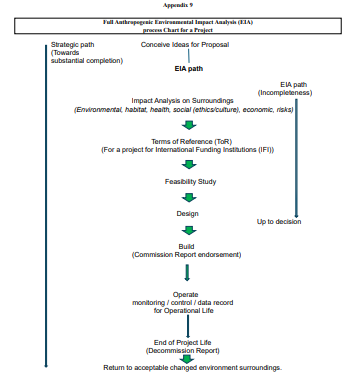
• Appendix 9: Full Anthropogenic Environmental Impact Analysis (EIA) process Chart
• Appendix 10: Advanced Project Management Solutions. (APMS)
Addendum
Global Environmental Legislation
• Incompleteness of EIA Regulations (EIA).
• United Nations Convention for the Law of the Seas (UNCLOS).
• The Agreement under UNCLOS on the conservation and sustainable use of marine biological diversity of areas beyond national jurisdiction (BBNJ).
• Protocol on Environmental Protection to the Antarctic Treaty.
Appendix No. 1
Facts Sheet: United Nations Charter107.
Purposes and Principles. The Charter of the United Nations is the treaty that established the United Nations, and includes the Purposes and Principles, membership, and organs of the United Nations, among other things. The Charter has 19 chapters and 111 articles, in which Articles 7, 8, 97, 98, 100, 101 and 105 relate to human resources.

Article 1 (Ch 1)
The Purposes of the United Nations are:
1. To maintain international peace and security, and to that end: to take effective collective measures for the prevention and removal of threats to the peace, and for the suppression of acts of aggression or other breaches of the peace, and to bring about by peaceful means, and in conformity with the principles of justice and international law, adjustment or settlement of international disputes or situations which might lead to a breach of the peace;
2. To develop friendly relations among nations based on respect for the principle of equal rights and self-determination of peoples, and to take other appropriate measures to strengthen universal peace.
3. To achieve international co-operation in solving international problems of an economic, social, cultural, or humanitarian character, and in promoting and encouraging respect for human rights and for fundamental freedoms for all without distinction as to race, sex, language, or religion; and
4. To be a centre for harmonizing the actions of nations in the attainment of these common ends.
Article 2 (Ch 1)
The Organization and its Members, in pursuit of the Purposes stated in Article 1, shall act in accordance with the following Principles.
1. The Organization is based on the principle of the sovereign equality of all its members.
2. All Members, to ensure to all of them, the rights and benefits resulting from membership, shall fulfil in good faith the obligations assumed by them in accordance with the present Charter.
3. All Members shall settle their international disputes by peaceful means in such a manner that international peace and security, and justice, are not endangered.
4. All Members shall refrain in their international relations from the threat or use of force against the territorial integrity or political independence of any state, or in any other manner inconsistent with the Purposes of the United Nations.
5. All Members shall give the United Nations every assistance in any action it takes in accordance with the present Charter and shall refrain from giving assistance to any state against which the United Nations is taking preventive or enforcement action.
6. The Organization shall ensure that states which are not Members of the United Nations act in accordance with these Principles so far as may be necessary for the maintenance of international peace and security.
7. Nothing contained in the present Charter shall authorize the United Nations to intervene in matters which are essentially within the domestic jurisdiction of any state or shall require the Members to submit such matters to settlement under the present Charter; but this principle shall not prejudice the application of enforcement measures under Chapter Vll.
Article 23: The Council is composed of 15 Members: Five permanent members: China, France, Russian Federation, the United Kingdom, and the United States, and ten non-permanent members elected for two-year terms by the General Assembly (with end of term year): Bahrain (2027)
Article 27, Voting
Each member has one vote.
Decision of security council – affirmative vote of nine members.
Members to be ‘Big 5’: China, France, (Russian Federation), United Kingdom, USA
Council composed of 15 members
Article 55 charges the United Nations to promote respect for and observance of universal human rights for all. Article 56 charges each member nation to help the UN to achieve goals set forth in Article 55.
Article 99 is a rarely used clause in the UN Charter that states that “The Secretary-General may bring to the attention of the Security Council any matter which in his opinion may threaten the maintenance of international peace and security” (emphasis).13 Feb 2024
Article 100: (Office of Legal Affairs)109
Each Member of the United Nations undertakes to respect the exclusively international character of the responsibilities of the Secretary- General and the staff and not to seek to influence them in the discharge of their responsibilities.
1. In the performance of their duties the Secretary-General and the staff shall not seek or receive instructions from any government or from any other authority external to the Organization. They shall refrain from any action which might reflect on their position as international officials responsible only to the Organization.
2. Each Member of the United Nations undertakes to respect the exclusively international character of the responsibilities of the Secretary-General and the staff and not to seek to influence them in the discharge of their responsibilities.
UNITED NATIONS STRUCTURE
The secretary-general, appointed by the General Assembly's 193 member states, serves as the chief administrative officer of the United Nations. Common responsibilities include making appointments to UN posts, overseeing peacekeeping missions, mediating conflict, and coordinating UN responses to global emergencies.
The permanent members of the United Nations Security Council ( known as the Permanent Five, Big Five, or P5) are five sovereign states to whom the UN Charter of 1945 grants a permanent seat on the UN Security Council: China, France, Russia, United Kingdom, and United States.
Countries who presently are not in the UN. The United Nations has 193 members among the 197 states it recognizes. While the Vatican and the Palestinian State are 'only' observers, the Cook Islands and Niue (embraced by New Zealand.).
The work of the United Nations covers five main areas:
• Maintain International Peace and Security.
• Protect Human Rights.
• Deliver Humanitarian Aid.
• Support Sustainable Development and Climate Action.
• Uphold International Law.
To be read in conjunction with the Statute of the International Court of Justice
Main Bodies of the United Nations111
Appendix 2.
Appendix -5 File Note
January 2025
Subject: ...........................................Plastic Pollution
History:
Plastic was first developed in mid-19th Century = replacement for natural materials such as ivory and tortoiseshell.114
1st Synthetic plastic, called celluloid. – created by John Wesley 1869. First produce photographic film, later consumer products: combs, buttons, billiard balls, etc.
Early 20th Century, invention Bakelite. This paved the way for mass production of plastic products.
Plastic packaging became most visible use of plastic in our daily lives. Environmental Impact. Can take hundreds of years to decompose. Plastic in Food and Beverage Industry. -keep food fresh and prevent spoilage.
Ocean Plastics.
Nearly half plastic sinks because of low buoyancy.
Other half floats – majority does not go far out to sea. 80% beach on coastline within month.
HDPE likely to travel long distances.
Plastic accumulates in huge subtropical oceanic areas called gyres. -massive circular currents that trap floating debris for decades.
5 gyres in our oceans. Great Pacific Garbe Patch(GPGP) , in North Pacific, between Hawaii & California. (Estimated twice size of Texas.)
Around 100 million kilograms of plastic estimated in (GPGP)- 1.8 trillion pieces larger than 0.5 mm. About 8% of the mass is microplastics.
Definition: Microplastics are plastic pieces that measure less than five millimetres across. (Some microplastics have formed by breaking away from larger plastics that have fragmented over time. Others have been made small intentionally, for example cosmetic microbeads used in facial scrubs.)
Reference: Conventions & Assemblies:
United Nations Environment Assembly of the United Nations Environment Programme
UNEP/EA.5/Res.14
Distr.: General 7 March 2022
‘Intergovernmental Negotiating Committee to develop an international legally binding instrument on plastic pollution, including in the marine environment’
1 December 2024
CHAIR’S TEXT1
Plastics. In the Ocean:
https://noc.ac.uk/under-the-surface/ocean-plastics
Appendix 7 Kunming Declaration115
Declaration from the High-Level Segment of the UN Biodiversity Conference 2020 (Part 1) under the theme:
“Ecological Civilization: Building a Shared Future for All Life on Earth”
(Final Draft)
The final draft includes 16 Principal points (PP), embracing Target 3116: “That biodiversity, and the ecosystem functions and services it provides, support all forms of life on Earth and underpin our human and planetary health and well-being, economic growth and sustainable development,” to Conserve30% of land, Water and Seas.
The Declaration is ‘Concerned’ that the ongoing loss of biodiversity jeopardizes achievement of the Sustainable Development Goals and other international goals and targets, and is Acknowledging with grave concern that the unprecedented and interrelated crises of biodiversity loss, climate change, land degradation and desertification, ocean degradation, and pollution, and increasing risks to human health and food security, pose an existential threat to our society, our culture, our prosperity and our planet,
The Ministers and other heads of declarations, duly declare that putting biodiversity on a path to recovery is a defining challenge of this decade, in the context of the UN Decade of Action for Sustainable Development, and Commit to 17 declarations of performance.
Conserve 30% of Land, Waters and Seas117 to ensure and enable that by 2030 at least 30 per cent of terrestrial, inland water, and of coastal and marine areas, especially areas of particular importance for biodiversity and ecosystem functions and services, are effectively conserved and managed through ecologically representative, well-connected and equitably governed systems of protected areas and other effective area-based conservation measures, recognizing indigenous and traditional territories where applicable, and integrated into wider landscapes, seascapes and the ocean, while ensuring that any sustainable use, where appropriate in such areas, is fully consistent with conservation outcomes, recognizing and respecting the rights of indigenous peoples and local communities, including over their traditional territories.

Appendix 8 – Protected Planet Report 2024.
The Protected Planet Report 2024118 is the first report to fully assess the global status of protected and conserved areas in the context of Target 3 of the Kunming-Montreal Global Biodiversity Framework. The report brings together the latest official data reported by governments and other stakeholders to the Protected Planet Initiative.
This decade marks the make-or-break moment for the health of the planet. In December 2022, Parties to the Convention on Biological Diversity reached a historic agreement to halt and reverse the unprecedented loss of biodiversity through the adoption of the Kunming-Montreal Global Biodiversity Framework. It calls upon governments, businesses and society to take urgent action by 2030 to end the biodiversity crisis.
Two years on, the Protected Planet Report 2024 provides the first official global evaluation of progress towards one of the Framework’s 23 targets – Target 3.
The aim of Target 3 is to expand the global network of protected and conserved areas to 30% coverage in a way that is equitable and that respects the rights of Indigenous Peoples and local communities119.
Cali, 28 October 2024 – The international community has made some headway on pledges to protect 30% of the Earth by 2030 but progress must accelerate, the official progress report from the UN Environment Programme World Conservation Monitoring Centre (UNEP-WCMC) and the International Union for Conservation of Nature (IUCN) has found120.
The Report reveals that 17.6% of land and inland waters and 8.4% of the ocean and coastal areas globally are within documented protected and conserved areas121.
Strongest progress since 2020 has been in the ocean, but most of this has been in national waters. In areas beyond national jurisdiction, coverage remains very low, accounting for less than 11% of the total area covered by marine and coastal protected areas. This is despite the fact that the high seas cover 61% of the ocean122.
The two remaining elements of Target 3, for which indicators have not yet been defined in the monitoring framework (or proposed since its adoption): “integrated into wider landscapes, seascapes and the ocean”; and “ensuring that any sustainable use, where appropriate in such areas, is fully consistent with conservation outcomes”123.

Global Environmental Legislation
Addendum 1
Subject: Incompleteness of EIA Regulations (EIA)
____________________________________________
Reference: The UK Town and Country Planning (Environmental Impact Assessment) Regulations 2017131, came into force on 16 May 2017
The path inherited for the EIA process starts at its conception and is analysed in defined steps through to the completion of the decision process for the anthropogenic project132. The construction period, its operational life, the important decommissioning process, its closure and a return to an acceptable environmental footprint, remain at present incomplete parts of the regulations133.
Changes will require a new Amendment for EIAR 2017 / 2018 to be triggered under EA 2021 containing aspects of new environmental law253 through the Office for Environmental Protection, and to involve the relevant Minister254 (EA 2021 s40). The restructure to require a sequential order for all Parts and to embrace provisions under CCA 2008, with additions as134:
Records and procedures during construction Works and Operational Life:
• Duty to record commencement date of construction works.
• Monitoring and reporting during the construction period
• Periodic reporting and submission of carbon emissions through construction period135
• Duty to keep records of all tests on completion.
• Availability of record drawings
• Carry out commissioning where appropriate.
• Submission to local authority of project completion report
• Duty to issue set of Operation and maintenance Manuals where appropriate.
• Duty to issue Hand-Over Report for commencement of commercial operation
• Duty to set out annual timetable for preparation for all records covering maintenance procedures and carbon equivalent emissions.
• Duty to submit regular carbon equivalent emissions to appropriate authority body.
Procedures for Decommissioning and End of Project Life
• Duty to prepare and carry out Decommissioning of project when and as required.
• Duty to carry out, prepare and submit carbon emissions136 for ‘operational’ life records.
• Submittal of Project records to appropriate authorities.
• Preparation of ‘end of life’ Brownfield Site Land Report to local authority.
Procedures for climate change requirements.
• Duty to be in compliance with the requirements of CCA 2008137
• Duty to prepare proposals for meeting the carbon targets.
• Duty to reach set carbon target and carry out carbon budgeting138
• Duty to submit to the appropriate authority amount of greenhouse gases emitted, expressed as CO2e.
Schedule 5: Decommissioning, ‘end of project life and return to environmental footprint’.
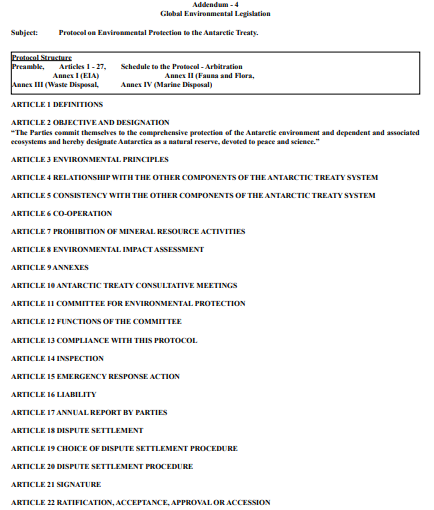
ARTICLE 23 ENTRY INTO FORCE
ARTICLE 24 RESERVATIONS ARTICLE 25 MODIFICATION OR AMENDMENT
ARTICLE 26 NOTIFICATIONS BY THE DEPOSITARY
ARTICLE 27 AUTHENTIC TEXTS AND REGISTRATION WITH THE UNITED NATIONS
SCHEDULE TO THE PROTOCOL. ARBITRATION, Articles 1-13
Bibliography
Table of Legislation / Conventions
1. World Commission on Environment and Development (WCED), Brundtland Report, 1987
2. 2nd Earth Summit, United Nations Framework Convention on Climate Change (UNFCCC), Rio de Janeiro, June 1992, comprising 27 Articles and Principles
3. 1st Earth Summit, Stockholm 1972
4. AGENDA 21: United Nations Conference on Environment & Development Rio de Janeiro, Brazil, 3 to 14 June 1992
5. Environmental Protection Act 1990, (EPA 1990) UK Public General Acts. 1990 c 43
6. United Nations Conference on Environment and Development (UNCED), Rio de Janeiro, 3-14 June 1992
7. Clean Air Act 1993, UK Public General Acts, 1993, c 11
8. Environment Act 2021, UK Public General Acts, 2021 c 30
9. The Water Framework Directive (WFD; 2000/60/EC)
10. Water Environment (Water Framework Directive) (England and Wales) Regulations 2003, SI 2003 No. 3242
11. Water Environment (Water Framework Directive) (England and Wales) Regulations 2017, SI 2017, No. 407
12. Implementation of the Nitrates Directive in England, 7th Report 2007-8
13. Council Directive 91/676/EEC (OJ L375, 31.12.1991, P1)
14. The Nitrate Pollution Prevention Regulations 2008 No. 2349
15. Reduction and Prevention of Agricultural Diffuse Pollution (England) Regulations 2018 (SI 2018 No. 151)
16. Floods and Water (Amendment etc.) (EU Exit) Regulations 2019 (SI 2019 No. 558)
17. Climate Change Act 2008, UK Public General Acts, 2008, c 27
18. Environment Act 2021, UK Public General Acts, 2021, c 30
19. UNFCCC, United Nations, FCCC/INFORMAL/84, GE.05-622200 (E) 200705
20. Agreement under the United Nations Convention on the Law of the Sea on the Conservation and Sustainable use of marine biological diversity of areas beyond National Jurisdiction (BBNJ), New York, 20 September 2023. Presented to UK Parliament October 2023. [Entered into force after ratification 17 January 2026.
21. Protocol on Environmental Protection to the Antarctic Treaty, signed in Madrid on October 1991, and entered into force in 1998 / Antarctic Act 2013, UK Public General Acts > 2013c. 15>
References
- EEZ’ extends 200 nautical miles (230 miles) beyond a nation’s territorial sea, which the nation’s jurisdiction extends.
- Kempton, R. " A Concept of Energy, embracing Earth's Environmental Mechanisms.
- “A Concept of Energy, Embracing Earth’s Environmental Mechanisms”, Prime Open Access, Journal of Rehabilitation Research Current Updated, 18 August 2025 / OPAST, World Journal of Forest Research-ISSN: 2994-5569, 11 August 2025/ GLINT Open Access, Journal of Environmental Dynamics and Geo-Sciences ISSN: 3069-8340, 9 February 2026 /SSRN, 30 July 2025
- Kempton, R. (2024). Approach Towards a Total UK Environmental Energy Master Plan for Clean Renewable Energy, Reviewing the Incompleteness of the British Energy Security Strategy after Brexit, and Embracing Tidal Waters and other Innovative Sources. Reviewing the Incompleteness of the British Energy Security Strategy after Brexit, and Embracing Tidal Waters and other Innovative Sources (May 17, 2024).
- Kempton, R. (2023). Restructuring of the Environmental Impact Process (EIA) AFTER Brexit for Incompleteness.
- Treaty, A. (1992). Protocol on environmental protection to the Antarctic treaty. Ministry of External Relations and Trade.
- 1st NWSSP(National Water Supply & Sanitation Project)- 4 Rayons Project 2008 - 2016, Employer; National Water Supply and Sanitation Authority (AZERSU), Baku Azerbaijan, Engineer: JV p2m berlin GmbH – GMR.
- 1st NWSSP(National Water Supply & Sanitation Project)- 4 Rayons Project 2008 - 2016, Employer; National Water Supply and Sanitation Authority (AZERSU), Baku Azerbaijan, Engineer: JV p2m berlin GmbH – GMR.
- 5 Continents: North America / South America / Euro Asia/ Africa / Antarctica. [ Northern Hemisphere 2 / SouthernHemisphere 3] A main finding of Protected Planet Report
- Agenda 21, Its aim initially was to achieve global sustainable development by 2000, with the "21" in Agenda 21 referring to the original target of the 21st century.
- Agreement under the United Nations Convention on the Law of the Sea on the Conservation and Sustainable use of Marine Biological Diversity of Areas Beyond National Jurisdiction, New York September 2023 [In force 17 September 2025]
- Appendix 7: The Kunming Declaration, Established at Biodiversity COP 15, December 2022
- Appendix 8: The Protection Planet Report, 2024, the first report to fully assess the global status of protected and conserved areas in the context of Target 3 of the Kunming-Montreal Global Biodiversity Framework.
- Article 2, “The Protocol on Environmental Protection to the Antarctic Treaty”1991, in force 1998, embracing 4 Annexes: EIA / Fauna and Flora / Waste Disposal / Marine Pollution.
- ASLO, Association for the Science of Limnology and Oceanography
- ASLO, ibid
- At that time literature and knowledge available was somewhat limited to movement of ‘thick liquids’ through circular pipes.Flow charts were readily available to the student or engineer, giving a variety of curves for flow through pipes of various roughness, age, and material.
- BBNJ - (Depository notification C.N. 447.2025. TREATIES-XXI. 10)
- BBNJ fast tracker,
- BBNJ,
- Pedersen, O. W., Bell, S., McGillivray, D., Lees, E., & Stokes,E. (2017). Environmental Law 9th ed.
- Bell S et al, The Water Framework Directive, Box ‘CONSIDER THIS’ p 626
- Cambridge University Press and assessment,
- Carbon Management in Infrastructure, PAS 2080: 2016, Construction Leadership Council, The Green Construction Board, British Standard Institute, (bsi), 9 Reporting 9.1, 9.2,9.3, 9.4, 9.5.
- Carbon Management in Infrastructure, PAS 2080: 2016, Construction Leadership Council, The Green Construction Board, British Standard Institute, (bsi)
- Charter of the United Nations and Statute of the International Court of Justice, San Francisco 1945, Chapter V, The Security Council, Voting, Article 27 (1) (2) (3).
- United States. President (1945-1953: Truman). (1945). The Charter of the United Nations with the Statute of the International Court of Justice Annexed Thereto: Address by the President of the United States Delivered Before the Senate on July 2, 1945 Presenting the Charter of the United Nations, with the Statute of the International Court of Justice Annexed Thereto: and a Message from the President of the United States Transmitting a Certified Copy of the Charter of the United Nations, with the Statute of the International Court of Justice Annexed Thereto US Government Printing Office.
- Clean Air Act 1993, UK Public General Acts, 1993, c 11
- Climate Change Act 2008, UK Public General Acts, 2008, c 27
- Climate Change Act 2008, UK Public General Acts, 2008, c 27, Part 1, Carbon budgeting 4,5,6,7,8,9,10.
- Convention on Biological Diversity, embracing Biodiversity Convention / Cartegena Protocol / Nagoya Protocol / Countries / Programmes
- Cross-Compliance under the Common Agricultural Policy: A possible mechanism for stronger standards
- David Hughes, Tim Jewell, Jason Lowther, Neil Parpworth, Paula de Prez, fourth edition, Further issues in atmospheric pollution, 548
- Deep-sea Mining, Secretary-General’s Scientific AdvisoryBoard,
- Department of Environment food and rural affairs (defra), Code of Good Agriculture Practice, 1st published 2009 ISBN 978 0 11 243284 5
- Department of Environment, Food and Rural Affairs (Defra),‘Air Pollution in the UK 2019’ published September 2020.
- Dr Jonathon Symons, The Lighthouse, Opinion of Dr Jonathon Symons, Associate Professor in Macquarie University’s School of International Studies.
- Drafted by the UN Special Committee on Palestine (UNSCOP)on 3 September 1947, the Plan was adopted by the UN General Assembly on 29 November 1947 as Resolution 181 (II)., -The UN recommended establishing Arab and Jewish states in Palestine, with an international regime for Jerusalem.
- Earthborn - Ecological Dominance Orientation (EDO), https://www.sciencedirect.com/science/article/pii/ S0272494422000287, “The roots of ecological dominance orientation: Assessing individual preferences for an anthropocentric and hierarchically organized world.”, Journal of Environmental Psychology, Elsevier, June 2022, 101783
- Environment Act 2021, UK Public General Acts, 2021 c 30, PART 4 Air quality and environmental recall s72 - schedule 11 - local air quality framework & s73 schedule 12 - smoke control in E&W
- Environment Act 2021, UK Public General Acts, 2021, c 30,Chapter 2, The Office for Environmental Protection, s 22 - 43
- Yanti Sulistiawati, L., Bouquelle, F., Lin, J., Lavrysen, L., Ortega, M., Pereira, R., & Tseng, S. (2022). Environmental courts and tribunals: A guide for policymakers. United Nations Environment Programme.
- Established at COP 15 in December 2022, under the theme “Ecological Civilisation: Building a Shared Future for All Life on Earth”.
- Uenal, F., Sidanius, J., Maertens, R., Hudson, S. K. T., Davis, G., & Ghani, A. (2022). The roots of ecological dominance orientation: Assessing individual preferences for an anthropocentric and hierarchically organized world. Journal of Environmental Psychology, 81, 101783.
- FIDIC, Structure of a FIDIC Contract, 25 November 2025>India>. https://www.legal500.com/ developments/thought-leadership/structure-of-a-fidic-contract/#:~:text=A%20typical%20FIDIC%20 contract%2C%20whether,Particular%20Conditions)%20 for%20each%20project.
- Floods and Water (Amendment etc.) (EU Exit) Regulations 2019 (SI 2019 No. 558)
- Global Environmental Organization Structure Plan. Appendix 1.
- GOV.UK, Explanatory Memorandum,
- Greater Irbid Sewerage and Sanitation Double Project, for Greater Irbid, Jordan, 1996-2001.
- https://legal.un.org › English › rep_supp3_vol4_art100
- https://www.cbd.int/gbf/targets/3#:~:text=Ensure%20and%20enable%20that%20by,representative%2C%20 well%2Dconnected%20and%20equitably
- Ibid, Executive Summary, paragraph 2.
- ICJ delivered an opinion, 23 July 2025, unanimous advisory opinion on the Obligations of States in Respect of Climate Change (PDF).
- Implementation of the Nitrates Directive in England, 7th Report 2007-8, from Council Directive 91/676/EEC (OJ L375, 31.12.1991, P1)
- Improvement / Refurbishment of Sewage Treatment Plant Phase-Ι,ΙΙ, Rehabilitation of Sewage Treatment Phase-ΙΙΙ and construction of new integrated Sewage Treatment Plant Phase-ΙV, 2004-2007; Employer: Capital Development Authority, Islamabad, Consultant: BCEOM International, Montpellier, France.
- Hindle, B. R., MORGAN, J., JOHNSTON, D., & KEMPTON,R. (1989). SALFORD DOCKS URBAN RENEWAL: DESIGN, CONSTRUCTION AND MANAGEMENT OF CIVIL ENGINEERING WORKS. Proceedings of the Institution of Civil Engineers, 86(6), 1067-1087.
- Intergovernmental Negotiating Committee to develop an international legally binding instrument on plastic pollution, including in the marine environment, 1 December 2024, Chair’s Text, Preamble.
- International Seabed Authority,
- Law of the Sea.
- Leicester City Corporation, Engineers Dept, Greyfriars, Leicester. lines 1-2 7
- Martínez, M. L., Intralawan, A., Vázquez, G., Pérez-Maqueo, O., Sutton, P., & Landgrave, R. (2007). The coasts of our world: Ecological, economic and social importance. Ecological economics, 63(2-3), 254-272.
- Met in Kunming Yunnan Province, People’s Republic of China, in person, and remotely, on 12 and 13 October 2021, on the occasion of the UN Biodiversity Conference, at the invitation of the Government of the People’s Republic of China.
- National Geographic, Learn with us. The Coriolis Effect: Earth’s Rotation and Its Effects on Weather
- Stark, C., Thompson, M., Andrew, T., Beasley, G., Bellamy, O., Budden, P., ... & Vause, E. (2019). Net Zero: The UK’s contribution to stopping global warming.
- Next Generation Methodology Approaches, page 7.
- Nitrate Pollution Prevention (Amendment)(No.2) Regulations 2016 (SI No. 1254)
- NOAA, ibid
- NOAA, E. N. D. S. (1996). National Oceanic and Atmospheric Administration (NOAA).
- Ward, B., & Dubos, R. (1972). Only one earth. The care andmaintenance of a small planet (pp. 304-pp).
- PAS 2080:2016, British Standard Institute Publicly Available Specification, Carbon Management in infrastructure, Construction Leadership Council, The Green Construction Board, 31 May 2016.
- Process Guidance Note 6/9 (04), Crown copyright 2004, defra, Scottish Executive, Welsh Assembly Government; (BATNEEC)
- Protected Planet Report 2024, Chapter 10 – Integration and Sustainable use.
- Protected Planet Report 2024,
- Purposes and Principles of the Charter of the United Nations are furnished in Appendix 1.
- Reduction and Prevention of Agricultural Diffuse Pollution(England) Regulations 2018 (SI 2018 No. 151)
- Ref. Skeletal reference Charts for UK agricultural legislation controls reference chart.
- Reference Appendix 1.
- Reference failures in 1947 to endorse UN General Assembly on 29 November 1947 as Resolution 181 (II). and 2025-26.
- Reference: The Institution of Civil Engineers Proceedings, Part 1, Design and Construction, December 1989, pages 1067-1087, Paper: “Salford Docks urban renewal: design, construction and management of civil engineering works”,B.R. Hindle, D.T. Johnson, R.C. Kempton, J.H. Morgan
- Boyle, S. (2014). The case for regulation of agricultural water pollution. Environmental Law Review, 16(1), 4-20,
- Stuart Bell et al, p 627, para 2, line 6
- Target 3, Kunming Declaration: Declaration from the High-Level Segment of the UN Biodiversity Conference 2020 (Part 1), under the theme to build a shared future for all life on Earth. / (PP3) Recalling that biodiversity, and the ecosystem functions and services it provides supports all forms of life on Earth.
- The Nitrate Pollution Prevention Regulations 2008 No. 2349
- The Protection of Waters against Pollution from Agriculture- Consultation on Implementation of the Nitrates Directive (Dec’ 2011)
- INSTRUMENTS, S. Impact Assessment) Regulations 2017.
- TSO. (2017). The Water Environment (Water Framework Directive)(England and Wales) Regulations 2017.
- This paper is the 6th paper originating from open research for “Model for preparing a Global Total Energy Master Plan”, embracing Ocean Energy of the Regional High Seas. / The 2nd paper with SSRN (13 June 2024) and published through GLINT Journal JEDGS (2 December 2025), ref: Addendum A – Information Sheet, Energy: Information – Organization – Regulations.
- Title: “Flow Conditions in Pipes due to Thick Liquids”, 1971. Paper presented at the North-West Institution of Civil Engineers Student and Graduate Meetings in March 1971. It received ICE Miller Prize Award recognition in July 1972.
- ANNEX, I. ON THE LAW OF THE SEA OF 10 DECEMBER1982.
- UN Environment Assembly of the United Nations EnvironmentProgramme, 7 March 2022, UNEEP/EA.5/Res.14, Resolution adopted by the United Nations Assembly on 2 March 2022.
- UNCLOS full set of Articles,
- UNCLOS was signed in Jamaica on 10 December 1982, an Island Nation, and entered into force 16 November 1994.
- UNCLOS, PART VI, Article76, definition of the continentalshelf - addendum sketch
- UNEP – UN Environmental Programme.
- UNFCCC, The Rio Declaration on Environment and Development, June 1992, reference only is mentioned in Principles 6 and 7.
- UNFCCC, United Nations, FCCC/INFORMAL/84, GE.05-622200 (E) 200705
- United Nations, Civil Society, The Question of Palestine, 1917 – 1947: British Mandate, “Palestine was among former Ottoman territories placed under UK administration by the league of Nations in 1922”.
- United Nations, General Assembly, 15April 2020, A/ CONF.232/2022/INF.1 – Intergovernmental Conference on an international legally binding instrument under UNCLOS on BBNNJ
- Wastewater Collection & Treatment Facilities for Fethiye, 2002-2004, Employer: Fethiye Municipality (FESKI) Turkey. Engineer: JV of MVV CWE GmbH / DAR GmbH / TÇT
- Water Environment (Water Framework Directive) (England and Wales) Regulations 2003, SI 2003 No. 3242
- Water Environment (Water Framework Directive) (England and Wales) Regulations 2017, SI 2017, No. 407
- Weather, Government Webpage, Flight Environment, Prevailing Winds, Hemispheric Prevailing Winds.
- Welcome to the United Nations, (full text)
- Welcome to the United Nations, UN Charter- United Nations,
- World Journal of Forest Research(WJFR), ISSN: 2994-5569| DOI: 10.33140/WJFR, Research Article - (2025) Volume 4, Issue 1, ‘Approach to ‘Climate Change’ Sustainability Project, for ‘Our Common Future.
Foot notes
1The roots of ecological dominance orientation: Assessing individual preferences for an anthropocentric and hierarchically organised world. Fatih Uenal et al, 2022, Journal of Environmental Psychology, Elsevier.
2 Purposes and Principles of the Charter of the United Nations are furnished in Appendix 1.
3 Structured Purpose, Appendix 2.
4 The Lighthouse, https://lighthouse.mq.edu.au/article/june-2025/the-united-nations-turns-80
5 Ibid, Opinion: Dr Jonathon Symons, Senior Lecturer in Politics and International Relations
6 Ibid, Opinion: Dr Jonathon Symons, Senior Lecturer in Politics and International Relations, looks at five key successes and failures of the UN since its formation 80 years ago, this month, 24 June 2025.
7 Cambridge University Press and assessment, https://www.cambridge.org/core/books/un-peacekeeping-in-civil-wars/failures-somalia-rwanda-angola-bosnia/C833ED903A64E8BB2B3A8FB8ED0F8982
8 The Lighthouse, Opinion of Dr Jonathon Symons, Associate Professor in Macquarie University’s School of International Studies.
9 United Nations, Civil Society, The Question of Palestine, 1917 – 1947: British Mandate, “Palestine was among former Ottoman territories placed under UK administration by the league of Nations in 1922”.
10 Ibid, Dr Jonathon Sysmons, School of International Studies.
11 Drafted by the UN Special Committee on Palestine (UNSCOP) on 3 September 1947, the Plan was adopted by the UN General Assembly on 29 November 1947 as Resolution 181 (II)., - The UN recommended establishing Arab and Jewish states in Palestine, with an international regime for Jerusalem.
12 Only One Earth, The Care and Maintenance of a Small Planet, Barbara Ward and Rene Dubos [An unofficial report commissioned by the Secretary-General of the United Nations Conference on the Human Environment. Prepared with the assistance of a 152-member committee of corresponding consultants in 58 countries. A] profoundly ethical, value-oriented study . . . points] to areas of concern for economists and political scientists, philosophers and theologians. P.J. Henriot, America]
13 Global Environmental Organization Structure Plan. Appendix 1.
14 “The Protocol on Environmental Protection to the Antarctic Treaty” signed in Madrid, October 4, 1991
15 Article 2, “The Protocol on Environmental Protection to the Antarctic Treaty”1991, in force 1998, embracing 4 Annexes: EIA / Fauna and Flora / Waste Disposal / Marine Pollution.
16 Reference failures in 1947 to endorse UN General Assembly on 29 November 1947 as Resolution 181 (II). and 2025-26
17 “A Concept of Energy, embracing Earth’s Environmental Mechanisms”, page 2 Atmosphere and page 13, Addendum 3. Atmospheric Prevailing Winds, Journal of Environmental Dynamics and Geo-Sciences ISSN: 3069-8340, GLINT OPEN ACCESS, 09 February 2026
18 Ibid, page 9, Appendix 1, Fluid Mechanics
19 Ocean Energy with Linkages to Earth’s Environmental Mechanisms and Approach to a Total Renewable Energy Structure Plan, Research Article, page 3 Fluid Mechanics, penultimate paragraph, ‘gaseous elastic fluids, and Appendix 1, Fluid Mechanics, pages 5-6
20 5 Continents: North America / South America / Euro Asia / Africa / Antarctica. [ Northern Hemisphere 2 / Southern Hemisphere 3]
21 ICE coastal management conference 2025, Creating a climate for change, 16-18th September 2025, Bristol, UK
22 A Concept of Energy, embracing Earth's Environmental Mechanisms, Addendum 3, Atmospheric prevailing winds.
23 ICJ delivered an opinion, 23 July 2025, unanimous advisory opinion on the Obligations of States in Respect of Climate Change (PDF).
24 Charter of the United Nations and Statute of the International Court of Justice, San Francisco 1945, Chapter V, The Security Council, Voting, Article 27 (1) (2) (3).
25 Reference Appendix 1.
26 Bell S et al, Environmental Law, 9th Edition, 2017, p 352, An Environmental Court.
27 Environmental Courts and Tribunals, A Guide for Policy Makers, UNEP
28 Ibid, 2.1 Characteristics of ECT’s, lines 1-4
29 Clean Air Act 1993, UK Public General Acts, 1993, c 11
30 Environment Act 2021, UK Public General Acts, 2021 c 30, PART 4 Air quality and environmental recall s72 - schedule 11 - local air quality framework & s73 schedule 12 - smoke control in E&W
31 David Hughes, Tim Jewell, Jason Lowther, Neil Parpworth, Paula de Prez, fourth edition, Further issues in atmospheric pollution, 548
32 Process Guidance Note 6/9 (04), Crown copyright 2004, defra, Scottish Executive, Welsh Assembly Government; (BATNEEC)
33 Department of Environment, Food and Rural Affairs (Defra), ‘Air Pollution in the UK 2019’ published September 2020.
34 Ibid, 1 Introduction, para 3; Directive 2008/50/EC; Fourth Daughter Directive (2004/107/EC) reference endnote 2.
35 Weather, Government Webpage, Flight Environment, Prevailing Winds, Hemispheric Prevailing Winds. https://www.weather.gov/ source/zhu/ZHU_Training_Page/winds/Wx_Terms/Flight_Environment.htm#:~:text=The%20pressure%20gradient%20causes%20 the,flow%20parallel%20to%20the%20isobars.
36 National Geographic, Learn with us. The Coriolis Effect: Earth’s Rotation and Its Effects on Weather https://www.nationalgeographic. org/encyclopedia/coriolis-effect/
37 UNFCCC, The Rio Declaration on Environment and Development, June 1992, reference only is mentioned in Principles 6 and 7.
38 Bell S et al, The Water Framework Directive, Box ‘CONSIDER THIS’ p 626
39 Water Environment (Water Framework Directive) (England and Wales) Regulations 2003, SI 2003 No. 3242
40 Water Environment (Water Framework Directive) (England and Wales) Regulations 2017, SI 2017, No. 407
41 Sam Boyle, The Case for Regulation of Agricultural Water Pollution, Performance standards under the Water Framework Directive, lines 1-2 7
42 Stuart Bell et al, p 627, para 2, line 6
43 Department of Environment food and rural affairs (defra), Code of Good Agriculture Practice, 1st published 2009 ISBN 978 0 11 243284 5
44 The Water Environment (Water Framework Directive) (England and Wales) Regulations 2017, UK Statutory Instruments, >2017 No. 407, Part 6, ss 26-33 .
45 Implementation of the Nitrates Directive in England, 7th Report 2007-8, from Council Directive 91/676/EEC (OJ L375, 31.12.1991, P1)
46 The Nitrate Pollution Prevention Regulations 2008 No. 2349
47 The Protection of Waters against Pollution from Agriculture - Consultation on Implementation of the Nitrates Directive (Dec’ 2011)
48 Nitrate Pollution Prevention (Amendment)(No.2) Regulations 2016 (SI No. 1254)
49 Reduction and Prevention of Agricultural Diffuse Pollution (England) Regulations 2018 (SI 2018 No. 151)
50 Floods and Water (Amendment etc.) (EU Exit) Regulations 2019 (SI 2019 No. 558)
51 Ref. Skeletal reference Charts for UK agricultural legislation controls reference chart, Appendix 4.
52 Cross-Compliance under the Common Agricultural Policy: A possible mechanism for stronger standards
53 UN Environment Assembly of the United Nations Environment Programme, 7 March 2022, UNEEP/EA.5/Res.14, Resolution adopted by the United Nations Assembly on 2 March 2022.
54 Ibid, 5/14, End plastic pollution: recalling UNEA resolutions, front page
55 Intergovernmental Negotiating Committee to develop an international legally binding instrument on plastic pollution, including in the marine environment, 1 December 2024, Chair’s Text, Preamble.
56 Ibid, footnote 1, This draft text….
57 Ibid, CHAIR’S TEXT, Preamble, The Parties to this Convention, opening sentence, 1 December 2024
58 Climate Change Act 2008, UK Public General Acts, 2008, c 27
59 ibid, Part 1, Carbon Budgeting, regs, 4-10
60 ibid, Part 2, The Committee on Climate Change, regs (32((33)(34)(35)(36)(37)(38)(39)(40)(41)(42) (43).
61 ibid, Part 1, Carbon Targeting and budgeting, The target for 2050, s1
62 ibid, Part 6, General supplementary provisions, regs (89)(90)(91)(92)(93)(94)(95)(96)(97)(98)(99) (100) (101)
63 PAS 2080:2016, British Standard Institute Publicly Available Specification, Carbon Management in infrastructure, Construction Leadership Council, The Green Construction Board, 31 May 2016
64 Ibid, 1 Scope, Table 1, The scope of PAS 2080
65 Ibid, 1 Scope, lines 1-2
66 Ibid, 3.17 greenhouse gases (GHGs), NOTE 2.
67 ibid, 7 Quantification of GHG emissions, 7.1.4 Study period
68 ibid, 0 Introduction, 0.1 Infrastructure and greenhouse gas emissions, Figure 1, [figures extrapolated from chart]; CO2e means Carbon Dioxide equivalent,
69 Ibid, 3.7 carbon dioxide equivalent (CO2e); [BS ISO 14064-1]: 2006; pas 2050: 2011]
70 Ibid,3.16 global warming potential (GWP); BS ISO 14084-1: 2006
71 Net Zero, The UK’s contribution to stopping global warming, Committee on Climate Change, May 2019.
72 Environment Act 2021, UK Public General Acts, 2021, c 30, Chapter 2, The Office for Environmental Protection, s 22 - 43
73 ibid, Reg. 17(1)(2)(3)(4)(a)(b)(5)(a)(b)(c)(d)(e)
74 UNFCCC, United Nations, FCCC/INFORMAL/84, GE.05-622200 (E) 200705
75 International Seabed Authority, https://isa.org.jm/nauru-ocean-resources-inc-nori/
76 ibid
77 ibid
78 ibid
79 NOAA, National Oceanic and Atmospheric Administration
80 ibid
81 ASLO, Association for the Science of Limnology and Oceanography
82 ibid
83 Deep-sea Mining, Secretary-General’s Scientific Advisory Board, https://www.un.org/scientific-advisory-board/en/deep-sea- mining#:~:text=This%20Science%20Brief%20on%20Deep,extracting%20minerals%20from%20the%20ocean.
84 UNCLOS was signed in Jamaica on 10 December 1982, an Island Nation, and entered into force 16 November 1994.
85 ‘EEZ’ extends 200 nautical miles (230 miles) beyond a nation’s territorial sea, which the nation’s jurisdiction extends.
86 UNCLOS full set of Articles, https://www.un.org/depts/los/convention_agreements/texts/unclos/unclos_e.pdf
87 BBNJ - https://www.un.org/bbnjagreement/en/bbnj-agreement/text-bbnj-agreement (Depository notification C.N. 447.2025. TREATIES-XXI. 10)
88 https://highseasalliance.org/treaty-ratification/table-of-countries/
89 UNCLOS, PART VI, Article76, definition of the continental shelf - addendum sketch
90 https://sites.tufts.edu/lawofthesea/chapter-two/
91 Martinez, M.L, et al, The coasts of our world: Ecological, economic and social importance. Ecol. Econ. 2007,63, 254-272
92 https://doi.org/10.65157/JEDGS.2025.07 Next Generation Methodology Approaches, page 7.
93 Agenda 21, Its aim initially was to achieve global sustainable development by 2000, with the "21" in Agenda 21 referring to the original target of the 21st century.
94 Appendix 7: The Kunming Declaration, Established at Biodiversity COP 15, December 2022
95 Established at COP 15 in December 2022, under the theme “Ecological Civilisation: Building a Shared Future for All Life on Earth”.
96 Appendix 8: The Protection Planet Report, 2024, the first report to fully assess the global status of protected and conserved areas in the context of Target 3 of the Kunming-Montreal Global Biodiversity Framework.
97 Target 3, Kunming Declaration: Declaration from the High-Level Segment of the UN Biodiversity Conference 2020 (Part 1), under the theme to build a shared future for all life on Earth. / (PP3) Recalling that biodiversity, and the ecosystem functions and services it provides supports all forms of life on Earth.
98 FIDIC, Structure of a FIDIC Contract, 25 November 2025>India>, https://www.legal500.com/developments/thought-leadership/ structure-of-a-fidic-contract/#:~:text=A%20typical%20FIDIC%20contract%2C%20whether,Particular%20Conditions)%20for%20 each%20project.
99 “A Concept of Energy, Embracing Earth’s Environmental Mechanisms”, Prime Open Access, Journal of Rehabilitation Research Current Updated, 18 August 2025 / OPAST, World Journal of Forest Research-ISSN: 2994-5569, 11 August 2025 / GLINT Open Access, Journal of Environmental Dynamics and Geo-Sciences ISSN: 3069-8340, 9 February 2026 / SSRN, 30 July 2025
100 At that time literature and knowledge available was somewhat limited to movement of ‘thick liquids’ through circular pipes. Flow charts were readily available to the student or engineer, giving a variety of curves for flow through pipes of various roughness, age, and material.
101 Leicester City Corporation, Engineers Dept, Greyfriars, Leicester.
102 Title: “Flow Conditions in Pipes due to Thick Liquids”, 1971. Paper presented at the North-West Institution of Civil Engineers Student and Graduate Meetings in March 1971. It received ICE Miller Prize Award recognition in July 1972
103 Agreement under the United Nations Convention on the Law of the Sea on the Conservation and Sustainable use of Marine Biological Diversity of Areas Beyond National Jurisdiction, New York September 2023 [In force 17 September 2025]
104 UN Convention on the Law of the Sea of 10 December 1982, proposed Amendment as Part VII, High Seas, Sections 3 with linked reference to additional Annex XI.
105 “Approach towards a Total UK Environmental Master Plan for Clean Renewable Energy, Reviewing the Incompleteness of the British Energy Security Strategy after Brexit, and embracing Tidal Waters and other Innovative Sources, page 7, Next Generation Methodology Approaches, 2nd paragraph, GLINT Open Access, Journal of Environmental Dynamics and Geo-Sciences, Research Article, 2nd December 2025 / Appendix 2, Explanatory Note: Advanced Project Management Services Solutions. [APMS].
106 World Journal of Forest Research(WJFR), ISSN: 2994-5569 | DOI: 10.33140/WJFR, Research Article - (2025) Volume 4, Issue 1 Approach to ‘Climate Change’ Sustainability Project, for ‘Our Common Future’.
107 Welcome to the United Nations, (full text) https://www.un.org/en/about-us/un-charter/full-text
108 Welcome to the United Nations, UN Charter- United Nations, https://www.un.org/en/about-us/un-charter
109 https://legal.un.org › english › rep_supp3_vol4_art100
110 Charter of the United Nations, and Statute of the International Court of Justice, San Francisco – 1945. UN Charter
111 University of Pennsylvania https://guides.library.upenn.edu › c.php
112 Earthborn - Ecological Dominance Orientation (EDO), https://www.sciencedirect.com/science/article/pii/S0272494422000287, “The roots of ecological dominance orientation: Assessing individual preferences for an anthropocentric and hierarchically organized world.”, Journal of Environmental Psychology, Elsevier, June 2022, 101783
113 https://www.weather.gov/source/zhu/ZHU_Training_Page/winds/Wx_Terms/Flight_Environment.htm
114 orders@plasticonline.com.au
115 Met in Kunming Yunnan Province, People’s Republic of China, in person, and remotely, on 12 and 13 October 2021, on the occasion of the UN Biodiversity Conference, at the invitation of the Government of the People’s Republic of China.
116 Convention on Biological Diversity, embracing Biodiversity Convention / Cartegena Protocol / Nagoya Protocol / Countries / Programmes
117 https://www.cbd.int/gbf/targets/3#:~:text=Ensure%20and%20enable%20that%20by,representative%2C%20well%2Dconnected%20 and%20equitably
118 Protected Planet Report 2024, Executive Summary, https://digitalreport.protectedplanet.net/
119 Ibid, Executive Summary, paragraph 2.
120 UNEP – UN Environmental Programme, https://www.unep.org/news-and-stories/press-release/world-must-act-faster-protect-30-planet-2030
121 Ibid
122 A main finding of Protected Planet Report.
123 Protected Planet Report 2024, Chapter 10 – Integration and Sustainable use
124 Reference: The Institution of Civil Engineers Proceedings, Part 1, Design and Construction, December 1989, pages 1067-1087, Paper: “Salford Docks urban renewal: design, construction and management of civil engineering works”, B.R. Hindle, D.T. Johnson, R.C. Kempton, J.H. Morgan
125 The Institution of Civil Engineers, Proceedings, Part 1, Design and Construction, June 1989, Volume 86, Salford Docks urban renewal: design, construction and management of civil engineering works, B.R. Hindle, D.T. Johnson, RC Kempton and JH Morgan, pages 1067-1087, Project co-ordination pages 1081-1087.
126 Improvement / Refurbishment of Sewage Treatment Plant Phase-Ι,ΙΙ, Rehabilitation of Sewage Treatment Phase-ΙΙΙ and construction of new integrated Sewage Treatment Plant Phase-ΙV, 2004-2007; Employer: Capital Development Authority, Islamabad, Consultant: BCEOM International, Montpellier, France.
127 Greater Irbid Sewerage and Sanitation Double Project, for Greater Irbid, Jordan, 1996-2001.
128 Wastewater Collection & Treatment Facilities for Fethiye, 2002-2004, Employer: Fethiye Municipality (FESKI) Turkey. Engineer: JV of MVV CWE GmbH / DAR GmbH / TÇT
129 1st NWSSP(National Water Supply & Sanitation Project)- 4 Rayons Project 2008 - 2016, Employer; National Water Supply and Sanitation Authority (AZERSU), Baku Azerbaijan, Engineer: JV p2m berlin GmbH – GMR. 1st NWSSP(National Water Supply & Sanitation Project)- 4 Rayons Project 2008 - 2016, Employer; National Water Supply and Sanitation Authority (AZERSU), Baku Azerbaijan, Engineer: JV p2m berlin GmbH – GMR.
131 The Town and Country Planning (Environmental Impact Assessment) Regulations 2017, UK Statutory Instruments 2017, No 571
132 “Restructuring of the Environmental Impact Process (EIA) after Brexit for Incompleteness”, 27 October 2025, GLINT Open Access, Journal of Environmental Dynamics and Geo-Sciences, Research Article, pages 6-7.
133 Ibid, Figure 4, Framework for ‘EIA’ towards substantial completion page 26
134 Ibid, New identified Environmental Regulations under a restructured process, pages 21-22
135 Carbon Management in Infrastructure, PAS 2080: 2016, Construction Leadership Council, The Green Construction Board, British Standard Institute, (bsi), 9 Reporting 9.1, 9.2, 9.3, 9.4, 9.5. 136 Ibid, Part 1, Other supplementary provisions, 29, 30
137 Carbon Management in Infrastructure, PAS 2080: 2016, Construction Leadership Council, The Green Construction Board, British Standard Institute, (bsi)
138 Climate Change Act 2008, UK Public General Acts, 2008, c 27, Part 1, Carbon budgeting 4,5,6,7,8,9,10.
139 This paper is the 6th paper originating from open research for “Model for preparing a Global Total Energy Master Plan”, embracing Ocean Energy of the Regional High Seas. / The 2nd paper with SSRN (13 June 2024) and published through GLINT Journal JEDGS (2 December 2025), ref: Addendum A – Information Sheet, Energy: Information – Organization – Regulations.
140 United Nations, General Assembly, 15April 2020, A/CONF.232/2022/INF.1 – Intergovernmental Conference on an international legally binding instrument under UNCLOS on BBNNJ
141 GOV.UK, Explanatory Memorandum, https://www.gov.uk/government/publications/agreement-under-the-united-nations-convention-on-the-law-of-the-sea-on-the-conservation-and-sustainable-use-of-marine-biological-diversity-of-areas-be
142 BBNJ fast tracker, https://highseasalliance.org/treaty-ratification/