

Dermatology Journal of Cosmetic and Laser Therapy(DJCLT)
ISSN: 2835-7329 | DOI: 10.33140/DJCLT
Impact Factor: 0.98


Research Article - (2022) Volume 1, Issue 1
Nairobi Fly Dermatitis Outbreak Investigation In Bodite Town Administrationwolaita Zone, Southern Ethiopia, April, 2018
2Ethiopian Public Health Institute, Ethiopia
3School of Public Health, College of Medicine and Health, Hawassa University, Ethiopia
4EFETP /Resident Advisor, Ethiopia
5Wolaita Zone MCH, Ethiopia
6Wolaita Zone PHEM, Ethiopia
Received Date: Nov 29, 2022 / Accepted Date: Dec 06, 2022 / Published Date: Dec 14, 2022
Copyright: ©Â©2022: Mesay Gunta, et al. This is an open-access article distributed under the terms of the Creative Commons Attribution License, which permits unrestricted use, distribution, and reproduction in any medium, provided the original author and source are credited.
Citation: Gunta, M., Woldetensai, A., Hailu, M., Sugerman, D., Bekele, H., et al. (2022). Nairobi Fly Dermatitis Outbreak Investigation In Bodite Town Administration Wolaita Zone, Southern Ethiopia, April, 2018. Dearma J Cosmetic Laser Therapy, 1(1), 32-38.
Abstract
Background: Nairobi fly dermatitis is unusual form of contact dermatitis caused by pederine, ahemolymph fluid released when the insects are crushed against the skin. Patients often present with a sudden onset burning sensation and cutaneous pain. The insects are belonging to the genus Paederus. These insects are found worldwide, although the concentration is higher in tropical and subtropical areas. In Ethiopia, more particularly in Wolaita, Nairobi fly dermatitis is uncommon previously. Hence, we aimed to describe the clinical characteristics and identify risk factors prone to the disease.
Methods: We conducted unmatched case-control study (ratio 1:2) with 45 cases and 90 controls from April 5 to 14, 2018 in Ade charake Village, Southern Ethiopia. Cases were patients who had a history of linear dermatitis, kissing/mirror image/ lesions, multiple vesiculo-pustular lesion, extensive pustules, blistering and papulo-pustular lesions over face, neck, arms, shoulders, axillaries region, lower limbs, chest, upper limbs or any other area of the body in Ade Charake Village in the study period. Controls were asymptomatic individuals selected randomly from the households or neighbors during the outbreak period. The investigators initially developed a clinical-epidemiological questionnaire to obtain data from cases as well as controls. Basic descriptive summary including attack rate, in addition to bivariate and multivariable logistic regression was computed. The odds ratio was computed at 95% CI with a P-value <=0.05 to ascertain the association.
Results: Among 45 cases, 60 %( 27/45) were females. The commonly affected age groups were between 8-15 years 31% (14/45). The frequently appearing clinical manifestation was Erythmato-vesicular lesions 40% (18/45) and most patients 71% (32/45) presented with a complain of burning sensation followed by pruritus 62% (28/45).We found that use of light during sleep (AOR=8.5,95% CI, 1.033-64.8), disposing wastes near vicinity(AOR=5.44, 95% CI 2.094,14.1250) and proximity of dense vegetations or fruit in the vicinity (AOR=7,95% CI, 1.143-43.78) were risk factors to develop Nairobi fly dermatitis. Conclusion: We found that Nairobi fly dermatitis predominantly affects females while sleeping with light on and disposing of wastes near vicinity. The presence vegetation’s and/or fruits in the neighborhood found to be the risk factors for Nairobi fly dermatitis.
Keywords
Nairobi fly, Outbreak, Ethiopia.
Methodology
Nairobi fly (Paederus) dermatitis is a peculiar, irritant contact dermatitis characterized by a sudden onset of erythematobul-lous lesions on exposed areas of the body.Common species of Paederus which have been reported to cause contact dermatitis were P. sabaeus, P. fuscipes, and P. eximius [1]. There are600 species of genus Paederus worldwide. It is an active predator of several crop-damaging insects and occurs in warm tropical cli- mates [2]. In East Africa, outbreaks of Paederus dermatitis and conjunctivitis were mostly reported in Kenya and northern Tan¬zania after the 1997/1998 El NiÅ?o rains [3]. A rapid increase in their population has been attributed to the increased rains asso¬ciated with the el Niño phenomenon [4]. The name ‘Nairobi fly’ is applied to PaederussabaeusErichson and Paederuscrebrepunc-tatus that both cause dermatitis and conjunctivitis in East Africa. Paederus dermatitis has also been reported from Nigeria, France, Okinawa, Australia, Malaysia, Indonesia, Thailand, Singapore, Taiwan, India, Vietnam (Perumbavoor, Kerala), Sierra Leone and Sri Lanka [5-6]. These insects require moist soils for their normal life cycle, so their population increased rapidly during March-April and July-August due to favorable abiotic environ-mental factors [7]. The difference in population during different months was due to biotic factors including different crops and such abiotic factors as temperature, relative humidity and soil moisture contents [8]. It is synthesized in only about 90% of the females the manufacture of pederin is largely confined to adult female beetles—larvae and males only store pederin acquired maternally (i.e., through eggs) or by ingestion [9]. Recently, it has been demonstrated that the production of paederin relies on the activities of an endosymbiont (Pseudomonas bacteria spe¬cies) within the beetle that probably essential for the synthesis of pederin and present only in the (+) females [1]. They can be especially troublesome if windows or doors are left wide open. This beetle does not bite or sting, but accidental brushing against it or crushing it over the skin provokes the release of its coelomic fluid, which contains paederin, a potent vesicant agent that re- sults in itching, burning, erythema and oozing 12-48 hours later [9].
Unusual skin condition was noticed by Boditi health center health professionals and subsequently the situation was official¬ly disclosed by boditi health office to Wolaita zone health de¬partment on 3/8/2018. Zonal health department sent a RRT that included physicians, public health officers and residents field epidemiology to investigate the outbreak, to identify risk factors and propose appropriate control measures.
Methods And Materials
Study Area
The study was conducted at boditi town administration. It is lo¬cated 18 km North to Wolayita zone, Sodo town. Boditi town administration health Office comprises of 1 primary Hospital, 1 Health center (HC), 3Health posts (HP), & 5 private health sec¬tors which were reporting regularly making the potential health coverage of the town administration to be 100 %in the year 2017 [10].
<img src="https://www.opastpublishers.com/scholarly-images/4855-6a509b56d5e31-nairobi-fly-dermatitis-outbreak-investigation-in-bodite-town.png" width="550" height="300">
Study Design
We conducted a descriptive study followed by unmatched case-control.
Study Period
Data were analyzed from the beginning of the outbreak, from April 5 to 14, 2018 G.C.
Data Dissemination
Written report (both hard and soft copies) was prepared and shared toBodit town administration, Wolaita Zonal health de-partment, Hawassa University School of Public Health Resident advisors and coordinators and for South Ethiopia Health Bureau of PHEM.
Sample Size
Unmatched case-control study in the ratio of 1:2 (45 cases-90 controls) was conducted.
Operational Definition
Cases All cases of Nairobi fly dermatitis, in which the diagnosis was established clinically with a detailed history and dermatological examination, characterized as linear dermatitis, kissing/mirror image/ lesions, multiple vesiculo- pustular lesion, extensive pustules ,Blistering and papulo-pustular lesions over face, neck, arms, shoulders, axillaries region, lower limbs, chest, upper limbs or any other area of the body with or without history of contact with insect in patients that live in or have visited boditi health center since April 5-14, 2018.
Controls
Any person in the area without signs or symptom of the disease during the study period
Selection of Cases and Controls
Patients with peculiar skin infections were taken from boditi health center and using house to house visit in the affected Vil¬lage from April 05-14/2018. Necessary information was taken from all eligible cases. Controls were enrolled from the commu- nity in which cases were found. Controls were selected from the same households where cases were resides using lottery method. Where asymptomatic cases were not available, the next house-holds were used to include in the control group.
Inclusion Criteria
1. Cases Any residents of Ade charake village, who had symp-toms of disease and agreed to participate.
2. Controls Any residents of Ade charake village during the study who was a neighbor to a case and who did not develop signs and symptoms of disease and agreed to participate.
Exclusion Criteria
• Cases Those who refused to participate and other differentials of skin disease
• Control Those who refused to participate and did not fulfill inclusion criteria
Environmental Investigation
We assessed the general living environment of cases and con-trols. In addition to this we assessed the possible Nairobi fly breeding sites within the community and nearby rivers, vege-tation or fruits around the home, forest in the surrounding area, grassy land, hygiene and sanitation activities were assessed ac-tively; especially poor housing condition such as broken doors and windows or not using screen in both, living condition in general observed and information obtained on other possible factors.
Data Collection Method
Registration book of the health center was reviewed retrospec¬tively to observe if similar outbreak had occurred and to set background the status of the disease. Active case search was conducted using line listing of cases. Structured Interviewer ad¬ministered questionnaires were used.
Data Analysis
Data generated from the study were entered Epi- info version 7.0 and transferred to SPSS version 25 for analysis proportion, means, tables and graphs used for data summarization and pre¬sentation. Degree of association was measured by odds ratio with 95% confidence interval (CI). Logistic regression analysis was performed to identify the risk factors of the disease by con¬trolling age, Sex and other socioeconomic variables.
Result
Totally 45 cases and no deaths were detected from April 05 to 14/2018 in Ade Charake village of Bodit town administration. The median age of the cases was 28 years old with a range of 1 to 60. Out of 45 total cases 27 (60%) were females and 18 (40%) males. All of the cases did not have travel history and the disease was not reported in that kebele ever before. Both the cases and controls of this study did not know the cause, transmission, pre¬vention and treatment of the disease.

Figure 2: Distribution of Nairobi fly dermatitis suspected cases by date of disease onset in Ade Charakekebele of Bodit administra-tive town, Wolaita zone, South Ethiopia, April 5-14, 2018.
The onset of the outbreak was on April 5/2018. Peak cases were seen in the onset but dropdown diminishingly in similar fashion, until 16/2018. All cases were found in one kebele and had epidemiologically linked.
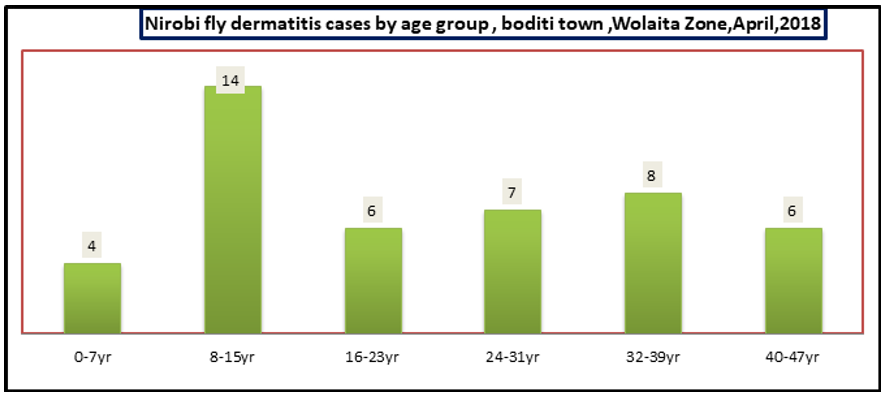
Figure 3: Distribution of Nairobi fly Cases by age group, Bodit town administration, Wolaita Zone, South Ethiopia, April 5-14, 2018.
The majority of patients were in the age group8-15 years (AR=31%) affected and 0-7 years old were lest (8.8%) affected age group.
Of the 45 patients, 32 patients (71 %) and 28(62%) were symp-tomatic with sensations of burning and itching, the burning sen- sation was more pronounced compared to itching. Clinically most patients had perorbital Conjunctivitis 17(37.7%). Vesicular postular lesions were present in 10 patients (22%). A striking feature was the presence of numerous Erythmato-vesicular le¬sions in 18 patients (40 %). None of the patients had exhibited residual effect of the skin due to the fly.
Table 1: Clinical presentations of Nairobi fly dermatitis, Bodit administrative town, Wolayita Zone, South Ethiopia, April 2018
|
|
Clinical presentation |
Frequency |
Percent |
|
|
1 |
Burning sensation |
Yes |
32 |
71.1 |
|
No |
13 |
28.9 |
||
|
2 |
Itching |
Yes |
28 |
62.2 |
|
No |
17 |
37.8 |
||
|
3 |
Conjunctivitis |
Yes |
17 |
37.8 |
|
No |
28 |
62.2 |
||
|
4 |
Erythmatovesicular |
Yes |
18 |
40.0 |
|
No |
27 |
60.0 |
||
|
5 |
Erythmatous |
Yes |
15 |
33.3 |
|
No |
30 |
66.7 |
||
|
6 |
Vesicular postular |
Yes |
10 |
22.2 |
|
No |
35 |
77.8 |
||
|
7 |
Blister |
Yes |
16 |
35.6 |
|
No |
29 |
64.4 |
||
|
8 |
Others |
Yes |
6 |
13.3 |
|
No |
39 |
86.7 |
||
Regarding the clinical findings of this study, all of the cases were observed on the exposed parts of the body. The majority 23 (51.1%) and 22(48.9%) of the lesion occurred on Neck and the faces respectively. Genitalia were the list exposed site which accounts 1(2.2%) and 3(6.7%) respectively. Number of lesion ranged from 1 to multiple (more than 5). Mostly, a two lesions were found in 17(37.8%) of the cases, followed by one lesion which was 13(28.9%) of the cases, the remaining 3-5 lesions accounted only 15 (33.3%) of the total cases.
Table 2: Distribution of lesions anatomically in cases, Bodit administrative town, Wolaita Zone, South Ethiopia, and April 2018
|
Site of lesions |
Frequency |
Percent |
|
|
Face |
Yes |
22 |
48.9 |
|
No |
23 |
51.1 |
|
|
Neck |
Yes |
23 |
51.1 |
|
No |
22 |
48.9 |
|
|
Axillaries |
Yes |
7 |
15.6 |
|
No |
38 |
84.4 |
|
|
Upper limbs |
Yes |
6 |
13.3 |
|
No |
39 |
86.7 |
|
|
Shoulder |
Yes |
10 |
22.2 |
|
No |
35 |
77.8 |
|
|
Chest |
Yes |
3 |
6.7 |
|
No |
42 |
93.3 |
|
|
Genitalia |
Yes |
1 |
2.2 |
|
No |
44 |
97.8 |
|
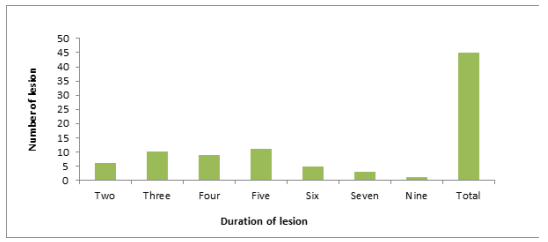
Mean duration of the symptoms manifestation were 3 to 5 days.
Table 3: Duration of lesion in affected cases by Nairobi fly dermatitis, Bodit town administration, Wolayita Zone, South Ethiopia, April 2018
Analytical Investigation
Multivariate analysis results showed that Proximity of dense vegetations or fruit trees, habit of leaving night lamp on while sleeping had statically significantly associated with contracting Nairobi fly dermatitis. Those individuals whose houses were in habit of leaving night lamp on while sleeping are 8.47 (95% CI 1.033-64.8) times more likely to develop Nairobi fly dermatitis than their counterparts, Proximity of dense vegetations or fruit trees 7 (95% CI 1.143-43.78) times more affected than those did not.
Table 4: Multivariate logistic regression analyses of factors that have been associated with the development of lesions in Bodit town, Wolaita Zone, South Ethiopia, April 2018
|
Variables |
Case |
Control |
AOR(95%CI) |
P-value |
|
|
In habit of leaving night lamp on while sleeping |
Yes |
38 |
52 |
8.47(1.033-64.8) |
0.047 |
|
No |
7 |
38 |
1 |
||
|
Proximity of dense vegetations or fruit trees? |
Yes |
43 |
57 |
7.073(1.143-43.78) |
0.035 |
|
No |
2 |
33 |
1 |
||
|
Disposing wastes near vicinity |
Yes |
39 |
87 |
5.44(2.094,14.1250 |
0.001 |
|
No |
6 |
13 |
1 |
||
Nairobi Fly Dermatitis Outbreak Investigation
Some of the Nairobi fly dermatits cases in Ade charake village in Bodit town administration, Wolaita Zone,SNNPR, Ethiopia, 2018
Discussion
The name ‘Nairobi fly’ is applied to Paederus sabaeus Erich-son and Paederus crebrepunctatus that both cause dermatitis and conjunctivitis in East Africa [3]. Nairobi fly dermatitis may af¬fect people of any sex, age, race or socioeconomic status. The risk depends on the parson’s activities and the insect habitat, exposed skin areas are at higher risk [11]. Nairobi fly dermatitis occurs predominantly on exposed parts of the body. Specially, face and neck were found to be the most commonly involved sites. Our study also found the dermatitis more commonly over uncovered parts of the body; the majority of the lesions were on the neck and face. Facial lesions had predilection for the peror¬bital region in 17(37.8%) percent of patients [12].
The increase in the Paederus sp. population and the increased dermatitis cases have been shown to occur during the rainy season. In similar study, Paederus dermatitis and conjunctivitis occurs mainly during the rainy season (March and October) in the north (Kilimanjaro and Arusha).Maximum cases reported in the month of April [6, 13]. This study suggested that females were more affected than males which are similar with the study done in Gurgaon [14]. However in other studies that were done in Province of Darien, Panama male sexes were more affected than their counterparts [13]. Though all ages, 8-15 years were affected more. This could be due to that older people may be more resistant to the bites than younger children and the young have more outdoor activities which more exposes to the bites of sand flies. Most of the cases had two lesions which are domi-nantly found on neck and face of the cases which is similar with the study that was conducted in panama [14]. Those individu¬als whose houses were in habit of leaving night lamp on while sleeping are 8.47 (95% CI 1.033-64.8) times more likely to de¬velop Nairobi fly dermatitis than their counter parts, Proximity of dense vegetations or fruit trees 7 (95% CI 1.143-43.78) times more affected than those who did not . The same study done on Sierra leone, showed that lamp on while sleeping significantly associated with contracting Nairobi fly dermatitis [12].
Ecological changes and climatic variations, such as El Niño, have also led to the appearance of unusual outbreaks of dermati¬tis caused by some species of these insects, which increase year after year in some regions worldwide [11, 15]. Global warming can also lead to increased incidence of Paederus sp. since high¬er temperatures may influence the ecological dynamics of some insect species. The increases in Paederus sp. populations and the dermatitis case reports in this outbreak could be due to climatic changes related to the onset of the rainy season; unfortunately, due to the limitation of current study, such variables were not available during the outbreak period in order to correlate them with the case incidence [16]. Heavy rainfall and consequently the increase of vegetation in deforested areas and along with the change in temperature and humidity cause an alteration in the natural habitat of these insects [17]. This may leads to the migra¬tion and proliferation of these insects to more urbanized areas, especially where there is artificial light [18-19]. Nairobi fly der¬matitis outbreak was the new event in Bodit town administration and the community did not know the name of the disease, cause, transmission, prevention, control and treatment of the disease, before investigation. Some of them believe that the disease is caused as a result of sin and others thought that the transmis¬sion is due to contact. Due to these perceptions they discriminate cases and the cases affected psychologically. However, the lim¬itation of this study was unavailability of expert dermatologist, laboratory investigation and entomological survey. Recall bias was also one limitation to remember onset of the date.
Conclusion
Nairobi fly dermatitis is an uncommon condition but, can be pre¬vented by increased public awareness. Inhabit of leaving night lamp on while sleeping, the proximity of dense vegetations or fruit trees and disposing wastes near vicinity significantly as¬sociated with Nairobi fly dermatitis. We conducted a series of awareness campaigns in and around the affected kebele stress¬ing on the simple preventive measures based on the behavioral pattern of this nocturnal beetle, leading to a significant reduction in the incidence of disease. Health professionals in the affected areas should also be enlightened of this condition and its man¬agement. Awareness about the morphological patterns of the condition and its clinical features will prevent misdiagnosis.
List of Abbreviations
AOR: Adjusted Odds Ratio, AR: Attack rate, C I: Confidence In¬terval, COR: Crude Odds Ratio, HC: Health Center, HP: Health Post, PHEM: Public Health Emergency Management, RRT: Rapid Response Team, SPSS: Software Package Social Scienc¬es.
Acknowledgement
I would like to take this opportunity to express my heartfelt thanks and appreciation to my advisor Dr. Mesay Hailu for his constructive comment, unreserved advice and made continuous follow up to complete on each of the outputs undertaken. Once again, I gratefully acknowledge Zonal Health department staff for their kindly support in general; and Mr. Ambesaw Wolde (Zonal Health department Head for his motivation toward ac¬complishing residents their field work in timely manner; the PHEM coordinator (Mr.Temese Teka) facilitating in the entire field activities and program management.
Funding
The funder had no role in the design and conduct of the study; collection, management, analysis, and interpretation of the data; preparation, review, or approval of the manuscript; and decision to submit the manuscript for publication. The authors and their contributions to the manuscript are independent from the funder.
Availability of Data and Materials
The datasets used and/or analyzed during the current study are available from the corresponding author on reasonable request.
Ethics Approval and Consent to Participate
All participants were informed about the objective of the study, confidentiality of the participants were assured and informed consent was sought from and given by the participants, with the knowledge they were free to withdraw at any time. Ethical clear¬ance was obtained from the institutional review board of Hawas¬sa University, College of health sciences and the support letter was written from Wolayita Zone health department to Boditi town administration.
Competing Interests
The authors declared that there is no competing interest.
Consent for Publication Springer
Nature remains neutral with regard to jurisdictional claims in published maps and institutional affiliations.
References
- Kellner, R. L. (2001). Suppression of pederin biosynthesis through antibiotic elimination of endosymbionts in Paederus sabaeus. Journal of Insect Physiology, 47(4-5), 475-483.
- Morsy, T. A., Arafa, M. A., Younis, T. A., & Mahmoud, I.A. (1996). Studies on Paederus alfierii Koch (Coleoptera: Staphylinidae) with special reference to the medical importance. Journal of the Egyptian Society of Parasitology, 26(2), 337-351.
- Nairobi fly doesn’t sting or bite, but it sure does hurt’. CNN 26 Jan 1998. EARTH/9801/26/kenya.beetle.ap/index.html(2009).
- Van Schayk, I. M., Agwanda, R. O., Githure, J. I., Beier,J. C., & Knols, B. G. (2005). El Niño causes dramatic outbreak of Paederus dermatitis in East Africa. Climate change and Africa, 240-247.
- Kamaladasa, S. D., Perera, W. D. H., & Weeratunge, L. (1997). An outbreak of Paederus dermatitis in a suburban hospital in Sri Lanka. International journal of dermatology,36(1), 34-36.
- Fox, R. (1993). Paederus (Nairobi fly) vesicular dermatitis in Tanzania. Tropical doctor, 23(1), 17-19.
- Piel, J., Butzke, D., Fusetani, N., Hui, D., Platzer, M., Wen, G., & Matsunaga, S. (2005). Exploring the chemistry of un-cultivated bacterial symbionts: antitumor polyketides of the pederin family. Journal of natural products, 68(3), 472-479.
- Gnanaraj, P., Venugopal, V., Mozhi, M. K., & Pandurangan,C. N. (2007). An outbreak of Paederus dermatitis in a suburban hospital in South India: a report of 123 cases and review of literature. Journal of the American Academy of Dermatology, 57(2), 297-300.
- Zargari, O., Kimyai-Asadi, A., Fathalikhani, F., & Panahi,M. (2003). Paederus dermatitis in northern Iran: a report of 156 cases.
- Monitoring Pa. HMIS report of bodit town admoinistration. (2018).
- Singh, G., & Ali, S. Y. (2007). Paederus dermatitis. Indian Journal of Dermatology, Venereology and Leprology, 73, 13.
- Qadir, S. N. R., Raza, N., & Rahman, S. B. (2006). Paederus dermatitis in Sierra Leone. Dermatology online journal, 12(7).
- Gupta, V. (2014). Clinical study of 100 cases of beetle dermatitis in rural population of Gurgaon. Journal of Evolution of Medical and Dental Sciences, 3(16), 4367-4372.
- Cáceres, L., Suarez, J. A., Jackman, C., Galbster, A., Miranda, R., Murgas, I., ... & Rodriguez-Morales, A. J. (2017). Dermatitis due to paederus colombinus: report of an epidemic outbreak of 68 cases in the province of Darien, Panama. Cureus, 9(4).
- Senel, E., & Sahin, C. (2011). A warmer world means more beetles and more dermatitis. Indian Journal of Occupational and Environmental Medicine, 15(1), 47-47.
- Rahmah, E., & Norjaiza, M. A. (2008). An outbreak of Paederus dermatitis in a primary school, Terengganu, Malaysia. Malaysian Journal of Pathology, 30(1), 53-56.
- Taneja, A., UK, S. N., & Shenoi, S. D. (2013). Clinical and epidemiological study of Paederus dermatitis in Manipal, India. Journal of Pakistan Association of Dermatologists, 23(2), 133-138.
- Wilkinson, S. M., & Beck, M. H. (2004). Contact dermatitis: irritant. Rook's textbook of Dermatology, 787-816.
- You, D. O., Kang, J. D., Youn, N. H., & Park, S. D. (2003).Bullous contact dermatitis caused by self-applied crushed Paederus fuscipes for the treatment of vitiligo. CUTIS-NEW YORK-, 72(5), 385-390.