

Advancement in Yoga and Physical Therapy(AYPT)
ISSN: 2995-3308 | DOI: 10.33140/AYPT



Review Article - (2023) Volume 1, Issue 2
Muscular Strength and Power Assessment and Taring Protocols for Optimal Performance
2Department of Physiotherapy, Faculty of Basic Medical Sciences, College of Medical Sciences, Rivers State University, PH, Nigeria
3Dept of Human Anatomy, Faculty of Basic Medical Sciences, College of Medical Sciences, Rivers State University, Port Harcourt, Nigeria
4Dept of Human Anatomy, Faculty of Basic Medical Sciences, College of Medical Sciences, Rivers State University, Port Harcourt, Nigeria
5Dept of Human Anatomy, Faculty of Basic Medical Sciences, College of Medical Sciences, Rivers State University, Port Harcourt, Nigeria
Received Date: Sep 04, 2023 / Accepted Date: Oct 21, 2023 / Published Date: Oct 31, 2023
Copyright: ©Â©2023 Chinonso Vincent Nweke, et al. This is an open-access article distributed under the terms of the Creative Commons Attribution License, which permits unrestricted use, distribution, and reproduction in any medium, provided the original author and source are credited.
Citation: Nweke C.V., Madume, A, K., Paul, J, N., Amadi, H., Amadi-Ikpa, H, A., (2023). Muscular Strength and Power Assessment and Taring Protocols for Optimal Performance. Adv Yoga Physical Ther, 1(2), 46-51.
Abstract
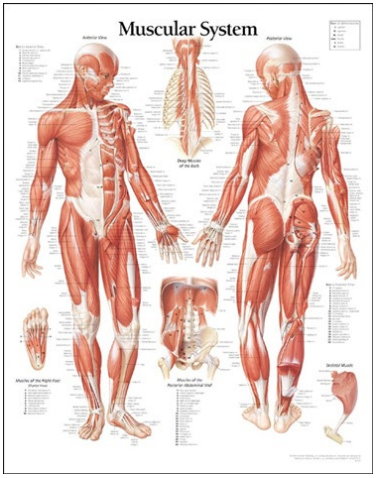
I Muscle Physiology
i Muscles consist of many muscle fibers [cells] connected in bundles
ii Muscle fibers are made up of myofibrils [actions and myosin]
iii Strength training increases the number of myofibrils and the size of muscle fibers = hypertrophy
Introduction
I Muscle Physiology
i Muscles consist of many muscle fibers [cells] connected in bundles
ii Muscle fibers are made up of myofibrils [actions and myosin]
iii Strength training increases the number of myofibrils and the size of muscle fibers = hypertrophy
• Inactivity reverses the process = atrophy

II Muscle Fibres; it consists of
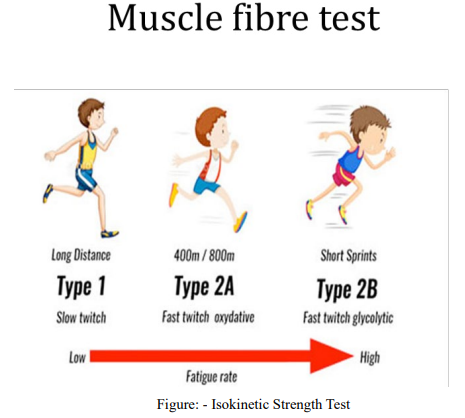
I slow-twitch fibers
i fatigue resistant
ii it does not contract as rapidly and forcefully as fast twitch fibers
iii it relies primarily on oxidative energy system
II Fast twitch fibers I contract rapidly and forcefully
ii fatigue more easily than the slow twitch fibers
iii relies more on oxidative energy system
Iii Physiological Effects of Strength Training; It Results in The Following
i Increased muscle mass and size of muscle fibers
ii Increased utilization and coordination of motor units
iii Increased strength of tendons, ligaments, and bones
iv Increased storage of fuel in and blood supply to muscles
v Improvements in blood fat levels and biochemical processes
I Muscular Strength
Muscular strength is the ability of a muscle or muscle group to exert force to overcome the most resistance in one effort. Strength can be measured based on the amount of weight lifted. Upper-body and lower-body strength are measured separately. Strength tests include the bench press for upper body, the squat for lower body and the dead lift for lower back and leg assess¬ments. Relative strength is based on a ratio of weight lifted to body weight. For example, if two people lifted the same weight, the person who weighs less has greater relative strength.
Ii Benefits of Muscle Strength and Muscle Endurance
i Useful for everyday task as lifting etc
ii Participation in everyday activity with minimal effort unimproved physical performance [in sports and physical ac¬tivity]
• Protection from injury
• Increased metabolic rate
• Maintenance of bone mineral density
• Improve body image
• Prevention and management of chronic disease
Assessing Muscular Strength and Endurance
• Muscular strength assessed by determining repetition max¬imum [1 RM], the maximum resistance that can be lifted once
• Muscular endurance assessed by counting the maximum number of repetitions of a muscular contraction [callisti-nenic tests]
Definitions Related to Strength
• Hypertrophy
• Increase in muscle size as a result of training
• Result of increase size of muscle fibres
• Atrophy
• Shrinking of the muscles
• Usually result from lack of use
Factors That Contribute to Muscle Strength and Size
• Exercise
• Resistance training activities or exercises that make mus-cles do more work than they are accustomed to.
• Diet
• Proper amount of carbohydrates, proteins and fats
• Genetics
• Somatotype contribute to overall muscle building process
• Hormones
• higher amounts of testosterone and androgens.
Types of Resistance Training
• Static or isometric exercises
• Involves muscular action in which length of the muscle do not change and there is no visible change.
Types of Dynamic Resistance Exercises
• Dynamic constant external resistance [DCER]
• Isotonic exercise [iso-constant; tonic-tension]
• Resistance training exercise in which the external resistance or weight does not change and both a lifting [concentric] and lowering [eccentric] phase occur during each repetition.
• Eg free weight or some weight machine
Types of Dynamic Resistance Exercises
• Isokinetic resistance training
• Type of contraction where speed is fixed and resistance var-ies with the force extended.
• Plyometric
• Is a rapid dynamic eccentric contraction and stretching fol¬lowed by a rapid dynamic concentric contraction. Eg jump training in which muscles exert max force in a short interval of time, ie [exerting force by body wt at first lift] with d goals of increasing muscle strength or power
Designing A Resistance Training Program
• FITT principle
• Frequency; guidelines recommend muscle strengthening activities on 2 or more days /week for all major muscle groups.
Intensity or How Hard;
• for muscle strength, choose resistance between 75-85%of ur maximum capacity.
• For muscle endurance, resistance btw 50-65% of ur max capacity
• For general health or fitness; resistance of 65-75% of ur max capacity.
Muscle Fibre Test
Time or Duration
• Repetition; one complete movement through an exercise
• Type of activity; using ur own body weight, using free weights or machines, multi joint exercise are recommend-ed over single joint bcos it affects more than one group of muscle
Tests for Muscle Strength
• 1 RM tests
• Muscle fibre RM tests
• Isokinetic strength test
• Hand grip strength test
• Abdominal strength test [7 stages]
• Abdominal strength test [4 stages]
1 Rm [One]
• One-repetition maximum [one rep maximum or 1RM] in weight training is the maximum amount of force that can be generated in one maximal contraction.
• Equipment used - barbells
Muscle Fibre Test
• Used indirectly to determine the type of muscle fibre [slow twitch type 1] or [fast twitch type 11] an athlete or a weight trainer uses during performance.
• procedure: Determine your [1RM] on a given exercise - a measure of the maximal weight a subject can lift with one repetition. Have a rest for 15 minutes. Then use 80% of your measured 1RM to perform as many repetitions as possible in a single attempt.
• Equipment – dumbbell, barbell for slow twitch,free weight for fast twitch
Isokinetic Strength Tests. Isokinetic exercise is performed with a specialized apparatus which provides variable resistance so that no matter how much effort is exerted the movement is conducted at a constant speed. equipment required: Isokinetic testing equipment [e.g. Biodex, Cybex]
Hand Grip Strength Test
• Grip strength is the force applied by the hand to pull on or suspend from objects and is a specific part of hand strength. Optimum-sized objects permit the hand to wrap around a cylindrical shape with a diameter from one to three inches.
• Equipment – dynamometer, myometer which measures isometric muscle strength.
What Determines the Strength
• Level of Motor Unit Recruitment: Motor unit recruitment is a measure of how many motor neurons are activated in a particular muscle.
• It is therefore a measure of how many muscle fibres of that muscle are activated.
• The higher the recruitment, the stronger the muscle contraction will be.
Muscle Cross-Sectional Area
• The greater the cross-sectional area of the muscle, the more muscle fibres that can be activated simultaneously.
• Muscle Stretch
• A muscle fibre can shorten to about 50 % to 60 % of its length, but it will be less efficient if it is already short.
• That’s why many athletes use a brief dynamic stretch sequence as a warm-up prior to their strength work.
POWER
• Power is defined as the amount of work performed per unit of time. Power is an element of skill-related fitness that is needed to excel in athletic performance. Increased strength does not always translate into increased power. For example, a strong upper body lifts a high amount of weight. However, a strong upper body does not always have the ability to throw a shot put very far if enough speed cannot be generated.
Training to Improve Power
• Training to improve power can include
• lifting weights,
• throwing implements such as medicine balls
• running against a resistance, and
• plyometrics [depth jumping and bounding].
• Power-specific training involves lifting relatively heavy weights as fast as possible.
Tests for Muscle Power
• Jumping and Running Tests
• Vertical jump tests
• Vertical Jump variations: using timing mat, test at home,
• off one step [for basketball players], with a run up, no arms.
• • Vertical jump in the water tests [for water polo players]
• Max touch; The Max Touch Vertical Leap Test is a basketball specific test that measures the overall skills of explosive leg power and coordinated jumping mechanics with the player's natural height and wingspan
• Bosco Ergo Jump Tests: squat jump, squat jump with extra weight, counter movement jump, Abalakov jump, drop jump, repeated jump, others in bosco jump tests includes-stand long [broad] jump test, 3 hop test, 2 hop test, margaria kalamen power test.
Tests for Muscle Power
Throwing and Hitting Tests
 Seated medicine ball throw
Overhead medicine ball throw
Overhead Powerball throw[kneeling]
Standing medicine ball throw
Underhand medicine ball throw
Rotational power ball throw
Power ball chest lunch
Shot put back throw
Baseball throw test
Softball throw test
Punch power
Seated Medicine Ball Throw Test
• procedure: The athlete sits on the floor with his legs fully extended, feet 24 inches [~60 cm] apart and the back against a wall. The ball is held with the hands on the side and slightly behind the center and back against the center of the chest. The forearms are positioned parallel to the ground. The athlete throws the medicine ball vigorously as far straight forward as he can while maintaining the back against the wall. The distance thrown is recorded.
Vertical Jump Test (Off One Step
• the athlete stands side on to a wall and reaches up with the hand closest to the wall. Keeping the feet flat on the ground, the point of the fingertips is marked or recorded. This is called the standing reach height. The athlete then stands away from the wall, and leaps vertically as high as possible using both arms and legs to assist in projecting the body upwards. The difference in distance between the standing reach height and the jump height is the score. The best of three attempts is recorded.
Bosco Ergo Jump Protocol
• The athlete stands in socks or bare feet on the mat with weight evenly distributed over both feet. Hands are placed on the hips, and stay there throughout the test. The athlete squats down until the knees are bent at 90 degrees, keeping the trunk straight. Once the mat is reset, the athlete jumps vertically as high as possible, and lands back on the mat with both feet hitting the ground at the same time. The best score of at least three attempts is recorded. Allow a good rest between trials. Both the take-off and landing must be from both feet, with no initial steps or shuffling. The best of at least three attempts is recorded - subjects may continue to jump as long as improvements are being made.
Bosco Ergo Jump Tests
• Squat Jump Test [SL] — a vertical jump test starting with the knees flexed at 90 degrees, and hands resting on hips.
• Squat Jump Test with Extra Load [SJ+1]— a SJ with an extra load, placed on the shoulders like doing a squat weight lifting exercise.
• Countermovement Jump Test— similar to the SJ, but the athlete starts in a standing position, and squats down to the 90-degree leg bend position before immediately jumping up. Hands remain on hips.
• Abalakov Jump Test [AJT]— traditional vertical jump test with swinging of the arms allowed.
• Drop Jump [DJ]— a jump after a drop of a given height, with hands on hips. The test is performed from 5 standardized drop heights: 20 cm, 40cm, 60 cm, 80 cm and 100 cm.
• Repeatitive Jump [RP] — continuous SJs with a duration of 5 to 60 seconds.
What Determines the Power of a Muscle Contraction
• the force of the contraction
• the contraction velocity
• The power of a muscle contraction is represented by the Physics formulas
• P = work/time
• Training Protocols
• The basic considerations for beginning a training protocol.
• Every individual has a certain reason for engaging in a fitness programme. Some medical conditions will make it indispensable for the PT to include an individual or patient in a fitness programme. Whatever be the case, the first thing to consider is;
• What is it that you are trying to accomplish? Eg are you trying to improve a client’s general health or are you trying to train the client for an event or activity involving competition?
• It could also be that as a PT, you are promoting health in disease condition through fitness programme. The answer to this question will largely determine the training technique that will enable you achieve your goals in fitness improvement.
Basic Principles of Training
• Programme must be fun and enjoyable; the programme adopted by the PT must be the one that the client has interest and motivation in. sometimes, it may be difficult for the patient to derive fun at the initial stage. The PT should select a programme that would enable the pt to;
• Achieve the ultimate goal of the physical fitness for the pt
• Maintain the interest and motivation for a long time.
Over Load Principle
• Over load principle; to achieve the greatest benefit of exercise programme, d PT should recognise the principle of overload. for the physiological compt of a system to improve, the body system should be subjected to more stress than usual. The system shld experience stress so that over period of time, it will improve to a point at which it can easily accommodate additional stress.
• SAID principle [specific adaptation to impose demands] states that when the body is subjected to stress and overload of varying intensity it would gradually adapt over time to overcome whatever demand that is placed over it. Though overload is a basic factor in training, the stress must not be enough to cause injury. The body needs time to adjust to imposed demands. Therefore, overload is a gradual increase in
• frequency,
• Duration or
• intensity of a physical activity that is part of a training programme.
Principle of Progression
Principle of progression; a little today and a little more tomorrow is a good principle to follow in any training programme. The role of the progression should be in the ability to adapt physiologically. In other words, d work out should gradually go a little or more stressful or intense until you reach a desired level of physical fitness.
Consistency
One of the biggest problems in beginning a fitness programme is finding the time during the day to fit in an hour, or minute or so in an activity. The best time of the day to exercise is when you have the time and also activated to do it. The most important thing is to set aside a day for the exercise and make it a daily routine.
Specificity
The type of physiological changes that occur are directly proportional to the type of training used. To achieve the max gain in a physiological system, activities and programme should be designed and selected to achieve this aim. According to SAID principle, a particular physiological system will respond and adapt over time to whatever demand that are placed on them.
Principle of Individuality
When a pt participates in a programme, it is important to know that no two individuals are exactly the same. Client who are involved in similar activity may not progress in the same rate or will not be able to overload their system to the same degree. Exercise is good but must be adopted for individual need and ability.
Safety
Injuries often occurs when a poorly planned programme is allowed. Too often, ppl who have been sedentary over a long period of time over estimate their physical ability and overdo it.
Strength and Power Assessment
• Athletic strength and power refer to the forces or torques generated during sporting activity. Their assessment can be used for
• strength diagnosis or talent identification,
• to monitor the effects of training interventions and
• to estimate the relative significance of strength and power to particular athletic pursuits.
References
- Areta, J. L., Burke, L. M., Ross, M. L., Camera, D. M., West, D. W., et al (2013). Timing and distribution of protein ingestion during prolonged recovery from resistance exercise alters myofibrillar protein synthesis. The Journal of physiology, 591(9), 2319-2331.
- Arciero, P. J., Ormsbee, M. J., Gentile, C. L., Nindl, B. C., Brestoff, J. R., et al(2013). Increased protein intake and meal frequency reduces abdominal fat during energy balance and energy deficit. Obesity, 21(7), 1357-1366.
- Arciero, P. J., Baur, D., Connelly, S., & Ormsbee, M. J. (2014). Timed-daily ingestion of whey protein and exercise training reduces visceral adipose tissue mass and improves insulin resistance: the PRISE study. Journal of applied physiology.
- Bray, G. A., Smith, S. R., De Jonge, L., Xie, H., Rood, J., et al (2012). Effect of dietary protein content on weight gain, energy expenditure, and body composition during overeating: a randomized controlled trial. Jama, 307(1), 47-55.
- Phillips, S. M., Moore, D. R., & Tang, J. E. (2007). A critical examination of dietary protein requirements, benefits, and excesses in athletes. International journal of sport nutrition and exercise metabolism, 17(s1), S58-S76.
- United States. Dietary Guidelines Advisory Committee. (2010). Dietary guidelines for Americans, 2010 (No. 232). US Department of Health and Human Services, US Department of Agriculture.