

World Journal of Tourism Management(WJTM)
ISSN: 3070-4030 | DOI: 10.33140/WJTM


Research Article - (2026) Volume 2, Issue 1
Mosaic Representation in Ancient Morocco: Iconography, Function, and Cultural Identity in Mauretania Tingitana
Received Date: Dec 05, 2025 / Accepted Date: Dec 29, 2025 / Published Date: Jan 17, 2026
Copyright: ©2026 Mohamed Amin Saad Farag. This is an open-access article distributed under the terms of the Creative Commons Attribution License, which permits unrestricted use, distribution, and reproduction in any medium, provided the original author and source are credited.
Citation: Farag, M. A. S. (2026). Mosaic Representation in Ancient Morocco: Iconography, Function, and Cultural Identity in Mauretania Tingitana. World J Tourism Mgmt, 2(1), 01-02.
Abstract
Mosaics represent one of the most expressive artistic media of Roman North Africa. In ancient Morocco, particularly within the Roman province of Mauretania Tingitana, mosaic art developed into a sophisticated visual language reflecting social identity, religious beliefs, and imperial ideology. This paper examines mosaic representation in ancient Morocco, focusing on iconography, stylistic development, workshop production, and the cultural significance of mosaic imagery. Through an analysis of major sites such as Volubilis, Lixus, and Banasa, this study argues that Moroccan mosaics demonstrate a unique synthesis of Roman artistic norms and local African traditions, forming a distinct provincial artistic identity.
Keywords
Roman mosaics, Mauretania Tingitana, Volubilis, North Africa, Roman Art
Introduction
The Roman occupation of northern Morocco transformed the artistic and architectural landscape of the region. After the annexation of Mauretania Tingitana in AD 40 under Emperor Claudius, Roman urban planning and decorative arts became prominent in cities such as Volubilis, Banasa, and Lixus [1]. Among these artistic forms, mosaics emerged as a dominant medium of elite self-representation. Unlike mere ornamental floors, mosaics functioned as narrative, ideological, and symbolic tools reflecting social status, religious affiliations, and cultural integration into the Roman world. This paper explores the representation of mosaics in ancient Morocco, analyzing their themes, styles, and socio-cultural roles within the provincial Roman context.
Historical and Cultural Context
Mauretania Tingitana occupied a strategic position at the western edge of the Roman Empire, linking the Mediterranean world with Atlantic trade routes. Romanization in this region was selective and uneven, with strong continuity of indigenous Berber traditions [2]. Urban elites embraced Roman artistic forms to express loyalty and cultural affiliation with imperial Rome. Mosaics were installed primarily in private houses, baths, and public buildings, indicating wealth and social prestige.
Major Mosaic Sites in Ancient Morocco
Volubilis
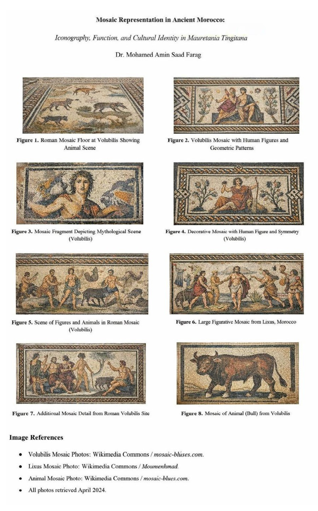
Volubilis is the most important archaeological site for studying mosaics in Morocco. Its elite residences, such as the House of Orpheus, the House of Dionysus, and the House of the Knight, contain some of the finest mosaics in North Africa. Notable examples include the Orpheus Mosaic, depicting Orpheus charming animals, and the Labors of Hercules mosaic, reflecting ideals of strength and heroism [3].
Lixus
At Lixus, mosaics were discovered mainly in bath complexes and villas. They frequently include marine motifs, geometric designs, and representations of sea deities, reflecting the city’s connection to maritime trade.
Banasa
Banasa provides evidence for mosaic floors in civic and domestic contexts. The mosaics here are simpler but illustrate the diffusion of Roman decorative traditions into provincial towns.
Iconography and Symbolism
Mythological Scenes: Dionysus, Hercules, Orpheus, and Venus appear frequently. Geometric Patterns: Reflecting both Roman and indigenous African decorative traditions. Faunal and Marine Motifs: Indicate abundance, fertility, and economic reliance on agriculture and trade.
Workshops and Artistic Production
Mosaic workshops in Morocco were regionally organized, possibly connected to Hispania and other parts of North Africa. Stylistic similarities suggest strong artistic and commercial connections across the Strait of Gibraltar [4]. Local artisans incorporated African stylistic traits, especially in geometric designs, creating a distinctive provincial style within Roman mosaic art.
Cultural Identity and Romanization
Moroccan mosaics reflect a process of Romanization rather than simple imitation. Local elites selectively adopted Roman iconography while maintaining indigenous elements in decorative patterns, creating a hybrid artistic identity.
Conclusion
Mosaic representation in ancient Morocco is a vital source for understanding provincial Roman art, social identity, and cultural interaction. Sites such as Volubilis, Lixus, and Banasa show how Roman artistic traditions were adapted in a local African context, forming a distinctive provincial identity.
References
- Mattingly, D. J. (1995). Tripolitania. University of Michigan Press.
- Gsell, S. (1928). Histoire ancienne de l’Afrique du Nord (Vol.6). Hachette
- Thébert, Y. (2003). Thermes romains d’Afrique du Nord et leur contexte méditerranéen. École Française de Rome.
- Dunbabin, K. M. D. (1999). Mosaics of the Greek and Roman world. Cambridge University Press.