

Advancement in Dairy Science Research(ADSR)


Research Article - (2023) Volume 1, Issue 1
Morphology and Yield Performance of Edible Mushrooms on Different Substrates
Received Date: Feb 24, 2023 / Accepted Date: Mar 17, 2023 / Published Date: Mar 27, 2023
Copyright: ©©2023 Tanmay Kotasthane. This is an open-access article distributed under the terms of the Creative Commons Attribution License, which permits unrestricted use, distribution, and reproduction in any medium, provided the original author and source are credited.
Citation: Kotasthane, T. (2023). Morphology and Yield Performance of Edible Mushrooms on Different Substrates. Adv Dairy Sci Res, 1(1), 30-33.
Abstract
Edible mushrooms were studied for morphology and yield performance. Oyster mushroom, milky mushroom and paddy straw mushroom were studied for spawn run, pin head formation and fruiting bodies. Sugarcane bagasse, coconut coir, mixture of sorghum and maize stalk, saw dust were used as substrate. Highest yield observed on mixture of sorghum and maize stalk for P.sajor-caju (800.16g) followed by P.ostreatus (675.14g).C.indica has good yield on paddy straw (500g).V.volvacea has good yield on (550.18 g).These mushrooms can be further explored for medicinal properties.
Keywords
Mushrooms, Substrates, Yield, Morphology
Introduction
Mushrooms occur in different parts of the world, ranging from arctic to the tropics. While some species are endemic, others exist in areas that are widely separated geographically. How- ever, most of the species show a preference for a certain type of habitat. Some are, found primarily in upland wooded areas; others exist in swamps and still others prefer open areas such as gardens, trees, lawns or pasture e.g Pleurotus spp. Many species particularly the mycorrhizal forms are associated with certain types of vegetations. Mushrooms may also show a pref- erence for a particular substratum within a certain habitat. Ba- sidiocarps of some are typically produced on the soil and are terrestrial forms. Others are saprophytes found on dead leaves (follicolous) or litter e.g Cortinarius melliolens and Tricholoma lobayensis, on wood (lignicolous) e.g Lentinus edodes. Mush- rooms are mostly found on wastes such as sawdust, garbages and composting materials. The recent production data revealed that button mushroom production holds the maximum share of about 73 per cent and followed by oyster mushroom with 16 per- cent [1].The next most common commercial species are shiitake (Lentinus edodes), straw (Volvariella volvacea), oyster (Pleuro- tus ostreatus), and enoki (Flammulina ostreatus) .There are sev- eral species of Pleurotus identified in the world and suitable for cultivation, some of them are Pleurotus ostreatus, P. florida P. sa- jorcaju, P.eryngii [2].Oyster mushroom (Pleurotus spp.) is very easy to cultivate and various agricultural wastes are being used as substrates for its cultivation.Cultivation of edible mushrooms might be the only current process that combines the production of protein-rich food with the reduction of environmental pollu- tion [3]. Studies have revealed that mushrooms offer a diversity of flavour, texture, and nutrients [4].
Material Methods
Spawn of milky mushroom (Calocybe indica) and paddy straw mushroom V.volvacea obtained from Indian Institute of Horti- culture (ICAR), Bangalore Oyster mushroom spawn (Pleuro- tus sajor-caju) was obtained from College of Agriculture pune. Pleurotus ostreatus spawn was obtained online.
In the present investigation yield performance of Pleurotus os- treatus, Pleurotus sajor-caju ,V.volvacea and Calocybe indica studied on different substrate. Substrate used is mixture of Maize stalk and sorghum stalk,saw dust,sugarcane bagasse and coco- nut coir were soaked in water with bavastin, bleaching powder and 5% formalin overnight. Substrate were kept for sun dry to remove excess water.6X4 polythene bags filled with substrate. Casing is done with (soil + cow dung) for milky mushroom after spawn run.
Collection of Mushroom Substrate
The substrate for mushroom cultivation (Sorghum stalk, Coconut coir, Sugarcane stalk, Paddy straw) was collected from the farm- er’s field nearing the substrate after chopping into 3-4 cm length was stored under a covered shade.
Spawning and Cropping Of Mushroom
After sterilization, the straw was taken out from water, put in a slanting position to drain out the excess water or cooled in case of hot treatment and then bags were prepared. Polythene bags of 40×60 cm size were taken, perforated by making random holes in each bag and used to put the spawn and substrates. The bagging was done by layer method by putting 3 per cent of spawn on wet weight basis of the substrate. Each bed contained one kilogram of substrate. After completing spawning the bags were kept in dark room and necessary records were taken periodically. On com- pletion of spawn run the poly bags were removed from the bed, kept in cropping room, watering was done regularly to keep them moist. The mushroom was harvested up to third flushes.
Recording of Data
Days for completion of spawn running. Time was recorded in days for the completion of 100 per cent growth of mycelium on each substrate in polythene bags. Days for the appearances of pinhead: The data were recorded in days taken for appearance of mushroom primordial formation in substrates. Maturation of fruiting bodies: Time period was recorded in days from pinheads to maturation of fruiting bodies in all treatments. Yield: The data were recorded for the harvesting of mushroom up to three flush- es. The first and respective harvesting was done at maturity and the yield of different flushes of fruiting bodies was noted.
Results & Discussion
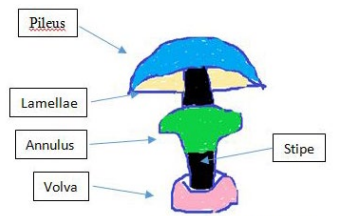
Mushroom Morphology
Table 1
|
|
Pleurotus ostreatus |
Pleurotus sajor caju |
Calocybe indica |
V.Vovacea |
|
Habitat |
Wood, leaf litter,trees |
Wood, leaf litter,trees |
Grassland |
Paddy straw |
|
Volva |
Present |
Absent |
Absent |
Present, prominent |
|
Lamellae |
Circular |
Blade |
Equal |
Angular |
|
Pileus |
Present,white |
Present, Grey color, large |
White, Umbrella |
Angular |
|
Stipe |
Tappering at base |
Small |
Present, Bulbous |
Thin stalk |
|
Annulus |
Present |
Absent |
Absent |
Absent |
|
Odour |
Bitter sweet |
Farinaceous |
Farinaceous |
Not distinctive |
Edible mushroom (oyster, milky mushroom, paddy mushroom) were studied for presence of different parts of mushroom i.e. pileus, lamellae, annulus, stipe given in (table1). Pleurotus sa- jor-caju is large sized mushroom without stipe. Milky mush- room (C.indica) has white cap like pileus with rouded base.Pad- dy mushroom V.volvacea is pink in color conical shaped, thin stipe with prominent volva.
Along with the methodical characterization of fungal communities in casing soil, a practical analysis is needed to highlight potentials and applications [5]. Pleurotus sajor caju,Pleuro- tus ostreatus,C.indica and V.volvacea studied for spawn run- ning,pinhead formation,fruit body formation and yield. Studied the effect of apple pomace on the growth rate of Pleurotus os- treatus mycelium.Yield performance varied within substrates Pleurotus sajor-caju has highest yield on substrate of maize and sorghum stalk (800.16 g) (Table2).Pleurotus ostreatus shown good yield on paddy straw with (675.14g) [6]. C.indica has good yield on paddy straw (500g).Coconut coir is good substrate but has low yield as compare to paddy straw and mixture of maize and sorghum stalk (Table 2, 3).Saw dust is not recommended for any of these mushroom.Higher yield of quality mushroom depends upon proper maintenance of pure culture as well as pu- rity and quality of the spawn used. Hence, low cost and quality spawn is the basic requirements for mushroom growers [7, 8].
Pleurotus Sajor Caju
Table 2
|
Substrates |
Spawn running |
Pinhead formation |
Fruiting body formation |
Yield (g) |
|
Paddy straw |
17-20 |
21-23 |
25-27 |
650.14 |
|
Mixture of Maize & sorghum stalk |
20-23 |
24-27 |
27-30 |
800.16 |
|
Saw dust |
20-25 |
27-28 |
30-32 |
--- |
|
Coconut coir |
20-23 |
23-25 |
25-27 |
500.12 |
Pleurotus Ostreatus
Table 3
|
Substrates |
Spawn running |
Pinhead formation |
Fruiting body formation |
Yield (g) |
|
Paddy straw |
17-20 |
21-23 |
25-27 |
675.14 |
|
Mixture of Maize & sorghum stalk |
21-22 |
23-25 |
25-28 |
650.12 |
|
Saw dust |
20-24 |
23-25 |
27-29 |
---- |
|
Coconut coir |
20-21 |
23-25 |
25-27 |
500.16 |
*Poor Spawn Run and Fruit Body Formation on Saw Dust as Substrate
Calocybe Indica
Table 4
|
Substrates |
Spawn running |
Pinhead formation |
Fruiting body formation |
Yield (g) |
|
Paddy straw |
23-25 |
27-29 |
31-35 |
500 |
|
Mixture of Maize & sorghum stalk |
25-27 |
30-32 |
33-36 |
300 |
|
Saw dust |
20-25 |
27-28 |
30-32 |
--- |
V.Volvacea
Table 5
|
Substrates |
Spawn running |
Pinhead formation |
Fruiting body formation |
Yield (g) |
|
Paddy straw |
17-20 |
21-23 |
25-27 |
400.15 |
|
Mixture of Maize & sorghum stalk |
20-23 |
24-27 |
27-30 |
550.18 |
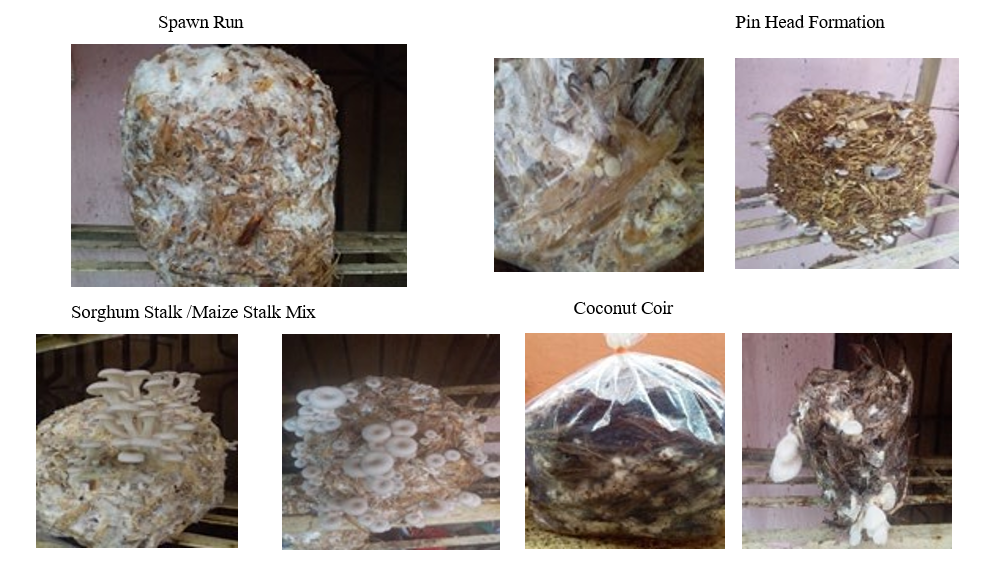


V.volvacea
Pleurotus and C.indica on sugarcane


Conclusion
Oyster mushroom, milky mushroom and paddy straw mush- room are edible and has medicinal properties.These mushroom can be grown on number of substrates available in agricultural field.Oyster mushroom and paddy mushroom is easy to cultivate whereas, milky mushroom require optimum growth conditions and good casing material.Oyster mushroom and paddy straw mushroom can be grown round the year whereas, milky mush- room grown in tropical region from march to october months. These edible mushroom could be explored for medicinal, aro- matic and chemical compounds.
References
- Sharma, V. P., Annepu, S. K., Gautam, Y., Singh, M., & Kamal, S. (2017). Status of mushroom production in India. Mushroom Res, 26(2), 111-120.
- Nadir, H., Ali, A., & Muhammed, G. A. R. (2016). Determi- nation of Yield and Quality of Oyster Mushroom (Pleurotus florida) Using Different Substrates in Halabja, Kurdistan Reign-Iraq. Journal of Plant Production, 7(7), 787-790.
- Sánchez, C. (2010). Cultivation of Pleurotus ostreatus and other edible mushrooms. Applied microbiology and bio- technology, 85, 1321-1337.
- Rahi, D. K., & Malik, D. (2016). Diversity of mushrooms and their metabolites of nutraceutical and therapeutic signif- icance. Journal of Mycology, 2016.
- Murmu, R., Maurya, A. K., & John, V. (2020). Mycoflora of certain casing materials used in the production of white button mushroom (Agaricus bisporus (Lange) Imbach). In- ternational Journal of Chemical Studies, 8(2), 2863-2868.
- Park, C., Lim, J. S., Lee, Y., Lee, B., Kim, S. W., Lee, J., &Kim, S. (2007). Optimization and morphology for decolor- ization of reactive black 5 by Funalia trogii. Enzyme and Microbial Technology, 40(7), 1758-1764.
- Maurya, A. K., John, V., Murmu, R., & Simon, S. (2019). Impact of different substrates for spawn production and pro- duction of milky mushroom (Calocybe indica). Int. J. Phar- ma. Bio. Sci, 10(2), 5-10.
- Chang, S. T. (1996). Mushroom research and develop- ment--equality and mutual benefit. In Mushroom biology and mushroom products: proceedings of the 2nd Interna- tional Conference, June 9-12, 1996, University Park, Penn- sylvania. University Park, PA: Pennsylvania State Uni- versity; [Sl]: World Society for Mushroom Biology and Mushroom Products, c1996.