

Current Research in Environmental Science and Ecology Letters(CRESEL)
ISSN: 2997-3694 | DOI: 10.33140/CRESEL


Research Article - (2026) Volume 3, Issue 1
Modeling and Prediction of Fouling in Reverse Osmosis by Combining Film Theory and Diffusion Transport through the Membrane
Received Date: Sep 10, 2025 / Accepted Date: Jul 06, 2026 / Published Date: Sep 02, 2026
Copyright: ©Â©2026 Fahed M Alsubaie, et al. This is an open-access article distributed under the terms of the Creative Commons Attribution License, which permits unrestricted use, distribution, and reproduction in any medium, provided the original author and source are credited.
Citation: Alsubaie, F. M., Assiri, Y. S. (2026). Modeling and Prediction of Fouling in Reverse Osmosis by Combining Film Theory and Diffusion Transport through the Membrane. Curr Res Env Sci Eco Letters, 3(1), 01-06.
Abstract
The accumulation of salts on the high-pressure side of the reverse osmosis membrane surface is known as concentration polarization. The reverse osmosis membrane rejects dissolved salts, resulting in the creation of a salt layer on the membrane surface. As a result, the salt concentration at the membrane surface is elevated to a level that exceeds the bulk salt Concentration polarization significantly affecting the performance of the reverse osmosis process. The osmotic pressure at the membrane surface is increased, resulting in a decrease in water flux and an increase in salt leakage. High salt concentration can lead to a decrease in membrane lifetime. This research aims to apply a combined theory of film and diffusion transport through the membrane. Flux through the reverse osmosis process can be described by coupling the solution diffusion transport model with film theory. Limiting data on water, salt, and membrane properties, as well as mass transfer coefficients, is an important factor in formulating concentration polarization. The primary goal of this research is to develop a predictive mathematical model for fouling in reverse osmosis desalination processes and demonstrate the effects of physical and operating parameters on permeate velocity, wall concentration, concentration polarization factor, and boundary layer thickness. This permeate velocity equation was used to predict and evaluate the permeate water flux values to validate the obtained model with field data from seawater pilot plant in our campus of KACST.
Introduction
The need for desalination has increased rapidly. Especially in Saudi Arabia where there are no other water resources. Saudi Arabia has an 18% share of the world's desalination water. Desalination plants in Saudi Arabia fall within two groups; which include membrane and thermal processes. A thermal process is energy intensive. The membrane consumes less energy, mostly reverse osmosis (RO). There is a growing trend in using more RO plants. Reverse osmosis (RO) is a process for desalting water using membranes that are permeable to water but essentially impermeable to salt. RO is a pressure-driven membrane separation process in which a dense membrane allows diffusion of the water and salts. This process leads to the accumulation of the rejected salts on the front of the membrane surface and a concentration gradient is formed with the highest concentrations directly at the membrane surface. This phenomenon known as concentration polarization (CP) is the unwanted and inevitable effect of the increased salt concentration in the boundary layer, close to the membrane surface.
Reverse osmosis suffers from fouling, which is considered a serious problem that limits growth [1]. It affects operational accuracy and increases the production cost Since it leads to increased salt leakage through the membrane. The terms "concentration polarization (CP)" and "membrane fouling" are always used qualitatively or quantitatively to describe the flux decline. Specifically, in cross-flow membrane filtration (e.g. reverse osmosis, ultrafiltration, microfiltration, and Nano-filtration) the loss of permeate flux with a time of operation is inevitable. Part of the rejected salts adheres to the surface of the membrane and slowly builds up a boundary layer, in which the concentration of the salts is more than that of the salts at the center of the membrane, where the flow is turbulent. As water passes through the membrane, the convective flow of the salts to the membrane surface is much larger than the diffusion of the salts back to the bulk feed solution; as a result, the concentration of the salts at the membrane wall increases.
The effect of concentration polarization on RO membrane performance was studied intensively. Matthiasson and Sivik and Bhattacharyya and Kermode have reported that due to the development of concentration polarization, the following phenomena were observed [2,3].
• There is an increase in the salt flux through the membrane because of an increased concentration gradient across the membrane.
• The deposition of salts on the surface can change the separation characteristic of the membrane.
• There is an exhibition of changes in membrane separation properties.
• There is an increase in water flux with less osmotic pressure causing an increase in concentration polarization.
• Formation of gel on the membrane surface, causing increasing the hydrostatic resistance.
The modeling of concentration polarization in RO processes was studied numerically. Suhan Kim et al. studied the modeling of concentration polarization in RO processes [4]. A numerical concentration polarization model was developed to enable a local description of permeate flux and salt rejection in cross-flow reverse osmosis separations. In their work, Predictions of channel averaged water flux and salt rejection by the developed numerical model, the classical film theory model, and a recently proposed analytical model were compared to well-controlled laboratory scale experimental data. At operating conditions relevant to practical RO applications, film theory, and the numerical model accurately predicted channel-averaged experimental permeate flux and salt rejection data, while the more recent analytical model did not. Predictions of local concentration polarization, permeate flux, and salt rejection by film theory and the numerical model also agreed well for realistic ranges of RO process operating conditions. also found that CP modulus increases with increasing applied pressure, decreasing Reynolds number, and decreasing bulk concentration. All model and experimental results are in qualitative agreement. Higher applied pressure and lower cross-flow rate make the CP modulus larger by increasing permeate convection and decreasing shear rate (mass transfer), respectively.
Denisov analyzed and discussed two different models of concentration polarization which have been used in the literature for interpretation of experimental data on UF using the gel layer model and the osmotic pressure model [5]. This analysis allowed to obtain an expression for the limiting flux which does not involve the unstirred layer thickness. Zhou et al., studied the effect of concentration polarization on the performance of the spiral wound membrane modules [6]. Concentration polarization in a channel filled with spacers was described as a combination of two extreme cases, namely the undisturbed concentration polarization and complete depolarization (uniform distribution across the channel height). They developed a mathematical model for the permeate flux in the spiral wound modules. They found that the polarization factor is related to the weights of undisturbed polarization and complete mixing to salt concentration profile. It was demonstrated through numerical simulations that the effect of concentration polarization was negligible in the spiral wound membrane modules if the hydraulic dispersion coefficient was greater than eight times the salt diffusion coefficient. Numerical simulations on the performance of membrane systems under various concentrations showed that the nonlinearity of the average permeate flux is mainly caused by an equilibrium established inside the membrane channel.
H Strathmann et al., studied the control of concentration polarization in reverse osmosis of water [7]. Concentration polarization has been studied in a thin channel reverse osmosis test device under laminar flow conditions. They found the thin channel laminar flow concept is also applicable to high flux membranes. A good agreement between theoretical and experimental data was achieved with membranes. Furthermore, it was shown that “moderate” variations in the channel alignment have no significant effect on the performance of the system. Extreme accuracy in the cell construction is therefore not required. The conventional method for controlling concentration polarization in reverse osmosis is to employ turbulent flow in relatively wide pipes or channels (0.1 to 1 inch).
Thus, different models can be used to predict flux behavior and concentration polarization in reverse osmosis membrane systems. This work aims to use film theory and diffusion transport through the membrane to develop a mathematical model for the concentration polarization in reverse osmosis. The film theory model provides an evaluation of the membrane wall concentration. On the other hand, the solution-diffusion model which is based on diffusion of the salt and water through the membrane offers a good view for the passage of salt through a reverse osmosis membrane. Concentration polarization then can be predicted by combining the film theory model and diffusion transport. A mathematical model was developed to estimate the permeate velocity using a combination of diffusion transport through a reverse osmosis membrane and the film theory model after being validated using field data, On the campus of KACST, a seawater pilot plant. Include three different sizes of RO: 8 inches, 4 inches, and 2.5 inches, Figure 1. The resulting model showed good agreement with the data.

Figure 1: Pilot Plant on KACST 3 m³/d
Modeling of Concentration Polarization
In the design and control of reverse osmosis desalination plants, the water flux, which passes through the membranes, is the most important variable. Water flux depends on several parameters, such as the membrane permeability or the applied pressure, but mainly on the salt concentration on the membrane surface. The salt concentration is easily measured in the bulk of the feed, but not on the membrane surface, where it should be estimated. The concentration polarization creates an unwanted increase in the salt concentration between the bulk side and the membrane surface. The polarization effect is due to the convective transport of salt molecules by the water flow to the boundary layer of the membrane, and their subsequent blockage by the membrane itself. A correct estimation of the concentration polarization is fundamental to predict the water flux, and finally, to be able to carry out a good design and control of the desalination plant. Concentration polarization (CP) is the inevitable effect of the increased salt concentration in the boundary layer, near the membrane surface. Salt molecules are accumulated in the boundary layer, after being transported by the permeate flow, which crosses the membrane, and (the majority) being rejected by the membrane itself.
Concentration polarization causes flux decline during the initial period of a membrane separation process. The concentration gradient at the membrane wall controls the diffusion of the rejected species back into the bulk solution as shown in Figure 2. The thickness of the boundary layer is established at the equilibrium of three fluxes; salt convective flux, salt flux, and salt back diffusive flux. The concentration at the membrane wall is calculated by using the combined film theory model and diffusion transport. To obtain an explicit formula for evaluating permeate flux in reverse osmosis, a mathematical model for the prediction of concentration polarization was developed. The estimation of the concentration polarization is essential to predict the water flux. Film theory and diffusion transport through the membrane can be combined to arrive at equations that predict the permeate flux and wall concentration. The film theory is simple, analytical, and somewhat accurate for most reverse osmosis processes. The film theory is often used to simplify the transport problem to a one-dimensional mass-transfer problem by assuming that axial solute convection near the membrane surface is negligible. Solution-diffusion model is commonly used to provide a prediction of the flow of water and salt through the membrane. This model incorporates three steps: sorption, diffusion, and desorption. In the solution-diffusion model, solvent and solute molecules dissolve into the membrane on the high-pressure side, diffuse through the homogeneous nonporous surface layer of the membrane independently, and emerge on the low-pressure side.
Development of Concentration Polarization Model
The salt concentration near the membrane surface increases due to the rejection of the salt at the membrane surface [8]. This leads to an accumulation of salts in a mass transfer boundary layer adjacent to the membrane surface across which salt concentration changes. Therefore, a concentration gradient is created then salt will diffuse away from the membrane surface. At a steady state, the salt flux is constant through the film and equals the salt flux through the membrane. Material balance for spiral wound reverse osmosis membrane segment as shown in Figure 2 can be expressed as:

Figure 2: Schematic of the Boundary Layer Adjacent to the Membrane Surface
Local Velocity Parameters
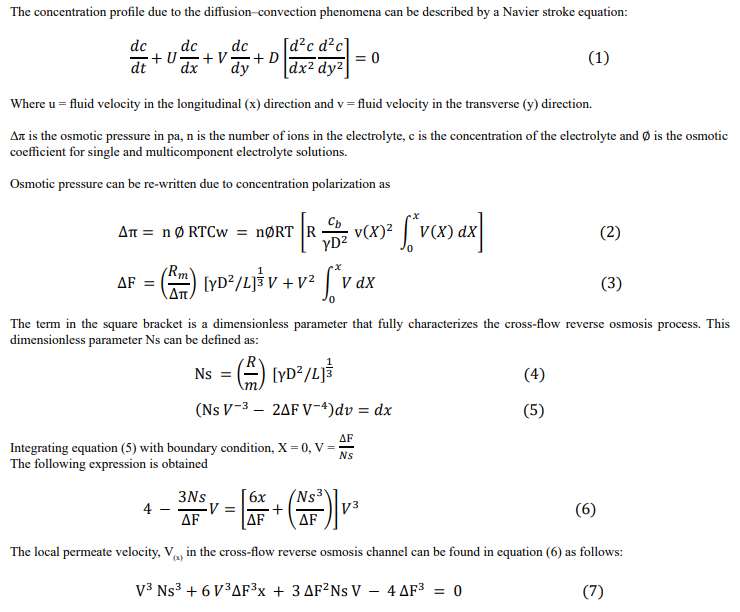
The developed equation for the local permeate velocity, equation (7), contains two dimensionless parameters (â??F and Ns) that need to be determined to predict permeate flux using the model.
Model Validation
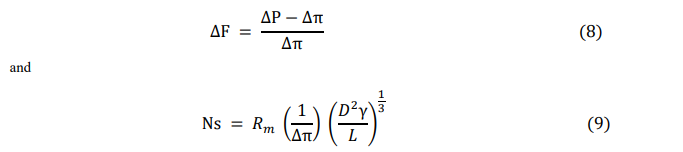
The obtained model for estimating the permeate velocity was verified against field data. Table shows membrane properties and physical data as well as both field and predicted values of the permeate water velocity. Estimated errors are between 3.7 % to 9.5 %.
|
Parameter |
8" RO unit |
4" RO unit |
2.5"RO unit |
|
Membrane properties and physical data: |
|||
|
Applied pressure, Δp, Pa |
8.27x10⁶ |
8.27x10⁶ |
6.9x10⁶ |
|
Bulk concentration, Cb, mol/m 3 |
1.7 |
50 |
2000 |
|
Temperature, T, K |
298 |
298 |
298 |
|
Osmotic pressure, â??π, Pa |
4.6 x 10³ |
2.48 x10⁵ |
5.4 x 10⁶ |
|
Membrane Water permeability, A, m•Pa-1s–1 |
4.5 x 10⁻¹⁰ |
4.5 x 10⁻¹⁰ |
4.5 x 10⁻¹⁰ |
|
Diffusion coefficient, D, m2 /s |
9.6x10⁻⁹ |
1.6x10⁻⁹ |
9.6x10⁻⁹ |
|
Channel length, L, m |
6.0 |
3.0 |
1.0 |
|
Membrane resistance, Rm, Pa.s/m |
1.0 x 10¹¹ |
1.0 x 10⁹ |
5.0 x 10⁹ |
|
Wall shear rate, γ, s-1 |
1000 |
1000 |
1000 |
|
Membrane salt rejection, Ro |
1 |
1 |
0.55 |
|
Evaluation of model parameters (â??F and Ns): |
|||
|
NS |
2.95 x10² |
2.76 x 10⁻¹ |
4.14 x 10⁻² |
|
â??F |
9.8 x 10² |
3.24 x 101 |
2.66 x 10⁻¹ |
|
Prediction of the permeate water velocity by the developed model: |
|||
|
Permeate water velocity, V, m/s |
1.9 x 10⁻⁵ |
3.1 x 10⁻⁴ |
1.31 x 10⁻³ |
|
Field data on permeate water velocity: |
|||
|
Permeate water velocity, V, m/s |
2.1 x10⁻⁵ |
2.9 x 10⁻⁴ |
1.2 x 10⁻³ |
|
|ð?ð«ð«ð¨ð«%| |
9.5 |
3.7 |
9.1 |
Table: Comparison between Predicted and Field Values of Permeate Water Velocity
Conclusions
Reverse osmosis desalination plants have become widely used for providing potable water. It is also utilized in industrial and municipal applications. Reverse osmosis suffers from various operational problems. Concentration polarization is considered one of the most common phenomena, which reduces water productivity, and limits the membrane life. So, concentration polarization may significantly affect the membrane performance in reverse osmosis. Concentration polarization is developed during the prolonged operation of the reverse osmosis plant. It can be avoided or at least delayed if better maintenance is attained. This can be achieved by modeling the concentration polarization and predicting the tendency of its formation. There are different models for the prediction of concentration polarization and flux behavior of reverse osmosis membrane systems. The solution-diffusion model which is based on diffusion of the salt and water through the membrane offers a good view of the passage of salt through a reverse osmosis membrane. On the other hand, the film theory model provides an evaluation of the membrane wall concentration. Concentration polarization then can be predicted by combining the film theory model and diffusion transport. For future work it is recommended to take care of the an intensive unsteady-state study is which will include the effects of long-term decline in product water flow due to fouling and membrane degradation.
References
- Palacin, L. G., Theodoropoulos, C., Weiguo, X., Tadeo, F., & De Prada, C. (2012, February). Two-scale modelling of the concentration polarization in a reverse osmosis membrane. In Chemical Process Control VIII, CPC 2012.
- Matthiasson, E., & Sivik, B. (1980). Concentration polarization and fouling. Desalination, 35, 59-103.
- Bhattacharyya, D., Back, S. L., Kermode, R. I., & Roco, M.C. (1990). Prediction of concentration polarization and flux behavior in reverse osmosis by numerical analysis. Journal of Membrane Science, 48(2-3), 231-262.
- Kim, S., & Hoek, E. M. (2005). Modeling concentration polarization in reverse osmosis processes. Desalination, 186(1-3), 111-128.
- Denisov, G. A. (1994). Theory of concentration polarization in cross-flow ultrafiltration: gel-layer model and osmotic-pressure model. Journal of Membrane Science, 91(1-2), 173-187.
- Zhou, W., Song, L., & Guan, T. K. (2006). A numerical study on concentration polarization and system performance of spiral wound RO membrane modules. Journal of Membrane Science, 271(1-2), 38-46.
- H. Strathmann. (1971). Control of CP in RO desalination of water, Desalination, 18, 179–201
- Al-Mutaz, I. S., & Alsubaie, F. M. (2017). Development of a mathematical model for the prediction of concentration polarization in reverse osmosis desalination processes. Desalination and Water Treatment, 71, 19-24.