

International Journal of Women's Health Care(IJWHC)
ISSN: 2573-9506 | DOI: 10.33140/IJWHC
Impact Factor: 1.011

Review Article - (2023) Volume 8, Issue 2
Migrant Men's Views and Experiences towards Female Genital Mutilation/Cutting (FGM/C) and its Prevention and Care in OECD Countries: A Qualitative Systematic Review Protocol
Received Date: May 24, 2023 / Accepted Date: Jun 09, 2023 / Published Date: Jul 07, 2023
Copyright: ©Â©2023 Mark Hayford Dwira. This is an open-access article distributed under the terms of the Creative Commons Attribution License, which permits unrestricted use, distribution, and reproduction in any medium, provided the original author and source are credited.
Citation: Dwira, M. H. (2023). Migrant Men's Views and Experiences towards Female Genital Mutilation/Cutting (FGM/C) and its Prevention and Care in OECD Countries: A Qualitative Systematic Review Protocol. Int J Women
Abstract
Objective: This review aims to synthesise male migrants' views and experiences about the provision of care services for survivors of FGM/C and related prevention strategies in healthcare settings in OECD countries.
Introduction: Concerns among survivors about FGM/C care access relate to the potential impact of newly enacted laws in the healthcare service delivery and whether their decisions to seek care are acceptable to their current or future male partners. Little is known about their male partners' views.
Inclusion Criteria: The review will consider articles that include male migrants of all ages who have close relationships with survivors and live in OECD countries. In studies comprising (men and women), where perspectives of men are reported separately, they will be included. Non-OECD countries' studies will be excluded.
Methods: The databases to be searched will include Ovid MEDLINE, EBSCOhost, CINAHL, ASSIA, Ovid Embase, PsycINFO, Cochrane Library, J.B.I. Databases and hand-searching of relevant journals. Unpublished studies will be searched through OpenGray and websites of national and international organisations working on FGM/C, including the National Health Services and World Health Organisation. The search will identify English-language publications from January 2002 onwards. Titles and abstracts will be reviewed first, and then full texts will be screened by two independent reviewers against the inclusion criteria. Any disagreements will be resolved through discussion or a third reviewer. The result will be critically appraised for methodological quality. Data extraction results will be synthesised and evaluated for credibility and dependability.
Keywords
Female Genital Mutilation/Cutting, FGM/C-Related Care Services, FGM/C Prevention Strategies, Men, Oecd Countries
Introduction
What is Already Known on this Topic?
Evidence shows that FGM/C survivors in some developed coun- tries have raised care-seeking concerns about the impact of laws being incorporated into providing FGM/C-related care services. It has also been found that survivors doubt whether their current or future partners would accept their decisions to take up the care services.
What this Study Adds?
A new insight into how male partners perceive the medico-legal approach adopted by most developed countries in providing FG- M/C-related care services and how they accept the survivor's deci- sion to seek the services.
How this Study Might Affect Research, Practice or Policy?
The review's findings could inform stakeholders and policymakers in developed countries to reconsider and re-evaluate their medi- co-legal approach and adopt a more family-inclusive educational strategy. The researcher believes this could incentivise survivors and their families to access FGM/C-related care services.
The care and prevention of female genital mutilation/cutting (FG- M/C) for survivors and those at risk have recently received global recognition. The practice, which involves partial or total remov- al of the external female genital organs, whether for cultural or non-medical reasons, can cause harm and has no health benefits for women and girls [1]. FGM/C is categorised into four types: I-clitoridectomy, II-excision, III-infibulation, and IV- all other genital injuries, including piercing, cauterising, pricking, bleeding, and incising1. Around 90% of FGM/C reported cases in various healthcare centres worldwide to comprise clitoridectomy and exci- sion, while about 10% constitute infibulation [2]. Of these types, I, II and IV may result in short-term effects, including haemorrhage, shock, septicaemia, and tetanus [2]. Long-term consequences are primarily associated with type III, including traumatic sexual in- tercourse, obstetric, gynaecological, psychological and mental health problems [2].
These severe effects of FGM/C on women and girls have inspired the development of care and prevention strategies in OECD coun- tries. These countries are non-FGM practising countries that share common economic and social-political principles regarding social and healthcare policies to better the well-being of their citizens [3]. This proposed review has been conducted in the OECD con- text because no existing review is available. In terms of preventive strategies, several different approaches are being implemented. In this review, they are classified into two categories: lawful and so- cial methods. Regarding their implementation, research has shown that the legal methods aimed at discouraging people from perform- ing the practice. In contrast, the social method consists of FGM/C advocacy and educational programmes used to empower and cre- ate awareness among individuals in the community [4]. While the social methods are still being used, the trend towards FGM/C pre- vention in several OECD countries has been to prosecute perpetra- tors within practising communities [5]. For example, the Istanbul Convention that banned FGM/C in Europe has been signed and ratified by 34 out of 44 countries [6,7]. Additionally, 32 out of the 54 states in the U.S.A. have laws that criminalise the FGM/C practice [8]. In Canada, FGM/C is prohibited under section 268 of the Criminal Code [6,7].
In some healthcare systems, the delivery of FGM/C care has been implicated by laws safeguarding unborn children and those under 18 years from being circumcised by their circumcised mothers. For example, the Serious Crime Act 2015 in the U.K. requires all healthcare providers (H.C.P.) to record all FGM/C cases and report those involving girls under the age of 18 to the police [9]. Addi- tionally, all H.C.Ps must flag and mark the electronic healthcare records of girls under 18 at risk of FGM/C and make their infor- mation available to other healthcare professionals [10]. Literature on whether these implemented legal strategies, particularly those in the service delivery, have impacted individuals from the prac- tising communities in OECD countries has been primarily studied among survivors than their male partners [11]. This makes this re- view timely as it may provide some insight.
Regarding FGM/C-related care services provision in OECD coun- tries, specialised services are given to non-pregnant survivors, in- cluding counselling, sexual and psychosexual, gynaecological and mental health, has been commissioned in the U.K. and Norway in recent years [12,13]. However, research had shown that FG- M/C care for pregnant survivors had long been offered in preg- nant-related units in healthcare settings such as the maternity and obstetric units [11]. While many studies on these services have been explored from the perspectives of FGM/C survivors and healthcare professionals, few studies have been conducted from the perspective of male partners [11,14,15]. The limitation of this study is that the author concentrated on a single service, thus, ob- stetrics interventions, one of the many services offered to survivors and their immediate families in some healthcare settings in OECD countries. Therefore, conducting this review which focuses on discovering men's views and experiences about all the pregnancy and non-pregnancy-related care services provided, could be signif- icant. Importantly, research indicates that survivors' access to these care services could enhance their health and well-being while widening the advocacy regarding users' awareness of the care ser- vices. For instance, the National Health Service (N.H.S.) has re- ported that approximately 83% of survivors use pregnancy-related services against 17% for non-pregnancy-related ones in the UK [11,16]. Attributable factors for these service-use disparities are associated with the newly introduced laws in FGM/C care delivery and survivors' fears that their existing or future male partners will not approve if they use the services [17,18].
However, recent research suggests men's involvement could avert these barriers, particularly in influencing FGM/C survivors' deci- sion to seek care services [13,19]. This is because their roles in helping women to access related healthcare services have had con- siderable positive consequences both in OECD and non-OECD countries [20]. For example, men have helped improve maternal health through increasing access to prenatal and postnatal care, encouraging healthcare seeking, and increasing both sexes' usage of H.I.V. testing and contraception [20]. In the case of FGM/C-re- lated care services in OECD countries, scholars have sought to understand how male migrants have played a part in the deci- sion-making role of preventing circumcision among girls [21,22]. Additionally, studies on men's involvement have been dominant in developing FGM/C preventive strategies by emphasising on their roles as fathers and husbands, faith and community leaders in fighting the practice [23].
However, literature remains unclear about male migrants' views on all FGM/C-related care services, their roles in survivors' care-seek- ing decisions and the nature of support they could offer survivors to access care. Aside from these, nothing is known about male mi- grants' perspectives on the newly introduced laws in FGM/C care delivery and how this may discourage their engagement in help- ing survivors to seek care. Therefore, conducting such a synthesis could provide evidence that could be useful for the prospective development of care pathways to include men while identifying ways of engaging them to support access to FGM/C care among survivors.
A preliminary search of PROSPERO, MEDLINE, the Cochrane Database of Systematic Reviews and the JBI EBP Databases was conducted, and one related review was identified [24]. However, the proposed review differs from it in terms of context (focus sole- ly on OECD countries) and purpose (men's role in caring for sur- vivors and preventing FGM/C in healthcare settings). This review aims to synthesise male migrants' views and experiences of the provision of care services for survivors of FGM/C and related pre- vention strategies in healthcare settings in OECD countries.
Review Question(s)
What are the views and experiences of male migrants towards the provision of FGM/C-related care services and prevention strate- gies in healthcare in OECD countries?
Inclusion Criteria
Participants
The review will consider studies that included male migrants from FGM-practising countries of all ages who have close relationships with FGM/C survivors and who currently live in OECD countries. In this review, migrants' status will be explored when the included articles use participants from the list of practising countries pro- vided in the UNICEF 2016 report [25]. According to this review, close relationships include husbands, boyfriends, fiancés, divorced males and widowers who have ever had intimate interactions with FGM/C survivors and those living with circumcised daughters or sisters (i.e. fathers, brothers and guardians). The term "male mi- grants" is used in this review to refer to men from the FGM/C practising communities. However, many journals to be searched for this review have used "men" or "male" interchangeably in their databases. So these terms will be used as part of my search words in this review to identify relevant articles. In studies where the sample population is mixed (male and female), they will be in- cluded in the views of male migrants and are reported separately. The review will exclude all studies that recruited participants from non-OECD countries.
Phenomena of Interest
This review will consider studies that explore the views and experi- ences of male migrants regarding; (i) the provision of care services related to FGM/C and (ii) FGM/C-related preventive strategies. These two phenomena have been selected for this review because they are consistent with the global trend of addressing FGM/C as a public health issue, which considers studies that suggest lasting approaches that could improve and protect the health and well-be- ing of survivors and those at risk of the practice, respectively.
Context
The review will be restricted to studies conducted in OECD coun- tries. For this review, OECD countries refer to countries with simi- lar socio-political principles regarding social policy and healthcare, enabling comparison across contexts [3]. Examples of OECD coun- tries where FGM discussions have attracted policy recognition in- clude the U.K., Europe, the U.S.A, Australia, Sweden, and Norway [3]. In addition, OECD countries are considered the destination countries for many migrant groups from FGM/C practising coun- tries and share similar challenges in developing health and policy re- sponses to what has previously been an unfamiliar cultural practice. The review will exclude papers from non-OECD countries.
Types of Studies
This review will consider studies that focus on primary qualitative data, including, but not limited to, designs such as phenomenolo- gy, grounded theory, action research, ethnography, and Feminist research. It will also include mixed-methods studies if the qual- itative component is reported separately. Finally, the review will include studies and reports only published in English due to a lack of financial constraints for translation.
Methods
The proposed systematic review will be conducted in accordance with the Joanna Briggs Institute methodology for systematic re- views of qualitative evidence [26]. The review has been registered at PROSPERO with registration number CRD42019155518
Search Strategy
The search strategy aims to locate both published and unpublished studies. A three-step search strategy will be utilised in this review. First, an initial limited search of MEDLINE and CINAHL will be undertaken to identify articles on the provision of care services and FGM/C-related prevention strategies from the male migrants' perspective. This will be followed by analysing the text words contained in the titles and abstracts and the index terms used to describe the articles. A second search will be conducted using all identified keywords and index terms across all the included data- bases. Third, the reference list of all identified reports and articles will be searched for additional studies. Studies published from 2002 to date and in English will be considered for inclusion in this review. This timeframe was selected to recognise the U.N. General Assembly's reaffirmation action of adopting a resolution on "tradi- tional or customary practices, including FGM/C affecting women's and girls' health" on January 30, 2002.
The databases to be searched for published articles include Ovid MEDLINE, Ovid Embase, PsycINFO, EBSCOhost, CINAHL, ASSIA, Cochrane Library, JBI EBP Databases, and Google Schol- ar. In addition, grey literature will be searched from; OpenGrey literature from Europe, Nottingham edissertation, and Nottingham eThese. The grey literature included in this review will be used in conjunction with the published included articles to broaden the base of evidence discovery and produce a comprehensive review. The website of national, regional and international organisations that are doing work on FGM/C, such as the World Health Organ- isation (WHO), European Institute for Gender Equality (EIGE), Foundation for Women's Health Research and Development (FORWARD). Authors will be contacted for further details in areas where clarification is required. The initial keywords to be used will be views, experiences, female genital mutilation, genitalia, female circumcision, men, male, male migrants, migrant men, FMG/C care-seeking, decision-making, FGM/C Preventive strategies, and OECD countries. Index terms, subject headings for each database, Boolean operators (AND/OR), and wild cards will be used. A sam- ple of the search strategy has been developed (Appendix I).
|
Database: MEDLINE via (Ovid) Date: 04/07/2022 |
Search Words |
Limits ( filter, Number of limits and Records refine) |
|
|
|
|
Publication dates: 2002- 2022 and English language. |
|
|
#1 |
exp circumcision, Female or female genital mutilation.mp. |
|
2017 |
|
#2 |
(“female genital mutilation” or “female circumcision” or “female genital cutting” or “traditional female genital surgery” or infibulate*or reinfibulat* or defibulat* or clitoridect*).mp. [mp=title,abstract, original title,name of substance word, subject heading word, floating sub- heading word, keyword heading word, organism supplementary concept word, protocol supplementary concept word, rare disease supplementary concept word, unique identifier, synonyms] |
|
1905 |
|
#3 |
((((ritual* or traditional* or ceremon* or sociali#ation*) adj3(practice* or cut or cutting or surg*)) or circumcis*or excis*)adj3(female* or wom#n or girl*or child* or adolescen*)).mp. |
|
3537 |
|
#4 |
(FGM or FGC or TFGS or FGMC).mp |
|
1846 |
|
#5 |
“FGM/C”.mp |
|
191 |
|
#6 |
1 or 2 or 3 or 4 or 5 |
|
4979 |
|
#7 |
exp Men/ |
|
4910 |
|
#8 |
(husband or brother or father).mp |
|
40572 |
|
#9 |
exp “Transients and Migrants”/ or exp “Emigrants and Immigrants”/ |
|
26149 |
|
#10 |
migrant.mp. or exp “Transients and Migrants”/ |
|
19643 |
|
#11 |
7 or 8 or 9 or 10 |
|
77341 |
|
#12 |
6 and 11 |
|
209 |
|
# 13 |
Exp Developed Countries/ |
|
20900 |
|
# 14 |
(((((((GERMAN* and GREECE) or greek*) and ICELAND*) or IRELAND or irish or ISRAEL*) and ITALY) or Italian* or JAPAN* or KOREA*) and MEXIC*).mp. |
|
1249 |
|
#15 |
((((((((AUSTRALIA* and AUSTRIA* AND BELGIUM*) or Belgian*) and |
|
76018 |
|
|
CANAD*and CHILE*) or DENMARK* or Danish*) and FINLAND) or Finnish and FRANCE) or French).mp. |
|
|
|
#16 |
((((((((((((SPAIN or spanish) and SWED* and SWITZERLAND) or swiss) and TURK* and “UNITED KINGDOM”) or “UK” or Britain or British) and England) or English) and scot* and wales) or welsh) and “UNITED STATES”) or “USA” or America*).mp. |
|
637764 |
|
#17 |
(((((((((((NETHERLAND* or Holland* or dutch) and “low countries”) or europe* and NEW ZEALAND*” and NORWAY) or norwegian*) and POLAND) or polish and PORTUGAL) or Portuguese).mp. |
|
14594 |
|
#18 |
13 or 14 or 15 or 16 or 17 |
|
736786 |
|
#19 |
12 and 18 |
|
34 |
Appendix I: Search strategy from MEDLINE (Ovid) Database (Search conducted on 04/07/2022)
Study Selection
Following the search, all identified citations will be collated and uploaded into EndNote, v.9 (Clarivate Analytics, PA, U.S.A.), and duplicates will be removed. Titles and abstracts will then be screened by two independent reviewers for assessment against the inclusion criteria for the review. Relevant studies will be retrieved in total. Their citation details will be imported into the J.B.I. Sys- tem for the Unified Management, Assessment and Review of In- formation (JBI SUMARI, J.B.I., Adelaide, Australia) [27]. Two independent reviewers will assess the full text of selected citations in detail against the inclusion criteria. The systematic review will record and report reasons for excluding full-text studies that do not meet the inclusion criteria. Any disagreements between the reviewers at each stage of the selection process will be resolved through discussion or with a third reviewer. The search results and the study inclusion process will be reported in full in the final sys- tematic review and presented in a Preferred Reporting Items for Systematic Reviews and Meta-analyses (PRISMA) flow diagram [28].
Assessment of Methodological Quality
Two independent reviewers will critically appraise qualitative papers for methodological validity using the standardised critical appraisal instrument from Joanna Briggs Institute Qualitative As- sessment and Review Instrument (JBI-QARI). Authors of articles will be contacted to request missing or additional data for clar- ification, where required. Any disagreements that arise between the reviewers will be resolved through discussion or with a third reviewer. The critical appraisal results will be reported in narra- tive form and in a table. Following the critical appraisal, studies that do not meet a certain quality threshold will be excluded: This decision will be based on the following: Q1: congruity between re- search methodology and research question. Q2: congruity between research methodology and methods to collect data. Q3: congruity between methodology and data analysis. Q4: congruity between methodology and results interpretation. Q5: adequate Participants' representation and their voices; Q6: ethical conduct of research/ evidence of ethical approval by the appropriate authority.
Data Extraction
Qualitative data will be extracted from papers included in the re- view utilising the standardised data extraction tool from JBI-QA- RI [26]. The data extracted will include specific details about the study methodology, methods, phenomena of interest, population or research participants, context, related outcomes of the studies relevant to the review questions, and specific objectives. Aside from these, other data to be extracted include the types of male re- lationships represented in the articles reviewed and migrant status to understand and assess the nature of sampled participants used in the reviewed articles.
Another data to be extracted had to do with those related health- care settings that have been explored to date in the reviewed pa- pers. This will allow the author to expose gaps in healthcare where services are not being provided. Data on the ages of participants would be extracted to understand the age range of participants uti- lised in the reviewed articles regarding the care and prevention of services. These additional data to be extracted have been captured in the modified extracted form (see Appendix II). One reviewer (primary reviewer) will extract the data and then discuss it with the entire review team as a form of validation and verification to minimise potential errors. As indicated above, the original authors of the papers will be contacted if any issues are needed for clarifi- cation during the data extraction.

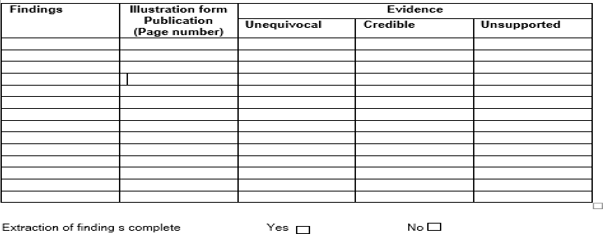
Appendix II: Data extraction instrument (QARI data extraction instrument)

Appendix III: Appraisal Instruments (QARI Appraisal Instruments)
Data Synthesis
Qualitative research findings will, where possible, be pooled using J.B.I.'s SUMARI with a meta-aggregation approach to synthesise [29]. This will involve the aggregation or synthesis of findings to generate statements representing that aggregation by assembling the findings (level finding 1) rated according to their quality and categorising these findings on the basis of similarity in meaning (level 2 findings). These categories will then be subjected to a me- ta-synthesis to produce a comprehensive set of synthesised con- clusions (Level 3 findings) that can be used for evidence-based practice. Where textual pooling is impossible, the findings will be presented in narrative form. Only unequivocal and credible find- ings will be included in the synthesis.
Assessing Confidence in the Findings
The final synthesised findings will be graded using the ConQual approach to establish confidence in the qualitative research synthe- sis output. The results will be presented in a Summary of Findings [30]. The Summary of Findings includes the major elements of the review and details how the ConQual score is developed. In addition, the summary of findings will have the title, population, phenomena of interest and context for the specific review. Each synthesised result from the review will then be presented, along with the type of research informing it, the score for dependability and credibility and the overall ConQual score.
Conclusions
This will involve the aggregation or synthesis of findings to gen- erate statements representing that aggregation by assembling the findings (level finding 1) rated according to their quality and cate- gorising these findings on the basis of similarity in meaning (level 2 findings). These categories will then be subjected to a meta-syn-thesis to produce a comprehensive set of synthesised conclusions (Level 3 findings) that can be used for evidence-based practice. Where textual pooling is impossible, the findings will be presented in narrative form. Only unequivocal and credible findings will be included in the synthesis.
References
- Ohchr, U., Undp, U., Unesco, U., & UNIFEM, W. (2008).Eliminating Female genital mutilation. An interagency state- ment. Geneva: WHO.
- Reisel, D., & Creighton, S. M. (2015). Long term health con- sequences of Female Genital Mutilation (FGM). Maturitas, 80(1), 48-51.
- OECD. SIGI 2019 Global Report. 2019.
- Baillot, H., Murray, N., Connelly, E., & Howard, N. (2018). Addressing female genital mutilation in Europe: a scoping review of approaches to participation, prevention, protection, and provision of services. International journal for equity in health, 17(1), 1-15.
- Johansen, R. E. B., Diop, N. J., Laverack, G., & Leye, E. (2013). What works and what does not: a discussion of popu- lar approaches for the abandonment of female genital mutila- tion. Obstetrics and gynecology international, 2013.
- De Vido, S. (2016). The ratification of the Council of Europe Istanbul Convention by the EU: a step forward in the protec- tion of women from violence in the European legal system. Eur. J. Legal Stud., 9, 69.
- Burrage, H. (2015). Eradicating female genital mutilation: A UK perspective. Ashgate Publishing, Ltd..
- McVeigh, K. (2018). ‘US Is Moving Backwards’: Female Genital Mutilation Ruling A Blow To Girls At Risk. The Guardian.
- Parliament of the United Kingdom. Serious Crime Act 2015. In: Kingdom PotU, (ed.). c 9. 2015.
- Department of Health. Female Genital Mutilation Risk and Safeguarding Guidance for professionals London Department of Health, 2016.
- Evans, C., Tweheyo, R., McGarry, J., Eldridge, J., Albert, J., Nkoyo, V., & Higginbottom, G. (2019). Improving care for women and girls who have undergone female genital mutila- tion/cutting: qualitative systematic reviews.
- Department of Health. Commissioning services to support women and girls with female genital mutilation. London: De- partment of Health, 2015.
- Johansen, R. E. B. (2017). Virility, pleasure and female gen- ital mutilation/cutting. A qualitative study of perceptions and experiences of medicalized defibulation among Somali and Sudanese migrants in Norway. Reproductive health, 14, 1-12.
- Turkmani, S., Homer, C. S., & Dawson, A. (2019). Maternity care experiences and health needs of migrant women from fe- male genital mutilation–practicing countries in highâ?ÂÂincome contexts: A systematic review and metaâ?ÂÂsynthesis. Birth, 46(1), 3-14.
- Johnson-Agbakwu, C. E., Helm, T., Killawi, A., & Padela, A.I. (2014). Perceptions of obstetrical interventions and femalegenital cutting: insights of men in a Somali refugee communi- ty. Ethnicity & Health, 19(4), 440-457.
- N.H.S. Digital. Female Genital Mutilation (FGM) Enhanced Dataset July 2019 to September 2019, England, experimental statistics. London Health and Social Care Information Cen- tre., 2019.
- Plugge, E., Adam, S., El Hindi, L., Gitau, J., Shodunke, N., & Mohamed-Ahmed, O. (2019). The prevention of female genital mutilation in England: what can be done?. Journal of Public Health, 41(3), e261-e266.
- Ziyada, M. M., Lien, I. L., & Johansen, R. E. B. (2020). Sex- ual norms and the intention to use healthcare services related to female genital cutting: A qualitative study among Somali and Sudanese women in Norway. PloS one, 15(5), e0233440.
- Johansen, R. E. B. (2017). Undoing female genital cutting: perceptions and experiences of infibulation, defibulation and virginity among Somali and Sudanese migrants in Norway. Culture, health & sexuality, 19(4), 528-542.
- Ruane-McAteer, E., Amin, A., Hanratty, J., Lynn, F., van Willenswaard, K. C., Reid, E., ... & Lohan, M. (2019). In- terventions addressing men, masculinities and gender equal- ity in sexual and reproductive health and rights: an evidence and gap map and systematic review of reviews. BMJ Global Health, 4(5), e001634.
- O’Neill, S., Dubourg, D., Florquin, S., Bos, M., Zewolde, S., & Richard, F. (2017). Men have a role to play but they don’t play it: a mixed methods study exploring men’s involvement in female genital mutilation in Belgium, the Netherlands and the United Kingdom: summary. Men Speak Out Project. Brus- sels.
- Gele, A. A., Kumar, B., Hjelde, K. H., & Sundby, J. (2012). Attitudes toward female circumcision among Somali immi- grants in Oslo: a qualitative study. International Journal of women's Health, 7-17.
- O’Brien, O., Baldeh, F., Sivapatham, S., Brown, E., & O’May,F. (2016). Participatory Action Research Project with Men, Women and Young People on Female Genital Mutilation (FGM) in Scotland:(Phase 1). Waverly Care, Edinburgh: Queen Margaret University.
- Varol, N., Turkmani, S., Black, K., Hall, J., & Dawson, A. (2015). The role of men in abandonment of female genital mutilation: a systematic review. BMC public health, 15(1), 1-14.
- UNICEF. Female genital mutilation/cutting: A global concern UNICEF DATA. New York: UNICEF, 2016.
- Lockwood C, Porrit K, Munn Z, et al. Chapter 2: Systematic reviews of qualitative evidence. Reviewers' Manual Edited by Aromataris E, Munn Z(editors), The Joanna Briggs Institute. 2017.
- Munn, Z., Aromataris, E., Tufanaru, C., Stern, C., Porritt, K., Farrow, J., ... & Jordan, Z. (2019). The development of soft- ware to support multiple systematic review types: the Joanna Briggs Institute System for the Unified Management, Assess- ment and Review of Information (JBI SUMARI). JBI Evi- dence Implementation, 17(1), 36-43.
- Page MJ and Moher D. Evaluations of the uptake and impact of the Preferred Reporting Items for Systematic reviews and Meta-Analyses (PRISMA) Statement and extensions: a scop- ing review. Systematic reviews. 2017; 6: 1-14.
- Lockwood, C., Munn, Z., & Porritt, K. (2015). Qualitative research synthesis: methodological guidance for systematic reviewers utilizing meta-aggregation. JBI Evidence Imple-mentation, 13(3), 179-187.
- Munn, Z., Porritt, K., Lockwood, C., Aromataris, E., & Pear- son, A. (2014). Establishing confidence in the output of quali- tative research synthesis: the ConQual approach. BMC medi- cal research methodology, 14(1), 1-7.