



Narrative Case Study - (2026) Volume 9, Issue 4
Longitudinal Health Symptom, Treatment and Control Summary (2008-2026) A Longitudinal Synthesis of Symptom Burden, Autonomic Linkage, Intervention, Recovery and Present Level of Control

Received Date: Sep 21, 2026 / Accepted Date: Oct 16, 2026 / Published Date: Oct 28, 2026
Copyright: ©2026 Bruce H. Knox. This is an open-access article distributed under the terms of the Creative Commons Attribution License, which permits unrestricted use, distribution, and reproduction in any medium, provided the original author and source are credited.
Citation: Knox, B. H. (2026). Longitudinal Health Symptom, Treatment and Control Summary (2008â2026) A Longitudinal Synthesis of Symptom Burden, Autonomic Linkage, Intervention, Recovery and Present Level of Control. Adv Neur Sci, 9(4), 01-16.
Abstract
This document brings together 50 recorded health conditions or symptom complexes across the period 2008–2026. Its purpose is to show, in one longitudinal record, what occurred, how each problem may or may not relate physiologically to secondary autonomic dysfunction/MSAD, what treatment or management was used, what outcome followed, and the present level of control. The table is therefore both a chronology and a functional account of recovery, adaptation and continuing clinical burden. This is, fundamentally, a very personal medical log, arising from my own recordings, observations and continuing analysis of a complex health journey since 2008.
Purpose and Scope
This document brings together 50 recorded health conditions or symptom complexes across the period 2008–2026. Its purpose is to show, in one longitudinal record, what occurred, how each problem may or may not relate physiologically to secondary autonomic dysfunction/MSAD, what treatment or management was used, what outcome followed, and the present level of control. The table is therefore both a chronology and a functional account of recovery, adaptation and continuing clinical burden. This is, fundamentally, a very personal medical log, arising from my own recordings, observations and continuing analysis of a complex health journey since 2008. The account has been developed in dialogue with the medical team that has supported me, whose clinical assessments and care have helped validate its central observations, and it has also been tested against relevant findings reported in the medical literature. I wrote it primarily to help myself understand the sequence, interrelationships and changing significance of what has happened over nearly two decades. It is therefore offered with the understanding that it is personal, candid and deliberately honest—not as a substitute for individual medical advice, but as a carefully considered lived-experience record that may help others facing a similar situation gain a greater sense of confidence, context and understanding in making sense of their own journey.

What has been done
• Each row is anchored to a period and a two- or three-word symptom summary, allowing the reader to identify the issue immediately before reading the detailed explanation.
• Column 2 records the condition or symptom complex and then, in italics, evaluates the MSAD/autonomic linkage using four mutually exclusive categories: PROBABLE, POSSIBLE, INDIRECT or NO ASSOCIATION. The colour-coded word in each row identifies the linkage category immediately.
• The linkage analysis is based on recognised physiology, the documented timing and pattern of symptoms, and the cumulative autonomic-reserve framework developed through the author’s MSAD work. It is intended to express biological plausibility, not to claim that every symptom was caused by dysautonomia.
• Key sources are identified within the cells and hyperlinked so that the underlying reference material can be opened directly.
• Columns 3–5 then show management, observed outcome and a current status classification: Resolved (R), Under Control (UC), Under Control Watchlist (UCWL), or Not Under Control Watchlist (NUCWL).
Current Position at a Glance
|
50 |
46 |
4 |
92% |
|
recorded entries |
resolved or under control |
not under control |
resolved or controlled |
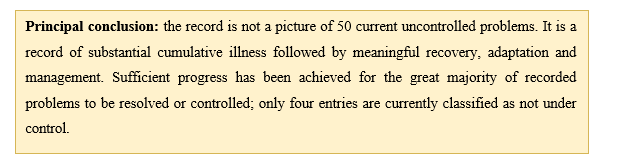
The statistical summary records 11 resolved entries (22%), 26 under control (52%), 9 under control but retained on the watchlist (18%), and only 4 not under control and remaining on the watchlist (8%). Thus, 46 of 50 entries (92%) are either resolved or presently controlled, although some continue to require active monitoring. UC and UCWL together account for 35 entries (70%) that remain under active management or control.
A selection of musical presentation can be accessed in this flipbook. These lyrics capture much of the story outlined in the summary findings below.

How the Table Should Be Read
Method, interpretive framework and meaning of the status categories
• Longitudinal Method
The table uses a retrospective longitudinal synthesis. It follows the documented sequence of illness, procedures, symptoms, interventions and response over time rather than treating each problem as an isolated event. This makes it possible to distinguish conditions that preceded the major autonomic deterioration from symptoms that appeared, intensified or became more functionally important after the later cardiovascular events.
• Three-Hit Physiological Framework
The table is interpreted against a three-hit working model: Hit 1 is the late-2008 CHIKV illness, described in the clinical history at the time as the virus “attacking the heart”, followed by myocarditis and subsequent cardiovascular difficulties; Hit 2 is the ventricular perforation, cardiac tamponade and haemodynamic collapse during LVOT PVC ablation on 15 October 2021; Hit 3 is the same-day emergency sternotomy, cardiopulmonary bypass and ventricular repair. The model proposes that repeated viral-inflammatory, haemodynamic and major-surgical stress may have cumulatively reduced autonomic and physiological reserve. It is a biologically plausible explanatory framework, not proof of a single causal chain.
• How Autonomic Linkage is Expressed
|
Autonomic linkage status |
Meaning in this table |
|
PROBABLE |
Recognised autonomic mechanism with a strong fit to the documented pattern. |
|
POSSIBLE |
Biologically plausible relationship, but the symptom is not specific to autonomic dysfunction. |
|
INDIRECT |
The condition may amplify symptom burden, reduce cardiovascular or physiological reserve, or complicate autonomic compensation without itself being an autonomic manifestation. |
|
NO ASSOCIATION |
No direct autonomic association is identified; the condition is retained as a separate structural, inflammatory, mechanical or other diagnosis. Any indirect reserve effect is described separately where relevant. |
• Meaning of the Current Status
|
Code |
Interpretation |
Current total |
|
R |
Resolved |
11 | 22% |
|
UC |
Under control |
26 | 52% |
|
UCWL |
Under control, but retained on watchlist because significant care, specialist review or close monitoring remains necessary |
9 | 18% |
|
NUCWL |
Not under control and retained on watchlist |
4 | 8% |
|
PROBABLE — 18 | 36% |
POSSIBLE — 15 | 30% |
INDIRECT — 13 | 26% |
NO ASSOCIATION — 4 | 8% |
• Overall Interpretation: MSAD as a Multisystem Package
Taken together, the linkage classifications show a coherent system-level pattern rather than a collection of 50 unrelated problems. Of the 50 recorded entries, 18 (36%) are PROBABLE, 15 (30%) are POSSIBLE, and 13 (26%) are INDIRECT. Only 4 (8%) are classified as NO ASSOCIATION. Thus, 46 of 50 entries (92%) have at least a probable, possible or indirect physiological relationship to the wider autonomic picture, while four are best retained as separate diagnoses. This does not mean that MSAD caused all 46 conditions; rather, it shows that autonomic dysfunction provides a plausible integrating framework for understanding how many of the symptoms arose, interacted, were amplified, or became harder to compensate for. In this synthesis, MSAD is therefore best understood as a package: an umbrella description of an autonomic nervous system whose automatic regulatory functions became dysregulated across several domains at the same time. The table documents strong or plausible autonomic involvement in blood-pressure and baroreflex control, heart-rate and vascular responses to standing and exertion, sweating and temperature regulation, gastrointestinal motility, bladder filling and emptying, pupillary responses, and the fatigue/cerebral-perfusion burden of upright activity. Other structural, inflammatory, cardiac or mechanical conditions sit around that core picture as indirect contributors because they can add physiological load, reduce reserve, or make autonomic compensation more difficult. The three-hit chronology offers a coherent temporal context for this cumulative loss of reserve, while remaining a working physiological model rather than proof of a single causal chain.
The positive conclusion is equally important. A dysregulated autonomic system is not necessarily a permanently failing system. Across this record there is substantial evidence of recovery, compensation, treatment response and learned management. Independently of the linkage classifications above, 46 of the 50 entries (92%) are now either resolved or under control, including those retained on the watchlist; only four entries (8%) remain classified as not under control. Taken as a whole, the longitudinal pattern is therefore most consistent with multifactorial secondary dysautonomia that has been extensive but increasingly contained: the system remains vulnerable and imperfectly regulated, but the dominant direction is toward adaptation, restored function and practical control rather than relentless deterioration.
Important interpretive limit: this remains a longitudinal single-case synthesis. The linkage categories describe physiological plausibility and interaction, not proof that autonomic dysfunction caused every recorded condition. Structural, inflammatory, medication-related and other diagnoses remain identified separately where appropriate.
Longitudinal Health Symptom, Treatment and Control Summary (2008 2026)
Highlighted entries are those identified from the table wording as involving significant ongoing care, specialist review, or close monitoring.
Status: R = Resolved | UC = Under control | UCWL = Under Control Watchlist | NUCWL = Not Under Control Watchlist Amber highlight = UCWL/NUCWL: [not] / under control, but requiring significant ongoing care, specialist review, or close monitoring
Autonomic-linkage colour key used below: PROBABLE = recognised autonomic mechanism with a strong fit to the documented pattern; POSSIBLE = biologically plausible but not specific; INDIRECT = may amplify burden, reduce physiological reserve or modify autonomic compensation; NO ASSOCIATION = no direct autonomic association identified and the condition is retained separately. These linkage categories express physiological plausibility, not proof of causation, and are separate from the R/ UC/UCWL/NUCWL clinical-control status in the final column.
Three-hit framework: Hit 1 = late-2008 CHIKV illness, described in this clinical history by the treating cardiologist as the virus 'attacking the heart', followed by myocarditis/cardiovascular dificulties; Hit 2 = ventricular perforation with cardiac tamponade and haemodynamic collapse during LVOT PVC ablation on 15 October 2021; Hit 3 = same-day emergency sternotomy, cardiopulmonary bypass and ventricular repair. The model proposes cumulative loss of autonomic/physiological reserve from repeated viral-inflammatory, haemodynamic and major-surgical stress. It is a working physiological hypothesis based on temporal sequence and biological plausibility, not proof of causation.
|
Period |
Medical condition or symptom complex/how this is related to MSAD |
Treatment or management approach |
Outcome or level of control achieved |
Status |
|
2008 Urinary outlet obstruction |
Prostate/urethral problems, later including urethral stricture and obstructed emptying MSAD linkage (POSSIBLE): structural outlet disease is not autonomic, but bladder filling sensation, detrusor activity and coordinated emptying depend on autonomic pathways. In this history, urethral obstruction and possible autonomic bladder dysfunction can therefore coexist and compound incomplete emptying. Three-hit context: later autonomic bladder impairment may have been superimposed on pre-existing structural outlet disease, especially after Hits 2-3. Key source: National Institute of Diabetes and Digestive and Kidney Diseases, “Autonomic Neuropathy.” |
Prostate surgery in 2008; intermittent self-catheterisation; urethroplasty in 2019; another urethral procedure in November 2022 |
Structural repair and catheterisation provided management; later urinary emptying difficulties persisted. |
UC |
|
2008, late |
Acute chikungunya—CHIKV: fever, rash, severe joint pain and profound fatigue. The clinical |
Hospital |
You survived |
R |
|
Acute |
understanding at the time was that a virus was attacking your heart, with no clear prediction of |
admission in April |
the acute illness. |
|
|
CHIKV |
which way the outcome would go. |
2009 with critical- |
Persistent joint |
|
|
illness |
MSAD linkage (POSSIBLE): major viral illness can be followed by persistent autonomic |
care monitoring |
symptoms, fatigue |
|
|
|
disturbance through post-viral inflammatory, immune and neural mechanisms. Within the |
and supportive |
and subsequent |
|
|
|
cumulative-injury/autonomic-reserve framework developed in the MSAD work, CHIKV |
management for |
cardiovascular |
|
|
|
is therefore a biologically plausible early 'hit', although the later dysautonomia cannot |
the acute viral |
difficulties became |
|
|
|
be attributed to it alone. Three-hit context: this is Hit 1, the proposed initiating viral- |
illness and cardiac |
part of the longer |
|
|
|
inflammatory/cardiac stressor in the model. |
involvement |
health journey. |
|
|
|
Key source: National Institute of Neurological Disorders and Stroke, “Postural Tachycardia |
|
|
|
|
|
|
|
|
|
|
2008 |
Persistent or recurrent joint pain following CHIKV |
Ongoing symptom |
Persistent joint pain |
UC |
|
onwards |
MSAD linkage (INDIRECT): persistent post-CHIKV joint pain is not itself an autonomic sign, |
monitoring, |
remained part of |
|
|
Persistent |
but chronic pain and inflammatory stress can increase sympathetic load, reduce activity and |
pacing and |
the longer recovery; |
|
|
joint pain |
deconditioning reserve, and consume physiological reserve. It may therefore amplify MSAD |
activity |
pacing and activity |
|
|
|
burden without being caused by MSAD. Three-hit context: persistent post-CHIKV pain added |
adjustment during |
adjustment |
|
|
|
physiological load after Hit 1 and may have reduced later reserve. |
recovery from |
supported day- |
|
|
|
Key source: Blitshteyn, “Dysautonomia: a common comorbidity of systemic disease,” 2025. |
CHIKV |
to-day function, |
|
|
|
|
|
with the degree |
|
|
|
|
|
of resolution |
|
|
|
|
|
remaining variable. |
|
|
2009 |
Myocarditis, diagnosed at North Shore Hospital |
Cardiology |
Cardiac function |
UC |
|
Myocarditis |
MSAD linkage (INDIRECT): myocarditis is a cardiac inflammatory injury rather than an |
assessment, |
stabilised |
|
|
cardiac |
autonomic diagnosis, but it can reduce cardiovascular reserve and increase the work required |
cardiac monitoring |
sufficiently |
|
|
injury |
of autonomic compensation. In a cumulative-injury model it is a biologically plausible |
and continuing |
for substantial |
|
|
|
contributor to reduced reserve, not proof of autonomic causation. Three-hit context: post-Hit |
management |
professional |
|
|
|
1 myocarditis represents an early documented cardiac injury within the cumulative-reserve |
following the |
activity to continue, |
|
|
|
model. |
myocarditis |
although the |
|
|
|
Key source: Blitshteyn, “Dysautonomia: a common comorbidity of systemic disease,” 2025. |
diagnosis |
myocarditis- |
|
|
|
|
|
specific |
|
|
|
|
|
contribution to later |
|
|
|
|
|
symptoms cannot |
|
|
|
|
|
be isolated. |
|
|
2009 |
Coronary artery disease requiring coronary stent placement |
Cardiac stenting |
Coronary stenting |
UC |
|
onwards |
MSAD linkage (INDIRECT): coronary artery disease is a separate structural vascular |
recorded in 2008 |
treated the |
|
|
Coronary |
disorder, but reduced cardiac/perfusion reserve and vasoactive treatment can materially limit |
and March 2022; |
identified arterial |
|
|
artery |
the body's ability to compensate for standing and exertion. It can therefore magnify autonomic |
another account |
disease; symptom- |
|
|
disease |
symptoms without being attributed to MSAD. |
mentions 2010 |
specific benefit is |
|
|
|
Key source: Juraschek et al., AHA Scientific Statement on orthostatic hypotension in adults |
|
difficult to separate |
|
|
|
|
from the broader |
|
|
|
|
|
|
cardiac history, |
|
|
|
|
|
and the procedural |
|
|
|
|
|
chronology varies |
|
|
|
|
|
between accounts. |
|
|
2009 onwards Persistent hypertension |
Persistent hypertension, sometimes difficult to control MSAD linkage (PROBABLE): blood-pressure stability depends heavily on baroreflex-mediated sympathetic and parasympathetic responses. Persistent hypertension alternating with orthostatic pressure falls is physiologically consistent with impaired baroreflex/autonomic |
Spironolactone introduced; renal ablation for BP control in |
A measure of control achieved, but substantial BP variability |
NUCWL |
|
|
regulation, while medication, renal and vascular factors may modify the pattern. Three-hit |
October 2012; |
continued. The |
|
|
|
context: later worsening after Hits 2-3 is compatible with cumulative baroreflex/autonomic |
later reported |
contribution of each |
|
|
|
vulnerability, without proving a single cause. |
medicines |
intervention is not |
|
|
|
Key source: Juraschek et al., AHA Scientific Statement on orthostatic hypotension in adults |
include losartan, |
separately recorded. |
|
|
|
spironolactone |
|
|
|
|
|
|
and Lasix |
|
|
|
2009 |
Recurrent cutaneous irritation and rash |
Identification |
Management |
UC |
|
onwards |
MSAD linkage (INDIRECT): rash is not a recognised core manifestation of dysautonomia. |
and avoidance of |
centred on avoiding |
|
|
Recurrent |
Inflammatory or medication-related skin disease can, however, increase systemic stress |
suspected irritants |
suspected triggers |
|
|
skin rash |
and autonomic demand, so it may add to overall MSAD burden while retaining a separate |
or medication |
and treating |
|
|
|
dermatological explanation. |
triggers, with |
irritation when |
|
|
|
Key source: Blitshteyn, “Dysautonomia: a common comorbidity of systemic disease,” 2025. |
skin-directed |
present; the longer- |
|
|
|
|
symptomatic care |
term pattern of |
|
|
|
|
as required |
recurrence remains |
|
|
|
|
|
unclear. |
|
|
2011 |
Atrial fibrillation: abnormal heart rhythm |
AF catheter |
AF brought under |
UC |
|
Atrial |
MSAD linkage (POSSIBLE): atrial fibrillation is an electrophysiological arrhythmia, but |
ablation; Pradaxa |
control and ceased |
|
|
fibrillation |
atrial rhythm is influenced by sympathetic-parasympathetic balance and autonomic reflexes. |
also appears |
to be the dominant |
|
|
|
Autonomic dysregulation can therefore modify susceptibility or symptom expression, although |
in your later |
rhythm problem. |
|
|
|
AF itself does not establish MSAD. Three-hit context: AF followed Hit 1; the timing is |
medication history |
Anticoagulation |
|
|
|
compatible with altered cardiac-autonomic vulnerability but is not proof of causation. |
|
served a separate |
|
|
|
Key source: NIDDK, “Autonomic Neuropathy.” |
|
protective purpose. |
|
|
2011 and later Reflux oesophageal pain |
Reflux, oesophageal or chest discomfort, nocturnal throat/oesophageal burning and pain MSAD linkage (POSSIBLE): vagal and enteric pathways coordinate oesophageal peristalsis, sphincter function and upper-GI motility. Reduced autonomic motor reserve can therefore worsen reflux, transit or swallowing symptoms, while EoE and other structural/inflammatory causes remain independently important. |
GERD assessment and treatment; gastroscopy, acid monitoring and barium swallow; |
Reflux reportedly resolved after G-POEM; later inflammatory oesophageal |
R |
|
|
Key source: NIDDK, “Autonomic Neuropathy.” |
later G-POEM |
symptoms required |
|
|
|
|
and EoE-directed |
separate treatment. |
|
|
|
|
treatment |
|
|
|
2014 and |
Severe hip joint disease requiring total hip replacement |
Total hip |
Both diseased |
R |
|
March |
MSAD linkage (INDIRECT): hip disease is structurally musculoskeletal, not autonomic. Pain, |
replacements |
hip joints were |
|
|
2021 |
reduced mobility and deconditioning nevertheless reduce the reserve available for upright |
|
surgically replaced, |
|
|
Severe hip |
compensation and can amplify orthostatic intolerance, gait limitation and falls risk within a |
|
providing structural |
|
|
disease |
multifactorial MSAD picture. |
|
treatment and |
|
|
|
Key source: Fedorowski et al., “Orthostatic Hypotension: Management of a Complex, But |
|
supporting |
|
|
|
|
mobility; the degree |
|
|
|
|
|
|
of pain relief is |
|
|
|
|
|
not separately |
|
|
|
|
|
quantified. |
|
|
2017 |
Falls, near-falls, gait instability and fall-related injuries, including broken bones |
Hospital |
The walking |
NUCWL |
|
onwards; |
MSAD linkage (PROBABLE): documented orthostatic hypotension can directly produce |
assessment when |
stick, activity |
|
|
severe |
dizziness, visual narrowing, presyncope, instability and falls through reduced cerebral |
required; walking |
modification |
|
|
episodes in |
perfusion. Musculoskeletal, vestibular and balance factors may coexist, but the autonomic |
stick; activity |
and postural |
|
|
2022 and |
mechanism is physiologically strong where episodes track upright BP deterioration. Three- |
modification and |
management |
|
|
2026 |
hit context: falls began before 2021, but more severe later episodes are compatible with |
management |
support safer |
|
|
Falls gait |
amplification after Hits 2-3. |
of postural |
participation, |
|
|
instability |
Key source: Fedorowski et al., “Orthostatic Hypotension: Management of a Complex, But |
symptoms |
although gait |
|
|
|
|
instability and falls |
|
|
|
|
|
|
risk persist. |
|
|
2018 |
Recurrent or severe urinary infections, antibiotic resistance and sepsis reported in earlier |
Antibiotic |
Antibiotics and |
UCWL |
|
and after |
history |
treatment and |
hospital care treated |
|
|
procedures |
MSAD linkage (POSSIBLE): autonomic bladder dysfunction can impair sensation and |
hospital care |
acute episodes, but |
|
|
in 2021– |
emptying, leaving residual urine that increases infection risk. Urethral obstruction and |
|
recurrent infection, |
|
|
2022 |
catheterisation provide additional non-autonomic pathways, so recurrent infection is plausibly |
|
resistance and |
|
|
Recurrent |
the downstream result of interacting autonomic and structural factors. |
|
the earlier sepsis |
|
|
urinary |
Key source: NIDDK, “Autonomic Neuropathy.” |
|
history continued to |
|
|
infections |
|
|
complicate urinary |
|
|
|
|
|
management. |
|
|
2019–2021 |
Frequent premature ventricular contractions, reaching approximately 15,000 in 24 hours |
LVOT PVC |
PVC problem |
R |
|
Frequent |
MSAD linkage (POSSIBLE): PVCs are an electrophysiological rhythm disorder rather than |
ablation on 15 |
treated, but the |
|
|
PVCs |
a diagnostic sign of dysautonomia, but ventricular excitability and symptom perception are |
October 2021 |
procedure caused |
|
|
|
influenced by sympathetic-parasympathetic balance. Autonomic instability can therefore |
|
ventricular |
|
|
|
interact with the arrhythmia and with BP/HR regulation without being its sole cause. Three- |
|
perforation and |
|
|
|
hit context: PVCs preceded Hits 2-3; their ablation precipitated Hit 2, followed immediately |
|
tamponade. |
|
|
|
by Hit 3. |
|
|
|
|
|
Key source: NIDDK, “Autonomic Neuropathy.” |
|
|
|
|
2019 |
Heat intolerance and difficulty regulating body temperature |
Activity and |
Temperature |
UC |
|
onwards; |
MSAD linkage (PROBABLE): sweating, cutaneous vasodilation/vasoconstriction and heat |
environmental |
regulation became |
|
|
worse after |
dissipation are autonomically regulated. Heat intolerance and impaired temperature control |
adaptation; pacing |
more dependable |
|
|
2021 |
therefore have a direct physiological route from autonomic dysfunction, although medication, |
|
during recovery, |
|
|
Heat |
cardiac status and deconditioning can add to the burden. Three-hit context: pre-2021 |
|
although heat |
|
|
intolerance |
heat intolerance worsening after Hits 2-3 supports amplification of an existing autonomic |
|
remains a stressor. |
|
|
|
vulnerability. |
|
|
|
|
|
Key source: NIDDK, “Autonomic Neuropathy.” |
|
|
|
|
2020 onwards; pronounced after 2021 Orthostatic hypotension |
Orthostatic hypotension: dizziness, light-headedness, presyncope and occasional syncope on standing MSAD linkage (PROBABLE): orthostatic hypotension is a cardinal manifestation of impaired autonomic cardiovascular compensation. Inadequate vasoconstriction and/or heart-rate adaptation on standing can reduce venous return and cerebral perfusion, producing the documented dizziness, presyncope and occasional syncope; medication and volume status may |
Fluids and salt as clinically directed; compression garments and abdominal support; positional |
Greater practical control and ability to function; postural pressure falls remain a major limitation. |
NUCWL |
|
|
add secondary effects. Three-hit context: orthostatic symptoms pre-dated 2021 but became |
adaptation; head- |
|
|
|
|
pronounced after Hits 2-3, strongly supporting a cumulative-reserve interpretation. |
of-bed elevation; |
|
|
|
|
Key source: Juraschek et al., AHA Scientific Statement on orthostatic hypotension in adults |
pacing and BP |
|
|
|
|
monitoring |
|
|
|
2020–2021; Gallbladder dysfunction |
Gallbladder dysfunction MSAD linkage (POSSIBLE): gallbladder emptying is influenced by vagal, sympathetic and enteric-neurohormonal control, so autonomic dysfunction can plausibly modify biliary motility. Gallbladder disease, however, has many independent causes and should not be attributed to MSAD without specific evidence. Key source: Blitshteyn, “Dysautonomia: a common comorbidity of systemic disease,” 2025. |
Cholecystectomy reported in an earlier account |
The gallbladder disorder was described as settled after cholecystectomy; the operation date differs between the available accounts.* |
R |
|
2020-21 |
Biliary tract dysfunction |
Clinical |
Biliary symptoms |
UC |
|
Biliary |
MSAD linkage (POSSIBLE): biliary motility is partly under neural and neurohormonal |
monitoring and |
remained |
|
|
tract |
control, and broader autonomic GI dysmotility can alter coordinated digestive function. This |
evaluation of |
under clinical |
|
|
dysfunction |
gives a biologically plausible connection, but biliary tract disease remains nonspecific and |
biliary symptoms, |
evaluation and |
|
|
|
requires its own explanation. |
considered |
were considered |
|
|
|
Key source: NIDDK, “Autonomic Neuropathy.” |
separately from |
separately from |
|
|
|
|
the gallbladder |
the gallbladder |
|
|
|
|
disorder |
disorder; a |
|
|
|
|
|
distinct treatment |
|
|
|
|
|
response cannot |
|
|
|
|
|
be established |
|
|
|
|
|
from the available |
|
|
|
|
|
account. |
|
|
2021 |
Altered or impaired sweating |
Temperature |
Sweating returned |
R |
|
onwards, |
MSAD linkage (PROBABLE): sweat-gland output is controlled by autonomic sudomotor |
regulation, |
and became more |
|
|
especially |
pathways. Altered or impaired sweating is therefore a direct physiological autonomic |
hydration, pacing |
dependable. |
|
|
Impaired |
manifestation; later return of sweating is also consistent with selective recovery, compensation |
and observation |
|
|
|
sweating |
or recalibration of autonomic function. Three-hit context: the post-Hits 2-3 timing strengthens |
during autonomic |
|
|
|
|
the fit with a broader multisystem autonomic deterioration. |
recovery |
|
|
|
|
Key source: NIDDK, “Autonomic Neuropathy.” |
|
|
|
|
2021 |
Delayed pupil response, light sensitivity and difficulty adapting between bright and dim |
Softer, predictable |
Provides practical |
UC |
|
onwards; |
conditions |
lighting and |
accommodation; |
|
|
described |
MSAD linkage (PROBABLE): pupil size and light-dark adaptation depend on coordinated |
environmental |
complete resolution |
|
|
in 2026 |
sympathetic and parasympathetic control. Delayed pupil response and impaired adaptation |
adaptation |
not reported. |
|
|
Delayed |
therefore have a direct autonomic pathway, although ocular or neurological causes should |
|
|
|
|
pupillary |
still be excluded. Three-hit context: this post-Hits 2-3 symptom fits the broader emergence of |
|
|
|
|
response |
autonomic signs after the 2021 insults. |
|
|
|
|
|
Key source: NIDDK, “Autonomic Neuropathy.” |
|
|
|
|
2021 |
Cognitive fatigue, slower processing, difficulty finding words or making decisions under load |
Pacing cognitive |
Sustained |
UC |
|
onwards; |
MSAD linkage (PROBABLE): cognitive slowing and fatigue can arise when orthostatic/ |
work, rest |
thinking, writing |
|
|
continuing |
autonomic failure reduces cerebral perfusion and increases the metabolic effort needed |
and assistive |
and professional |
|
|
in 2026 |
to maintain homeostasis. The close association with upright intolerance makes this |
communication, |
work regained; |
|
|
Cognitive |
physiologically plausible, while sleep, medication and other neurological factors remain |
including LLM- |
processing speed |
|
|
fatigue |
possible contributors. Three-hit context: prominence after Hits 2-3 is consistent with reduced |
supported writing |
and fatigue remain |
|
|
|
cerebral-perfusion/autonomic reserve in the post-2021 phase. |
|
limiting at times. |
|
|
|
Key source: NINDS, “Postural Tachycardia Syndrome (POTS).” |
|
|
|
|
2021–2026, |
Trauma-related distress, fear, frustration, grief, emotional exhaustion and the burden of |
Self-directed |
Research, writing |
UC |
|
recurring |
repeated setbacks |
trauma processing |
and musical |
|
|
Trauma |
MSAD linkage (INDIRECT): emotional stress activates sympathetic, cardiovascular and |
through research, |
expression provided |
|
|
emotional |
endocrine stress pathways and can temporarily consume autonomic reserve. It can therefore |
explanatory |
a framework |
|
|
exhaustion |
amplify an established dysautonomia; this is a bidirectional physiological interaction and |
writing and |
for processing |
|
|
|
does not imply that the autonomic disorder is psychological in origin. Three-hit context: Hits |
musical |
repeated setbacks, |
|
|
|
2-3 were themselves major physiological trauma; later emotional arousal can further tax |
expression, |
while pacing and |
|
|
|
autonomic reserve. |
together with |
reduced demands |
|
|
|
Key source: Goldstein, “Linking the Extended Autonomic System with the Homeostat Theory,” |
pacing and |
supported ongoing |
|
|
|
adjustment of |
adjustment. |
|
|
|
|
|
daily demands |
|
|
|
15 October 2021 Cardiac tamponade |
Cardiac tamponade and haemodynamic collapse following ventricular perforation MSAD linkage (POSSIBLE): haemodynamic collapse, emergency sternotomy and cardiopulmonary bypass constitute major cardiovascular, inflammatory and neural stress. Within the cumulative-injury/autonomic-reserve model, this event is a plausible major 'hit' capable of reducing autonomic reserve and preceding multisystem dysregulation, although causation cannot be proved from one case. Three-hit context: tamponade/haemodynamic collapse is Hit 2; the emergency sternotomy, CPB and ventricular repair constitute Hit 3. Key source: NINDS, “Postural Tachycardia Syndrome (POTS).” |
Emergency sternotomy, cardiopulmonary bypass and ventricular repair |
Life saved and immediate cardiac injury repaired. Recovery was followed by extensive multisystem difficulties. |
R |
|
October 2021 onwards Post-exertional fatigue |
Severe fatigue, weakness, reduced endurance and slow recovery after exertion MSAD linkage (PROBABLE): exertion requires rapid autonomic adjustment of heart rate, vascular tone and cerebral perfusion. Blunted or delayed compensation can produce weakness, breathlessness, fatigue and prolonged recovery; cardiac recovery and deconditioning may add to, but do not exclude, this autonomic mechanism. Three-hit context: onset immediately after Hits 2-3 gives this fatigue/endurance syndrome a particularly strong temporal relationship. Key source: NINDS, “Postural Tachycardia Syndrome (POTS).” |
Pacing, rest, protected exercise, recumbent cycling and treatment of individual cardiac, digestive and urinary problems |
Meaningful recovery of activity and professional participation; fatigue and delayed recovery continue to fluctuate. |
UC |
|
2022–2026, especially BP regulation instability |
Supine or resting hypertension alternating with low upright BP MSAD linkage (PROBABLE): the combination of supine or resting hypertension with low upright BP is a recognised pattern of impaired autonomic/baroreflex control. Failure to buffer pressure appropriately in opposite postures provides a strong physiological link, while cardiovascular disease and medication can further shape the observed values. Three-hit context: this post-Hits 2-3 BP pattern is a central expression of impaired baroreflex/autonomic reserve. Key source: Juraschek et al., AHA Scientific Statement on orthostatic hypotension in adults with hypertension. |
Specialist-directed medication management, home BP readings, head-of-bed elevation and adjustment of daily activity |
Partial control; the coexistence of high and low pressures remains difficult to manage. |
NUCWL |
|
2022–2023, |
Inadequate heart-rate response to standing or exertion, with breathlessness and exercise |
Cardiology |
Gradual |
UC |
|
especially |
intolerance |
review, heart-rate |
improvement: |
|
|
Blunted |
MSAD linkage (PROBABLE): heart-rate adaptation to standing and exercise is partly |
and symptom |
exercise HR |
|
|
heart-rate |
autonomically mediated. A blunted chronotropic response with breathlessness and exercise |
monitoring, |
reportedly rose |
|
|
response |
intolerance therefore fits impaired autonomic cardiac regulation within the broader MSAD |
graded activity |
from rarely |
|
|
|
pattern. Three-hit context: post-Hits 2-3 chronotropic limitation is compatible with worsened |
within tolerance, |
exceeding about 70 |
|
|
|
autonomic cardiac responsiveness. |
and pacing to |
bpm to around 100 |
|
|
|
Key source: NIDDK, “Autonomic Neuropathy.” |
limit exertional |
during walking and |
|
|
|
|
breathlessness |
approximately 120 |
|
|
|
|
|
with greater effort |
|
|
|
|
|
by late 2025. |
|
|
2022–2024; |
Autonomic storms: abrupt widespread physiological disturbance and exhaustion |
Blood-pressure |
Storms ceased |
UC |
|
later |
MSAD linkage (POSSIBLE): abrupt multisystem episodes involving cardiovascular, |
management, |
or markedly |
|
|
intermittent |
thermoregulatory, gastrointestinal or exhaustion symptoms are physiologically compatible |
pacing, trigger |
diminished during |
|
|
episodes |
with unstable autonomic signalling and an exaggerated homeostatic stress response. |
reduction, self- |
2024–2026. |
|
|
Autonomic |
'Autonomic storm' remains a descriptive term rather than a separate diagnosis. Three-hit |
monitoring and |
Improvement |
|
|
storms |
context: emergence after Hits 2-3 fits a temporarily unstable, low-reserve autonomic system. |
recovery during |
cannot be attributed |
|
|
|
Key source: Goldstein, “Linking the Extended Autonomic System with the Homeostat Theory,” |
episodes |
to one intervention |
|
|
|
2024. |
|
alone. |
|
|
2022–2024, |
Delayed gastric emptying/gastroparesis: early fullness, nausea, bloating and difficulty moving |
Gastrointestinal |
Improved gastric |
UC |
|
especially |
food through the stomach |
investigations; |
emptying and |
|
|
Delayed |
MSAD linkage (PROBABLE): gastric emptying depends substantially on vagal, enteric |
smaller meals; |
digestive function; |
|
|
gastric |
and pyloric coordination. Autonomic neuropathy can slow gastric transit and produce |
G-POEM in 2024 |
meaningful |
|
|
emptying |
gastroparesis, making the documented delayed emptying a recognised GI-autonomic |
to address pyloric |
improvement in |
|
|
|
manifestation, while medication and local gastric factors may coexist. Three-hit context: |
resistance |
quality of life. |
|
|
|
clinically important gastroparesis emerged after Hits 2-3, matching the broader post-2021 |
|
|
|
|
|
GI-autonomic deterioration. |
|
|
|
|
|
Key source: NIDDK, “Autonomic Neuropathy.” |
|
|
|
|
2022 diagnosis; |
Pancreatic exocrine insufficiency, impairing digestion MSAD linkage (INDIRECT): the exocrine pancreas is densely regulated by parasympathetic and sympathetic pathways, so autonomic dysfunction can plausibly alter digestive secretion and gut-pancreatic coordination. Established pancreatic exocrine insuficiency nevertheless requires its own pancreatic explanation; within MSAD it may further reduce nutritional and physiological reserve. Key source: Blitshteyn, “Dysautonomia: a common comorbidity of systemic disease,” 2025. |
Creon with meals |
Digestion improved and pancreatic insufficiency brought under practical control with ongoing enzyme support. |
UC |
|
treatment |
|
|
||
|
from 2023 |
|
|
||
|
Pancreatic |
|
|
||
|
insuficiency |
|
|
|
2022 onwards Constipation evacuation difficulty |
Constipation and difficult evacuation MSAD linkage (PROBABLE): autonomic and enteric pathways regulate colonic propulsion, rectal sensation and internal-sphincter behaviour. Dysfunction can therefore contribute to constipation and dificult evacuation; pelvic-floor, medication and structural mechanisms may coexist, especially where outlet relaxation is impaired. Three-hit context: post-Hits 2-3 onset fits the wider post-2021 pattern of enteric/autonomic dysmotility. Key source: NIDDK, “Autonomic Neuropathy.” |
Hydration, soluble fibre in earlier accounts, and Microlax when required |
A measure of bowel control achieved; continued bowel management remained necessary. |
UC |
|
2022 onwards Dry eyes |
Acute dry eyes MSAD linkage (POSSIBLE): lacrimal secretion and ocular-surface homeostasis are influenced by autonomic parasympathetic and sympathetic pathways. Dry eyes can therefore form part of autonomic dysfunction, although local ocular-surface disease, medication and environmental factors are common alternative or additional causes. Three-hit context: post-Hits 2-3 timing is compatible with multisystem autonomic involvement but remains nonspecific. Key source: NIDDK, “Autonomic Neuropathy.” |
Prescribed eye drops following University of Auckland Optometry Clinic assessment |
Prescription eye drops provided a defined treatment pathway following optometry assessment; the extent and durability of symptom relief are not quantified. |
UC |
|
2022 |
Muscle tightening and dystonic episodes occurring with autonomic disturbance |
Pacing, postural |
Pacing, gentle |
UC |
|
Muscle |
MSAD linkage (POSSIBLE): dystonia or muscle tightening is not a core autonomic sign, |
and autonomic |
mobility and |
|
|
dystonic |
but sympathetic surges, pain, altered perfusion and heightened physiological arousal can |
symptom |
autonomic |
|
|
episodes |
trigger or intensify abnormal muscle contraction. A primary neurological or musculoskeletal |
management, |
management |
|
|
|
explanation must remain in consideration. Three-hit context: post-Hits 2-3 timing makes |
gentle mobility, |
provided a practical |
|
|
|
autonomic surges or altered perfusion plausible amplifiers, not proven causes. |
and monitoring of |
framework for |
|
|
|
Key source: Goldstein, “Linking the Extended Autonomic System with the Homeostat Theory,” |
muscle-tightening |
episodes; their |
|
|
|
episodes |
frequency, severity |
|
|
|
|
|
|
and response |
|
|
|
|
|
remain under |
|
|
|
|
|
observation. |
|
|
2023 Colonic polyps |
Four colonic polyps identified during colonoscopic investigation MSAD linkage (NO ASSOCIATION): colonic polyps are structural mucosal lesions and are not explained by autonomic dysfunction. Their importance is gastrointestinal surveillance rather than evidence for MSAD. Key source: NIDDK, “Autonomic Neuropathy.” |
Colonoscopy and removal of four polyps |
Polyps removed; a separate effect on bowel symptoms is not recorded. |
R |
|
2024, during oesophageal treatment Oesophageal medication irritation |
Oesophageal irritation associated in your observations with taking Pradaxa MSAD linkage (INDIRECT): medication-associated mucosal irritation is not autonomic, but impaired oesophageal motility or clearance could prolong local exposure and magnify symptoms. The observed relationship to Pradaxa remains clinical observation rather than proof of an autonomic cause. Three-hit context: post-Hits 2-3 dysmotility could plausibly have reduced oesophageal clearance and amplified a medication-related injury. Key source: NIDDK, “Autonomic Neuropathy.” |
Taking the medicine with food, as you reported |
Irritation reportedly settled. The proposed inflammatory mechanism remains an interpretation. |
R |
|
2024 Altered taste |
Altered taste MSAD linkage (INDIRECT): taste is not a defining autonomic function, but autonomic control |
Observation of taste changes, |
Taste changes were managed through |
UC |
|
|
of salivary secretion and oral perfusion can influence the environment needed for normal taste |
review of possible |
observation, |
|
|
|
perception. Medication, oral and gastrointestinal causes remain more direct alternatives, so |
medication or |
review of possible |
|
|
|
the MSAD connection is biologically plausible but weak. |
gastrointestinal |
contributors and |
|
|
|
Key source: Blitshteyn, “Dysautonomia: a common comorbidity of systemic disease,” 2025. |
contributors, and |
dietary adaptation; |
|
|
|
|
dietary adaptation |
the subsequent |
|
|
|
|
as needed |
course remains |
|
|
|
|
|
uncertain. |
|
|
2025 recurrences; |
Eosinophilic oesophagitis: swallowing difficulty, oesophageal discomfort and recurrent attacks MSAD linkage (INDIRECT): EoE is an inflammatory oesophageal disease, but autonomic/ enteric dysmotility can reduce oesophageal motor reserve while EoE reduces structural-mechanical reserve. The combined loss of reserve can plausibly lower the threshold for dysphagia or food-impaction symptoms without making MSAD the cause of EoE. Three- hit context: EoE remains independent, but post-Hits 2-3 dysmotility may have reduced oesophageal functional reserve. Key source: NIDDK, “Autonomic Neuropathy.” |
Jorveza/ budesonide, followed at times by swallowed Flixotide/ fluticasone |
Symptoms brought under control. Approximately eight weeks without treatment or flare were reported in 2026; later recurrence again required Jorveza. |
UCWL |
|
clinically |
|
|||
|
active after |
|
|||
|
G-POEM |
|
|||
|
Eosinophilic |
|
|||
|
oesophagitis |
|
|
2025/26 During |
Attacks associated in your observations with dog exposure MSAD linkage (INDIRECT): an environmental or allergic trigger is not an autonomic phenomenon, but inflammatory activation can increase sympathetic and homeostatic load and transiently reduce available physiological reserve. The dog-exposure association remains observational and does not establish either allergy or autonomic causation. Key source: Goldstein, “Linking the Extended Autonomic System with the Homeostat Theory,” 2024. |
Grooming and bathing the dog; modifying close interaction |
You reported elimination of that apparent trigger. This records your experience without establishing an allergy mechanism. |
R |
|
recurrent |
|
|||
|
EoE |
|
|||
|
symptoms |
|
|||
|
Suspected |
|
|||
|
allergic |
|
|||
|
trigger |
|
|||
|
2026 |
Post-meal exhaustion or “crash”, particularly about two hours after dinner |
Smaller, more |
Used to reduce |
UC |
|
Post-meal |
MSAD linkage (PROBABLE): after a meal, blood is redistributed to the splanchnic |
frequent meals; |
the burden of |
|
|
exhaustion |
circulation and healthy compensation requires increased vascular resistance and appropriate |
pacing around |
eating; the evening |
|
|
|
cardiac responses. When autonomic compensation is limited, this can produce postprandial |
meals |
crash remains a |
|
|
|
hypotension, cerebral hypoperfusion and a delayed energy 'crash'; meal size and GI disease |
|
vulnerability. Its |
|
|
|
may intensify the effect. Three-hit context: this late post-Hits 2-3 symptom has a strong |
|
separate treatment |
|
|
|
physiological route through impaired splanchnic vascular compensation. |
|
response is not |
|
|
|
Key source: NINDS, “Postural Tachycardia Syndrome (POTS).” |
|
quantified. |
|
|
2026 |
Fluctuating focus or blurred vision; visual fatigue during reading, screens and conversation |
Screen breaks, |
Helps organise |
UC |
|
Blurred |
MSAD linkage (PROBABLE): blurred or narrowed vision can result from reduced cerebral |
pacing visual |
visual demands; |
|
|
vision |
and ocular perfusion during inadequate autonomic BP compensation. Refractive, ocular- |
work and |
symptoms remain |
|
|
fatigue |
surface and neurological causes remain possible, but the physiological link is strong when |
managing lighting |
variable. |
|
|
|
symptoms accompany upright pressure falls. Three-hit context: the post-Hits 2-3 timing is |
|
|
|
|
|
most meaningful when visual symptoms track upright BP/perfusion deterioration. |
|
|
|
|
|
Key source: NINDS, “Postural Tachycardia Syndrome (POTS).” |
|
|
|
|
2026 |
Visual motion sensitivity, disorientation in busy surroundings and night-vision difficulty |
Choosing |
Practical |
UC |
|
Visual |
MSAD linkage (POSSIBLE): autonomic pupillary dysfunction can impair light-dark |
environments |
management |
|
|
motion |
adaptation, while orthostatic cerebral hypoperfusion can worsen visual disorientation |
carefully and |
documented; |
|
|
sensitivity |
and motion sensitivity. Vestibular and ophthalmic disorders remain important alternative |
adapting lighting |
specific |
|
|
|
explanations, so the association is plausible rather than specific. Three-hit context: these later |
|
improvement in |
|
|
|
symptoms are compatible with post-Hits 2-3 pupillary and cerebral-perfusion vulnerability. |
|
night vision not |
|
|
|
Key source: NINDS, “Postural Tachycardia Syndrome (POTS).” |
|
recorded. |
|
|
2026 |
Reduced hearing acuity requiring audiological assessment |
Audiology and |
Audiological |
UC |
|
Reduced |
MSAD linkage (INDIRECT): hearing loss is not a recognised defining manifestation of MSAD |
hearing-aid care |
review established |
|
|
hearing |
and requires independent audiological assessment. Autonomic regulation of vascular tone and |
discussed in your |
a pathway for |
|
|
|
systemic BP can influence inner-ear perfusion, providing a biological route for interaction, |
history |
hearing-aid support; |
|
|
|
but there is insuficient evidence to attribute this hearing loss to dysautonomia. |
|
the fitting status |
|
|
|
Key source: Blitshteyn, “Dysautonomia: a common comorbidity of systemic disease,” 2025. |
|
and functional |
|
|
|
|
|
benefit are not |
|
|
|
|
|
yet clear from the |
|
|
|
|
|
available history. |
|
|
2026 |
Reduced vocal strength and endurance during sustained conversation |
Voice |
Voice conservation, |
UC |
|
Reduced |
MSAD linkage (INDIRECT): sustained speech depends on respiratory endurance, perfusion |
conservation, |
hydration and |
|
|
vocal |
and energy reserve. Autonomic-related fatigue, breathlessness or reduced cardiovascular |
pacing of |
paced conversation |
|
|
endurance |
compensation can therefore limit vocal endurance, while laryngeal, pulmonary and age- |
conversation, |
support continued |
|
|
|
related causes remain separate possibilities. Three-hit context: late post-Hits 2-3 voice fatigue |
hydration and rest |
communication, |
|
|
|
may reflect reduced whole-body cardiovascular/autonomic reserve. |
between periods |
although vocal |
|
|
|
Key source: NINDS, “Postural Tachycardia Syndrome (POTS).” |
of speaking |
strength and |
|
|
|
|
|
endurance remain |
|
|
|
|
|
limited during |
|
|
|
|
|
sustained use. |
|
|
2026, especially Delayed walking deterioration |
Delayed deterioration during walking: head pressure, light-headedness, visual narrowing and substantial BP falls after approximately 15–30 minutes or longer MSAD linkage (PROBABLE): delayed deterioration during sustained upright walking, with head pressure, visual narrowing and measured BP falls, strongly fits failure of autonomic vascular compensation and progressive cerebral hypoperfusion. Relative preservation of |
Compression, hydration and salt as directed; pacing; walking stick; supported |
Recumbent cycling remains comparatively preserved. Sustained upright |
UCWL |
|
|
recumbent cycling further supports an orthostatic rather than purely muscular exercise |
or recumbent |
walking continues |
|
|
|
limitation. Three-hit context: this is a strong late post-Hits 2-3 expression of limited autonomic |
exercise |
to be restricted. |
|
|
|
vascular reserve under sustained gravitational stress. |
|
|
|
|
|
Key source: Fedorowski et al., “Orthostatic Hypotension: Management of a Complex, But |
|
|
|
|
|
|
|
|
|
2026, |
Urinary hesitancy, incomplete emptying and retention |
Tamsulosin, |
SPC restored |
UCWL |
|
progressing |
MSAD linkage (PROBABLE): bladder filling sensation, detrusor contraction, sphincter |
morning/ |
dependable |
|
|
Urinary |
coordination and emptying are autonomically regulated. Neurogenic/autonomic dysfunction |
evening self- |
drainage and |
|
|
retention |
can therefore cause hesitancy and retention, while established urethral disease and medication |
catheterisation, |
brought the |
|
|
|
provide concurrent structural or pharmacological contributors. Three-hit context: post-Hits |
then suprapubic |
immediate |
|
|
|
2-3 progression supports autonomic bladder impairment superimposed on longstanding |
catheter—SPC |
emptying problem |
|
|
|
structural urethral disease. |
|
under practical |
|
|
|
Key source: NIDDK, “Autonomic Neuropathy.” |
|
control. |
|
|
2026; after |
Slower healing and longer recovery from tissue injury |
Surgical repair |
Healing continues, |
UCWL |
|
surgery/ |
MSAD linkage (POSSIBLE): delayed healing is not a standard diagnostic feature of |
where required, |
but more slowly. |
|
|
injury |
dysautonomia, but autonomic disturbance can plausibly affect regional perfusion, |
wound/catheter |
No specific |
|
|
Slow tissue |
inflammatory signalling, stress responses and the physiological resources available for repair. |
care, time and |
treatment restoring |
|
|
healing |
The MSAD work therefore treats this as a hypothesis of reduced repair reserve, not established |
careful pacing |
repair speed is |
|
|
|
causation. Three-hit context: the cumulative Hits 1-3 underpin the reduced-repair-reserve |
|
documented. |
|
|
|
hypothesis, while that relationship remains unproven. |
|
|
|
|
|
Key source: Goldstein, “Linking the Extended Autonomic System with the Homeostat Theory,” |
|
|
|
|
|
|
|
|
|
|
6 |
Accidental SPC loss after tubing was cut and the balloon deflated; tract subsequently closed |
Attempted |
Initial reinsertion |
R |
|
September |
MSAD linkage (NO ASSOCIATION): accidental SPC loss and tract closure were mechanical |
reinsertion and |
unsuccessful; later |
|
|
2026 |
complications. The autonomic relevance lies upstream: neurogenic or mixed-mechanism |
subsequent |
accounts describe |
|
|
Accidental |
bladder dysfunction may have contributed to the need for catheter drainage, but it did not |
urological/catheter |
functioning |
|
|
SPC loss |
cause the tubing/tract event itself. |
management |
SPC drainage. |
|
|
|
Key source: NIDDK, “Autonomic Neuropathy.” |
|
Exact restoration |
|
|
|
|
|
procedure needs |
|
|
|
|
|
recording. |
|
|
September |
Generalised night sweating, exhaustion and a prolonged response following emotional triggers |
Recovery over |
Physical, cognitive |
UC |
|
2026 |
MSAD linkage (PROBABLE): sweating is directly autonomically controlled and emotional |
several days; |
and emotional |
|
|
Night |
triggers activate sympathetic stress pathways. Generalised sweating followed by prolonged |
ongoing pacing |
function improved |
|
|
sweating |
exhaustion is therefore physiologically compatible with dysregulated autonomic arousal, |
and monitoring |
markedly by |
|
|
exhaustion |
although infection, endocrine and medication causes must remain excluded. Three-hit context: |
|
14 September; |
|
|
|
this late post-Hits 2-3 episode is consistent with prolonged recovery from sympathetic/ |
|
subsequent triggers |
|
|
|
sudomotor activation. |
|
were better |
|
|
|
Key source: NIDDK, “Autonomic Neuropathy.” |
|
contained. |
|
|
September |
Bright-red urinary bleeding, particularly as the bladder filled |
Free drainage |
You observed |
UCWL |
|
2026 |
MSAD linkage (NO ASSOCIATION): visible haematuria is not a recognised autonomic |
through the |
urine clearing or |
|
|
Urinary |
manifestation and requires independent urological assessment. Autonomic retention, bladder |
SPC leg bag; |
bleeding reducing |
|
|
bleeding |
overdistension and catheter dependence may create the mechanical context in which bleeding |
urological review |
with continuous |
|
|
|
occurs, but they should not be assumed to be the bleeding source. |
and planned |
drainage. Persistent |
|
|
|
Key source: NIDDK, “Autonomic Neuropathy.” |
investigations |
or recurrent |
|
|
|
|
|
bleeding was not |
|
|
|
|
|
fully resolved in the |
|
|
|
|
|
original account. |
|
|
September |
Bladder spasms and urethral leakage/incontinence despite SPC |
Maintaining |
Maintaining free |
UCWL |
|
2026 |
MSAD linkage (PROBABLE): autonomic bladder dysfunction can disturb storage pressure, |
unobstructed |
SPC drainage |
|
|
Bladder |
detrusor activity and coordinated emptying, producing urgency, leakage or spasm-like |
SPC drainage, |
supports bladder |
|
|
spasms |
symptoms. Catheter irritation, blockage or local bladder pathology can provoke the same |
catheter review |
emptying, while |
|
|
leakage |
symptoms, so autonomic and mechanical mechanisms can reasonably coexist. Three-hit |
and urological |
spasms and |
|
|
|
context: post-Hits 2-3 autonomic bladder vulnerability and SPC irritation provide plausible |
assessment of |
urethral leakage |
|
|
|
simultaneous mechanisms. |
bladder spasms |
remain active |
|
|
|
Key source: NIDDK, “Autonomic Neuropathy.” |
and urethral |
issues requiring |
|
|
|
|
leakage |
catheter review |
|
|
|
|
|
and urological |
|
|
|
|
|
assessment. |
|
|
September |
New bowel-outlet difficulty: urge preserved, stool apparently reaching the rectum, repeated |
Existing bowel |
Existing bowel |
UCWL |
|
2026, |
attempts, incomplete emptying and a sense that the outlet would not relax |
support, including |
support provided |
|
|
after SPC |
MSAD linkage (POSSIBLE): autonomic/enteric dysfunction can alter colonic propulsion, |
Microlax; |
incomplete relief, |
|
|
placement |
rectal sensation and internal-sphincter coordination, while non-relaxation of the external |
investigation and |
and the new outlet |
|
|
Bowel |
outlet points to pelvic-floor recruitment. The change after SPC placement supports a |
development of |
difficulty remained |
|
|
outlet |
biologically plausible bladder-bowel interaction hypothesis, but the SPC-to-outlet pathway |
a bladder–bowel |
under investigation; |
|
|
dysfunction |
remains unproven. Three-hit context: this late post-Hits 2-3 problem arose after GI and |
hypothesis |
a relationship to |
|
|
|
bladder dysautonomia were already established, supporting systems interaction. |
|
SPC-related pelvic- |
|
|
|
Key source: NIDDK, “Autonomic Neuropathy.” |
|
floor recruitment |
|
|
|
|
|
remains a working |
|
|
|
|
|
hypothesis. |
|
|
September |
Incisional hernia/bulge near the SPC site |
Photographic |
Photographic |
UCWL |
|
2026 |
MSAD linkage (NO ASSOCIATION): an incisional hernia is a structural surgical |
monitoring, |
comparison and |
|
|
Incisional |
complication and should not be labelled an autonomic manifestation. Within the reduced- |
comparison over |
clinical assessment |
|
|
hernia |
repair-reserve hypothesis, autonomic dysregulation could theoretically influence perfusion |
time and clinical |
support monitoring |
|
|
bulge |
and recovery capacity, but this remains an indirect hypothesis rather than an explanation for |
assessment of the |
of the bulge; the |
|
|
|
the hernia itself. Three-hit context: the hernia is not caused by the model; any link is indirect |
bulge near the |
need for hernia- |
|
|
|
through the reduced-repair-reserve hypothesis. |
SPC site |
specific treatment |
|
|
|
Key source: Blitshteyn, “Dysautonomia: a common comorbidity of systemic disease,” 2025. |
|
remains to be |
|
|
|
|
|
determined. |
|
Statistical Summary of Recorded Health Entries
|
Measure |
Number |
% of all entries |
|
Total entries |
50 |
100.0% |
|
Resolved (R) |
11 |
22.0% |
|
Under control (UC) |
26 |
52.0% |
|
Under Control Watchlist (UCWL) |
9 |
18.0% |
|
Not Under Control Watchlist (NUCWL) |
4 |
8.0% |
|
Interpretation: of 50 recorded entries, 11 are resolved (R: 22.0%), 26 are under control (UC: 52.0%), 9 are under control but remain on the watchlist (UCWL: 18.0%), and 4 are not under control and remain on the watchlist (NUCWL: 8.0%). These four categories are mutually exclusive and together account for 100% of entries. UC and UCWL together represent 35 of 50 entries (70.0%) that are currently controlled or actively managed. |
||
Additional Reading
|
Hip disease, gait instability, falls and fall-related injury |
New Zealand Falls Prevention Toolkit for Clinicians Detecting postural hypotension and falls risk |
|
Urinary infections, catheter-associated infection and antibiotic resistance |
EAUN: Catheter complications and catheter-associated urinary tract infection |
|
Premature ventricular contractions and autonomic–arrhythmic interaction |
|
|
Heat intolerance, sweating disturbance and temperature regulation |
Mayo Clinic: Autonomic neuropathy symptoms and causes NIDDK: Autonomic Neuropathy—sweating and temperature regulation |
|
Orthostatic hypotension, presyncope, syncope and delayed deterioration while walking |
Merck Manual: Orthostatic Hypotension Torabi et al.: Classical and delayed orthostatic hypotension Cerebral blood flow in orthostatic intolerance |
|
Gallbladder and biliary-tract dysfunction |
Richmond: Biliary dyskinesia—controversies, diagnosis and management American College of Surgeons: Biliary dyskinesia management |
|
Pupillary delay, light sensitivity and impaired dark adaptation |
Mayo Clinic: Autonomic neuropathy and sluggish pupil response |
|
Cognitive fatigue, slower processing, exercise intolerance and post-exertional weakness |
Cerebral blood flow in orthostatic intolerance Merck Manual: Orthostatic intolerance symptoms and mechanisms |
|
Emotional triggers, autonomic arousal and multisystem symptom exacerbation |
|
|
Cardiac tamponade, ventricular perforation and complications of catheter ablation |
American College of Cardiology: Procedure-related complications of catheter ablation Major complications after catheter ablation of cardiac arrhythmias |
|
Supine hypertension alternating with low upright blood pressure |
Hypertension and orthostatic hypotension: a challenging balance European hypertension guidance and cardiovascular autonomic dysfunction |
|
Blunted heart-rate response to standing or exertion |
|
|
Autonomic storms and abrupt widespread physiological disturbance |
|
|
Gastroparesis, delayed gastric emptying and G-POEM |
American Gastroenterological Association: Management of gastroparesis |
|
Pancreatic exocrine insufficiency and pancreatic enzyme replacement |
AGA: Evaluation and management of exocrine pancreatic insufficiency |
|
Constipation, difficult evacuation and bowel-outlet dysfunction |
AGA: Evaluation and management of constipation AGA–ACG guideline: Pharmacological management of chronic idiopathic constipation |
|
Dry eyes and autonomic–ocular-surface interaction |
Kaido et al.: Autonomic nerve activity in dry eye with reduced tear stability |
|
Muscle tightening and dystonic episodes |
|
|
Colonic polyps and post-polypectomy surveillance |
US Multi-Society Task Force: Follow-up after colonoscopy and polypectomy |
|
Medication-associated oesophageal irritation |
American College of Gastroenterology: Eosinophilic oesophagitis guideline summary |
|
Altered taste |
Mayo Clinic: Autonomic neuropathy symptoms and differential contributors |
|
Eosinophilic oesophagitis, dysphagia and swallowed topical steroids |
American College of Gastroenterology: Updated eosinophilic oesophagitis guideline ACG Clinical Guideline: Diagnosis and management of eosinophilic oesophagitis |
|
Environmental or allergic triggers associated with oesophageal attacks |
ACG: Eosinophilic oesophagitis diagnosis, treatment and monitoring |
|
Post-meal exhaustion and postprandial orthostatic symptoms |
Merck Manual: Meals as an aggravating factor in orthostatic hypotension |
|
Blurred vision, visual narrowing, visual fatigue and cerebral hypoperfusion |
Hypocapnia and cerebral hypoperfusion in orthostatic intolerance Cerebral blood flow in orthostatic intolerance |
|
Visual motion sensitivity, disorientation and night-vision difficulty |
|
|
Reduced hearing acuity and increased communication load |
|
|
Reduced vocal strength and conversational endurance |
Merck Manual: Fatigue, breathlessness and orthostatic intolerance |
|
Neurogenic or mixed-mechanism bladder dysfunction |
NIDDK: Autonomic neuropathy and bladder dysfunction Managing a suprapubic catheter |
|
Slow tissue healing and prolonged recovery |
Mayo Clinic: Autonomic neuropathy, circulation and systemic contributors |
|
SPC loss, tract closure and catheter replacement |
British Association of Urological Surgeons: Suprapubic catheter practice guidelines |
|
Night sweating and prolonged episodes after triggers |
BMJ: Patients who report night sweats Persistent night sweats: Diagnostic evaluation |
|
Visible urinary bleeding/haematuria |
|
|
Bladder spasms, leakage and catheter complications |
Clinical guidance: Bladder spasm and suprapubic catheter management |
|
Incisional hernia or bulge near the SPC site |
European Hernia Society: Midline incisional hernia guidelines |
