

International Journal of Clinical and Medical Education Research(IJCMER)
ISSN: 2832-7705 | DOI: 10.33140/IJCMER
Impact Factor: 0.93


Research Article - (2025) Volume 4, Issue 4
Lipid Profiles and Metal Levels Assessment in Chicken Meat Sold in Benin, Nigeria: Implications for Public Health
2Department of Biochemistry, Institute of Basic Health Sciences, Federal University of Rio Grande do , Brazil
3Lahor Research Laboratories and Diagnostics Centre, Benin City, Nigeria
Received Date: Jun 01, 2025 / Accepted Date: Jun 27, 2025 / Published Date: Jul 04, 2025
Copyright: ©Â©2025 Stanley Udogadi Nwawuba, et al. This is an open-access article distributed under the terms of the Creative Commons Attribution License, which permits unrestricted use, distribution, and reproduction in any medium, provided the original author and source are credited.
Citation: Nwawuba, S. U., Nathaniel, O. P., Oizamsi, A. V., Chidiebere-Anuoluwapo, M. C., Damilola, T. A., et al. (2025). Lipid Profiles and Metal Levels Assessment in Chicken Meat Sold in Benin, Nigeria: Implications for Public Health. Int J Clin Med Edu Res, 4(4), 01-09.
Abstract
The Poultry sector is an evolving agroindustry that has globally increased its reputation as one of the most rapidly expanding agricultural sector. Further, chicken meat wider acceptance translates to an increased demand. Thus, constant assessment to ensure the toxicological and safety profile of chicken meat has become imperative. The study locations of this study include ma- jor open markets located in the capital city (Benin City) of Edo State designated as market A, B, C, and D respectively. A total twenty-five samples were collected, distinctly sealed in a polyethtlene bags which was pre-treated and analysed following stan- dard protocols. All reagents used for analysis were of analytical grade. The result revealed that the chicken meat sample sourced from a local farm had a significantly p<0.05 higher level of the HDL-C (21.67±1.53) in comparison to the imported frozen chicken meat samples sourced from the various markets as follows; market A (15.33±1.15), B (12.00±2.00), C (15.33±1.53) and D (12.00±1.73) respectively. As per the other parameters of lipid profile including LDL-C, TC, and TG, and lipid peroxidation (malondialdehyde) the levels of these parameters was significantly p<0.05 lower in the chicken meat from the local farm. Metal analysis of the samples revealed that the chicken meat sample from the local farm significantly had the lowest concentration of cobalt (Co), chromium (Cr) while the highest concentration was noted for the sample from market B (2.767±0.208) and market A (0.087±0.006) for Co and Cr respectively. No significant difference was noted between the samples for the iron and copper concentration however samples for market B had the highest levels of iron 17±1.73 and copper 8.33±1.15. In terms of the per- missible limits, the metals were found to be within acceptable ranges in all the sample. Further, a risk assessment profile showed that hazard index (HI) was found to be less than 1 in all the samples which suggest that the chicken meat sold in major markets of Benin city metropolitan poses no public health concern.
Keywords
Poultry, Chicken Meat, Lipid Profile, Metal Contamination, Nutritional Quality and Food Safety
Introduction
The global demand for poultry products, notably chicken meat, has witnessed a significant surge in present-time, influenced by population expansion, suburbanisation, and shifting nutritional predilections [1]. Poultry is considered as domesticated birds raised predominantly for the purpose of human consumption. Commonly known poultry consist of chickens, turkeys, ducks, geese and quail. Less common poultry species include guinea fowl and peafowl, pheasants, pigeons, emus and ostriches [2,3]. In Nigeria, the common poultry types are turkeys, guinea fowl and chicken been the most popular [2,4]. The poultry sector in Nigeria has been experiencing swift growth in recent times and stands out as one of the notable commercialized (invested) subsectors [4,5]. Nonetheless, local poultry production has struggled to keep up with the swiftly rising domestic demand. This could significantly heighten the population's reliance on imported frozen chicken meat [4]. As in many other countries, frozen chicken meat has become a staple in the diets of millions due to its convenience, and year-round availability [5].
In 2003, Nigeria imposed a ban on the importation of chicken meat with the aim of boosting domestic production [4,6]. This import restriction has since led to a decrease, though not a complete eradication, of the consumption of imported frozen chicken in Nigeria, as countless tons continue to be smuggled into the nation daily to satisfy the demands of the large population [4]. Additionally, it has been noted that chickens can be raised to slaughter readiness within five to seven weeks (particularly those fed or injected with growth hormones), while the typical growing strains require about 14 weeks to achieve their slaughter weight, raising significant concerns regarding safety [4].
Against this backdrop, toxicological safety assessment is a fundamental aspect of ensuring the quality and harmlessness of food products [7]. With specific regard to frozen chicken meat, various factors such as the use of antibiotics, growth promoters, and the handling processes throughout the supply chain may contribute to potential health risks for consumers [8]. The nature of food supply chain, food processing and preservation methods utilized in underdeveloped countries which may results to metals contamination raises significant concern about the safety of food products. Metals, such as lead (Pd), cobalt (Co), chromium (Cr), copper (Cu), and mercury (Hg), and iron (Fe), are naturally occurring elements that can find their way into the food chain through several routes, including soil, water, and feed posing potential risks to human health when found to be above the safe limit [9,10]. In the case of poultry, the possible avenues of metal accumulation include the use of contaminated feed, exposure to polluted water sources, and environmental factors. These metals can amass in the tissues of chickens over time, resulting to possible health risks for consumers when consumed regularly [8]. Another key aspect of the safety examination of the food products particularly meat is the lipid profile and peroxidation assessment.
Lipid peroxidation, a biochemical process involving the oxidative degradation of lipids, is a crucial aspect of food quality and safety assessment [11]. In the context of frozen chicken meat, lipid peroxidation can lead to the formation of potentially harmful compounds, such as reactive oxygen species and malondialdehyde [4]. These compounds have been linked to oxidative stress, inflammation, and various chronic diseases in humans [11]. Further, lipid peroxidation can also be regarded as a key indicator contributing to quality degradation during fat storage and other lipid-based foods [12]. Considerable emphasis and extensive research been carried out till present with varieties of seafood specifically on metal contamination relatively to poultry productsvnotably chicken meat. Evidently, chicken meat offers significant dietary value, however, there are indications that it may also contain considerable concentrations of certain contaminants and malondialdehyde (MDA) a byproduct of fat oxidation [8,11]. Therefore, evaluating the extent of lipid peroxidation and toxicological profile of frozen chicken meat becomes imperative to ascertain its impact on the safety of the consumed product.
Materials and Methods
Study Site and Sample Collection
The research sites for this study encompass prominent open market places situated in the capital city (Benin City) of Edo State. This includes four significant open markets in Benin City labeled as market A, B, C, and D, which are the New Benin Market, Oluku Market, Uselu Market, and Aduwawa Market, respectively. Meanwhile, the local poultry was sourced from a nearby farm also within the Benin City area referred to as farm chicken. A total of twenty-five samples, featuring five raw chicken meat samples from each market location, were randomly collected, individually wrapped in polyethylene bags, and then conveyed to the laboratory for preparation and examination utilizing standard methodologies.
Lipid Profile Examination
Using Randox kits, the levels of total cholesterol and triglycerides were determined spectrophotometrically in accordance with the methods of Allain et al. and Buccolo and David, respectively [13,14]. After heparin-MnCl2 solution was used to precipitate Very Low Density Lipoproteins (VLDL) and LDL, HDL cholesterol was measured using the same commercial kits for total cholesterol. Using the procedures described by Friedewald et al., LDL cholesterol values were calculated using measurements of total cholesterol, HDL-cholesterol, and triglycerides [15].
Malondialdehyde Assessment
As described by Varshney and Kale, the amounts of malondialdehyde in the chicken meat sample were measured spectrophotometrically using Thiobarbituric Acid Reactive Substances (TBARS) [16].
Metal Evaluation
The specimens were rinsed with deionised water and dried in an oven at 40oC for 3-5 days before being crushed using a laboratory mortar and pestle. A digestion solution consisting of HNO3, HClO4, and H2O2 (10:1:2) was employed to pulverize the pre- treated specimens. Precisely 5.0 mL of the digestion solution was extracted into the digestion tube containing 0.5 g of each specimen and allowed to digest at 150 oC. to guarantee complete digestion. After adding 5.0 mL of the digestion solution to the tube, it was gradually heated until it became transparent. After allowing the solution to cool, the contents were filtered into a sterile 100 mL conical flask. Distilled water was added to correct the remaining volume. In order to ensure quality, blank setups were performed. A graphite furnace atomic absorption spectrophotometer (GBS Scientific Equipment SensAAS 1175, Australia) was then used to evaluate the selected heavy metals. Each metal's residual concentrations were reported as milligrams per kilogram of wet weight.
Quantitative Assessment of Human Health Risks
The possible dangers posed by human exposure to these metals through the consumption of contaminated chicken meat includes the evaluation of the Estimated Daily Intake (EDI), with respect to both carcinogenic and non-carcinogenic impacts using the US EPA model and its threshold guidelines as outlined in [17,18].
Estimated Daily Intake (EDI) = Cm × Df/ / Bwt
Where:
Cm = Metal concentration in meat in mg/kg
Df = Daily intake of food (chicken meat) in kg per person
Bwt = Average body weight in kg per individual
Df: The daily intake value of chicken meat in kg per person was derived from the FOA and the research by Emurotu and Habib, indicating that the typical daily intake of chicken meat in Nigeria was 1.16 kg (= 3.18 g/day) for adults and 0.4 kg (= 1.09 g/day) for children [19,20].
Bwt: The average body weights for adults were estimated at 70 kg (adults) and 24 kg (children) based on the findings of Ekhator et al. and Kamaly and Sharkawy [17,21].
Assessment of Non-Carcinogenic Risk
The risk for non-carcinogenic impacts from metal intake in meat was assessed by applying the equations for Target Hazard Quotient (THQ) and Chronic Hazard Index (HI) [21,22]. THQ represents the proportion of the measured dose of a toxic substance to a benchmark dose deemed dangerous. When the ratio is 1 or higher, the exposed group faces a risk. THQ values were computed using the following equation below [18,22].
Target Hazard Quotient (THQ) = EF × ED × IR × CM / BWA × ATn × RfD × 1000
Where:
THQ = Target hazard quotient,
EF = Exposure frequency (365 days per year),
ED = Exposure duration (30 years for non-cancer risk as indicated by the USEPA),
IR = Consumption rate of chicken tissue (g/person/day), CM = Concentration of metal in chicken (mg/kg), BWA= Average body weight,
ATn = Average exposure duration for non-carcinogenic substances (EF × ED), calculated as 10,950 days (365 days/year over 30 years) for non-cancer risk assessment
RfD = Reference oral dose of metal (an estimate of the daily exposure that humans could sustain over a lifetime without substantial risk of adverse effects (RfD for Cu, Cd, Cr, and Fe are 0.040, 0.001, 1.500, and 0.007 mg/kg body weight per day respectively [18,22,23].
Hazard Index (HI) = THQ (Pb) + THQ (Cr) + THQ (Cd) + THQ (Cu) + THQ (Zn) + THQ (Ni) + THQ (Mn)
Where:
HI= Chronic Hazard Index
THQ = Target hazard quotient for multiple metals or toxic substancesâ??â??â??â??â??â??â??
Statistical analysis
Data were analysed using one-way ANOVA and separation of mean was evaluated using Turkey HSD. Significance difference was considered as p<0.05 was and data were expressed as means±standard deviation. All statistical analysis was done using IBM SPSS Version 22 and the graphs were created using Graphpad Prism 8.
Results
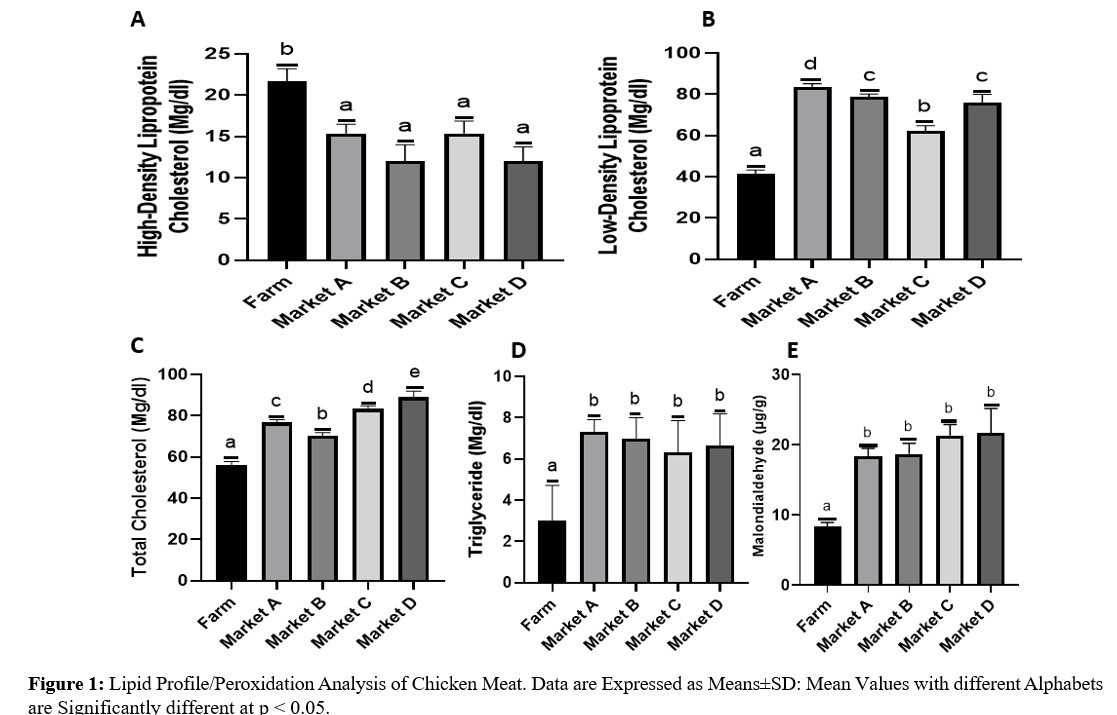
The result as presented in figure 1 revealed that the level of high density lipoprotein cholesterol (HDL-C) in chicken meat sample from the local farm (21.67±1.53) was significantly p<0.05 higher as compared to the imported frozen chicken sold at the different markets respective. Conversely, for the other parameters of lipid profile/peroxidation including Low density lipoprotein cholesterol (LDL-C), total cholesterol (TC), triglyceride (TRIG), and malondialdehyde (MDA), it was observed that the chicken meat from the local farm had a significant p<0.05 lower level of the mentioned parameters vis-à-vis the meat samples from the various market locations used for the study respectively.
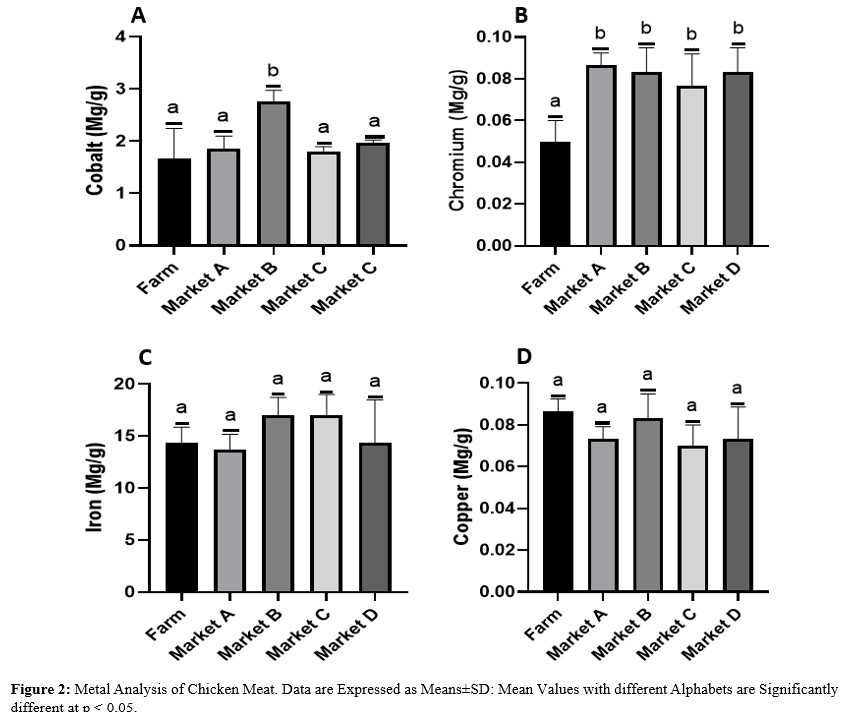
The result presented in figure 2 showed that they was a significant p<0.05 variations in the concentration of the analysed metals between the samples particularly cobalt (Co) and Chromium (Cr). As it was noted that the chicken meat sample from the local farm significantly p<0.05 had lower concentration. As per the concentration of iron (Fe) and Copper (Cu), the result revealed that there was no significant difference p>0.05 between the study groups.
|
Samples |
Iron (Fe) |
Copper (Cu) |
Cobalt (Co) |
Chromium (Cr) |
|
ADULT (70Kg) |
||||
|
Farm |
0.2375 |
0.001442 |
0.027625 |
0.000829 |
|
Market A |
0.2265 |
0.00121 |
0.030939 |
0.001442 |
|
Market B |
0.2817 |
0.001375 |
0.045853 |
0.001375 |
|
Market C |
0.2817 |
0.00116 |
0.029829 |
0.001276 |
|
Market D |
0.2375 |
0.00121 |
0.032596 |
0.001375 |
|
CHILDREN (24kg) |
||||
|
Farm |
0.2388 |
0.00145 |
0.027783 |
0.000833 |
|
Market A |
0.2278 |
0.001217 |
0.031117 |
0.00145 |
|
Market B |
0.2833 |
0.001383 |
0.046117 |
0.001383 |
|
Market C |
0.2833 |
0.001167 |
0.03 |
0.001283 |
|
Market D |
0.2388 |
0.001217 |
0.032783 |
0.001383 |
Table 1: Estimated Daily Intake (EDI) of Metals (Mg/Kg/Bw/Day) for Adults (70kg) and Children (24kg) for Chicken Meat Samples
Table 1: Presents the estimated daily intake (EDI) of metals for persons weighing 70 kg (adults) and 24 kg (children) respectively. The daily intake of Cranium (Cr) varied from 0.000829-0.001276 mg/kg bw day-1 for adult and 0.000833 - 0.001283 mg/kg bw day-1 for children. The daily intake of Cobalt (Co) varied between 0.027625 and 0.045853 mg/kg bw/day for adults and between 0.028 and 0.046 mg/kg bw/day for children.
|
Samples |
(Iron)Fe |
Copper (Cu) |
Cobalt (Co) |
Chromium (Cr) |
HI |
|
ADULT (70Kg) |
|||||
|
Farm |
0.093 |
9.88E-05 |
0.25243 |
1.51E-06 |
0.3624 |
|
Market A |
0.08872 |
8.29E-05 |
0.28272 |
2.63E-06 |
0.5510 |
|
Market B |
0.11033 |
9.43E-05 |
0.419 |
2.51E-06 |
0.4096 |
|
Market C |
0.11033 |
7.95E-05 |
0.27257 |
2.33E-06 |
0.4127 |
|
Market D |
0.093 |
8.29E-05 |
0.29786 |
2.51E-06 |
0 |
|
CHILDREN (24Kg) |
|||||
|
Farm |
0.03188 |
3.39E-05 |
0.08653 |
5.19E-07 |
0.1242 |
|
Market A |
0.03041 |
2.84E-05 |
0.09691 |
9.03E-07 |
0.1352 |
|
Market B |
0.03782 |
3.23E-05 |
0.14362 |
8.62E-07 |
0.1889 |
|
Market C |
0.03782 |
2.73E-05 |
0.09343 |
7.99E-07 |
0.1404 |
|
Market D |
0.03188 |
2.84E-05 |
0.1021 |
8.62E-07 |
0.1415 |
Table 2: Target Hazard Quotient (THQ) and Hazard Index (HI) for Adults (70kg) and Children (24kg) for Chicken Meat
Table 2 show the target hazard quotient (THQ) and hazard index (HI) for adults (70kg) and children (24kg) for chicken meat samples. The THQ of each metal from chicken consumption in Benin City for both adults and children followed this increasing order: Co < Fe < Cu < Cr. The highest THQ value was observed imported frozen chicken sold in market D (0.298 and 0.1) for adults and children in cobalt (Co). They hazard index (HI) was found to be less than 1 in all the samples.
Discussion
An understanding of several parameters including lipid profile status, lipid peroxidation and metal concentration as indices for the safety and quality of frozen meat is imperative. As such this study investigates the toxicological safety, lipid profile/ peroxidation status of frozen chicken meat sold in Benin City metropolitan. Evaluating the lipid profile, which encompasses high-density lipoprotein (HDL), low-density lipoprotein (LDL), triglycerides (TRIG), and total cholesterol (TC), offers essential perspectives on the integrity and safety of frozen poultry meat.4 The lipid metabolism in birds varies from that in mammals, with the liver being recognized as the primary organ responsible for this metabolic process, unlike mammals where adipose tissue plays a more significant role. Typically, the accumulation of body fat can be viewed as the overall outcome of the interplay between dietary fat absorption, endogenous fat formation (lipogenesis), and fat breakdown through beta-oxidation (lipolysis) [4,24].
Against this backdrop, this study demonstrated that the chicken meat gotten from a local farm had higher level of HDL and hypolipidemia characterized by lower levels of LDL, TRIG, and TC in comparison to the imported chicken meat. Higher levels of HDL and are considered to be good cholesterol and low levels of other parameters of lipid profile examined in this study may suggest that the farm chicken has better nutritional value. However, the variations in these parameters can be attributed to several factors including processing method, storage conditions and oxidation changes. Therefore, further analysis, including the impact of storage duration and freezing conditions, could provide deeper insights into the long-term stability of lipid profiles in frozen poultry products. Further, lipid peroxidation leads to quality deterioration, rancidity and accumulation of potentially toxic compounds in foods [25,26]. The quality of the secondary products of lipid oxidation is generally measured using the thiobarbituric acid reactive substances (TBARS) method [27]. These secondary products cause rancid, fatty, pungent and other off-flavours. The development of these flavours marked by an increased level of vMDA was noted in the study of Okolie et al. on frozen importedvfrozen sold in Benin City, Nigeria [11].
The result of this study on the levels of MDA in imported frozen chicken samples corroborates the existing finding, as it was observed the level of MDA in chicken meat sourced from a local farm was significantly p<0.05 significantly lower compared to imported frozen chicken sold at the selected markets. Although, it has been demonstrated that freezing can contribute to lipid oxidation in chicken meat [28]. The formation of ice crystals during freezing and subsequent storage can disrupt cell membranes, leading to increased exposure of lipids to oxygen. This exposure promotes oxidative reactions, resulting in the production of volatile compounds and potential off-flavors in the meat [29]. Metals are everywhere in our surroundings, entering our diets through various natural and human-made routes [30]. The metals found in our food have a substantial impact on the human body, and without these elements, essential physiological functions would face considerable disruption [31]. Nevertheless, they can turn toxic to living beings at high levels [32,33,34]. Importantly, diet acts as the main source of exposure for those who do not come into contact with these metals in their work environments [34].
Therefore, carrying our regularly assessments to ascertain the toxicological safety of food products particularly poultry meat is important in maintaining public health. In this study, analysis of the samples revealed that the chicken meat sample from the local farm significantly had the lowest concentration of cobalt (Co), chromium (Cr) while the highest concentration was noted for the sample from market B (2.767±0.208) and market A (0.087±0.006) for Co and Cr respectively. No significant difference was noted between the samples for the iron and copper concentration however samples for market B had the highest levels of iron 17±1.73 and copper 8.33±1.15. Ensuring that the concentrations of cobalt, chromium, iron, and copper in poultry meat remain within safe limits is crucial for public health. The safety of consuming poultry meat is influenced by the concentrations of various metals present within it. Overall, generalized permissible limit of these metals in poultry meat were difficult to find but the Egyptian Organization for Standardization and Quality Control as reported by Korish & Attia and more recently Kamaly & Sharkawy indicated that the allowable level of these metals was set at, Chromium (Cr): 1ppm (1 mg/kg), Iron (Fe): 150 ppm (150mg/kg), and Copper (Cu): 10 ppm (10mg/kg) [21,35]. Thus the concentration of these metals examined in this study was found to all be within the allowable limit in poultry.
Risk assessment was carried out on the chicken meat samples to ascertain the safety of its consumption. A hazard index value of greater than 1 indicates a high chance of an unfavorable health consequence associated with consumption of the food product [17,20,23]. The Hazard Index (HI), established to reflect the overall risk of metal toxicity, is the sum of all THQ values in a dietary sample [36,37,38]. The highest THQ value was recorded in imported frozen chicken from Market D (0.298 for adults and 0.1 for children) for cobalt (Co). They hazard index (HI) wasvfound to be less than 1 in all the samples which suggest that the chicken meat sold in major markets of Benin city metropolitan poses no public health concern. While this study provides baseline for further research on the toxicological and safety profile of chicken meat, provide a baseline for future study on the correlation between metal contamination and chicken meat quality in another geographical location, and also provide a guide to regulatory bodies and consumers alike on the potential health risks associated with parameters examined in this study, the study acknowledges that may be gap in the study particularly on the limited number of metal analysis and perhaps do not comprehensively represent metal contamination profile of the sample.
Conclusion
Assuring the safety of the meat products being provided to all parts of the world is a crucial component of the meat export sector, which is currently valued at over US$13 billion. Thus constant assessment and monitoring of the safety and quality of meat product has become imperative. The study noted that the chicken meat sample from the local farm presented a better option in terms of the lipid profile and lipid peroxidation status. In terms of the metal contamination profile, the concentration of cobalt, chromium, copper and iron were all found to be within the permissible limit in all the samples. Further, a risk assessment profile showed that hazard index (HI) was found to be less than 1 in all the samples which suggest that the chicken meat sold in major markets of Benin city metropolitan poses no public health concern.
Declaration of Interest Statement
The authors report there are no competing interests to declare.
References
- Attia, Y. A., Aldhalmi, A. K., Youssef, I. M., Bovera, F., Tufarelli, V., El-Hack, M. E. A., ... & Shukry, M. (2024). Climate change and its effects on poultry industry and sustainability. Discover Sustainability, 5(1), 397.
- Adene, D. F., Oguntade, A. E. (2006). The structure and importance of the commercial and village-based poultry systems in Nigeria. FAO Review Nigeria, 1–109.
- Istiak, M. S., & Khaliduzzaman, A. (2022). Poultry and egg production: an overview. Informatics in Poultry Production: A Technical Guidebook for Egg and Poultry Education, Research and Industry, 3-12.
- Kayode, O. T., Afolayan, O. A., Kayode, A. A. A., & Halimat, A. M. (2018). Nutritional quality and safety of chicken meat consumed in Ota, Ogun State. International Journal of Poultry Science, 17(11), 280-284.
- Fagbamila, I. O., Barco, L., Mancin, M., Kwaga, J., Ngulukun, S. S., Zavagnin, P., ... & Muhammad, M. (2017). Salmonella serovars and their distribution in Nigerian commercial chicken layer farms. PLoS One, 12(3), e0173097.
- Toluwase, S. O. W., & Kolapo, A. (2017). Economic analysis of consumer demand for chicken meats in Rural and Urban Household of Ondo State. Global Educational Research Journal: ISSN-2360-7963, 4(3), 531-535.
- Tsutsumi, Y. (2021). Quality Assurance in Toxicology and Safety Science. Yakugaku Zasshi: Journal of the Pharmaceutical Society of Japan, 141(6), 813-816.
- Edet, U. O., Joseph, A., Bassey, D., Bassey, I. N., Bebia, G. P., Mbim, E., & Ogar, A. Y. (2024). Risk assessment and origin of metals in chicken meat and its organs from a commercial poultry farm in Akwa Ibom state, Nigeria. Heliyon, 10(17).
- Tchounwou, P. B., Yedjou, C. G., Patlolla, A. K., & Sutton, D. J. (2012). Heavy metal toxicity and the environment. Molecular, clinical and environmental toxicology: volume 3: environmental toxicology, 133-164.
- Balali-Mood, M., Naseri, K., Tahergorabi, Z., Khazdair, M. R., & Sadeghi, M. (2021). Toxic mechanisms of five heavy metals: mercury, lead, chromium, cadmium, and arsenic. Frontiers in pharmacology, 12, 643972.
- Okolie, N. P., Akioyamen, M. O., Okpoba, N., & Okonkwo, C. (2009). Malondialdehyde levels of frozen fish, chicken and turkey on sale in Benin City markets. African Journal of Biotechnology, 8(23).
- Imade, F., Ankwasa, E. M., Geng, H., Ullah, S., Ahmad, T., Wang, G., ... & Liu, Y. (2021). Updates on food and feed mycotoxin contamination and safety in Africa with special reference to Nigeria. Mycology, 12(4), 245-260.
- Allain, C. C., Poon, L. S., Chan, C. S., Richmond, W. F. P. C., & Fu, P. C. (1974). Enzymatic determination of total serum cholesterol. Clinical chemistry, 20(4), 470-475.
- Bucolo, G., & David, H. (1973). Quantitative determination of serum triglycerides by the use of enzymes. Clinical chemistry, 19(5), 476-482.
- Friedewald, W. T., Levy, R. I., & Fredrickson, D. S. (1972). Estimation of the concentration of low-density lipoprotein cholesterol in plasma, without use of the preparative ultracentrifuge. Clinical chemistry, 18(6), 499-502.
- Varshney, R., & Kale, R. K. (1990). Effects of calmodulin antagonists on radiation-induced lipid peroxidation in microsomes. International journal of radiation biology, 58(5), 733-743.
- Ekhator, O. C., Udowelle, N. A., Igbiri, S., Asomugha, R. N., Igweze, Z. N., & Orisakwe, O. E. (2017). Safety evaluation of potential toxic metals exposure from street foods consumed in midâ?West Nigeria. Journal of environmental and public health, 2017(1), 8458057.
- USEPA (United States Environmental Protection Agency). (2018). Regional screening levels (RSLs)-generic tables.
- FAO (Food and Agriculture Organization of the United Nations). (2021). Chicken meat production statistics.
- Emurotu, J. E., & Habib, L. (2023). Evaluation of Essential Metal Concentration and Possible Potential Health Risk in Chicken Giblets Commonly Sold to Consumers in Lokoja Main Market, Kogi State, Nigeria. Journal of Applied Sciences and Environmental Management, 27(11), 2561-2567.
- Kamaly, H. F., & Sharkawy, A. A. (2023). Health risk assessment of metals in chicken meat and liver in Egypt. Environmental Monitoring and Assessment, 195(7), 802.
- Ogu, G. I., & Akinnibosun, F. I. (2020). Health risks associated with heavy metals in commercial chicken meat via consumption within southern Nigeria. African Journal of Health, Safety and Environment, 1(1), 22-37.
- Patrick-Iwuanyanwu, K., & Chioma, N. C. (2017). Evaluation of heavy metals content and human health risk assessment via consumption of vegetables from selected markets in Bayelsa State, Nigeria. Biochem Anal Biochem, 6(332), 2161-1009.
- Sanz, M., Flores, A., & Lopez-Bote, C. J. (2000). The metabolic use of energy from dietary fat in broilers is affected by fatty acid saturation. British poultry science, 41(1), 61-68.
- Miyazawa, T. (2021). Lipid hydroperoxides in nutrition, health, and diseases. Proceedings of the Japan Academy, Series B, 97(4), 161-196.
- Wang, D., Xiao, H., Lyu, X., Chen, H., & Wei, F. (2023). Lipid oxidation in food science and nutritional health: A comprehensive review. Oil Crop Science, 8(1), 35-44.
- Abeyrathne, E. D. N. S., Nam, K., & Ahn, D. U. (2021). Analytical methods for lipid oxidation and antioxidant capacity in food systems. Antioxidants, 10(10), 1587.
- Wazir, H., Chay, S. Y., Zarei, M., Hussin, F. S., Mustapha, N. A., Wan Ibadullah, W. Z., & Saari, N. (2019). Effects of storage time and temperature on lipid oxidation and protein co-oxidation of low-moisture shredded meat products. Antioxidants, 8(10), 486.
- Leygonie, C., Britz, T. J., & Hoffman, L. C. (2012). Impact of freezing and thawing on the quality of meat. Meat science, 91(2), 93-98.
- LazareviÄ?-Pašti, T., TasiÄ?, T., MilankoviÄ?, V., & Potkonjak, N. (2023). Molecularly imprinted plasmonic-based sensors for environmental contaminants—current state and future perspectives. Chemosensors, 11(1), 35.
- Moustakas, M. (2021). The role of metal ions in biology, biochemistry and medicine. Materials, 14(3), 549.
- Kong, Y. W., Baqar, S., Jerums, G., & Ekinci, E. I. (2016). Sodium and its role in cardiovascular disease–the debate continues. Frontiers in endocrinology, 7, 164.
- Borrelli, S., Provenzano, M., Gagliardi, I., Michael, A., Liberti, M. E., De Nicola, L., ... & Andreucci, M. (2020). Sodium intake and chronic kidney disease. International journal of molecular sciences, 21(13), 4744.
- MilankoviÄ?, V., TasiÄ?, T., Leskovac, A., PetroviÄ?, S., MitiÄ?, M., LazareviÄ?-Pašti, T., ... & Potkonjak, N. (2024). Metals on the Menu—Analyzing the Presence, Importance, and Consequences. Foods, 13(12), 1890.
- Korish, M. A., & Attia, Y. A. (2020). Evaluation of heavy metal content in feed, litter, meat, meat products, liver, and table eggs of chickens. Animals, 10(4), 727.
- Devanesan, E., Gandhi, M. S., Selvapandiyan, M., Senthilkumar, G., & Ravisankar, R. (2017). Heavy metal and potential ecological risk assessment in sedimentscollected from Poombuhar to Karaikal Coast of Tamilnadu using Energy dispersive X-ray fluorescence (EDXRF) technique. Beni-Suef University journal of basic and applied sciences, 6(3), 285-292.
- Goumenou, M., & Tsatsakis, A. (2019). Proposing new approaches for the risk characterisation of single chemicals and chemical mixtures: The source related Hazard Quotient (HQS) and Hazard Index (HIS) and the adversity specific Hazard Index (HIA). Toxicology reports, 6, 632-636.