

Advances in Theoretical & Computational Physics(ATCP)
ISSN: 2639-0108 | DOI: 10.33140/ATCP

Research Article - (2026) Volume 9, Issue 1
Joint Field Theoretical Description of The Electron and Neutrino Scattering Off Nuclei
Received Date: Oct 09, 2025 / Accepted Date: Dec 02, 2026 / Published Date: Mar 10, 2026
Copyright: © 2026 This is an open-access article distributed under the terms of the Creative Commons Attribution License, which permits unrestricted use, distribution, and reproduction in any medium, provided the original author and source are credited.
Citation: Shebeko, A. (2025). Joint Field Theoretical Description of The Electron and Neutrino Scattering Off Nuclei. Adv Theo Comp Phy, 9(1), 01-13.
Abstract
Despite the unpleasant current situation, our institute continues to work in a remote regime, allowing us to do some explorations at a distance. Accepting this invitation to contribute to an extensive development of the theory of electroweak interactions with nuclei, let me remind of several pages from the 90s [1-4]. Then, in this century, we have extended our explorations by applying field theoretical methods. In particular, working in the late 90s on the LTP (Dubna) in the papers by M.Shirokov and me [5,6] we developed the notion of the so-called clothed particles, i.e., particles with physical properties, put forward in the QFT by Greenberg and Schweber [7,8].
Priniciple
Despite the unpleasant current situation, our institute continues to work in a remote regime, allowing us to do some explorations at a distance. Accepting this invitation to contribute to an extensive development of the theory of electroweak interactions with nuclei, let me remind of several pages from the 90s [1-4]. Then, in this century, we have extended our explorations by applying field theoretical methods. In particular, working in the late 90s on the LTP (Dubna) in the papers by M.Shirokov and me [5,6] we developed the notion of the so-called clothed particles, i.e., particles with physical properties, put forward in the QFT by Greenberg and Schweber [7,8].
Clothed Particle Representation (CPR) in Action
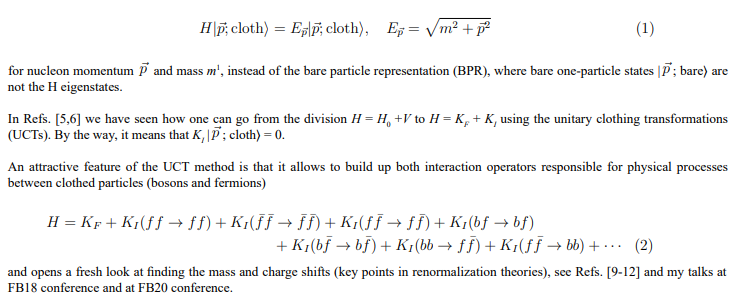
within its basic idea to remove from the total Hamiltonian H for a system of interacting fields, e.g., meson and nucleon ones, undesirable (bad) terms that prevent one-body states to be H eigenvectors, viz., in the case of the nucleon, for instance,
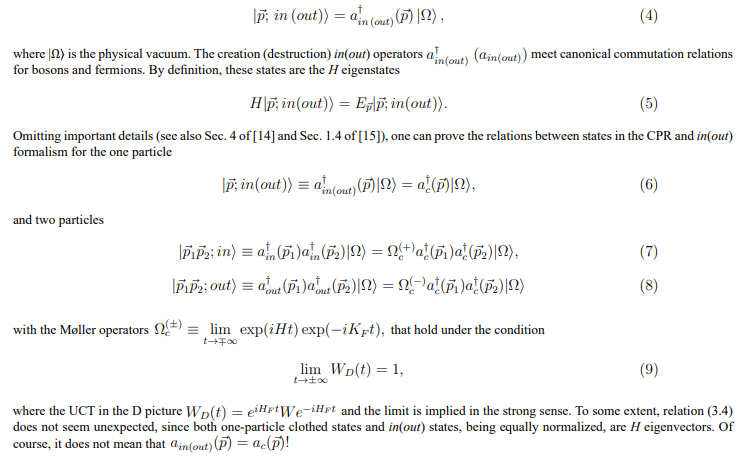
Links between in(out) and clothed particle states in QFT
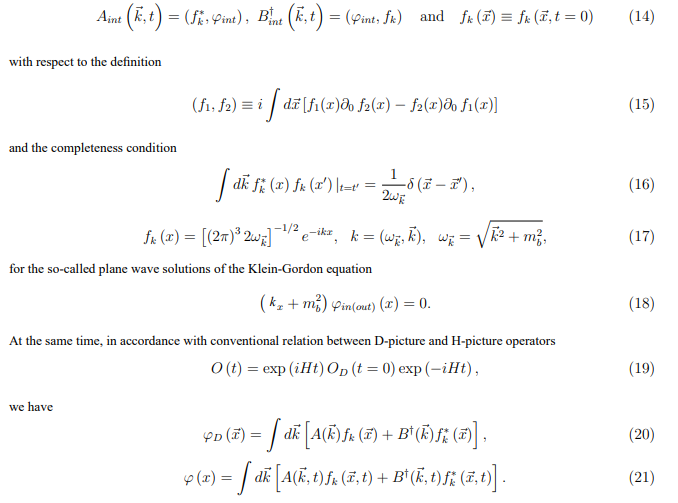
As well-known, when evaluating the S-matrix in the Heisenberg picture,

one has to deal with the in(out) states (see, e.g., [13]), in particular, one-particle state
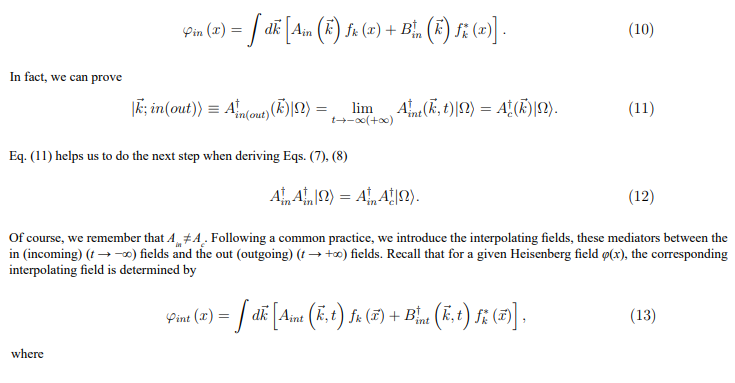
1D.. Some Deviation
For instance, in case of opposite-charged scalar particles, we have
Two-Body Currents
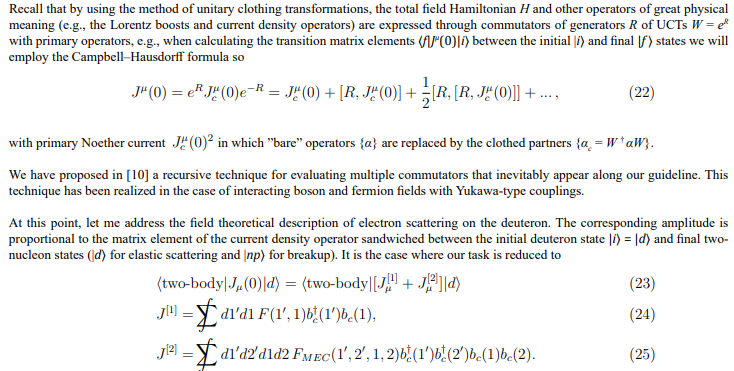
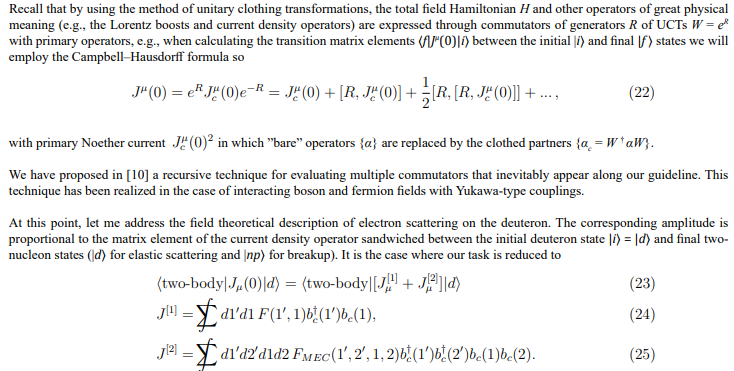
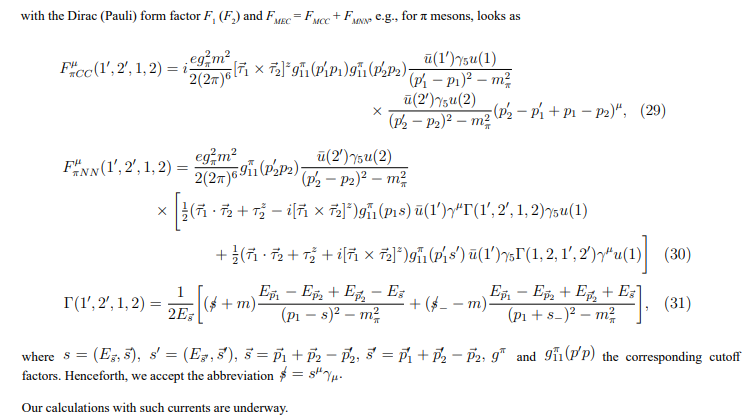
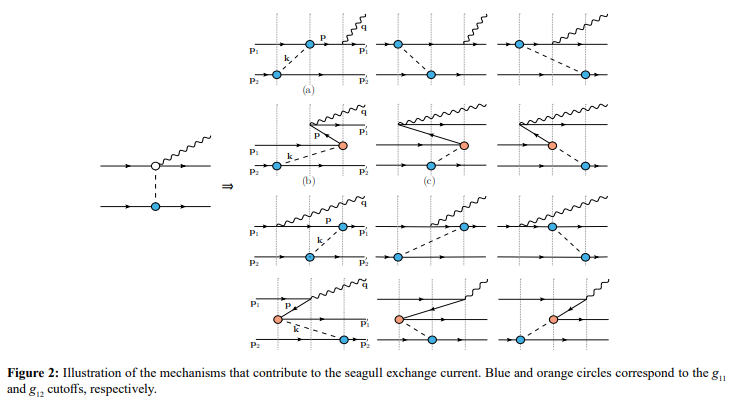
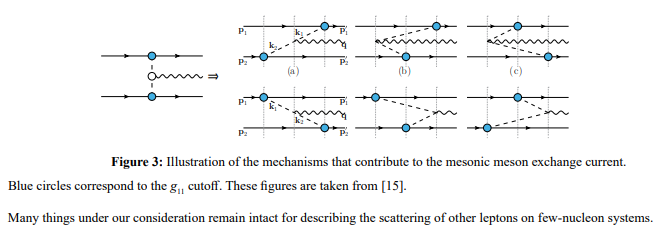
Recall that by using the method of unitary clothing transformations, the total field Hamiltonian H and other operators of great physical meaning (e.g., the Lorentz boosts and current density operators) are expressed through commutators of generators R of UCTs W = eR with primary operators, e.g., when calculating the transition matrix elements ⟨f|Jμ(0)|i⟩ between the initial |i⟩ and final |f ⟩ states we will employ the Campbell–Hausdorff formula so
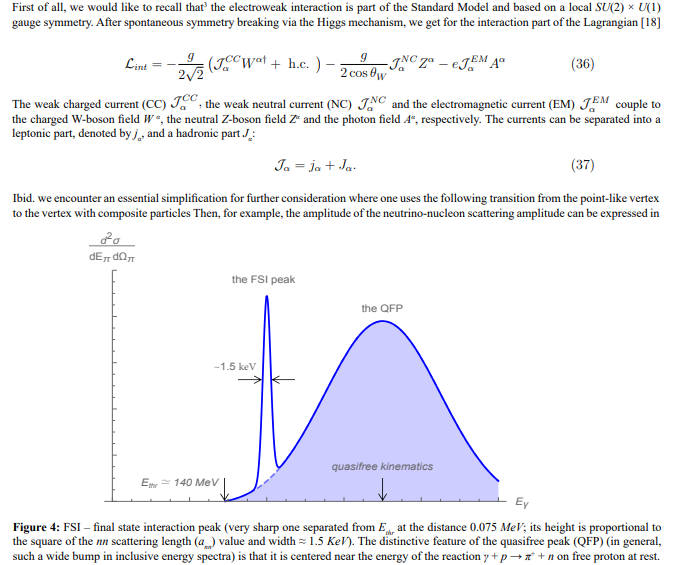
Final State Interactions in Inclusive and Semi-Inclusive Processes
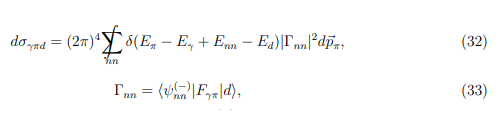
Special attention in our studies is paid to the effects due to interactions between reaction products in processes induced by leptons off nucleons and nuclei below and above the pion production threshold. In this context, let me recall our collaborative research on the pion photoproduction off the deuterium d(γ, π+)nn and pion electroproduction in the reaction d(e, e′π+)nn [16,17].
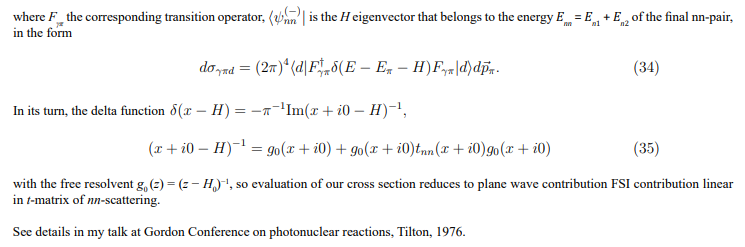
These inclusive (in final states, only pions are detected) and semi-inclusive (pions are observable with scattered electrons) reactions are typical to illustrate a general idea, viz., we rewrite the expression
Well-Forgotten Pages from Past to Future
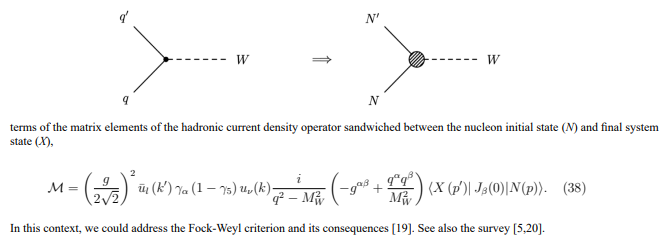
First of all, we would like to recall that3 the electroweak interaction is part of the Standard Model and based on a local SU(2) × U(1) gauge symmetry. After spontaneous symmetry breaking via the Higgs mechanism, we get for the interaction part of the Lagrangian [18]
An Effective Way of Ensuring Gauge Independent Treatment of Single-Photon Processes on Nuclei. Extension of The Siegert Theorem [21]
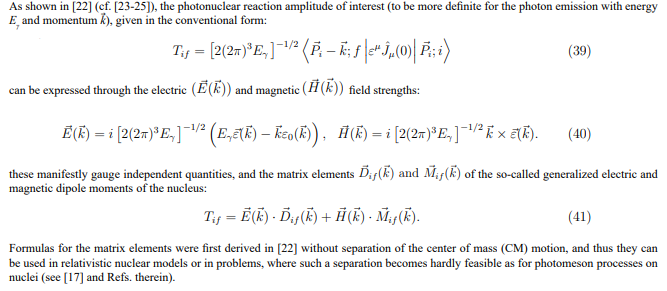
Single-Photon Emission Amplitude in Terms of Electric and Magnetic Field Strengths
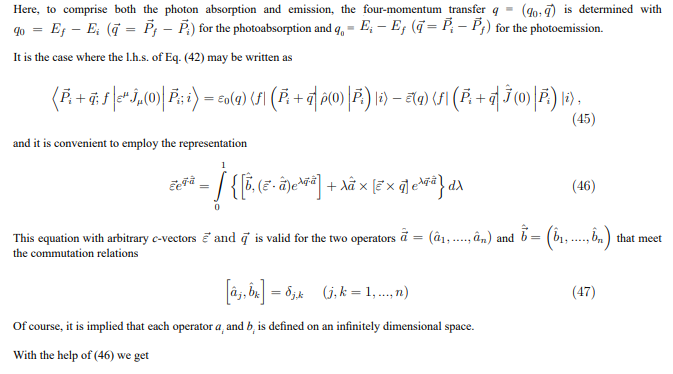
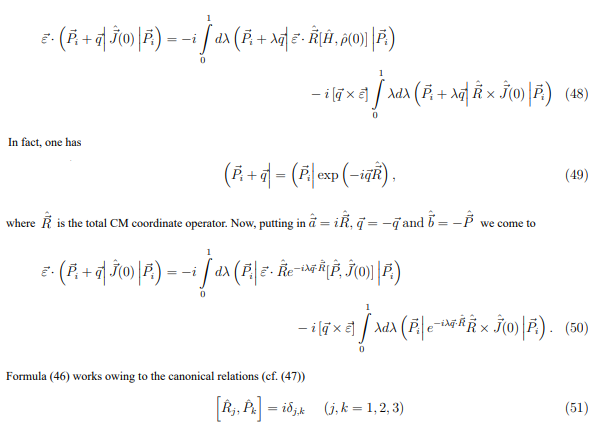
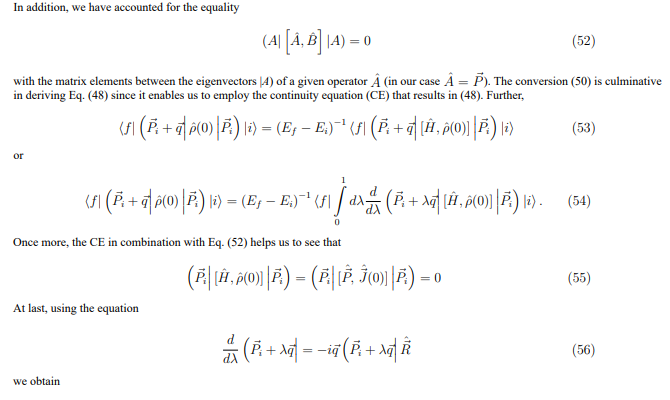
Using the nonrelativistic ansatz we will prove that
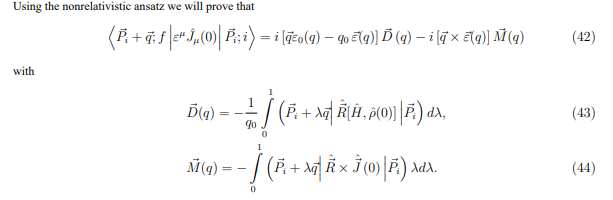

Gauge Independent Expression for The Amplitude [17]
An incompleteness of the description may lead to results that are not gauge independent. To restore the gauge independence (GI) of the treatment, one often adds an extra term to the amplitude making the subtraction
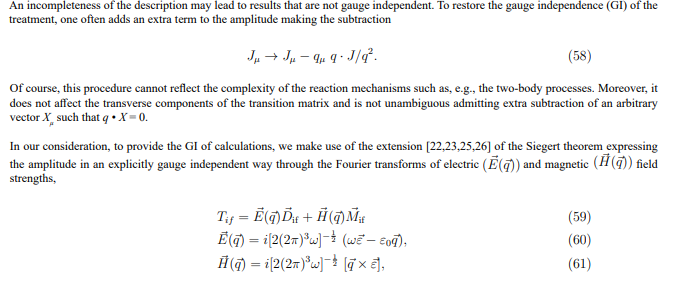
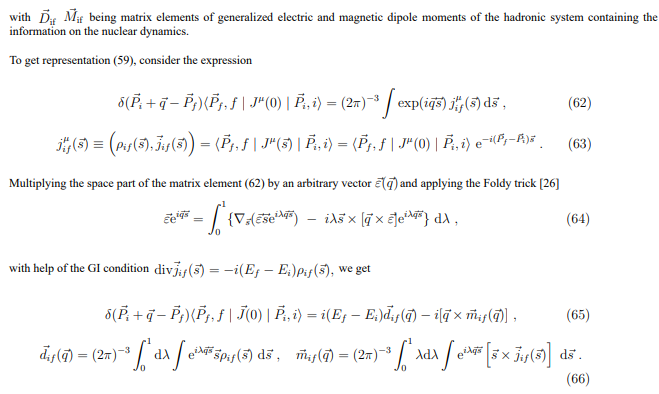
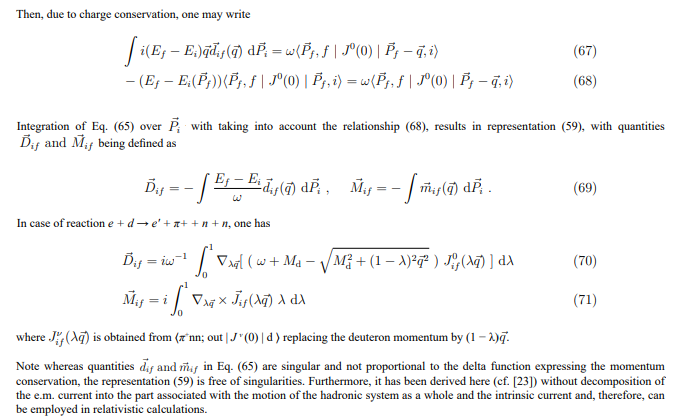
This representation generates a correction term additional to the “canonical” expression, which restores the GI of the amplitude in calculations that fail to satisfy the requirement qµJµif (qâ??) = 0. However, when this condition does hold, this correction is equal to zero automatically. In the long-wave limit, Eq. (59) provides the fulfillment of the Siegert theorem [27] for electric transitions in reactions with nonmeson channels [22,25]. For pion photoproduction on the free nucleon at threshold, it leads (as shown in [28]) to the Kroll-Ruderman result [29] emerging here as a particular case of the Siegert theorem.
To Conclude
Accent on joint description of the electron and neutrino scattering off atomic nuclei for this exposition is not accidental since from the physics point of view they have much in common. In fact, for the both cases the so-called one-boson-exchange approximation (OBEA) works well with photons and W-Z bosons as interaction mediators, respectively. At the beginning, it opens a comparatively simple way to studying different properties of nuclear structure. However, many-particle reaction mechanisms (in particular, via the meson exchange currents) complicate such a consideration so understanding of their role gets some priority. We have shown a number of fresh analytical tools when constructing the e.m. and weak current density operators. We foresee good prospects for applications of our approach in the theory of electroweak interactions with nuclei as a whole.
Acknowledgements
I am indebted to Dr. Yan Kostylenko for fruitful cooperation. Part of this work was supported by the National Academy of Sciences (USA) and Office of Naval Research Global (USA) in assistance of the Science and Technology Center in Ukraine (grant No. 7134).
References
- Korchin, A., Mel’nik, Y., & Shebeko, A. (1990). Angular distributions and polarization of protons in the d(e, e′p)n reaction. Few-Body Systems, 9, 211–226.
- Mel’nik, Y., & Shebeko, A. (1992). Calculation of proton polarization in deuteron disintegration with longitudinally polarizedelectrons. Few-Body Systems, 13, 59–70.
- Mel’nik, Y., & Shebeko, A. (1993). Electrodisintegration of polarized deuterons. Physical Review C, 48, 1259–1272.
- Kotlyar, V., Mel’nik, Y., & Shebeko, A. (1995). Studies of polarization phenomena in photo- and electrodisintegration of the lightestnuclei at intermediate energies. Physics of Elementary Particles and Atomic Nuclei (PEPAN), 26, 192.
- Shebeko, A., & Shirokov, M. (2000). Clothing procedure in relativistic quantum field theory and its applications to description ofelectromagnetic interactions with nuclei (bound systems). Progress in Particle and Nuclear Physics, 44, 75–152.
- Shebeko, A., & Shirokov, M. (2001). Unitary transformations in quantum field theory and bound states. Physics of Particles and Nuclei, 32, 15–46.
- Greenberg, O., & Schweber, S. (1958). Clothed particle operators in simple models of quantum field theory. Nuovo Cimento, 8, 378–405.
- Schweber, S. (1961). An introduction to relativistic quantum field theory. Row, Peterson & Co.
- Korda, V., & Shebeko, A. (2004). Clothed particles representation in quantum field theory: Mass renormalization. Physical Review D, 70, 085011.
- Korda, V., Canton, L., & Shebeko, A. (2007). Relativistic interactions for the meson–two-nucleon system in the clothed-particleunitary representation. Annals of Physics, 322, 736–785.
- Dubovyk, I., & Shebeko, A. (2010). The method of unitary clothing transformations in the theory of nucleon–nucleon scatteringFew-Body Systems, 48, 109–136.
- Kostylenko, Y., & Shebeko, A. (2023). Clothed particle representation in quantum field theory: Fermion mass renormalization dueto vector boson exchange. Physical Review D, 108, 125019.
- Goldberger, M., & Watson, K. (1967). Collision theory. John Wiley & Sons.
- Shebeko, A. (2004). The S-matrix in the method of unitary clothing transformations. Nuclear Physics A, 737, 252–272.
- Kostylenko, Y. (2024). Field-theoretical description of deuteron and positronium properties in the clothed-particle representation(PhD thesis). National Science Center “Kharkiv Institute of Physics and Technology”.
- Levchuk, L., & Shebeko, A. (1999). Positive pion electroproduction on the deuteron near threshold. Yadernaya Fizika, 62, 263–274.
- Levchuk, L., Canton, L., & Shebeko, A. (2004). Nuclear effects in positive pion electroproduction on the deuteron near threshold.European Physical Journal A, 21, 29–45.
- Thomas, A., & Weise, W. (2001). The structure of the nucleon. Wiley-VCH.
- Kazes, E., Feuchtwang, T. E., Cutler, P. H., & Grotch, H. (1982). Gauge invariance and gauge independence of the S-matrix in nonrelativistic quantum mechanics and relativistic quantum field theories. Annals of Physics, 142, 80–93.
- Jackson, J. D., & Okun, L. B. (2001). Historical roots of gauge invariance. Reviews of Modern Physics, 73, 663–680.
- Shebeko, A. (2014). Towards gauge-independent treatment of radiative capture in nuclear reactions: Applications to low-energy cluster–cluster collisions. Physics of Atomic Nuclei, 77, 518–528.
- Levchuk, L., & Shebeko, A. (1993). On a generalization of Siegert’s theorem: A corrected result. Physics of Atomic Nuclei, 56, 227–235.
- Friar, J., & Fallieros, S. (1986). Gauge-invariant nuclear Compton amplitude manifesting low-energy theorems. Physical Review C, 34, 2029–2033.
- Friar, J., & Haxton, W. (1985). Current conservation and the transverse electric multipole field. Physical Review C, 31, 2027–2034.
- Shebeko, A. (1989). A generalization of Siegert’s theorem and separation of center-of-mass motion. Soviet Journal of Nuclear Physics, 49, 30.
- Foldy, L. (1953). Matrix elements for the nuclear photoeffect. Physical Review, 92, 178–182.
- Siegert, A. J. F. (1937). Note on the interaction between nuclei and electromagnetic radiation. Physical Review, 52, 787–789.
- Levchuk, L., & Shebeko, A. (1995). Applications of the unitary-transformation method to the theory of photomeson processes onnuclei. Physics of Atomic Nuclei, 58, 923–936.
- Kroll, N., & Ruderman, M. (1954). A theorem on photomeson production near threshold and the suppression of pairs in pseudoscalar meson theory. Physical Review, 93, 233–236.