

Advances in Bioengineering and Biomedical Science Research(ABBSR)
ISSN: 2640-4133 | DOI: 10.33140/ABBSR
Impact Factor: 1.7

Research Article - (2023) Volume 6, Issue 1
Impact of Environmental Pollution on the Residents of Sharada from Tannery Industries, Kano, Northwestern Nigeria
Received Date: Dec 03, 2022 / Accepted Date: Dec 12, 2022 / Published Date: Jan 21, 2023
Copyright: ©Â©2023 Dave Eleojo Ekpa. This is an open-access article distributed under the terms of the Creative Commons Attribution License, which permits unrestricted use, distribution, and reproduction in any medium, provided the original author and source are credited.
Citation: Ekpa, D. E. (2023). Impact of Environmental Pollution on the Residents of Sharada from Tannery Industries, Kano, Northwestern Nigeria. Adv Bioeng Biomed Sci Res, 6(1), 05-13.
Abstract
Environmental pollution has become a worldwide challenge due to industrialization and anthropogenic activities. Industrial effluents cause a wide scope of environmental problems with health hazards and these challenges are more complex and critical now than before, in developing countries like Nigeria. This study assessed the impact of environmental pollution and determined levels of heavy metals (HMs) in the effluents from tannery industries in Sharada phase I and II. The data used include laboratory test to determine heavy metals (Cd, Cr, Cu, Pb, Zn, Ni, Mn, Fe), Electrical Conductivity (EC) and Total Dissolved Solid (TDS) from industrial effluents. Interview was conducted and systematic field observation was employed to ascertain the perceptible impacts of the pollution on the environment. The finding reveals that concentrations of the physicochemical parameters are within the FEPA acceptable limits but the EC and TDS are above the limit. The pH value of the effluents is neutral. The major conspicuous and dangerous environmental challenges in the study area include air pollution and open drainages. The economic activities of the residents are negatively affected due to stink from the effluents and untidy environment. The environment has become detrimental to people’s health and the passerby. Thus, Federal Environmental Protection Agency (FEPA) laws should be enforced, the industries should construct closed drainage, study on environmental impact assessment (EIA) should be conducted often to curtail the environmental challenges in the area in order to make the environment conducive for living, avoid further deterioration and ensure a sustainable hygienic environment.
Keywords
Impact, Environmental Pollution, Residents, Industries
Introduction
Pollution is one of the major environmental challenges that is threatening many lives globally. Environmental pollution is the negative alteration of the state or quality of an environment re-sulting in negative impacts on human health, animals, plants and soil. In Nigeria, industrial pollution is still a serious problem in spite of the efforts by the government to control the menace to ensure that Nigerians live in a sanitised and disease-free envi¬ronment. Fereidoun et al. (2007) asserted that there are numer¬ous industries established in Nigeria that cause pollution, among which are tanneries, textiles, petroleum refinery, chemicals and plastics, food and beverages, breweries, soaps and detergents [1]. Pollution is caused by anthropogenic activities and natural forces.
Over time industries have become the major contributors of en¬vironmental pollution. Gana and Toba (2015) opined that the extent of industrial pollutants damage to health and the envi¬ronment is directly proportional to the increase in industries and the rate of production as well as consumption of products [2]. Textile, cellulose and various chemicals productions are usually associated with synthetic dyes usage with other toxic metals and the discharge of their effluents could have a serious hazardousinfluence on the environment. It is high time to take proactive actions by the government and other responsible agencies to curb the issue of environmental pollution and degradation in every nook and cranny in Nigeria so as to protect the natural environment and lives. To ensure a conducive and sustainable pro¬ductive environment man must avoid environmental pollution.
For decades Nigerian cities have been confronted with high lev-el of pollution of which is responsible for several challenges to human’s health. In Kano state environmental pollution has been one of the prevailing challenges in many locations particularly industrial areas and the tannery industries located in Sharada area of Kano are among the major sources of environmental pollution. This calls for adequate assessment of water pollution and determination of heavy metals concentration in the effluents that are discharged to the environment. This has become a great con¬cern for the responsible institutions and environmental agencies as this menace has currently reached an alarming rate that needs urgent attention. Therefore, this study focused on ascertaining the levels of heavy metals present in the effluents discharged to the environment from tannery industries in Sharada phase I and II.
Methodology
Study Area Sharada the study area is located in Kano Municipal local gov-ernment area (LGA) and it is one of the renown industrial estates in Kano State. It is located at the southern part of the ancient Kano city and it is situated between latitude 110 57’30” N, and longitude 8030’50’’E (Figure 1). Sharada LGA, boarded with Bayero University, Kano road to the North, Gidan Maza to the South, Gandu to the East and Dorayi Karama to the West. Shara¬da area is a mixture of many types of industries including heavy, light, wet, dry, food, household, plastic, among others. The cli- mate of Sharada is the same as Kano metropolis’ which is tropi-cal dry and wet climate classified as AW by Koppen. The climate of the study area is the tropical dry-and-wet type, classified by Koppen’s as Aw. The movement of the Inter-Tropical Discon¬tinuity (ITD) gives rise to two seasons (wet and dry seasons). The wet season lasts from May to mid-October with a peak in August while the dry season extends from mid-October of one calendar-year to mid-May of the next. The annual mean rainfall is between 800 mm to 900 mm; and variations about the annual mean values are up to ± 30%. The mean annual temperature is about 260 C [3, 4].
Figure 1: The Study Area (Source: Cartography Laboratory, Geography Deptment, Bayero University, Kano)
Data Sources
This study used primary and secondary data which include a laboratory test, interview, observation and relevant information from previous works. The laboratory test was carried out on all the industrial effluents samples that were collected from the study area and heavy metals such as Cd, Cr, Cu, Pb, Zn, Ni, Mn, Fe and physical parameters like Electrical Conductivity (EC) and Total Dissolved Solid (TDS) were analysed in the laboratory. Interview was conducted for some industrial personnel and residents of the study area. Furthermore, a systematic observation was employed to see the visible impacts of the pollution on the environment.
The study was undertaken within Sharada phase I and II industrial areas where two tannery industries are located. The effluents samples were collected from Sharada Phase I and II through the major parts where the industrial effluents flow in the study area. In 2016, industrial effluents were collected from the tannery A and B in the study area. The first two effluents samples were col-lected separately from the tannery A and B discharge channels while the other samples were collected as mixture of effluents from both tanneries. The effluents samples were properly labeled before taking them to the laboratory for test. Table 1 shows the 2016, industrial effluents samples from rwo tannery industries in Sharada Phase I and II. Descriptive statistic was used in analys¬ing the data collected from the field and laboratory test. The average concentration of each parameter in the industrial effluents were determined and compared with the Federal Environmental Protection Agency (FEPA) permissible limits.
Results
Laboratory Analysis of Parameters and their Characteris-tics
Industrial effluents cause a wide scope of environmental prob-lems and health hazards. These challenges are becoming more complex and critical not only in developing countries like Nige- ria but also in developed countries. Table 1 shows the average concentration of physiochemical properties of the industrial ef-fluents from Tannery A and B.
Analysis of Concentration of Electrical Conductivity, Total Dissolved Solid and pH Value
The findings in table 1 reveals that the average concentration of all the physicochemical parameters of the industrial effluents are within the acceptable limits except for the Electrical Conductivi¬ty and Total Dissolved Solid which have large disparity between the FEPA tolerant value. The average concentration of the Elec¬trical Conductivity is 14442μS/cm while the FEPA standard lim¬it is 1200 μS/cm and on the other side the average concentration of the Total Dissolved Solid in the effluents is 8660mg/l which exceeded the acceptable limit of FEPA (2000mg/l). This implies that there is a significant difference between the concentration of the two parameters (Electrical Conductivity and Total Dissolved Solid) and FEPA Permissible values.
Electrical conductivity gives an idea about the concentration of electrolytes in water and is a limiting factor. The high concentra¬tion of EC in this study is detrimental to crops production in the study area as well as human who eat such crops. Tanko (2002) asserted that the salinity of soil has influence on plant growth, crop yield and the quality of produce which is often determined by the salt concentration of irrigation water [5]. The optimum EC level for irrigation water is 2 millimho/cm, whilst if any val-ue is above this level will reduce the water osmotic potential or the rate of water entry into the crops.
The pH which is the measurement of the acidity and alkalinity of water has a scale which ranges from 0-14. A pH of 7 means neutral and a pH less than 7 indicates acidity while the pH great¬er than 7 shows alkalinity. An irregular level of pH of water is rarely a problem. Therefore, the normal levels of a sample should be between 6.5 and 8 but values outside this range in-dicate that there are severe abnormalities in water quality [6]. In this study the average pH value of the effluent samples is 7.0 (neutral) while the FEPA permissible limit is 6-9 (Table 1). This shows that the concentration of pH in the effluents is within the Permissible value set by FEPA. The high pH value in water can destroy bacterial and other microorganisms as well as inhibit self-purification of a stream.
Table 1: Average Concentration of Parameters in Industrial Effluents and FEPA Permissible Limit
|
Parameters |
Average Value |
Fepa Tolerance Limit |
|
Electrical Conductivity μS/cm) |
14442 |
1200 μS/cm |
|
Total Dissolved Solid (mg/l) |
8660 |
2000(mg/l) |
|
pH (mg/l) |
7 |
6-9 (mg/l) |
|
Copper (mg/l) |
0.004 |
Less than human 1 (mg/l) |
|
Lead (mg/l) |
0.0055 |
Less than 1 (mg/l) |
|
Cadmium (mg/l) |
0.0054 |
Less than 1(mg/l) |
|
Zinc (mg/l) |
0.0026 |
Less than 1(mg/l) |
|
Nikel (mg/l) |
0.0012 |
Less than 1(mg/l) |
|
Iron (mg/l) |
0.0028 |
20(mg/l) |
|
Calcium (mg/l) |
0.0178 |
200(mg/l) |
|
Manganese (mg/l) |
0.0035 |
5(mg/l) |
|
Chromium (Trivalent and Hexavalent) (mg/l) |
0.0024 0.0024 |
Less than(mg/l)an 1 |
|
Source: Field Survey, 2016 |
||
Heavy Metals (HMs) Concentrations in the Industrial Effluents Figure 2, reveals the concentrations’ of the various heavy metals in the industrial effluents of sample I from tannery A and Calci¬um has the highest concentration of 22.00% followed by copper and cadmium with 18% respectively, and Lead with 15% while Nickel has the least concentration of 3% but all the heavy metals concentrations are still within the FEPA permissible limit. Study has proven that concentration of heavy metals in the environ-ment occur due to continuous disposal of untreated industrial effluents generated during the operational phase of industries. Metals like hexavalent chromium, iron, manganese, copper, lead, cadmium and nickel etc majorly produced by Textile and tannery [7]

Figure 2: Heavy Metals Concentrations in Sample I of Tannery A
Figure 3, reveals the heavy metals concentrations in the indus-trial effluents of sample 2 from tannery B. The finding indicates that Calcium has the utmost concentration of 28% followed by manganese 17% and Lead 14% while the minimum concentra-tion is Nickel 2.77%. The concentrations of all the heavy metals are within the FEPA permissible limit.

Figure 3: Heavy Metals Concentrations in Sample 2 of Tannery B
Figure 4 indicates that Calcium has the highest concentration of 63.07% in sample 3 of the industrial effluents from tannery A and B, of which Lead and Copper have 6.15% correspondingly while Nickel, Manganese and Chromium have 2.56% respec- tively being the least heavy metal present in the industrial efflu-ents. However, the heavy metals concentrations are still within the FEPA permissiblelimts

Figure 4: Heavy Metals Concentrations in Sample 3 of A and B
Figure 5 shows the various concentrations of heavy metals in the industrial effluents of sample 4 from tannery A and B. Calcium happens to be the maximum concentration of 35.29% followed by Cadmium 23.52%, then Copper and Lead with 11.76% re- spectively while the minimum concentration is 1.96%. Nev-ertheless, the heavy metals concentrations in the industrial effluents of sample 4 fromthe two tanneries fall within FEPA permissible limit.
Figure 5: Heavy Metals Concentrations in Sample 4 of Tannery A and B Effluents
Figure 6 reveals the variation in the concentrations of heavy metals present in the industrial effluents’ sample 5 of the two tanneries. The result shows that Calcium emerges as the high-est concentration with 33.33%, then Lead and Iron with 12.82% respectively, followed by Cadmium 10.25% while Nikel 2.56% happens to be the lowest concentration. However, all the heavy metals concentrations are within the FEPA permissible limit.
Figure 6: Heavy Metals Concentrations in Sample 5 of Tannery A and B Effluents
Heavy metals deficiency or excess could lead to a number of disorders but on the hand they are significant for proper func-tioning of biological systems [8]. Lead is found to be one of the most toxic heavy metal according to American public health association (APHA).
Health and Environmental Impacts of the Industrial Efflu-ents
It is factual that tannery and textile industries use the largest quantities of water and produce the highest amounts of waste-water that constitutes the main sources of pollution. The waste bi-products from tanneries often have high concentrations of heavy metals such as Chromium and Cadmium but in this study they were low. The field observation carried out and interview conducted for the residents of the study area revealed some im¬pacts of industrial effluents on health and the environment which include air pollution. This problem has reached the extent that the people living in the environment and passerby find it hard to breathe in when the air is polluted by the effluents.
Also, customers find it difficult to patronise the restaurant workers and other business people in the environment as a result of the smell from the effluents and the untidy environment caused by the industrial effluents. Binns (2003) asserted that industrial effluents do not only emits miasmal odours, but is an excellent breeding ground for disease vectors [9]. It was observed that there is severe harmful odour emanating from the discharged industrial effluents and these have serious effects on the people, and the occupational activities in the study area. Thus, the environment has become non conducive/hygienic for people. Moreover, the people in the study area expressed their painful and uncomfortable feelings concerning the effluents but since the businesses are their means of livelihood they have to be in the excruciating condition in the environment so as to earn a living.
The major conspicuous and dangerous environmental challenges in the study area which the people are agonising and lamenting for are odour and open drainages along the road which cause air pollution thereby making the environment untidy and unhealthy to the people in the area and the passerby. These cause sickness and low patronage to the businesswomen/men who sell food and goods in the study area, as the customers run away from them particularly as a result of the severe stinking odour from the in¬dustrial effluents. This odour is actually excruciating as it is very uncomfortable to stand in the environment most times when the effluent is stinking or humming after discharge. Different kinds of diseases have been attributed to the industrial effluent among which is malaria. The health hazards are associated with pol¬luted peri-urban water sources. For transparency and evidence backing up this study, figure 7-8 reveal some economic activities in the study area where the industrial effluents flow and emanate odour which negatively affects the workers and businessmen/ women.

Figure 7: The Meat Seller in the Study Area
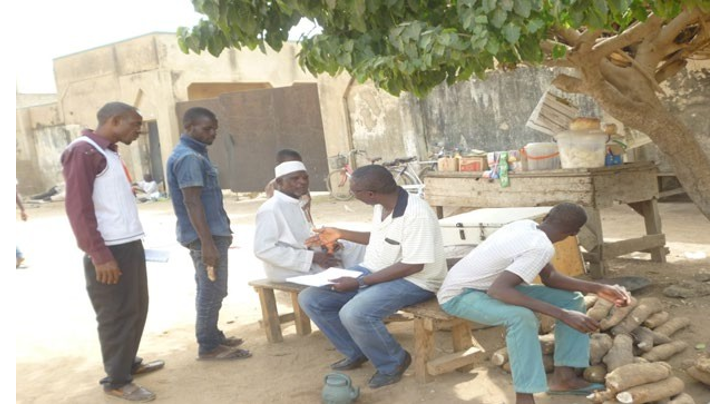
Figure 8: The Yam Vender
Environmental pollution is a colossal threat to human health, plants, soil and animals. Some of the business people who are respondents expressed their feelings on how they are uncomfort-able with the odour from the effluents. Indeed, this condition is worth agonising and lamenting over.The respondents stated that the residents of the study area have protested before now against the dangerous problem of effluents, yet this is ongoing till date. Also, they have complained to the industries and government but the problem has not been solved. The people revealed that they have not received any support or relief material from the industries and the government to tackle their challenges. The re- spondents are of the opinion that the government should tackle this problem which has become a serious threat to lives.
Means of Discharging Effluents from the Industries
In the study area it was observed that the tannery B has under-ground pipe for effluents discharge but it is link to the road drain-age after a little distance from the industry while the tannery A discharges effluents directory from the industry to the road drainage in the study area of which is not proper. The means in which the both industries release their effluents to the environ¬ment is inappropriate. Thus, there is need for the industries to develop better means of releasing the industrial effluents to the environment. This issue calls an urgent attention of the govern-ment to enforce the Federal Environmental Protection Agency (FEPA) laws on the industries for adequate solution to the envi-ronmental and people’s challenges in the study area.
In the interview conducted for the industrial personnel of tannery B as shown in figure 9, it was revealed by the maintenance engi- neer that the effluents are treated before discharge. The treatment plant and processes involve in treating the effluents were made known and explained lucidly. Despite this, the findings have ap¬parently shown an indisputable proof of high air pollution and poor drainage of the environment. Moreover, the concentration of electrical conductivity and total dissolved solids appear to be the highest among all other parameters.

Figure 9: Interview with the Maintenance Engineer and Personnel Manager
There is stagnant water in the environment because the tanneries industries discharge the effluent to environment since they have no reservoir which the effluents can be discharged into directly. This is responsible for diseases. Studies have shown that there has been a great deal of concern that stagnant water channels may increase the abundance of mosquito breeding sites and hence the risk of malaria and other vector-borne diseases [10-12]. Figure 10 shows an open local drainage where industrial effluents flow in the study area.

Figure 9: Stinking Open Drainage in the Study Area at Sample Collection Point
Open drainage is very detrimental to the environment and hu-man health as different toxic chemicals and substances emanate from it. This can be prevented by adopting modern closed drain¬age system which helps in controlling air pollution.
Conclusion
Environmental pollution has become endemic in Sharada in-dustrial areas due to stagnant water and the presence of heavy metals in the effluents that are regularly discharged into the en-vironment. This menace has currently reached an alarming rate in the study are as the environmental pollution is very glaring and the inhabitants are not comfortable with the condition which is excruciating. The protection of lives and sustainable hygienic environment are very significant. Thus, this study assessed the impact of environmental pollution on the residents of Sharada tanneries industrial area, Kano and has shown that concentration of all the physicochemical parameters of the industrial effluents is within the acceptable limits except for the Electrical Con¬ductivity and Total Dissolved Solid which have large disparity between the FEPA tolerant values. The industrial effluents are affecting lives, the environment and economic activities of the people in the study area. Thus, the government intervention for the control of this menace is needed and if nothing is done con¬cerning this problem, in the nearest future, it will become more alarming and devastating to the environment and human’s health thereby resulting in loss of lives.
Ethical Approval: Not Applicable
Consent to Participate: Not Applicable
Consent to Publish: I, Dave E. Ekpa, the author of this article wants it to be published
Authors Contributions: This study assessed the impact of en-vironmental pollution and determined levels of heavy metals (HMs) in the effluents from tannery industries in Sharada phase I and II. The data used include laboratory test to determine heavy metals (Cd, Cr, Cu, Pb, Zn, Ni, Mn, Fe), Electrical Conductivity (EC) and Total Dissolved Solid (TDS) from industrial effluents. Funding: Not Applicable Competing Interests: Not Applicable
Competing Interests: Not Applicable
Availability of Data and Materials: Primary and secondary data were sourced by the author through field survey, interview, physical observation and previous works on the subject matter Preprint: Manuscript has not been submitted to preprint server prior to submission on Environmental Science and Pollution Research (ESPR).
References
- Fereidoun, H., Nourddin, M. S., Rreza, N. A., Mohsen, A., Ahmad, R. &Pouria, H. (2007). The Effect of Long-Term Exposure to Particulate Pollution on the Lung Function of Teheranian and Zanjanian Students. Pakistan Journal of Physiology, 3(2), 1-5.
- Gana A. J. and Toba A. P. (2015). Environmental Pollution and Sustainability. Journal of Research in Environmental Science and Toxicology, 4(1), 1-9.
- Falola, J. A. (2002). Kano. In S. Okafor, E. Osaghae, C. Ik-porukpo, & S. Abumere (Eds), Africa Atlases: Atlas of Nigeria, 146-147.
- Olofin, E. A. (2008). The physical setting. In E.A. Olofin, A.B. Nabegu and A.M. Dambazau (Eds). WudilWithin Kano Region: A Geographical Synthesi. Kano City: Ada-muJoji Publishers, 5-34.
- Tanko, A. I. (2002). Spatio-temporal patterns of environmental pollution. Paper presented at the 45th Annual NGA Conference, University of Ilorin.
- Pescod, (199)
- Deepali, K. K., & Gangwar, K. (2010). Metals concentration in textile and tannery effluents, associated soils and ground water. New York Science Journal, 3(4), 82-89.
- Ward N. I. (1995). In Environmental analytical chemis-try-Trace elements. (Eds.F.W. Fifield, and P.J.Haines.), Blackie Academic and Professional, UK. pp. 320-328.
- Binns, J. A., Maconachie, R. A., & Tanko, A. I. (2003). Water, land and health in urban and peri-urban food production: the case of Kano, Nigeria. Land Degradation & Development, 14(5), 431-444.
- Lindsay, S. W., Campbell, H., Adiamah, J. H., Greenwood,A. M., Bangali, J. E., Greenwood, B. M. (1990). Malaria in a peri-urban area of The Gambia. Annals of Tropical Medicine and Parasitology 84, 553-562.
- Trape, J. F., Lefebvre Zante, E., Legros. F., Ndiaye, G., Bouganali, H. et al.
- Trape, J. F., Zoulani. A. (1987). Malaria and urbanisation in Central Africa: the example of Brazzaville. Transactions of the Royal Society of Tropical Medicine and Hygiene 81(2), 1-33.
- Inyinbor (2013). Impact of Nigerian textile industry on economy and environment: a review. International Journal of Basic & Applied Sciences, 13(1), 98-106.