

General Surgery and Clinical Medicine(GSCM)
ISSN: 2836-4961 | DOI: 10.33140/GSCM


Research Article - (2024) Volume 2, Issue 1
Hernias in a Tertiary Care Center: a Cross-Sectional Study
2Orthopedic surgery resident, King Abdullah University Hospital, Irbid, Jordan
3Family medicine resident, King Abdullah University Hospital, Irbid, Jordan
4Family medicine resident, King Abdullah University Hospital, Irbid, Jordan
5Department of Surgery, University of Aleppo, Aleppo, Jordan
6Medical student, Jordan University of Science and Technology, Irbid, Jordan
7Otolaryngology resident, Ministry of Health, Zarqa, Jordan
8General Surgery Resident, King Abdullah University Hospital, Irbid, Jordan
9General physician, Krefeld, Germany
Received Date: Dec 20, 2023 / Accepted Date: Jan 10, 2024 / Published Date: Jan 23, 2024
Copyright: ©©2024 Maher Al-Hajjaj, et al. This is an open-access article distributed under the terms of the Creative Commons Attribution License, which permits unrestricted use, distribution, and reproduction in any medium, provided the original author and source are credited.
Citation: Abokhsab, M. M., Matalqah, H., Matalkeh, L. E., Yaseen, R., Al-Hajjaj, M., et al. (2024). Hernias in A Tertiary Care Center: A Cross-Sectional Study. Gen Surgery Clin Med, 2(1), 01-04.
Abstract
Background: Abdominal wall hernias are a common condition that is seen in daily general surgery patients. However, still more researches are needed to be conducted regarding hernias. The aim of this study is to see the prevalence of hernias among patients admitted to the Department of Surgery of a tertiary care center.
Methods: A descriptive cross-sectional study was performed among patients who admitted to the department of surgery in a tertiary care center between 1 August 2023 and 20 September 2023. All patient’s data were extracted to an excel sheet. Patients under age 18 years old or currently pregnant were excluded from this study. Using SPSS version 23, we analyzed the data.
Results: We had 760 patients who visited in this period. Only 272 patients (27.9 %) were diagnosed with hernias. We found 52.6 % of patients were male and 47.4 % of patients were female. The age between 46- 60 years old was the most to have hernias (97 patients). Inguinal hernias were the common among other types. Diabetes mellitus, hypertension, COPD, and hydrocele were found in 10.7 % of all patients.
Conclusion: The prevalence of hernias in this study was nearly to other studies that conducted in the same conditions. Early diagnosis and patient’s education are the corner stone to prevent morbidities and mortalities.
Keywords
Abdominal Wall Hernias, Inguinal Hernia, Cross-Sectional Study
Introduction
Abdominal wall hernia is the most frequently encountered surgical condition that affects all age groups regardless of sex. Globally, the prevalence of abdominal wall hernia was 1.7% for all ages. Abdominal wall hernias are accounting for 15%–18% of all sur-gical procedures, and annually more than 20 million hernias are operated worldwide [1].
The hernia can also be characterized as a rupture in smooth tissue through which an organ protrudes or pushes through. It is main¬ly common in the abdomen, groin regions, navel area and upper thigh. Common types include inguinal, hiatal and umbilical herni¬as. The most frequent hernia is the inguinal hernia (73% of cases) [2-5].
Hernia is a common surgical condition whose frequency is esti- mated at five percent of the total male population [6-7].
Knowledge of the prevalence, pattern and management of her-nia disease locally will highlight local surgical needs and inform health resource allocation [8].
For such circumstances, hernias should be studied more to have the most advanced knowledge about it. We performed a cross-sec-tional study about the prevalence and associated risk factors of hernias.
Methods
We conducted a descriptive cross-sectional study among patients who admitted to the department of surgery in a tertiary care center. Data were collected from 1 August 2023 to 20 September 2023. Inclusion criteria were patients who are 18 years old and older and visiting the department of surgery. Exclusion criteria were those who were pregnant women and children.
Patients with missed details were excluded for the study. Age, sex, types of hernia, and comorbidities were studied. Full clinical ex¬amination was performed for all the patients. All data were saved on excel sheet for statistics. Data were processed on SPSS Statis¬tics version 23.
Analysis was done using descriptive statistics.
Results
Out of 760 patients, we had 272 (27.9 %) patients who had herni¬as. The mean age of our patients was 37.28 ± 11.55 years (19-77) years.
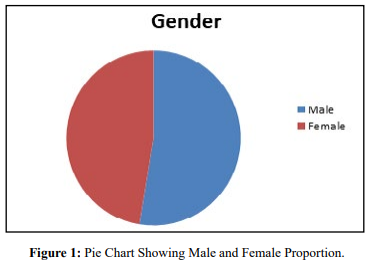
We found 143(52.6 %) patients were males and the rest 129 (47.4 %) patients were female (Figure 1).
In our study, inguinal hernias were 72.4 %, incisional hernias were 11.76 %, umbilical hernias were 6.25 %, Epigastric hernias were 4.41 %, and femoral hernias were 3.30 % (Figure 2).
We found 18 patients were 20 years age or less, 31 patients were between 21-30 years, 85 patients were between 31-45 years, 97 pa- tients were between 46-60 years, and only 41 patients were more than 60 years old. The male: female ratio of overall hernia patients was 2.8:1 and that for the inguinal hernia was 3.10:1, the incision¬al hernia was 2.2:1, the umbilical hernia was 2.4:1, the epigastric hernia was 2:1 and the femoral hernia was 3.5:1.

Figure 2: Types of Hernias.
In our study, we had 29 (10.7 %) patients out of 272 who had comorbidity. Diabetes mellitus was found in 16 patients (5.8 %), hyperten-sion was found in 7 patients (2.5 %), chronic obstructive pulmonary disease was found in 4 patients (1.4 %), and hydrocele was found in 3 patients (1.1 %) (Table 1)
|
Comorbidities |
N (%) |
|
Diabetes mellitus |
16 (5.8 %) |
|
Hypertension |
7 (2.5 %) |
|
Chronic obstructive pulmonary disease |
4 (1.4 %) |
|
Hydrocele |
3 (1.1 %) |
|
Total |
29 (10.7 %) |
Table 1: Comorbidities Among Patients With Hernia
Discussion
Our study aimed to assess the prevalence of hernias among pa-tients who admitted to a general surgery department. This study showed the prevalence of hernia was 27.9 %. Deo et al and Kibret AA, et al found the prevalence of hernias was 23.14%, 11.7% re¬spectively (1, 9).
A retrospective analysis of the National Center for Health Statis-tics in the US showed a 15.6% baseline prevalence of abdomi¬nal inpatient emergent hernia repaired from 2001 to 2010 over 10 years. In our study, we found the male-to-female ratio of inguinal hernia, incisional hernia, and umbilical hernia showed male pre¬ponderance whereas femoral hernia was found to be more in the female. These findings resemble a study by Deo et al. which they found male predominance of male gender except for femoral her¬nia (female predominance). In contrast, female preponderance was found in study by This cross-section study revealed that most cas¬es were inguinal hernias (72.4 %), followed by incisional hernias (11.76 %), 6.25 % for umbilical hernias, 4.41 % epigastric hernias, and 3.30 % for femoral hernias [9,10].
Another study was done by Abdul Majeed Ahmed Alazani et al. found that the most common site of abdominal hernias was pa-ra-umbilical, as they were found in 33.9% of cases followed by The distribution of hernias was found to be higher in age between 46- 60 years (97 cases). The less proportion of hernias was found in younger patients (less than 20 years).
These findings were declared in a study Kibret AA, et al (1).
Many studies showed the same finding regarding the correlation between hernias and advanced age [12-14] The reason could be attributed to the degenerative weakness of abdominal muscles and fibrous tissue in the elderly age group. Loss of abdominal muscle strength and resistance to high intra-abdominal pressure can lead to herniation [15].
Many studies showed comorbidities accompanied with hernias. Comorbidities associated with inguinal hernia are male gender, low body mass index, Ehlers-Danlos syndrome, protanomaly, smoking, COPD, etc. [16,17].
In this study, we found diabetes mellitus was the most common in our patients (10.7 %), followed by hypertension (2.5 %), COPD was found in 4 patients (1.4 %), and hydrocele was found in 3 patients (1.1 %).
Conclusion
We conclude that the prevalence of hernias in our study was among the range of most previous studies. More studies and efforts are needed to make guidelines regarding early diagnosis of hernias and well management [18,19].
References
- Kibret, A. A., Tekle, S. Y., Worede, A. G., & Dessie, M. A. (2022). Prevalence and associated factors of external hernia among adult patients visiting the surgical outpatient department at the University of Gondar Comprehensive Specialised Hospital, Northwest Ethiopia: A cross-sectional study. BMJ open, 12(4).
- Bailey, H., CAPPER, W. M., Love, R. J. M., & RAINS, A. J.H. (1971). Bailey & Love's Short Practice of Surgery. Revised by AJ Harding Rains and W. Melville Capper... Consulting Editor McNeil Love. HK Lewis.
- Kingsnorth, A. N., & LeBlanc, K. A. (Eds.). (2003). Management of abdominal hernias. Springer Science & Business Media.
- Kingsnorth, A., & LeBlanc, K. (2003). Hernias: inguinal and incisional. The Lancet, 362(9395), 1561-1571.
- Townsend, C. M., Beauchamp, R. D., Evers, B. M., & Mat-tox, K. L. (Eds.). (2016). Sabiston textbook of surgery: the biological basis of modern surgical practice. Elsevier Health Sciences.
- Zendejas, B., Ramirez, T., Jones, T., Kuchena, A., Ali, S. M., Hernandez-Irizarry, R., ... & Farley, D. R. (2013). Incidence of inguinal hernia repairs in Olmsted County, MN: a population-based study. Annals of surgery, 257(3), 520.
- Odula, P. O., & Kakande, I. (2004). Groin hernia in Mulago hospital, Kampala. East and Central African journal of surgery, 9(1).
- Odula, P. O., & Kakande, I. (2004). Groin hernia in Mulago hospital, Kampala. East and Central African journal of surgery, 9(1).
- Waweru, J., Barasa, M., Mwenda, A. S., & Mwago, J. (2014).Hernia surgery in Nyeri Provincial General Hospital, Kenya: our 6 year experience. Annals of African Surgery, 11(2).
- Deo, K. K., Shrestha, R., Saroj, G. C., Maharjan, S., Shrestha, A., & Neupane, A. (2023). Hernia among Patients Admitted to the Department of Surgery of a Tertiary Care Centre: A Descriptive Cross-sectional Study. JNMA: Journal of the Nepal Medical Association, 61(259), 200.
- Beadles, C. A., Meagher, A. D., & Charles, A. G. (2015). Trends in emergent hernia repair in the United States. JAMA surgery, 150(3), 194-200.
- AhmedAlenazi, A., Alsharif, M. M., Hussain, M. A., Alenezi,N. G., Alenazi, A. A., Almadani, S. A., ... & Alanazi, T. H. (2017). Prevalence, risk factors and character of abdominal hernia in Arar City, Northern Saudi Arabia in 2017. Electronic physician, 9(7), 4806.
- Sazhin, A., Zolotukhin, I., Seliverstov, E., Nikishkov, A., Shevtsov, Y., Andriyashkin, A., ... & Kirienko, A. (2019). Prevalence and risk factors for abdominal wall hernia in the general Russian population. Hernia, 23, 1237-1242.
- Iqbal, M. N., Akhter, S., & Irfan, M. (2015). Prevalence of hernia in relation to various risk factors in Narowal, Pakistan. Sci Lett, 3(1), 29-32.
- Van Der Rest, M., & Garrone, R. (1991). Collagen family of proteins. The FASEB journal, 5(13), 2814-2823.
- Lauscher, J. C., Loh, J. C., Rieck, S., Buhr, H. J., & Ritz, J. P. (2013). Long-term follow-up after incisional hernia repair: are there only benefits for symptomatic patients?. Hernia, 17, 203-209.
- Van Der Rest, M., & Garrone, R. (1991). Collagen family of proteins. The FASEB journal, 5(13), 2814-2823.
- Abebe, M. S., Tareke, A. A., Alem, A., Debebe, W., & Beyene, A. (2022). Worldwide magnitude of inguinal hernia: Systematic review and meta-analysis of population-based studies. SAGE Open Medicine, 10, 20503121221139150.
- Jensen, K. K., Henriksen, N. A., & Jorgensen, L. N. (2017). Inguinal hernia epidemiology. Textbook of hernia, 23-27.