



Research Article - (2019) Volume 4, Issue 4
Heavy Metal Testing Ensures Better Supplement Safety
Received Date: Nov 06, 2019 / Accepted Date: Nov 13, 2019 / Published Date: Dec 05, 2019
Copyright: ©Iftekhar Ahmed Mohammed. This is an open-access article distributed under the terms of the Creative Commons Attribution License, which permits unrestricted use, distribution, and reproduction in any medium, provided the original author and source are credited.
Abstract
Heavy metal contamination in our food and supplements is a very real and serious issue. Surveillance activities in a number of countries in recent years have identified high levels of the heavy metals like lead, cadmium, arsenic and mercury in certain food supplements. Consumption of such contaminated food supplements may contribute to human exposure to these metals. Heavy metal testing is a cornerstone of any GMP-certified manufacturer’s quality assurance program, and to ensure consumer safety. The aim of the study was to compare the levels of these metals found in food supplements, which are available in the local market of Dubai with the legislative requirements. Over 200 food supplements were analyzed in this study during the year 2018. The concentration of heavy metals in supplement products were determined using microwave digestion and high-resolution inductively coupled plasma mass spectrometry with concentrated nitric acid. The results showed a high degree of compliance with the limits of 3 μg lead/g, 1 μg cadmium/g and 0.1 μg mercury/g in the products with the exception of two samples were above the maximum levels of 3 μg lead/g and 1 sample above the maximum levels of 0.1 μg mercury/g. Cadmium were below regulations set by the European Union. However, total arsenic has no regulatory limits set up by the European Union legislation to assess the risk. The concentration ranges were as follows: arsenic, <50-32381 μg/kg; cadmium, <10-958 μg/kg; mercury, <50-139 μg/kg; and lead, <50-44303 μg/kg. Therefore, determination of these elements in these products is necessary and the authorities should be survey and monitor these products at regular intervals.
Keywords
Food Supplements, Arsenic, Cadmium, Mercury, Lead, Microwave Digestion, High-Resolution Icp-Ms, European Union, Dubai
Introduction
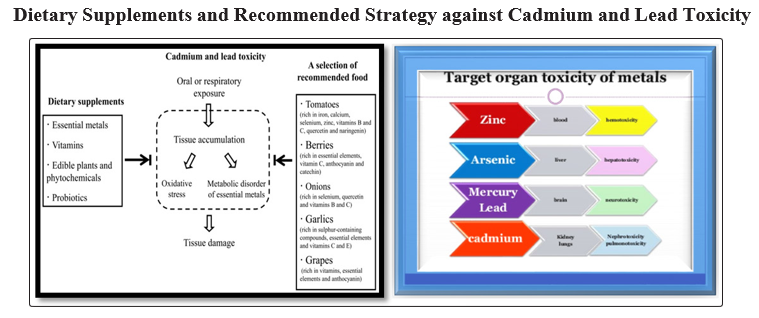
1. Heavy metal toxicity is one of the oldest environmental problems and remains a serious health concerns today. Cadmium (Cd) and lead (Pb) are common toxic heavy metals in the environment. The public is exposed to Cd and Pb through the ambient air, drinking water, food, industrial materials and consumer products [1].
2. Food supplements have been defined as materials taken by mouth that include ingredients intended to provide dietary supplementation. They can be found in various forms, including tablets, powders, and liquids. They may consist of vitamins, minerals, herbs or other botanicals, amino acids, and substances such as enzymes, organ tissues, and metabolites.
3. Food supplements are intended to correct nutritional deficiencies, maintain an adequate intake of certain nutrients, or to support specific physiological functions.
4. The dietary supplement manufacturer is responsible for ensuring that a dietary supplement is safe before it is marketed. FDA is responsible for taking action against any unsafe dietary supplement product after it reaches the market [2].
Materials and Methods
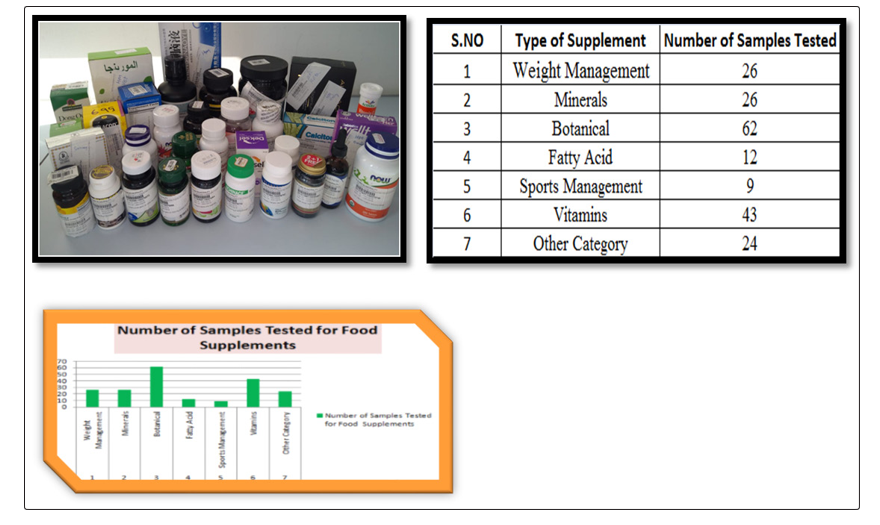
A total of over 200 Food Supplement samples with different matrices like Vitamins, Minerals, and Fatty Acids, Sports and Slimming products and Others etc. were collected from different locations within Dubai during the year 2018. Approximately 1 or 2 bottles of samples was bought from the market and send to the sample management for labeling and from there it was sent to the lab for analysis through the laboratory procedures (BS: EN 15763).
The main objective of this study was to determine selected heavy metals content (Pb, As, Cd, Hg) present in food supplement samples and to compare the level of heavy metal concentrations in food supplement analyzed, with the COMMISSION REGULATION (EC) No EC No 629/2008 of July 2008 setting maximum levels for certain contaminants in foodstuffs.
Analytical Methodology
1. Commercially available Food Supplements representing different types of matrices or brands were collected and prepared in duplicate. Samples were grinded using laboratory grinder. The samples should be fairly homogeneous and in a form that allowed a representative sample to be easily taken. If the samples were chunky solids, grinding, blending or other procedures might be necessary to ensure a more homogeneous sample to be measured. For the determination of heavy metals in different supplements first, the samples were digested by microwave digestion (CEM Mars Technologies) using concentrated Nitric acid. Concentration of different heavy metals in analytical solution measured as per laboratory Procedures.
2. Nitric acid and Hydrogen peroxide were added to PTFE vessels with known amount of sample and is heated at in a closed-vessel microwave digestion system (MDC). The samples were then transferred and diluted with ASTM Type I water. Concentration of heavy metals were determined by using ICP-MS.
Results and Discussions
Average Concentration of Heavy Metals in Different Food Supplements in µg/kg
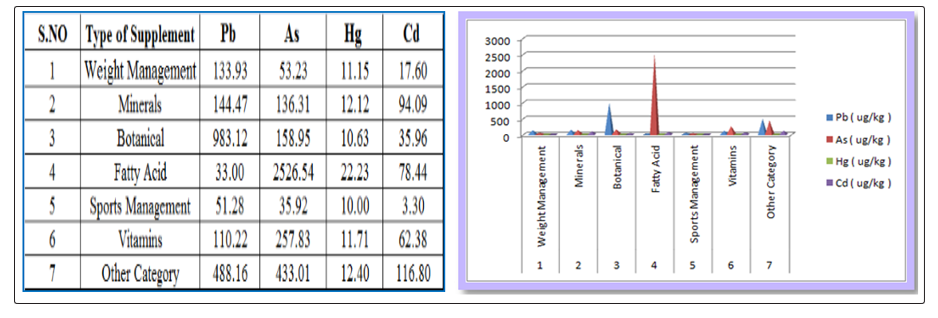
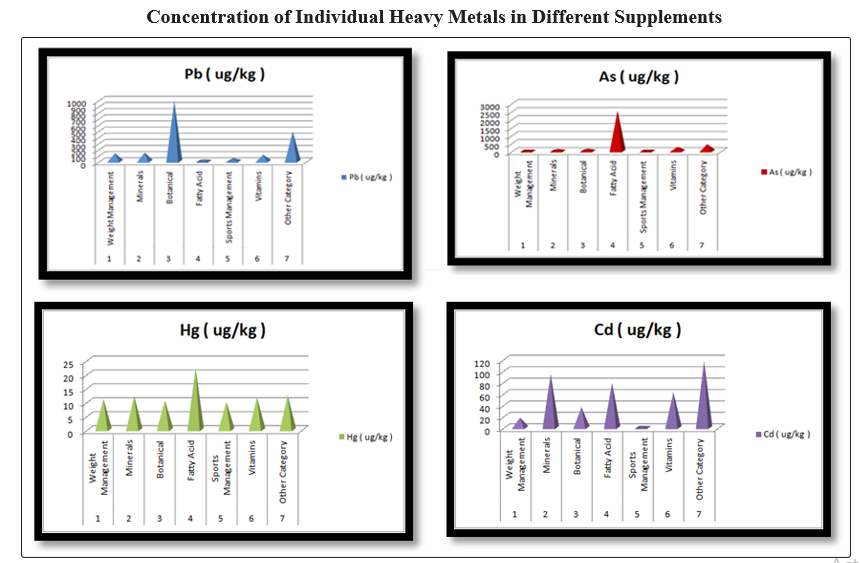
1. From the results studied it was observed that the average mean concentration of lead was high in the food supplements of botanical origin 983 (ug/kg) followed by other categories of supplements 488 (ug/kg) and less contamination was seen in supplements of fatty acid content.
2. Highest arsenic content was found in fatty acid supplements (2527) ug/kg, followed by other categories and vitamins supplements. Sports management supplements has very less amount of arsenic (36) ug/kg.
3. Among all samples tested for food supplements only 1 sample (Fatty acid class) has more than100 (ug/kg) of Hg and it is non-compliance with the regulation of 0.1 (mg/kg wet weight).
4. The individual concentration of heavy metals in different brands and categories of food supplements varies as follows: arsenic, <50-32381 μg/kg; cadmium, <10-958 μg/kg; mercury, <50-139 μg/kg; and lead, <50-44303 μg/kg.
5. The results showed a high degree of compliance with the limits of 3 μg lead/g, 1 μg cadmium/g and 0.1 μg mercury/g in the products with the exception of two samples were above the maximum levels of 3 μg lead/g and 1 sample above the maximum levels of 0.1 μg mercury/g. Cadmium were below regulations set by the European Union. However, total arsenic has no regulatory limits set up by the European Union legislation to assess the risk.
6. Methodology developed on the ICP-MS was tested through analysis of a Dorm Fish Protein and other certified reference materials. The results from duplicate sample preparations are in good agreement with each other. Generally, less than 15% relative percent difference is acceptable and these range from 2-13%.
Dietary supplements are generally utilized by most people on voluntary basis and without strict supervision and knowledge of their health/risk factor, in contrast to medications, which are under control of Physicians. Varying levels of Pb, Cd and Hg have been found in certain food supplements tested. ML’s for Pb, Cd and Hg in food supplements have been introduced by Regulation (EC) No.629/2008 of 2nd July 2008 and are applicable since 1st July 2009 [3,4].
Results from the study showed that all brands of supplements tested have different levels of heavy metals. It showed a high degree of compliance with the limits of 3 μg lead/g, 1 μg cadmium/g and 0.1 μg mercury/g in the products with the exception of two samples were above the maximum levels of 3 μg lead/g and 1 sample above the maximum levels of 0.1μg Mercury/g. Cadmium were below regulations set by the European Union.
Conclusions
1. Arsenic has no regulatory limits set up by the European Union legislation to assess the risk associated with it.
2. Heavy metals are dangerous group of elements and they can have adverse effect on human health; therefore, the determination of these elements in these products is necessary and the authorities monitor these products.
3. Consequently, supplements consumed as essential nutrient for their Ca, Zn, Fe and Mn should be monitored for toxic metal levels due to their natural geochemical association with essential metals to ensure the safety of supplement consumptions. Measurement of trace toxic metals can help ensure dietary supplement product safety.
4. However, exact justification of this association requires subjecting samples to chemical speciation analysis like Inorganic arsenic by LC-ICPMS Technique.
Acknowledgement
We would like to thank our Head of Section Mrs. Maha Suwekeet AlHajri, Head of Unit Mrs Fatema Saeed and other staff of Food Chemical Analysis Unit, Dubai Central Laboratory, and Dubai Municipality who helped us to carry out this important study. In addition, we would like to thank to Food control department for providing samples required for this study. In addition, thanks to our assistants who support for sample preparation and grinding.
References
- Goyer RA, Clarkson TW (2001) Toxic Effects of Metals. In: Casarett and Doull’s Toxicology: The Basic Science of Poisons. Klaassen, CD (Ed.) 6th Edn. McGraw-Hill, New York, pp: 822-826.
- US. FDA Website http://www.cfsan.fda.gov
- Foodstuffs-Determination of trace elements-Determination of arsenic, cadmium, mercury and lead in foodstuffs by inductively coupled plasma spectrometry (ICP-MS) after pressure digestion. British Standard BS-EN 15763:2009.
- Dolan Scott P, Nortrup David A, Bolger P Michael and Capar Stephen G (2003) Analysis of Dietary Supplements for As, Cd, Hg, and Pb Using Inductively Coupled Plasma Mass Spectrometry, J. Agric. Food Chem 51: 1307-1312.