

Space Science Journal(SSJ)
ISSN: 2997-6170 | DOI: 10.33140/SSJ


Review Article - (2026) Volume 3, Issue 1
Fourier Transform of a Single-Frequency Octonion
Received Date: Jan 12, 2026 / Accepted Date: Feb 06, 2026 / Published Date: Feb 13, 2026
Copyright: ©2026 Vadim Sovetov. This is an open-access article distributed under the terms of the Creative Commons Attribution License, which permits unrestricted use, distribution, and reproduction in any medium, provided the original author and source are credited.
Citation: Sovetov, V. (2026). Fourier Transform of a Single-Frequency Octonion. Space Sci J, 3(1), 01-14.
Abstract
A method for Fourier transforms in 8D space of a single-frequency octonion for 8 different pulses is presented. The octonion Fourier transform is calculated using the fundamental matrix of the octonion by integrating the product of the signal vector with this matrix. The inverse Fourier transform uses the transposed fundamental matrix multiplied by the spectrum vector. Spectra of different pulses were obtained. It is shown that the pulse spectra are formed using the theorem of shifting spectra along the frequency axis in accordance with their shift in time. In this case, the shift of the signal vector elements is performed using a direct and quadrature shift matrix. As is known, the octonion is used to form a MIMO system with 8 inputs and 8 outputs. Therefore, the spectra of each pulse are located on each axis of spatial coordinates of 8D space. In this case, we obtain the sum of the spectra of different pulses as elements of the output vector. Since the sum spectra are formed from the spectra of individual pulses shifted along the frequency axis in accordance with their time shift, the sum spectra have a wider frequency band and are more resistant to interference. The spatial coordinate axes are orthogonal, since the octonion-based fundamental matrix is orthogonal, therefore, the total spectra on the axes will be orthogonal and the pulses are separated during the inverse transformation.
Keywords
Octonion, Quaternion, Hypercomplex Signals, Spectrum, Fourier Transform, MIMO
Introduction
The Fourier transform appeared in 1807 as a way to represent a function as a sum of harmonic oscillations of different frequencies. It is noteworthy that the Fourier transform used a complex function on the complex plane in the form of an exponential of the circular frequency  2
2 f and time t: eiwt cos(·t) + isin(·t) As can be seen from the given expression, the function consists of the sum of the real part and the imaginary part. If an exponential complex function has continuous derivatives of any order, it is called analytic or harmonic. It is known that the first derivatives of a harmonic function satisfy the Cauchy-Riemann conditions (CRC), and the second derivatives satisfy the Laplace equation. The CRC requires that as the amplitude of real oscillations increases, the amplitude of imaginary oscillations decreases. In this case, in accordance with the Laplace equation, the total power of the oscillations should remain unchanged. These two conditions are of fundamental importance for the analysis of physical processes, since, according to the law of conservation of energy, in physical space, with any transformation of energy, it must remain the same in magnitude. For example, if the real part of a complex function is defined as potential energy, and the imaginary part as kinetic energy, then the sum of the energies must be constant at any moment in time. It follows that the harmonic function describes a circle with constant radius on the complex plane. However, the dimension of physical space is greater than the dimension of the complex plane and is equal to 3D – length, width, height. Therefore, to analyze physical processes in real space, it is necessary to use harmonic functions of higher dimension than complex ones on the plane. It is clear that these functions must be analytical and harmonic, i.e. satisfy the CRC and the Laplace equation. Complex numbers of higher dimensions are known as hypercomplex. In 1843, Hamilton discovered quaternions. Later, using the doubling procedure, octonions, sedenions, and other hypercomplex numbers of higher dimension were defined. According to the doubling procedure, the dimension of hypercomplex numbers N describing hypercomplex spaces is a multiple of 2, i.e. N = 2n , where n = 1,2,3, Hence, the dimension of a quaternion is 4, an octonion is 8, a sedenion is 16, etc. Hypercomplex functions constructed on the basis of hypercomplex numbers also satisfy the CRC and the Laplace equation. Therefore, an analytical physical space constructed using hypercomplex functions can have a large dimension, a multiple of 2, and be analytical and harmonic. Therefore, to obtain the Fourier transform in a space with higher dimensions, it is necessary to use hypercomplex functions based on hypercomplex numbers. It is important to note that, despite the fact that physical space has a 3D dimension, it is possible to form spaces of very high dimensions in it using hypercomplex numbers. Methods of quaternion single-frequency and three-frequency Fourier transform and discrete quaternion Fourier transform for calculating the spectra of a sequence of different 4 pulses are known [1-3]. The aim of the article is to present a technique for octonion single-frequency Fourier transform in 8D space for 8 different pulses.
Materials and Methods for Solving the Problem
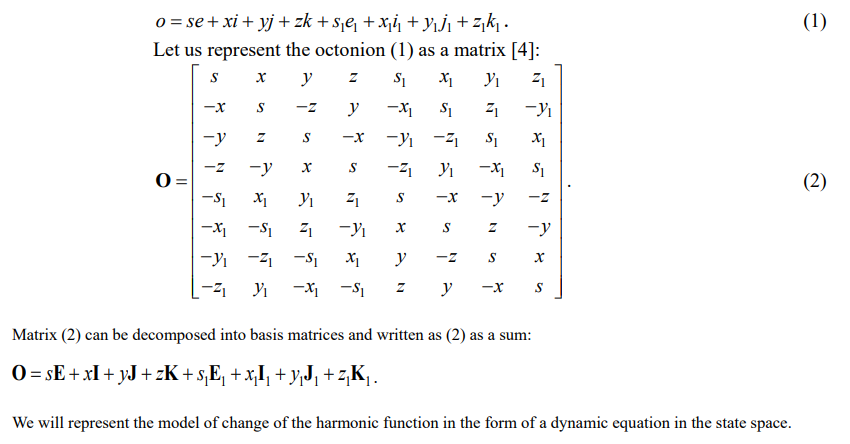
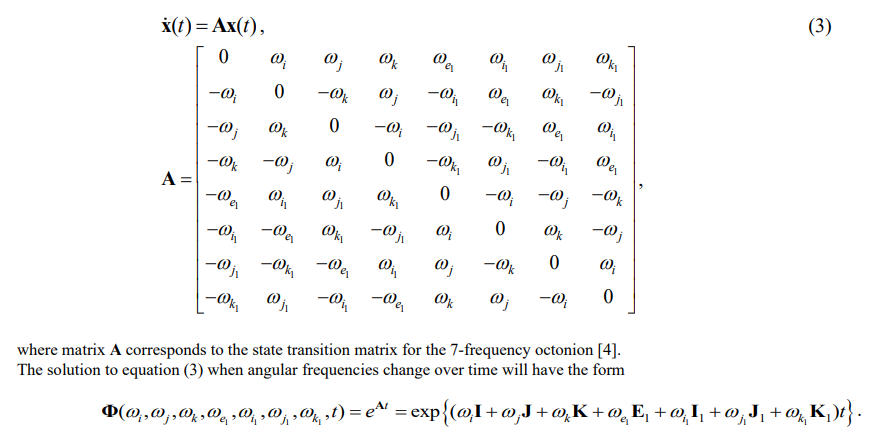
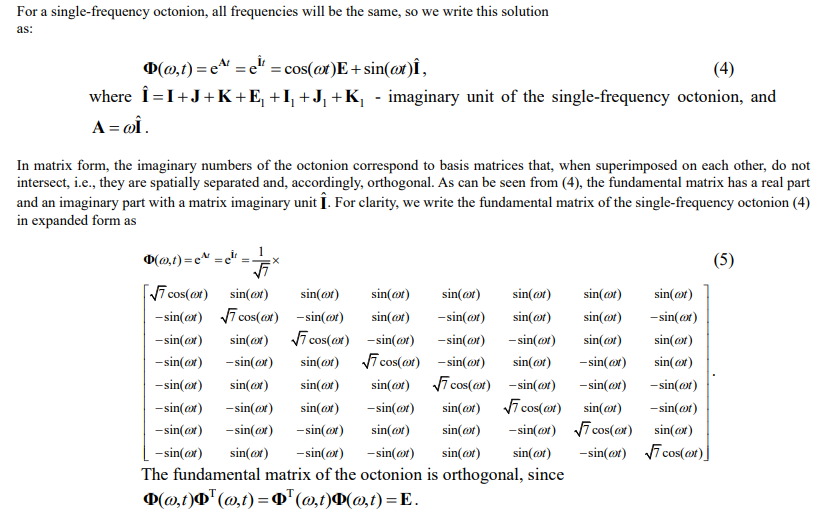
Let us write the octonion as a hypercomplex number with real values s, x, y, z, s1, x1 , y1 , z1 on the corresponding coordinate axes of the 8D space with one real axis e and seven mutually orthogonal imaginary spatial axes i, j, k, e1, i1, j1, k1:
Examples of obtaining the octonion Fourier transform
Let's find OFT and IOFT for the most common pulses. In this case, we will consider the successive shift of pulses in time, a multiple of the pulse length T:

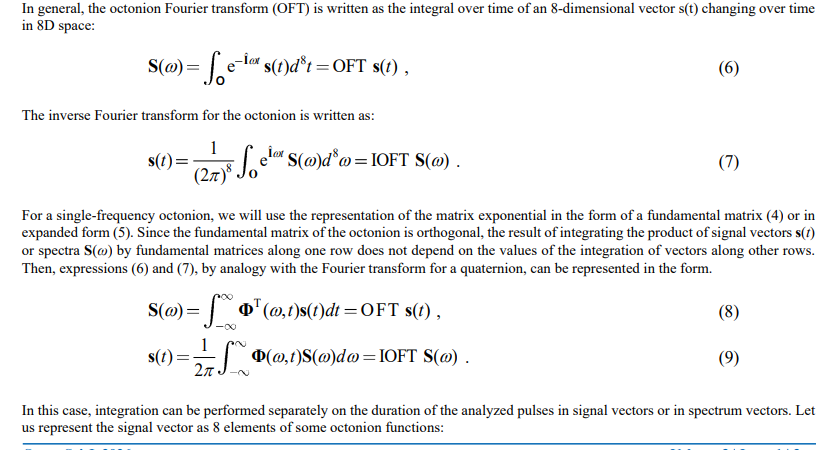
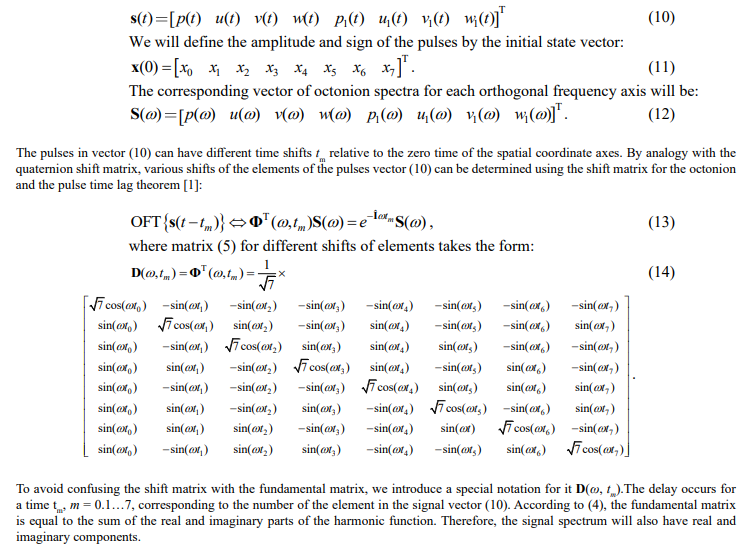
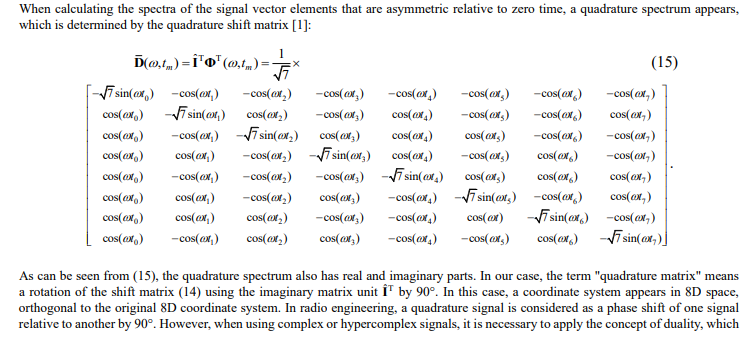
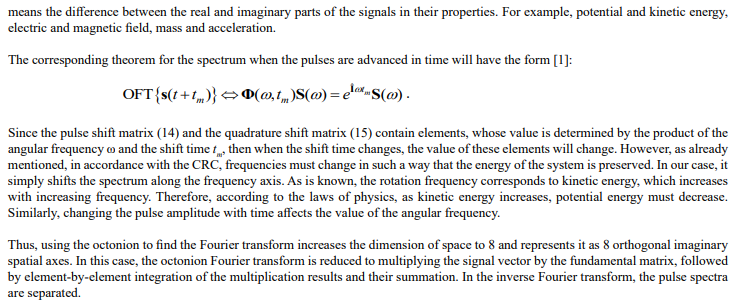
It is assumed that the middle of the first pulse is located at the zero point of the time axis. With such a shift, each pulse of the signal vector (10) will be multiplied by the corresponding column of the fundamental matrix (5) and the pulse time shift matrices (14) and (15).
OFT and IOFT Rectangular Pulses
In accordance with formula (8), for the vector of rectangular pulses (10), the integral for a duration from 0 to 8T can be written as separate integrals for the duration of individual pulses T, i.e., in the form of a matrix of the spectrum of a rectangular pulse symmetrical to zero r(w) ï?½ T sinc (Tw/ 2) with a corresponding frequency shift. In accordance with the shift theorem (13), when multiplying r(ω) by the matrix (14) with the values of the pulse shifts in time (16), we obtain a matrix of spectra of rectangular pulses with a unit pulse amplitude:

As can be seen from (17), when calculating the spectrum of rectangular pulses with a sequential shift, the quadrature shift matrix (15) is not used. This is explained by the fact that the initial pulse is taken to be a pulse that is symmetrical relative to zero time with a constant amplitude.In other words, the mirror image of a rectangular pulse has the same shape as the original pulse. By adding up the spectra of all pulses of each row with the corresponding signs and amplitudes, i.e. by multiplying the matrix (17) by the vector of initial states (11), we obtain the vector of spectra:

Figure 1 shows the spectra of the elements of vector (18) for x(0) = [1-1 1-1-1-1 1 1] T. According to the delay theorem (13), the spectrum of a rectangular pulse will be shifted along the angular frequency axis relative to the zero value according to the pulse delay values. As can be seen from Figure 1, the spectra are formed by summing the spectra at different shifts and, accordingly, the spectrum is expanded. The figure also shows the spectrum module. Calculations show that as the considered spectrum width increases, the power of each element of the spectrum vector tends to 1, i.e. to the value of the power of each element of the initial vector x(0).
Figure 1: Spectra of Rectangular Pulse Vector Elements
Note that the spectra are located on 7 orthogonal imaginary coordinate axes and one scalar axis with the values of angular frequencies ω. Therefore, with IOFT (9) the pulses can be separated and each pulse can be calculated separately by summing its spectra on orthogonal axes. Figure 2 shows the initial vector impulses obtained using IOFT (9).
Figure 2: Initial Vector Impulses X(0) = [1-1 1-1-1 1 1 1] Obtained Using IOFT
OFT and IOFT of Meander pulses
A meander is a signal consisting of two rectangular pulses of different signs. With a rectangular pulse width of T/2, the meander pulse duration is T. The spectrum of a rectangular pulse has the shape (17). We will represent the meander spectrum as the spectrum of a rectangular positive pulse of duration T/2 and a negative pulse shifted in time by T/2 relative to the first pulse:

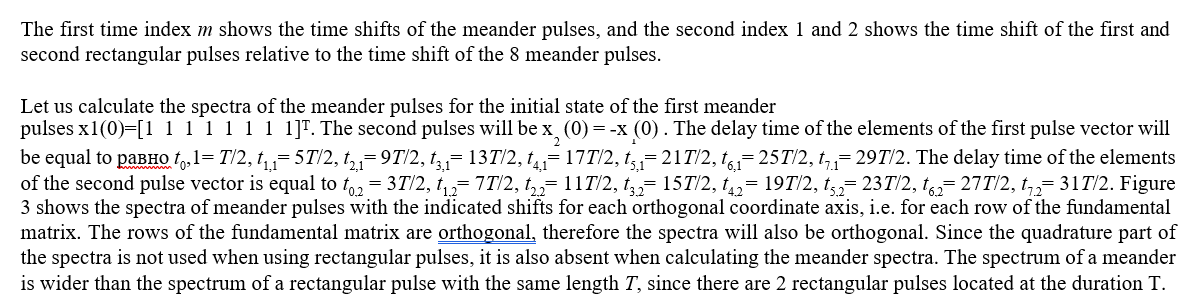
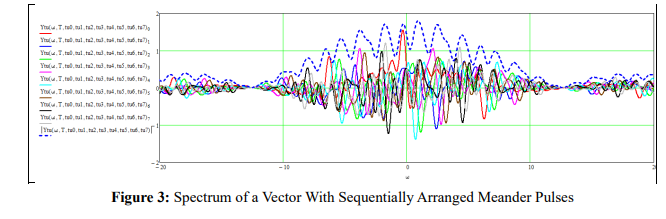
The IOFT is calculated using formula (9). Integrationcan also be performed S(ω) separately for each row of the fundamental matrix Φ (ω,t) and for each meander pulse. Figure 4 shows the IOFT results for meanders.
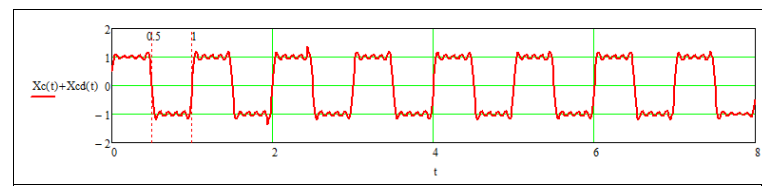
Figure 4: IOFT for a Sequence of Meanders
OFT and IOFT Sawtooth Pulses
Sawtooth pulses can be increasing or decreasing in amplitude. Let's find OFT and IOFT of increasing sawtooth pulses. The middle of the first sawtooth pulse is located at the 0 time coordinate, so the sawtooth pulse is not symmetrical. Therefore, the spectrum of the sawtooth pulse has a quadrature component. When calculating spectra, it is also necessary to use the quadrature shift matrix (15). As a result of calculations we obtain:
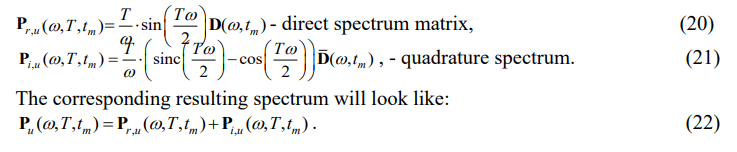
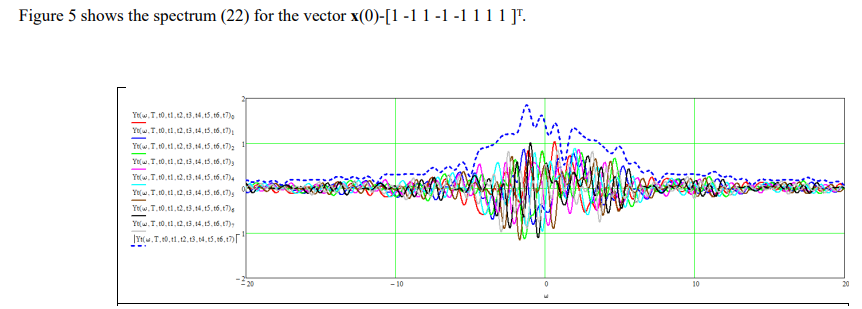
Figure 5: Spectrum of a Sequence Of Increasing Sawtooth Pulses
Figure 6 shows the IOFT of increasing sawtooth pulses.
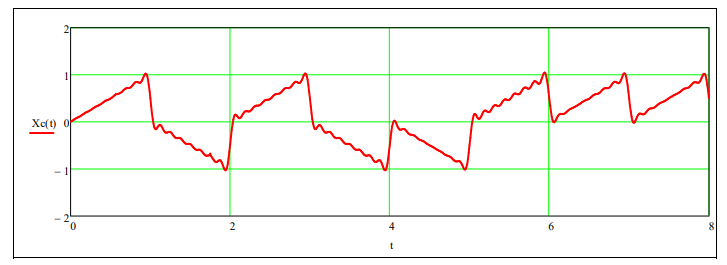
Figure 6: IOFT of Increasing Sawtooth Pulses
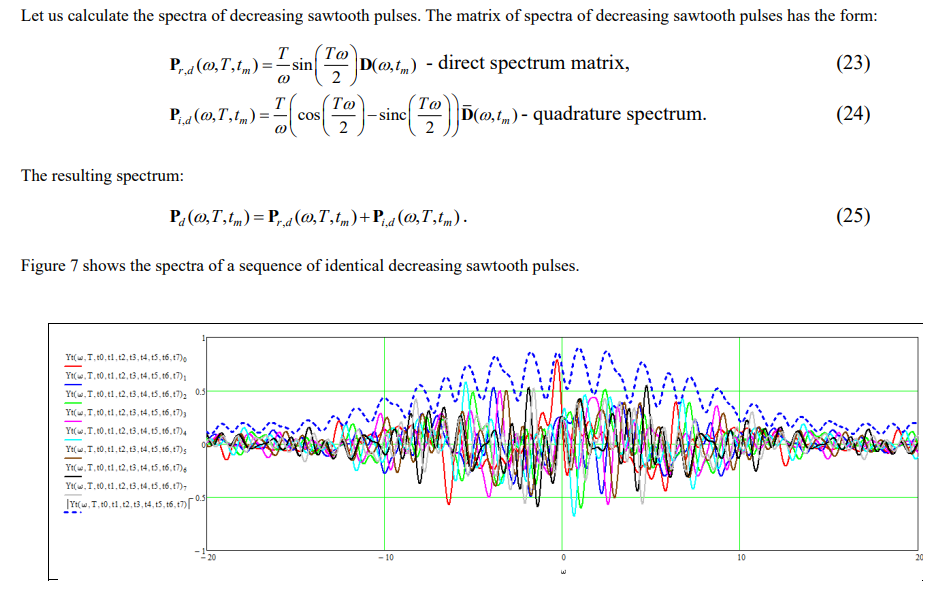
Figure 7: Spectrum of a Sequence of Decreasing Sawtooth Pulses
Figure 8 shows the IOFT of a sequence of identical decreasing sawtooth pulses
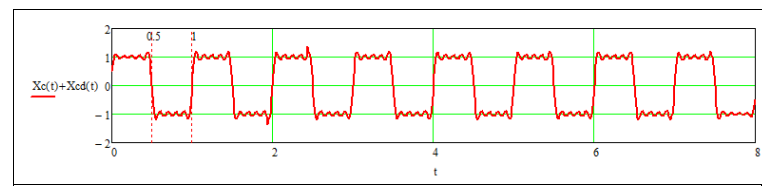
Figure 8: IOFT of Decreasing Sawtooth Pulses
OFT and IOFT Triangular Pulses
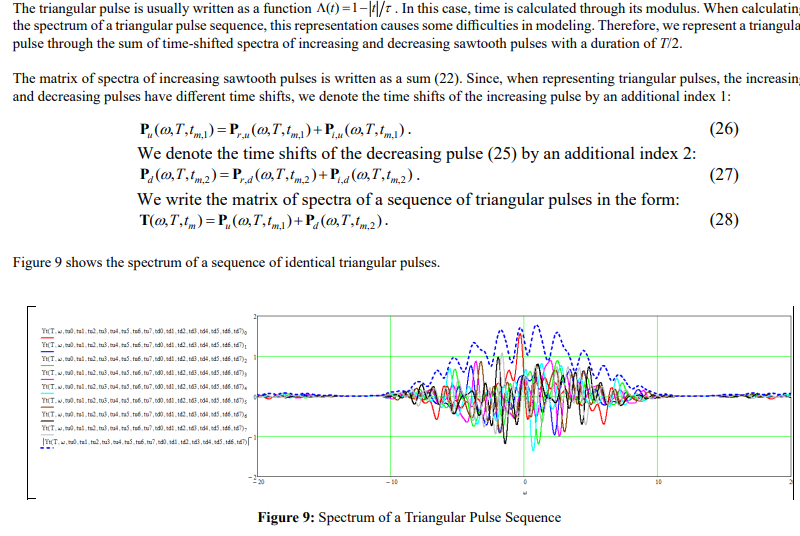
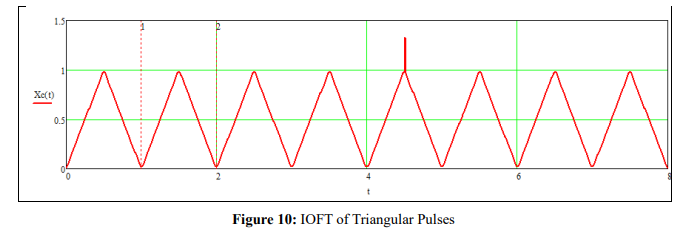
The sequence of triangular pulses obtained using IOFT is shown in Figure 10.
OFT and IOFT Trapezoidal Pulses
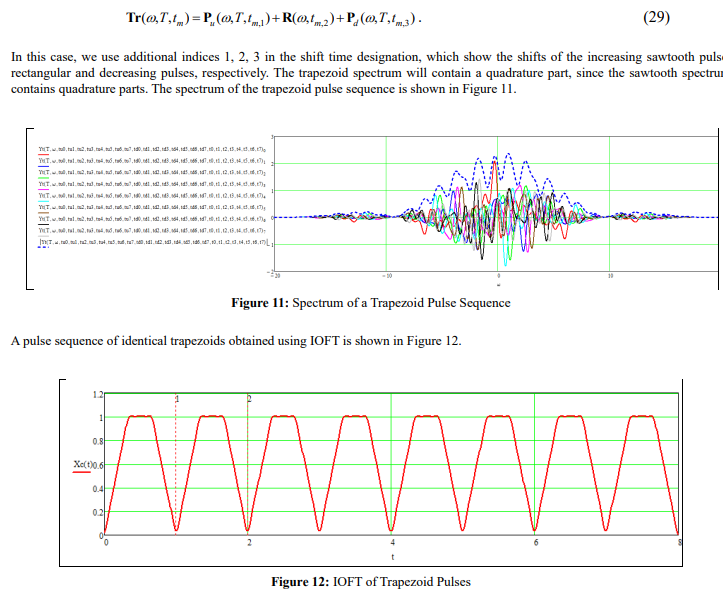
OFT and IOFT Sinus impulses
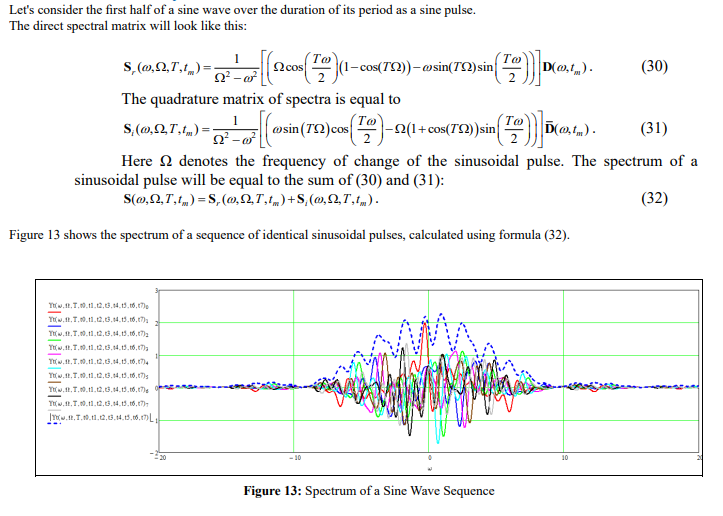
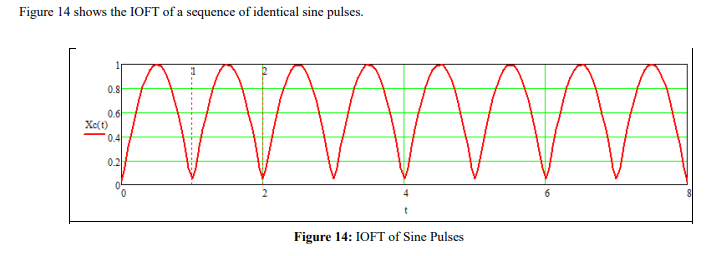
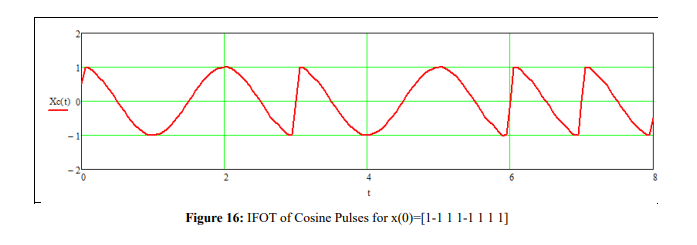
OFT and IOFT Cosine Pulses

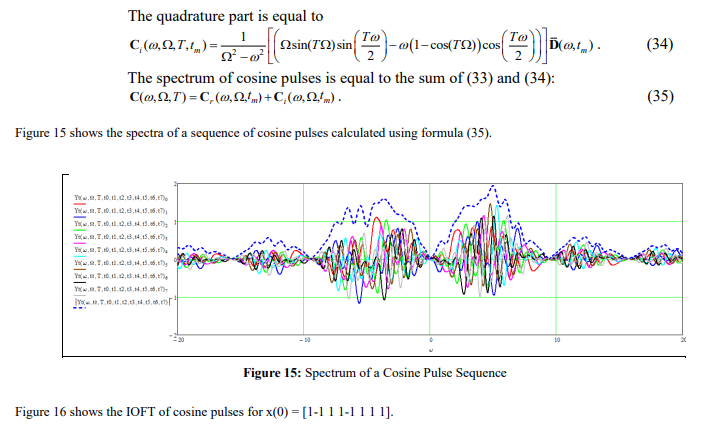
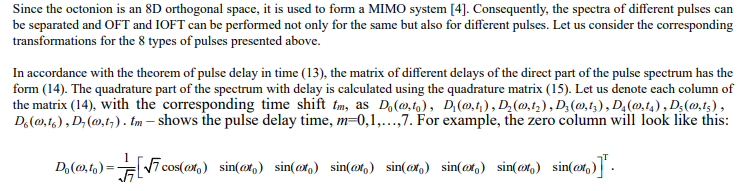
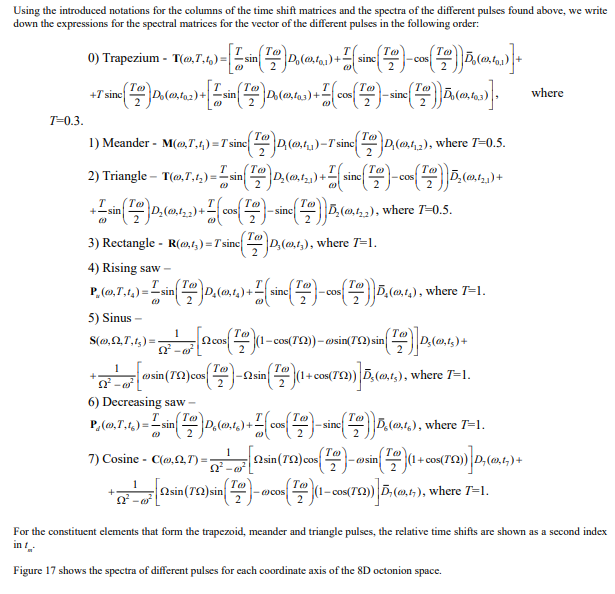
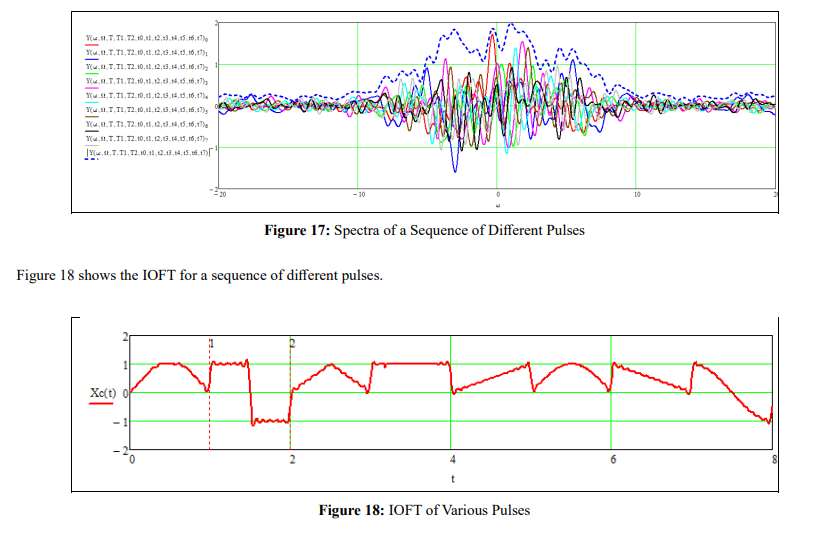
OFT and OIFT of Different Pulses
Conclusion
The octonion forms an orthogonal 8-dimensional space, so using the octonion significantly simplifies the Fourier transform of the 8-dimensional vector pulses, since integration can be performed for each pulse separately along each orthogonal coordinate axis.
The octonion is also used to form a MIMO scheme, since each pulse of the 8 at the input of the channel matrix is associated with all 8 pulses at its output. However, due to the orthogonality of space, the output pulses can be freely separated by IOFT, where identical spectra of each axis are added together to form corresponding pulses with a given time delay.
The spectra of the same 8 pulses are formed in accordance with the theorem of time shift of pulses from the spectrum of a single pulse by means of its frequency shift. In this case, the spectrum of pulses along each axis expands in accordance with the number of pulses. The expansion of the spectrum due to the joint processing of 8 pulses at once and the addition of the spectra of identical pulses along 8 orthogonal axes contributes to an increase in the noise immunity of the octonion Fourier transform.
References
- Sovetov, V. (2021). Quaternion Fourier transform of pulses vector. Radiotekhnika, 85(2), 83-94. DOI: 10.18127/j00338486-202103-01.
- Sovetov, V. (2024). Three-Frequency Quaternion Fourier Transform. J Res Edu, 2(2), 01-13.
- Sovetov, V. Quaternion domain discrete Fourier transform of the pulses vector.
- Sovetov, V. (2024). The MIMO Data Transfer Line with Seven-Frequency Octonion Carrier. Eng OA, 2(3), 01-23.