

Journal of Oil and Gas Research Reviews(JOGRR)
ISSN: 2993-3617 | DOI: 10.33140/JOGRR
Impact Factor: 0.7


Research Article - (2025) Volume 5, Issue 1
Experimental Investigation of Effect of Demulsifiers on Crude Oil Properties
Received Date: Sep 08, 2025 / Accepted Date: Oct 13, 2025 / Published Date: Oct 16, 2025
Copyright: ©Â©2025 Uche Osokogwu, et al. This is an open-access article distributed under the terms of the Creative Commons Attribution License, which permits unrestricted use, distribution, and reproduction in any medium, provided the original author and source are credited.
Citation: Osokogwu, U., Tukorogha, A. B. (2025). Experimental Investigation of Effect of Demulsifiers on Crude Oil Properties. J Oil Gas Res Rev, 5(1), 01-13.
Abstract
Laboratory experiment was used to investigate the effect of demulsifiers on crude oil properties. To achieve this study, experimental investigation was conducted in a laboratory. First, Bottle test experiment was done to assess the rate of emulsion separation as measured by visually tracking the volume of water that has been separated over time. Crude oil was taken from two Niger Delta oil production fields for the investigation. A demulsifier at different dosage was introduced into each of the oil samples and was analyzed. 100mL graduated glass centrifuge tube from ASTM was used in the bottle test. The crude oil Density and Viscosity was measured at (15°C and 40°C) using a U-tube that oscillates as part of a density meter. This investigation shows that demulsifiers should not be generalized rather should be field or area based because reservoirs are made up of different chemical components. It was worthy to note that the various components of the crude oil could be affected by addition of demulsifier. However, the major components such as density, viscosity, water content, Sulphur content and API gravity were the priority of this investigation. From the results obtained in this study, it was observed that the commercial demulsifiers when applied in low concentrations has the ability to reduce density, at 10ppm and 50ppm the same density reduction was obtained while the local demulsifiers reduces density according to the rate injected. The kinematic viscosity was positively reduced to enhance flow and separations. For the local demulsifiers, there was a slight reduction in viscosity.There was a good percentage of water been knocked off at the appropriate application of demulsifiers. As more water is removed, the better the density and viscosity, and the local separation of water was not as good as the commercial demulsifier. The application of the demulsifiers lightens the API gravity to better market value. The local demulsifiers do not have significant effect on the crude oil samples.
Keywords
Demulsifier, Crude Oil, Viscosity, Density, Water Content, Separation
Introduction
Emulsion treatment is a major challenge in the production of crude oil, storage, transportation and processing. Crude oil mixtures pro- duced from reservoirs are difficult to handle, meter or transport. Ineffective separation of water from crude oil increases the likelihood of pipeline corrosion and the associated production expenses. Chemical treatment when using demulsifier for separation is an effective method.
Demulsifiers were considered by as a means to reduce oil field emulsions' interfacial characteristics. When water and crude oil react, a new substance called an emulsion is formed during both the extraction process and processing. The emulsions' high viscosity makes pumping more expensive, and the pipeline and equipment corrosion high due to alkaline clay materials' presence.
The purpose of demulsifier is to help separate the produced contents to yield products that meet the specification as requested by the buyer. The produced fluid is firstly processed into three phases (oil, water and gas) in the separator as enhanced by the demulsifier. As the demulsifier is injected, it prevents early corrosion and scaling problem in transportation and refinery operations.
The purpose of demulsifier is to help separate the produced contents to yield products that meet the specification as requested by the buyer. The produced fluid is firstly processed into three phases (oil, water and gas) in the separator as enhanced by the demulsifier. As the demulsifier is injected, it prevents early corrosion and scaling problem in transportation and refinery operations.
Chemical Compositions and Properties of Hydrocarbon
Pentane and pentadecane (C5-C15) are among the liquid paraffin hydrocarbon molecules that makes up crude oil. Saturated hydrocarbon with a low molecular weight is known as typical paraffins. As a result of the bonding properties, naphthene (or cycloparaffins) is present in crude oil in significant quantities up to 10% by composition.
Crude oil is made up of hydrocarbon and none hydrocarbon like water with inorganic compounds such as chlorides, sulfates, nitrates, and others. In most production systems, the amount of water used to emulsify crude oil varies depending on the kind of crude oil and the production. The demulsification process begins with the flocculation of water droplets, also known as aggregation or flocculation. Aggregates or "floccs" that are formed when water droplets clump together. Even if they touch at specific spots, the droplets retain their own identities as they are close to one another. that is, they might not come together.
In order to ensure that the demulsifier mixes effectively with the well stream as it enters the separators, it is commonly noted that the majority of facilities add it at the suction of the separators. In order to avoid re-emulsification, agitation is minimized once the emulsion has been broken.
Chemical demulsifiers were used in studies that examined the function of interfacial characteristics in the stability and destabilization of emulsions. A demulsifier must be carefully chosen in or- der to prevent any error that could result in wasted time and money when working with a newly discovered oilfield. When choosing a demulsifier, it is important to take into account the physical properties of all oilfield parameters.
Effect of Demulsifier on Crude Oil Properties
Along with crude oil, many inorganic chemicals, such as chlorides, sulfates, and nitrates, are naturally present in the water that is produced during the extraction of crude oil. Which means that an oil-in-water or water-in-oil emulsion is possible. Less energy is required for processing and transportation because for emulsion breaking, enhanced separation, increased oil quality, reduced corrosion in pipelines, and lower viscosity of fluid in pipelines, pumps, and other equipment. Changes in density, specific gravity, viscosity, and other physical qualities reveal the demulsifier's action. In order to facilitate the correct and expedited emulsion breaking process by decreasing bulk viscosity and increasing density for the fluid to flow with less restriction. Found that when subterranean water and additive chemicals are mixed, the degree of oil-water emulsification in the final product increases, which in turn makes crude oil emulsions more stable, increases the cost of collecting, transporting, and storing crude oil, and even increases the likelihood of catalyst poisoning during refining. When it comes to treating crude oil emulsions, several demulsification procedures work better than others.
Demulsification of crude oil will aid proper and quick separation of the crude oil phases. This research will identify the importance of demulsifier in breaking emulsion and to ensure proper dosage with respect to calculated and approved concentration in part per million (ppm).
Dosage = Production x concentration x Ltrs/(24 x 60) (1)
Demulsifiers are effectively used to break emulsions in the oil and gas industries, to avoid commercial and domestical impacts of crude oil transportation, refinery and treatment facilities.
The main aspect of this research which is an experimental investigation of demulsifier effect on the properties of crude oil would involve conducting laboratory tests to study the impact of the demulsifiers on the emulsion separation. Some essential properties that were investigated includes: Density, Viscosity, Water Content, Sulphur Content and API Gravity.
Emulsions come in two main varieties: water-in-oil (W/O) emulsions, in which water droplets are scattered in the oil phase, and oil-in-water (W/O) emulsions, in which oil is the dispersed phase. The term "emulsion" describes the phenomenon that occurs when two immiscible liquids combine to form a dispersion of droplets.
Different methods of treating emulsion are expensive such as heating, electrical dehydration and gravity settling. The main goals of these processes are to decrease the continuous phase's viscosity, raise the liquid and particle gravity differentials, break the interfacial tension, and balance the emulsifier's hydrophile- lipophile balance (HLB) by neutralizing electrostatic charges. The stability of water-in-oil (O/W) emulsions can be predicted using the HLB.
A demulsifier must be carefully chosen in order to prevent any error that could result in wasted time and money when working with a newly discovered oilfield. When choosing a demulsifier, it is important to take into account the physical properties of the oilfield parameters.
Dosage
Also essential is the amount of chemical that is added. If you don't add enough demulsifier, the emulsion won't be dissolved. On the other hand, something bad might happen if you overtreat with de- mulsifier. When used in excess, demulsifiers can create emulsions that are both thick and very stable, as they are surface-active agents similar to emulsifiers. The demulsifier acts as an interface replace- ment for the natural emulsifiers. The bottle test is a straightforward way to measure the rate of emulsion separation. It involves visu- ally observing the volume of water that separates over time. The geometrical features and flow properties of the separation tubes, as well as the pressure in the live production stream, are not consid- ered in the bottle test.
Point of Demulsifier Injection
Keep in mind that the injection locations for demulsifiers vary de- pending on their type. The sort of reservoir condition must be stud- ied in great detail. To improve correct separation, there are three suggested injection points:
1) Before the choke, the choke is quite agitated when the pressure is being reduced from the wellhead to the matched separator.
2) Prior to the separator inlet level control valve. In order to choose the most effective and cost-effective demulsifier for a given well, our work was driven by the necessity to resolve or treat emulsions. The purpose of this research was to determine which demulsifier was most effective in breaking down crude oil emulsions from different wells by analyzing their chemical kinetics. The objectives of the study are to investigate how demulsifier interacts with different crude oil samples, determine the effect of chemical demulsifier on fluid properties and investigate optimal injecting quantity void of effects.
Experimental Setup
Materials and Methods
To achieve the objectives of this study, experimental investigation was conducted in a laboratory. First, Bottle test experiment was done to assess the rate of emulsion separation as measured by visually tracking the volume of water that has separated over time. Crude oil was taken from two Niger Delta oil production field for the investigation. A demulsifier at different dosage was introduced into each of the oil samples and was analyzed. 100mL graduated glass centrifuge tube from ASTM was used in the bottle test. The crude oil Density and Viscosity was measured at (15°C and 40°C) using a U-tube that oscillates as part of a density meter.
Procedure for the Bottle Test
Choosing different concentrations such as 0ppm, 10ppm and 50ppm in bottle test procedure allows for a range of concentration to be screened, helping to determine the most effective dosage, and also helps to optimize the treatment process by finding the lowest concentration that achieves the desired outcome for the efficient emulsion separation process.
Procedure for the Determination of Viscosity
A fluid's viscosity is a measure of the internal friction that makes it flow or not flow as easily as other fluids. At a precisely controlled and known temperature, a calibrated U-tube was used to allow a fixed amount of liquid to flow under gravity through its capillary, which is also called a viscometer tube. Viscosity = Force x Distance.
Procedure for the Determination of Density
i) Transferred the sample into a clean 250ml measuring cylinder without splashing to avoid deformation of bubbles.
ii) The thermometer was lowered & steered until a constant temperature was observed.
iii) The hydrometer was inserted gradually into the liquid by releasing it.
iv) Allow hydrometer to gain balance and take reading of sample (hydrometer and Temperature).
v) Using the specific gravity table at 60oF/60oF to match the specific gravity hydrometer reading against temperature. E.g. Hydrometer reading for 10ppm in 135L (sample 1) crude 0.8700 at 84oF, is now 0.8786, to get density (specific gravity minus 0.0005).
Procedure for the Determination of Water Content
i) The sample was shaken homogeneously and vigorously then poured into 100ml measuring cylinder the volume was taken.
ii) Transfer the sample into a round bottom flask containing anti- boiling chips (Anti boiling chips is to avoid bumping and splashing of the crude oil) and rinse the cylinder with 100ml Xylene into the flask.
iii) Connect to the condenser set up.
iv) Cotton wool was used to plug off the top of the condenser to avoid evaporation.
v) Observe the reflux for one hour until the volume of the condenser is constant.
vi) The volume of water level was recorded and collected in the receiver, e.g Water from receiver for sample 135L (sample 1) = 0.9%
Procedure for the Determination of Sulphur Content
i) We turn on the Sulphur equipment, allow to warm up for 30min.
ii) Prepared sample holder
iii) Pipette 2.5mill of the sample into the holder and place.
iv) Reading was observed and recorded after 2min.
The procedure for determining Density at 15°C, Viscosity at 40°C, Water Content and Sulphur Content is repeated is done for different dosage such as 0ppm, 10ppm, and 50ppm is carried out for two different samples and five different demulsifier. The results of the demulsifier dosage will be plotted against the resulting density, viscosity, water content and Sulphur content. The conclusion of the effect of the demulsifier will be discussed.
Results & Discussion
This part of the work provides and discusses the results obtained in this study. Demulsifier affects the Density, Viscosity, Water content, Sulphur content (slightly) and API gravity. Two crude oil samples from two different field and five Demulsifier was used for this investigation in the Laboratory. Names of crude oil: Sample A and Sample B while names of Demulsifiers: A, B, C, D and E.
Two crude oil samples from two different field and five Demulsifier was used for this investigation in the Laboratory. Names of crude oil: Sample A and Sample B while Names of Demulsifiers: A, B, C, D and E were used.
|
|
Results for Sample B |
||||||||
|
Demulsifier A |
Demulsifier B |
Demulsifier C |
|||||||
|
Test 1 |
Test 2 |
Test 3 |
Test 1 |
Test 2 |
Test 3 |
Test 1 |
Test 2 |
Test 3 |
|
|
Volume of Demulsifier (ppm) |
0ppm |
10ppm |
50ppm |
0ppm |
10ppm |
50ppm |
0ppm |
10ppm |
50ppm |
|
Volume of separated water less than 40mins (ml) |
- |
0.05 |
0.05 |
- |
0.05 |
0.05 |
- |
No Separation |
0.02 |
Table 1: Bottle Test Result Sample B (Commercial Demulsifiers)
Analytical Procedure: Different concentration volumes of Demulsifier were added to a constant volume of crude oil (100ml).
Oil and water separation was observed in 40mins for Demulsifier, A, B, C, D and E with heating applied.
Local Demulsifier
|
|
Results for Sample B |
|||||
|
Demulsifier E on sample A |
Demulsifier E on sample B |
|||||
|
Test 1 |
Test 2 |
Test 3 |
Test 1 |
Test 2 |
Test 3 |
|
|
Volume of Demulsifier (ppm) |
0ppm |
10ppm |
50ppm |
0ppm |
10ppm |
50ppm |
|
Volume of separated water less than 40mins (ml) |
20 |
38 |
55 |
0.5 |
0.6 |
1.0 |
Table 2: Bottle Test Result Sample A (Commercial Demulsifiers)
|
|
Results for Sample B |
||||||||
|
Demulsifier A |
Demulsifier B |
Demulsifier C |
|||||||
|
Test 1 |
Test 2 |
Test 3 |
Test 1 |
Test 2 |
Test 3 |
Test 1 |
Test 2 |
Test 3 |
|
|
Volume of Demulsifier (ppm) |
0 |
10 |
50 |
0 |
10 |
50 |
0 |
10 |
50 |
|
Volume of separated water less than 40mins (ml) |
- |
12 |
5 |
- |
67 |
68 |
- |
No Separation |
60 |
Local Demulsifiers
|
|
Results for Sample A |
|||||
|
Demulsifier D on sample A |
Demulsifier D on sample B |
|||||
|
Test 1 |
Test 2 |
Test 3 |
Test 1 |
Test 2 |
Test 3 |
|
|
Volume of Demulsifier (ppm) |
0ppm |
10ppm |
50ppm |
0ppm |
10ppm |
50ppm |
|
Volume of separated water less than 40mins (ml) |
20 |
50 |
55 |
0.5 |
0.8 |
1.5 |
Table 3: Test Result Sample B
|
S/N |
Test De- scriptions |
Test Method |
Units |
Results for Sample B |
||||||||
|
Demulsifier A |
Demulsifier B |
Demulsifier C |
||||||||||
|
0ppm |
10ppm |
50ppm |
0ppm |
10ppm |
50ppm |
0ppm |
10ppm |
50ppm |
||||
|
1 |
Density at 15oC |
ASTMD 1298 |
g/cm3 |
0.8693 |
0.8781 |
0.8781 |
0.8693 |
0.8781 |
0.8781 |
0.8693 |
0.8693 |
0.8693 |
|
2 |
Kinematic Viscosity at 40oC |
ASTMD 445 |
cSt |
2.94 |
2.76 |
2.76 |
2.94 |
2.79 |
2.75 |
2.94 |
2.95 |
2.88 |
|
3 |
Water Content |
ASTMD 6304 |
% |
0.9 |
0.02 |
0.02 |
0.9 |
0.03 |
0.03 |
0.90 |
0.91 |
0.88 |
|
4 |
Sulphur Content |
ASTMD 2622 |
%(m/m) |
0.1106 |
0.0958 |
0.0962 |
0.1106 |
0.0967 |
0.0996 |
0.1106 |
0.1109 |
0.1117 |
|
5 |
API Gravity |
ASTMD 1298 |
g/cm3 |
31.27 |
29.64 |
29.64 |
31.27 |
29.64 |
29.64 |
31.27 |
31.27 |
31.27 |
Table 4: Legend: ASTM - American Society for Testing and Materials, g/cm3 - Gram Per Centimeter Cube, cSt - Centistokes, % (m/m) - Percentage Mode Per Mole ml - milli litre, ppm - part per millions
Bar Chats for Sample B
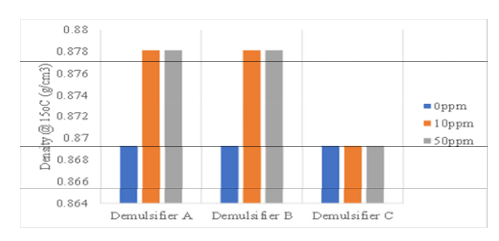
Figure 1: Density of the Different Demulsifiers and Concentrations for Sample B.
Figure1 shows density at 15oC against demulsifier A, B and C. It is observed physically that sample B (W135) is almost a pure crude oil. The application of demulsifier A and B on the original crude oil at 0ppm for density at 15oC yielded 0.8693. while at 10ppm, the density increased and yielded 0.8781g/cm3 whereas Demulsifier C effect on the crude oil was not positively or negatively.
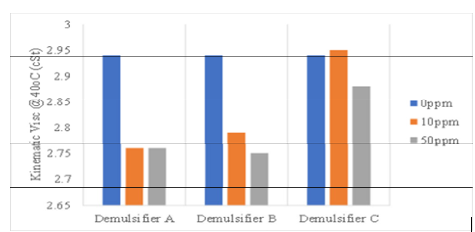
Figure 2: Kinematic Viscosity of Different Demulsifiers and Concentrations for Sample B
Figure 2 the bar chat of kinematic viscosity against different con- centration of the demulsifier indicates that the addition of demul- sifier A and B positively reduced the viscosity to enhance flow and separations but the effect of demulsifier C on the crude was not effective at the different ppm.

Figure 3: Water Content of Different Demulsifiers and Concentrations for Sample B
Figure 3 Water content when plotted demulsifier A, B and C shows that the water in oil was not much, the water content was very small even when demulsifier A, B and C were added. Original water content is 0.9 after adding 10ppm and 50ppm for the three demulsifier A, B and C.
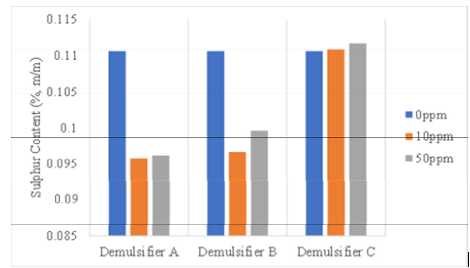
Figure 4: Sulphur Content of the Different Demulsifiers and Concentrations for Sample B
From Figure 4 which the bar chat of Sulphur content against demulsifier A, B and C, illustrated that demulsifier A and B had a reduction of Sulphur content while that of demulsifier C increased the Sulphur content at 50pp.
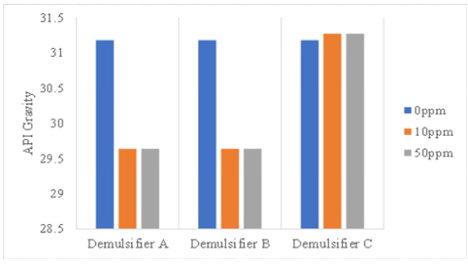
Figure 5: API Gravity of the Different Demulsifiers and Concentrations for Sample B
The above Fig. 5 shows the plot of API gravity against Demulsifier A and B which clearly shows an increase in API gravity at 10ppm while demulsifier C remains unchanged as the original level. Demulsifier A, B and C also increased the API gravity level which impacted on the crude positively because the higher the API number, the better quality the crude oil. The higher the API, the lighter the crude oil. The lower the API, the heavier the crude oil.
Local Demulsifier on sample B
|
S/N |
Test Descriptions |
Test Method |
Units |
Results for Sample A |
|||||
|
Demulsifier D |
Demulsifier E |
||||||||
|
0ppm |
10ppm |
50ppm |
0ppm |
10ppm |
50ppm |
||||
|
1 |
Density at 15oC |
ASTMD 1298 |
g/cm3 |
0.9498 |
0.9415 |
0.9289 |
0.9299 |
0.9266 |
0.9178 |
|
2 |
Kinematic Viscosity at 40oC |
ASTMD 445 |
cSt |
43.66 |
41.56 |
39.89 |
3.95 |
3.90 |
3.88 |
|
3 |
Water Content |
ASTMD 4006 |
% |
70.66 |
20.56 |
5.22 |
2.50 |
2.20 |
2.40 |
|
4 |
Sulphur Content |
ASTMD 2622 |
%(m/m) |
0.1511 |
0.1530 |
0.1527 |
0.1776 |
0.1771 |
0.1775 |
|
5 |
API Gravity |
|
|
17.49 |
17.53 |
19.14 |
20.67 |
20.67 |
20.90 |
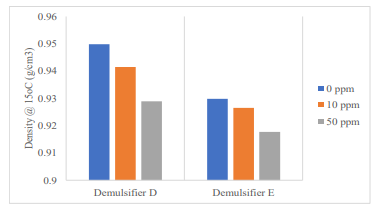
Figure 6: Density of the Different Demulsifiers and Concentrations
The above bar chat was that of Local demulsifiers. Both Demulsifier D and E in Fig. 6 were able to reduce the density with respect 10ppm and 50ppm injected. The higher the concentration, the higher the density reduction. At 50ppm, there was a better reduction than 10ppm
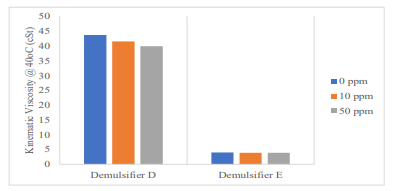
Figure 7: Kinematic of different Demulsifiers and Concentrations
Figure 7, was that of local demulsifiers that were investigated on viscosity. The demulsifier D has little effect on the fluid viscosity while demulsifier E effect on the fluid was not noticeable.
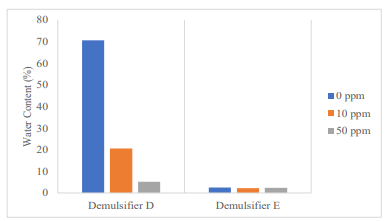
Figure 8: Water Content of different Demulsifiers and Concentrations
Figure 8, which also the local demulsifiers, shows that demulsifier D significantly dropped the water cut according to ppm injected. Demulsifier E at different concentration do not have effect on the crude samples.
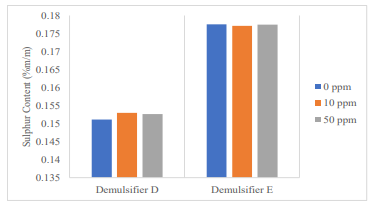
Figure 9 was that of local demulsifiers. Demulsifier D and E did not show sign of reduction of Sulphur content in the crude samples.
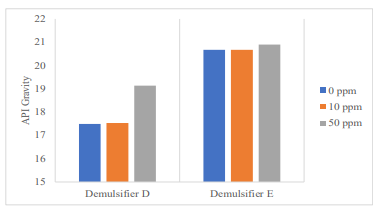
Figure 10: API Gravity of different Demulsifiers and Concentrations
The above Figure10 was also that of the local demulsifiers. Demulsifier D at different concentration, reduced the API to same point with 10ppm and 50ppm, while demulsifier E effect was insignificant on the API gravity of the crude samples.
|
S/N |
Test De- scriptions |
Test Method |
Units |
Results for Sample A |
||||||||
|
Demulsifier A |
Demulsifier B |
Demulsifier C |
||||||||||
|
0ppm |
10ppm |
50ppm |
0ppm |
10ppm |
50ppm |
0ppm |
10ppm |
50ppm |
||||
|
1 |
Density at 15oC |
ASTMD 1298 |
g/cm3 |
0.9791 |
0.9040 |
0.9549 |
0.9791 |
0.8990 |
0.8990 |
0.9791 |
0.9791 |
0.9330 |
|
2 |
Kinematic Viscosity at 40oC |
ASTMD 445 |
cSt |
44.86 |
31.31 |
35.70 |
44.86 |
11.50 |
11.52 |
44.86 |
44.84 |
22.28 |
|
3 |
Water Content |
ASTMD 6304 |
% |
68.16 |
55.82 |
64.72 |
68.16 |
1.68 |
0.90 |
68.19 |
68.18 |
9.0 |
|
4 |
Sulphur Content |
ASTMD 2622 |
%(m/m) |
0.1413 |
0.1293 |
0.1288 |
0.1413 |
0.3924 |
0.3928 |
0.1413 |
0.1327 |
0.3911 |
|
5 |
API Gravity |
ASTMD 1298 |
g/cm3 |
13.02 |
24.94 |
16.61 |
13.02 |
25.81 |
25.81 |
13.02 |
13.02 |
20.08 |
Table 5: Test Result Sample A
Results of Sample A
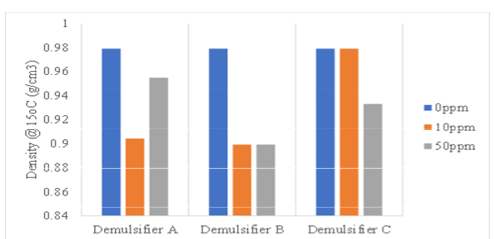
Figure 11: Density of different Demulsifiers and Concentrations
The bar chat of Figure 11 was that of density at 15oC against demulsifier A, B and C. The results illustrated that, demulsifiers A, B and C at 0ppm, density of 15°C was 0.9791 for the entire crude oil. While at 10ppm the density reduced (flow enhanced) but at 50ppm, the density increased. The Demulsifier B at density at 15oC shows it reduced better than Demulsifier A. Demulsifier C at 10ppm did not show difference from the original position but there was decrease in density at 50ppm. In conclusion, demulsifier B was a better demulsifier.
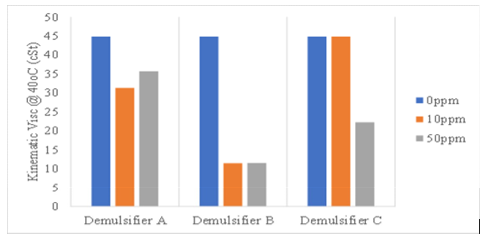
Figure 12: Kinematic Viscosity of different Demulsifiers and Concentrations
Figure 12 is the bar chat of kinematic viscosity at 40°C against demulsifier A, B and C which shows that demulsifier B enhances crude oil flow and causes less resistance compared to demulsifier A and C with high resistance. In the oilfield, the application of Demulsifiers is mainly to improve oil and water separation process without critically looking at their effects.
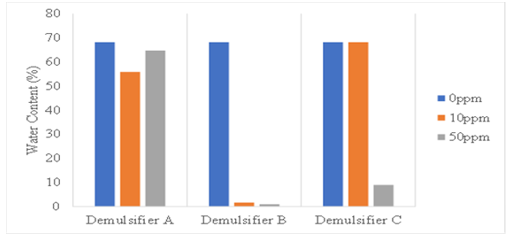
Figure 13 was water content bar chart against demulsifier A, B and C. From the above result, it shows that demulsifier A could not remove the water while demulsifier B which was a better demulsifier breaks down the separation further to near pure oil grade at both 10ppm and 50ppm with the water reduced from original water content of 68.16 to about 1.68% at 10ppm and 0.90% at 50ppm. The water content reduction also affects the density and viscosity positively. As more water reduces from the crude, the better the density and viscosity as observed. Demulsifier C at 50ppm also reduced the large percentage of the water content.
The better the quality of separated water from the oil, the better the dispose water will be which will be environmentally friendly and take away the cost of waste treatment planned.'
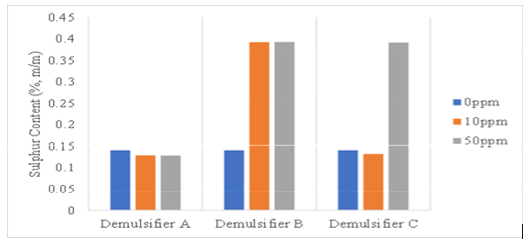
Figure 14: Sulphur Content of different Demulsifiers and Concentrations
Figure 14 Shows the plot of Sulphur content against Demulsifier A, B and C. The demulsifier A at 10ppm and 50ppm dosage, affected the crude oil positively as the original Sulphur content which was 0.1413, reduced to 0.1293 and 0.1288 respectively. While demulsifier B affected the crude oil negatively as the original Sulphur content which was 0.1413 at 0ppm became 0.3924 and 0.3928 at 10ppm and 50ppm respectively. Although, the negative effect of the demulsifier was still within the acceptable allowable range of Nigeria crude oil which is < 0.5m/m. Finally, Demulsifier C also affected the crude oil negatively at 50ppm with Sulphur content of 0.3928.
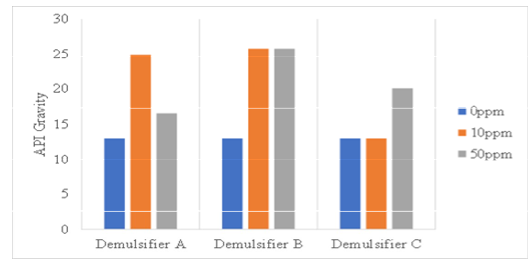
Figure 15: API Gravity of different Demulsifiers and Concentrations
The API gravity against demulsifier A, B and C in Figure15 indicates that both demulsifier A and B increased the API at 10ppm and 50ppm, while demulsifier C increased the oil gravity at 50ppm.
Local Demulsifiers on sample A
|
S/N |
Test Descrip- tions |
Test Method |
Units |
Results for Sample A |
|||||
|
Demulsifier D |
Demulsifier E |
||||||||
|
0ppm |
10ppm |
50ppm |
0ppm |
10ppm |
50ppm |
||||
|
1 |
Density at 15oC |
ASTMD 1298 |
g/cm3 |
0.9498 |
0.9415 |
0.9289 |
0.9299 |
0.9266 |
0.9178 |
|
2 |
Kinematic Viscosity at 40oC |
ASTMD 445 |
cSt |
43.66 |
41.56 |
39.89 |
3.95 |
3.90 |
3.88 |
|
3 |
Water Content |
ASTMD 4006 |
% |
70.66 |
20.56 |
5.22 |
2.50 |
2.20 |
2.40 |
|
4 |
Sulphur Content |
ASTMD 2622 |
%(m/m) |
0.1511 |
0.1530 |
0.1527 |
0.1776 |
0.1771 |
0.1775 |
|
5 |
API Gravity |
|
|
17.49 |
17.53 |
19.14 |
20.67 |
20.67 |
20.90 |
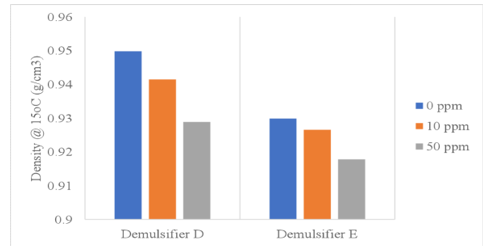
Figure 16: Density of different Demulsifiers and Concentrations
For the Local demulsifiers in Figure16, the density at 15oC against demulsifier D and E were able to reduce the density depending on the ppm injected. 50ppm gave a better reduction than 10ppm.
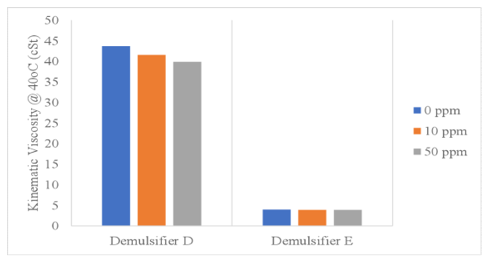
Figure 17: Kinematic Viscosity of different Demulsifiers and Concentrations
From Figure17 which is still the local demulsifiers, there was a slight reduction in viscosity in the case of demulsifier D at 10ppm and 50ppm. Meanwhile, no effect on the samples was felt when demulsifier E was injected.
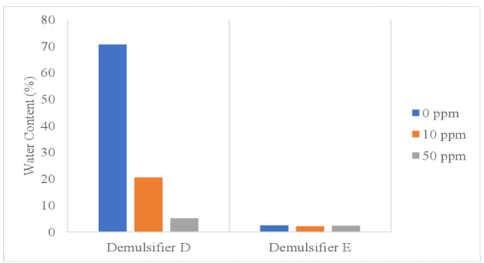
Figure 18: Water Content of different Demulsifiers and Concentrations
Figure 18 For the local demulsifiers, demulsifier D drastically reduced the water content. Demulsifier E when applied at different concentrations has no effect on the crude samples.
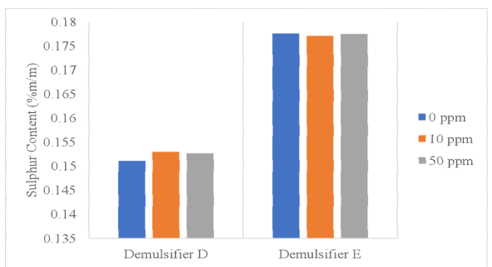
Figure 19: Sulphur Content of different Demulsifiers and Concentrations
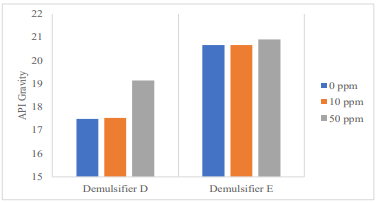
Figure 20 For the local demulsifiers, Demulsifier D and E increased the API gravity of the samples.
API = 141.5/SG - 131.5
The Specific Gravity was obtained from the hydrometer which was lowered into the measuring cylinder at a temperature of 84oF
Conclusion
Laboratory experiment was used to investigate the effect of demulsifiers on crude oil properties. This investigation shows that demulsifiers should not be generalized, they should be field or area based as reservoirs are made up of different chemical components. It was worthy to discover that the various components of the crude oil can be affected by addition of demulsifier. However, the major components such as density, viscosity, water content and API gravity were the priority of this investigation [1-10].
For the purpose of effective separation and economic profitability bottle test and other form of analysis should be carried out before accepting and adopting any demulsifier.
From the findings obtained in this study, the following conclusion could be drawn: The point of introducing demulsifier to the crude can positively or negatively impact on the crude oil separation process.
The three demulsifiers used had impact on the crude oil properties.
References
- Abdel-Aal, H. K., & Shaikh, A. A. (1977). Desalting of oil using multiple orifice mixers: An empirical correlation for the water of dilution. In Third Iranian Congress of Chemical Engineering.
- Abdulredha, M. M., Hussain, S. A., & Abdullah, L. C. (2020). Optimization of the demulsification of water in oil emulsion via non-ionic surfactant by the response surface methods. Journal of Petroleum Science and Engineering, 184, 106463.
- Brown, C. E., Neustadter, E. L., & Whittingham, K. P. (1977). Crude–oil/water interfacial properties-emulsion stability and immiscible displacement. Proceedings of Enhanced Oil Recovery by Displacement with Saline Solutions, 91-122.
- Dimitrov, A. N., Yordanov, D. I., & Petkov, P. S. (2012).Study on the effect of demulsifers on crude oil and petroleum products. International Journal of Environmental Research,6(2), 435-442.
- Grist, D. M., Neustadter, E. L., & Whittingham, K. P. (1981). The interfacial shear viscosity of crude oil/water systems. Journal of Canadian Petroleum Technology, 20(02).
- Jones, T. J., Neustadter, E. L., & Whittingham, K. P. (1978). Water-in-crude oil emulsion stability and emulsion destabilization by chemical demulsifiers. Journal of Canadian Petroleum Technology, 17(02).
- Oskarson, H., Vieira, F., Dos Santos, A., Gogo, U., & Janwoski, S. (2024, August). New Environmentally Improved Demulsifiers for Nigerian Oilfields. In SPE Nigeria Annual International Conference and Exhibition (p. D021S001R002).SPE.
- Tang, L., Wang, T., Xu, Y., He, X., & Yan, A., et al. (2024). Research and application progress of crude oil demulsification technology. Processes, 12(10), 2292.
- Mepaiyeda, E. B., Ofoegbu, A. A., Isehunwa, S. O., & Akinola, A. A. (2020). Evaluation of a novel ionic demulsifier in the treatment of selected Niger Delta crude oil emulsions. Journal of Petroleum and Gas Engineering, 11(1), 37-56.
- Neustadter, E. L., Whittingham, K. P., & Grist, D. M. (1975). The role of demulsifiers in water/crude oil emulsions. In Proceedings of the International Conference on Colloid and Surface Science, September (pp. 15-20).