

Journal of Architectural Engineering and Built Environments(JAEBE)
ISSN: 3071-2955 | DOI: 10.33140/JAEBE


Research Article - (2026) Volume 1, Issue 1
Enhancing Pavement Management Through a Comprehensive Framework for Pavement Condition Index (PCI) Evaluation of Asphalt and Concrete Pavements
Received Date: Nov 24, 2025 / Accepted Date: Dec 19, 2025 / Published Date: Jan 16, 2025
Copyright: ©2026 Hossein Alimohammadi. This is an open-access article distributed under the terms of the Creative Commons Attribution License, which permits unrestricted use, distribution, and reproduction in any medium, provided the original author and source are credited.
Citation: Alimohammadi. H. (2026). Enhancing Pavement Management Through a Comprehensive Framework for Pavement Condition Index (PCI) Evaluation of Asphalt and Concrete Pavements. J Archit Eng Built Environ, 1(1), 01-16.
Abstract
The Pavement Condition Index (PCI) is one of the most widely used methodologies for assessing the surface condition of asphalt (flexible) and concrete (rigid) pavements. As transportation infrastructure continues to age under increasing traffic demands, environmental stresses, and constrained maintenance budgets, the need for consistent, objective, and cost-effective pavement evaluation tools has become critical. This paper presents a comprehensive framework for PCI evaluations in accordance with ASTM D6433, including a detailed review of its application to both asphalt and concrete pavements. The methodology involves visual identification of distress types, severity levels, and quantities, which are converted into deduct values to determine PCI at the sample-unit and section levels. The study summarizes the major distress mechanisms observed in flexible and rigid pavements including structural, climate/durability-related, and other surface-related deficiencies and highlights their implications for pavement performance and service life. Evaluation results further emphasize the significance of the “critical PCI range, below which deterioration accelerates and rehabilitation becomes more cost-effective than routine maintenance. General maintenance, rehabilitation recommendations, and short-term remediation strategies are provided for asphalt and concrete pavements depending on their PCI levels. The proposed framework aims to support agencies and practitioners in implementing systematic pavement management programs that optimize maintenance investments and extend pavement service life.
Keywords
Pavement Condition Index (PCI), Pavement Management Systems (PMS), Asphalt and Concrete Pavements, Pavement Distress Evaluation
Introduction and Literature Review on PCI Evaluations
The increasing demand on transportation infrastructure, driven by rising traffic volumes, evolving climate conditions, and constrained maintenance budgets, places significant pressure on agencies to systematically monitor and manage pavement assets [1]. A reliable and repeatable method for evaluating pavement health is essential for effective infrastructure management. Among available condition assessment methodologies, the PCI has emerged as one of the most widely adopted metrics for both flexible (asphalt) and rigid (concrete) pavements [2]. PCI provides a standardized rating of pavement surface condition on a scale from 0 (failed) to 100 (excellent), enabling agencies to compare conditions across networks, track deterioration over time, and implement data-driven maintenance and rehabilitation (M&R) strategies [3].
Originally developed by the U.S. Army Corps of Engineers for airfield pavements, PCI methodology was later adapted for roadway networks and formalized in ASTM D6433 (for roads and parking lots) and ASTM D5340 (for airport pavements) [4,5]. The consistent applicability of PCI to both asphalt and concrete surfaces makes it particularly valuable for agencies managing diverse pavement systems. However, despite decades of widespread use, concerns remain regarding PCI’s sensitivity, consistency, and predictive capability especially when distinguishing performance characteristics between flexible and rigid pavements. Given the fundamental differences in how asphalt and concrete respond to loadings, environmental effects, and aging mechanisms, a comprehensive review of PCI applications across both pavement types is warranted [6].
Numerous studies have demonstrated the practicality, cost-effectiveness, and relative objectivity of PCI in evaluating flexible pavements [7-11]. For example, studies in Yemen applied PCI (via PAVER™) to heavy-traffic corridors and showed that PCI effectively supported rational maintenance prioritization in budget-limited environments [12]. Similarly, in Maringa, Brazil, a comparison of “objective” PCI evaluations (using GIS-based distress quantification) with “subjective” visual inspections revealed a strong correlation (Pearson r ≈ 0.95), confirming that subjective PCI surveys remain viable where technological resources are limited [13]. Nonetheless, PCI evaluations depend heavily on inspector expertise and remain inherently subjective. Moreover, PCI focuses solely on surface distresses and does not directly measure structural capacity, roughness, or skid resistance limitations that may hinder comprehensive pavement performance evaluation.
Recent advances have aimed to overcome these challenges through automation and data-driven approaches. For instance, deep learning and image-processing algorithms have been used to automate crack detection and quantify crack widths with high accuracy, improving repeatability and reducing labor intensity [14]. Emerging tools such as the Pave Cap framework integrate object detection, segmentation, and dense captioning to provide both quantitative PCI predictions and qualitative condition descriptions [15]. Machine learning models including artificial neural networks (ANN), fuzzy inference systems (FIS), and multiple linear regression have been used to predict PCI using distress types as inputs. Studies have reported strong prediction accuracy, with some ANN models achieving R² values as high as 0.997 between predicted and observed PCI [16]. These innovations suggest that PCI-based evaluations can evolve into scalable, automated, and more objective network-level pavement monitoring tools [17].
Although PCI was initially developed for flexible pavements and airfields, the methodology has also been extended to rigid pavements [18]. A recent study developed a PCI-based performance model for airport concrete pavements by integrating mechanistic–empirical fatigue predictions with observed PCI values, resulting in a reasonable coefficient of determination (R² ≈ 0.621) [19]. Moreover, a 2025 study demonstrated data-driven PCI forecasting for jointed concrete pavements, showing that modern analytics can support long-term predictive maintenance planning beyond traditional visual inspection [20]. These extensions indicate that PCI with supplemental structural or environmental data can serve as a holistic performance indicator even for rigid pavements.
A primary strength of PCI is its universality: the same methodology (ASTM D6433/D5340) can be applied across pavement types, facilitating consistent network-wide assessment [4,5]. PCI assessments are relatively inexpensive and straightforward, making them attractive to municipalities and agencies with limited budgets. However, several limitations remain [21-24]. As a surface-distress-based metric, PCI may not reflect early-stage structural deterioration, subsurface problems, or load-bearing deficiencies. PCI also does not directly assess ride quality, skid resistance, or safety factors [25]. Inspector subjectivity introduces variability across agencies and overtime. Additionally, because PCI aggregates numerous distress types into a single index, it may obscure specific failure mechanisms (e.g., joint faulting in concrete, rutting in asphalt) that carry distinct maintenance implications [26-30]. To address these issues, researchers have proposed modified PCI models and supplemental indices tailored to specific pavement types, climates, or functional classifications [Citations].
This paper reviews current literature on PCI applications for both asphalt and concrete pavements, identifies strengths and limitations of the methodology, and discusses opportunities for improvement. It also presents a general step-by-step framework for conducting PCI evaluations. The proposed framework aims to support practitioners in assessing pavement conditions more effectively and selecting appropriate maintenance strategies to extend pavement service life.
Methodology of PCI Evaluations
The PCI method is based on a visual or instrument-assisted inspection of pavement surface distresses. The procedure begins by dividing a pavement network into branches, sections, and sample units. Each sample unit is surveyed to identify distress types, evaluate their severity levels, and quantify their extent. These observations are then converted into “deduct values,” which are summed and subtracted from a perfect score of 100 to determine the PCI for that sample unit. The average PCI across all sample units within a section is reported as the section PCI. Although PCI primarily reflects surface condition, it is commonly used as an indirect indicator of structural condition and overall pavement health—particularly when supplemented with historical data to monitor trends and predict deterioration over time. The PCI scale (0–100) is widely accepted: a value near 100 represents new or excellent pavement condition, while lower values correspond to increasingly severe levels of deterioration. As the first step of each project, an expert engineer conducts field observations of the existing pavement through a site visit. A manual PCI survey is then performed to document the type, quantity, and severity of surface distresses in accordance with ASTM D6433, Standard Practice for Roads and Parking Lots PCI Surveys. The results of this survey are used to calculate the PCI for the pavement at the site.
Evaluation Procedures
The scope of this study is to determine the condition of both asphalt and concrete pavements through visual surveys using the PCI method. In accordance with ASTM procedures, asphalt pavement areas—when present and applicable to the project— are divided into sample units of approximately 2,500 square feet (±1,000 sq. ft). Each sample unit is then evaluated to identify the types of distresses present, along with their corresponding severity and extent. The PCI for each sample unit is calculated based on the quantity and severity of up to twenty (20) potential distress types that may occur in asphalt pavements, as summarized in Table 1.
|
1. Alligator Cracking |
11. Patching & Utility Cut Patching |
|
2. Bleeding |
12. Polished Aggregate |
|
3. Block Cracking |
13. Potholes |
|
4. Bumps and Sags |
14. Railroad Crossing |
|
5. Corrugation |
15. Rutting |
|
6. Depression |
16. Shoving |
|
7. Edge Cracking |
17. Slippage Cracking |
|
8. Jt. Reflection Cracking |
18. Swell |
|
9. Lane/Shoulder Drop Off |
19. Raveling |
|
10. Long & Transverse Cracking |
20. Weathering |
Table 1: Potential Asphalt Pavement Distress Types Following ASTM D-6433 Standard Practice for Roads and Parking Lots
For concrete pavements, when present and applicable to the project, the ASTM procedure calls for sample units comprised of 20 slabs (+/- 8 slabs) and then determining the distress evident in each of the sample units. The PCI for each sample unit for concrete pavements is based on evaluating the quantity and severity of twenty (19) potential distresses that can occur as summarized in the following table 2.
|
21. Blowup/Buckling |
31. Polished Aggregate |
|
22. Corner Break |
32. Pop outs |
|
23. Divided Slab |
33. Pumping |
|
24. Durability “D” Cracking |
34. Punchout |
|
25. Faulting |
35. Railroad Crossing |
|
26. Joint Seal Damage |
36. Scaling, Map Cracking, Crazing |
|
27. Lane Shoulder Drop-Off |
37. Shrinkage Cracks |
|
28. Linear Cracking |
38. Spalling, Corner |
|
29. Patching, Large |
39. Spalling, Joint |
|
30. Patching, Small |
|
Table 2: Potential Concrete Pavement Distress Types Following ASTM D-6433 Standard Practice for Roads and Parking Lots
The ASTM procedure is based on the determination of the PCI for each individual sample unit in the pavement area(s) and then averaging the PCIs of all sample units to determine the overall PCI for the entirety of the pavement area or section. The pavement areas are designated by pavement type for the projects, (i.e. by asphalt concrete or concrete pavements when applicable).
Distress Summary
A total of eleven types of the ASTM potential types of asphalt distress and two potential types of concrete distress were recorded on the surface of the pavement, respectively. The individual distress types, grouped by the three major distress categories, are as following table 3.
|
|
Category I |
Category II |
Category III |
|
Structural Distress |
Climate/Durability Distress |
Other Distress Types |
|
|
Asphalt Concrete |
1. Alligator Cracking |
3. Block Cracking |
Other Distress Types |
|
7. Edge Cracking |
8. Joint Reflection Cracking |
4. Bumps and Sags |
|
|
|
13. Potholes |
10.Longitudinal & Transverse Cracking |
5. Corrugation |
|
15. Rutting |
19. Raveling |
6. Depression |
|
|
16. Shoving |
20. Weathering |
9. Lane/Shoulder Drop-off |
|
|
|
|
11. Patching & Utility Cut Patching |
|
|
12. Polished Aggregate |
|||
|
14. Railroad Crossings |
|||
|
17. Slippage Cracking |
|||
|
18. Swell |
|||
|
Portland Cement Concrete |
22. Corner Break |
21. Blowup/Buckling |
25. Faulting |
|
23. Divided Slab |
24. Durability Cracking |
27. Lane/Shoulder Drop-off |
|
|
28. Linear Cracking |
26. Joint Seal Damage |
29. Patching, Large |
|
|
34. Punchout |
37. Shrinkage Cracks |
30. Patching, Small |
|
|
|
38. Spalling, Corner |
31. Polished Aggregate |
|
|
39. Spalling, Joint |
32. Pop outs |
||
|
|
33. Pumping |
||
|
35. Railroad Crossing |
|||
|
36.Scaling/Map Cracking/Crazing |
Table 3. Distress Categories & Distress Types
Structural distress is considered the most detrimental type of pavement distress. When present, it can significantly shorten pavement life if preventative maintenance or rehabilitation measures are not performed in a timely manner. Climate- and durability-related distresses also contribute to the deterioration of pavement serviceability. Although generally less severe than structural distresses, these types of distresses still require maintenance to ensure safe and functional pavement conditions. The distresses observed at each site may occur in varying types and severity levels.
Asphalt Concrete Distresses
Load/Structural Distresses
Alligator Cracking: Alligator or fatigue cracking is a series of interconnecting cracks caused by fatigue failure of the asphalt concrete surface under repeated traffic loading. Cracking begins at the bottom of the asphalt surface (or stabilized base) where tensile stress and strain are highest under a wheel load.
Edge Cracking: Edge cracks are parallel to and usually within 1 to 1.5 ft of the outer edge of the pavement. This distress is accelerated by traffic loading and can be caused by frost-weakened base or subgrade near the edge of the pavement.
Potholes: Potholes are small – usually less than 30 in. in diameter – bowl-shaped depressions in the pavement surface. They generally have sharp edges and vertical sides near the top of the hole.
Rutting: Rutting is a surface depression in the wheel paths that may or may not be accompanied by uplift along the sides. This distress is caused by permanent deformation in the asphalt surface or supporting layers as a result of compaction or downward movement due to repeated traffic loading.
Shoving: Shoving is a permanent, longitudinal displacement of a localized area of the pavement surface caused by traffic loading. When traffic pushes against the pavement, it produces a short, abrupt wave in the pavement surfaces.
Figures 1 through 4 illustrate some Load/Structural related Distresses for asphalt pavements with different severities

 a) b)
a) b)
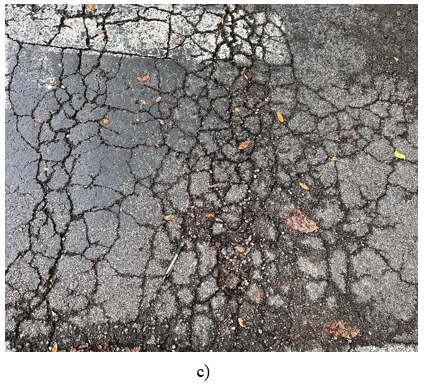
Figure 1: Alligator Cracking With A) Low Severity, B) Medium Severity, C) High Severity
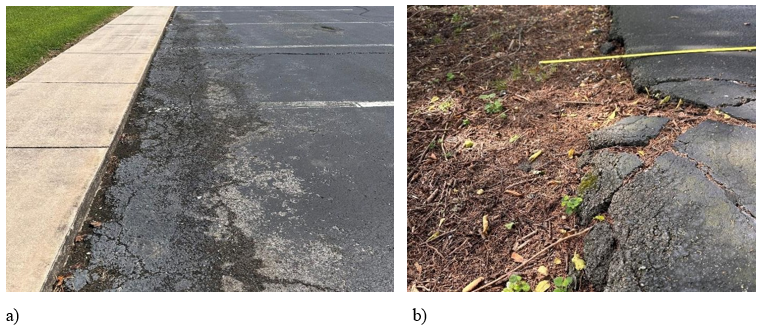
Figure 2: Edge Cracking With A) Medium Severity, B) High Severity

 a) b)
a) b)
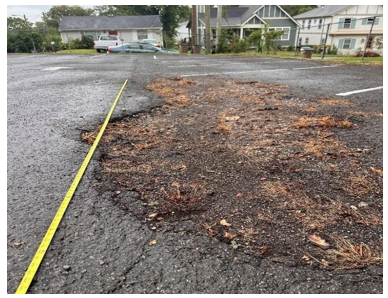
Figure 3: Potholes With A) Low Severity, B) Medium Severity, C) High Severity
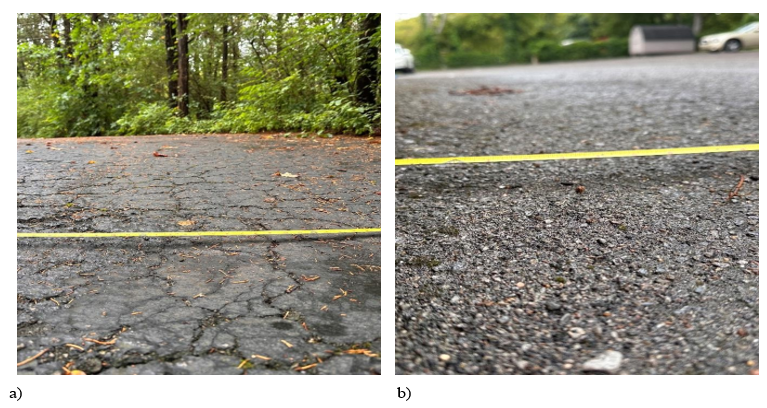
Figure 4: Rutting With A) Low Severity, B) Medium Severity
Climate/Durability Distresses
Block Cracking: Block cracks are interconnected cracks that divide the pavement into approximately rectangular pieces. The blocks may range in size from 1 by 1 ft to 10 by 10 ft. Block cracking is caused mainly by shrinkage of the asphalt concrete and daily temperature cycling (which results in daily stress/strain cycling). It is not load associated. Block cracking usually indicates that the asphalt has hardened significantly. Block cracking normally occurs over a large portion of the pavement area, but sometimes will occur only in non-traffic areas.
Joint Reflection Cracking: In asphalt surfaces that overlay PCC slabs, movement of the underlying slab due to thermal or moisture related effects can cause cracking to occur in the overlaying asphalt pavement. These cracks match the jointing pattern of the PCC slabs below.
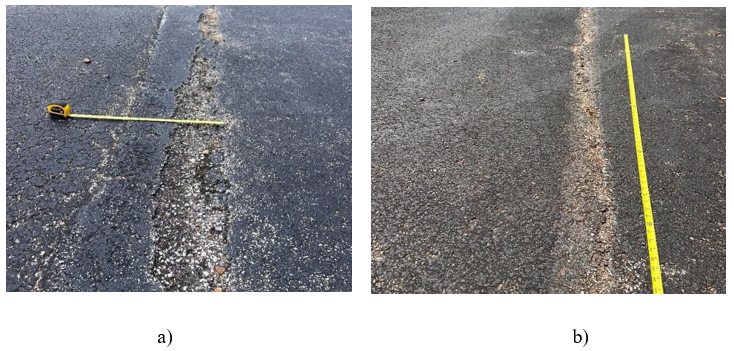
Longitudinal/Transverse Cracking: Longitudinal and transverse cracking is parallel to or extends across the pavement at approximately right angles to the pavement centerline. Longitudinal and transverse cracking can be caused by a number of reasons, such as poorly constructed paving lane joints, shrinkage of asphalt due to temperature cycles and repeated traffic loading.
Raveling: Raveling is the dislodging of coarse aggregate particles. Raveling may be caused by insufficient asphalt binder, poor mixture quality, insufficient compaction, segregation, or stripping.
Weathering: Weathering is the wearing away of the pavement surface due to a loss of asphalt or tar binder and dislodged aggregate particles. This distress indicates that either the asphalt binder has hardened appreciably or that a poor quality mixture is present.
Figures 5 and 6 illustrate some climate/durability related distresses for asphalt pavements with different severities


a) b)
Figure 5. Block Cracking With A) Low Severity, B) Medium Severity

c)
Figure 6. Longitudinal Cracking With A) Low Severity, B) Medium Severity, and C) High Severity
Other Distress Types
Bleeding: Bleeding is a film of bituminous material on the pavement surface that creates a shiny, glasslike, reflecting surface that usually becomes quite sticky. Bleeding is cause by excessive amounts of asphaltic cement or tars in the mix, excess application thereof.
Bumps and Sags: Bumps are small, localized, upward displacements of the pavement surface. Sags are small, abrupt, downward displacements of the pavement surface.
Corrugation: Corrugation is a series of closely spaced ridges and valleys occurring at fairly regular intervals, usually less than 10 feet along the pavement. The ridges are perpendicular to the traffic direction. This type of distress usually is caused by traffic action combined with an unstable pavement surface or base.
Depression: Depressions are localized pavement surface areas with elevations slightly lower than those of the surrounding pavement. In many instances, light depressions are not noticeable until after a rain, when ponding water creates a “birdbath” area; on dry pavement, depressions can be spotted by looking for stains caused by ponding water. Depressions are created by settlement of the foundation soil or are a result of improper construction.
Lane/Shoulder Drop-off: Lane/shoulder drop-off is a difference in the elevation between the pavement edge and the shoulder. This distress is caused by shoulder erosion, shoulder settlement, or by building up the roadway without adjusting the shoulder level.
Patching & Utility Cut Patching: A patch is an area of pavement which has been replaced with new materials to repair the existing pavement, such as during utility installation. A patch is considered a defect regardless of how well it performs, as patched areas or adjacent areas generally do not hold up as well as the original pavement. It is common for patches to display some degree of roughness relative to the original pavement.
Polished Aggregate: Polished aggregate is caused by repeated traffic applications. Polished aggregate is present when close examination of a pavement reveals that the portion of aggregate extending above the asphalt is either very small, or there are no rough or angular aggregate particles to provide good skid resistance.
Railroad Crossings: Railroad crossing defects are depressions or bumps around or between tracks, or both.
Slippage Cracking: Slippage cracks are crescent or half-moon shaped cracks, usually transverse to the direction of travel. They are produced when breaking or turning wheels cause the pavement surface to slide or be deformed. This usually occurs when there is a poor bond between the surface and next layer of the pavement structure.
Swell: Swelling is identified by a long, gradual, upward wave in excess of 10 feet in length and can sometimes be accompanied by surface cracking. The cause of this distress is often frost heave or expansive soils in the subgrade.
Figures 7 through 10 illustrate some other distress types related for asphalt pavements with different severities


a) b)
Figure 7: Depression With A) Low Severity, B) Medium Severity
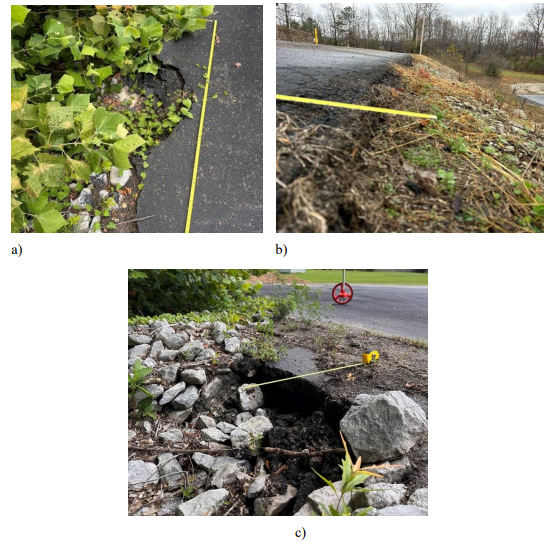
Figure 8. Lane/Shoulder Drop-Off With A) Low Severity, B) Medium Severity, and C) High Severity


a) b)
Figure 9. Patching With A) Low Severity, B) Medium Severity
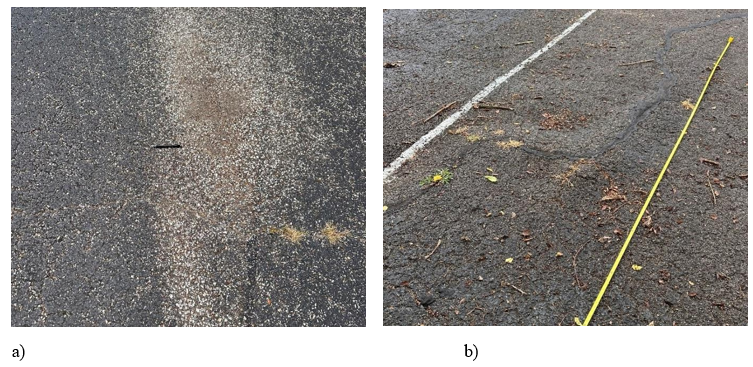
Figure 10. Distress With A) Polished Aggregates, B) Low Severity Swell
Portland Cement Concrete
Load/Structural Distresses
Corner Break: A corner break is a crack that intersects the joints at a distance less than or equal to one-half the slab length on both sides.
Divided Slab: The slab is divided by cracks into four or more pieces due to overloading or inadequate support, or both.
Linear Cracking: These cracks, which divide the slab into two or more pieces, usually are caused by a combination of repeated traffic loading, thermal gradient curling, and repeated moisture loading.
Punchout: This distress is a localized area of the slab that is broken into pieces. The punchout is usually defined by a crack and a joint closely spaced within 5 feet of each other.
Figures 11 a and b illustrate some load/structural related distresses for Portland cement concrete pavements with low severities

 a) b)
a) b)
Climate/Durability Distresses
Blowup/Buckling: Blowups or buckling occur in hot weather, usually at a transverse crack or joint that is not wide enough to allow slab expansion. The insufficient width usually is caused by infiltration of incompressible materials into the joint space. When expansion cannot relieve enough pressure, a localized upward movement of the slab edges or shattering will occur in the vicinity of the joint.
Durability Cracking: Durability cracking is caused by freeze-thaw expansion of the large aggregate which, over time, gradually breaks down the concrete. This distress usually appears as a pattern of cracks running parallel and close to a joint or linear crack. Since the concrete becomes saturated near joints and cracks, a dark-colored deposit can usually be found around fine “D” cracks. This type of distress may eventually lead to disintegration of the entire slab.
Joint Seal Damage: Joint seal damage is any condition that enables soil or rocks to accumulate in the joints or allows significant water infiltration. Accumulation of incompressible materials prevents the slab from expanding and may result in buckling, shattering, or spalling.
Shrinkage Cracks: Shrinkage cracks are hairline cracks that usually are less than 6.5 ft long and do not extend across the entire slab. They are formed during the setting and curing of the concrete and usually do not extend through the depth of the slab.
Spalling, Corner: The breakdown of the slab within 1.5 ft of the corner is known as corner spall. This distress is distinct from a corner break because the spall penetrates the slab at an angle towards the joint rather than vertically to the bottom of the slab.
Spalling, Joint: Joint spalling is the breakdown of the slab edges within 1.5 ft of the joint. A joint spall usually does not extend vertically through the slab but intersects the joint at an angle.
Figures 12 illustrates a climate/durability related distresses for Portland cement concrete pavements with low severities

Figure 12: Low Severity Corner Break
Other Distress Types
Faulting: Faulting is the difference in elevation across a joint. Some common causes of faulting are settlement because of soft foundation, pumping or eroding of material from under the slab, and curling of the slab edges due to temperature and moisture changes.
Lane/Shoulder Drop-off: Lane/shoulder drop-off is a difference in the elevation between the pavement edge and the shoulder. This distress is caused by shoulder erosion or shoulder settlement and can result in increased water infiltration.
Patching, Large: A patch is an area where the original pavement has been removed and replaced by filler material. A patch is considered a distress no matter how well it performs, as patched and/or adjacent areas generally do not hold up as well as the original pavement. A large patch is any patch with an area greater than 5.5 square feet.
Patching, Small: A patch is an area where the original pavement has been removed and replaced by filler material. A patch is considered a distress no matter how well it performs, as patched and/or adjacent areas generally do not hold up as well as the original pavement. A small patch is any patch with an area less than 5.5 square feet.
Polished Aggregate: This distress is caused by repeated traffic applications. Polished aggregate is present when close examination of a pavement reveals that the portion of aggregate extending above the cement matrix is either very small, or there are no rough or angular aggregate particles to provide good skid resistance. This distress is not associated with a severity level.
Pop outs: A pop out is a small piece of pavement that breaks loose from the surface due to freeze-thaw action, combined with expansive aggregates.
Pumping: Pumping is the ejection of material originating beneath the slab through joints or cracks. It is the result of water infiltration through cracks or slab joints that is then forced back through those cracks or joints by traffic loading. This process erodes the subgrade material and leads to the loss of pavement support and further distresses.
Railroad Crossing: Railroad crossing distress is characterized by depressions or bumps around the tracks.
BMap cracking or crazing refers to a network of shallow, fine, or hairline cracks that extend only through the upper surface of the concrete. The cracks tend to intersect at angles of 120Ë?. Map cracking or crazing usually is caused by concrete over-finishing and may lead to surface scaling, which is the breakdown of the slab surface to a depth of approximately 1/4 to 1/2 in.
Figures 13 a and b illustrate some other distress types related for Portland cement concrete pavements with low severities

 a) b)
a) b)
Figure 13: Distress With A) Polished Aggregates, B) Pop outs
Pavement Condition Rating
The PCI, as defined in ASTM D6433, is calculated by deducting specific values based on the type, amount, and severity of distress present within each pavement sample unit. Theoretically, a newly constructed pavement—or one that has recently undergone rehabilitation to restore structural integrity—has a PCI of 100. Pavements exhibiting any level of distress will have PCI values less than 100. Thus, the PCI numerical rating provides a quantitative indicator of overall pavement condition. A visual pavement condition survey must be conducted in general accordance with ASTM D6433 and locally accepted pavement engineering practices. Based on the results of this survey, the PCI for the pavement at the site can be summarized in Table 4.
|
Sample Unit |
Distress Types Observed |
Approximate Area (sf) |
PCI for Sample Unit/Section |
PCI Rating per ASTM D6433 |
|
Name |
Number |
Number |
PCI Number |
Failed to Good |
|
Overall Parking AC |
Number |
Overall PCI Number |
Failed to Good |
|
|
Name |
Number |
Number |
PCI Number |
Failed to Good |
|
Overall Parking PCC |
Number |
Overall PCI Number |
Failed to Good |
|
|
Pavement Conditioning Scoring |
||||
|
PCI Range |
0-10 |
11-25 |
26-40 |
41-55 |
|
PCI Rating |
Failed |
Serious |
Very Poor |
Poor |
Table 4: Pavement Condition Index Rating
Evaluation and General Recommendations
For most pavements, there is an approximate 40% decrease in pavement condition during the first 75% of the pavement’s service life—at which point the condition typically reaches a critical level. At this approximate age and PCI threshold, predictions generally indicate a rapid increase in the rate of deterioration for the remainder of the pavement’s life unless planned maintenance and rehabilitation strategies are implemented.
In general, asphalt pavements are designed for a 20-year service life, while concrete pavements are typically designed for 25 to 30 years. However, by implementing an effective preventative maintenance plan, pavement life can be extended. Preventative maintenance activities are intended to slow deterioration and preserve the pavement investment. These activities typically include localized treatments such as crack sealing and patching. Preventative maintenance is usually the first priority in a pavement management program because it offers the highest return on investment. It is generally performed on pavements that are still above the critical PCI threshold. A critical PCI value usually falls within the range of 41 (Poor) to 56 (Fair), and is determined based on factors such as usage, client expectations, and acceptable performance levels.
For pavements that have fallen below this critical level, some form of rehabilitation—such as reconstruction or removal and replacement—is generally recommended. At this stage, routine maintenance is not considered a viable option, as it will not restore structural integrity. Pavements that fall below the critical PCI typically exhibit significant aging, loss of structural capacity, reduced ride quality, and diminished aesthetic appearance.
Based on the PCI survey of the asphalt and concrete pavements at each site, the overall PCI values will be evaluated in accordance with ASTM standards. As noted previously, the overall condition rating is a function of age, structural performance, climate effects, and other distress mechanisms. For pavements with PCI values within the critical range, the effectiveness of preventative maintenance measures is reduced; however, certain preventative treatments may still serve as short-term remediation options.
Based solely on the condition ratings, pavements that have fallen below the critical PCI value generally require reconstruction and/ or rehabilitation. A geotechnical field exploration is recommended to evaluate the existing pavement structure and subsurface conditions and to collect representative pavement and subgrade samples for laboratory testing. The geotechnical evaluation will provide information for new pavement design alternatives and will help determine the feasibility of a potential mill-and-overlay procedure for asphalt pavements.
For asphalt pavements where funding is not currently available for full reconstruction or a mill-and-overlay treatment, it is typically recommended that the pavement be placed on a safety-maintenance program. This would consist of patching potholes and trip hazards on an as-needed basis until adequate funding becomes available for comprehensive reconstruction. Common materials for safety patching include cold-mix asphalt or hot-mix asphalt. All patch areas should be properly compacted and monitored regularly. Alternatively, as a short-term remediation to prolong the pavement life for another 3-5 years, it is recommended maintenance activities for the existing asphalt pavements should include:
Crack Sealing: Crack sealing is recommended for medium severity longitudinal and transverse cracking and block cracking where the existing crack width exceeds 1/4-inch to a maximum of 1” in width. Cracks should be cleaned of debris and vegetation prior to placement of crack sealant.
Patching: Patching is recommended for medium and high severity alligator cracking at locations as shown on the Site Plan and Repair Plan. Patches should be constructed full depth and should be a minimum of 5” in depth. A tack coat should be placed around the perimeter of the patch area to provide a bond between the old and new asphalt.
Global Seal Coat: An application of a global seal coat, such as micro surfacing or slurry seal is recommended after completion of preventative maintenance work and should be scheduled once every five to seven years thereafter.
Recommended maintenance activities for the existing concrete pavement should include:
Crack/Joint Sealing: Crack sealing is recommended for slabs with cracks greater than ½”. Consideration should be given to sealing of all joints at the site to prevent water from penetrating to the subgrade. All joints and cracks should be thoroughly cleaned with pressurized air to remove old joint sealant, soil and any vegetative matter.
Slab Replacement: Slab replacement is recommended at the site for concrete pavements that have fallen below the critical level. Preventative maintenance of the pavement should be planned and provided for through an on-going pavement management program in order to enhance future pavement performance. We recommend a continued pavement program including a project level pavement survey every three years. We recommend continuing with a preventative pavement maintenance program consisting of crack sealing, patching, and an application of a global treatment once every three to seven years. Global surface treatments are usually programmed after completion of preventive maintenance activities.
Conclusions
The PCI remains a foundational tool for evaluating the surface condition of both asphalt and concrete pavements, offering agencies a standardized and cost-effective method for monitoring pavement health and planning maintenance activities. This paper reviewed the PCI methodology, summarized the major distress types that influence pavement performance, and presented a structured framework for conducting PCI surveys in accordance with ASTM D6433. The findings emphasize that while PCI provides valuable insight into visible pavement deterioration, it should be interpreted with an understanding of its limitations—particularly its reliance on surface distresses and its inability to directly capture subsurface or structural deficiencies.
The study highlights the importance of the critical PCI range (41–56), where pavement deterioration accelerates and preventative maintenance becomes less effective. Pavements falling below this threshold typically require rehabilitation or reconstruction to restore structural integrity and serviceability. For pavement sections within or slightly above the critical range, targeted maintenance strategies—including crack sealing, patching, and global surface treatments—can extend pavement life and delay costly rehabilitation.
Emerging technologies such as automated distress detection, machine learning–based PCI prediction, and image-processing tools show strong potential to enhance the objectivity, repeatability, and efficiency of future PCI assessments. Integrating these advancements with traditional PCI evaluations will allow agencies to transition toward more predictive and data-driven pavement management practices.
Overall, the proposed PCI framework provides practitioners with a systematic approach for evaluating pavement conditions and selecting maintenance strategies that optimize lifecycle performance and maximize infrastructure investment. Continued refinement of PCI methods and incorporation of advanced analytical tools will be essential for sustaining the long-term health of roadway networks.
References
- Alimohammadi, H. (2020). A framework for evaluation of existing pavement conditions and selection of feasible maintenance/rehabilitation alternatives; a case study in some routes of Livingston Parish in the state of Louisiana. SN Applied Sciences, 2(2), 289.
- Alimohammadi, H., Zheng, J., Buss, A., Schaefer, V. R., Williams, C., & Zheng, G. (2021). Finite element viscoelastic simulations of rutting behavior of hot mix and warm mix asphalt overlay on flexible pavements. International Journal of Pavement Research and Technology, 14(6), 708-719.
- “Pavement Condition Index (PCI)”, FAA PaveAir Help,
- ASTM D6433, 2023 “Standard Practice for Roads and Parking Lots Pavement Condition Index Surveys”
- ASTM D5340, 2023 “Standard Test Method for Airport Pavement Condition Index Surveys”,
- Alimohammadi, H., Zheng, J., Buss, A., Schaefer, V. R., & Zheng, G. (2020, May). Rutting performance evaluation of hot mix asphalt and warm mix asphalt mixtures by using dynamic modulus, Hamburg wheel tracking tests, and viscoelastic finite element simulations. In International Conference on Transportation and Development 2020 (pp. 83-94). Reston, VA: American Society of Civil Engineers.
- Alimohammadi, H., Zheng, J., Buss, A., Schaefer, V. R., Williams, C., & Zheng, G. (2020). Field and simulated rutting behavior of hot mix and warm mix asphalt overlays. Construction and Building Materials, 265, 120366.
- Alimohammadi, H. (2021). Rutting behavior of laboratory, field, and finite element simulated hot mix and warm mix asphalt overlays (Master's thesis, Iowa State University).
- Abu-Farsakh, M. Y., Alimohammadi, H., & Mohammad, L.N. (2020). Finite element analysis to evaluate the benefits of geosynthetic reinforcement in flexible pavements over weak subgrade for low volume traffic roads. Geosynth Int.
- Alimohammadi, H. (2021). A State-of-the-art Large-scale Laboratory Approach to Evaluating the Effectiveness of Geogrid Reinforcement in Flexible Pavements.
- Alimohammadi, H. (2021). Effectiveness of Geogrids in Roadway Construction: Determine a Granular Equivalent (GE) Factor (Doctoral dissertation, Iowa State University).
- Karim, D. F., Rubasi, D. K. A. H., & Saleh, D. A. A. (2016).The road pavement condition index (PCI) evaluation and maintenance: a case study of Yemen. Organization, technology & management in construction: an international journal, 8(1), 1446-1455.
- Pinatt, J. M., Chicati, M. L., Ildefonso, J. S., & Filetti,C. R. G. D. A. (2020). Evaluation of pavement condition index by different methods: Case study of Maringá, Brazil. Transportation Research Interdisciplinary Perspectives, 4, 100100.
- Ibragimov, E., Kim, Y., Lee, J. H., Cho, J., & Lee, J. J. (2024). Automated pavement condition index assessment with deep learning and image analysis: an end-to-end approach. Sensors, 24(7), 2333.
- Agyei Kyem, B., Denteh, E. K. O., Asamoah, J. K., & Aboah,A. (2024). Pavecap: The First Multimodal Framework for Comprehensive Pavement Condition Assessment with Dense Captioning and Pci Estimation. Eugene Kofi Okrah and Asamoah, Joshua Kofi and Aboah, Armstrong, Pavecap: The First Multimodal Framework for Comprehensive Pavement Condition Assessment with Dense Captioning and Pci Estimation.
- Shehu, A. A., Mohamed, M. S., Zakwan, A. M., & Jiang,J. (2025). Machine-Learning PCI Forecasts for ConcretePavements: Evidence from a Nigerian Airfield.
- Alimohammadi, H., & Abu-Farsakh, M. (2019). Finite element parametric study on rutting performance of geosynthetic reinforced flexible pavements (No. 19-05396).
- Alimohammadi, H., Zheng, J., Buss, A., Schaefer, V. R., Williams, C., & Zheng, G. (2021). Finite element viscoelastic simulations of rutting behavior of hot mix and warm mix asphalt overlay on flexible pavements. International Journal of Pavement Research and Technology, 14(6), 708-719.
- Park, H. W., Kim, J. M., Lee, J. H., Lee, D. S., & Jeong, J. H.(2023). Pavement Condition Index Model for Mechanistic–Empirical Design of Airport Concrete Pavements Considering Environmental Effects. Buildings, 13(10), 2512.
- Taher, S. A., Alyousify, S., & Hassan, H. J. A. (2020). Comparative study of using flexible and rigid pavements for roads: A review study. Journal of Duhok University, 23(2), 222-234.
- Zheng, J., He, H., & Alimohammadi, H. (2021). Three-dimensional Wadell roundness for particle angularity characterization of granular soils. Acta Geotechnica, 16(1), 133-149.
- Alimohammadi, H., Schaefer, V. R., Zheng, J., & Li, H. (2021). Performance evaluation of geosynthetic reinforced flexible pavement: a review of full-scale field studies. International Journal of Pavement Research and Technology, 14(1), 30-42.
- Alimohammadi, H., Zheng, J., Schaefer, V. R., Siekmeier, J., & Velasquez, R. (2021). Evaluation of geogrid reinforcement of flexible pavement performance: A review of large-scale laboratory studies. Transportation Geotechnics, 27, 100471.
- Zheng, G., Alimohammadi, H., Zheng, J., & Schaefer, V. R. (2021). Effectiveness of geosynthetics in the construction of roadways: a full-scale field studies review. IFCEE 2021, 223-232.
- Kohn, S. D., & Shahin, M. Y. (1984). Evaluation of the Pavement Condition Index for Use on Porous Friction Surfaces (No. CERLTRM351).
- Alimohammdi, H., Schaefer, V. R., Zheng, J., Jahren, C. T., Zheng, G., & White, D. (2021). Effectiveness of Geotextiles/ Geogrids in Roadway Construction; Determine a Granular Equivalent (GE) Factor (No. MN 2021-26). Minnesota. Department of Transportation.
- Alimohammadi, H., Schaefer, V., Zheng, J., & White, D.(2022). A full-scale field approach for evaluating the geogrid reinforcement effectiveness in flexible pavement. In 22nd Int.Conf. Soil Mech. Geotech. Eng.
- Alimohammadi, H., Been, D., Duncan, J. 2025, “Forensic Investigation and Petrographic Analysis of Concrete Apron Distresses; A Case Study in Nashville, Tennessee” Journal of Civil Engizeering Researchers, 7(3)
- Alimohammadi, H., & Memon, A. A. (2024). Comprehensive Sinkhole Mitigation: A Case Study and Application of Compaction Grouting in Karstic Environments in the State of Tennessee, USA.
- Alimohammadi, H., & Memon, A. A. (2023). A Case Study of Mechanically Stabilized Earth (MSE) Retaining Wall Failure in the State of Tennessee; Recommendations for Future Design and Constructions.
- Adey, B. T. (2019). A road infrastructure asset management process: Gains in efficiency and effectiveness. Infrastructure Asset Management, 6(1), 2-14