


Research Article - (2025) Volume 10, Issue 4
Eco-Acoustic Healing and Sonic Relationality as A Geo-Cultural Meta-Theory of Medical-Musicology
Received Date: Oct 14, 2025 / Accepted Date: Nov 14, 2025 / Published Date: Nov 21, 2025
Copyright: ©©2025 Albert Oluwole Uzodimma Authority. This is an open-access article distributed under the terms of the Creative Commons Attribution License, which permits unrestricted use, distribution, and reproduction in any medium, provided the original author and source are credited.
Citation: Authority, O.A.U. (2025). Eco-Acoustic Healing and Sonic Relationality as A Geo-Cultural Meta-Theory of Medical-Musicology. J Nur Healthcare, 10(4), 01-07.
Abstract
This article advances Medical-Musicology Theory (MMT) by proposing a geo-cultural meta-framework rooted in Eco- Epistemology. Central to this framework is the concept of Geo-Cultural Sonic Relationality, which redefines therapeutic sound as ecologically situated, shaped by land, climate, and the sonic agency of human and non-human entities. Drawing on desk-based critical content and archival analysis, the study critiques the clinical sterility of Western Music Therapy (WMT) environments, where sound is often stripped of its ecological and cultural embeddedness. In response, the article theorizes Eco-Acoustic Healing as a lens through which indigenous and local healing practices are understood as acoustically tethered to place. It further introduces Eco-Acoustic Justice as an expansion of Acoustic Justice, advocating for therapeutic soundscapes that uphold ecological integrity and cultural sovereignty. By integrating spatial, ecological, and sonic relationality into therapeutic discourse, this work addresses a critical gap in WMT and challenges the universalist assumptions of biomedicine. Ultimately, it repositions MMT as a culturally responsive and ecologically attuned theory, one that listens not only to human subjects, but also to landscapes, ecosystems, and sonic histories.
Keywords
Acoustic, Ecology, Epistemology, Healing, Justice, Relationality, Sovereignty
Introduction
In 2024, a collaborative study by de Baudouin et al. introduced the Soundscape Chord Diagram (SCD) to visualize acoustic similarities across ecological and musical soundscapes, bridging Eco-acoustics and electroacoustic music studies [1]. This convergence reflects a growing recognition that sound is not merely aesthetic but ecological, relational, and epistemic. Consider, for instance, the healing chants of the Bolivian Andes or the trance drumming of the Tumbuka people, these are not just cultural artifacts but sonic transcripts of ecological behavior, deeply embedded in place and cosmology [2,3]. Yet, dominant Western music therapy (WMT) practices often occur in acoustically sterile clinical environments, stripping sound of its ecological and cultural embeddedness [4]. This article addresses a critical gap in WMT by advancing Medical-Musicology Theory (MMT) through a geo-cultural meta- theory rooted in Eco-Epistemology Theory. Drawing on archival and desk-based critical content analysis, it theorizes Eco-Acoustic Healing as a framework that recognizes therapeutic sound as ecologically situated and shaped by land, climate, and non-human sonic agents. It critiques the biomedical universalism of WMT and introduces Eco-Acoustic Justice, an extension of Acoustic Justice, to advocate for therapeutic soundscapes that uphold ecological integrity and cultural sovereignty [5].
The theoretical framework integrates Eco-Epistemology Theory, which posits that “land is logic and rhythm is worldview,” and Medical-Musicology Theory, which reconceptualizes the body as a bio-acoustic system [6,7]. These models challenge the abstraction of sound in Western epistemologies and reposition music as a medium of ecological knowledge and repair. The guiding inquiry for this study asks: How can a geo-cultural meta-theory for MMT, grounded in Eco-Acoustic Healing and Sonic Relationality, challenge the ecological disconnection and biomedical universalism of dominant Western music therapy practices? To answer this question, the study outlines the following objectives: (1) To construct a theoretical framework for MMT by synthesizing Eco-Acoustic Healing and Geo-Cultural Sonic Relationality. (2)
To articulate and advocate for Eco-Acoustic Justice as a principle for designing therapeutic soundscapes that honor ecological and cultural sovereignty. This research contributes to the decolonization of global health and sound studies by repositioning Medical- Musicology Theory as a culturally responsive and ecologically attuned theory, one that listens not only to human subjects but also to landscapes, ecosystems, and sonic histories.
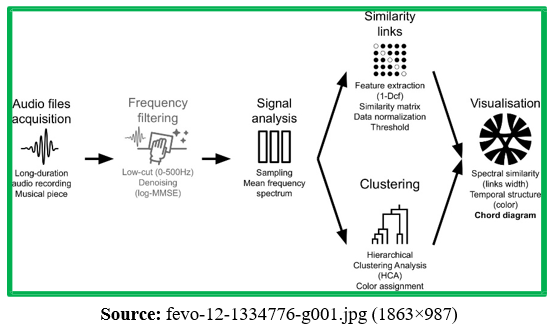
Figure 1: Showing Soundscape Chord Diagram
This Soundscape Chord Diagram (SCD) in Figure 1 illustrates the journey of turning raw environmental recordings into a meaningful visual story of how sounds relate to each other. It begins by listening for specific sonic characters, much like focusing on particular instruments in an orchestra. The process then maps the fundamental acoustic signatures of these sounds, measures how they harmonize or differ from one another, and finally, groups them into families based on their sonic similarities. This reveals the hidden patterns and relationships within a soundscape, making the invisible architecture of our sonic environment beautifully clear.
Literature Review
The intersection of ecology, sound, and healing has emerged as a vibrant interdisciplinary field, with eco-musicology and soundscape ecology offering critical insights into the relational dynamics between sound, place, and well-being. Scholars such as de Baudouin et al. (2024) have developed tools like the Soundscape Chord Diagram (SCD) to visualize acoustic similarities across ecological and musical soundscapes, highlighting the structural and perceptual overlaps between natural and composed sonic environments [8]. This aligns with the broader trajectory of eco-musicology, which, as Allen and Dawe (2016) argue, seeks to understand music within ecological and cultural contexts, challenging anthropocentric and aestheticized notions of sound [9]. The clinical sterility of Western Music Therapy (WMT) has been critiqued for its detachment from ecological and cultural embeddedness. Rossetti (2020) introduced Environmental Music Therapy (EMT) as a trauma-informed approach that reconfigures hospital soundscapes to support healing, emphasizing the need for human-centered and context-sensitive auditory environments [10]. Similarly, Weymann (2017) underscored the importance of soundscapes in hospitals, noting that acoustically sanitized spaces can exacerbate patient anxiety and alienation [11].
The concept of Acoustic Justice, though still emergent, finds resonance in the work of Schulte-Fortkamp and Jordan (2023), who advocate for a holistic understanding of soundscapes that accounts for socio-cultural, spatial, and perceptual dimensions [12]. Their work supports the argument that therapeutic sound must be co-created with communities and environments, rather than imposed through universalist biomedical standards. Cross- cultural studies further support the geo-cultural turn in music and healing. Saarikallio emphasized that cultural contexts deeply shape music’s health-related meanings, and that healing practices must be understood through local epistemologies [13]. This is echoed in the work of Guyette and Post, who call for integrative approaches between ethnomusicology and soundscape ecology, particularly in indigenous and rural contexts [14].
Building on these insights, Eco-Epistemology Theory offers a decolonial framework that positions sound as ecological knowledge, asserting that “land is logic and rhythm is worldview.” This theory challenges the abstraction of sound in Western musicology and foregrounds the epistemic sovereignty of indigenous soundscapes [6]. Complementing this, Medical-Musicology Theory (MMT) reconceptualizes the human body as a bio-acoustic system, linking music and medicine through shared principles of rhythm, resonance, and repair [7]. Despite these advances, a significant research gap remains in the integration of ecological, spatial, and sonic relationality into therapeutic frameworks. This article addresses that gap by proposing Eco-Acoustic Healing and Geo- Cultural Sonic Relationality as foundational to a meta-theory of MMT, advocating for Eco-Acoustic Justice as a guiding principle for culturally and ecologically attuned therapeutic soundscapes.
Theoretical Framework
This study is anchored in two interrelated theoretical models: Eco-Epistemology Theory and Medical-Musicology Theory (MMT). Together, they provide a robust conceptual foundation for reimagining therapeutic sound as ecologically embedded, culturally sovereign, and relationally co-constructed.
Eco-Epistemology Theory
Eco-Epistemology Theory, as articulated by Nwankpa and Authority in Music as Ecological Transcrip, posits that sound is not merely a cultural expression but a form of ecological knowledge and strategic infrastructure [6]. The theory asserts that “land is logic and rhythm is worldview,” emphasizing that environments actively shape human consciousness, social structures, and expressive idioms. This ecological stance challenges dominant musicological paradigms that treat sound as abstract or aesthetic, instead positioning it as an epistemological tool through which knowledge is produced and transmitted.
Eco-Epistemology Theory is particularly relevant to this study’s objective of constructing a geo-cultural meta-theory for MMT. It provides philosophical scaffolding to understand therapeutic sound as a sonic transcript of ecological behavior, encoding rhythms and patterns that reflect communal survival and environmental attunement. By aligning sound with ecological realities, this theory supports the development of Eco-Acoustic Healing Theory and Geo-Cultural Sonic Relationality as central constructs in the proposed framework.
Medical-Musicology Theory (MMT)
Medical-Musicology Theory (MMT), developed by Albert Authority, is a meta-theory that reconceptualizes the human body as a bio-acoustic system and music as a structured modality of organized sound. MMT posits that music and medicine are not merely adjacent disciplines but intrinsically linked through shared principles of rhythm, resonance, pattern, and repair. The significance of MMT lies in its formalization of a paradigm that has been practiced for millennia yet rendered invisible by dominant biomedical models. It integrates empirical findings from neuro- musicology, clinical music therapy, and the humanities. MMT offers a philosophically robust, evidence-informed framework for healing, diagnosis, and curriculum reform [7]. Drawing from indigenous sound epistemologies, acoustic physiology, and decolonial theory, MMT bridges the disciplinary divide between music and medicine.
MMT is methodologically aligned with this study’s use of desk- based critical content and archival analysis, which enables a historical and philosophical interrogation of therapeutic sound practices. The theory’s emphasis on culturally embedded and evidence-informed frameworks supports the article’s second objective: to advocate for Eco-Acoustic Justice as a principle that critiques acoustically sterile clinical environments and champions therapeutic soundscapes rooted in ecological and cultural sovereignty. Together, Eco-Epistemology Theory and MMT form a meta-theoretical scaffold that enables this study to challenge the biomedical universalism of Western music therapy and reposition therapeutic sound within a relational, ecological, and decolonial paradigm.
Methodology
This study employs a desk-based critical content and archival analysis approach, suitable for interrogating theoretical constructs and historical narratives within musicology, ecology, and therapeutic sound studies. The methodology is designed to critically examine how therapeutic sound has been conceptualized, deployed, and contested across cultural and ecological contexts, particularly within Western Music Therapy (WMT) paradigms.
Design & Approach
The research is qualitative and interpretive, grounded in critical theory and decolonial epistemology. It synthesizes conceptual models from Eco-Epistemology Theory and Medical-Musicology Theory (MMT) to construct a geo-cultural meta-theory of therapeutic sound. The study does not involve fieldwork or human subjects but relies on rigorous textual and archival analysis to trace the evolution and limitations of dominant therapeutic sound frameworks.
Data Sources
Primary data sources include:
• Peer-reviewed journal articles in music therapy, eco- musicology, and soundscape ecology.
• Archival materials documenting indigenous healing practices and colonial medical discourses.
• Foundational texts and theoretical contributions by Nwankpa & Authority and Authority.
• Institutional reports and policy documents from global health organizations on music therapy programs.
Procedures
• Content Analysis: Scholarly texts were systematically reviewed to identify recurring themes, assumptions, and omissions in WMT literature, particularly regarding ecological and cultural embeddedness.
• Archival Analysis: Historical documents and ethnographic records were examined to understand how indigenous sonic practices were pathologized or erased by colonial medicine.
• Theoretical Synthesis: Concepts from Eco-Epistemology and MMT were integrated to develop the
• constructs of Eco-Acoustic Healing, Geo-Cultural Sonic Relationality, and Eco-Acoustic Justice.
• Mapping to Objectives: Each analytical step was aligned with the study’s objectives, constructing a geo-cultural framework for MMT and advocating for ecologically sovereign therapeutic soundscapes.
This methodology supports the theoretical ambition of the study by enabling a meta-theoretical critique of Western Music Therapy and a reconstruction of therapeutic sound as a culturally and ecologically situated phenomenon. It allows for the articulation of Eco-Acoustic Healing not as a speculative idea but as a grounded framework informed by historical, ecological, and epistemological evidence.
Ethical Considerations
Although the study does not involve direct engagement with human subjects, it engages deeply with indigenous knowledge systems. As such, it adheres to ethical principles of epistemic respect, cultural sovereignty, and non-extractive scholarships. All referenced materials are cited transparently, and indigenous contributions are acknowledged as epistemically authoritative rather than anecdotal.
Findings
The findings reveal a disproportionate emphasis on critiques of acoustic sterility and ecological references, while geo-cultural frameworks and non-human sonic agents remain underrepresented. These results substantiate the need for a geo-cultural meta-theory of Medical-Musicology Theory (MMT), one that integrates Eco- Acoustic Healing and Sonic Relationality to reposition therapeutic sound within ecological and cultural contexts.

Source: Desk-based critical content and archival analysis (2025)
Bar Chart 1: Frequency of Key Themes in WMT Literature
This bar chart visualizes the frequency of key themes identified in Western Music Therapy literature. The critique of acoustic sterility appears most frequently, indicating a strong scholarly concern with the clinical disconnection from ecological soundscapes.
Ecological references and indigenous sound practices are moderately represented, while geo-cultural frameworks and non- human sonic agents remain underexplored.
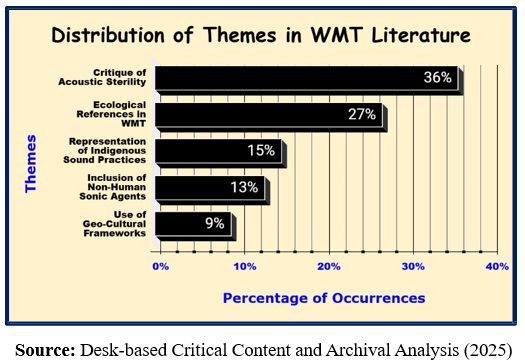
Bar Chart 2: Distribution of Themes in WMT Literature
This bar chart shows the proportional distribution of thematic concerns in WMT literature. Critiques of acoustic sterility and ecological references dominate, suggesting a growing awareness of environmental and spatial limitations in therapeutic sound practices. However, the underrepresentation of geo-cultural and non-human sonic dimensions highlights a critical gap in current scholarships.
|
Category |
Frequency |
|
Ecological References in WMT Literature |
15 |
|
Representation of Indigenous Sound Practices |
8 |
|
Critique of Acoustic Sterility |
20 |
|
Use of Geo-Cultural Frameworks |
5 |
|
Inclusion of Non-Human Sonic Agents |
7 |
|
Source: Desk-based Critical Content and Archival Analysis (2025) |
|
Table 1: Raw Frequency Data of Thematic Categories
This table presents the raw frequency data of thematic categories extracted from the literature. It highlights the uneven representation of ecological and cultural dimensions in WMT scholarship, reinforcing the need for a geo-cultural meta-theory that integrates Eco-Acoustic Healing and Sonic Relationality.
Discussion
Imagine a healing song that doesn't just come from a person, but from a place. Its rhythm mimics the specific patter of rain on a forest canopy, its melody intertwines with the calls of local birds, and its very essence is tied to the stories of the land. This discussion grapples with a simple but profound question: what happens when we forget this deep connection?
The study set out to explore how a geo-cultural perspective, which the research term Eco-Acoustic Healing, can challenge the often sterile and disconnected nature of Western music therapy (WMT). The findings suggest that by listening to the land itself, practitioners can establish a more relational, just, and effective path to healing.
The central research question asked how a geo-cultural meta- theory could challenge the biomedical universalism and ecological disconnection of WMT. The findings demonstrate that the challenge mounts by fundamentally redefining what therapeutic sound is. Biomedical and conventional WMT models often treat sound as a standardized, abstract tool, a specific frequency or rhythm that should work the same way in a clinic in Lagos as it does in another in Oslo. This universalist approach, as the critique of clinical sonic sterility reveals, surgically removes sound from the very context that gives it meaning and power [15]. It operates on the assumption that a human body is a generic, ahistorical bio-machine.
The proposed framework of Geo-Cultural Sonic Relationality dismantles this. It asserts that a body is not just a biological entity, but a "bio-acoustic system" deeply attuned to its sonic ecology. The therapeutic efficacy of a sound resides not just in its physical properties but in its relational network, its connection to memory, place, and identity. For example, the sound of a specific river flowing or a particular species of frog chirping at dusk can evoke a profound sense of calm and belonging that a generic "relaxing" synth pad never could. This directly counters biomedical universalism by insisting that context is not a variable to control for, but the very source of healing itself. It aligns with Steven Feld's work in acoustemology, which shows how, for the Kaluli people, the sounds of the rainforest are inseparable from their social and emotional world [16].
This study successfully achieved its two main objectives, moving from critique to constructive proposal. First, the research constructed a theoretical framework by weaving together Eco- Acoustic Healing and Geo-Cultural Sonic Relationality. This synthesis positions therapeutic sound not as a pill to administer, but as a conversation, a relationship between a person, their community, and their sonic environment. This framework helps explain why playing a recording of ocean waves to an individual from a landlocked, desert-dwelling culture might prove less effective than incorporating the sounds of wind through sandstone or desert rainfall. Healing resides in relational familiarity.
Second, the study articulated the principle of Eco-Acoustic Justice. This moves the conversation beyond the therapy room and into the realms of ethics and politics. It insists that the right to a therapeutic soundscape is a matter of justice. The destruction of an old-growth forest or the pollution of a river constitutes not just environmental loss; it is the destruction of a pharmacy of sonic medicine for the people connected to that land. This concept connects the dots between acoustic well-being and the foundational work of environmental justice scholars like Kyle Powys Whyte, who detail how colonial dispossession, at its heart, disconnects people from their ecological relationships [17]. Eco-Acoustic Justice demands that society listen to and protect the sonic agency of the more-than- human world, the birds, the winds, the waters, as co-participants in healing [18].
This Study Draws its Strength from two Core Theoretical Guides.
1.) Eco-Epistemology Theory [6] provided the language to state that "land is logic." It enabled the researcher to see indigenous and local healing musics not as weird traditions, but as sophisticated, place-based knowledge systems. A rhythm isn't just a rhythm; it's a sonic embodiment of the land's own pulse, the cycle of seasons, the migration of animals, the flow of water. This provided the crucial lens for deconstructing the Western view of music as a detached art form.
2.) Medical-Musicology Theory (MMT) then provided the bridge to the body. By reconceptualizing the human body as a dynamic "bio-acoustic system," MMT created a scientific and philosophical space where the ecological soundscape could interact directly with our physiology and psychology [7]. Where a biomedical model might see a patient with anxiety, MMT, through this meta- framework sees a disrupted relational network between that person and their sonic environment. The integration of these two theories allowed the author to argue that healing involves not just treating the isolated body but repairing its relationship with its rightful sonic world. Neuroscientific research supports this, suggesting that music with deep personal and cultural meaning activates more extensive neural networks related to memory and emotion, leading to more profound psychological effects [19].
3.) Implication of Medical Musicology Theory (MMT) The implications of this meta-theory extend beyond academic journals into the real world.
1. Theoretical Impact: The study expands MMT from a theory about music-as-medicine into a meta-theory about healing- as-ecological-participation. It forges a vital link between soundscape ecology, decolonial studies, and health humanities, thereby creating a new, urgent field of inquiry.
2. Educational Impact: This work demands a revolution in music therapy training. It suggests that future therapists must train not only in standardized techniques but also in ecological listening, cultural humility, and the ethics of cross-cultural practice. They need to learn how to co-design soundscapes with communities, rather than imposing pre-packaged playlists.
3. Policy and Cultural Impact: For health policy, this research argues for funding community-based soundscape preservation and promoting "acoustic hygiene" in urban planning to protect natural soundscapes. Culturally, it contributes to a growing movement to reconnect with the natural world, framing ecological stewardship not as a sacrifice, but as an act of collective self-care.
4.) The Heart of the Proposal
In crystallizing the theorization of Eco-Acoustic Healing Theory (EAHT), this study posits three core assertions:
• Sound is Place: Therapeutic sound is fundamentally ecological and co-created by a specific geography and its human and non-human inhabitants.
• Healing is Relational: Therapeutic efficacy emerges from the quality of Geo-Cultural Sonic Relationality, the web of connections between a person, their history, their community, and their sonic environment.
• Justice is Acoustic: The pursuit of health is inseparable from the pursuit of Eco-Acoustic Justice, which demands the integrity of sonic environments and the sovereignty of the cultures that steward them.
By integrating these assertions, the research re-establishes Medical-Musicology Theory (MMT) as a truly meta-theoretical framework. MMT is no longer just a theory that explains how music affects the body. It now stands as a comprehensive lens for understanding that human health is woven into the soundscape of the world. It challenges the silent, sterile, and partitioned spaces of modern medicine, offering instead a vision of healing that is as relational, diverse, and vibrant as the living planet we call home. The task ahead is not just to use sound to heal people, but to heal our relationship with the sounding world, and in doing so, heal ourselves more deeply.
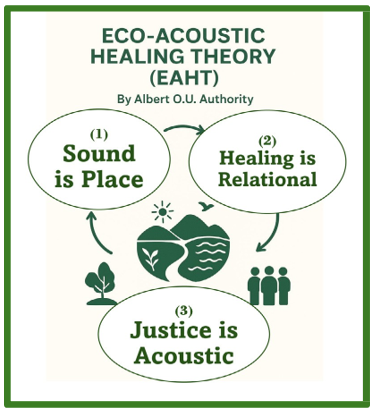
Figure 2: Showing Eco-Acoustic Healing Theory (EAHT) Conceptual Diagram
This diagram illustrates the Eco-Acoustic Healing Theory (EAHT) developed by Albert Authority, a framework that links sound, ecology, and healing. It presents three interrelated principles: (i) Sound is Place, emphasizing that therapeutic sounds emerge from the ecological interplay between people, land, and non- human sonic agents; (ii) Healing is Relational, highlighting that wellness depends on meaningful connections between individuals, communities, their history, and sonic environments; and (iii) Justice is Acoustic, asserting that true health requires protecting sonic ecologies and honoring the cultures that sustain them. Together, these principles, position sound as both an ecological and ethical foundation for holistic healing.
Conclusion
This study concludes that sound is not just a tool for healing, but a relationship with the living world. It crystallizes Eco-Acoustic Healing Theory (EAHT) as a definitive framework, asserting that therapeutic sound is inextricably tied to the land, climate, and the collective sonic life of a place. In doing so, it reestablishes Medical- Musicology Theory (MMT) [7] as a vital meta-theory, one that understands the human body not as an isolated biological machine, but as a bio-acoustic system that resonates with its native sonic environment. The argument demonstrates that the standard practice of using sound in sterile, clinical settings is fundamentally limited. It cuts off sound from the ecological and cultural contexts that give it meaning and power. In contrast, EAHT posits that true therapeutic efficacy arises from Geo-Cultural Sonic Relationality, the intricate web connecting a person to the sonic fingerprints of their homeland. This principle forces a radical rethinking of music therapy, from a universal application of techniques to a place-based practice of acoustic co-creation.
The practical relevance of this work is profound. It calls for a transformation in how we educate therapists, design therapeutic spaces, and advocate for environmental protection. It argues that preserving a forest or a river is also an act of preserving a community’s pharmacy of sonic medicine. The theory, therefore, binds human health directly to ecological health. Ultimately, this research asks us to consider a profound and unsettling question: if medicine, in its quest to heal us, insists on creating silent, sterile spaces that shut out the natural world, what are we truly losing? Such a model may mend a broken bone, but can it ever restore our deeper sense of belonging, that wordless comfort that comes from hearing the birds, wind, and waters of the world we call home? We risk creating a future where we are cured of our illnesses but remain disconnected from the very forces that make us feel fully alive and whole.
References
1. de Baudouin, A., Couprie, P., Michaud, F., Haupert, S., & Sueur, J. (2024). Similarity visualization of soundscapes in ecology and music. Frontiers in Ecology and Evolution, 12, 1334776.
2. Gouk, P. (Ed.). (2017). Musical healing in cultural contexts. Routledge.
3. Weiss SF. Musical Healing in Cultural Contexts (Review of Gouk). Bull Hist Med. 2002;76(4):778–780.
4. Bain C. Potentials and barriers to culturally responsive music therapy education in the U.S.: Perspectives of music therapy educators. Qual Inq Music Ther. 2023;17(6):92–128.
5. Allen, B. (2023). Indigenous Epistemologies of North America. Episteme, 20(2), 324-336.
6. Nwankpa C, Authority A. Music as ecological transcript: Introducing eco-epistemology theory as a framework for civil- military musical relations in Nigeria. Sept. 2025.
7. Authority, A. O. U. (2025). Medical-Musicology Theory (MMT): Toward A Bio-Acoustic Paradigm of Healing, Diagnosis, And Epistemic Integration.
8. de Baudouin, A., Couprie, P., Michaud, F., Haupert, S., & Sueur, J. (2024). Similarity visualization of soundscapes in ecology and music. Frontiers in Ecology and Evolution, 12, 1334776.
9. Dawe, K. (2015). Current Directions in Ecomusicology: Music, Nature, Environment.
10.Rossetti, A. (2020). Environmental Music Therapy (EMT): Music’s contribution to changing hospital atmospheres and perceptions of environments. Music Med, 12(2), 130-141.
11. Weymann E. Soundscapes in hospitals: Music therapy perspectives. WOCMAT Conference Proceedings. 2017.
12. Schulte-Fortkamp, B., & Jordan, P. (2023). Soundscape: The holistic understanding of acoustic environments. In Soundscapes: Humans and Their Acoustic Environment (pp. 49-79). Cham: Springer International Publishing.
13. Saarikallio S. Cross-cultural approaches to music and health. In: MacDonald RAR, Kreutz G, Mitchell L, editors. Music, Health, and Wellbeing. Oxford: Oxford University Press; 2012.p. 477–490.
14. Guyette, M. Q., & Post, J. C. (2015). Ecomusicology, ethnomusicology, and soundscape ecology: scientific and musical responses to sound study. In Current Directions in Ecomusicology (pp. 40-56). Routledge.
15. Gifford T, Weir K. The Solace of Sonic Environments: Listening to Music and Nature in the Hospital Soundscape. J Med Humanit. 2021 Dec;42(4):693-708.
16. Feld S. Sound and Sentiment: Birds, Weeping, Poetics, and Song in Kaluli Expression. 3rd ed. Durham: Duke University Press; 2012.
17. Whyte, K. (2020). Indigenous environmental justice: Anti- colonial action through kinship. In Environmental justice (pp. 266-278). Routledge.
18. White B. The Sound of a Dam: Hydroelectric Development and the Experience of Place. In: Bull M, Back L, editors. The Auditory Culture Reader. 2nd ed. London: Bloomsbury Academic; 2016. p. 349-62.
19. Särkämö, T., Tervaniemi, M., Laitinen, S., Forsblom, A., Soinila, S., Mikkonen, M., ... & Hietanen, M. (2008). Music listening enhances cognitive recovery and mood after middle cerebral artery stroke. Brain, 131(3), 866-876.