

Annals of Computational Physics and Material Science(ACPMS)
ISSN: 2997-2795 | DOI: 10.33140/ACPMS


Research Article - (2026) Volume 3, Issue 1
Dose Calculations and Determination of Shielding Characteristics for Protecting Emergency Workers During the Response to Radiological Emergencies
2Nuclear Safeguards and Physical Protection Department, Regulations and Nuclear Emergencies Division, Nuclear and Radiological Research Center, Egyptian Atomic Energy Authority, Cairo, Egypt
Received Date: Jun 03, 2025 / Accepted Date: Nov 25, 2025 / Published Date: Jan 16, 2026
Copyright: ©2026 W. F. Bakr, et al. This is an open-access article distributed under the terms of the Creative Commons Attribution License, which permits unrestricted use, distribution, and reproduction in any medium, provided the original author and source are credited.
Citation: Bakr, W. F., Shaaban, N., Said, N. M. (2026). Dose Calculations and Determination of Shielding Characteristics for Protecting Emergency Workers During the Response to Radiological Emergencies. Ann Comp Phy Material Sci, 3(1), 01-11.
Abstract
Effective and efficient response to radiation emergency including those with security related events is the main goal of the national strategy for emergency preparedness and response. Accidents due to radioactive sources have a wide range of possibilities and consequences. Mapping of the radiation doses related to the exposure of radioactive sources with different activities give a fast view and expectation of the consequences and the required protective actions and other response actions. The aim of this publication is to provide a practical guidance for emergency response in terms of absorbed dose rate and their related required shielding parameters for different categories of radioactive sources that, if implemented, will provide a fast assessment and response capability needed to protect the public and the workers in the event of different types of radiological emergencies including radioactive sources. MNCP Code is used for predicting the absorbed doses from the famous radioactive sources under different hazard categories (categories 2&3) in case of loss of their shielding at different distances and to calculate their appropriate shielding characteristics.
Introduction
Using of radioactive sources in different applications is growing daily. Despite all safety precautions taken in design and operations, accidents involving radiation sources do occur more frequently. The consequences and the impact of the accidentally and unmanaged exposure of such radioactive sources may be serious and fatal. The effective response with promptly and adequately actions to protect the public and the emergency workers is one of the most important aspects of managing a radiological emergency [1]. The categorization of radioactive sources is providing a fundamental and internationally harmonized basis for risk-informed decision making especially in emergency preparedness and response related activities [2]. The aim of this work is to provide a fast guideline for expecting dose rate and required shielding characteristics during the response to radiological emergencies involving radioactive sources. Monte Carlo calculations are carried out on several radioactive sources that mostly used in industrial applications and are belonging to hazard categories 2 and 3. The provided fitted equations allow the planner to easily calculate the flux and the dose rates as well as the required shielding characteristics at a range of distances due to different types of radiation sources.
In this work, general Monte Carlo code MCNP5 is used taken into consideration the effect of real setup and situations including source geometry, self-attenuation due to material density and types of emitted radiations for dose rate calculations. Emitted radiations, type of isotopes, shielding geometry, shielding density and interaction of radiation with matter are the theoretical parameters used in determining the shielding characteristics. The general Monte Carlo code, MCNP5, has the feature of calculating the radiation flux gammas and neutrons at a specified point using the point detector “F5” tally. The energy distribution of the gamma rays emitted from the sources are identified using a distribution number “Dn” in the energy variable of the source definition card “SDEF”. The distribution itself is defined in the source information “SI” and source probability distribution “SP” cards. The gamma energies with their emission probabilities are inserted in the source information and probability distribution cards. Finally, conversion of the calculated flux at the specified points into dose is accomplished using the “flux-to-dose conversion factors” listed in the DE/DF cards. The multiplier card “FMa” was used to modify the results such that they are directly given in units of μSv/hr.
The Table of gamma flux-to-dose rate conversion factor given in the MCNP manual was used [3,4]. The selected isotopes with their corresponding activity in (TBq) and their modes of decay are presented as well as their industrial applications and hazard categories in Table 1 [2]. The results of calculations for both flux and dose rate as functions of distance are then fitted to a power function.
|
Category |
Radioactive Source |
Applications |
Activity (TBq) |
Mode of Decay |
||
|
Min. |
Max. |
Typ. |
||||
|
Category II |
60CO |
Industrial radiography |
4.1E-01 |
7.4E+00 |
2.2E+00 |
Gamma |
|
Category II |
192Ir |
1.9E-01 |
7.4E+00 |
3.7E+00 |
Gamma |
|
|
Category II |
137Cs |
Calibration Source |
5.6E-02 |
1.1E+02 |
2.2E+00 |
Gamma |
|
Category III |
241Am |
1.0E-01 |
7.4E-01 |
3.7E-01 |
Gamma |
|
|
Category III |
137Cs |
Level gauge |
3.7E0-2 |
1.9E-01 |
1.9E0-1 |
Gamma |
|
Category III |
241Am/Be |
Well logging |
1.0E-02 |
8.5E-01 |
7.4E-01 |
Neutron |
|
Category III |
252Cf |
1.0E-03 |
4.1E-03 |
1.1E-03 |
Neutron |
|
Table 1: The Used Radioactive Sources and Their Modes of Decay and Corresponding Energies
Results and Discussion
Two models for the calculation of dose rate due to the point sources are estimated, the first one; the point source is located on the air space as sphere model without any effect of the land and the dose rate calculated at different distances from the source as shown in Figure 1. The second one; the point source is located on concrete land and in air space in rectangle shape to decrease the backscattering effect; where the dose rates are also calculated at different distances as shown in Figure 2. Figures 1&2 illustrate the particles display of the point source in each model. Another hypothetical model for dose calculation due to using Lead Pb, shield between the source and the worker is introduced.
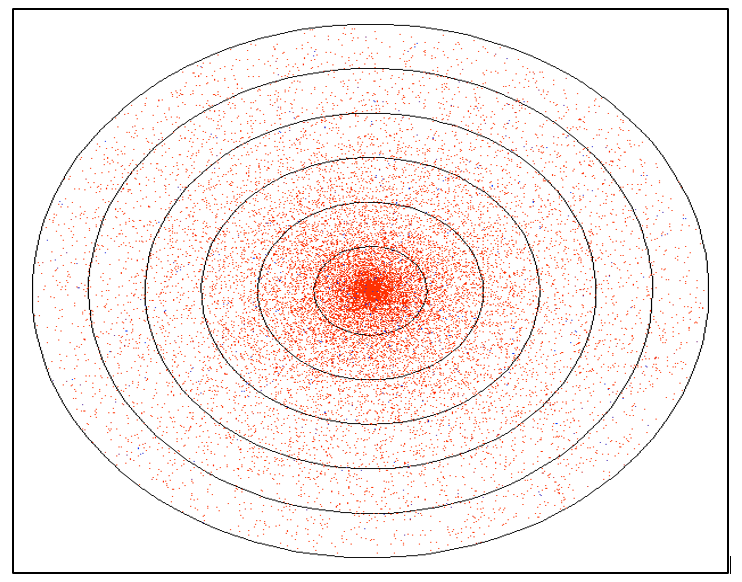
Figure 1: The Particle Display of 60Co Point Source in Sphere Model Air Space without Concrete Land
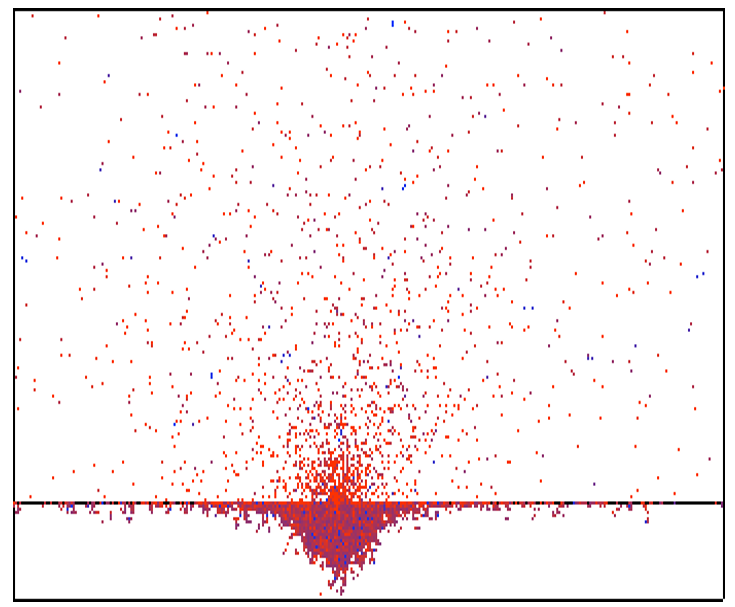
Figure 2: The Particle Display of 60Co Point Source in Rectangle Model Air Space with Concrete Land
The model estimated that the source and the shield are positioned at the concrete land and in air space. The geometry of the shield is described as rectangle shape with diameters 1.0 cm and 3.0 cm of Pb for gamma emitters. The location of the emergency worker from the shield (x,y,z) are estimated as (x,0,100) where x, are the distance between the worker and the shield. Figure (3) illustrates the schematic diagram of the model.

Figure 3: Schematic Diagram of the Estimated Shield Model
The absorbed dose rates at different distances from the point source and the shield (100, 150, 200, 250, 300, 350, 400, 450, 500 and 550 cm) were calculated. Figure 4 and Figure 5 illustrate the particles display from 0.2 TBq 137Cs gamma line in the presence of 1.0 cm and 3.0 cm Pb shield respectively.

Figure 4: The Particle Display of the 137Cs (0.2 TBq) Photons in the Opposite Directions of 1.0 cm Pb Shield
Figure 5: The Particle Display of the 137Cs (0.2 TBq) Photons in in the Opposite Directions of 3.0 cm Pb Shield
Dose Mapping of the Selected Isotopes
The dose rate due to three activities presented in Table 1 of each isotope were calculated using MCNP 5 code based on the estimated models. The dose map of the unshielded sources as described in Figures 6,7,8 and 9 illustrate the dose rate (mSv/h) due to 0.2, 3.7 and 3.7 TBq of 137Cs, 60Co and 192Ir respectively at three conditions (without shield, presence of 1.0 cm Pb shield and 3.0 cm Pb shield).

Figure 6: Dose Rate (mSv/h) due to 137Cs Point Source (0.047-110 TBq) at Different Distances
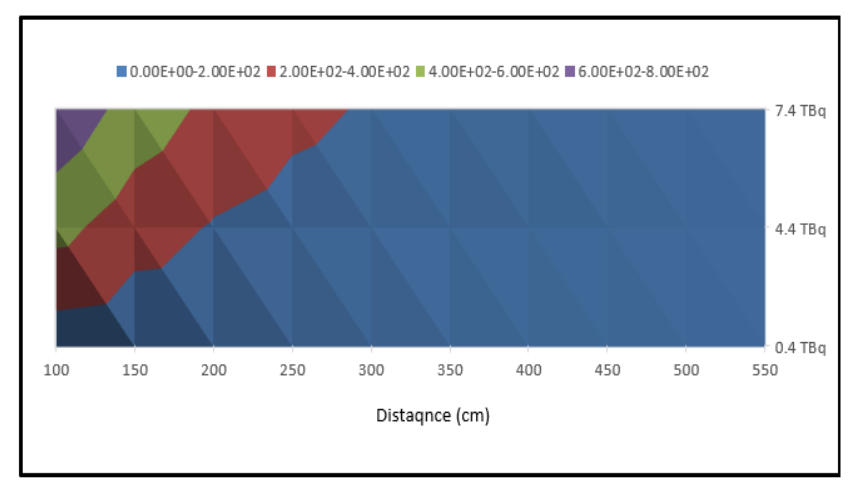
Figure 7: Dose Rate (mSv/h) due to 60Co Point Source (0.2 -7.4 TBq) at Different Distances

Figure 8: Dose Rate (mSv/h) due to 192Ir point source (0.2 -7.4 TBq) at Different Distances
While figures 9, 10, 11 and 12 illustrate the dose mapping due to the presence of 1.0 cm and 3.0 cm Pb shield around 137Cs, 60Co and 192Ir respectively for the same selected activities.
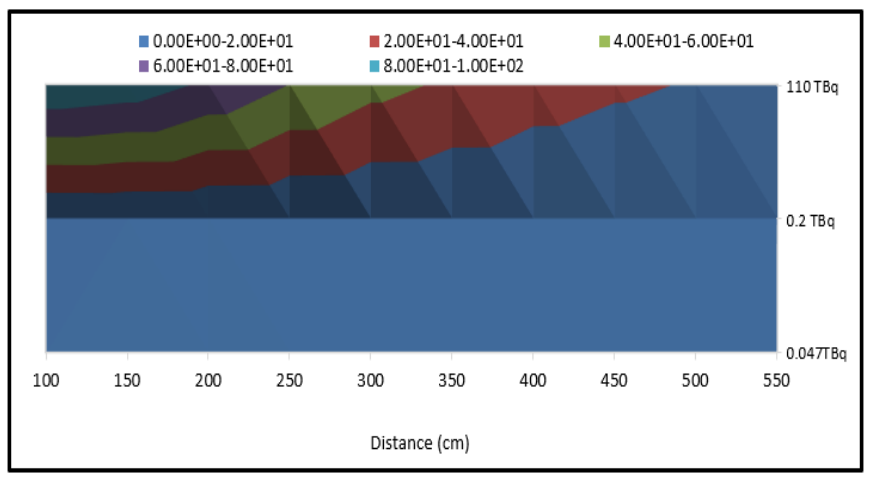
Figure 9: Dose Rate (mSv/h) for 137Cs Point Sources (0.047 -110 TBq) in the Presence of 1.0 cm Pb Shield at Different Distances

Figure 10: Dose rate (mSv/h) for 137Cs Point Sources (0.047 -110 TBq) in the Presence of 3.0 cm Pb Shield at Different Distances
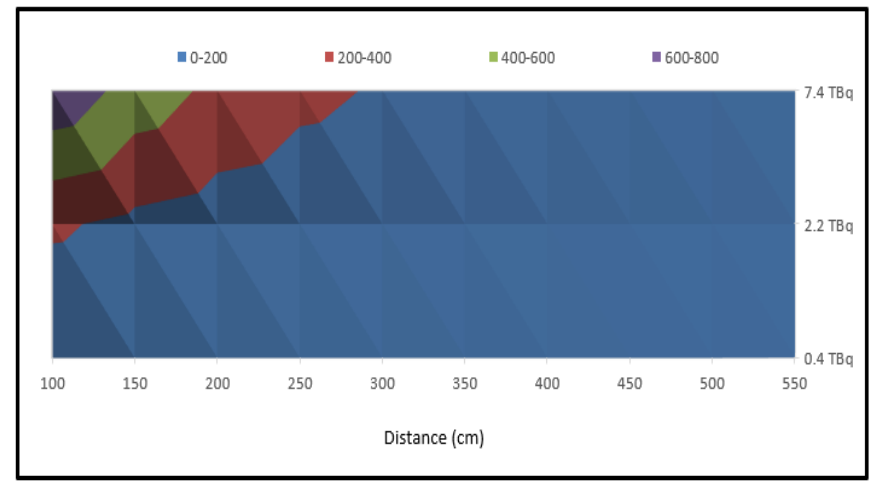
Figure 11: Dose Rate (mSv/h) due to 60Co Point Sources (0.4-3.7 TBq) in the Presence of 1.0 cm Pb Shield at Different Distances

Figure 12: Dose Rate (mSv/h) due to 60Co Point Sources (0.4-3.7 TBq) in the Presence of 3.0 cm Pb Shield at Different Distances
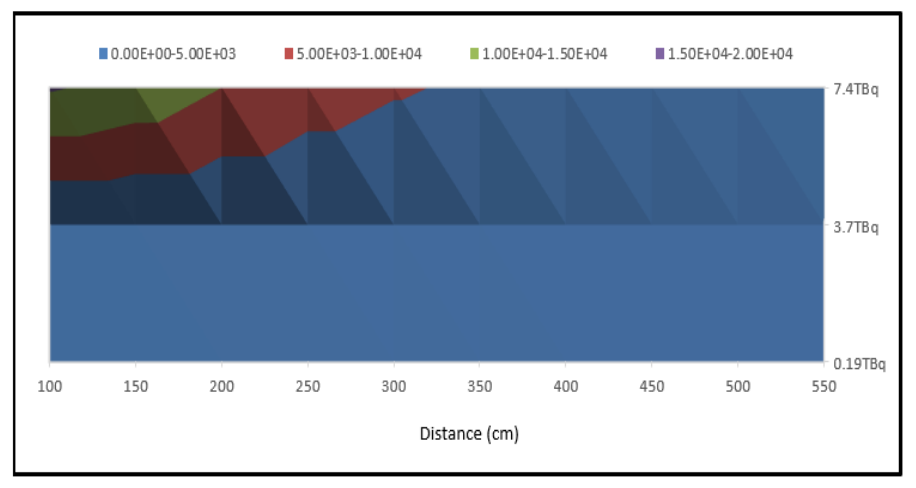
Figure 13: Dose Rate (mSv/h) due to 192Ir Point Source (0.2-7.4 TBq) in the Presence of 1.0cm Pb Shield at Different Distances

Figure 14: Dose Rate (mSv/h) due to 192Ir Point Source (0.2-7.4 TBq) in the Presence of 3.0 cm Pb Shield at Different Distances
From the Figures, we can declare that the safety perimeter around 137Cs point source with maximum, activity 0.2 TBq (5.4 Ci) in the presence of rectangle shaped Pb shield with diameters 100 and 150 cm and thickness of 1.0 and 3.0 cm will be 500 and 250 cm respectively, showing that the worker’s dose in these cases is still below the guidance values for emergency workers.
Calculations of Dose Rate due to Shielded and Unshielded Radioactive Point Sources
Figures 15, 16, 17 and 18 are presenting the fitting curves for typical activities of the three isotopes as selected in Table 1 in case of unshielded source and in the presence of 1.0 and 3.0 cm Pb shield.
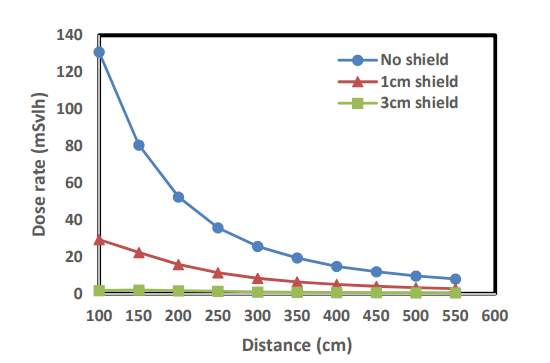
Figure 15: Dose Rate (mSv/h) due to 0.2 TBq of 137cs at Different Distances With and Without Shield
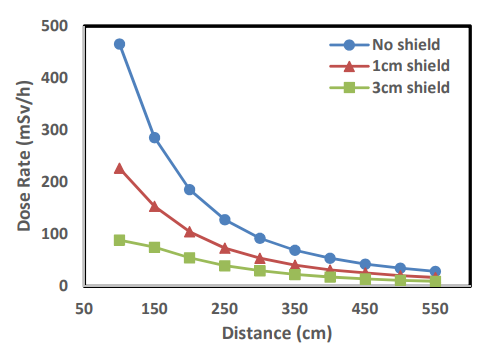
Figure 16: Dose Rate (mSv/h) due to 2.2 TBq of 60Co at Different Distances With and Without Shield
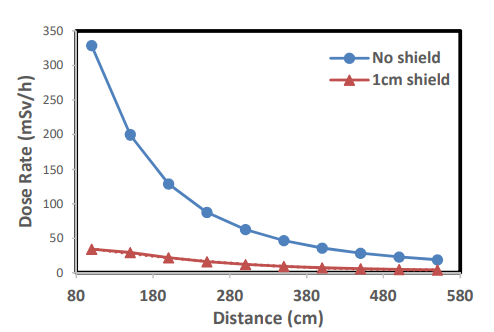
Figure 17: Dose Rate (mSv/h) due to 3.7 TBq of 192Ir at Different Distances With and Without 1.0 cm Pb Shield
Gamma Dose Rate Equation for Unshielded Radioactive Point Sources
The equation (1) can be used to calculate gamma dose rate (mSv/h) at any distance in the range of 100-550 cm due to an isotropic radioactive point source with activity A(TBq)
Dose Rate (A,x) = A* [ ax4-bx3+cx2-dx+e] (1)
Where x is the distance from the shield; a, b, c, d and e are fitting parameters given in Table 2.
|
Isotope |
Fitting Parameters |
||||
|
|
a |
b |
c |
d |
e |
|
137Cs |
4.50E-08 |
5.00E-05 |
0.0465 |
13.3285 |
1590.65 |
|
60CO |
1.36E-08 |
2.27E-05 |
0.015864 |
5.201818 |
729.7273 |
|
192Ir |
5.41E-09 |
1.08E-05 |
0.006514 |
1.855108 |
218.727 |
Table 2: Fitting Parameters for Each Unshielded Isotopes
Gamma Dose Rate Equation for Shielded Radioactive Point Sources
The equation (2) can be used to calculate gamma dose rate (mSv/h) at any distance in the range of 100-550 cm due to a shielded isotropic radioactive point source with activity A(TBq)
Dose Rate (A,x) = A* [ ax3+bx2-cx+d] (2)
Where x is the distance from the shield, a, b, c and d are fitting parameters given in Table 3.
|
Isotope |
Shielding thickness |
Fitting parameters |
|||
|
a |
b |
c |
d |
||
|
137Cs |
1.0 cm |
-1.50E-06 |
0.0025 |
1.3155 |
255.585 |
|
3.0 cm |
2.00E-07 |
-2.00E-04 |
0.0305 |
7.1755 |
|
|
60Co |
1.0 cm |
-1.82E-06 |
0.002545 |
1.163545 |
194.95 |
|
3.0 cm |
-1.82E-07 |
0.000409 |
0.269045 |
64.65909 |
|
|
192Ir |
1.0 cm |
-1.9E-08 |
5.40541E-05 |
0.053703 |
14.18568 |
|
3.0 cm |
8.11E-09 |
-8.11E-06 |
0.00173 |
0.102027 |
|
Table 3: Fitting Parameters for Shielded Isotopes (at 1.0 cm and 3.0 cm Pb Shield)
Conclusion
Equations for flux and dose rate calculations for radioactive point sources that are most likely encountered in radiological emergencies including those of nuclear security events are presented. Shielding characteristics for gamma emitters at different thicknesses with different shapes were illustrated. Optimization of the shape and thickness of the shield are required to facilitate the dealing with the source and assure the protection of the emergency workers during the response of the recovery of unshielded sources. The results obtained can be used in preparation phase to provide the responder and radiological assessor with a full spectrum of the expected dose rates and suitable shielding characteristics needed while dealing with unshielded radioactive sources belonging to categories 2&3 [5-9].
References
- Lee, Tae-Young. (2011). IAEA-TECDOC-1162, GenericProcedures for Assessment and Response During a Radiological Emergency. Proceedings of the Korean Societyfor Radiation Protection Academic Conference, 56-59.
- International Atomic Energy Agency. (2005). Categorization of Radioactive Sources, IAEA Safety Standards Series No. RS-G-1.9
- Booth, T. (2003). A General Monte Carlo Nâ?Particle Transport Code, Version 5, Volume 1: Overview and Theory. Los Alamos National Laboratory.
- Team Monte, C. (2003). MCNP—A General Monte Carlo N Particle Transport Code Version 6. Los Alamos National Laboratory.
- IAEA-TECDOC-1312. (2002). Detection of Radioactive Materials at Borders.
- Martin, J. E. (2006). Physics for Radiation Protection: a Handbook. John Wiley & Sons.
- Briesmeister, J. F. (1997). A General Monte Carlo N-particle Transport Code. LA-12625-M.
- Chu, S. Y. F. (1999). The Lund/LBNL Nuclear Data Search.
- ANS Issues Clarification on ANSI/ANS-6.1.1-1991, Neutron and Gamma-Ray Fluence-to-Dose Factors.