

Advances in Theoretical & Computational Physics(ATCP)
ISSN: 2639-0108 | DOI: 10.33140/ATCP

Short Communication - (2026) Volume 9, Issue 1
Depth from Diffraction During a Solar Eclipse
Received Date: Nov 23, 2025 / Accepted Date: Jan 07, 2026 / Published Date: Jan 19, 2026
Copyright: ©2026 Greg Passmore. This is an open-access article distributed under the terms of the Creative Commons Attribution License, which permits unrestricted use, distribution, and reproduction in any medium, provided the original author and source are credited.
Citation: Passmore, G. (2026). Depth from Diffraction During a Solar Eclipse. Adv Theo Comp Phy, 9(1), 01-02.
Abstract
For fun, we can use the Huygens-Fresnel Principle to calculate depth to a partial occluder (like a leaf on a tree), where every point on a wave front from the occlude edge can be considered as a secondary source of spherical waves. This only works in any useful sense with point emitters (solar eclipse, artificial lighting, RF emitters). These secondary waves propagate outward from their respective partial occlusion points in all directions. The sum of all these secondary wavelets at any given point and time determines the shape and behavior of the overall wave front. So guess what, we can measure that and work back to distance!
Introduction
For fun, we can use the Huygens-Fresnel Principle to calculate depth to a partial occluder (like a leaf on a tree), where every point on a wave front from the occlude edge can be considered as a secondary source of spherical waves. This only works in any useful sense with point emitters (solar eclipse, artificial lighting, RF emitters). These secondary waves propagate outward from their respective partial occlusion points in all directions. The sum of all these secondary wavelets at any given point and time determines the shape and behavior of the overall wave front. So guess what, we can measure that and work back to distance!
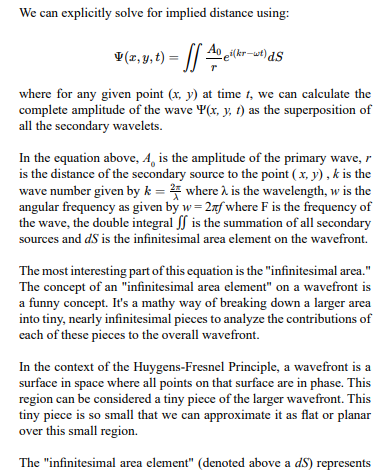
this tiny, flat piece of the wavefront. It is an incredibly small area within the wavefront, so small that it's basically treated as a point by many math geeks. However, it still has an area, just extremely tiny.
When applying the Huygens-Fresnel Principle, we consider how the wave emanates from every point on this small area element (dS) as if it were a point source (which is really cool BTW). In essence, you break down the larger wavefront into countless such tiny point sources, each corresponding to an infinitesimal area element.
The contributions of these countless point sources (associated with infinitesimal area elements) are then all handily superimposed to calculate the wave's behavior at any specific point in space at a given time. This superposition process accounts for the interference and diffraction effects that you see in the photos.
When integrating over all these infinitesimal area elements, we effectively sum up the contributions of all these tiny portions of the wavefront to determine the wave's behavior at a particular point.
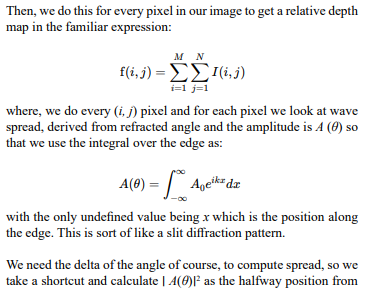
maximum.
It is more complex than this, since we do not have the luxury of slits, but this method works for any refractive edge, with tuning for what our occluder is ... and yes, I hacked over the explicit depth measurement, but it is simply the spread delta Δθ ≈ λ where d is edge geometry. This means if we have the distance, we can also figure out the edge geometry instead (useful or calibrations). Keep in mind, that this only works outdoors during a solar eclipse (or in controlled conditions).

Huygens-Fresnel-Kirchhoff popping up on my kitchen floor during the solar eclipse