


Research Article - (2025) Volume 3, Issue 4
Deficit Irrigation Effect on Wheat Grain Yield and Water Productivity at Gota Irrigation Scheme in Beza Koyisa Kebele Gena-Bosa District, Dewuro Zone, South West Ethiopia Region
Received Date: Sep 06, 2025 / Accepted Date: Oct 10, 2025 / Published Date: Oct 15, 2025
Copyright: ©©2025 Markos Habtewold Adebo. This is an open-access article distributed under the terms of the Creative Commons Attribution License, which permits unrestricted use, distribution, and reproduction in any medium, provided the original author and source are credited.
Citation: Adebo, M. H. (2025). Deficit Irrigation Effect on Wheat Grain Yield and Water Productivity at Gota Irrigation Scheme in Beza Koyisa Kebele Gena-Bosa District, Dewuro Zone, South West Ethiopia Region. J Water Res, 3(4), 01-05.
Abstract
This study aimed at effect of deficit irrigation on the yield of wheat and water productivity on Gota irrigation scheme in Gena district Dewuro Zone South Western Region of Ethiopia. Two level of treatments; 85%ETc, and farmers practice replicated in six times which laid out in Randomized Complete Block Design (RCBD). The maximum total grain yield (35.69Qt/ha) obtained from treatments of 85%ETc and minimum grain yield (30.61Qt/ha) was obtained from farmers practice. There was 5.08Qt/ha difference scored between the two levels of water application methods. As an ANOVA indicates that; the maximum water productivity value (1.06kg/m3) was recorded from treatment level of 85%ETc than farmers practice (0.85kg/m3). Economically, net income of 132,393ETB/ha was obtained from deficit irrigation and 102,901.4 ETB/ha obtained from farmers’ practices. Benefit cost ratio (B: C) obtained were 2.83 at 85%ETc and 2.03 at farmers’ practices which the project is expected to deliver a positive net present value to a firm and its investors. Therefore, demonstration of deficit irrigation technology is highly recommended, and scaled up especially in water shortage areas without reducing optimum grain yield and water Productivity
Keywords
Irrigation Water Stress, Wheat Gain Yield, Water Productivity, Net IncomeIntroduction
Ethiopia is one of the countries in Africa with huge potential wheat production though traditional small-scale irrigation. Ethiopian agriculture has been fully dependent on natural rain fall until recently [1,2]. Deficit irrigation (DI) is believed to improve water productivity without causing severe yield reductions; which the crop is exposed to a certain level of water stress [3]. Deficit irrigation (DI) could provide greater economic returns than maximizing yields per unit of water. The DI has been considered worldwide as a way of maximizing water use efficiency (WUE) by eliminating irrigation that has little impact on yield [4]. In conditions of scarce water and drought, deficit irrigation can lead to greater economic gain by maximizing water use efficiency. The term water use efficiency (WUE) is used to describe the relation between crop yield and water use [5,6].
Deficit irrigation improves water productivity and irrigation water management practices resulting in water saving by maintaining soil moisture content below optimum level throughout growth season. With deficit irrigation, the crop is exposed to a certain level of water stress either during a particular period or throughout the whole growing season [7]. Considering the scarcity of irrigation water in the region and the sensitivity of onion crop to moisture stress this research was aimed to identify the level of deficit irrigation on wheat yield and water productivity. Therefore, the study was conducted to demonstrate the level of deficit irrigation technology for optimum wheat grain yield, water productivity and assess farmers’ perception.
Materials and Methods
Description of Study Area
The study was conducted oat Gota irrigation scheme in Beza Koyisa kebele, Gena District Dewuro Zone South Western Region of Ethiopia. The study area was geographically located in latitude of 7°14.021’, and longitude of 37°18.393’ with altitude of 1850m. a. m. s. l. Crop wheat (King bird variety) in the area was one of irrigable potential crop and selected by the farmers preference regarding costliness in the seasonal market.
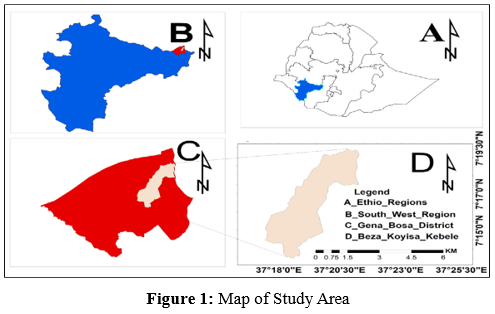
Figure 1: Map of Study Area
Experimental Design
The study has two treatments with six replications and laid out in Randomized Complete Block Design (RCBD) and farmers were used as replication. The two treatments were 85%ETc deficit irrigation and farmer practice. The wheat (King bird) was sown in broad casting system with seed (125kg/ha), NPSB (100kg/ha), and Urea (100kg/ha). Urea was applied after main stem leaf emergence nearly after planting or beginning of tillers. Plot size was 20m*20m and space between furrows prepared with oxen was adjusted 40cm so that the furrow can carry sufficient water to the plot. Furrow can at the same time dig ditch for water and also covers both seed and NPS at the ridge. After sowing and furrowing the plot; plots were irrigated within two daysâ?? time to avoid extended dry condition after sowing which can cause desiccation of seed. The first irrigation was applied with serious follow up since that the first irrigation should stabilize the plot and follow up irrigations easier. The seed grain of wheat (Variety Kingbird), was sown with seed quality (99.6%), germination (93%), moisture content (13%), and thousand seed weight (32gm).
Crop Water Requirements
Crop water requirement refers to the amount of water that needs to be supplied, while crop evapotranspiration refers to the amount of water that is lost through evapotranspiration [8]. To determine crop water requirement, it is important to consider the effect of crop coefficient (Kc) and the effect of climate on crop water requirement, which is the reference crop evapotranspiration (ETo) [9]. The daily climate data like maximum and minimum air temperature, relative humidity, wind speed, sunshine hour and rainfall data of the study area were collected to determine reference evapotranspiration. Crop data like crop coefficient, growing season and development stage, effective root depth, and critical depletion factor of onion were also used as input data.
ETc = ETo x Kc 1
Where: ETc-Crop Evapotranspiration, Kc-Crop Coefficient, ETO-Reference Evapotranspiration.
Irrigation Water Management
The bulk density is also the ratio of the oven dried mass of soil to its volume for undisturbed soil condition and is expressed on a dry weight basis of the soil: -

Where: Bd-Bulk density, Md- dry mass of the soil and VC-Volume of core sampler The total available water (TAW), stored in a unit volume of soil.

TAW-Total Available Water, FC-Field Capacity, PWP-Permanent Wilting Point, Bd-Bulk density and Rd-Root depth.
For onion production, the irrigation scheduling was fixed based on readily available soil water (RAW).

RAW-Readily Available Water in mm, P (25%)-Allowable moisture depletion for no stress

NI-Net irrigation, ETc-Seasonal crop water requirement, Peff-Effective rain fall.

GI-Gross Irrigation, NI-Net Irrigation and Ea- application efficiency but Ea = Application Efficiency for surface irrigation (60%) which is common for surface irrigation method in furrow irrigation [10].
The time required to deliver the desired depth of water into each furrow was be calculated using the equation:

Where: - dg- gross depth of water applied (cm), t-application time (min), l- furrow length in (m), w- furrow spacing in (m), and Q-flow rate (discharge) (l/s).
The amount of irrigation water depth applied at each irrigation application was measured using calibrated 3-inch Parshall flume.
Water productivity
Water Productivity plays a crucial role in modern agriculture which aims to increase yield production per unit of water used,both under rain fed and irrigated conditions. Water productivity with dimensions of kg/m3 is defined as the ratio of the mass of marketable yield (Y) to the volume of water consumed by the crop (Wa). Mathematically water productivity can be represented as follow in equation [11].

Where, WP-Water Productivity (Kg/m3), Y-Economic Yield (kg), and Wa- Total Water applied (m3).
Results and Discussions
Soil of Study Area
Soil is one of the basic natural resource that hinders agricultural production and productivity. The textural class of the study area soil was clay that hold water for longer time as compared to other soil types. Soil pH affects the availability of all the necessary nutrients in the soil. The pH values of the soil was (5.38); which is below pH value (6.4) more than this value lime application is recommended for both growth and for efficient use of fertilizers.
|
Sand% |
Clay% |
Silt% |
Textural Class |
OC% |
TN% |
pH |
P(ppm) |
|
37 |
48 |
15 |
Clay |
3.03 |
0.26 |
5.38 |
8.42 |
Table 1: Analysis Result of Soil
Deficit Irrigation Technology Effect and Wheat Grain Response
Irrigated wheat is technology that increases production and sustain food security of country Ethiopia. Even though it was new beginning technology; farmers were practiced and obtained good yield relatively as compared to previously production and knowledge from the system. As the study indicates; (35.69 Qt/ ha) was recorded from deficit irrigation technology and (30.61Qt/ ha) was obtained from farmers practices as usual production system as shown in table 2 below. There was (5.08Qt/ha) yield difference between the two treatments. Stressing 15% ETc of irrigation water gives higher result from farmers practice. Deficit irrigation technology is applicable without yield reduction through appropriate irrigation scheduling in areas of scarce water.
|
Treatments |
NTPP |
PH |
SL |
BMY(Qt/ha) |
GY(Qt/ha) |
|
85%ETc |
1.59 |
65.01 |
6.54 |
61.13 |
35.69 |
|
Farmer practice |
1.71 |
64.51 |
6.20 |
61.21 |
30.61 |
|
Grand Mean |
1.65 |
64.76 |
6.37 |
61.33 |
33.15 |
|
CV |
17.63 |
2.11 |
7.32 |
13.4 |
17.70 |
|
LSD (5%) |
NS |
NS |
Ns |
NS |
NS |
Table 2: Grain Yield Data Analysis Result
Trts-Treatments, NTPP- Number of Tillers per Plant, PH-Plant Height, Spike Length, BMY-Biomass Yield, GY-Grain Yield

Figure 2: Grain Yield Data Collection
Water Productivity
There was significant water productivity difference between 85%ETc deficit irrigation and farmers practice. Treatment with 85%ETc has higher water productivity (0.78kg/m3) than farmers’ irrigation practice (0.5kg/m3). Deducting 15%ETc was highly utilizes irrigation water without reducing wheat production.
|
Trts |
WP(kg/m3) |
|
85%ETc |
0.78a |
|
Farmer practice |
0.50b |
|
Grand Mean |
0.64 |
|
CV |
18.52 |
|
LSD (5%) |
0.18 |
|
Where: - WP-Water productivity |
|
Table 3: Water Productivity Values of the Study
Partial Budget Analysis
Economically farmers were much benefited and obtain 5578ETB per quintal from the seasonal market. According to this study; irrigators should obtain maximum net income of (132,393 ETB/ha) and minimum net income of 102,901.4 ETB/ha from the seasonal market. Benefit cost ratio (B: C) obtained were 2.83 at 85%ETc and 2.03 at farmers’ practices which is greater than 1.0 and that the project is expected to deliver a positive net present value to a firm and its investors.There was 22.27% net income advantage recorded from deficit irrigation technology over farmer practices.
|
Variable |
Cost (ETB) Items |
85%ETc |
FP |
|
|
Seed |
6972.5 |
6972.5 |
|
Land preparation |
4800 |
4800 |
|
|
Fertilizer |
6000 |
6000 |
|
|
Pesticide Chemicals |
2000 |
2000 |
|
|
Watering |
12000 |
16000 |
|
|
Harvesting |
4000 |
4000 |
|
|
Trashing |
5000 |
5000 |
|
|
Transportation |
6000 |
6000 |
|
|
Total Cost (ETB) |
|
46,772.5 |
50,772.5 |
|
Yield(kg/ha) |
|
3569 |
3061 |
|
10% Adjusted yield(kg/ha) |
|
3212 |
2755 |
|
Gross revenue (ETB/ha) |
|
179,165.4 |
153,674 |
|
Net Benefit (ETB/ha) |
|
132,393 |
102,901.4 |
|
Benefit Cost Ratio |
|
2.83 |
2.03 |
Table 4: Cost Benefit Analysis
Farmers’ Perception
Randomly selected farmers were perceived deficit irrigation technology by setting different criteria’s that saves scarce irrigation water. The criteria were labour and water saving, grain yield increment, and technology easiness for handling. Deficit irrigation technology ranked first by following farmers’ practices as a result indicated in table 5 below and enumeration process in figure 3. Farmers were maintained the grain as a seed source and sustained the technology. Females were participated in farmers’ research group and perceived the technology.
|
Criteria’s |
Labour saving |
Water saving |
Yield increment |
Technology easiness to manage |
Grand Total |
Rank |
|
85%ETc |
10 |
12 |
9 |
8 |
39 |
1 |
|
Farmer Practice |
5 |
2 |
6 |
7 |
21 |
2 |
Table 5: Farmers’ Perception on Deficit Irrigation Technology
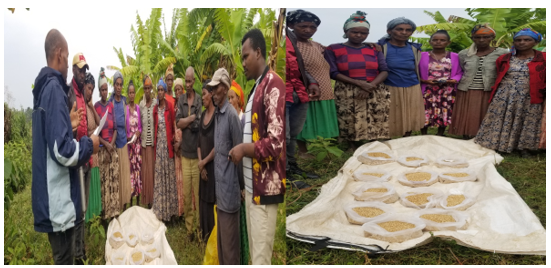
Figure 3: Farmers’ Perception Identification and Training on Irrigated Wheat
Conclusion and Recommendations
Saving scarce irrigation water is the main objective of the study that irrigation water management program. Result obtained indicates that deficit irrigation technology significantly affects water productivity. Numerically higher grain yield and water productivity were obtained from deficit irrigation technology that improves water, labour use and time of application. Improving water productivity has vital advantages in under irrigated wheat production in the area where scarce water resource. Therefore, deficit irrigation technology should be recommended for increasing both grain yield and water productivity in water shortage areas. Therefore, the technology should scale up on other irrigation schemes with the same agro ecology.
Acknowledgements
Author would like to thank, Participatory Small Scale Irrigation Development Program (PASIDP-II) for allocating budget for field research expenditures and Areka Agricultural Research Center for over all facilitation and logistic provisions. Our gratitude also goes to Gena-Bosa district agricultural office for their unreserved support and follow up all field works.
Author Contributions: For this manuscript, Markos Habtewold contributed in stages of proposal development, field work, data analysis, data interpretation, draft preparation and final manuscript write up.
Funding: The authors appreciate Participatory Small Scale Irrigation Development Program (PASIDP-II) for funding budget to this research work.
Conflict of Interest: No potential conflict of interest was reported still.
Data Availability: All necessary data will be made available on request according to the journal policy.
References
- Amanuel Gorfu, A. G., Kefyalew Girma, K. G., Tanner, D. G., Asefa Taa, A. T., & Shambel Maru, S. M. (2000). Effect of crop rotation and fertilizer application on wheat yield performance across five years at two locations in south-eastern Ethiopia.
- Awulachew, S. B., Yilma, A. D., Loulseged, M., Loiskandl, W., Ayana, M., & Alamirew, T. (2007). Water resources and irrigation development in Ethiopia (Vol. 123). Iwmi.
- Mugoro, T., Assefa, S., & Getahun, A. (2020). Effect of deficit irrigation on yield and water productivity of onion (Allium cepa L.) under conventional furrow irrigation system. Bennatsemay Woreda, Southern Ethiopia. Journal of Agricultural and Biological Engineering, 1(1), 2-13.
- Kirda, C., Kanber, R., Tulucu, K., & Gungor, H. (1999). Yield response of cotton, maize, soybean, sugar beet, sunflower and wheat to deficit irrigation. Crop Yield Response to Deficit Irrigation. Kluwer Academic Publishers, Dordrecht, Boston,London, 21-38.
- Oweis, T., Pala, M., & Ryan, J. (1998). Stabilizing rainfed wheat yields with supplemental irrigation and nitrogen in a Mediterranean climate. Agronomy Journal, 90(5), 672-681.
- Zhang, H., Oweis, T. Y., Garabet, S., & Pala, M. (1998). Water-use efficiency and transpiration efficiency of wheat under rain-fed conditions and supplemental irrigation in a Mediterranean-type environment. Plant and Soil, 201(2), 295-305.
- Kirda, C. (2002). Deficit irrigation scheduling based on plant growth stages showing water stress tolerance. Food and Agricultural Organization of the United Nations, Deficit Irrigation Practices, Water Reports, 22(102), 3-10.
- Allen, R. G., Pereira, L. S., Raes, D., & Smith, M. (1998). Crop evapotranspiration-Guidelines for computing crop water requirements-FAO Irrigation and drainage paper 56. Fao, Rome, 300(9), D05109.
- Doorenbos, J., & Pruitt, W. O. (1977). Guidelines for predicting crop water requirements.
- Tilaye, A., Ahmed, B., & Gemeda, F. (2022). Evaluation of different furrow irrigation systems and water levels on potato at Oda Sirba Scheme. Journal of Soil and Water Science, 6(1), 244-252.
- Ali, M. H., & Talukder, M. S. U. (2008). Increasing water productivity in crop production—A synthesis. Agricultural water management, 95(11), 1201-1213.