

Open Access Journal of Applied Science and Technology(OAJAST)
ISSN: 2993-5377 | DOI: 10.33140/OAJAST
Impact Factor: 1.08


Research Article - (2026) Volume 4, Issue 2
Dark Energy and the Evolution of the Universe

Received Date: Jan 10, 2026 / Accepted Date: Apr 22, 2026 / Published Date: May 29, 2026
Copyright: ©2026 Jerry Ray Bettis. This is an open-access article distributed under the terms of the Creative Commons Attribution License, which permits unrestricted use, distribution, and reproduction in any medium, provided the original author and source are credited.
Citation: Bettis, J. R. (2026). Dark Energy and the Evolution of the Universe. OA J Applied Sci Technol, 4(2), 01-10.
Abstract
Dark energy has not been explained other than to state that it may be the driving force behind the expansion of the universe. Each topic in the evolution of the universe has its own explanation: Temperature versus time is driven by radiation, then by matter, then by dark energy; Cosmic Microwave Background (CMB) isotropy is driven by inflation; Matter production is explained by saying sub-atomic particles get together but do not say where they came from; Recently discovered acceleration of expansion of the physical universe (that collection of things we see all around us) is still awaiting a consistent explanation. A single theory of dark energy with no adjustable parameters answers all these concerns and more. The temperature in the singularity was too great for matter to exist, thus, dark energy is a massless form of energy. It produces matter by the Breit-Wheeler process. Dark energy is the remains of the total energy from the singularity after matter production ceased. It is a perfect fluid and expands adiabatically and homogeneously with large initial velocity and will be analyzed by Friedmann’s solution of Einstein’s Field Equations. It forms a homogeneous sphere that keeps temperature, pressure, and matter isotropic. The physical universe expands at a rate that is the difference between the expansion due to dark energy and the inward rate induced by gravity. This accounts for the increased acceleration of distant cosmological entities. The expansion slows but never stops. The CMB radiation is the thermal footprint of dark energy.
Keywords
(Cosmology) Dark Energy, (Cosmology) Dark Matter, (Cosmology) Inflation, (Cosmology) Theory
Introduction
Various descriptions of the Big Bang theory and the Standard Model of cosmology have a set of assumptions and omissions with which this paper finds fault. The following will be addressed based on the theory of dark energy espoused here. Responses from this paper are indicated with italics.
1. Initial conditions of size and temperature are assumed. Based on agreed-to present values, the total energy of the universe will be determined and the initial conditions at Planck time will be calculated using Friedmann’s equation [1,2].
2. The initial temperature at Planck time is set to the Planck temperature. Planck temperature is not the maximum allowed temperature. It does define when our understanding of physics falters and precludes the presence of matter, even quarks and gluons [3].
3. The initial pressure is not given. The equation of state for dark energy will be developed and both the present pressure and the initial pressure at Planck time will be calculated.
4. The formation of matter is a series of ill-defined events. Matter is shown to be produced by the highly energetic thermal photons from the dark energy using the Breit-Wheeler process [4].
5. Dark energy is an unknown entity that keeps the universe from collapsing under gravity. Dark energy is that portion of the total energy contained in the singularity that remains after matter creation ceases. It defines the temperature and expansion rate of the sphere in which the physical universe resides.
6. Without Inflation the Standard Model cannot explain the isotropy of the CMB. Inflation is problematic for a number of reasons, the unusual temperature profile included. In a spherically expanding perfect fluid the temperature and pressure remain homogeneous throughout the sphere. Thus, dark energy is the actual engine that produces the temperature that is homogeneous and isotropic and produces matter that is uniformly distributed [5,6].
7. The CMB is a snapshot of the universe 380,000 years after the big bang and is a remnant of the radiation present at the onset of the big bang [7,8]. The enormous temperatures at the outset were produced by the extreme energy density of the dark energy. Energy from radiation was much smaller than dark energy. The recombination time will be calculated from the initial conditions and, using Saha’s ionization equation [9], the dark energy induced temperature will be shown to agree exactly with measured values. The CMB is the measure of the temperature produced by the dark energy [10].
8. The temperature of the universe has been controlled by which entity was dominant: radiation, matter, or dark energy. Dark energy is, by far, the dominant energy in the universe, and it controls the temperature and expansion rate of the sphere in which the physical universe exists. Dark energy, in concert with total matter, controls the expansion of the physical universe [11].
9. There is no preferred location in the universe, i.e. there is no center nor edge. The recently discovered increased acceleration of the physical universe can only be understood by considering the distance the involved supernovae are from the center. This realization will be used to locate our galaxy within the known universe and its 92 billion light year diameter [12,13].
The single assumption in this paper is that description of the expansion of the universe began at Planck time with temperature, pressure, and size determined by extrapolation of the present values backward using the cosmic scale factor determined by Friedmann’s equation [1,2]. This gives temperatures far in excess of the Planck temperature because once that temperature has been reached any additional energy will necessarily raise the temperature. Calculations also reveal the very great pressure at Planck time that will cause rapid expansion consistent with the cosmic scale factor from Planck time onward. The recently observed increased acceleration of distant portions of the physical universe can be correctly described once the dark energy is identified.
Understanding the cosmology of the universe is hampered by the prevailing assumptions. It would appear that when a new problem arises, for example the isotropy of the Cosmic Microwave Background, CMB, or the measured temperature at recombination versus the present temperature, a new theory has to be developed to account for the findings. In these cases, it was Inflation and differing rates of cooling for radiation, matter and dark energy respectively that explained the observations. A theory based on assumed initial conditions is not robust and encourages piecemeal solutions as new discoveries are introduced. The initial conditions herein are calculated, not assumed. While attempting to understand the increased acceleration of the physical universe within the confines of the known universe, it became apparent that all these stated issues could be resolved by the proper characterization of dark energy. This paper proposes a unified theory of dark energy and suggests a possible source of dark matter. The total energy of the universe will be calculated and will then be tracked from the big bang to billions of years in the future.
Selecting Planck time, 5.39 × 10-44 s, as the starting instant, the initial conditions of the dark energy will be determined. This will be done by calculating the total energy in the universe and, using Friedmann’s equation, calculating the temperature and radius of the nascent universe. The equation of state for dark energy will be developed so that the current pressure in the universe can be determined. Then, again using Friedmann, the pressure at Planck time will be calculated. This pressure is sufficient to cause the dark energy sphere to expand orders of magnitude faster than the speed of light. It is important to note that none of this involves assumptions.
According to the big bang theory, at the outset all mass and energy was confined to a singularity. The standard model argues that the big bang began at Planck time of 5.39 ×10-44 s at the Planck temperature of 1.42 × 1032 K. The temperature calculated from the proposed theory is many orders of magnitude beyond Planck temperature into a realm where physics breaks down and all matter, including quarks and gluons, ceases to exist and is transformed to energy, Wilzsec [3]. Dark energy is, therefore, massless and does not respond to gravity. The large calculated pressure within the singularity would send the dark energy into a rapid expansion many orders of magnitude faster than the speed of light. This expansion continues today with greatly reduced velocity, Son [14].
Dark energy would initially produce extremely high temperatures, and the resulting thermal photons would be very energetic gamma rays. A portion of the dark energy would then produce the building blocks of matter. Because the dark energy is massless, one way to produce matter in empty space is by the Breit-Wheeler process [4]. This process predicts that photon to photon collisions in free space can create particle-anti particle pairs. There are several ongoing laboratory experiments attempting to prove this assertion [15-17]. Initially the extremely high-energy gamma rays would produce exotic particles that have never been detected and which may be the genesis of dark matter. As the expansion caused the temperature to cool, all the subatomic particles would be sustainably produced at temperatures below which the production of dark matter would cease.
Because the contents of the universe were produced by thermal photons that were spread uniformly throughout the universe, the content of the physical universe began homogeneous and isotropic. As dark energy expanded the universe and carried the contents with it, our universe has remained nearly isotropic to a remarkable extent [13,18-24]. The energy density, and thus temperature and pressure, throughout the dark energy sphere would be uniform. This agrees with the cosmological principle that requires on a large scale the universe to be both homogenous and isotropic.
The purpose of this paper is to track the total energy encapsulated within the singularity as it: rapidly expanded in a homogeneous sphere; produced the building blocks of all the matter in our universe from a portion of its energy; used the extremely energetic remnant to expand to the point where the universe encompasses some 92 billion light years in diameter; and is causing distant portions of the physical universe to accelerate in their expansion.
Utilizing Friedmann’s equation, with the cosmological constant replaced by dark energy, the motion of the physical universe driven by the interplay of gravity and dark energy reveals the accelerated expansion rate and allows a prediction of our galaxy’s place in the known universe.
In his exhaustive review of dark energy, Peebles acknowledges that dark energy can be detected and acts like Einstein’s cosmological constant [18]. We shall, therefore, replace Λ with dark energy and investigate its role in the expansion of the universe.
As the universe continued to cool, it fell to temperatures below which matter production was possible. The remnant of the dark energy left over from matter production continues to expand, carrying the universe uniformly with it. Peebles also wondered how space, now transparent, is filled with radiation that has relaxed to a thermal spectrum [18]. The answer is that the CMB is precisely that, the thermal footprint of dark energy. The startling conclusion must be that dark energy has been hiding in plain sight since 1965 when Penzias and Wilson chanced upon it [25]. We are now able to measure the temperature of the dark energy and find it to be 2.7255 K.
Analysis
The first 380,000 years following the big bang have been shrouded in mystery. That is because the early universe was filled with a plasma of electrons and other fundamental particles that scattered and absorbed all the light. No light from that epoch has been studied. It will be shown that the CMB radiation is not billions of years old but is being produced currently by the thermal signature of dark energy. Much effort has been expended in explaining how causally disconnected portions of the universe could have all stabilized to a single temperature, uniform and isotropic. The solution was not to make the production of radiation from widely separated matter somehow equilibrate, but to realize it was the producing engine itself, dark energy, that completely and homogeneously fills and expands the sphere in which our physical universe exists. It is this single entity that produced the matter, the temperature, and the expansion of the universe. Here we make a distinction between the matter and radiation in the physical universe and the dark energy sphere that contains it.
Most of the things we understand about this early time are theoretical only, and it wasn’t until the temperature of the universe was cool enough for neutral atoms to form, about 3000 K according to the Saha ionization equation [9], that we were able to see what the universe looked like. What it looked like was a system in thermal equilibrium. Once the total energy of the universe is determined and the cosmic scaling factor, given by Friedmann’s equation, have been evaluated, it will be possible to track the energy from Planck time to the current time and beyond.
Calculate Total Energy
The present matter/energy distribution has been determined to be approximately 69.3% dark energy with 4.84% ordinary matter and 25.9% dark matter [7,8,10,12]. Estimates of the total baryonic matter in the known universe range from 1053 to 1060 kg, with most calculations about 1.75x1053 kg [10,12,26]. With this value and the ratio of baryonic mass energy to the total energy in the universe of 4.84%, we find the total energy in the singularity at Planck time was

The total internal energy of the dark energy sphere today is this value minus the 30.7% that went into the production of matter, and has the value,

Here the subscript 0 refers to conditions at the present time. The total amount of energy from Eqn.1 was originally confined to a singularity. This massless energy will not respond to gravity and, because it expands into empty space, it will do no work on its surroundings. It will also do no work in moving matter in the gravitational field because any gravitational potential energy increase will be returned by a decrease in the kinetic energy as the matter slows down. This involves only the internal energy of the system and does not qualify as mechanical work performed [27]. The only perceived way for the dark energy to deplete is for the thermal photons driven by the temperature to create matter. This is merely a transfer of energy into matter and not a loss of energy.
It will be shown that dark energy is a perfect fluid. A perfect fluid has zero shear stress, zero viscosity, and no capacity for heat conduction. It could produce no work and cannot dissipate energy through radiation, but only transform energy to matter. It cannot transmit energy over large distances [28,29]. It would produce the space that our physical universe occupies without moving objects through that space. Rather, any increased space will separate gravitationally connected entities from each other without moving them through the space.
Expansion of the Dark Energy (DE)
The first Friedmann equation solves for the Hubble parameter of the expanding universe, H(t), as a function of the density of the energy content and is classically written

Here H(t) is the Hubble parameter (å ⁄ a), the ratio of the time derivative of the cosmic scale factor to the scale factor, with the terms on the right respectively, energy density due to mass and radiation, a term concerning curvature of the universe, and the cosmological constant, or its modern representation, dark energy. The cosmic scale factor, a(t), is a function only of time and describes how the universe expands. Given a radius, r0 (t0), the radius at any other time t is a(t)r0. Because the radiation and matter content of the physical universe have no effect on the dark energy, one may describe the expansion of the dark energy sphere by replacing the terms on the right with just the dark energy density, ρDE. Then the expansion of the dark energy sphere alone is described by
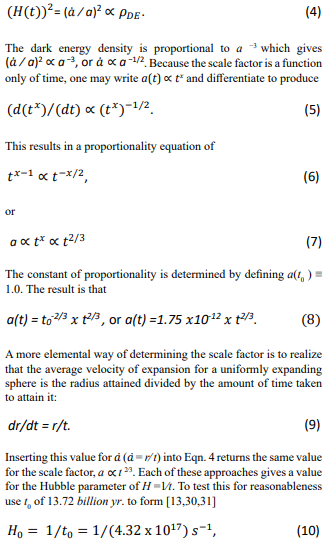
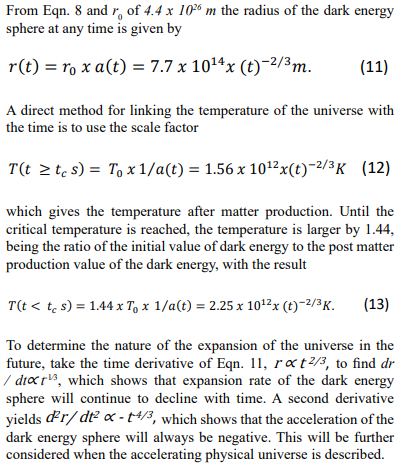
which, with r0 of 4.4 x 1026 m, calculates to an expansion rate of -1 -1 71.9 km s Mpc and compares favorably with recent observations by Riess, et al [32] of about 73 km s-1 Mpc-1. Thus the cosmic scale factor for dark energy is reliably a ∝ t2/3. The fact that T ∝ 1⁄a and r ∝ a will allow one to scale radius and temperature with time. If there were no matter production, the dark energy would remain the total given in Eqn.1, and the plot of temperature versus time would be an uninterrupted straight line on log-log graph paper.
However, for a portion of time, the dark energy is producing the building blocks of matter. This will result in a transfer of dark energy as the subatomic particles are produced. As the temperature cools to a time to be designated as the critical time, tc , when photon to photon pair production is no longer possible, the dark energy would have been reduced to the value in Eqn. 2. After the critical time, both the temperature and the pressure would fall below the straight line. There isn’t currently enough information to detail this drop and because it happens very early in the evolution of the universe it will be treated here as a step function at tc. We will shortly explore for a reasonable value for the critical time; however, the use of a step in the temperature and pressure does not materially alter the explanation of the expansion.
Equation of State for DE
A complete picture of the universe at Planck time requires a knowledge of the pressure exerted by the dark energy. To scale for pressure the current pressure, P0, must be determined. This can be done by considering the equation of state for the dark energy.
In his discussion of adiabatic processes, Feynman considered a gas comprised totally of energy [33]. He replaced the kinetic energy of the particles with the energy in the gas. The kinetic energy in each of the three coordinate directions was then replaced with one-third of the total energy in the gas. This resulted in the energy balance giving the equation of state, with γ, the adiabatic gas constant, as

This is the same result one would get from the energy-momentum tensor [29]. The only components in the tensor are along the diagonal with energy density and the three negative equal pressures in all three coordinate directions along the trace. This defines the dark energy as a perfect fluid. The trace of the energy–momentum tensor is a Lorentz scalar; the electromagnetic field (and in particular electromagnetic waves) has no Lorentz-invariant energy scale, so its energy–momentum tensor must have a vanishing trace. The off-diagonal components are zero because perfect fluids have neither shear stresses nor viscosity. Equation 14 not only allows for the determination of P0 when V0 and U0 are known, it also gives a value for the adiabatic gas coefficient of γ = 4/3. The adiabatic 

Inserting the current value of the dark energy, Eqn. 2, and the volume of 3.57 x 1080 m3 from a radius of 4.4 x 1026 m [8], into Eqn. 14 results in the value of P0 as

This compares with published values ranging from 1.33 x 10⁻¹⁷ Pa to 5.2 x 10⁻¹⁰ Pa [34,35]. This small pressure will help alleviate Peebles’ concern that the value of dark-energy density has to be tiny compared to what is suggested by dimensional analysis [18]. This is indeed a low pressure; however, as we will now see, pressure began at very high values. Peebles correctly suggested that the reason the dark energy is so small now is because it is old [18]. This agrees with Castelvecchi [36] who noted that new data is indicating that dark energy is getting weaker.
To evaluate pressure at any time later than tc find

Before the critical time this constant is increased by 1.44 to reflect the larger value of dark energy, therefore pressure, at those times.
Conditions at Planck Time
We are now able to predict radius, temperature, and pressure for Planck time, which will lead to prediction of expansion rates of the universe. One should note that in a flat or closed universe the radius of the dark energy sphere always exceeds the radius of the physical universe, which is held back by gravity.

It is easy to see that restriction of the early temperature to Planck temperature of 1.42x1032 K greatly underestimates the extreme conditions of the big bang. The pressure will cause an early extremely great expansion rate. This can be calculated from Eqn. 9 to be

a value more than 1020 times as large as the speed of light.
Matter Production via Breit-Wheeler
To understand the process of matter production the Breit-Wheeler process requires special attention [4]. This process was proposed following the seminal paper by Dirac [37] in which he laid the foundations of quantum electrodynamics. Dirac showed it was possible for an electron-positron pair to annihilate, thereby producing radiation. Breit and Wheeler proposed turning that process around by showing it was theoretically possible for colliding photons to cause e+ - e- pair production in the vacuum of space. They believed this could not be demonstrated in the lab because there was no way in 1934 to produce the necessary extremely high energy of the colliding photons. With the advent of lasers and improved output of linear accelerators, in 1997 the Stanford Linear Accelerator Center, SLAC, was able to demonstrate photon to photon pair production [38]. This was not the vacuum photon-photon demonstration that Breit and Wheeler suggested because it involved a highly energetic electron beam. The quest to produce photon-photon pair production in a vacuum without matter or electromagnetic fields continues. Each of the institutions that have been studied for this effort, as revealed in press releases and papers, have employed one stream of very highly energetic photons in their experiments colliding with another lower energy stream of photons [16,39-41]. Most of the teams use gamma rays with energy of 100 MeV or more to overcome the high threshold. Taking this number as required for pair production in the early universe, we find the temperature of the dark energy that would produce 100 MeV thermal photons. Employing Wein’s displacement law, λmax = 2.8978x10⁻³ ⁄ T , with wavelength in meters and temperature in K, and Planck’s equation, E = h c ⁄ λ, we find the cutoff threshold temperature of the dark energy as
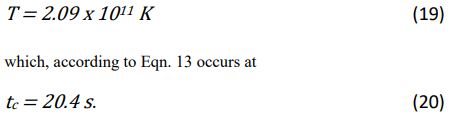
This time will be considered the end of matter production by the dark energy. This will be treated as a step in the temperature and pressure at 20 seconds. No new subatomic particles, except neutrinos, are produced after this time; however, the temperature of the universe is still capable of producing fusion for a short additional time. This results in a small additional fraction of deuterium, helium, and lithium nuclei to be produced before fusion is stopped at T=1010 K as predicted by [1,2]. Equation 13 can be used to determine when fusion ceased and is found to be

At the early stages of the expansion, the temperatures far exceed that given by Eqn. 19. Photon to photon pair production would easily produce the most energetic of the known fundamental particles, the Higgs boson at 125.2 GeV and the top quark at 172.57 GeV [8]. Beyond these highly energetic particles there may be many others of which we have no knowledge. These would cease production first as the temperature reduces, and those with stable lifetimes would still be around as dark matter.
At the bottom of the energy hierarchy lie the electrons and neutrinos. These could be produced very early on because the available energy is certainly there. However, the extreme temperatures would prevent electrons from surviving in the early stages. They and many of the other low energy particles would be blasted apart by the heat and energy. As the temperature cooled, the hierarchy of elemental particles would each cease to be produced in turn until the point was reached at about 20 seconds when all elemental production stopped, except for some neutrinos.
The next point of reference in the growth of the universe comes when the temperature has cooled enough for neutral atoms to form without being torn apart. As stated above, the temperature at which this occurs is 3000 K. From Eqn. 12 one can calculate the time at which the temperature was expected to be 3000 K. This simple calculation results in a time of 376,439 years after the big bang. This number is in concert with the 380,000 years accepted by the big bang theory and serves to add weight to the present theory.
Inflation of the Universe
The process of inflation must be reconsidered. This rapid expansion, according to Guth [5], was what was needed to account for why the universe is so close to homogeneous on the scale of the Hubble length, known as the horizon problem. The anisotropy of the temperature of the CMB is of the order of 100 μK, which other models have trouble explaining [13,18,21-23]. Guth proposed that at a very early time the universe underwent an exponential expansion that froze all matter in a homogeneous distribution. He proposed a 28 order of magnitude drop in temperature in about 10-32 s. To regain a more reasonable temperature profile it was suggested that the vacuum energy would bring the temperature back up. He proposed that if every bit of matter produced an equal temperature there would be no need for causally separated entities to communicate and equilibrate. In a further communication Guth [6] suggested that the inflation was driven by gravitation and that the total energy remains small. That the resulting trillions of stars and galaxies would remain equal in temperature is unlikely. It is easier to conceive of a single engine, dark energy, that would produce equal temperatures. Just as in blowing up a balloon, the expanding dark energy would remain homogeneous in pressure and temperature and produce the remarkably isotropic CMB radiation. Because it is also the production engine for matter this explains why the universe is so equally distributed with mass. This explanation has the advantage that it has a recognized method for expansion and that its effects are readily calculable. This solves the horizon problem.
The flatness problem can be explained by observing that the universe is successful because of its near flatness. There could have been many failed attempts due to nascent universes having either too much mass or too little, so the fine-tuning may be accidental. The inflation process seems too complex to consider with a simpler solution at hand.
Expansion Velocity of Physical Universe
The first term on the RHS of Friedmann’s first equation (Eqn. 3) contains the energy densities of radiation and matter. The dark energy density is significantly larger than the energy density of the radiation. The present dark energy density is the current value of dark energy divided by the present volume. Even after 13.72 billion yrs. this value yields an energy density of [10,13,27,31]
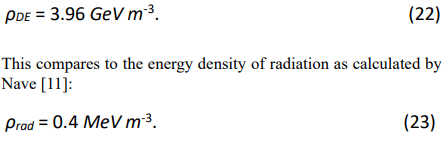
The wide disparity in these competing energy densities mean that the radiation density will play an insignificant part in the expansion of the universe. The gravitational effect, therefore, must be closely addressed as the major contribution of the physical universe to the expansion. To analyze this, compare the velocity induced by gravity with that produced by the expansion of dark energy. Every indication we have shows that the universe is flat or nearly so. Considering this, set k=0 in Friedmann’s equation.
We know from Eqn. 10 that the Hubble parameter is 1/t and that the rate of expansion at radius r becomes Hr. Thus, at any fixed time t, the rate of expansion is directly related to the radius of interest. To find the gravitational rate of collapse invoke Newton’s [42] shell theorem that states: If the body is a spherically symmetric shell, no net gravitational force is exerted by the shell on any object inside, regardless of the object's location within the shell. A corollary is that inside a sphere of constant density, the gravitational force within the object varies linearly with distance from the center.
Consider then a particle at radius r in an expanding sphere.
The gravitational force of a sphere filled with mass is the same as a point mass at the center of the sphere of the same total mass. This means that for a test particle interior to the dark energy sphere the gravitational force on it would be

where G is the gravitational constant, 6.67 x 10⁻¹¹ Nm2 kg-2, M1 is a test particle of 1kg at radius, r, and M2 is the total mass enclosed by the radius r. By equating the potential energy of the test particle at a distance r from the center of the sphere to its kinetic energy, an inward velocity due to gravity can be obtained as
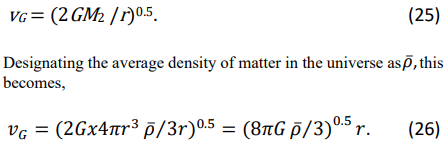
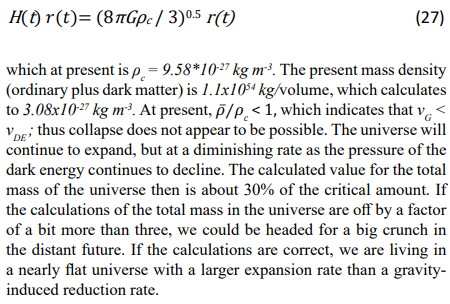
This reveals that the induced gravitational velocity at a set time scales linearly with radius, as does the expansion rate. If the expansion rate at any time, H(t)r(t), exceeds the gravitational rate, the universe will continue to expand. Because the expansion and the contraction are both linear with radius, if the expansion exceeds the contraction at any time it will always exceed it. There is, then, a critical density, ρc, that determines whether the universe will be flat, open, or closed. That value is found by equating the expansion rate with the gravitationally induced velocity for any radius, r,
Results
Temperature of the Universe
The dark energy temperatures for the universe are plotted in Figure. 1 along with representative temperatures from other investigators, none of whom included the concept of inflation in their calculations [43-45]. On this scale it is just possible to discern the 30.7% depletion of the dark energy at 20 seconds by the slight offset of the pre and post production lines at the overlapping large (no fill) and small circles. The drop is from 3x10¹¹ to 2x10¹¹ K and represents all the matter produced by the dark energy.
Because temperature scales as the inverse of the cosmic scale factor, the upper line falls as T ∝ t-2⁄3. It intercepts the point at t= 1.2x 10¹³ s (380,000yr) and T = 3000 K exactly, and, obviously, the point t0 = 4.32x 10¹⁷ s and T0 = 2.7255 K. These calculated temperatures for the time of recombination and the present measured temperature are exact numbers from which to evaluate any cosmological theory.
The lower curve is in two parts. In order to limit the temperature at Planck time to the Planck temperature it was necessary to provide a reason that radiation from 13.72 billion yrs. ago would intercept these two standard points. As can be seen, the temperature at first falls as T ∝ t-1⁄2, , the inverse of the cosmic scale factor for radiation. This is explained by the assumption that the temperature of the early universe was dominated by radiation associated with the material contents of the universe.
In order to have the temperature curve intercept the current temperature the lower line bends sharply downward from 380,000 years to the present at T , the inverse of the cosmic scale factor for matter. This is explained by assuming that at 380,000 years the universe began to be dominated by matter and, thus the temperature falls with time proportional to the decrease of mass density. This paper proposes that dark energy controls the uniformity of the universe’s temperature, which falls uniformly at T ∝ t-2/3 and which offers a much simpler explanation for the observed temperatures.
The dark energy theory proposed here gives a much more robust explanation of the expansion of the universe and its declining temperature than does inflation. The upper curve in Fig. 1 falls naturally out of the simple equations of motion of the dark energy sphere.
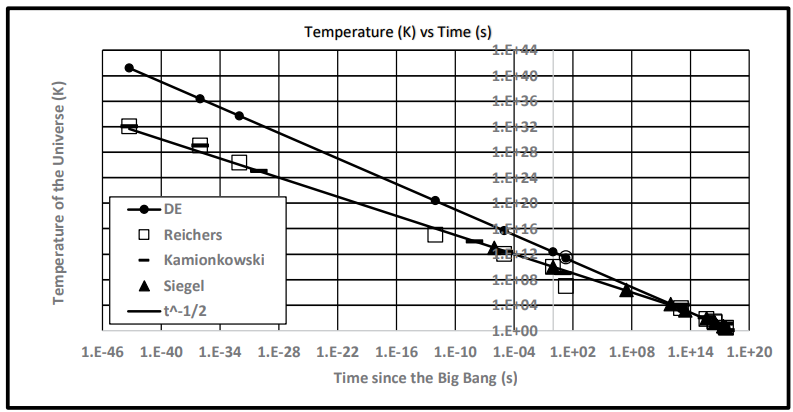
Figure 1: Demonstrating the Difference between the Dark Energy Theory and the Current Big Bang Theory
Expanding DE is Isotropic
The early universe was homogeneous, being completely filled with dark energy and zero matter. As the universe expanded rapidly during the time of matter production, the density of matter remained homogeneous. It does not seem possible that the radiation produced by the subatomic matter could have raised the temperature of the universe to such high values as shown on Fig. 1. As stated above, the isotropy of the CMB is not due to the fact that the matter density is isotropic but that the dark energydriven temperature is.
Nearly Flat Universe and Cyclical Universe
If there were three or more times as much mass as the estimated amount chosen for this study, it would argue for a closed universe rather than the barely open, or nearly flat one, we currently envision. Of note is the fact that in a cyclic universe the next iteration would be diminished in total energy by the amount of the dark energy that remains after matter production. The next universe, following a new big bang, would have only 30.7% of the total energy as the present one. The 69.3% remaining after matter production will continue to expand forever, being unaffected by gravity.
The Accelerating Physical Universe
Finally consider the accelerating physical universe. There is no mechanism in the foregoing that allows for accelerated expansion of the dark energy sphere. As detailed following Eqn. 13, the expansion rate of dark energy is an inverse function of time and the acceleration is always negative.
It was shown in Eqn. 26 that at a fixed time the velocity induced by gravity, vG, was linearly proportional to the radial distance of the matter from the center of the universe. Likewise the velocity f the expansion of dark energy, vDE, is Hr, and is also linearly proportional to the radial distance. Matter at a fixed time would then move at the difference in these two velocities for the case in which  The expectation is that physical matter of the universe will be propelled at vDE - vG . Thus, one would assume that if vG is a fraction, R of vDE , for example, then the expansion rate of matter would be R x vDE . This would hold true if the ratio remained fixed. However, for the case when the expansion rate of the dark energy sphere at maximum radius exceeds c/R, there is a point on the radius where the gravity induced velocity reaches the speed of light. Beyond this radial point the gravity induced velocity is constrained by special relativity to not exceed c. This means that beyond this radial point the expansion of the physical universe is no longer the difference between vDE and an increasing vG , but the difference between vDE and the fixed speed of light, c; thus the expansion is seen to accelerate.
This is demonstrated in figure 2. The curve denoted by open squares limits the gravitationally induced velocity to the speed of light. At the present epoch, the value of vGmax reaches c at about 50 per cent of the maximum radius of the universe. The observed expansion rate of the physical universe, solid line, increases beyond this radius. The curve with the solid line is the velocity of expansion of the dark energy sphere plus the negative velocity caused by gravitational attraction. This is the expansion of our physical universe, and it does increase its rate after the velocity induced by gravity reaches the speed of light.
Of note is the prediction that expansion of the dark energy sphere will slow to the speed of light at 537 billion years after the big bang.
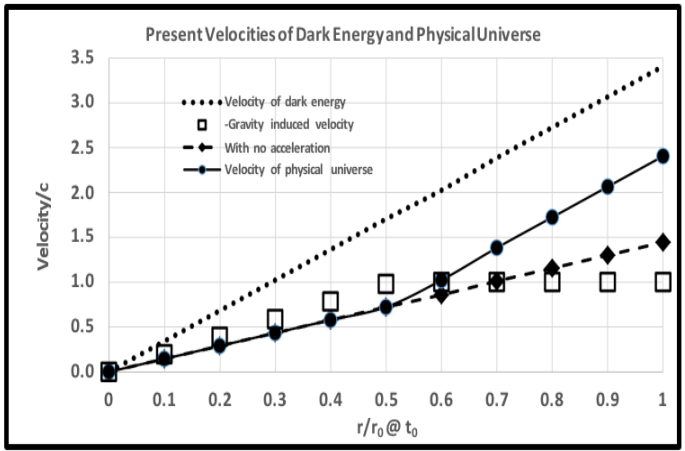
Figure 2: Expansion Rates of Dark Energy and Matter Showing the Effect of Maximum Recession C
Our Place in the Known Universe
We cannot precisely locate the observable universe within the dark energy sphere. However, we can attempt to locate it in general. For example, we can be sure that the observable universe is located along the radial line less than half the radius of the known universe. This is because if we were located along the extended portion of the velocity curve beyond 0.5 x r⁄r0 there would be no evidence of acceleration, rather a uniformly increasing velocity.
There has been much evidence that the physical universe began to show increased expansion about five billion years ago [46,47]. This would place the Milky Way closer than 5 billon light-years from the halfway radius, where the curve begins to indicate increased speed. As Adam Riess demonstrated [32], we are able to observe supernova now at distances of 10 billon light-years. Riess observed supernova SN 1997ff at 10 billon light-years away to be moving up to 15 percent faster than expected. If we search for a point where the observed expansion rate of the physical universe is about 15 percent greater than what was expected without acceleration, we find the points at r⁄r0=0.6. If the Milky Way is positioned at about 0.39 times the maximum radius, then indications that accelerated expansion began about five billion years ago and Reiss’s observations of accelerated expansion at a distance of ten billion light years would coincide. When Riess, et al. reached out to 10 billion light-years, about 0.6 times maximum radius, he observed that the velocities were about 15 per cent higher than expected [32]. This corresponds to the data points at r⁄r0 =0.6 of 1.02/0.865 times the speed of light, a difference of about 15 per cent. This realization caused some anxiety when Riess and Perlmutter measured far distant sources and found them to be accelerating. However, it appears that it should have been expected [46-49].
Conclusion
Proposing a unique massless dark energy has resulted in a self-consistent explanation of the expansion of the universe. This description of dark energy supplants the cosmological constant with an astrological system that is amenable to systematic examination. It not only conforms to the conclusions of the current standard model regarding the expansion of the universe, but also provides answers to topics such as cosmic inflation, the isotropy of the cosmic background radiation, whether the universe is flat, open or closed and the parameters that will determine the ultimate fate of the universe. A massless energy provides physically realizable solutions rather than the, as yet, unexplained cosmological constant. Nothing in this analysis allows for accelerated expansion of the dark energy sphere. The increased acceleration of the physical universe is understood because of the maximum value for the gravity induced velocity of the physical universe. Because both the dark energy velocity and the velocity due to gravity are linearly dependent on radius the inward velocity of gravity will never overcome the outward dark energy velocity. Our universe will continue slowly expanding until overcome by other events such as heat death of the universe or the solar system being consumed by the expanding sun. The major conclusion is that the dark energy is not dark, it is merely hiding in plain sight. It is a startling fact that dark energy isn’t dark at all. We’ve been observing it as the cosmic microwave background since 1965 [23]. The CMB is the thermal footprint of dark energy. After over a century of discussions about Einstein’s cosmological constant, it may be that finally we understand what it is and how it has shaped our universe. Perhaps this endeavor may supply that answer because we now may know what Lambda is
References
- Peebles, P. J. E. (1993). Principles of physical cosmology.Princeton university press.
- Peacock J.A. (1999). Cosmological Physics. Cambridge, UK: Cambridge University Press.
- Wilzcek, F. (2005). PhT 58 (10): 12-13
- Breit, G., & Wheeler, J. A. (1934). Collision of two light quanta. Physical Review, 46(12), 1087.
- Guth, A. H. (1981). PhRvD 23 347-356.
- Guth, A.H. (2004). Carnegie Observatories Astrophysics Series, V2: Measuring and Modelling the Universe ed. W. L. Freedman (Cambridge: Cambridge Univ. Press).
- Schramm, D.N., Turner, M.S. (1998) RvMP 70 (1) 303–318.
- Navas, S., Amsler, C., Gutsche, T. et al. (2024). PhRvD, 110(3) 1-708.
- Saha, M. N. (1920). Philosophical Magazine Series 6,40:238,472-488.
- Bars, I., Ternin, J. (2009). Extra Dimensions in Space and Time, ed. Nekoogar F. (Los Angeles, CA: Springer.)
- Nave, R. 2017. http://hyperphysics.phy-astr.gsu.edu/hbase/ Astro/astcon.html#c.
- Mercier, C. (2019). JMPh, Vol. 10, 980-1001
- Krauss, L. M. (2012). A universe from nothing: Why there is something rather than nothing. Simon and Schuster.
- Son, J. et al, (2025). MNRAS, 544(1). 975-987
- Aad, G. et al, (2020). PhRvL 125, 261801.
- Kettle, B., Hollatz, D., Gerstmayr, E., Samarin, G. M., Alejo, A., Astbury, S., ... & Mangles, S. P. D. (2021). A laser–plasma platform for photon–photon physics: the two photon Breit–Wheeler process. New Journal of Physics, 23(11), 115006.
- Watt, R. A., Rose, S. J., Kettle, B., & Mangles, S. P. D. (2023). Monte Carlo modeling of the linear Breit-Wheeler process within the geant4 framework. Physical Review Accelerators and Beams, 26(5), 054601.
- Peebles, P.J.E., Ratra, B. (2003). RvMP 75, 559-606.
- Smoot, G. F. (1994). COBE observations of the early universe. Journal of the Royal Astronomical Society of Canada, Vol. 88, NO. 2: 64/APR, P. 114, 1994, 88, 114.
- Mather, J. C., Fixsen, D. J., Shafer, R. A., Mosier, C., & Wilkinson, D. T. (1999). Calibrator design for the COBE* far infrared absolute spectrophotometer (FIRAS). The Astrophysical Journal, 512(2), 511.
- Spergel, D. (2007). Astron Suppl. 170(2), 377-408.
- Mather, J. C. (2008) Frontiers in Optics 2008 Laser Science XXIV 133-168, Rochester, NY.
- Fixsen, D. J. (2009) ApJ, 707, 2
- Bennett, C. L. (2003). First-year Wilkinson Microwave Anisotropy Probe (WMAP)*observations: parameter estimation methodology. ApJS, 148(1), 1-27.
- Penzias, A., Wilson, R. (1965). ApJL, 142, 419-421.
- Gupta, R. P. (2018) IJAA, 8(1).
- Weimer, J. (2021). https://physics.stackexchange.com/ q620517.
- Tolman, R.C. (1934). Relativity Thermodynamics and Cosmology, (London, UK: Oxford University Press). Reprinted by Dover Publications. New York. 1987.
- De Boer, J., Hartong, J., Obers, N.A., Sybesma, W., Vandoren,S. (2018) ScPP, (1) 003.
- Gott III, J. R., JuriÄ?, M., Schlegel, D., Hoyle, F., Vogeley, M., Tegmark, M., ... & Brinkmann, J. (2005). A Map of the Universe. The Astrophysical Journal, 624(2), 463.
- Olive, K.A., Peacock, J.A. 2017. https://pdg.lbl.gov- rev-bbang-cosmology
- Riess, A. G., Macri, L. M., Hoffmann, S. L., Scolnic, D.,Casertano, S., Filippenko, A. V., ... & Foley, R. J. (2016). A 2.4% determination of the local value of the Hubble constant. The Astrophysical Journal, 826(1), 56.
- Feynman, R.P., Leighton, R.B. (1963). Sands M. Lectures on Physics, Vol. I (Palo Alto, CA:AddisonWesley)
- Atkins, P. and Jones, L. (1997) Chemistry: Molecules, Matter & Change (New York: W.H. Freedman and Co)
- Merle, A. (2016). Pressure of the Universe, Max Planck Institute of Physics.
- Castelvecchi, D. (2025). Nat 639, 849.
- Dirac, P. A. M. (1928) Proceedings of the Royal Society A: Mathematical, Physical and Engineering Sciences. 117 (778), 610–624.
- Burke, D.L. et al. (1997). PhRvL 79, 1626.
- Dunning, H. (2025). Imperial College, London, UK.
- Nousch, T., Seipt, D., Kämpfer, B., Titov A. (2016). PhLB,755,162-167.
- Upton, A., Mozumber, A. (2025). Pair Production Encyclopaedia Britannica.com
- Newton, I. (1687). Philosophiae Naturalis Principia Mathematica, London 193.
- Kamionkowski, M., Benson, A. (2010) Lectures on Cosmology (Caltech, Pasadena).
- Riechers, D. and Weiß, A. (2022) Nat 3.
- Siegel, E. L., Lane, K., Yuan, A., Smalls-Mantey, L. A., Laird, J., Olson, C., & Hernández, D. (2024). Energy insecurity indicators associated with increased odds of respiratory, mental health, and cardiovascular conditions: study examines energy insecurity and health conditions. Health Affairs, 43(2), 260-268.
- Riess, A.G. et al. (1998). ApJ 116, 1009-1038.
- Perlmutter. (1999). Astron J. 517