



Research Article - (2023) Volume 8, Issue 1
Comparative Study of Nutritional Composition in Organic and Conventional Cereals from Vidarbha Region
2Post Graduate Teaching Department of Home Science, Rashtrasant, Tukdoji Maharaj Nagpur University (RTMNU), India
Received Date: Aug 21, 2023 / Accepted Date: Sep 19, 2023 / Published Date: Sep 25, 2023
Copyright: ©©2023 Mrunmayee Joglekar, et al. This is an open-access article distributed under the terms of the Creative Commons Attribution License, which permits unrestricted use, distribution, and reproduction in any medium, provided the original author and source are credited.
Citation: Joglekar, M., Jadhav, K. (2023). Comparative Study of Nutritional Composition in Organic and Conventional Cereals from Vidarbha Region. Adv Nutr Food Sci, 8(1), 50-53.
Abstract
Organic food means crop produced using natural elements and synthetic chemical free inputs. With rising awareness about harmful effects of chemicals, consumer tend to purchase more of organic as compared to inorganic or convention- ally available. In present study, organically grown cereals and millet samples compared with inorganic or convention- ally available in market in terms of nutritional value and anti-nutritional factors. Wheat, rice, sorghum, Bajra and ragi evaluated in duplicates and data tabulated, statistically analysed by using student T test. Results shows that moisture and Protein content was lesser in organic as compared to conventionally available samples. Dry matter or total ash and fats percentage were high in organic crop produce. Anti-nutritional factors such as tannins, trypsin inhibitors and oxalates were more in organic as compared to inorganic or conventionally available cereals. However, hydrogen cyanide content was less in organic in comparison with inorganic. Organic cereals and millets are beneficial for human health as com- pared to conventionally available one.
Keywords
Organic Millets, Organic Rice, Wheat, Jowar, Bajra, Anti-Nutritional Factors, Tannins in Millets, Hydrogen Cyanide in Millets, Fat in Organic Crop
Introduction
India is world’s leading producer of millets includes Jowar, Ba¬jra and Ragi. (apeda.gov.in) Organic food is considered to be pro-duced using cattle manure as well as devoid use of chemicals or synthetic pesticides. Inorganic of conventionally available crop is considered to be raised without using chemicals for pest and weed management. Awareness about organic food consumption is rising in consumers. Recent study shows that people tend to pur¬chase organic farm produce due to fear of ill effects of consuming chemicals through inorganic or conventional farm produce. Some consumers also reported difference of taste and texture between organic and conventional [1].
Few studies conducted to study effects of organic fertilizers and chemical fertilizers on crop quality that gives variation in results. Soluble fibre content as well as more oxalates found to be present in more quantity in organically grown wheat as compared to con¬ventional. However no significant differences in antioxidant activ¬ity levels. Langenkämper G, et al levels of micronutrients reduced in conventionally grown crops as compared to organically grown such as vitamin C, iron, magnesium, phosphorus [2]. These micro¬nutrients found in organically grown crops in higher quantity [3,4]. Few studies conducted to study differences between organic and conventionally available spices, fruits and vegetables. However, very little study done for organic cereals and millets and how this differs from conventionally available in market [5].
This study focuses on cereals, millets and comparative differences between organic and conventional in terms of Nutritional value. Rice (Oryza sativa), Wheat (Triticum aestivum), Jowar (Sorghum vulgare), Bajra (Pennisetum typhoideum) and Ragi (Eleusine coracana) analysed for proximate content- moisture%, ash%, fat, Protein and antinutritional factors – HCN, Trypsin inhibitors, Tannins, Oxalates. Objective of this study is to see if organically grown cereals are different from that of conventionally available. Null hypothesis is there is no difference in organic and convention¬ally grown cereals about proximate and anti-nutritional factors.
Materials and Methods
Required chemicals (analytical grade) procured from Global mar¬keting. Organic cereal samples of rice, wheat and ragi were collect¬ed from organic certified farmer in Nagpur. Organic certification obtained by Neem Research and Technology Development Centre Village Gondkhairy, Tehsil Kalmeshwar, Amravati Road (NH-6), District Nagpur Samples of organic jowar and bajra acquired from organic certified farmer from Akola. Inorganic or conventionally available samples of cereals in retail market. All samples were an¬alysed in duplicates.
Sample Selection
Samples of Rice, Wheat, Jowar, Bajra, Ragi were selected through organic certified farmers from Nagpur and Akola region. Collected samples were mixed and blended for further use. Inorganic or con-ventional samples of cereals and millets procured from convenient stores. Proximate analysis carried out as per mentioned in AOAC for percent moisture, ash, fat and protein. Moisture was calculated by heating at 80 degree Celsius followed by cooling. This heating and cooling repeated until we get constant weight. Ash analysis done in muffle furnace at 600 degree Celsius followed by cooling and measuring on weighing balance. Soxhlet apparatus in petro¬leum ether was used for fat analysis. Kjeldhal method was used for analysing crude protein.
Antiutritional Factors
HCN Content
Sample extracted by distillation and collected in Sodium hydrox-ide solution (0.5 gm in 20 mL water). Distilled sample was diluted to 250 mL. 100 mL sample was taken for titration. Ammonium hydroxide and Potassium iodide solution added into it and titrated with Silver nitrate until permanent turbidity appears [6].
Trypsin Inhibitors
Sample extracted by blending and keeping for four hours at re-frigeration temperature followed by centrifugation. Supernatant reacted by trypsin during incubation at 37°C. Substrate reaction carried out by using BAPNA (N-α-benzoyl-DL-arginine-pnitroan-ilide). Absorbance recorded on UV-VIS Spectrophotometer only after stopping reaction by 30% glacial acetic acid [7].
Tannins
Sample prepared by extracting in distilled water at 900 Celsius. This solution is filtered to avoid interference in colour during ti-tration. Indigo carmine solution (25ml) was added before titrating with 0.1N KMnO4 aqueous solution. Blank test was performed without sample and used for calculation [6].
Oxalates
Sample extracted by 30 ml 1M HCL at 100°C. Sample reacted with 5% calcium chloride, which further centrifuged. Supernatant collected after washing by ammonium hydroxide. Sample solution titrated with 0.1M KMnO4 at 600C until end [6]. All analysis per-formed in duplicate and mean values taken for data analysis
Results and Discussion
After running tests including proximate and anti-nutritional factors entire data tabulated and analysed. Comparative statistical analysis performed using two-tailed test. Results of proximate analysis pre¬sented in Table 1. Proximate analysis of Organic and Convention¬ally available cereals. P- Value of two tailed tests of all five cereals about moisture content shows statistical significance, as all values are less than 0.05. This proves that organically grown cereals are low in moisture as compared to conventionally available. This can be justified by careful handling of organic crop.
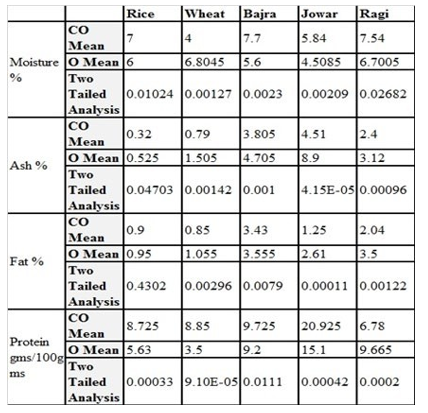
CO- Conventionally or inorganically grown, O- Organically grown Table 1: Proximate Analysis of Organic and Conventionally Available Cereals
During analysis of ash%, all organically grown food samples weighed more than conventionally available one. Organically grown rice, wheat, jowar, bajra and ragi showed more ash% than conventionally available. This suggests posibility of having more micro mineral content in cereals raised with natural fertilizers. Be¬cause more ash % is directy proportional to high fibre and mineral content.
Organically grown cereals such as wheat, rice, jowar, bajra are shown to have less crude protein as compared to conventionally grown. In addition, this difference is statistically significant as all p values of two-tailed test are less than 0.005. Therefore, we can safely conclude that high protein content in cereal crops is directly proportional to increase in protein fertilizer. However organically grown ragi contains 9.6 gms per 100gms which is higher than that of conventionally grown that is 6.7gms per 100 gms.
After analysing fat percentage of organically grown wheat, rice, jowar, bajra and ragi, we can see trend of high fat in organical-ly grown samples rather than conventionally available. In case of wheat, there is no significant difference of fat between two sam¬ples. But difference between two types in rest of four samples is statistically significant at 95% level of significance. This may be due to no provision of fats in chemical fertilizers for convention¬ally grown samples.
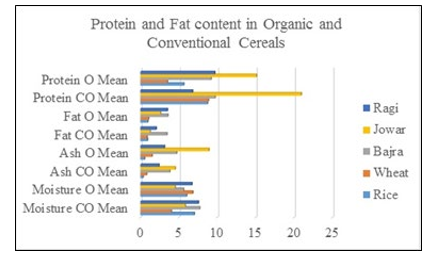
CO- Conventionally or inorganically grown O- Organically grown Figure 1: Protein and Fat Content in Organic and Conventionally Grown Ragi, Jowar, Bajra, Wheat and Rice
After analysing macronutrients, both varieties were analysed for antinutritional factors- oxalates, trypsin inhibitors, tannins and hy-drogen cyanide content. All samples analysed in duplicates and results presented as mean values as follows.
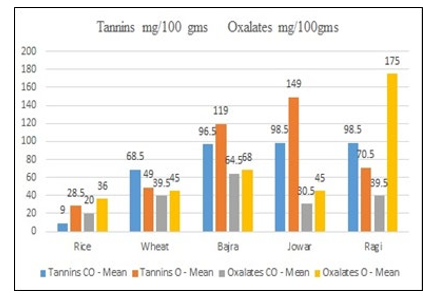
CO- Conventionally or inorganically grown, O- Organically grown Figure 2: Tannins and Oxalates in Organic and Conventionally Grown Rice, Wheat, Bajra, Jowar, Ragi
Wide variation was observed in organically grown rice, wheat, bajra, jowar and ragi with respect to tannin content. Organical¬ly grown rice, bajra, jowar and ragi contain more tannins, which was found to be statistically significant. However, organic wheat contains lower tannins than in conventionally grown sample. Two tailed test shows this difference is significant at 95% level of sig¬nificance.
Oxalates are complexes of oxalic acid and other minerals such as potassium, sodium, calcium and form potassium oxalates, sodium and calcium oxalates. (Bora P., 2014) Oxalates in all six organic samples was more than that of conventionally available. There¬fore, we can deduce that organic rice, wheat, bajra, jowar and ragi contains more minerals than chemical fertilized conventionally grown crop.
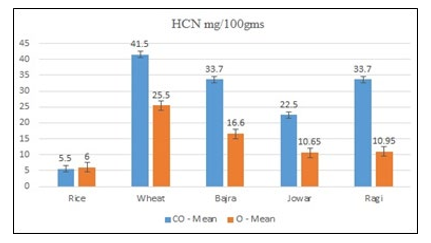
CO- Conventionally or inorganically grown O- Organically grown Figure 3: Hydrogen Cyanide in Organic and Conventionally Grown Rice, Wheat, Bajra, Jowar, Ragi
Hydrogen cyanide is major antinutritional factor present in cereals and legumes, which acts by inhibiting cytochrome oxidase, which is the final step in electron transport, and blocks ATP synthesis. It shows symptoms such as faster and deeper respiration, a faster irregular and weaker pulse, salivation and frothing at the mouth, muscular spasms, dilation of the pupils, and bright red mucous membranes [8]. While analysing hydrogen cyanide from organic and conventionally available cereals and millets, it is found that wheat, bajra, jowar and ragi showed less HCN content in organ¬ically grown samples. This difference between O and CO is sta¬tistically significant in two-tailed T test. However, organic rice contains 6mg/100gms HCN and conventionally available rice contains 5.5, which is slight more, but statistically this difference is not significant.
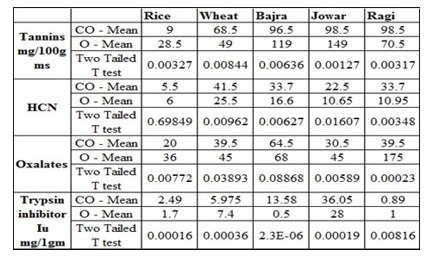
CO- Conventionally or inorganically grown, O- Organically grown Table 2: Tanins, HCN, Oxalates and Trypsin Inhibitors in Organic and Conventionally Grown Cereals and Millets
Trypsin inhibitors is an antinutritional factor that causes intestine to absorb less protein through intestinal membrane. New research-es shows long term beneficial effects of trypsin inhibitors in hu-man body. Organic wheat and ragi comprise less trypsin inhibitors than conventionally available samples [9]. But organic rice, bajra and jowar had less trypsin inhibitors than conventionally grown with chemical fertilizers and pesticides. In the view of statistical analysis of data, we fail to accept null hypothesis that there are no differences in organic and conventional grown cereals and millets.
Conclusion
Significant differences between organically grown and conven-tionally available cereals and millets found in terms of nutrient and antinutritional factors. Differences in moisture, ash, fat sug-gests that there might be lack of micronutrients and minerals in conventionally available cereals and millets. Variations in proteins content suggests need to study amino acid content in organic sam¬ples. Dissimilarities with respect to antinutritional factor shows or¬ganically grown cereals and millets provides long term beneficial effects for human body [10].
Acknowledgement
Present study conducted in Post Graduate Department of Home Science, Nagpur University under guidance of Dr Kalpana Jad-hav, Head of Department. Work presented in this paper is funded by Post Graduate Teaching department of Home Science, Nagpur University.
Author Contributions
Mrunmyee Paranjape- Joglekar worked on present study, analysed data and wrote the manusctipt. Dr. Kalpana Jadhav guided on how to design experiment and conduct it.
References
- Mrunmayee, J., & Kalpana, J. (2023), Consumer Behavior Towards Buying Organic Food, International Journal of Management and Social Science Research Review, 10(3), 12-17.
- Langenkämper, G., Zörb, C., Seifert, M., Mäder, P., Fretzdorff, B., & Betsche, T. (2012). Nutritional quality of organic and conventional wheat. Journal of Applied Botany and Food Quality, 80(2), 150-154.
- Lairon, D. (2010). Nutritional quality and safety of organic food. A review. Agronomy for sustainable development, 30, 33-41.
- Worthington, V. (2001). Nutritional quality of organic versus conventional fruits, vegetables, and grains. The Journal of Alternative & Complementary Medicine, 7(2), 161-173.
- Mohankumar, J. B., Uthira, L., & Maheswari, S. U. (2020). Total Phenolic Content of Organic and Conventionally Grown Gourd Vegetables. The Indian Journal of Nutrition and Dietet-ics, 266-275.
- Aoac. (2000). Association of official analytical chemist. Official methods of analysis.
- Hajela, N., Pande, A. H., Sharma, S., Rao, D. N., & Hajela,K. (1999). Studies on a doubleheaded protease inhibitor from Phaseolus mungo. Journal of Plant Biochemistry and Biotechnology, 8, 57-60.
- Bjarnholt, N., & Møller, B. L. (2008). Hydroxynitrile gluco-sides. Phytochemistry, 69(10), 1947-1961.
- Kennedy, A. R. (1998). The Bowman-Birk inhibitor from soy-beans as an anticarcinogenic agent. The American journal of clinical nutrition, 68(6), 1406S-1412S.
- Bora, P. (2014). Anti-nutritional factors in foods and their effects. Journal of Academia and Industrial Research, 3(6), 285-290.