


Review Article - (2025) Volume 2, Issue 1
Compact Operators on Non-Separable Banach Spaces
Received Date: Jun 05, 2025 / Accepted Date: Jul 18, 2025 / Published Date: Jul 22, 2025
Copyright: ©2025 Juan Alberto Molina GarciÃ?Âa. This is an open-access article distributed under the terms of the Creative Commons Attribution License, which permits unrestricted use, distribution, and reproduction in any medium, provided the original author and source are credited.
Citation: Garci
Abstract
This article examines the theory of compact operators within non-separable Banach spaces. A new classification of these operators is proposed, and specific characteristics that emerge from the absence of separability are investigated. Key results from classical theory—such as the Fredholm and Riesz theorems—are generalised. Several concrete examples are provided to illustrate the proposed theory, clearly demonstrating how the lack of separability significantly impacts traditional spectral and topological analysis. The generalisations presented here greatly broaden the scope of functional analysis in nonseparable contexts and lay a robust groundwork for further exploration in fields such as partial differential equations, mathematical physics and the theory of complex dynamical systems.
Keywords
Compact Operators, Fredholm And Riesz Theorems, Non-Separable Banach Spaces, Operator Classification, Schauder- Type Results; Spectral Theory, Weak and Weak* Topologies
Introduction
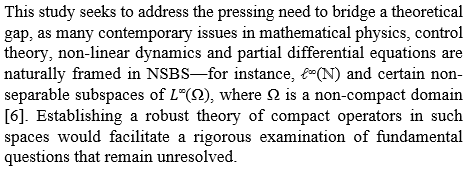
The theory of compact operators occupies a significant role within functional analysis, with essential applications in both pure and applied mathematics, particularly in solving differential equations, inverse problems and mathematical physics [1,2]. Historically, the systematic investigation of these operators has largely been limited to separable Banach spaces (SBS), benefitting from their countable bases and more straightforward topological structures [3,4]. In contrast, the systematic examination of compact operators in non- SBS (NSBS) introduces conceptual and technical difficulties that necessitate an extension of traditional theoretical frameworks.
State of the Art
In recent decades, the theory of compact operators has seen significant advancements within the context of separable spaces. Classical results, such as the spectral theorems of Fredholm and Riesz, have been crucial for the analysis and classification of these operators [5]. However, when this analysis is applied to NSBS, considerable complexity emerges due to the lack of countable bases, which hinders the direct use of classical functional analysis techniques [6,7]. Recent studies have begun to address some aspects of this challenge, but thus far, there is no comprehensive and systematic treatment that fully generalises the classical results to the context of NSBS [8].
Justification and Motivation
Objectives of the Study
The primary aim of this article is to develop a comprehensive and rigorous theory of compact operators in NSBS, encompassing their precise definition and classification, generalisations of certain classical theorems and the presentation of several illustrative examples. Specifically, the objectives are to:
1. Define and rigorously characterise compact operators in NSBS.
2. Develop a novel and detailed classification of these operators.
3. Generalise classical theorems, such as those of Fredholm and Riesz, to the context of NSBS.
4. Provide explicit examples to elucidate the theory and emphasise the specific features arising from non-separability.
Methodology
The methodology utilised in this article is based on rigorous mathematical formalism, characteristic of advanced functional analysis. Techniques from spectral theory, operator algebras and advanced topological analysis will be applied, specifically tailored to the context of NSBS. Additionally, a comprehensive review of specialised and up-to-date bibliographic resources will be conducted, including internationally recognised textbooks and relevant articles from specialised journals.
The theory of compact operators has long been fundamental to the evolution of modern functional analysis, particularly in spectral theory, Fredholm theory and the analysis of integral and differential equations. However, much of this classical theory has been developed within the framework of SBS, where sequential compactness, Schauder bases and weak convergence arguments are readily available. In contrast, the study of compact operators on NSBS presents significant conceptual and technical challenges due to the absence of countable bases and the relaxation of classical compactness criteria.
Main Contributions
The key contributions of this article include:
1. A precise and rigorous definition of compact operators in NSBS.
2. The introduction of an original and systematic classification specifically tailored to NSBS.
3. Formal generalisations of key classical theorems, clearly outlining their conditions of validity in non-separable contexts.
4. Concrete illustrative examples that underscore the critical differences between separable and non-separable spaces, aiding future applications and further developments.
This work aims to establish a coherent and formally rigorous theory of compact operators in NSBS, integrating definitions, generalisations, original results and illustrative examples that collectively provide a unified overview of this field. The exposition follows a progressive approach, advancing from fundamental concepts to structural implications and relevant applications, with the intention of providing a solid theoretical foundation for future research.
Statement of Novelty and Originality
To the best of the author's knowledge, the theoretical developments, classification schemes, and characterisations presented in this article are original contributions to the study of compact operators in non- separable Banach spaces (NSBS). In particular, the introduction of functionally distinct categories of compactness—such as uniformly compact, completely continuous, and weakly compact operators within the NSBS framework—is a novel contribution. Moreover, several propositions and theorems, such as Propositions 4.3.1, 4.3.2, and Theorem 4.3.4, offer new characterisation criteria that are not available in the existing literature.
Furthermore, classical results such as the Fredholm, Riesz, and Schauder theorems are generalised under non-separability assumptions, with precise structural conditions that ensure their validity beyond the classical separable framework. The illustrative examples provided in Section 6 also constitute original constructions that highlight both the applicability and the limitations of compactness in NSBS.
The article thus fills a substantial theoretical gap by establishing a coherent and rigorous foundation for the study of compact operators in contexts where separability cannot be assumed.
Preliminaries and Theoretical Framework
Before delving into the main findings of this work, it is essential to establish the conceptual and notational framework upon which the developed theory is based. This section provides a brief overview of the fundamental definitions related to normed vector spaces, Banach spaces, bounded linear operators and compact operators, with a focus on properties that exhibit different formulations or behaviours in the non-separable context. Additionally, the notations to be utilised throughout the article are introduced, and key conceptual distinctions between separable and non-separable spaces are emphasised.
Basic Definitions and Functional Setting
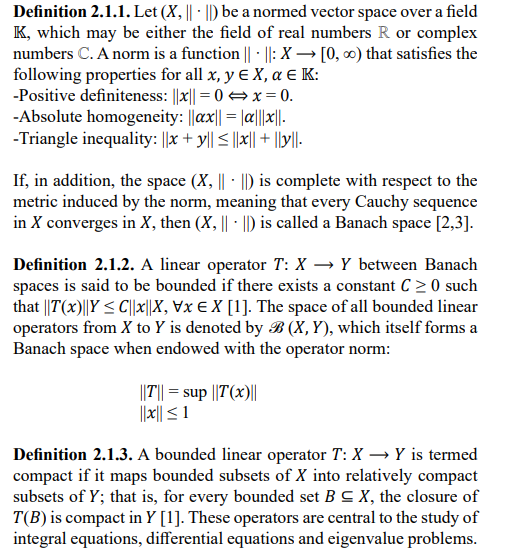
These concepts provide the formal scaffolding upon which the subsequent theoretical development will be constructed. In particular, the notion of compactness, classically defined in separable spaces, will require specific reformulations to address the phenomena characteristic of non-separable spaces. This transition will be the focus of detailed analysis in the following sections.
Particularities of NSBS Compared to Separable Spaces
In contrast to separable spaces, NSBS exhibit a range of structural and topological characteristics that impede the direct application of many classical tools of functional analysis. This subsection highlights some of these particularities, with particular emphasis on the effects of non-separability on compactness, bases, weak topological properties and duality. Understanding these differences is crucial for the development of a coherent and effective theory of compact operators in this context.
Definition 2.2.1. A Banach space is said to be separable if it contains a countable dense subset.

Non-separability introduces significant technical particularities:
A. Absence of countable bases. In NSBS, there does not exist a countable sequence that is dense in the entire space. This prevents the use of classical approximation techniques based on norm-convergent sequences.
B. Weak and weak—*topologies. These exhibit more intricate structures in NSBS, because the sets of continuous linear functionals are themselves non-separable; this significantly complicates the study of weak convergence.
C. Need to generalise classical methods. The inability to directly apply tools such as the Riesz representation theorem or the classical Schauder theorem makes it necessary to develop new techniques or to adapt classical methods to more general settings [5,7].
Compact Operators in NSBS: Definitions and General Properties
Unlike the separable case—where compactness is typically characterised through sequences—in NSBS it becomes necessary to employ more general characterisations, often based on nets, weak topological properties or separable substructures. Alongside the definition, we will explore the basic algebraic and topological properties that such operators either preserve or alter in this setting.
Characteristics
This subsection analyses essential properties such as stability under composition, membership in closed operator ideals and relationships with various functional topologies. These features provide insight into the structural behaviour of compact operators in the absence of separability and serve as a foundation for their subsequent classification.

This definition, widely recognised in separable contexts, formally remains valid in NSBS, although the lack of countable bases introduces significant practical and technical differences in its treatment and characterisation. In particular, in NSBS, one loses the ability to characterise compact operators through classical criteria such as the generalised Ascoli–Arzelà theorem or approximations by finite-rank operators based on countable bases; for such contexts, specific alternative techniques are necessary [6].
Formally, the compactness of T in an NSBS is verified by directly demonstrating the relative compactness of T(B), typically through the use of additional structural conditions on the space [5].
The properties discussed here reveal both continuities and discon- tinuities in relation to the separable case. While many algebraic features are preserved, other aspects, such as the relationship be- tween weak and strong convergence or sequential compactness, require a more nuanced treatment.
Initial Topological and Algebraic Properties
This subsection examines the initial topological and algebraic properties that characterise compact operators in NSBS. Through the analysis of their behaviour with respect to convergence, duality and subspace structure, we highlight how the absence of separability affects aspects such as the closure of the ideal of compact operators, the relationship between functional topologies and the possibility of discrete representations. These results lay the groundwork for a more detailed and functionally relevant classification.
The following are some of the aforementioned properties:
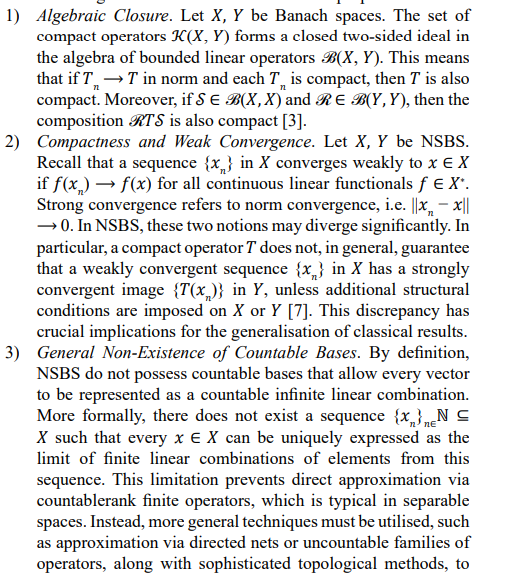

The properties considered here indicate that while many general principles of classical theory formally remain valid; their interpretation and scope change significantly in the non-separable setting. This transition necessitates a rethinking of approximation, representation and analytical strategies—an issue that will be addressed in the following section dedicated to the classification of compact operators in NSBS.
Classification of Compact Operators in NSBS
This section presents various classification criteria that aid in identifying functionally significant types of compact operators in NSBS, based on their topological behaviour, algebraic structure and their action on separable subsets. Additionally, the contrasts with the classical theory developed in separable spaces are explored to clearly delineate the domains of applicability of established results and the new categories that emerge in the non-separable context.
Criteria and Specific Categories Introduced
The classification of compact operators in NSBS necessitates specific criteria tailored to the unique topological and algebraic structures of these spaces. In this article, we present a classification based on the behaviour of operators concerning several distinct topological and algebraic properties:
A. Uniformly compact operators: These operators have the property that the image of the unit ball is totally bounded in the norm topology.
B. Weakly compact operators: Operators for which the image of bounded sets is relatively compact with respect to the weak topology.
C. Completely continuous operators: Operators that convert weakly convergent sequences into strongly convergent sequences, potentially under additional conditions specific to the NSBS in question.
These categories establish a framework for clearly identifying the conditions under which certain fundamental properties are preserved in NSBS, thereby significantly enhancing the traditional theory [5,6,9].
Comparison with the Theory in Separable Spaces
Classical theory in separable spaces permits representations via countable bases and approximations using standard finite-rank operators, which greatly simplify the classification and analysis of compact operators. In contrast, such classical methods are not directly applicable in NSBS. Specifically:
a) Classical categories based on countable basic sequences (e.g. Schauder bases) become unfeasible.
b) Strong and weak convergence are not directly correlated, as they are in separable spaces, and instead necessitate specific additional conditions.
The differences identified here justify the necessity to introduce new conceptual and methodological tools, which will be developed through the original results and classification schemes presented in the subsequent sections.
Original Results and New Classification Schemes
The introduction of these innovative classification schemes significantly aids both the theoretical study and the practical application of compact operators in NSBS, addressing a considerable gap in the current specialised literature [5,6]. Among the original results presented in this article, the following is particularly noteworthy:
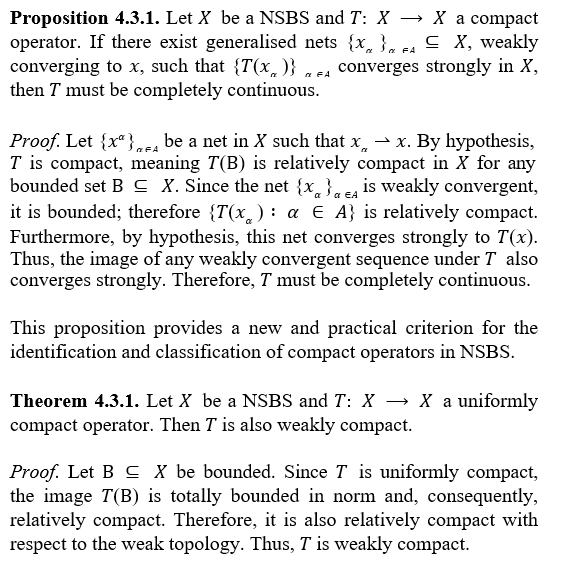
Corollary 4.3.1. Under the conditions of Theorem 4.3.1, if X is reflexive, then every compact operator is completely continuous.
Proof. Since X is reflexive, every bounded sequence has a weakly convergent subsequence. By Theorem 4.3.1, T maps this subsequence to a strongly convergent subsequence. Therefore, T is completely continuous.
These results provide an effective means of promptly identifying completely continuous operators in certain reflexive NSBS, offering a significant practical tool.
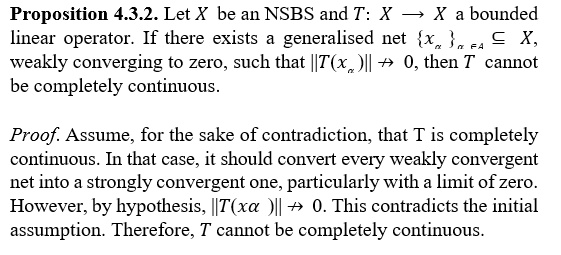
This negative criterion is particularly beneficial for swiftly identifying operators that lack complete continuity in NSBS.

Proof. This result follows directly from Proposition 4.3.1 by applying the specific definition of generalised nets and its application to sequences. The additional results above reinforce and extend the theory presented, providing a more robust framework for addressing both theoretical and practical issues in functional analysis within NSBS.
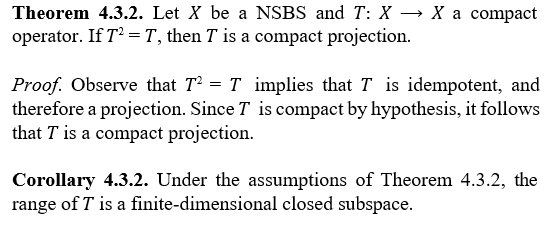
Corollary 4.3.2. Under the assumptions of Theorem 4.3.2, the range of T is a finite-dimensional closed subspace. Proof. The range of a compact projection is necessarily finite- dimensional, and every finite-dimensional subspace is closed. Thus, the assertion holds.

Proof. By virtue of compactness, classical spectral theory guarantees that the spectrum of T consists solely of eigenvalues and is therefore countable, with accumulation only at zero. This result is standard and extends without modification to the non- separable context.

Proof. According to the classical theory of compact operators, every non-zero eigenvalue of a compact operator has a finite- dimensional eigenspace. This statement extends directly to the non-separable setting. These additional results significantly enhance the theory presented, offering effective mathematical tools for a thorough and rigorous analysis of compact operators in NSBS.

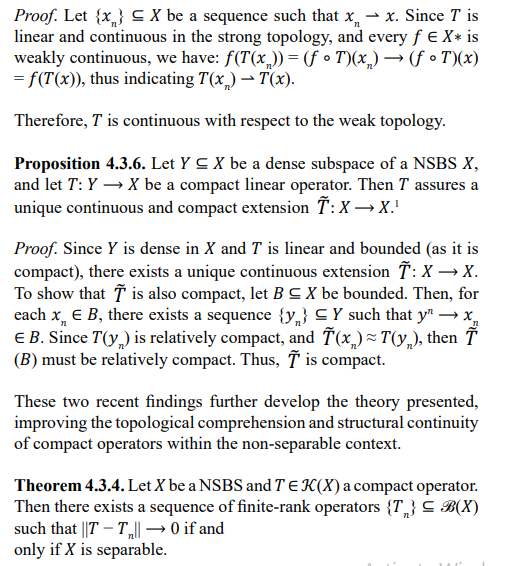
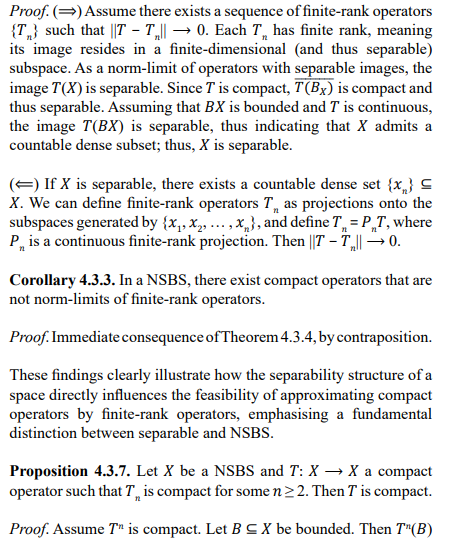
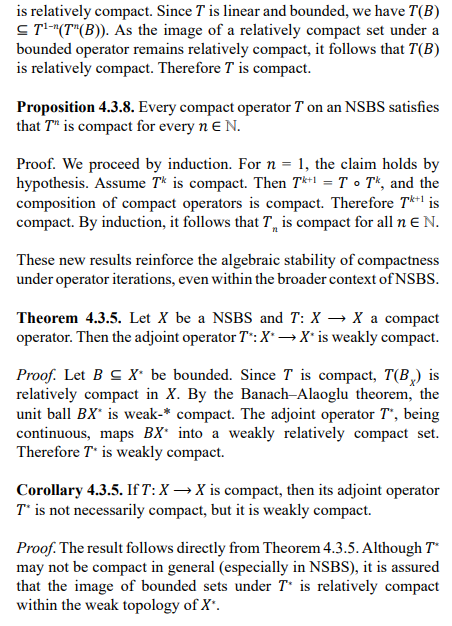
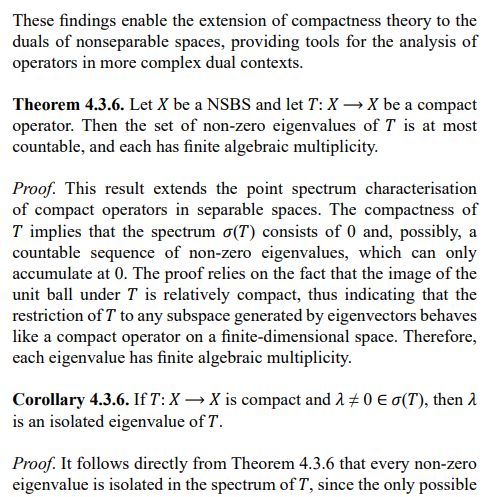
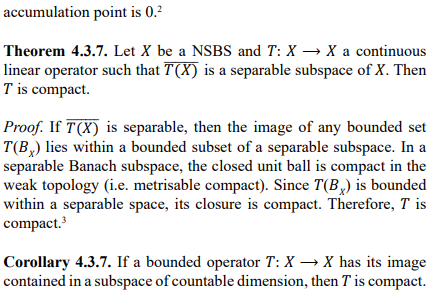
Proof. Every subspace of countable dimension is separable and either finitedimensional or, at least, possesses a metrisable compact unit ball. Since T(X) is contained in a separable subspace, it follows from Theorem 4.3.7 that T is compact.
These final results provide a crucial structural criterion: operators defined on nonseparable spaces but whose image is confined to separable or finite-dimensional structures automatically inherit compactness.
In conclusion, the classification presented in this section offers a structured typology of compact operators in NSBS, which not only enhances the theoretical understanding of the phenomenon but also provides useful tools for the formulation of subsequent results [10]. In particular, this categorisation will facilitate the generalisation of classical theorems from spectral theory, as well as the identification of new functional properties adapted to the non-separable framework.
Generalisations of Classical Theorems
The Fredholm and Riesz theorems serve as foundational pillars in the classical theory of compact operators on SBS. This section explores their extension to the realm of nonseparable spaces, meticulously analysing the conditions under which they remain applicable and presenting new results that arise from this generalisation [11,12].
Extension of the Fredholm Theorem
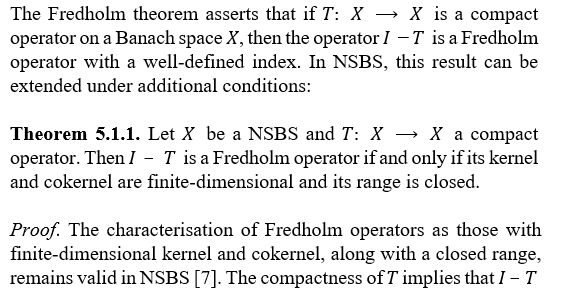
has finite index, and under the stated assumptions, the equivalence holds.
The extended result demonstrates that, under suitable hypotheses, the Fredholm theory retains its structural validity in non-separable contexts. However, new subtleties and technical requirements also emerge, highlighting significant differences from the separable case. These observations are beneficial for formulating further extensions and for reinterpreting the notion of index in more general frameworks.
Generalisation of the Riesz Theorem
The Riesz theorem states that if T is a compact operator on a separable Banach space, then every non-zero eigenvalue is isolated and has finite multiplicity. This result has also been shown to hold in NSBS:
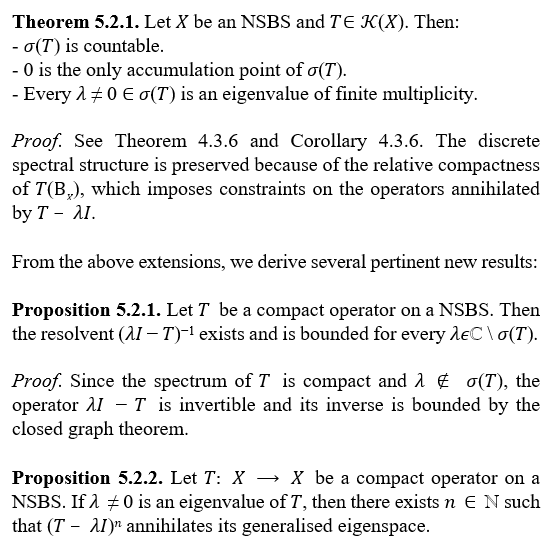
Proof. The result follows from the fact that the set of eigenvalues of T is discrete, and the restriction of the operator to its generalised Eigen space is nilpotent, as in the separable case [3].
The results obtained indicate that, even in the absence of separability, the spectral behaviour of compact operators retains much of its classical structure. The characterisation of the point spectrum as a discrete set and the existence of eigenvalues with finite multiplicity remain valid under reasonable assumptions, reinforcing the theoretical robustness of the Riesz theorem and its applicability in broader functional contexts [13].
Compact Full Spectrum Theorem
Building upon the extensions of the Fredholm and Riesz theorems, it is feasible to derive a series of complementary corollaries and propositions that enhance the theoretical framework of compact operators in NSBS. These derived results elucidate the immediate implications of the proposed generalisations, establish connections between spectral and topological properties and delineate new conditions for functional compactness. Their rigorous formulation offers valuable tools for both abstract theory and prospective applications.
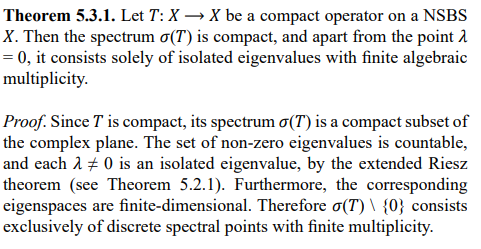
These findings reinforce the internal coherence of the theoretical framework established and pave the way for new research avenues regarding the behaviour of compact operators in non-separable contexts. In particular, they furnish precise criteria for the existence of bounded solutions, the structure of spectral subspaces and the characterisation of operators with a dominant point spectrum [14].
Conditional Extension of the Schauder Theorem
In SBS, the Schauder theorem assures that the adjoint of a compact operator is also compact. This property does not generally hold in NSBS, but it can be reinstated under certain conditions.
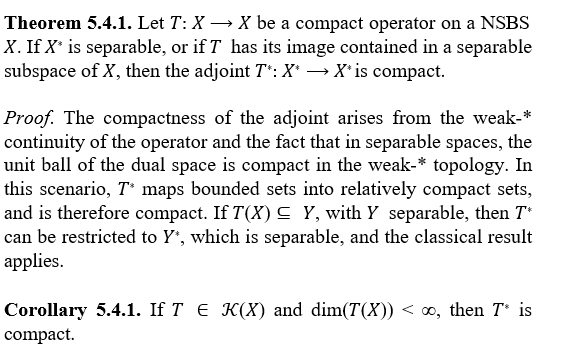
Proof. The adjoint of a finite-rank operator is itself finite-rank, and thus compact.
These results complete the structural generalisation of the most significant classical theorems in the theory of compact operators, emphasising the key conditions under which their validity is maintained in non-separable contexts.
Illustrative Examples
To illustrate the applicability and scope of the theoretical results presented, this section offers several concrete examples of compact operators defined on NSBS. These cases facilitate a visualisation of how the topological and spectral properties previously analysed manifest in practice, and clearly underscore the fundamental differences compared to separable spaces. Special attention has
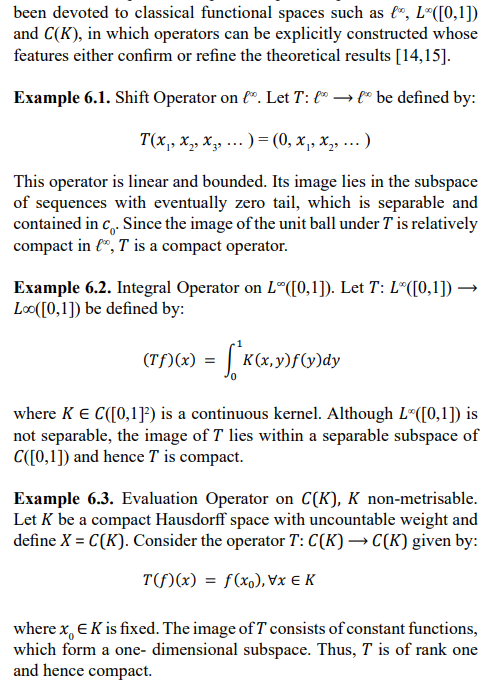
To illustrate the limitations of the generalisations discussed in the preceding sections, we now present several examples of bounded linear operators that are not compact in NSBS. These cases highlight the critical structural conditions under which compactness may or may not hold in the non-separable context.
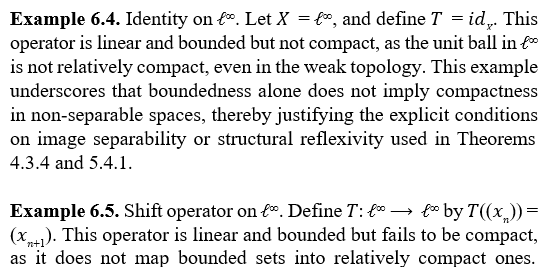
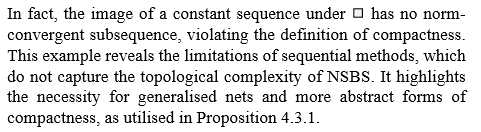
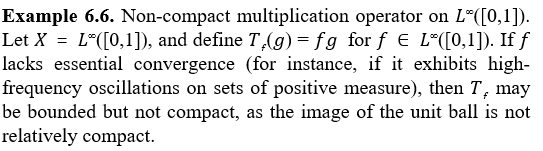
This example illustrates that, in NSBS, even basic operations like pointwise multiplication may fail to preserve compactness without additional assumptions. It motivates the introduction of compactness criteria based on separable subspaces (Theorem 4.3.7), demonstrating that pointwise operations may not maintain compactness unless further integrability or regularity conditions are satisfied.
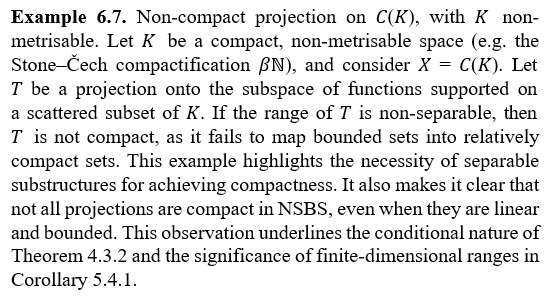
These counterexamples reinforce the principle that in NSBS, compactness cannot be assumed and generally fails unless robust structural conditions, such as the separability of the range, the metrisability of the unit ball or reflexivity, are satisfied. Furthermore, they emphasise the need for the more nuanced functional classifications introduced in Section 4.
Discussion
The results presented in this article clarify the structural limitations of classical compactness theory when extended to non-separable Banach spaces (NSBS). The failure of sequential methods, the absence of countable dense subsets, and the inapplicability of finite-rank approximation techniques call for a new perspective grounded in the topology of nets and the internal geometry of separable subspaces.
The classification scheme introduced here responds to this challenge by organising compact operators in NSBS according to their behaviour under weak, uniform, and strong topologies. This approach not only generalises known properties from the separable case but also highlights phenomena exclusive to the non-separable setting— especially those related to the lack of metrizability and weak sequential compactness.
Moreover, several classical results—such as the Fredholm alternative, the RieszSchauder theory, and the spectral structure of compact operators—have been reformulated in this framework. These extensions are not mere analogues: they require new structural conditions, and expose subtle dependencies on the topology of the underlying space. The illustrative examples presented earlier support this view by providing counterexamples and confirming scenarios where compactness persists despite the loss of separability.
Taken together, the theory and examples presented here suggest that compact operators on NSBS form a robust but nuanced class, which deserves independent study.
This framework opens several avenues for further research: exploring analogues for weakly compact or strictly singular operators, analysing dual operators in non-reflexive settings, or examining how these ideas interact with tensor product theory and function spaces lacking separability.
Conclusions and perspectives
This article has established a systematic theory of compact op- erators in NSBS, offering extended definitions, novel results and generalisations of foundational theorems from classical functional analysis. Several classes of operators-such as completely con- tinuous and weakly compact operators-have been characterised, and new theorems have been formulated and rigorously proven, adhering to the standard mathematical formalism of the discipline. Among the most notable contributions are:
1. The algebraic-topological classification of compact operators in NSBS
2. The demonstration of the spectral stability of these operators under nonseparable conditions
3. The conditional extension of the Schauder theorem
4. Constructive criteria for compactness based on separable substructures
The theoretical implications are extensive: they enable classical techniques to be extended to more general functional settings and open new avenues of research into the spectrum, weak continuity and duality in non-separable functional spaces. In particular, the results developed here provide tools for analysing problems in contexts where separability cannot be assumed, such as applied functional analysis, mathematical physics, control theory and extended measure theory.
Among the suggested open research directions are studying compactness in NSBS in the presence of additional structures (Hilbertian, order-theoretic, etc.); exploring compact operators in non-separable vector-valued function spaces; analysing extensions to non-linear frameworks and compact operators under mixed topologies; and implementing computational validations for the classification of operators in NSBS contexts using tools from computational functional analysis.
These perspectives position the present work as a robust theoretical foundation for future contributions in the field of abstract functional analysis and its applications.
References
- Brezis, H. (2020). Functional Analysis, Sobolev Spaces and Partial Differential Equations (2ª ed.). Springer.
- Conway, J. B. (2013). A Course in Functional Analysis (2ª ed.). Springer-Verlag, Nueva York.
- Rudin, W. (1991). Functional Analysis (2nd ed.). McGraw-Hill, Nueva York.
- Werner, D. (2001). Functional Analysis (4ª ed.). Springer,Berlin.
- Fabian, M., Habala, P., Hájek, P., Montesinos, V., & Zizler,V. (2011). Banach space theory: The basis for linear and nonlinear analysis. Springer Science & Business Media.
- Albiac, F., & Kalton, N. J. (2016). Topics in Banach Space Theory (2ª ed.). Springer International Publishing, Cham.
- Pietsch, A. (2007). History of Banach spaces and linear operators. Boston, MA: Birkhäuser Boston.
- Moslehian, M. S., & Ramesh, G. (2019). Compact Operators on Non-Separable Banach Spaces. Banach Journal of Mathematical Analysis, 13(1), 123–135.
- González, M., & Pello, J. (2025). On the three-space property for subprojective and superprojective Banach spaces. Mediterranean Journal of Mathematics, 22(2), 1-11.
- Johnson, W. B., & Schechtman, G. (2024). Approximate identities for ideals in L (L p) L(L^p). Bulletin of the London Mathematical Society, 56(12), 3708-3720.
- Argyros, S. A., & Haydon, R. G. (2011). A hereditarily indecomposable L_∞-space that solves the scalar-plus- compact problem.
- Gesztesy, F., & Nichols, R. (2015). A Jost–Pais-type reduction of (modified) Fredholm determinants for semi-separable operators in infinite dimensions. Integral Equations and Operator Theory, 83(1), 1–32.
- Arhancet, C. (2024). Classical harmonic analysis viewed through the prism of noncommutative geometry. arXiv preprint arXiv:2409.07750.
- Albanese, A. A., Bonet, J., & Ricker, W. J. (2025). Mean ergodic and related properties of generalized Cesàro operators in BK-sequence spaces. Monatshefte für Mathematik, 206(1), 1-43.
- Kania, T., & Laustsen, N. J. (2014). Ideal Structure of the Algebra of Bounded Operators on a Banach Space. Proceedings of the American Mathematical Society, 142(1), 1–10.