
Research Article - (2026) Volume 11, Issue 1
Chronic Respiratory Symptoms and Associated Factors Among Solid Waste Collectors and Office Workers in Debre Tabor Regiopolitan City, Northwest Ethiopia
Received Date: Oct 21, 2025 / Accepted Date: Dec 15, 2025 / Published Date: Feb 17, 2026
Copyright: ©2026 Arega Asnakew Agazie, et al. This is an open-access article distributed under the terms of the Creative Commons Attribution License, which permits unrestricted use, distribution, and reproduction in any medium, provided the original author and source are credited.
Citation: Arega Asnakew Agazie, Tadesse Wuletaw Demissie and Abaynew Honelgn Dessalegn (2026). Chronic Respiratory Symptoms and Associated Factors Among Solid Waste Collectors and Office Workers in Debre Tabor Regiopolitan City, Northwest Ethiopia. J Nur Healthcare, 11(1), 01-13.
Abstract
Background: Occupational exposure and unhealthy working conditions likely contribute to obstructive diseases and changes in pulmonary function. Moreover, there is a lack of comprehensive studies comparing respiratory symptoms between solid waste collectors and office workers in the Debre Tabor Regiopolitan city. The aim of the study is assessing respiratory symptoms and associated factors among solid waste collectors and office workers in Debre Tabor Region-Politian city.
Method- A community-based comparative cross-sectional study involving 336 waste collectors and office workers. Interviewer-administered questionnaires was used to collect data. Data were analyzed with SPSS version 26, calculating crude odds ratios (COR) and adjusted odds ratios (AOR) with a 95% confidence interval (p ≤ 0.05).
Result– The prevalence of respiratory symptoms among waste collectors was 14.3% (95% CI: 8.9-19.6). Work experience <4 years had an adjusted odds ratio (AOR) of 4.01 (95% CI: 1.37-11.74), and lack of training had an AOR of 6.19 (95% CI: 2.13-18.03) for respiratory symptoms. Age of waste collector’s vs office workers 18-35 years (AOR: 8.7 (95% CI: 2.02-37.85), and who don’t received training (AOR: 5.73(95%CI: 1.87-17.5) had significantly higher odds of developing chronic respiratory symptoms.
Conclusion - The study reveals a concerning 14.3% prevalence of respiratory symptoms among waste collectors, influenced by factors such as limited work experience and lack of training. Limited work experience, particularly among those with less than four years on the job, and a lack of training, both of which significantly increase the odds of developing respiratory issues. Younger waste collectors, specifically those aged 18-35, and those who have not received training, face the highest risks of developing chronic respiratory symptoms. To mitigate these issues, it is crucial to implement comprehensive training programs on safe practices and respiratory protection, conduct regular health assessments, and enhance workplace safety standards by providing proper protective equipment. These measures can significantly improve the health and safety of waste collectors.
Keywords
Solid Waste, Chronic Respiratory Symptoms, WorkersAbbreviations and Acronyms
COPD-Chronic Obstructive Pulmonary Disease
Epi Info- Statistical Software for, Epidemiology
ETB – Ethiopian Birr
NCDs-Non-Communicable Diseases
RTIs-Respiratory Tract Infections
SPSS – Statistical Package for Social Science
SW-Sanitation Workers and SWP-Solid Waste Pickers
Introduction
Chronic respiratory symptoms refer to persistent respiratory issues such as chronic cough, chronic phlegm production, wheezing, shortness of breath, difficulty in breathing and chest tightness [1]. Occupational exposure and unhealthy working conditions are the most likely causes of obstructive disease [2]. Occupational solid waste management is a social issue which impacts on the environment and public health [3]. Whereas solid waste collectors face a range of work-related pressures that may negatively impact their well-being [4]. Occupational exposure can also significantly influence respiratory system impairment and contribute to other ailments among elementary workers [5]. Approximately 30- 40% of solid waste workers report different chronic respiratory symptoms [6]. Respiratory illnesses particularly acute respiratory infections have been linked to infectious waste exposure which increases the risk of lung cancer and other respiratory disorders [7]. Moreover, street cleaners and waste collectors appear to still be heavily exposed to dust in underdeveloped nations [8]. The history of asthma, dust exposure, contact with trash, and non-use of respiratory protection equipment are all important indicators of the respiratory related infection among waste collectors [9]. However, the true prevalence of ill health and harmful biological impacts among trash and recycling workers has not been fully documented [10]. Prolonged exposure to airborne pollutants, such as dust, toxic fumes, and biological agents present in solid waste is a primary concern [11]. Poor working conditions, including inadequate ventilation and lack of protective gear, exacerbate these risks [12].
In Ethiopia, research on respiratory symptoms among solid waste collectors and office workers is limited, which impedes a thorough understanding of occupational health disparities. Some existing studies lack comparison groups, such as non-risky occupations, making it difficult to draw meaningful conclusions. Although chronic dust exposure is recognized as harmful, current research findings do not adequately support this assertion. Therefore, this study aimed to fill these gaps by conducting a comparative cross- sectional analysis of respiratory symptoms and their determinants.
Materials and Methods
Study Design and Settings
A community based cross sectional study design was conducted from May 1 /2024 to June 1/2024 in Debre Tabor Region-Politian city. Debre Tabor city is one of the ancient towns of civilization in Ethiopia during the regime of Atse Tewodros the II. It has three sub-cities; Atse Tewodros, Gebrye and Taytu. According to the information obtained from the municipality office, there are an estimated 173 of which 155 female waste collectors and cleaners living in three sub-cities of Debre Tabor.
Sample Size and Sampling Procedure
Data was collected from 23 government-employed street cleaners and 150 waste collectors. The Yamane formula was used to determine sample size, relying on registered population data rather than similar prevalence [13-15]. This formula also uses N=total population, e2=precision level and the sample size were using the following formula and the total sample size were173.
n = N/ (1+N (e) 2
n = 173/ (1+173 (0.05) 2=121
Where N=173
e=5%
Non-response rate =10% the final sample size was 134. However, according to Yamane formula and rule of thumb if the total population is <200, the whole population was taken and the final sample size were 173 for both waste collectors and office workers. In the small population of Debre Tabor Region-Politian city, a survey was conducted with all available waste collectors, while office workers were randomly sampled at a 1:1 ratio.
Variables and Measurements
The dependent variable was respiratory symptoms ,while the independent variables were socio-demographic related factors including sex, age of the respondents (years), marital status, religion, educational level and monthly income, working environment related factors such as work experience, duration of working hours/ day, number of working days/week, duration of working in waste collection, participating in cooking activities, place of cooking and types of fuel used for cooking and occupational health and safety related factors like PPE use, training with work place health and safety, supervision on occupational health and safety.
Operational Definitions
Respiratory symptoms: The development of one or more of the symptom/s of cough, phlegm, wheezing, shortness of breath and chest tightness last (s) at least 3 months in 1 year [16].
Chronic Cough: Experience of cough as much as 4– 6 times per day occurring for most days of the week (≥4 days) for at least three months in one year [6].
Data Collection Tools and Procedures
The data were collected by structured interviewer-administered questionnaires developed by critically reviewing the research conducted in Addis Ababa, Abbas city and Dessie town [17-19]. The questions consist of five parts including socio-demographic characteristics, employment background and occupational Hx, respiratory symptoms, and respiratory protective devices, related questions.
Data Quality Control
The quality of the data was guaranteed by administering the questioner pre-test to 5% (9) of the total sample size in Bahir Dar city. The validity, completeness, and clarity of the questioner were assessed, and it was modified based on the pretest scoring findings. To enhance data quality, careful observation and the correction of mistakes was done. Training also provided to the data collectors and supervisors focusing the objective, getting consent, and protecting the privacy of the information they gathered.
Data Processing and Analysis
The data was entered into EPI Data version 4.6 after double- checked and then transferred to SPSS version 26 for statistical analysis. Data that requires coding was converted and coded appropriately. Respiratory symptoms were discussed using both descriptive and analytical analysis. To determine factors associated with respiratory symptoms on both waste collectors and office workers and separately was determined by Binary logistic regression. Bi-variable and multi-variable logistic regression was employed to identify factors associated with the outcome variable. After screening all variables having p value ≤0.2, multivariable analysis was determined and interpreted p value ≤ 0.05 at a 95% confidence level. The model goodness-of-fit also checked by using the Hosmer-Lemeshow test, which evaluated the model's goodness- of-fit if the p-value is greater than the alpha value specified.
Ethical Consideration
The ethical procedures were followed by the declaration of Helsinki. The ethical clearance was obtained from Debre Tabor University, College of Health Sciences, and social and public health department with the ethical approval number of 305/16. Verbal consent was also obtained from each study participants after explaining, the advantage risks and all the ethical issues.
Results
Socio-demographic Characteristics
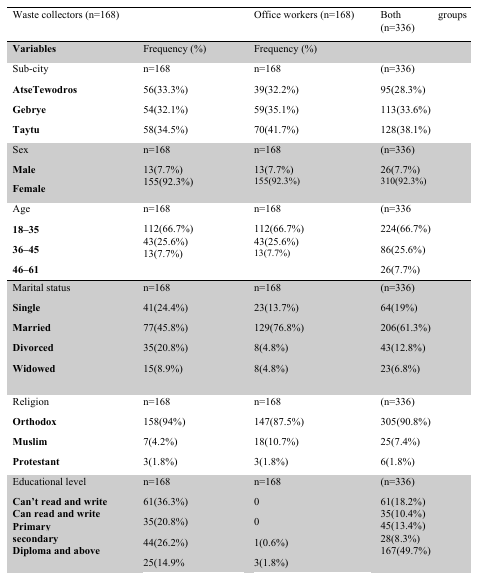
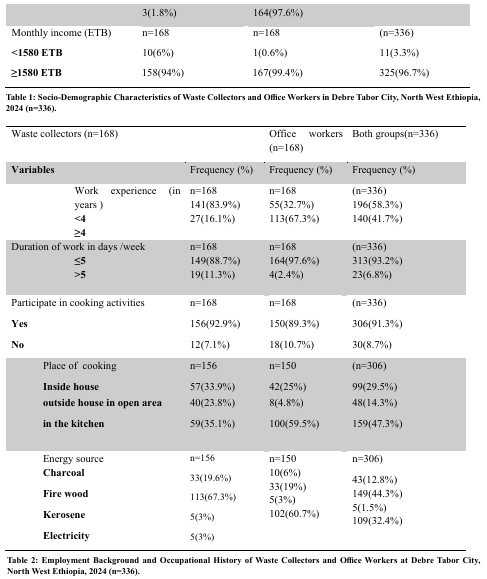
In this study, three hundred thirtysix (1 to 1 ratios of waste collectors and office workers) study subjects participated, making the response rate 97.1%. Among both groups, 92.3% were female, while the majority of office workers (76.8%) were married. The age distribution showed that 66.7% of participants in both groups were aged 18–35.
Employment Background and Occupational History
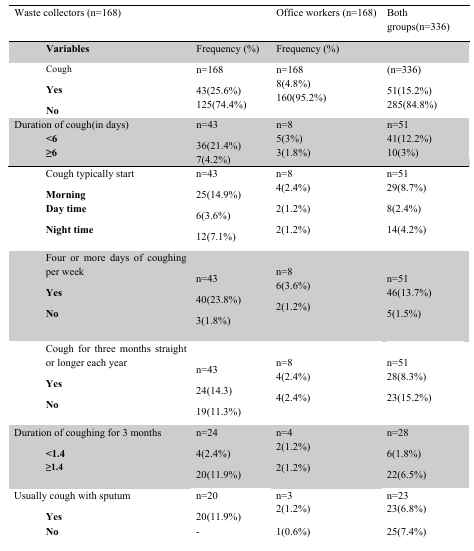
Among waste collectors, majority 141(83.9%) had less than four years of work experience, while 113(67.3%) of office workers had four or more years. About, 156(92.9%) of waste collectors participated in cooking often using charcoal 116(69%) as their primary energy source, which poses further respiratory risk.
Respiratory Symptoms
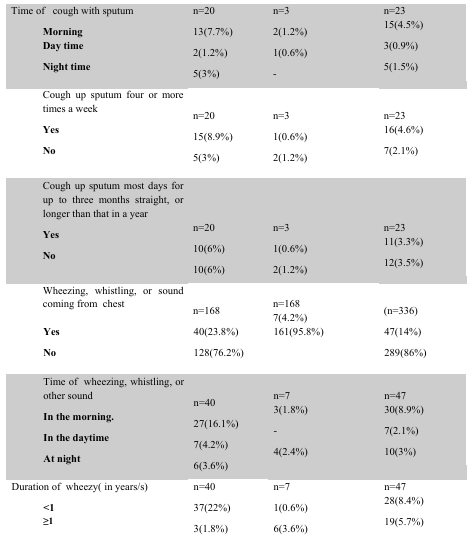
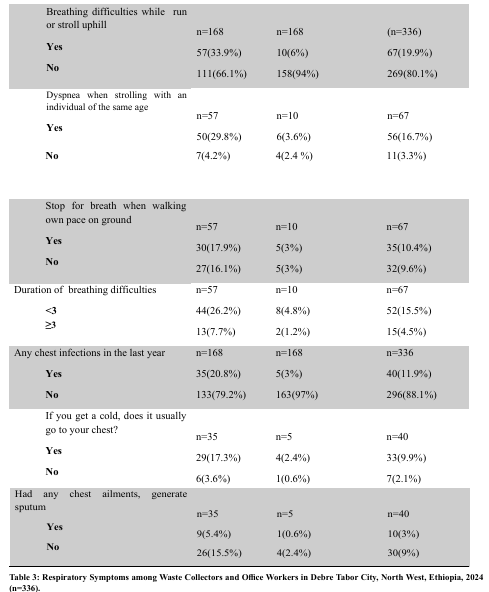
The overall prevalence of respiratory symptoms among both waste collectors and office workers was 8.3% (95% CI: 5.7- 11.3). Specifically, waste collectors had a higher prevalence of respiratory symptoms at 14.3% (95% CI: 8.9-19.6), while office workers reported a much lower prevalence of 2.4% (95% CI: 0.6- 4.8). Among the study participants, 25.6% of waste collectors and 4.8% of office workers experienced coughing.
Respiratory Protective Devices
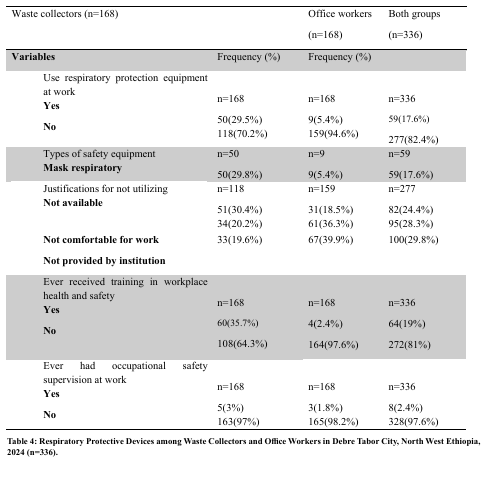
The study found significant disparities in the use of respiratory protection equipment, with only 29.5% of waste collectors and 5.4% of office workers reporting usage, leading to an overall rate of 17.6%.
Factors Associated with Respiratory Symptoms among Waste Collectors and Office Workers
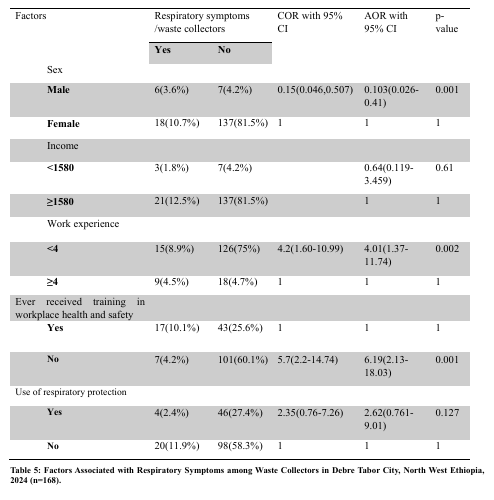
Males had lower odds of reporting respiratory symptoms (AOR: 0.22 (95% CI: 0.052-0.91) compared to female. Younger individuals (ages 18-35) had markedly higher odds of respiratory symptoms (AOR: 8.7 (95% CI: 2.02-37.85), compared with older age groups. Study participants in both groups who don’t received training had significantly higher odds of developing chronic respiratory symptoms (AOR: 5.73(95%CI: 1.87-17.5 compared to the trained groups.
Factors Associated with Respiratory Symptoms among Waste Collectors
Male waste collectors exhibited lower odds of reporting respiratory symptoms (AOR: 0.103 (95% CI: 0.026-0.41) compared to their female counterparts. Waste collectors who had less than four years of experience had higher odds of experiencing respiratory symptoms (AOR: 4.01 (95% CI: 1.37-11.74), than the counterpart. Waste Collectors who did not receive training reported higher respiratory symptoms (AOR: 6.19(95%CI: 2.13-18.03), conversely, those compared with who had received training.
Factors Associated with Respiratory Symptoms among Office Workers
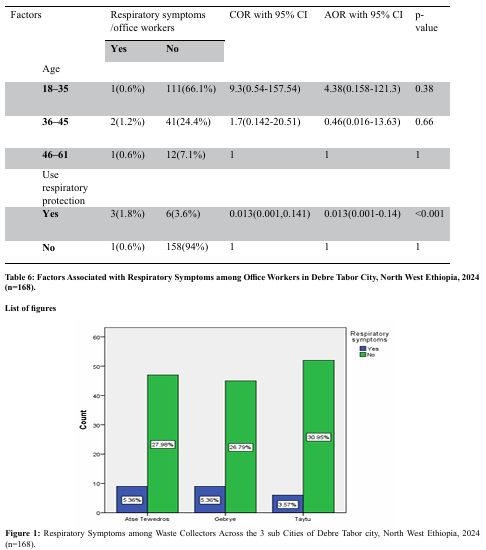
Office workers who used respiratory protection, such as masks, had a probability of reducing respiratory symptoms, with odds of 0.12 compared to those who did not use respiratory protection (AOR: 0.12 [95% CI: 0.001-0.141].
Discussion
This is a comparative cross-sectional study comparing respiratory symptom among waste collectors and office workers in DT City. In this study the prevalence of respiratory symptoms among waste collectors was 14.3% (95% CI: 8.9-19.6).This finding is lower than the study conducted in Dessie and Kombolcha City (45.4%),Gondar town(35.3%) and Addis Ababa (40.7%) [20,21]. This difference might be variations in environmental conditions, such as air quality and waste management practices, exposure to hazardous materials. This finding also lower than the study in African counties including the study conducted in Gambia (83.8%), South Africa (58.5%), revealed [22,23]. This variation may stem from factors like environmental conditions, levels of occupational exposure, and the level of occupational exposure interventions to tackle respiratory health issues in different contexts.
The study finding also notably lower with the findings in the Iran (81%), Malaysia (21%), India (25%), and South Africa (Jonesburg) (58.5%) respectively [2,24,25]. The differences between the current study and previous research may stem from variations in occupational exposure, as well as the impacts of urbanization and differing levels of air pollution. These factors could predispose individuals in the current study to similar exposure conditions compared to those in the referenced studies. The current study finding reported as 14.3% among waste collectors, in line with study conducted in Germany (15.4%), Iran (15.09%), Philippines (19.29%), and [4,24,27]. These comparisons revealed significant regional differences while showing consistent respiratory health outcomes, revealed the influence of environmental and occupational factors on respiratory symptoms across diverse populations.
This study also revealed that 2.4% (95% CI: 0.6-4.8) of the office workers reported respiratory symptoms. The findings, indicating a lower burden of respiratory health issues compared with the study finding in Iran and Nepal [28,29]. The disparity may be attributed to differences in occupational exposure, and environmental factors. The current study found age significantly influences respiratory symptoms, with individuals aged 18–35 showing a higher prevalence in the exposed group compared to controls. In contrast, no significant correlation was observed in the 36–45 age group. The 46–61 age group served as a reference [2]. However, sex and waste collectors who ever received training reduce the likelihood of respiratory symptoms among waste collectors. But, no study finding in line with the current study [30].
The current study found no significant association between cooking methods and mask use with respiratory symptoms in waste collectors. However, personal protective equipment reduced symptoms in office workers, and workplace safety training was a preventive factor among waste collectors. Similarly, a study in Dessie Town indicated that not using masks and lacking health training increased acute respiratory infections [31]. The current study found that monthly income and work experience positively influenced lung function, while employment and education did not predict respiratory symptoms in either group. In contrast, a study in Dessie indicated that these variables were significant predictors of respiratory symptoms among waste collectors [19]. This discrepancy may due to the difference in the amount of dust exposure between the two comparative groups in the previous study and may also depend on the number of service years.
Strength and Limitation of the Study
This study's comparative design, which assessed symptoms among municipal waste collectors and office workers, has strengths. A small sample size, particularly in certain age groups, may hinder the generalizability of the findings. Moreover, the "healthy worker effect" could skew results, as symptomatic office workers might leave their jobs. Recall and interviewer biases from the questionnaire method further limit the study, and its cross-sectional nature prevents establishing causal relationships. Lastly, the lack of participant diversity restricts the applicability of results to broader populations facing different respiratory health challenges.
Conclusion
The study revealed significant impairments in lung function among the waste collectors compared to office workers. Factors affecting respiratory health include sex, age, work experience, and training in workplace health and safety. Training in workplace health and safety was found to be a crucial protective factor for waste collectors.
Authors’ Contribution
All authors have had a significant contribution with regard to conception , study deign , questionnaires design ,execution , acquisition of data, analysis and interpretation of the research result out puts ,or all those areas took part in drafting, revising / critically reviewing ,the research ;gave final approval of version to be published :have agreed on the journal to which the article has been submitted and agree to be accountable for all aspects of the research work.
Acknowledgement
We are grateful to Debre Tabor University College of Health Sciences, Department of Environmental Health for its ethical support and approval to undertake this research. We would like also extend our appreciation to supervisors, data collectors and study participants for their greater contribution on the accomplishment of this research.
References
- Labaki, W. W., & Han, M. K. (2020). Chronic respiratory diseases: a global view. The Lancet Respiratory Medicine, 8(6), 531-533.
- Habybabady, R. H., Sis, H. N., Paridokht, F., Ramrudinasab, F., Behmadi, A., Khosravi, B., & Mohammadi, M. (2018). Effects of dust exposure on the respiratory health symptoms and pulmonary functions of street sweepers. The Malaysian journal of medical sciences: MJMS, 25(6), 76.
- Venkataraman, S., Suguna, A., Surekha, A., & Priyankha, R. S. (2022). Screening for respiratory morbidities and obstructive lung function among municipal waste handlers in Puducherry: A community-based cross-sectional study. Journal of Family Medicine and Primary Care, 11(3), 1119-1125.
- Velasco Garrido, M., Bittner, C., Harth, V., & Preisser, A.M. (2015). Health status and health-related quality of life of municipal waste collection workers–a cross-sectional survey. Journal of Occupational medicine and toxicology, 10(1), 22.
- Hamid, A., Saleem, W., Yaqub, G., & Ghauri, M. U. D. (2019). Comparative assessment of respiratory and other occupational health effects among elementary workers. International Journal of Occupational Safety and Ergonomics, 25(3), 394- 401.
- van Dijk, F. J., & Moti, S. (2023). A repository for publications on basic occupational health services and similar health care innovations. Safety and Health at Work, 14(1), 50-58.
- Zohoori, M., & Ghani, A. (2017). Municipal solid waste management challenges and problems for cities in low- income and developing countries. International Journal of Science and Engineering Applications, 6(2), 39-48.
- Van Kampen, V., Hoffmeyer, F., Seifert, C., Brüning, T., & Bünger, J. (2020). Occupational health hazards of street cleaners–a literature review considering prevention practices at the workplace. International Journal of Occupational Medicine and Environmental Health, 33(6), 701-732.
- Vimercati, L., Baldassarre, A., Gatti, M. F., De Maria, L., Caputi, A., Dirodi, A. A., ... & Bellino, R. M. (2016). Respiratory health in waste collection and disposal workers. International journal of environmental research and public health, 13(7), 631.
- Poole, C. J. M., & Basu, S. (2017). Systematic Review: Occupational illness in the waste and recycling sector. Occupational Medicine, 67(8), 626-636.
- Patel, K. S., Pandey, P. K., Martín-Ramos, P., Corns, W. T., Varol, S., Bhattacharya, P., & Zhu, Y. (2023). A review on arsenic in the environment: contamination, mobility, sources, and exposure. RSC advances, 13(13), 8803-8821.
- Wu, Q., Wu, Q., Wang, X., Zhang, X., & Zhang, R. (2023).Polychlorinated diphenyl ethers in the environment: a review and future perspectives. International Journal of Environmental Research and Public Health, 20(5), 3982.
- Cai, N., Revez, J. A., Adams, M. J., Andlauer, T. F., Breen, G., Byrne, E. M., ... & Flint, J. (2020). Minimal phenotyping yields genome-wide association signals of low specificity for major depression. Nature genetics, 52(4), 437-447.
- Chaokromthong, K., & Sintao, N. (2021). Sample size estimation using Yamane and Cochran and Krejcie and Morgan and green formulas and Cohen statistical power analysis by G* Power and comparisions. Apheit international journal of interdisciplinary social sciences and technology, 10(2), 76-86.
- Tipton, E., Hallberg, K., Hedges, L. V., & Chan, W. (2017). Implications of small samples for generalization: Adjustments and rules of thumb. Evaluation review, 41(5), 472-505.
- Gizaw, Z., Yifred, B., & Tadesse, T. (2016). Chronic respiratory symptoms and associated factors among cement factory workers in Dejen town, Amhara regional state, Ethiopia, 2015. Multidisciplinary respiratory medicine, 11(1), 13.
- Emiru, Z., Gezu, M., Chichiabellu, T. Y., Dessalegn, L., & Anjulo, A. A. (2017). Assessment of respiratory symptoms and associated factors among solid waste collectors in Yeka Sub City, Addis Ababa, Ethiopia. Journal of Public Health and Epidemiology, 9(6), 189-197.
- Asadzadeh, M., Danesh, H., & Kakhaki, H. E. S. (2020). Investigation of the Pulmonary Function Level in Municipal Solid Waste Collectors: A Case of Bandar Abbas City During 2015-2017. Hormozgan Medical Journal, 24(2), e99749-e99749.
- Manaye, E., Manaye, Y., & Birkie, M. (2022). Magnitude and risk factors of chronic respiratory symptoms among municipal street sweepers in Dessie and Kombolcha City, Northeast, Ethiopia: Cross-sectional study. SAGE Open Medicine, 10, 20503121221105329.
- Worede, E. A., Brhan Alemaw, H., Feleke, H., & Engdaw, G.T. (2022). Prevalence of respiratory symptoms and risk factors among street sweepers in Gondar City Northwest, Ethiopia, 2021: a cross-sectional study. Environmental Health Insights, 16, 11786302221145429.
- Zerihun Emiru ZE, Meaza Gezu MG, Tesfaye Yitna Chichiabellu TYC, Lemma Dessalegn LD, Antehun Alemayehu Anjulo AAA. Assessment of respiratory symptoms and associated factors among solid waste collectors in YekaSub City, Addis Ababa, Ethiopia. 2017.
- Darboe B, Kao M-Y, Tsai D. Respiratory symptoms among municipal waste workers in the Gambia: types of solid waste and working conditions. International Journal of Health Promotion and Education. 2015;53(1):17-27.
- Tlotleng N, Kootbodien T, Wilson K, Made F, Mathee A, Ntlebi V, et al. Prevalence of respiratory health symptoms among landfill waste recyclers in the city of Johannesburg, South Africa. International journal of environmental research and public health. 2019;16(21):4277.
- Patil PV, Kamble R. Occupational health hazards in municipal solid waste collecting workers of Chandrapur city, Central India. International Journal of Environment. 2017;6(1):46-57.
- Salvaraji L, Jeffree MS, Avoi R, Akhir HM, Rahim SSSA, Lukman KA. Respiratory symptoms among domestic waste collectors. Medeniyet Medical Journal. 2020;35(4):304.
- Gholami A, Tajik R, Atif K, Zarei AA, Abbaspour S, Teimori- Boghsani G, et al. Respiratory symptoms and diminished lung functions associated with occupational dust exposure among iron ore mine workers in Iran. The open respiratory medicine journal. 2020;14:1.
- Mariano L, Matias A. Prevalence of Symptoms and Risk Factors of Health Problems of Solid Waste Collectors in the Philippines. Philippine Engineering Journal. 2019;40(2).
- Heibati B, Jaakkola MS, Lajunen TK, Ducatman A, Veysi R, Karimi A, et al. Do hospital workers experience a higher risk of respiratory symptoms and loss of lung function? BMC Pulmonary Medicine. 2022;22(1):303.
- Poudel L, Regmi S, Dahal P, Ghimire M, Nepal S, Manandhar N. Work-related Respiratory Symptoms and Associated Factors among Cement Factory Workers in Rupandehi District, Nepal. Kathmandu University Medical Journal. 2021;19(1):41-6.
- Eze JN, Ozoh OB, Otuu FC, Shu EN, Anyaehie BU. Respiratory symptoms and lung function among inmates in a Nigerian prison: a cross sectional study. BMC Pulm Med. 2022;22(1):84.
- Eneyew B, Sisay T, Gizeyatu A, Lingerew M, Keleb A, Malede A, et al. Prevalence and associated factors of acute respiratory infection among street sweepers and door-to-door waste collectors in Dessie City, Ethiopia: a comparative cross-
List of tables