

International Journal of Forensic Research(IJFR)
ISSN: 2767-2972 | DOI: 10.33140/IJFR
Impact Factor: 1.9

Review Article - (2022) Volume 3, Issue 1
China Transport Supply Chain Risk Management Challenges Face to Covid-19 Analysis
Copyright: ©Copyright: ©2022 Veslav Kuranovic. This is an open-access article distributed under the terms of the Creative Commons Attribution License, which permits unrestricted use, distribution, and reproduction in any medium, provided the original author and source are credited.
Citation: Veslav Kuranovic (2022) China transport supply chain risk management challenges face to Covid-19 analysis. In J Fore Res, 3(1), 104-111.
Abstract
The international COVID-19 outbreak at the beginning of 2019 has had a huge influencing factor on lot of global and local manufacturing transportation chains, and triggered a continuous risks of logistics chains breakage by the way the COVID-18 pandemic has revealed the weakness of intercontinental supply chains arising from initial raw material scarcity, mass production and transportation disruption, and human being isolation. Among them, the short-term and medium-term and long-term impacts include encouraging companies to improve the flexibility of supply chains by constructing supply chains digital platforms, supply chains diversification systems and supply chains early warning system in the short, medium and long term, the global supply chains layout will change from internationalization to regionalization, and some high-end manufacturing industries will have a backflow trends. The risks associated with global supply chains management have created a discourse among practitioners and academics. Supply chains risk management is an integral function of the supply chains networks. Supply chains risks management have increasingly becoming a more popular research area recently, when COVID-18 appeared regionally, internationally and globally. In the article there are presented different calculation equations beginning from risk assessment during transportation and finishing by risk modeling, there are important factors influencing logistics and mainly supply chains when different types of risks appeared during COVID-22 transportation time.
Keywords
Supply Chain, Logistics, Risk Management, Dangerous Goods Transport
Introduction
The Importance of The Article
The practitioners and scholars believe that the effective supply chain management has become an important enabler to improve organization performance and valuable way of securing competitive advantage (Chirderhouse et al, 2003; Li et al, 2006). The intensifying business competition since 1990s has forced logistics companies to improve productivity in many aspects of their transport business. On the other hand, the increasing uncertainty requires them to spend more human resources to anticipate for demand, supply, as well as internal uncertainties for better sustainability of their supply chain management. Interestingly, such an increasing uncertainty is not solely induced by the external logistics business environments, but also due to increasing complexity of transport the supply chain structure, form and varying mechanism initiated by the supply chains in their logistics business. The trend of transport companies outsourcing their activities to outside parties has certainly created a new source of uncertainty. The chance of having a huge delay in raw materials delivery is increasing if a logistics company relies to outside parties to do most of the inbound and outbound logistics activities. Likewise, the trend of supply chain base reduction has exposed some transport companies to more risks than the associated global benefits. Different risks and uncertainty have always been an important issue in supply chain management. Earlier literature consider risks in relation to supply lead time reliability, price uncertainty, and demand volatility which lead to the need for safety stock, inventory pooling strategy, order split to suppliers, and various contract and hedging strategies (Tang, 2006a) for an excellent review of various quantitative models considering supply chain risk). Although supply chain management has always had a strong emphasis on different kind of risks, the notion of supply chain risk management has gained an increasing popularity in recent years due to increasing supply chain complexity, including the use of global contract manufacturers, suppliers and customers. Faisal et al (2006b) and Tang (2006a) believe that effective supply chain risk management (SCRM) has become a need for companies nowadays. According to Chopra and Sodhi (2004),the supply chain risks could be in the form of delays of materials from suppliers, large forecast errors, system breakdowns, capacity issues, inventory problems, and disruptions. Another classification is provided by Tang (2006a) who categorized supply chain risks into operations and disruptions risks. The operations risks are associated with uncertainties inherent in a supply chain management, which include demand, supply, and cost uncertainties while disruption risks are those caused by major natural and man-made disasters such as flood, earthquake, tsunami, and major economic crisis.
Relevance of The Research
This research contributes to logistics-oriented literature by operationalizing the implementation of an companies service- oriented strategy, the renewed attention to the concept of transportation service orientation provides insights into critical determinants that influence the implementation of a service- oriented supply chain strategy, research sheds light on the advantages and risks that can jeopardize a successful opening up innovation processes, there is important to identify and propose causes for reflection and tools maximizing potentiality and reducing risks in the implementation of such processes.
The Purpose of The Research
Due to the convergence of rapid transport supply chains development and logistics challenges, orientation on the article research to present a new concept to improve transport companies business services to investigate the role of boundary management when logistics companies should implement open innovation and play a key role.
Relevant Research Question
Alimitation is imposed by the limited practical logistics implications and the unbalanced response from transportation players including supply chain global system, empirical research is necessary to identify, analyze and use equations in the relationships between supply chains mechanism and logistics companies service-oriented strategy.
The Tasks of The Research
Building on structural equation models and unique solutions, identify and analyze the key determinants in the context of a transportation companies are oriented unique strategy.
Hypothesis of The Research
On a practical level, the company executive management should pay attention to invest in an risk entity that manages business services continuously, supply chain entity has to ensure that related processes and knowledge sharing are in place to establish and maintain a service-oriented logistics strategy.
Literature Research Analysis
The studies on supply chain risk in foreign countries mainly focus on three aspects: supply chain risk identification, supply chain risk assessment, and supply chain risk prevention and control. In supply chain risk identification research, scholars have identified risk factors from different perspectives. Some scholars considered the supply and demand perspective (Hallikas et al., 2002; Johnson, 2001; Sharma and Bhat, 2012), and divided supply chain risk into demand and supply risk. Some scholars pointed to risk factor identification based on supply chain structure (Ghadge et al., 2012; Musa, 2012), and divided supply chain risk into capital risk, information flow risk, and logistics risk. Mandal (2011) noticed that supply chain risk mainly originates from supply chain demand uncertainty and imperfect supply chain organization. Some scholars studied risk control from the whole supply chain perspective (Bertsimas and Thiele, 2004; Huang et al., 2007; Savaskan et al., 2004; Xu et al., 2007), and considered the supply chain as an adaptive system. The focus of the research was risk integration, that is, to define all risk factors as elements of comprehensive risk. Some scholars studied risk control from the respective of establishing risk prevention mechanisms and improving risk management (Heckmann et al., 2015; Lavastre et al., 2012; Oehmen et al., 2009). Domestic research on supply chain risk is mainly concentrated on two aspects, namely, the identification of supply chain risk and supply chain risk assessment. In supply chain risk identification research, some scholars analyzed risk factors from the internal and external supply chain perspectives (Fu et al., 2012; Hu, 2008), and divided supply chain risk into two categories, namely, endogenous risk and exogenous risk; however, Xu et al. (2013) paid more attention to internal supply chain risk. In addition, some scholars focused on researching supply chain risk factor identification (Chen, 2012; Jing and Liu, 2014; Suo, 2011). The authors S. Ghazinoory and A. Kheirkhah (2008) confirm that dangerous materials are continuously moved between all countries. These movements are naturally dangerous as the release of hazardous substances as a result of an accident can lead to deaths and irreparable damages to the environment. The authors M.A. Tomasoni, E. Garbolino (2010), M.F. Milazzo, R. Lisi, G. Maschio, G. Antonioni, G. Sadoni (2010) note that in order to ensure safety of transportation, in choosing vehicles, it is necessary to explore factors making influence on transportation riskiness.
Main Problems and Risk Assessment Research Analysis Methodology
Transportation of dangerous freight in most of all countries involves problems and resolutions issues, which mainly arise in local, regional and internationals routes. Nowadays, insufficient attention is paid to regional routes by which dangerous freight are being transported. In most cases, the longest route is selected without evaluating the possible consequences of an accident. Transportation of dangerous freight requires special and constantly updated supply chains knowledge. It is relevant to all of the participants of transportation process – consignors, loaders, warehouse workers, carriers, consignees and terminals assistants. Therefore, special attention should be given to their continuous logistical professional development. Tang (2007) “The management of supply chain risks through coordination or collaboration among the supply chain partners so as to ensure profitability and continuity.” Jüttner (2005), Jüttner et al. (2010) “The identification and management of risks for the supply chain, through a coordinated approach amongst supply chain members, to reduce supply chain vulnerability as a whole.” This helps in adopting the most effective SCRM strategies. Wagner and Bode (2006) “The negative deviation from the expected value of a certain performance measure, resulting in negative consequences for the focal firm.” Norrman and Jansson (2004) “To collaborate with partners in a supply chain apply risk management process tools to deal with risks and uncertainties caused by, or impacting on, logistics related activities or resources.” Tang (2007) “The management of supply chain risks through coordination or collaboration among the supply chain partners so as to ensure profitability and continuity.” Jüttner (2005), Jüttner et al. (2010) “The identification and management of risks for the supply chain, through a coordinated approach amongst supply chain members, to reduce supply chain vulnerability as a whole.” Goh et al. (2007) “The identification and management of risks within the supply network and externally through a coordinated approach amongst supply chain members to reduce supply chain vulnerability as a whole.” Risk Disruption Disruptions in supply chains are evolving to be more comprehensive and recurrent in the business environment (Narasimhan and Talluri 2009). The scale and rate of risk events in supply network are increasing (Blackhurst et al. 2005). An uncertain business environment causes supply chain risks. The uncertain business environment results from cyclical business behavior, fluctuation in demands, or a disaster (Tang 2007). Therefore, uncertainty may be seen as a risk that can disrupt supply chain performance. Some authors have categorized risks in supply chains under operational risk, network risk, and external risks (Handfield and McCormack 2008). Operational risks are due to a strategic re-engineering failure arising from within the system. Risk Management “Risk management refers to strategies, methods, and supporting tools to identify and control risk to an acceptable level” (Alhawari et al. 2012).
Thereotical Background
Road Safety Risk Assessment Analysis Road safety analysis is related to the survival of humans on roads and during road safety risk evaluation, ‘risk’ is associated with a number of fatalities and known as a road safety outcome. In the field of road safety, the risk is defined as the road safety outcome to the amount of exposure, as shown in equation:

Researchers have calculated exposure according to the availability of data; some have used passenger kilometers traveled, population, number of registered vehicles, etc. (Al Haji, 2005). Risk assessment is necessary for road safety performance analysis. Previously, road safety outcome was directly related with and calculated using the different exposure variables, but handling the multiple variables remained a problem. It is necessary to evaluate the risk and its relationship with the road safety performance indicators. The concept of Safety Performance Indicators (SPIs) was developed by the European Transport Safety Council (ETSC, 2001). Thus, SPIs can be defined as measures that are causally related to accidents or injuries and are used in addition to the figures about accidents or injuries, in order to indicate safety performance or understand the processes that lead to accidents (Gitelman et al., 2010). The basic concept of the data envelopment analysis (DEA) efficiency calculation is as in equation:
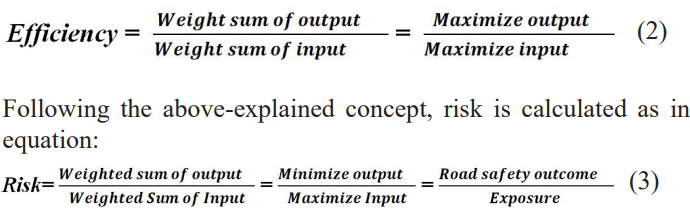
Data envelopment analysis (DEA) was introduced by researchers in the field of road safety by assigning weights for the construction of composite performance indicators; then, for the evaluation of road safety rankings, a risk value was calculated. That risk value was based on outputs and inputs considering road fatalities per million inhabitants (Hermans et al., .2008). Further, an improvement was tested in the model by testing it along with six inputs: alcohol, speed, protective systems, infrastructure, vehicles, and trauma management (Hermans et al., 2009). Analyzing this equation, we can calculate: packaging, filling degree of tare/cistern, marking and labeling, mixed loading, technical equipment, special safety equipment, fixing of shipment, driver training, loading/ overloading/unloading actions, accidents during loading, material losses during loading, non-adaptation of the machines they enable loading into the means of transport, inadequate securing of the load, accidents during discharge, failure, material loss, property damage, maximizing the global profitability of the supply chain, improvement of customer orientation, synchronization of supplies with needs, flexibility and orientation of production to the needs and reduction of stocks along the way supply chain, scope of application of solutions such as JIT, lean, Six-Sigma, etc., scope of process automation,
Analysis of The Accidents in Transport 0f Dangerous Freight
Safety elements could be defined as the composition of components, which create a whole complex of means with the aim to ensure the safety of transportation in normal conditions. Ten safety elements were selected such as (Recommendations … 2001): packaging; filling degree of tare/cistern; marking and labeling; mixed loading; technical equipment; special safety equipment; fixing of shipment; driver training; loading/overloading/unloading actions; documents and their informativeness. Not all of ten safety elements have the same link to an accident with regard to their intense impact.
The biggest part of accidents are related to insufficient technical condition of vehicles and technical issues have great influence on accident probability. We can calculate the probability of a possible road accident in such two ways:
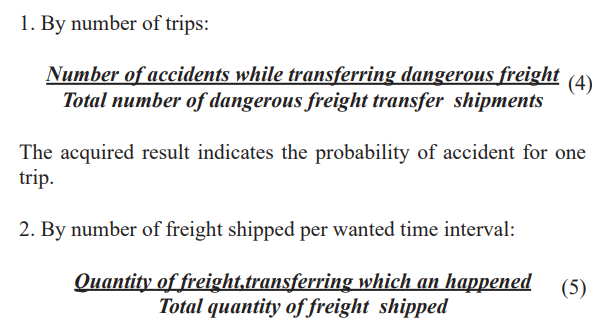
The acquired number shows the probability of accident per 1 weight measurement. Using this we can regulate the quantity of freight transferred in one shipment, because the larger the quantity of freight, the higher the probability of the accident. Possible damage is calculated using other methods when oil is spilt into water or soil and so on.
As an example we can calculate monetary damage to polluted water reservoirs. It can be calculated using this formula:

Where:
Nat – the monetary loss of spilling pollutants in a prohibited area, territorial waters or economic zones, evaluating the category of the reservoir;
Nalt – the monetary loss, which is taken from tables after assessment of the type and quantity of the pollutant;
Kcat – coefficient evaluating the category of the reservoir;
Both dangerous freight shipment risk factors are related, because when you have an accident, harm will be incurred, but harm is not always a straightforward reason of an accident, thus the first factor is more important and plays a bigger part in the reasoning of the transportation choice problem; but the second factor should not be forgotten, as it also plays an important role. The harm possibility factor directly intertwines with monetary loss because much attention is now paid to the protection of the environment and the money’s worth of harm to the surroundings is large, directly influencing the cost of the transportation (European road safety … 2006; eSafety – Making Europe’s roads … 2001 eSafety – Improving road … 2006). Analyzing this equation, we can calculate: evaluation of the routes, selection of alternative transport modes, evaluation of technological transportation process, risk assessment for transportation process, possibilities to reduce the risk of the accidents, lack of communication, errors in order delivery, errors in reading the information, too long delivery time, choosing an unsuitable means of transport, selecting the wrong driver, not having an available driver, lack of available means of transport, errors when handing over the driver route information, uneconomical route planning, preparation errors and handing over the transport documents to the driver, poor planning of the driver's working time, accidents involving the user means of transport, failure of the means of transport, unfavorable weather conditions, failure to deliver the goods on time, having to make a detour, incorrect route selection by the driver, not being able to drive the vehicle through driver
Analysis of Costs of Damage in Transportation
In the event of an accident while transporting dangerous freight, it is important to assess the damage caused to the environment (Milazzo et al., 2010). This damage is described as follows: • direct – loss of the fish, technological process ‘failures of the treatment plants, etc. • indirect – which may appear after a long period of time, such as reduction of biological productivity of the bodies of water, extinction of valuable species and the like. Damage to the Environment is assessed by determining relative costs of the consequence elimination. This damage is calculated without taking into account the direct costs for consequence elimination using this formula:
Nat = Nalt Kkat (7)
Where:
Nat – the extent of damage caused by the spill of the pollutants in an inadmissible location, as well as territorial waters and economic zones considering the category of the body of water;
Nalt – the extent of damage, that is taken from the tables; taking into account the type and the amount of the pollutant;
Kkat– coefficient, assessing the category of the body of water;The second way of calculating the damage is applied in the cases where hazardous substances pass into the air due to the fault of the polluter. In this case the following formula is to be applied:
Nat =T0 (1+4F) (8)
Where:
T0 – the main tariff provided in the methodology;
F – the factual amount of the pollutants;
The model for calculating overall costs of an accident should comprise a number of variables. Numerical values of these coefficients may be determined by analyzing the complexity of separate accidents and the impact of its consequences. The overall cost of an accident can be mathematically calculated in accordance with the formula:
C = k1k2 (Cat + Cant ) (9)
Where:
C – cost of an accident;
Cat – direct costs of an accident;
Cant – indirect costs of an accident;
k1– coefficient, assessing the significance of an accident in an exclusive, natural-sensitive areas;
k2– coefficient, assessing the significance of an accident in an exclusive, residential areas;
If an accident is not exclusive or belongs to one type of exclusiveness (e.g. natural-sensitive areas or residential areas), thus the corresponding coefficients are equated to 1, since factors described by these coefficients do not have substantial impact on the costs of an accident and it is can be calculated by the follow formula:
Cat = TP + Nat + IF + PL+ K (10)
Where:
TP – Costs of the Vehicle Repair;
Nat – Pollution Charges;
IF – Costs for Road Infrastructure;
PL – Costs related to Liquidation of Accidents;
K – Costs of Cargo Loss;

Where:
n – number of people who received a negative impact on health during the accident, when i = 1, ..., j;
Z – Evaluation of human life in monetary terms;
Si – Evaluation of injuries in monetary terms;
Pi – Evaluation of Loss of human productive capacity in monetary terms;
TV – Costs of Governent-funded research;
TNV – Costs of non-Governent-funded research;
PTP – Costs for Vehicle downtime;
T – time;
Evaluation of human injuries is based on inpatient treatment and is calculated by multiplying the number of days (t) spent at Medical institution with the then costs for official one-day treatment (Cs).
S = Cst
The analysis of the costs of accidents, which is applied in performing cost/benefit analysis, revealed that it is important to solve the issue with the major goal of reducing the costs of an accident and increase the safety of transportation. Additionally,this technology would provide prerequisites for selection of rational transport task solution (Jarašuniene and Jakubauskas, 2007). Analyzing this equation, we can calculate: the technical base of the type of transport, length of the road, the cost of the shipment, chemical properties of the material and its quantity, the preparedness and knowledge base of the staff and route, climate conditions, the level of probable damage, environmental hazards, negative natural phenomena, threat to human health, incorrect driver behavior,
Risk Analysis in Transportation
The significance of the risk is measurable effect of materialization of negative events and considered is as the product of the probability of risk and the consequences of its occurrence risk according to the following formula:
IR = P x S (12)
Where:
IR - risk significance factor;
P - risk probability;
S - the result of the risk;
The given formula assumes that the level of risk depends both on the probability of the risk occurrence and on the consequences of the risk. determination of the significance factor risk allows you to determine the weight of the risk assessment and to organize it list of identified dangers:
R = p x c (13)
Where:
R - significance risk;
P- undesirable event;
C loss of health or life, loss or damage to cargo and / or mode of transport, losses in production / financial / environment;
Analyzing this equation, we can calculate: identifying dangerous freight and site classification, providing information, training and supervision in evacuation and fire fighting procedures, controlling ignition sources such as naked lights, sparks and mobile phones where flammable atmospheres may exist, segregating incompatible freight, separating dangerous freight from ‘protected places’, lack of communication, errors in order delivery, errors in reading the information, too long delivery time, issuing an incorrect invoice, lack of financial resources, incorrect sending of funds,
Problem Description and Risk Modeling
Fabiano et al. (2002) argued that a proper evaluation of the expected frequency is the starting point for an effective approach to risk modelling. The frequency of an accident on the the road section can be expressed by the following equations:

Where:
Yi is the expected frequency on the road section (accident km-1 per vehicle);
Li the road length (km),
ni is the vehicle number;
Yo the basic frequency (accident km-1 per vehicle);
Hj is the local enhancing/mitigating parameters;
Referring to a scenario S, the frequency of a road accident on the the road section, can be expressed as:
Fis = Yi Li ni PS PI (15)
Where:
Ps is the probability of evolving scenarios of type S, following the accident initializer (i.e. collisions, roll-over, failure, etc. and Pt is the ignition probability from flammable substances involved in the accident.
The common evidence would suggest a parabolic relationship between density and crash energy. When densities increase, there would be first a positive relationship due to the increase in the numbers of cars in the system. However, when density becomes so high that speeds are influenced negatively, the crash energy will decrease (Shefer and Rietveld, 1997). The risk associated to a road accident of an ADR transport on the motorway section can be expressed by the following equation:
Where:
RRA/i - is the risk associated to a road accident associated of an ADR transport on the the motorway section, expressed in €;
Ffv - is the road accident frequency for freight vehicles expressed in [n° accident/km];
d(P/i)- is the density of population in leaving in the area crossing the i-th motorway section;
A1 - is area of impact of the dangerous goods release;
d(R/I) - is the road density express in terms of number of vehicle per km per line;
NLN - is the number of line of the motorway;
ro - is the occupancy rate of passenger vehicle;
CHLL - is the cost of human life loss in terms of potentiality to create income per person;
Li - is the length of the the the motorway section;
λi - is a parameter describing the weather conditions the the motorway section;
Hi - is a parameter describing the variation of the road accident frequency in relation to the traffic density in the the motorway section;
βi is a parameter describing the variation of the consequences in relation to the road speed the motorway section;
λi , Hi and βi are modification parameters used to represent the influence of weather, traffic density d1, average flow-speed AFS1, and free-flow-speed FFS1, of the the motorway section lamda is the parameter taking into account weather;
Hi and βi are parameters that describes the mutual relationships between flow and accident frequency; Concerning weather, λi is set equal to 1 if there are ideal travel conditions (meaning sunny). If the ADR transport is carried in weather condition worse than ideal one, the parameter λi decreases. Relationship with road accident frequency shows that if the λi parameter decreases of 10%, the frequency f increase 10 times. Analyzing this equation, we can calculate: exceeding the assumed logistic costs, conflict of logistic goals, conflict of logistics costs selecting unreliable suppliers, improper use of the material substance of the warehouses, wrong choice of own or third party storage, incorrect determination of safety stock levels, decrease in the value of goods and semi-finished products during storage, incorrect picking system, non-rhythmic production support, developing incorrect concepts of reception and disposition systems and order control, developing an incorrect product distribution strategy, poor positioning of the company in logistics channels, non- rhythmic freight forwarding and increased transport costs, decrease in the value of goods and semi-finished products during transport, logistic and marketing inconsistencies (incorrect response to demand), lost sales costs, incorrect labeling of products, selecting unreliable recipients, an incorrect recycling strategy, downtime and interruptions when receiving goods, inadequate information and physical logistic flows, changes in exchange rates in operating flows (transactional and operational), political and legal changes (e.g. the amount of customs duties, clearance conditions, etc.) and others. reconfiguration of supply chains in the direction of cost- optimal, regionally matching structures, assessing the impact of selected supply chain management instruments on the probability and effects of disruptions in the supply chain, recognizing the interdependencies between the attributes of the supply chain inherent for the use of selected instruments and the assessment of their impact on the probability and the effects of disturbances, establishing the effect of the nature of the product and the demand on the probability of its occurrence disturbances, assessment of the conditions for the use of selected chain management instruments supply in the context of disruptions, establishing the relationship between the use of selected instruments supply chain management, company size, number of suppliers and recipients, the geographic coverage of the supply and distribution network and the frequency of disturbances
Conclusions and Future Research Trends
Scientific novelty is revealed in my article, by the actuality and novelty in the global COVID-19 pandemic is relatively unprecedented, recovery challenges have yet to be fully evaluated in research. It assists decision-makers by providing a list of potential recovery challenges they may face during and beyond the COVID-19 pandemic. Awareness of these challenges can help them formulate appropriate strategies and reimagine their supply chains in the post-COVID-19 era. The changing phases of globalization, lean manufacturing processes, and outsourcing to low-income countries have made supply chain networks more efficient and changed their supply chain risk profile. Supply chain cost reductions can be gained through optimally designed supply chain flows combined with goods’ physical movement. This can be simplified by extending trade credit through conventional modes of distribution, reducing inventory levels, cost in supply chain management, and increase the access to trade finance organizations. Future research should then be expanded to explore how collaborative risk management between companies in a supply chain could work. The possible research could be the design of a framework for collaborative risk management and various possible schemes for collaborative risk management between organizations in a supply chain. Research on supply chain risk management that attempts to compare strategies to manage risk or to create a robust supply chain across different sectors is still limited. By using the risk assessment it is possible to reduce accident probability and to raise transportation safety. Risk assessment is one of the main preventive measures of dangerous freight transportation. Risk analysis enables the carrier to select the desired criteria, depending on key conditions of transportation, assures flexibility of decision- making in performing carriage of dangerous freight. By the means of risk assessment of equations and models, it is possible to calculate the extent of the consequences and reduce the risks during the process of transportation.
References
- Al Haji, G. (2005). Development of an International Index to Measure Road Safety Performance. Linköping Studies in Science and Technology, Norrköping, Sweden.
- Alhawari, S., Karadsheh, L., Talet, A. N., & Mansour, E. (2012). Knowledge-based risk management framework for information technology project. International Journal of Information Management, 32(1), 50-65.
- Bertsimas, D., & Thiele, A. (2004, June). A robust optimization approach to supply chain management. In International conference on integer programming and combinatorial optimization (pp. 86-100). Springer, Berlin, Heidelberg.
- Blackhurst*, J., Craighead, C. W., Elkins, D., & Handfield, R.B. (2005). An empirically derived agenda of critical research issues for managing supply-chain disruptions. International journal of production research, 43(19), 4067-4081.
- Childerhouse, P., Hermiz, R., Masonâ?Jones, R., Popp, A., & Towill, D. R. (2003). Information flow in automotive supply chains–identifying and learning to overcome barriers to change. Industrial Management & Data Systems.
- Jingxian, C. (2012). Construction of supply chain risk early warning system based on EDI. Modern information, 6, 115- 118.
- Communication from the Commission. (2006). European Road Safety Action Programme Mid-term Review 22/02/2006 COM (2006) 74 final. Brussels: Commission of the European Communities.
- European Transport Safety Council(ETSC). (2001). Transport Safety Performance Indicators; European Transport SafetyCouncil: Brussels, Belgium.
- Fabiano, B., Currò, F., Palazzi, E., & Pastorino, R. (2002). A framework for risk assessment and decision-making strategies in dangerous good transportation. Journal of hazardous materials, 93(1), 1-15.
- Faisal, M. N., Banwet, D. K., & Shankar, R. (2006). Supply chain risk mitigation: modeling the enablers. Business Process Management Journal.
- Liang, F., Hong, Z., & Pengshi, L. (2012). Supply chain riskidentification and analysis. Logistics technology, 9, 192-193.
- Gitelman, V., Doveh, E., & Hakkert, S. (2010). Designing a composite indicator for road safety. Safety science, 48(9), 1212-1224.
- Ghazinoory, S., & Kheirkhah, A. S. (2008). Transportation of hazardous materials in Iran: A strategic approach for decreasing accidents. Transport , 23(2), 104-111.
- Goh, M., Lim, J. Y., & Meng, F. (2007). A stochastic model for risk management in global supply chain networks. European Journal of Operational Research, 182(1), 164-173.
- Hallikas, J., Virolainen, V. M., & Tuominen, M. (2002). Risk analysis and assessment in network environments: A dyadic case study. International journal of production economics, 78(1), 45-55.
- Heckmann, I., Comes, T., & Nickel, S. (2015). A critical review on supply chain risk–Definition, measure and modeling. Omega, 52, 119-132.
- Hermans, E., Van den Bossche, F., & Wets, G. (2008). Combining road safety information in a performance index. Accident Analysis & Prevention, 40(4), 1337-1344.
- Xiao, H. (2008). Study on risk identification and prevention of logistics industry in Henan based on group decision making. Henan Polytechnic University.
- Xiaoyuan, H., Haifeng, G., & Zhen, L. (2007). AH∞ control method of the bullwhip effect for a class of supply chain systems. Int J of Production Research, 45(1), 207-226.
- JarašÅ«niene, A., & Jakubauskas, G. (2007). Improvement of road safety using passive and active intelligent vehicle safety systems. Transport, 22(4), 284-289.
- Jing Kunpeng & Liu Qianran .(2014). A comparative study on several methods of supply chain risk identification. Logistics technology, 19, 363-366.
- Johnson, M. E. (2001). Learning from toys: Lessons in managing supply chain risk from the toy industry. California management review, 43(3), 106-124.
- Jüttner, Uta .(2005). Supply chain risk management. TheInternational Journal of Logistics Management, 16, 120-141.
- Jüttner, U., Peck, H., & Christopher, M. (2003). Supply chain risk management: outlining an agenda for future research. International Journal of Logistics: research and applications, 6(4), 197-210.
- Lavastre, O., Gunasekaran, A., & Spalanzani, A. (2012). Supply chain risk management in French companies. Decision Support Systems, 52(4), 828-838.
- Mandal S .(2011). Supply Chain Risk Identification and Elimination: A Theoretical Perspective. IUP Journal of Supply Chain Management, 8(1), 124.
- Milazzo, M. F., Lisi, R., Maschio, G., Antonioni, G., & Spadoni, G. (2010). A study of land transport of dangerous substances in Eastern Sicily. Journal of Loss Prevention in the Process Industries, 23(3), 393-403.
- Musa, S. N. (2012). Supply chain risk management: identification, evaluation and mitigation techniques (Doctoral dissertation, Linköping University Electronic Press).
- Narasimhan, R., & Talluri, S. (2009). Perspectives on risk management in supply chains. Journal of Operations Management, 27(2), 114-118.
- Norrman, Andreas, and Ulf Jansson .(2004). Ericsson’s proactive supply chain risk management approach after a serious sub-supplier accident. International Journal of Physical Distribution & Logistics Management, 34, 434-56.
- Sharma, S. K., & Bhat, A. (2012). Identification and assessment of supply chain risk: development of AHP model for supply chain risk prioritisation. International Journal of Agile Systems and Management, 5(4), 350-369.
- Savaskan, R. C., Bhattacharya, S., & Van Wassenhove, L.N. (2004). Closed-loop supply chain models with product remanufacturing. Management science, 50(2), 239-252.
- Shefer, D., & Rietveld, P. (1997). Congestion and safety on highways: towards an analytical model. Urban Studies, 34(4), 679-692.
- Sodhi, M. S., Son, B. G., & Tang, C. S. (2012). Researchers' perspectives on supply chain risk management. Production and operations management, 21(1), 1-13.
- Suo Xiuhua. (2011). Supply chain risk identification andevaluation. Jinan University.
- Tang, C. S. (2006). Perspectives in supply chain risk management. International journal of production economics, 103(2), 451-488.
- Tang, C. S. (2006). Robust strategies for mitigating supply chain disruptions. International Journal of Logistics: Research and Applications, 9(1), 33-45.
- Tomasoni, M.A., Garbolino, E .(2010). Risk evaluation of real-time accident scenarios in the transport of hazardous material on road. Management and Environmental, 21(5), 695-711.
- Wagner, S. M., & Bode, C. (2006). An empirical investigation into supply chain vulnerability. Journal of purchasing and supply management, 12(6), 301-312.
- Xu, J., Huang, X., & Yan, N. (2007). A multi-objective robust operation model for electronic market enabled supply Chain with uncertain demands. Journal of systems science and systems engineering, 16(1), 74-87.
- Xusong, X., Xuegong, Z., & Xiaojing, Z. (2013). Research on supply chain risk management risk identification. Technology economy, 5, 78-86.