



Review Article - (2019) Volume 4, Issue 4
Cashew Apple Utilization-Generating Wealth from Waste
Received Date: Nov 05, 2019 / Accepted Date: Nov 28, 2019 / Published Date: Dec 09, 2019
Copyright: ©A Sobhana. This is an open-access article distributed under the terms of the Creative Commons Attribution License, which permits unrestricted use, distribution, and reproduction in any medium, provided the original author and source are credited.
Abstract
Cashew (Anacardium occidentale), belonging to the family Anacardiaceae, is a major commercial horticultural crop of India. It is primarily cultivated for its nut, and widely grown in tropical areas. However, may be due to the high value of the nut, another important produce from cashew i.e. cashew apple, has been neglected all along without any utilization. Cashew apple is very tasty and is highly nutritious.
Introduction
Cashew (Anacardium occidentale), belonging to the family Anac-ardiaceae, is a major commercial horticultural crop of India. It is primarily cultivated for its nut, and widely grown in tropical areas. However, may be due to the high value of the nut, another important produce from cashew i.e. cashew apple, has been neglected all along without any utilization. Cashew apple is very tasty and is highly nutritious. It is comparable with many other tropical fruits in its nutritive value and contains more vitamin C and riboflavin. It is not commercially used in India, except in Goa where it is profitably used for the production of feni. The cashew apple, weighing about 8-10 times that of the nut, is an equally valuable produce from the crop, if it is economically exploited. Cashew apple is a pseudo fruit formed by the swollen receptacle and is highly nutritious and is a valuable source of sugar, minerals and vitamins. Ripe apple is very juicy and spongy having a unique flavour and smell. The astringent and acid principles in cashew apple produce a rough unpleasant and biting sensation on the tongue and throat, major drawback of the fruit which prevents the consumption of fresh fruits and the tannin content varies from 0.06 to 0.76g per 100 g. This in fact limits the utilization of cashew apple as fresh fruit as well as raw material in the fruit processing industry [1,2]. Hence the removal of astringency is the primary step in cashew apple processing. Large number of technologies has been developed by various research stations in India, more specifically Cashew Research Station, Madakkathara, Kerala Agricultural University, Vellanikkara, Thrissur, Keralka India, for the economic utilization of cashew apple by processing it into various value added products.
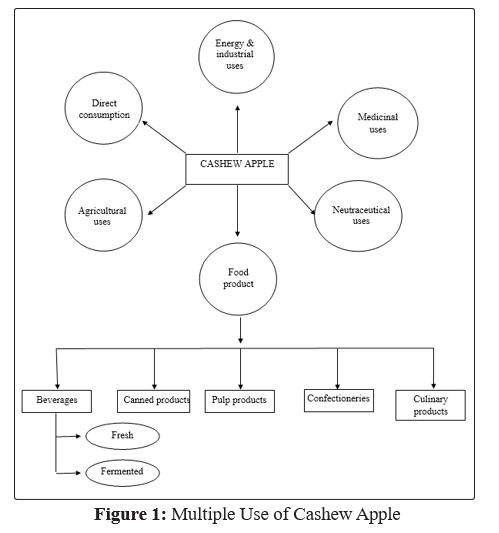
An overview of the multiple uses of cashew apple is given in Figure 1. The figure depicts the large number of uses of cashew apple unlike other common fruits. Traditionally, several products are prepared from cashew apple, including those with medicinal properties.
Cashew apple contains 85% juice, 10% of which is sugar [3]. The chemical composition of cashew apple is : Moisture 86.3% , protein 0.2%, fat 0.1%, carbohydrate 12.3 %, crude fibre 0.9%, calcium 10.0 mg/100g, phosphorous 10.0 mg/100g, iron 0.2 mg/100g, vit C 180mg/100g, minerals 200.0 mg/100g, thiamin 0.02 mg/100g, riboflavin 0.05 mg/100g, nicotinic acid 0.4 mg/100g and carotene 23µg/100g . Akinwale et al., reported that cashew apple juice had the highest vitamin C content (203.5 mg per 100g) when compared to other common fruit juices [4]. Vitamin C content of unsteamed cashew apple juice was reported to be 287mg/100g [5].
There are many medicinal uses for cashew apple and juice. Cashew apple liquor is used as a cure for cold, body ache, fever, toothache, fresh wounds and cuts. Cashew apple powder lipids are rich in unsaturated fatty acids, the major ones being palmitoleic and oleic acids. A valuable by- product that can be obtained from cashew apple waste is pectin. Pectin is used in manufacturing jams, jellies, marmalades, preserves etc., [6].
Entrepreneurship Development in Cashew Apple Processing Sector Generally, cashew nut is considered as the only economic produce from the crop. Research studies as well as experiences running in India’s first cashew apple processing unit at Cashew Research Station, Madakkathara, Thrissur, and Kerala have clearly revealed that the cashew apple, is an equally valuable produce from crop, if it is economically exploited. In spite of its high nutritive value, it is quite unfortunate that the country is wasting such an excellent fruit causing economic loss both to the farmers and the nation.
Cashew Research Station Madakkathara has succeeded in commer-cializing eight value added products from cashew apple. Efforts bestowed in this line enabled the commercial production of different fermented and non fermented products viz; syrup, RTS beverages, jam, pickle, chutney, candy, wine, alcohol, vinegar etc., [7-9].
Processing of cashew apple is an economically viable enterprise in cashew growing tracts. Women Self Help Groups can very well take up this enterprise, thereby effectively contributing to the cause of women empowerment. If legal permission is available for production of fermented products like alcohol and wine, it can substantially enhance the income from cashew apple processing. There is also a vast untapped export market for the cashew apple products.
Infrastructure development is the primary requirement for starting any processing unit. Cashew apple production being seasonal, en¬suring availability of raw material round the year for full utilization of infrastructure capacity is the basic necessity. Processing of locally available fruits and vegetables along with cashew apple can solve this problem. Cashew apple based processing unit can be an effective driving force for rural development.
Value Added Products of Cashew Apple
A. Beverages
a. Fresh apple beverages
Clarified and cloudy juice, juice concentrate, syrup, squash and ready- to- serve drink are some of the nutritious and refreshing beverages that can be made from the unfermented juice of cashew apple by adding varying concentrations of sugar, citric acid and preservative. The Kerala Agricultural University has standardized the technique for the preparation of juice, syrup, carbonated drink and ready to serve beverage.
b. Fermented beverages
Cashew apple can be utilized for the manufacture of fermented prod¬ucts like wine, vinegar, liquor and alcohol. Cashew apple vinegar can be prepared by alcoholic and subsequent acetic fermentation of juice, which is perhaps the oldest known fermentation product.
Cashew liquor is made by distillation of the pure juice of cashew apple without addition of any extraneous matter. One liter of 60-62% ethyl alcohol can be obtained from eight liters of cashew apple juice. Kerala Agricultural University has standardized the method of producing four different grades of liquor from cashew apple.
In Goa, the cashew apple is used in the manufacture of fermented beverages. Cashew apple juice is extracted and kept for fermenta¬tion for a few days. Fermented juice is then double distilled and the resulting beverage is called feni or fenny. Feni has about 40-42% alcohol. The single-distilled version is called urrac, which has about 15% alcohol.
In the southern region of Mtwara, Tanzania, the cashew apple is dried and stored. Later it is reconstituted with water and fermented, then distilled to make strong liquor often referred by the generic name, gongo. In Mozambique, cashew farmers commonly make a strong liquor namely agua ardente (burning water) from cashew apple [6].
Cashew wine is a product of fermentation of hexose sugar of cashew apple juice by intact yeast cells to form ethyl alcohol and carbon dioxide. Kerala Agricultural University has developed methods for producing four grades of wine such as soft, medium, hard and sweet, based on the alcohol percentage and sweetness.
Cashew apple wine can be mixed with fresh juices of orange, pine¬apple, tomato, grape and cashew apple as well as tender coconut water to produce wine coolers to serve as good health drink as they contain both wine with its medicinal properties and fruit juices with high amount of nutrients and minerals.
B. Products from Cashew Apple Pulp
Jam is the most important pulp product of cashew. It can be prepared by boiling the cashew fruit pulp with sufficient quantity of sugar and a pinch of citric acid to a reasonably thick consistency. Mixed fruit jam can also be prepared by mixing cashew apple pulp with equal quantity of banana pulp, mango pulp or pineapple pulp. The Madakkathara Centre is commercially producing Cashew apple-Mango mixed jam named Cashewman.
Fruit bar having 800 brix can be prepared by heating layers of fruit pulp mixed with pectin, sugar, glucose and potassium metabisulphite to 90°C and drying to 15% moisture. Different layers of cashew apple paste mixed with 1% citric acid are sun dried and cut into required size after placing one on top of the other to form leather. The layers, after smearing sugar syrup and pressed together, can be eaten like fruit wafers.
C. Confectionery products
Candied fruit is prepared from cashew apple by impregnating with cane sugar with subsequent draining and drying. One kilogram of cashew apple on processing gives 745 g candies. The Madakkathara Centre is commercially producing cashew apple candy. The syrup left over from the candying process can be used for sweetening chutneys, in vinegar making or for candying another batch of fruits.
Cashew apple can also be utilized for the preparation of tutty fruity. One kilogram of cashew apple on processing gives 715 g tutty fruity. The whole fruit can also be processed in to nutritious toffee, a feasible dessert item with extended shelf life. Cashew apple juice can be used for preparing frozen desserts and dairy/ confectionery items by optimization of juice concentration and spray drying. The only constraint here is the large capital investment required for spray drier equipment.
Ready- to- serve beverage mix, fruit–milk/ milk shakes, ice creams, ice candy mix, etc can be prepared from clarified juice by homogeni-zation, spray drying and mixing with fruit /milk powder as required.
Osmotic dehydrated cashew apple is a novel value added prod-uct developed from the cashew apple. Sugar has been completely replaced with honey in preparation of this product, hence having medicinal property with no side effect of sugar. Thus, it is possible to make the seasonal fruit available to the consumers throughout the year. One Kg of good quality fresh cashew apple on processing gives about 200g of osmotically dehydrated cashew apples.
D. Culinary products
Sliced raw green fruit can be used to prepare pickle using chili powder, gingelly oil, fenugreek powder, asafoetida, turmeric pow-der, garlic, mustard powder, a pinch of sodium benzoate and salt to taste. Chutney can be prepared from sliced cashew apple using sugar, onion, ginger, cumin, pepper, cardamom, cinnamon, coriander powder, salt, vinegar etc.
Several traditional culinary preparations are in vogue in cashew growing areas using both unripe and ripe cashew apples.
Post harvest handling of cashew apple
Desired qualities of cashew apple for processing are medium to large fruit size with more than 70 % juice, juice containing more than 11 % sugar and 0.39 - 0.42 % acidity and sugar content more than 13 %. Crisp, firm, tight and full colour developed apples are to be collected and used for processing purpose; riper the fruit, the sweeter it will be. The apples are to be collected every day when it falls to the ground and if the apples are left un-gathered for some time, rotting of cashew apples takes place. Once damaged, the apples may ferment and deteriorate rapidly. After harvesting, fruits are to be sorted to select the best quality ones. The selected fruits are washed with water in different ways, such as soaking or washing with cold or hot water sprays.
Cashew apple utilization-Generating wealth from waste
Depending upon the quantity of juice required, the extraction can be done either manually or mechanically. For domestic purposes, extraction by hand pressing will serve the purpose. Mechanical extraction by hydraulic press or screw press, or juice expeller, saves labour and ensures increased recovery of juice and hence is preferred for commercial processing.
Astringency in Cashew Apples and Its Removal
The presence of astringent and acrid principles in cashew apple produces a rough, unpleasant and biting sensation on the tongue and throat. The astringency of the cashew apple is determined to a large extent by the presence of phenolic compounds, such as tannins, oily substances and anacardic acid and cardol.
Removal of Astringency
Removal of components responsible for astringency, from whole or sliced cashew apples (ripe/green) is known as de-tanning. Clarifica¬tion is the process of removal of astringency from cashew apple juice.
De-Tanning of Cashew Apples
The efficient method of de-tanning of whole ripe cashew apple, for making preparations such as jam, candy, chutney is as follows. The cleaned ripe whole cashew apples are immersed in 5% salt solution for 3 days. To ensure full immersion, keep weight of glass or stainless steel. The salt solution is to be changed daily. The fruits, which are taken out on the 4th day are washed thoroughly in water and can be used for product preparation.
De-Tanning of Whole Green Cashew Apples
The method standardized for de-tanning of green cashew apples for pickle preparation involves cutting of selected raw green fruits into small pieces, washing and keeping in 8% salt solution for 3 days with changing salt solution daily. The fruits taken out on the fourth day can be used for product preparation after washing with water.
Clarification of Cashew Apple Juice
Clarification of cashew apple juice can be done using either 2.5 to 4.0g gelatin dissolved in hot water or 125 ml of rice gruel or 5g of sago per litre of juice. Cashew Research Station, Madakkathara has developed effective low cost and organic technology for the removal of tannin by using sago.
Calcium hydroxide or pectin can also be used for clarification. Any one of the above materials is added, stirred and allowed for settling for required time ranging from 2-3 hours to overnight. The clarified clear juice is decanted without disturbing the sediments.
Utensils for cashew apple processing
Stainless steel vessels are to be used for cooking. Iron, copper, alumi¬num and brass containers should never be used as it will blacken the products. Food grade plastic barrels and containers are to be used to store cashew apple juice. Plastic buckets and trays are to be used for cleaning, sorting and, de tanning of cashew apples. Jars and bottles of clear white glass, which can withstand heating, are preferred for storage of raw materials or products. Though, glass containers are fragile and require extra care in handling, being visible, the contents can be easily displayed.
Storage of pulp and juice
In view of the seasonal nature of production, long term storage of cashew apples is required, either as juice or pulp, for off-season processing. Rapid deterioration of both pulp and juice demands its immediate preservation even for short term processing. To store as pulp, make de-tanned apple in to pulp and add preservatives. Juice can be stored either by sterilizing by heating or treating with preservatives. Heat treatment adversely affects flavour and imparts cooked taste and hence not preferred. Potassium Meta Bisulphite (KMS) can be used as preservative.
Storage of cashew apple pulp
The de-tanned cashew apple is steamed for 10-15 minutes in low pressure taking care not to become too soft. The black spots and parts of pedicel are removed from cooked fruit and made in to pulp by thorough agitation using mixer or pulper. Add 2.5 g Potassium Meta Bisulpbite (KMS) and 5.0 g citric acid for every kg of pulp and store air tight in food grade plastic barrel or glass bottles. Storage of cashew apple juice Add 2.5 g Potassium Meta Bisulphite (KMS) and 5.0 g citric acid, during the clarification process and stir well. Treated juice after sep- arating the tannin can be stored for long period, even up to one year.
Value added products of cashew apple developed at Kerala Agri-cultural University, Thrissur, Kerala, India
1. Cashew Apple Syrup
The clarified juice is siphoned out as the raw material for the prepa¬ration of syrup. Sugar and citric acid are added to the clarified juice in required quantity to produce syrup. Taste is better if served chilled. Syrup has a storage life of one year.
2. Cashew Apple Drink
The drink is an RTS (Ready – To -Serve) beverage. It is prepared by adding water and sugar to the required quantity of clarified juice. Drink is marketed both in glass bottles and in attractive food grade pouches. Pasteurized drink in glass bottles has a storage life of three months under ambient storage conditions.
3. Cashew apple carbonated drink
Cashew apple carbonated drink (soda) is made by adding chilled carbonated water at 100 psi pressure. Drink is marketed both in glass bottles and in attractive food grade pouches. Pasteurized drink in glass bottles has a storage life of three months under ambient storage conditions.
4. Cashew Apple- Mango Mixed Jam
The ripe apples are selected, cleaned and soaked in salt solution for three days to remove tannin. Apples are again washed in water, cooked, made into pulp and is mixed with equal quantity of mango pulp. Pulp is mixed with sugar and citric acid to prepare jam. It is marketed under the trade name Cashewman Mixed Jam.
5. Cashew Apple Candy
It is a sweet product and quality apples with good shape are selected for candy preparation. As in jam preparation, tannin is removed from apples, cooked, pierced using fork and dipped in sugar solution. Concentration of sugar solution is gradually increased so as to reach 700 brix. After two weeks of soaking, sugar solution is drained out and candy is dried in shade. It takes about 2-3 weeks for making the final product.
6. Cashew Apple Pickle
Mature but unripe cashew apples are collected directly from planta¬tions without disturbing the flowers and tender nuts. After cleaning, the fruits are cut into small pieces and astringency is removed by immersing in salt water. After removing from salt water, it is again washed and pickle is prepared using oil, chili powder, fenugreek powder, turmeric powder, ginger and garlic.
7. Cashew Apple vinegar
Vinegar is prepared from cashew apple juice by adding a little sugar and yeast to cashew apple juice and keeping for one week for alco¬holic fermentation. After one week, alcoholic ferment is got to which three times mother vinegar is added and again kept for 2 weeks. After this period the vinegar is ready with the acidity of 4-5 %.
8. Cashew apple chocolate
Cashew apple powder is used to make chocolate, by adding sugar, milk powder and ghee in appropriate proportions.
9. Cashew apple biscuit
Cashew apple biscuit is prepared using cashew apple powder, ghee, sugar and maida in required quantities and further baking.
10. Cashew apple wine
Wine is a fermented product from cashew apple. This is made by mixing cashew apple, sugar, clove and Luke warm water after add¬ing starter solution. Starter solution is prepared by adding 5g yeast to 10 g sugar and keeping for half an hour. The mixture should be kept in glass bottles or clay pots for 21 days with daily shaking. Then, the solution is strained and again kept for 21 days by which time the wine is ready.
11. Cashew apple squash
For making cashew apple squash, sugar and citric acid are added to water and boiled. After cooling the sugar solution, clarified juice is added, strained, bottled and sealed. This can be diluted to three times for drinking.
12. Cashew apple bar
Cashew bar is prepared from the pulp by adding 40% sugar.
13. Cashew halva
Halva is made from cashew apple pulp by adding coconut milk, sugar and ghee.
14. Cashew apple pudding
Cashew apple pudding is another confectionery which is prepared by mixing cashew apple powder, sugar, milk and gelatin along with vanilla essence.
15. Osmodehydrated Cashew Apple
The process involves dehydration of cashew apple in three stages. Osmotic dehydration, in which fruits are subjected to osmosis by dipping them in aqueous honey syrup under specific conditions followed by dehydration wherein the fruits are dried to 15-20% moisture by air and oven drying and then packaging in flexible laminated pouches filled with nitrogen. It is a value added product from cashew apple with complete replacement of sugar with honey and a ready to eat snack.
Other Uses of Cashew Apple
1. Conversion to Vermi Compost
The pomace or the waste after the extraction of the juice can be converted to vermicompost with the help of earth worm, Eudrillus euginae,with high manurial value of 1.69 % N, 0.44 % P and 0.58 % K. it is also a good ameliorant for acidic soils, since pH is 8.9.
2. As Animal Feed
Ripened apple or residue can be converted to cattle, pig and poultry feed. Apples/residues are dried and subjected to anaerobic ensiling is preserved as cattle feed for rainy season/long storage.
3. Bio Fuel
There is a great scope to utilize cashew apple for production of alcohol to be used as a bio fuel. The residue, after extracting juice for feni preparation, is used as fuel in liquor industry in Goa.
4. Biogas
Ripened fruits as well as fruit waste can be used as raw material for biogas plant.
5. Tannin Extraction
Cashew peel can be used for the extraction of tannin.
Conclusion
Processing of cashew apple is to be considered as a programme of agricultural waste utilization, adding income to the growers. The excellent qualities of cashew apple offer immense opportunities for its processing to various value added products. Commercial exploitation of cashew apple is the need of the hour considering its vast potential in enhancing the income from cashew plantations. It is one of the prime areas of utilizing the indigenous fruit and opens up wider market possibilities and hence tremendous scope for commercialization. The running of the cashew apple processing unit at CRS, Madakkathara under Kerala Agricultural University for the commercial production, clearly demonstrates the economic viability of cashew apple processing.
References
- Attri BL (2009) Effect of initial sugar concentration on the physico-chemical characteristics and sensory qualities of cashew apple wine. Natural Product Radiance 08: 374-379.
- Narayanankutty MC and Augustine A (2009) Cashew apple-quality attributes and its utilization. In: Cashew Research and Development in Humid Tropics (Eds: Jose Mathew, Mini, C and Abraham, M, 2009), KAU, Vellanikkara pp.137-142.
- Sobhana A, Mathew J, Mini C and Pushpalatha PB (2013) Technologies for cashew apple utilization on commercial scale. Souvenir, National Conf. on Cashew pp. 65-71.
- Akinwale TO, Olubamiwa O and Ajav EA (2001) Cottage processing of cashew apple juice in Nigeria: physico-chemical and sensory evaluation of product. J. Food Technol. Africa 6: 56-58.
- Inyang UE and Abah UJ (1997) Chemical composition and organoleptic evaluation of juice from steamed cashew apple blended with orange juice. Plant Food Hum Nutr 50: 295-300.
- Sobhana A and Mini C (2018) Entrepreneurship Ventures in Cashew Processing. In Entrepreneurship and Skill Development in Horticultural Processing. (Eds. Sudheer KP and Indira P) New India Publishing Agency, New Delhi p: 140-159.
- Vijayakumar P (1991) Cashew apple utilization-a novel method to enhance the profit. The Cashew 5: 17-21.
- Mathew J, Gregory Zachariah & Mini C (2008) Economic potentials of tuber crops for intercropping in young cashew plantaions. J Plantation Crops 36: 366-367.
- Mini C & Mathew J (2007) Multi uses of cashew apple. Proceedings of 6th National Seminar on Indian Cashew in the next decade- challenges and opportunities, Raipur pp: 45-52.