




Case Report - (2023) Volume 8, Issue 1
Case Report of Protruded Implantable Cardiac Device through Chest in 50 Years Old Male
Received Date: Feb 10, 2023 / Accepted Date: Feb 17, 2023 / Published Date: Feb 20, 2023
Copyright: ©Ahmed AlShudukhi, et, al. This is an open-access article distributed under the terms of the Creative Commons Attribution License, which permits unrestricted use, distribution, and reproduction in any medium, provided the original author and source are credited.
Citation: Alrajhi, A., Sultan, M. A., Alotaibi, L., AlShudukhi, A. (2023). Case Report of Protruded Implantable Cardiac Device through Chest in 50 Years Old Male. Cardio Open, 8(1), 22-23.
Abstract
Background: Implantable cardiac defibrillators use has been increasing for the last two decades and they are prone to infections. ICD device infection risk factors are many, some are host related while the others are procedures related. Staphylococcus aureus and staphylococcus epidermidis are accountable for 65 to 75% of the total cases of Implantable cardiac devices infections.
Case Presentation: A 50 years old male presented to our emergency department with ICD pocket migrated through the skin. The symptoms started over 2 weeks, started as gradual feeling of foreign body moving underneath the skin, associated with mild pain and 3 days before presentation, the ICD penetrated the skin. The patient denied any history of fever, bleeding, pus discharge, palpitations, abnormal shocks or syncope. He was admitted to the hospital, treated for a presumed infection and his ICD device was removed.
Conclusion: ICD devices complications are many, including infections. But, to have an infected device protruded through the skin is not a common presentation. We outlined the approach that was taken for this patient and his management in order to enhance the literature in terms of the above mentioned rare presentation.
Keywords
Implantable Cardiac Device (ICD), Pocket Infection, Device Immigration, Skin Infection, Foreign Body
Case Presentation
A 50 years old male presented to our emergency department with ICD pocket migrated through the skin. The symptoms start- ed over 2 weeks, started as gradual feeling of foreign body mov- ing underneath the skin, associated with mild pain and 3 days before presentation, the ICD penetrated the skin. The patient de- nied any history of fever, bleeding, pus discharge, palpitations, abnormal shocks or syncope.
Picture
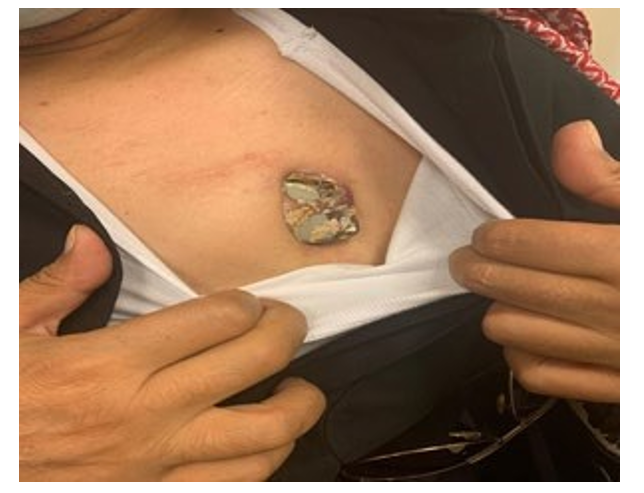
The patient presented in stable condition, vitally stable, upon examination he is conscious and oriented. Cardiac examination unremarkable. Skin examination shows battery of ICD bulging through skin as shown in (Figure), no signs of skin infection, and other systems unremarkable. His past medical history includes PAD on medical therapy, Ischemic-CMP, STEMI on 2018 PCI to LAD and staging to PDA and RCA done in Kuwait and ICD insertion, diabetes mellitus and hypertension. The past surgical history was positive for PCI and ICD insertion.
Hospital Course
Initial labs and ECG at emergency department shows Hemoglo- bin 122g/dL, No leukocytosis, Creatinine 173mg/dL, hyperka- lemia 5.8mmol/L. Cardio Open, 2023
ECG interpretation Shows
Sinus rhythm at rate 69 bpm, with 1st degree A-V block Antero- lateral infarct, age undetermined. Cardiology team admitted the patient as a case of ICD pocket infection and migration. Septic workup including wound culture sent .Started on ceftazidime and vancomycin as per ID recommendation. Septic and wound culture came back negative.
Underwent Tran’s Esophageal Echocardiogram (TEE) to rule out IE which showed:
• The left ventricle is mildly dilated.
• Left ventricular systolic function is moderately reduced. Ejec- tion fraction = 35-40% LV Filling pressure Raised
• There are regional wall motion abnormalities as specified c/w LAD territory infarct.
• The right ventricle is normal in size and function.
• The left atrium is moderately dilated.
• There is mild to moderate mitral regurgitation.
• There is mild tricuspid regurgitation.
• Right ventricular systolic pressure is elevated at 40-50mmHg.
• Mild atherosclerotic plaque(s) in the aortic arch.
• There is no pericardial effusion.
Underwent ICD removal on 31/12/2020 successfully
Intra-Operative TEE Showed
• There is large and mobile thrombus is noted on the atrial seg- ment of the pacer wire.
• No thrombus is detected in the left atrium or atrial appendage.
• There is no evidence of vegetation’s on cardiac valves.
• There is no pericardial effusion.
Underwent another ICD implantation on 13/01/2021, was dis- charged on stable condition after
Overview
Implantable cardiac devices use has been increasing for the last two decades. This term include pacemakers, implanted cardiac defibrillators, and cardiac resynchronization therapy devices.
Risk Factors
ICD device infection risk factors are many, some are host related while the others are procedures related. End stage renal disease, malignancy and diabetes are some of the host related risk factors. While procedure duration, revision or use of temporary pacing before the procedure can also increase the risk of infection.
Epidemiology
Staphylococcus aureus and staphylococcus epidermidis are ac- countable for 65 to 75% of the total cases of Implantable cardiac devices infections. Incidence of Implantable cardiac defibrillator (ICD) infections is around 1.9% in a lifetime. Where the risk dif- fers for other cardiac devices such as pacemakers 1.2%, where it reaches up to 3.4% for Cardiac resynchronization therapy de- vices [1].
Management
Implantable cardiac devices infections can cause systemic or pocket infections. Endocarditis with bacteremia is a common systemic manifestation while pain, purulent discharge or erosion through the skin are manifestations of pocket infection. The pa- tient management should include bacterial and fungal infection coverage. Also the infected device must be removed with the reinsertion of the new device to be inserted through an uninfect- ed route [2].
Declarations
Ethics approval and consent to participate:
• The project was submitted to Research Approval Committee (RAC) committee in the research center in King Faisal Special- ist Hospital & Research Centre.
• Certify that the Case study was performed in accordance with the ethical standards as laid down in the 1964 Declaration of Helsinki and its later amendments or comparable ethical stan- dards.
• Written Informed consent was obtained from the patient for participation in the study and case publication.
Consent for publication
Written Informed consent was obtained from the patient for par- ticipation in the study and case publication.
Availability of Data and Materials
The Data that support the findings of this study are available from the corresponding author upon reasonable request.
Authors' Contributions
All authors contributed to the study conception and design. Ma- terial preparation, data collection and analysis were performed by Abdulaziz Alrajhi, Mohammed AL sultan, Lama Alotaibi and Ahmed AlShudukhi. The first draft of the manuscript was writ- ten by Abdulaziz Alrajhi, Mohammed AL sultan, Lama Alotaibi and Ahmed AlShudukhi and all authors commented on previous versions of the manuscript. All authors read and approved the final manuscript.
References
- Karchmer, A., Chu, V., & Dardas, T. F. (2022). Infections involving cardiac implantable electronic devices: Epidemi- ology, microbiology, clinical manifestations, and diagnosis.I. Baron, L., Dardas, T. (Ed.), UpToDate. March, 31, 2022.
- Karchmer, A., Chu, V., & Dardas, T. F. (2021). Infections involving cardiac implantable electronic devices: Treatment and prevention. In I. Baron, L., Dardas, T. (Ed.), UpToDate. May 21, 2021.