

Journal of Veterinary Health Science(JVHS)
ISSN: 2831-3887 | DOI: 10.33140/JVHS

Impact Factor: 0.762

Review Article - (2025) Volume 6, Issue 1
Can Coal-Fired Thermal Power Plants in India Cause Industrial Fluorosis in Domestic Animals? Livestock Owners are Unaware
Received Date: Apr 07, 2025 / Accepted Date: May 12, 2025 / Published Date: May 22, 2025
Copyright: ©©2025 Shanti Lal Choubisa. This is an open-access article distributed under the terms of the Creative Commons Attribution License, which permits unrestricted use, distribution, and reproduction in any medium, provided the original author and source are credited.
Citation: Choubisa, S. L. (2025). Can Coal-Fired Thermal Power Plants in India Cause Industrial Fluorosis in Domestic Animals? Livestock Owners are Unaware. J Vet Heal Sci, 6(1), 01-07.
Abstract
Fluorosis usually develops in domestic animals that are continuously exposed to a potential source of fluoride over a long period of time. In India, thousands of domestic animals of different species, such as cattle (Bos taurus), water buffalo (Bubalus bubalis), sheep (Ovis aries), goats (Capra hircus), camels (Camelus dromedarius), horses (Equus caballus), and donkeys (E. asinus) suffer from fluorosis due to drinking fluoridated water. But in these species, industrial fluorosis can also develop due to exposure to industrial fluoride emissions or pollution. In the country, there are more than 300 coal-based thermal power plants (TPPs) for power generation. These require coal to operate. Burning of coal in these thermal power projects releases various types of poisonous gases, including fluoride-containing gases like HF, SiF4 , and CF4 , which spread in the surrounding environment and contaminate freshwater reservoirs, forest vegetation, agricultural crops, soil, grasslands, air, etc. The fly ash and fly ash pond of TPP also contain fluoride, up to 12.6 mg/kg and 9.94 ppm, respectively, which causes fluoride contamination of freshwater and groundwater in the surrounding areas. If animals drink such fluoride contaminated water, they also develop hydrofluorosis. Due to fluorosis (hydro and industrial fluoroses), teeth and bones of animals get severely damaged. Many animals also become severely weak and lame due to this. This also affects the productivity of animals, which has a deep impact on the economy of livestock farmers. But livestock farmers around TPPs do not know that TPPs can also cause fluorosis disease in their domesticated animals. However, there is a need for detailed research on industrial fluorosis due to TPPs in the country. In the present communication, the current status of TPPs in India and the fluoride contamination and industrial fluorosis in domestic animals caused by them are briefly reviewed and the research gaps are also highlighted. This review will be useful in planning health policy to protect animals from chronic fluoride poisoning caused by fluoride emissions from TPPs in the country.
Keywords
Domestic Animals, Coal, Fluoride Emission, Fluoride Poisoning, Freshwater, Groundwater, Health, Industrial Fluorosis, Thermal Power Plants (TPPs)
Introduction
In India, the main cause of fluorosis in human and animals, especially in rural areas, is due to drinking of fluoridated water for prolonged period [1,2]. In the country, almost all drinking groundwater sources such as hand- pumps, bore- wells, and deep dug- wells in rural areas are contaminated with fluoride [3]. Many of them have fluoride levels higher than the recommended level of 1.0 mg/l or even 1.5 mg/l [1,4,5]. Hence, millions of people in the country suffer from fluorosis (hydrofluorosis) due to consumption of water from these sources for drinking and cooking. However, endemic hydrofluorosis in humans has been widely studied in the country, especially in the tribal areas of Rajasthan state where almost all drinking groundwater sources are contaminated with high levels of fluoride [6-16]. The important thing is that due to easy availability of water from these drinking water sources in rural areas, most of the livestock owners started providing water from these groundwater sources to their domestic animals such as cattle (Bos taurus), water buffalo (Bubalus bubalis), sheep (Ovis aries), goat (Capra hircus), horse (Equus caballus), donkey (E. asinus). This results in the development of hydrofluorosis in these animals [17-27], which causes heavy financial losses to the livestock farmers [28-30]. Thousands of animals in India are suffering from this disease. But livestock owners are hardly aware of this.
The second biggest cause of chronic fluoride poisoning or fluorosis in humans and animals in the country is industrial fluoride emission or pollution from coal-burning industries such as thermal power plants (TPPs) and brick kilns [31-33]. However, some industries producing steel, iron, aluminium, zinc, phosphorus, chemical fertilizers, glass, plastics, cement and hydrofluoric acid are also responsible for fluoride pollution in the country [1,34]. This industrial fluoride is released into the environment around them which ultimately contaminates freshwater sources, soil, air, agricultural crops, forest vegetation, etc. Prolonged exposure to this industrial fluoride pollution easily leads to the development of fluorosis (industrial fluorosis) in humans [35-37] and animals [38-45]. Generally, industrial fluorosis is restricted to the areas around TPPs. Recent studies have also shown that continuous exposure to fluoride pollution adversely affects various species of agricultural and horticultural crops. This results in the destruction of the crop yields and causes huge economic losses to farmers [46,47]. However, in the country, no comprehensive research has been done on industrial fluorosis in domestic animals due to TPPs. This is urgently needed. In the present communication, the current status of TPPs in India and the fluoride contamination and industrial fluorosis in domestic animals caused by them are briefly reviewed and the research gaps are also highlighted. This review will be useful in planning health policy to protect animals from fluorosis caused by fluoride emissions from TPPs in the country. The author also aims to draw the attention of concerned departments, veterinarians, national animal health policy makers, and environmentalists to the industrial fluorosis in domestic animals due to exposure to fluoride emissions from these coal-fired TPPs in the country.
Current Status of TPPs in India
There are about 300 coal-based thermal power plants (TPPs) in operation in India for electricity generation [48]. They require continuous supply of fossil coal fuel and freshwater for their operation. Hence, most of the TPPs are located at a place where both are easily available. This is the reason why most of the TPPs in India are located near perennial freshwater reservoirs such as dams, rivers, lakes, large ponds, etc. (Figure 1a-c). But it is not necessary that coal mines are usually found in the vicinity of TPPs. However, TPPs located in areas like Singrauli in central India have both coal mine and large reservoir available which is one of the ideal areas for setting up TPPs in the country. This region shares the border of three states i.e. Uttar Pradesh in the north, Madhya Pradesh in the west and south and Chhattisgarh in the east. Three major super thermal power stations are located in this region, viz. Singrauli, Vindhyachal, and Rihand. These plants use coal obtained from local mine and water from the Rihand reservoir. Agricultural and horticultural crops, grasslands, and forest vegetation are also found around many TPPs in the country, on which not only domesticated animals but also wild herbivorous animals usually depend for their food (Figure 1a-c).
Fluoride Contamination from TPPs
A total of 859.25 million tons of fossil coal is required annually to run TPPs in the country [49]. These natural coals contain traces of fluorine/fluoride. In most of these coals, the fluoride concentration range is found to be between 20–500 μg g−1, with an average value of about 150 μg g−1 [50–52]. In Indian coals, the fluoride range is generally between 10−20 g/ton [53, 54]. These coals are burned in TPPs to produce electricity or power. With the combustion of coal, several fluoride-containing toxic gases, such as hydrogen fluoride (HF), silicon tetrafluoride (SiF4), and carbon tetrafluoride (CF4), are emitted into the atmosphere [50,52]. These fluoride-containing gases (industrial fluoride emissions) not only contaminate soil, air, and freshwater sources, but also grasslands, agricultural and horticultural crops, and forest vegetation found around TPPs. These industrial fluoride emissions can also contaminate food grains and crop fodder on which humans and animals generally depend for their food, respectively. All these fluoride contaminated sources are potential sources of fluoride exposure for both humans and domestic animals.
Interestingly, in addition to fluoride emissions, these coal-based TPPs also generate about 233 million metric tons of coal fly ash annually in the country. This figure is constantly rising, with forecasts suggesting it could exceed 300 million tons by 2025 [55]. This represents a significant environmental challenge due to the need for land-based disposal and the potential for heavy metal and fluoride leaching into groundwater. Fly ash is a fine powder generated as the primary byproduct of coal combustion, accounting for about 80% of the total coal ash generated while the remaining 20% is bottom ash. This fly ash is also rich in fluoride, nevertheless, the amount of which depends on the quality of coal. Generally, the fluoride content in fly ash ranges from 0.73 to 1.27 ppm. However, some studies have also shown that fluoride levels in fly ash from some Indian power plants can be as high as 12.6 mg/ kg [56]. This fluoride-rich fly ash is usually transported in dry form or as a wet slurry to silos or ash ponds near the TPP, respectively.
Wet slurry or fly ash ponds are also potential sources of fluoride contamination. Through leaching from fly ash, fluoride can be released into soil and water, which eventually reaches groundwater aquifers. Slurry water from ash ponds is typically discharged into freshwater reservoirs located near TPPs, which leads to freshwater being contaminated with fluoride. Fluoride in slurry water from ash ponds of some TPPs has been reported to be >10.0 ppm [56]. Similarly, fluoride in reservoir water near TPPs in Singauli area has been found to be around 5.0 ppm [56]. These fluoride contaminated groundwater and freshwater are potential sources of fluoride exposure to both humans and animals, which may cause hydrofluorosis in them (Figure1c).
Can Coal-Based TPPs Cause Industrial Fluorosis in Domestic Animals?
Yes, domestic animals can certainly develop industrial fluorosis if they are repeatedly and over a long period of time exposed to fluoride emissions from coal-fired TPPs. The disease has also been observed in sheep and other species of domestic animals that graze and live near coal-fired TPPs [57-59]. Even people living near coal-fired TPPs can develop chronic fluoride toxicosis if they are exposed to fluoride pollution. Animals can also develop fluorosis if they drink surface and groundwater contaminated with fluoride due to fly ash ponds or slurry water for a long time.
Whether domestic animals are suffering from chronic fluoride poisoning due to chronic exposure to industrial fluoride emission or pollution and fluoridated water can be known by the assessment of fluoride in their urine [60,61]. However, examination of teeth of immature animals is also one of the ideal methods for confirmation and evidence of chronic fluoride poisoning in animals. If the teeth of these animals show evidence of hypocalcification or discoloration, it indicates that the animal is suffering from chronic fluoride poisoning also known as dental fluorosis. This entity is the earliest visible pathognomonic or clinical sign of chronic fluoride poisoning in animals, characterized by the presence of bilateral striated, condensed or diffused, and horizontal light to dark brown staining stripes of varying degrees on the surface of the anterior teeth (Figure 2) [61]. In some animals, it may also appear as brownish black spots, patches, and fine dots on tooth enamel. In some children, this type of dental fluorosis is also found to be caused by long-term fluoride exposure. But sometimes researchers get confused about the presence of this type of dental fluorosis. While it is caused by chronic fluoride poisoning.
In animals, excessive bioaccumulation of fluoride in bones causes various pathological changes in the skeletal bones known as skeletal fluorosis which is more dangerous and highly painful [62]. Skeletal fluorosis ultimately reduces mobility of animals at a very young age by various changes in their bones such as periosteal exostosis, osteosclerosis, osteoporosis, and osteophytosis [63-65]. These changes appear clinically as unexplained aches and pains in the muscles and joints associated with stiffness, small body growth, and recognizable bone lesions (Figure 3) [62]. Excessive bioaccumulation of fluoride in muscles also reduces activities or movements in animals and this condition causes lameness in them. Development of lameness in animals also shows evidence of chronic fluoride exposure.
Animals suffering from fluorosis also develop certain health problems or issues such as muscle/body weakness, frequent drinking of water (polydipsia), frequent urination tendency (polyuria), digestive problems (loss of appetite, bloating, abdominal pain, constipation, intermittent diarrhea, etc.), reproductive problems (irregular reproductive cycles, abortions, stillbirths, etc.), allergies, aneamia, etc. [61, 66, 67]. However, it is not necessary that all these health problems are found in the same animal suffering with chronic fluoride intoxication. However, these health results are helpful in diagnosing fluorosis at an early stage. They can give an initial idea whether the animal is suffering from ill effects of chronic fluoride poisoning or not. The severity of industrial fluoride poisoning in animals also depends on several determinants or factors such as age, diet, nutrients, chemicals in water, environment, individual sensitivity, tolerance, and genetics, etc. [68-72]. However, bovines are more susceptible to chronic fluoride intoxication or industrial fluorosis [73]. Industrial fluorosis also significantly affects the body health and productivity of livestock, often causing heavy financial losses to livestock farmers.
Conclusion
There are more than 300 coal-burning thermal power plants (TPPs) in operation in the country which continuously emit fluoride into the atmosphere contaminating water, soil, air, horticultural and agricultural crops, grasslands and forest vegetation in their vicinity. Fluoride emissions from TPPs and fluoride contaminated these natural sources are potential sources of fluoride exposure. If domestic animals living and grazing in the vicinity of TPPs are exposed to any of these potential sources of fluoride for a long time, they will be affected by fluoride poisoning in the form of industrial fluorosis. But most livestock keepers are not aware of this. This disease can also develop in humans if they are continuously exposed to industrial TPP fluoride pollution. Very limited studies have been done on industrial fluorosis in domestic animals due to exposure to fluoride emissions from TPPs in the country. This disease can also occur in wild animals. Hence, there is a dire need for such studies in the country. The present brief review will be very useful in formulating effective health policies on how to protect health of domestic animals from chronic fluoride poisoning or industrial fluorosis due to chronic exposure to fluoride emissions from TPPs in the country.
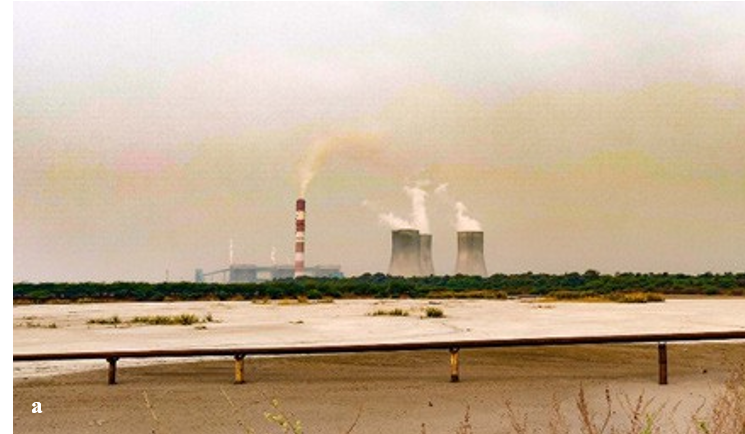
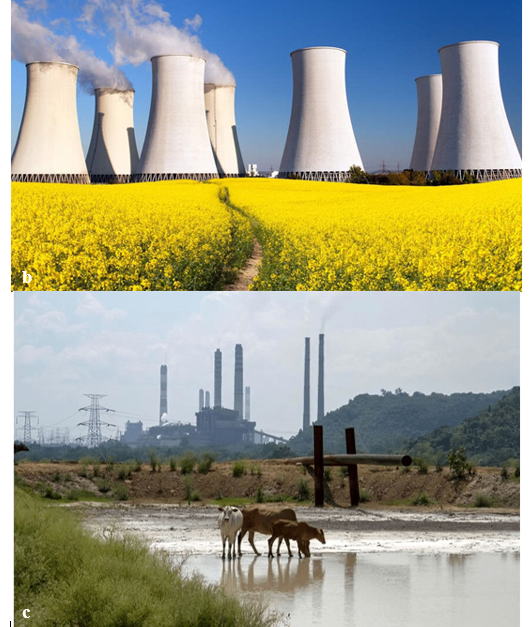
Figure 1a-c. Fluoride emissions and fly ash from TPPs and slurry water from fly ash pond are contaminating air, soil, freshwater reservoirs, agricultural crops, forest vegetation, and groundwater (a, b, and c). In Figure 1c, domestic animals are drinking fluoride-contaminated water, causing fluorosis.
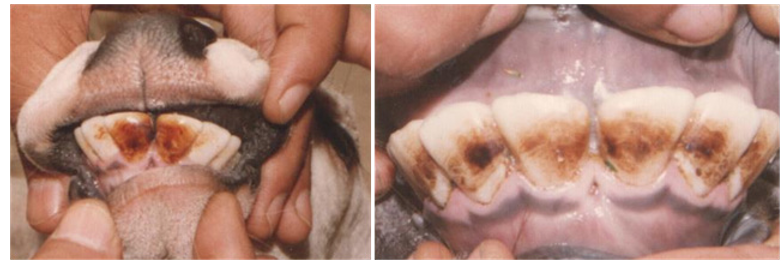
Figure 2. Dental fluorosis in bovine calves chronically exposed to fluoride is characterized by bilateral striated, dense, and horizontal deep brown mottled bands or strips on the surface of the anterior teeth.

Figure 3: Older buffaloes (B. bubalis) suffer from severe skeletal fluorosis due to long-term exposure to fluoride, characterized by weak bodies, bone lesions, and lameness in the hind legs.
Funding
No funding was received for this work.
Competiting Interest
The author has no conflict of interest.
Acknowledgement
The author thanks to Prof. Darshana Choubisa, Department of Prosthodontics and Crown & Bridge, Geetanjali Dental and Research Institute, Udaipur, Rajasthan 313002, India for help.
References
- Adler, P., Armstrong, W. D., Bell, M. E., Bhussry, B. R., Büttner, W., Cremer, H-D., et al. (1970). Fluorides and Human Health. World Health Organization Monograph Series No. 59. Geneva: World Health Organization.
- Choubisa, S. L. (2018). Fluoride distribution in drinking groundwater in Rajasthan, India. Current Science, 114(9), 1851-1857.
- Choubisa, S. L. (2018). A brief and critical review on hydrofluorosis in diverse species of domestic animals in India. Environmental Geochemistry and Health, 40(1), 99-114.
- I. C. M. R. (1974). Manual of Standards of Quality for Drinking Water Supplies. Special report series No. 44. Indian Council of Medical Research. New Delhi, India.
- B. I. S. (2012). Indian Standard Drinking Water-Specification. 2nd revision. New Delhi: Bureau of Indian Standards New Delhi, India. 2012. p. 2.
- Choubisa, S. L., Choubisa, D. K., Joshi, S. C., & Choubisa, L. (1997). Fluorosis in some tribal villages of Dungarpur district of Rajasthan, India. Fluoride, 30(4), 223-228.
- Choubisa, S. L. (1998). Fluorosis in some tribal villages of Udaipur district (Rajasthan). Journal of Enviornmental Biology, 19(4), 341-352.
- Choubisa, S. L. (1999). Chronic fluoride intoxication (fluorosis) in tribes and their domestic animals. International Journal of Environmental Studies, 56(5), 703-716.
- houbisa, S. L. (2001). Endemic fluorosis in southern Rajasthan, India. Fluoride, 34(1), 61-70.
- Choubisa, S. L., & Choubisa, D. (2015). Neighbourhood fluorosis in people residing in the vicinity of superphosphate fertilizer plants near Udaipur city of Rajasthan (India). Environmental Monitoring and Assessment, 187(8), 497.
- Choubisa, S. L. (2012). Fluoride in drinking water and its toxicosis in tribals of Rajasthan, India. Proceedings of the National Academy of Sciences, India Section B: Biological Sciences, 82(2), 325-330.
- Choubisa, S. L. (2018). A brief and critical review of endemic hydrofluorosis in Rajasthan, India. Fluoride, 51(1), 13-33.
- Choubisa, S. L. (2022). Status of chronic fluoride exposure and its adverse health consequences in the tribal people of the scheduled area of Rajasthan, India. Fluoride, 55(1), 8-30.
- Choubisa, S. L., Choubisa, D., & Choubisa, A. (2024). Are children in India safe from fluoride exposure in terms of mental health? This needs attention. Journal of Pharmaceutics and Pharmacology Research, 7(11), 1-6.
- Choubisa, S. L. (2025). A brief and critical review of longterm exposure to fluoride and its toxic health effects in tribal children in India. Journal of Clinical Medicine and Health Care, 2(2), 1-9.
- Choubisa, S. L., Choubisa, D., & Choubisa, A. (2023). Fluoride contamination of groundwater and its threat to health of villagers and their domestic animals and agriculture crops in rural Rajasthan, India. Environmental Geochemistry and Health, 45(3), 607-628.
- Choubisa, S. L. (1999). Some observations on endemic fluorosis in domestic animals in Southern Rajasthan (India). Veterinary Research Communications, 23(7), 457-465.
- Choubisa, S. L. (2007). Fluoridated ground water and its toxic effects on domesticated animals residing in rural tribal areas of Rajasthan, India. International Journal of Environmental Studies, 64(2), 151-159.
- Choubisa, S. L. (2010). Fluorosis in dromedary camels in Rajasthan, India. Fluoride, 43(3), 194.
- Choubisa, S. L., Choubisa, L., & Choubisa, D. (2010). Osteo-dental fluorosis in relation to age and sex in tribal districts of Rajasthan, India. Journal of Environmental Science & Engineering, 52(3), 199-204.
- Choubisa, S. L. (2013). Fluoride toxicosis in immature herbivorous domestic animals living in low fluoride water endemic areas of Rajasthan, India: an observational survey. Fluoride, 46(1), 19-24.
- Choubisa, S. L. (2013). Fluorotoxicosis in diverse species of domestic animals inhabiting areas with high fluoride in drinking water of Rajasthan, India. Proceedings of the National Academy of Sciences, India Section B: Biological Sciences, 83(3), 317-321.
- Kinkrawali, L., & Morzonda, N. (2013). Why desert camels are least afflicted with osteo-dental fluorosis?. Current science, 105(12), 1671.
- Choubisa, S. L. (2021). Chronic fluoride exposure and its diverse adverse health effects in bovine calves in India: an epitomised review. Global Journal of Biology and Agricultural Health Science, 10(3), 1-6.
- Choubisa, S. L. (2023). A brief review of endemic fluorosis in dromadary camels (Camelus dromedarious) and focus on their fluoride susceptibility. Austin Journal of Veterinary Sceince and Animal Husbandary, 10(1, 1-6, id 1117.
- Choubisa, S. L., Modasiya, V., Bahura, C. K., & Sheikh, Z. (2012). Toxicity of fluoride in cattle of the Indian Thar Desert, Rajasthan, India. Fluoride, 45(4), 371-376.
- Choubisa, S. L. (2023). Is drinking groundwater in India safe for human health in terms of fluoride?. Journal of Biomed Research, 4(1), 64-71.
- Choubisa, S. L. (2022). A brief review of chronic fluoride toxicosis in the small ruminants, sheep and goats in India: focus on its adverse economic consequences. Fluoride, 55(4).
- Choubisa, S. L. (2022). A brief and critical review of chronic fluoride poisoning (fluorosis) in domesticated water buffaloes (Bubalus bubalis) in India: focus on its impact on rural economy. Journal of Biomedical Research and Environmental Sciences, 3(1), 96-106.
- Choubisa, S. L. (2023). A brief and critical review of endemic fluorosis in domestic animals of scheduled area of Rajasthan, India: focus on its impact on tribal economy. Clinical Research in Animal Science, 3(1), 1-11.
- Choubisa, S. L. (2025). Are coal-based thermal power plants safe for human health in case of fluoride poisoning in India? People need to be careful and alert. Clinical Medical Reviews and Reports. Reference Number: CMRR-25-LE-263. (In-press).
- Choubisa, S. L. (2025). can smoke from coal-fired brick kilns in india cause fluorosis in domestic animals? if yes, then livestock owners need to be made aware. Biomediocal and Clinical Research Journal, 1(2), 1-7.
- Choubisa, S. L. (2025). risk of fluorosis and other health hazards in humans from coal-fired brick kilns in india: people need to be aware. Clinical Medical Reviews and Reports, 7(1), 1-7.
- Choubisa, S. L., & Choubisa, D. (2016). Status of industrialfluoride pollution and its diverse adverse health effects in man and domestic animals in India. Environmental Science and Pollution Research, 23(8), 7244-7254.
- Bhawsar, B. S., Desai, V. K., Mehta, N. R., Vashi, R. T. & Krishnamachari, K. A. V. R. (1985). Neighbourhood fluorosis in western India part II: population study. Fluoride, 18(2): 86-92.
- Desai, V. K., Saxena, D. K., Bhavsar B. S.,& Kantharia, S.L. (1988). Epidemiological study of dental fluorosis in tribal residing in fluorspar mines. Fluoride, 21(3), 137-141.
- Choubisa, S. L., & Choubisa, D. (2015). Neighbourhood fluorosis in people residing in the vicinity of superphosphate fertilizer plants near Udaipur city of Rajasthan (India). Environmental Monitoring and Assessment, 187(8), 497.
- Swarup, D., Dwivedi, S. K., Dey, S., & Ray, S. K. (1998). Fluoride intoxication in bovines due to industrial pollution. Indian Journal of Animal Science, 68, 605-608.
- Patra, R. C., Dwivedi, S. K., Bhardwaj, B., & Swarup, D. (2000). Industrial fluorosis in cattle and buffalo around Udaipur, India. Science of the Total Environment, 253(1-3), 145-150.
- Swarup, D., Dey, S., Patra, R. C., Dwivedi, S. K., & Ali, S.L. (2001). Clinico-epidemiological observations of industrial bovine fluorosis in India. Indian Journal of Animal Science, 71, 1111-1115.
- Choubisa, S. L. (2015). Industrial fluorosis in domestic goats(Capra hircus), Rajasthan, India. Fluoride, 48(2), 105-112.
- Jena, C. K., Gupta, A. R., & Patra, R. C. (2016). Osteo-dental fluorosis in cattle reared in villages on the periphery of the aluminium smelter in Odisha, India. Fluoride, 49(4), 503.
- Pati, M., Parida, G. S., Mandal, K. D., Gupta, A. R., & Patra,R. C. (2020). Clinico-epidemiological study of industrial fluorosis in calves reared near aluminium smelter plant, at Angul, Odisha. Pharmacy Innovation Journal, 9(6): 616-620.
- Choubisa, S. L. (2023). Industrial fluoride emissions are dangerous to animal health, but most ranchers are unaware of it. Austin Environmental Sciences, 8(1), 1-4.
- Choubisa, S. L. (2023). A brief review of industrial fluorosis in domesticated bovines in India: focus on its socio-economic impacts on livestock farmers. Journal of Biomed Research, 4(1), 8-15.
- Choubisa, S. L. (2023). Is industrial fluoride pollution harmful to agricultural crops: farmers need to know. Environmental Analysis and Ecology Studies, 11(3), 1261-1266.
- Choubisa, S. L. (2023). Is naturally fluoride contaminated groundwater irrigation safe for the health of agricultural crops in India. Pollution and Community Health Effects, 1(2), 1-8.
- Yadav, V. K., Gacem, A., Choudhary, N., Rai, A., Kumar, P., Yadav, K. K., ... & Islam, S. (2022). Status of coal-based thermal power plants, coal fly ash production, utilization in India and their emerging applications. Minerals, 12(12), 1503.
- I. C. I. D. (2024). India Climate and Energy Dashboard, National Institute of Transforming India (NITI Aayog), Government of India, New Delhi, India.
- Li, W., Lu, H., Chen, H., & Li, B. (2005). Volatilizationbehavior of fluorine in coal during fluidized-bed pyrolysis andCO2-gasification. Fuel, 84(4), 353-357.
- Liu, G., Zheng, L., Duzgoren-Aydin, N. S., Gao, L., Liu, J.,& Peng, Z. (2007). Health effects of arsenic, fluorine, and selenium from indoor burning of Chinese coal. Reviews of Environmental Contamination and Toxicology: Continuation of Residue Reviews, 89-106.
- SredoviÄ?, I., & RajakoviÄ?, L. (2010). Pyrohydrolytic determination of fluorine in coal: A chemometric approach. Journal of Hazardous Materials, 177(1-3), 445-451.
- Yadav, K., Raphi, M., & Jagadevan, S. (2021). Geochemical appraisal of fluoride contaminated groundwater in the vicinity of a coal mining region: spatial variability and health risk assessment. Geochemistry, 81(1), 125684.
- Ghosh, R., Majumder, T., & Ghosh, D. N. (1987). A study of trace elements in lithotypes of some selected Indian coals. International Journal of Coal Geology, 8(3), 269-278.
- C. E. A. (2021). Central Electricity Authority, Thermal Civil Design Division, Ministry of Power, Government of Inda, New Delhi, India.
- Usham, A. L., Dubey, C. S., Shukla, D. P., Mishra, B. K., & Bhartiya, G. P. (2018). Sources of fluoride contamination in Singrauli with special reference to Rihand reservoir and its surrounding. Journal of the Geological Society of India, 91, 441-448.
- Tourangeau, P. C., Gordon, C. C., & Carlson, C. E. (1977). Fluoride emissions of coal-fired power plants and their impact upon plant and animal species. Fluoride;(United States), 10(2).
- Fidanci, U. R., & Sel, T. (2001). The industrial fluorosis caused by a coal-burning power station and its effects on sheep. Turkish Journal of Veterinary & Animal Sciences, 25(5), 735-741.
- Sharma, R., Patel, K. S., Lata, L., & Milos, H. (2017). Contamination of pond water and sediment in coal burning area. Journal of Environmental Protection, 8(03), 358.
- Choubisa, S. L., & Choubisa, A. (2021). A brief review of ideal bio-indicators, bio-markers and determinants of endemic of fluoride and fluorosis. Journal of Biomedical research and Environmental Sciences, 2(10), 920-925.
- Choubisa, S. L. (2022). How can fluorosis in animals bediagnosed and prevented. Austin Journal of Veterinary Scienceand Animal Husbandry, 9(3), 1-5.
- Choubisa, S. L. (2024). A brief and critical review of skeletal fluorosis in domestic animals and its adverse economic consequences. Journal of Dairy and Veterinary Sciences, 16(4), 1-8.
- Choubisa, S. L. (1996). Radiological skeletal changes due to chronic fluoride intoxication in Udaipur district, Rajasthan. Pollution Research, 15, 227-229.
- Choubisa, S. L. (2012). Toxic effects of fluoride on humanbones. Advances in Pharmacology & Toxicology, 13(1), 9-13.
- Choubisa, S. L. (2022). Radiological findings more important and reliable in the diagnosis of skeletal fluorosis. Austin Midical Scinces, 7(2), 1-4.
- Choubisa, S. L. (2012). Status of fluorosis in animals. Proceedings of the National Academy of Sciences, India Section B: Biological Sciences, 82, 331-339.
- Choubisa, S. L. (2022). The diagnosis and prevention of fluorosis in humans. Journal of Biomedical Research and Environmental Sciences, 3(3), 331-339.
- Choubisa, S. L., Choubisa, L., & Choubisa, D. (2010). Osteo-dental fluorosis in relation to age and sex in tribal districts of Rajasthan, India. Journal of Environmental Science & Engineering, 52(3), 199-204.
- Choubisa, S. L. (2010). Natural amelioration of fluoride toxicity (fluorosis) in goats and sheep. Current Science, 99(10), 1331-1332.
- Choubisa, S. L. (2012). Osteo-dental fluorosis in relation to chemical constituents of drinking waters. Journal of Environmental Science & Engineering, 54(1), 153-158.
- Choubisa, S. L., Choubisa, L., & Choubisa, D. (2011). Reversibility of natural dental fluorosis. International Journal of Pharmacology & Biological Sciences, 5(2).
- Choubisa, S. L., Mishra, G. V., Sheikh, Z., Bhardwaj, B., Mali, P., & Jaroli, V. J. (2011). Food, fluoride, and fluorosis in domestic ruminants in the Dungarpur district of Rajasthan, India. Fluoride, 44(2), 70-76.
- Choubisa, S. L. (2014). Bovine calves as ideal bio-indicators for fluoridated drinking water and endemic osteo-dental fluorosis. Environmental Monitoring and Assessment, 186(7), 4493-4498.