

Journal of Geology & Mining(JGM)
ISSN: 3066-4950 | DOI: 10.33140/JGM


Research Article - (2025) Volume 2, Issue 1
Breeding and Exploitation of Animals Among the Inhabitants of the East Central Zagros in the Late Chalcolithic Age: Fauna Study of Kuy-e Keyvan Tepe
2MA in archaeology, University at Tehran, Iran
Received Date: Oct 04, 2024 / Accepted Date: Dec 13, 2024 / Published Date: Jan 04, 2025
Copyright: ©©2025 Behzad Hoseyni, et al. This is an open-access article distributed under the terms of the Creative Commons Attribution License, which permits unrestricted use, distribution, and reproduction in any medium, provided the original author and source are credited.
Citation: Sarbisheh, B. H., Khaledabadi, F, Z. (2025). Breeding and Exploitation of Animals Among the Inhabitants of the East Central Zagros in the Late Chalcolithic Age: Fauna Study of Kuy-e Keyvan Tepe. J Geol Min, 2(1), 01-10.
Abstract
Kuy-e Keyvan Tepe of Azna is located in the East Central Zagros of Iran. This archaeological site was excavated during an emergency project in 2019 by the first author. Azna plain is one of the most important intercultural plains in Iran. Due to its rich ecosystem, suitable climatic conditions, and strategic geographical location, Azna has been a desirable area for the settlement of different communities and could have been one of the important cultural centers of interaction between nomadic life and sedentary life. Kuy-e Keyvan Tepe, located in this plain, has favorable conditions for settlement and its findings obtained from archaeological excavations indicate the settlement of human communities at this site during prehistoric, historical, and Islamic periods. In addition, the study of bone remains at this site can provide very important results in terms of the subsistence system of its inhabitants. The animal remains studied in this article belong to the cultural layers of the Late Chalcolithic Age. In general, most of the animal bone collection at this site is divided into two groups: large mammals and small ruminants. According to the analysis of the frequency of identified animal species (Caprinae, Bos taurus, Equidae, Sus scrofa Carnivorae), it can be said that the exploitation of domestic animals is much more than wild species and animal husbandry has been one of the main ways to provide the subsistence for the inhabitants of this site in the second half of the fourth millennium BC.
Keywords
Zooarchaeology, Late Chalcolithic, Kuy-e Keyvan, Zagros
Introduction
Despite the importance of intercultural plain of Azna in Iranian archaeology, limited studies and excavations have been carried out in this region [1,2]. Due to the existence of arable lands and numerous pastures in the foothills, this area has been suitable for the settlement of rural, nomadic, and semi-nomadic communities and has been inhabited in different periods [3]. Kuy-e Keyvan Tepe is one of the archaeological sites located in the center of Azna plain in the east of Central Zagros. Archaeological excavations at this site provide evidence of settlement in prehistoric (Middle and Late Chalcolithic), historical, and Islamic periods. In this article, the animal remains of the Late Chalcolithic Age of this site are discussed. Zooarchaeological research in the east of the Central Zagros is in the early stages and therefore it is necessary to conduct such studies. Research on animal bone remains found from the prehistoric layers of the Kuy-e Keyvan site has been done to better understand the subsistence system of its inhabitants. This research is based on the study of animal remains in order to identify domestic and wild animal species in the Chalcolithic Age, subsistence system, and animal exploitation, recognize the productivity of animals from different aspects (use of meat, milk, wool, and hair of animals such as goats and sheep and use of animals such as Bos taurus and Equidae for labor and transportation) as well as slaughter age of animals by examining their teeth.
Geographical Location of Azna and Kuy-e Keyvan Tepe
Azna city is located in the eastern part of Lorestan province, between Aligudarz and Khomein to the east, Arak to the north, Doroud to the west and Oshtorankuh -situated in the Zagros Mountains- to the south and southwest. Azna region is situated in the High Zagros in terms of geographical divisions and geology. Mountain valleys in this part of Zagros are often rivers' route for this mountain range. In some cases, they have expanded and caused the arable lands as well as towns and villages. Azna alluvial plain is a natural continuation of Silakhor plain which extends from Borujerd in the direction of Zagros folds. Some structural movements have caused cracks in the plain, but they have almost the same environment, due to their similar climatic conditions. The most famous heights of Zagros in this area include Oshtorankuh, Kuh-e-Shahan, Kino-Kuh, and Qali-kuh. The Kuy-e Keyvan site (3703292.21 N, 357527.70 E, 1880 m) with an area of about 7 hectares and a height of 28 meters is located on a natural hill, 300 meters east of the permanent Asgharabad River, on the eastern side of Azna County. According to an aerial photograph dated to 1964, a seasonal river flowed from the western side of Kuy-e Keyvan, of which no trace remains. Topographically, this site has a moderate and regular slope to the sides. Also, the infrastructure of the site is a natural hill (rock and conglomerate) and wild plant species grow on it.
Methodology
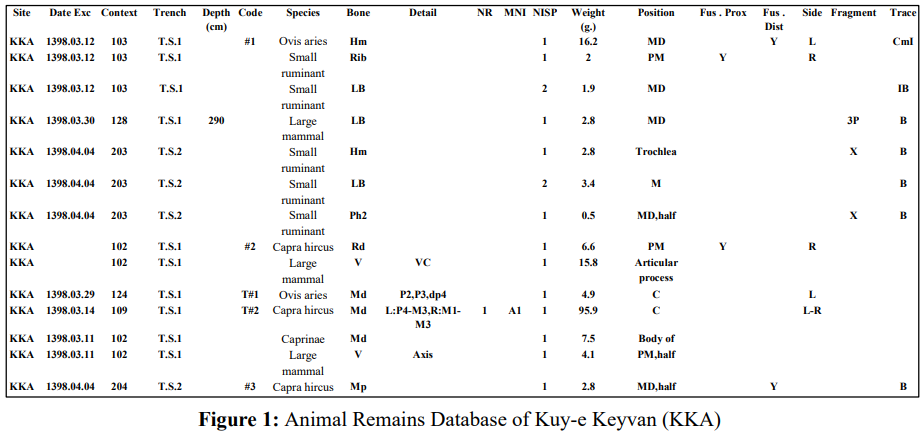
The remained animal bones collection from Kuy-e Keyvan Tepe was systematically classified after cataloging and ensuring that the excavated layers were not disturbed. The identification of bone anatomy and animal taxonomy was performed using comparative collections in lab and animal osteology [4-9]. Then in order to register each bone, different variables were entered to the database (Fig. 1). The simplest way to calculate the bones of an animal species is to count the number of its identifiable bones [10]. There are two main quantitative methods in order to determine the frequency of animal class in a collection: The Number of Remains or Number of Fragments (NR or NF) containing all identifiable and unrecognizable bones and the Number of Identified Specimens (NISP) [11]. One way to determine the economic importance of animal species is to weigh the bones. There is a direct relationship between both weights of the mammalian skeleton and its meat, so the weight of any animal can indicate some of the nutritional value of that animal [12].
Besides, the frequency of a category can be calculated by another measure called the Minimum Number of Individuals (MNI). This calculation provides the closest picture to reality of the number of animals in an ancient site. The basis for calculating MNA is to consider the number of bony organs according to their right or left direction and to prevent the artificial progression of bone remains. In extensive horizontal excavations or closed textures (pits, tombs, etc.), the use of this amount can be a good indicator, because it provides a relatively more accurate reflection of the frequency of species in a given place and time.
Bone measurements provide measurable information, such as identifying and estimating the size and limbs of animals. It is also considered as a method for determining whether animals are domestic or wild; because domestication puts animals under biological pressure and causes hormonal norms that directly affect the animal's organs. Other functions of measurement are the study of the effects of climate change on body shape and its reactions [13].
One of the most common and complete methods for Osteometry is the analysis of Log Size Index (LSI). In this method, it is possible to simultaneously analyze the sizes of all the bones of a species. The purpose of reconstructing and comparing animal sizes is to identify racial diversity in different regions and periods, as well as the status of domestic or wild animals. First, metric data is converted to logarithmic data, and as a result, the scale of dimensions, which can differ greatly due to morphological differences, becomes the same. These logarithmic data are then compared with a reference sample, and the obtained indices of each bone set represent the dispersion of the sizes of an animal population at a particular time and place [14,15]. The standards defined by Von den Driesch (1976) have been used to measure bones.
The Collection's Introduction
The total 461 pieces of bone weighing 2,845 grams were recovered in the first session of excavation at this site and transferred to the Bio-Archaeological Laboratory of the University of Tehran. The collection of animal remains was obtained in two stratigraphic trenches. Trench T.S.1 started with contexts from number 100 and trench T.S.2 started from number 200. Most bones, with 330 pieces, were obtained from context 103 in trench T.S.1. Contexts 121 and 124 in the same trench contained 31 to 48 bone fragments, respectively. Such a distribution is related to the nature of these contexts (Table 1).
|
Trench |
Context |
NISP |
Weight (g.) |
|
Stratigraphic Trench 1 (T.S.1) |
102 |
5 |
35.5 |
|
103 |
330 |
1442.1 |
|
|
109 |
2 |
117.9 |
|
|
110 |
19 |
136.7 |
|
|
120 |
4 |
123.2 |
|
|
121 |
31 |
519.1 |
|
|
124 |
48 |
287.8 |
|
|
125 |
4 |
44.6 |
|
|
128 |
9 |
30.4 |
|
|
104 |
1 |
96.3 |
|
|
Total |
453 |
2833.6 |
|
|
Stratigraphic Trench 2 (T.S.2) |
203 |
5 |
7.7 |
|
204 |
3 |
4.1 |
|
|
Total |
8 |
11.8 |
|
|
Grand Total |
461 |
2845.4 |
|
Table 1: Distribution of Number and Weight of Animal Remains in Stratigraphic Trench, Kuy-e Keyvan Azna, 2019 (NISP=Number of Identified Specimens; WR=Weight of Remains)
The site of Kuy-e Keyvan is chronologically related to the Late Chalcolithic Age. Therefore, all animal remains discovered from the excavated trenches belong to this period, regardless of the trench number or context. Identifiable species are identified by (NISP) and are the main basis of the analysis. These bones contain 137 pieces (30% of the total). Unrecognizable bones, which are 324 pieces (70% of the total), have no recognizable features due to fractures and fragmentation, and in the group of large mammals include Bos Taurus and, less likely, Equidae. Besides, small ruminants in this group include goat and sheep bones (Table 2).
|
Status |
Number |
Number (%) |
Weight (g.) |
Weight (%) |
|
Identifiable |
137 |
30 |
1851.4 |
65 |
|
Unidentifiable |
324 |
70 |
994 |
35 |
|
Total |
461 |
100 |
2845.4 |
100 |
Table 2: Ratio of Number and Weight of Identifiable and Unidentifiable Bones in The Whole Collection, Kuy-e Keyvan
Unidentifiable bones make up 35% of the weight of the collection and the rest (65%) is for the identified bones. This statistic indicates the good condition of the collection and shows that the unrecognizable bones, despite their relatively large number, are light in weight because they are small and fragmented.
As a result of zooarchaeological research, the range of identified species in the site of Kuy-e Keyvan belongs only to mammals (Table 3)
|
Species |
NISP |
Weight (g.) |
|
Capra hircus |
20 |
344.5 |
|
Ovis aries |
14 |
337.6 |
|
Caprinae |
83 |
451.3 |
|
Bos Taurus |
12 |
569.7 |
|
Equus cf. asinus |
1 |
96.3 |
|
Sus scrofa |
1 |
14.2 |
|
Canidae |
6 |
37.8 |
|
Large mammal |
36 |
421.4 |
|
Small ruminant |
288 |
572.6 |
|
Grand Total |
461 |
2845.4 |
Table 3: Number of Animal Species, Kuy-e Keyvan Azna
Classification of Animal Species in Kuy-e Keyvan Tepe
In the whole collection, 371 bone pieces weighing 1851 grams were identified as species. The rest were classified as large mammals and small ruminants. NISP is the basis of the analysis here, which we will discuss below.
Caprinae
In the Near East archaeological sites, Caprinae generally have the largest portion of animal bone assemblages [16]. Osteologically, it is difficult to distinguish the bones of two species of goats and sheep because of their morphological similarities. That is why they are classified in the group of Caprinae. However, using comparative collections and osteology atlases, some organs can be typologized to some extent [17,18].
Species of domestic goat (Capra hircus) and domestic sheep (Ovis aries) have been identified at the site of Kuy-e Keyvan. The number of domestic sheep's bones is 14 and that of domestic goats is 20 (Fig. 2). 83 pieces were also attributed to sheep / goat due to the lack of typological characteristics. This statistic indicates the dominance of domestic Caprinae (goat and sheep) in the collection. In the precise classified samples, it can be generally noted that neither is superior to the other.

Figure 2: Samples of Domestic Caprinae Bones, Kuy-e Keyvan: (1) The Forearm of a Goat, (2) First Phalanx Bone of a Goat (3) Lower End of Sheep Arm (4) Lower End of Sheep Tibia
Evaluation on the abrasion degree of the masticatory surfaces in tooth crown and the pattern of tooth growth are among the methods of reconstructing the slaughter age of animals. In the bones collection of Kuy-e Keyvan Tepe, 5 goat teeth and 11 sheep teeth were obtained. Among the goat teeth, 4 specimens between 1 and 3 years old and one specimen between 6 and 8 years old were slaughtered. Among sheep teeth, two specimens between 6 and 12 months, two specimens between 1and 2 years, three specimens between 1 and 3 years, one specimen between 3 and 6 years and three specimens between 4 and 10 years were slaughtered. As can be seen, approximately two-thirds of Caprinae were slaughtered under the age of 2 and the rest in old age (Fig. 3).

Figure 3: Jaw Samples of Domestic Caprinae, Kuy-e Keyvan: (Right) Goat Mandible Aged 6 to 8 Years; (Left) Sheep Mandible Aged 1 to 3 Years
BOS Taurus
Bos taurus as a species of the Bovidae family belongs to the Even-toed Ungulates. Its bones found at the site of Kuy-e Keyvan contained 12 pieces weighing 569 grams. Bos taurus is the second most dominant species in the collection after Caprinae. They are attributed to the European-Asian Bos taurus based on their morphological features and other comparative collections (Fig. 4). Also, the bones, which were classified as large mammals, probably belong to them [19,20].
The upper and lower parts of most dynamic organs have been joined to the bones. There are three Bos taurus teeth in the collection. Degree of their abrasion reveals that they all belong to mature animals. This evidence suggests that the Bos taurus were generally over two years old and mature at the time of slaughter. Their remains at the site of Kuy-e Keyvan are important for two reasons. The remains of Bos taurus indicate its role in the supply of protein nutrients and possibly its productivity in agriculture by the inhabitants of this site. It also could be considered as one of the characteristics of sedentary.

Figure 4: Sample of Domestic BOS Taurus Bones, Kuy-e Keyvan: (Right) The Lower end of the Tibia; (Left) Second Phalanx Bone
Equidae
There are two domesticated species of Equidae in Southwest Asia, including horse (Equus caballus) and donkey (Equus asinus), as well as one mixed breed called mules [28]. The Persian zebra is the only species of wild Equidae that survives in the Middle East. Both deserts of Dasht-e Kavir and Dasht-e Lut are the habitats for the Persian zebra. Equidae species are difficult to distinguish due to the similarity of the morphological features of their limbs. Therefore, metric methods and bone measurement, as well as DNA testing, are widely used for typology. The bone remains of Equus asinus have been increasing in the ancient sites of Iran since the Late Chalcolithic Age. In the whole collection of Kuy-e Keyvan, only half of a probably domesticated donkey skull has been obtained from Context 104 (Trench 1). This skull belongs to a mature animal (Fig. 5).

Sus Scrofa
Sus scrofa are scattered in most parts of Iran except the central desert. The only lower joint of a boar with its butchery cut marks was identified in Kuy-e Keyvan (Fig. 6). The low number of Sus scrofa remains may be due to the minor role of this animal in the subsistence system. It could be caused by the pastoralism lifestyle based on goat and sheep breeding, dated back to the Neolithic Age in Iran. So the communities turned to nomadism for grazing, which has led to the slow growth of breeding of species such as Bos taurus and Sus scrofa.

Figure 6: The Lower End of The Boar Arm with Cut Marks, Kuy-E Keyvan
Carnivorae
Six pieces of bone have been attributed to Canidae, which belong to Canis familiaris. However, they cannot be classified accurately. The Canidae bones are generally found alongside the other consumable animals' bones in ancient sites, and their bodies were probably dumped in landfills. Canis familiaris served as guardian of the village along with herds of goats and sheep during this period.
Taphonomy of the Bones
The study of the taphonomy of a collection studies all the factors that affect from the moment of an animal's death until its bones reach archaeologists and zooarchaeologists [22]. Human artifacts are created on the bones during the processes of carcass division, butchery, cooking, the use of bones as tools, and so on. Environmental factors such as weathering, sedimentation, moisture, plant roots, soil acids, etc. also have different effects on bones [23]. By examining the limbs of animals, it is possible to reconstruct the pattern of skeletal distribution and how the animal carcass is exploited in the butchering process [24]. Ethnography, meanwhile, can lead to more accurate inferences in the reconstruction of butchery practices and carcass division. In fact, by examining the residual effects on bones, we seek to understand the subsistence behavior of our ancestors [25]. Due to its texture and function, different organs and parts of the skeleton of animals do not have the same resistance against natural factors (atmospheric conditions such as temperature and humidity) and chemical conditions of the soil. The collection of animal bones of the Kuy-e Keyvan site has a good preservation conditions. There is clay on all the bones. On the surfaces of some of them, coarse-grained sediment, lime grains and root traces of plants can be seen. Fragility and erosion of bones due to weathering and changes in moisture were observed in only a few cases. Human effects include the effects of bone burn and carbonization, and the effects of butchery cuts and the carcass division. Heat, which turns the bones limestone, black, and brown colors, has the most human effects, with 42 cases. Two cases of carnivorous teeth and one case of masticatory teeth were observed on the bone surfaces, which are in the group of animal injuries. Most of these effects are present on the bones of Caprini and small ruminants (Table 4; Fig. 7). The presence of the teeth of carnivores and rodents also indicates the access of these animals to the food waste of the inhabitants of the site.
|
Type of Injury |
Human |
Animal |
||
|
Animal species |
carbonized |
Cut mark |
Carnivorae gnawing |
Rodent gnawing |
|
Caprinae |
3 |
|
1 |
|
|
Ovis aries |
1 |
1 |
|
|
|
Capra hircus |
3 |
1 |
|
1 |
|
Bos taurus |
1 |
|
|
|
|
Small ruminant |
31 |
|
1 |
|
|
Large mammal |
3 |
|
|
|
|
Sus scrofa |
|
1 |
|
|
|
total |
42 |
3 |
2 |
1 |
Table 4: Frequency of Different Effects on Bone Remains of Kuy-e Keyvan Azna

Figure 7: Some effects on the bones of different animals Kuy-e Keyvan : (1) Rodent teeth on the forearm of a goat, (2) High heat that has caused the calcification of the third phalanx bone of a Bus taurus, (3) The effects of chewing and digestion of the second phalanx bone of a Caprinae, (4) Formation of sediment (calcium carbonate) on sheep tibia
The amount of organs of all animal species is shown in Table 5. The remaining organs of Caprinae (sheep and goats) and Bus taurus, which are the predominant species in this collection, were examined. In total, there are 117 pieces of Caprinae and 12 pieces of bone of Bus taurus. There are almost all the organs of Caprinae in the collection, which shows that all the steps of slaughtering and preparing the animal were done on the site and then all their organs were consumed or discarded in this place. The pattern of skeletal distribution indicates the greater amount of full-flesh bones (such as Spine and Ribs, Scapula, Humerus, Ulna and Radius, Femur, and Tibia). Almost the same pattern is seen for the skeleton of a Bus taurus (Table 5).
The presence of all the long, flat bones (Skull, Spine, and Hip bone) in the collection indicates that the bones had the same preservation conditions against post-accumulation processes and that all bones remained in ancient deposits (Fig. 8).
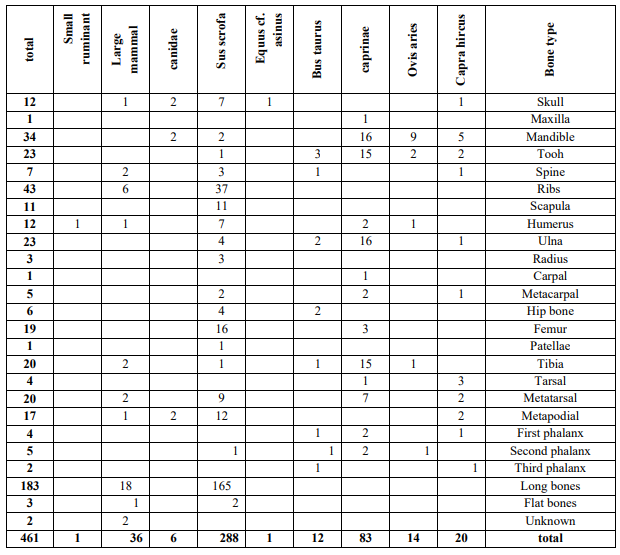
Table 5: The Number of Different Organs of Different Identified Animals, Kuy-e Keyvan Azna
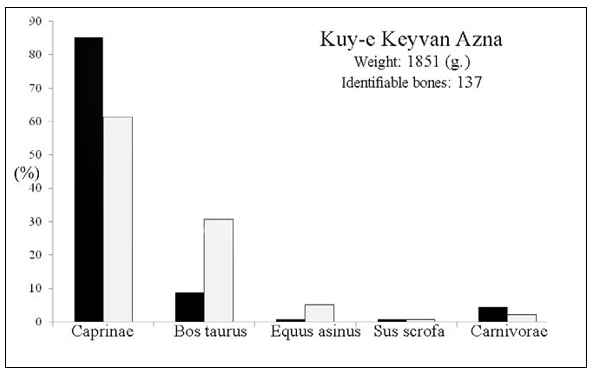
Figure 8: Percentage of Frequency, Number and Weight of Animal Species Identified, Kuy-e Keyvan
Pattern of Animal Slaughter in Kuy-e Keyvan
The basis of the study of this stage is the sequence of tooth growth, replacement of deciduous teeth with permanent and their wear pattern. In fact, the age at which animals are slaughtered depends on factors such as the relative value of production of various products (meat, milk, wool, dairy, etc.), individual and genetic characteristics of animals and climatic factors and environmental conditions (especially seasonal changes and access to Pastures and forage) [26]. The use of the slaughter pattern and its description expresses the management strategies of animals to exploit them for specific purposes. According to Payne (1973), if the purpose of slaughtering Caprinae is to exploit the animal to use its meat, most ram lambs are butchered when they reach their optimal weight, and only a few are kept for reproduction. Most male sheep are butchered in the first year of life, and the number of male sheep kept for reproduction is 1 in 40-50 compared to female sheep (in average). Males are castrated a few months before being butchered to gain weight. This pattern is slightly different for goat slaughter. The difference is that more male goats are kept for reproduction and fewer male goats are butchered. Ewe lambs in a herd may not be butchered even in harsh and critical conditions, and they are often kept for reproduction. Older sheep usually have the best wool between the ages of 2 and 6, which is exploited to use wool at these ages. It should be noted, however, that herds are never kept for a single purpose. Therefore, in the Kuy-e Keyvan collection, the pattern of slaughter can be interpreted as follows: In total, two-thirds of Caprinae were slaughtered under the age of two and the rest in old age. Slaughter under the age of 2 indicates the exploitation of meat and milk. Therefore, the slaughter pattern at this site was mostly based on meeting the needs of dairy and protein food sources, and one third of Caprinae were kept for wool and hair exploitation until the age of more than 2 years. Further, at this site, the exploitation and processing of fleece and goat hair has been done as a home activity by the residents. The slaughter pattern of cattle also indicates the slaughter ages are generally more than 2 years, and most of the bones belong to mature cattle, which shows the exploitation of this animal more as a labor force in matters such as agriculture.
Conclusion
The study of the collection of animal remains of the site of Kuy-e Keyvan Azna provided important information about the animal species and the subsistence system of this site in the Late Chalcolithic Age. Examination of the bone remains of the Kuy-e Keyvan site will be useful in knowing the development of animal husbandry and patterns of animal exploitation over time. Among the bone remains found, most of the animals identified include mammals. The results show the importance of goats, sheep and cattle as the main source of meat consumption and supply of dairy products, wool, hair and skin. The amount of remains of the two species of goats and sheep indicates the preference of the inhabitants of the site to breed and maintain both species. Cattle are in the next category of economic importance. The number of bones of cattle is much less than that of Caprinae, but the weight of cattle is about half the weight of Caprinae; This indicates the importance of this animal in providing milk, meat and labor to the inhabitants of the site. It can be inferred that in the Late Chalcolithic Age, the use and exploitation of domestic animals was much more than wild species, so livestock breeding was the main basis of the nutrition system of the inhabitants of the site.
Canoidea (most likely Canis familiaris) are other domestic animals identified in Kuy-e Keyvan. The bones of Canoidea were found at this site along with the bones of other animals consumed, and their bodies may have been dumped in a dumpster. Domestic dogs were present in the village as guards during this period, along with herds of goats and sheep. From the Equidae family, only one bone specimen (probably a domestic donkey bone) was obtained. The presence of only one piece of boar bone in the collection indicates that hunting has played a marginal role in the livelihood economy of the inhabitants of this site, although compared to other simultaneous sites in the area, such as Qela Gap, we find that hunting of various species of animals has continued. Of course, this issue can also be related to the use of the site and its time period. Obtaining boar remains can also help to reconstruct the environmental conditions of the area because boars live in humid areas with long vegetation.
The slaughter pattern at this site was largely based on meeting the needs of dairy and protein food sources, and one-third of Caprinae were kept to exploit wool and hair for more than 2 years. The slaughter pattern of cattle also shows the slaughter ages was generally more than 2 years and most of the bones belong to mature cattle, which probably indicates the exploitation of this animal often as labor. It should be noted that most of the animals identified were domesticated. Considering the amount of remains of domestic species, especially goats and sheep, as well as the remains of domestic cattle and horses, it is possible that this site has been used by ranchers. The presence of the teeth of carnivores and rodents on the bones of Caprinae and small ruminants indicates the access of these animals to food waste of the inhabitants of the site. Future excavations at this site and other contemporary sites in the area will help to better understand how humans and animals interact.
References
- Sarbisheh, B. H., & Khaledabadi, F. Z. (2024). Breeding and exploitation of animals among the inhabitants of the East Central Zagros in the Late Chalcolithic Age: Fauna study of Kuy-e Keyvan Tepe. Journal Name, Volume(Issue), Page Numbers.
- Gilbert, A. S. (1983). On the origins of specialized nomadic pastoralism in western Iran. World Archaeology, 15(1), 105– 119.
- Abbate, F., Germana, G., Montalbano, G., Guerrera, R. Z., Amato, V., & Ciriaco, E. (2010). Association of Veterinary Anatomists, Paris, France, July 28–31, 2010.
- Ebrahimi, M. A., & Radmehr, B. (2001). Cattle osteology atlas. Tabriz: Sotoudeh Press.
- Barone, R. (1986). Anatomie comparée des mammifères domestiques. Paris: Vigot.
- Schmidt, E. (1972). Atlas of animal bones: For prehistorians, archaeologists, and quaternary geologists. Elsevier Publishing Company.
- Pales, L., & Garcia, M. A. (1981). Atlas ostéologique pour servir à l'identification des mammifères du quaternaire. Paris: Editions du Centre National de la Recherche Scientifique.
- Pales, L., & Lambert, C. (1971). Atlas Osteologique. Paris: Editions du Centre National de la Recherche Scientifique.
- O'Connor, T. (2004). The archaeology of animal bones.Britain: Co. Ltd, Sparkford.
- Reitz, E. J., & Wing, E. S. (2008). Zooarchaeology. Cambridge:Cambridge University Press.
- Davis, S. J. M. (1987). Archaeology of animals. London: B.T. Bastford Ltd.
- Mashkour, M. (2002). Trends in Iranian bioeconomics based on zooarchaeological research, questions, and answers. InM. Azarnoush (Ed.), Proceedings of the First Archaeometry Conference in Iran: The Role of Basic Sciences in Archaeology (pp. 17–33). Tehran: Cultural Heritage and Tourism Organization (Research Institute), Archaeological Research Center.
- Uerpmann, H.-P. (1979). Probleme der Neolithisierung des Mittelmeerraums. Wiesbaden: Dr. Ludwig Reichert Verlag.
- Meadow, R. H. (1999). The use of size index scaling techniques for research on archaeozoological collections from the Middle East. In C. Becker, H. Manhart, J. Peters, & J. Schibler (Eds.), Historia Animalium ex Ossibus: Festschrift für Angela von den Driesch (pp. 285–300). Rahden/Westf.: Verlag Marie Leidorf GmbH.
- Davis, S. J. M. (1993). The zooarchaeology of sheep and goat in Mesopotamia. In N. Postgate & M. Powell (Eds.), Bulletin on Sumerian Agriculture, 7, 1–7.
- Helmer, D., & Rocheteau, M. (1994). Atlas appendiculaire des principaux genres holocènes de petits ruminants du Nord de la Méditerranée et du Proche-Orient (Capra, Ovis, Rupicapra, Capreolus, Gazella). Juan-les-Pins: Éd. APDCA.
- Boessneck, J. (1969). Osteological differences between sheep and goat. In Science in Archaeology: A Survey of Progress and Research (pp. 331–358).
- Boessneck, J., Jequier, J.-P., & Stampfli, H. R. (1963). Wisent, Bison bonanus (Linnaeus), Ur, Bos primigenius Bojanus, and Hausrind, Bos taurus (Linnaeus). Burgäschisee-Süd, 2, 117– 196.
- Grigson, C. (1974). The craniology and relationships of four species of Bos. 1. Basic craniology Bos taurus L. and its absolute size. Journal of Archaeological Science, 1, 353–3
- Uerpmann, M., & Uerpmann, H.-P. (1994). Animal bone finds from Excavation 520 at Qala'at al Bahrain. In F. Hojlund H. H. Andersen (Eds.), Qala'at al Bahrain, Volume I, The Northern City Wall and the Islamic Fortress (pp. 227–237). Aarhus: Aarhus University Press
- Lyman, R. L. (2008). Quantitative paleozoology. Cambridge: Cambridge University Press.
- Fernández-Jalvo, Y., & Andrews, P. (2016). Atlas of taphonomic identifications. Dordrecht: Springer Science, Business Media
- Rackham, J. (1994). Animal bones. Berkeley: University of California Press
- James, E., & Thompson, J. (2015). On bad terms: Problems and solutions within zooarchaeological bone surface modification studies. The Journal of Human Palaeoecology, 20, 89–103
- Von den Driesch, A. (1976). A guide to the measurement of animal bones from archaeological sites. Cambridge: Peabody Museum of Archaeology and Ethnology, Harvard University
- Wilson, D. E., & Reeder, D. M. (1993). Mammal species of the world: A taxonomic and geographic reference. Smithsonian Institution.
- Zeder, M. A. (2006). Reconciling rates of long bone fusion and tooth eruption and wear in sheep (Ovis) and goat (Capra). In D. Ruscillo (Ed.), Recent Advances in Ageing and Sexing Animal Bones (pp. 87–118). Oxford: Oxbow Books.
- Ziaei, H. (1996). Iran mammal field guide. Tehran:Environmental Protection Organization.
- Payne, S. (1973). Kill-off patterns in sheep and goats: The mandibles from Asvan Kale. Anatolian Studies, 23, 281–303.
- Grigson, C.: The craniology and relationships of four species of Bos. 1. Basic craniology Bos taurus L. and its absolute size. Journal of Archaeological Science, Vol. 1: 353-379 (1974)
- Helmer, D., & Rocheteau, M. (1994). Atlas appendiculaire des principaux genres holocènes de petits ruminants du Nord de la Méditerranée et du Proche-Orient (Capra, Ovis, Rupicapra, Capreolus, Gazella). Fiches d’ostéologie animale pour l’archéologie, Série B Mammifères. Juan-les-Pins: Éd. APDCA