

Dermatology Journal of Cosmetic and Laser Therapy(DJCLT)
ISSN: 2835-7329 | DOI: 10.33140/DJCLT
Impact Factor: 0.98


Research Article - (2024) Volume 3, Issue 1
Auto-Occlusive Lidocaine 7% and Tetracaine 7% Cream has Greater Pain Reduction Effects in Comparison with Lidocaine 4% Cream during Laser CO2 Dermabrasion Procedure in Preparation of Non-Cultured Autologous Epidermal Cell Grafting for Repigmentation in Vitiligo Subjects. An Intrasubject Pilot Evaluation Study
2Cantabria Labs Difa Cooper Medical Department, Italy
Received Date: Jan 02, 2024 / Accepted Date: Jan 25, 2024 / Published Date: Feb 08, 2024
Copyright: ©Â©2024 Massimo Milani, et al. This is an open-access article distributed under the terms of the Creative Commons Attribution License, which permits unrestricted use, distribution, and reproduction in any medium, provided the original author and source are credited.
Citation: Leone, G., Vidolin, A. P., Colombo, F., Milani, M. (2024). Auto-Occlusive Lidocaine 7% and Tetracaine 7% Cream has Greater Pain Reduction Effects in Comparison with Lidocaine 4% Cream during Laser CO2 Dermabrasion Procedure in Preparation of Non-Cultured Autologous Epidermal Cell Grafting for Repigmentation in Vitiligo Subjects. An Intrasubject Pilot Evaluation Study. Dearma J Cosmetic Laser Therapy, 3(1), 01- 04.
Abstract
Introduction: Autologous non-cultured epidermal cell graft is a complex but promising technique in the treatment of vitiligo. Affected vitiligo areas should be de-epithelialized using an ablative Laser CO2 prior healthy epidermal cell inoculation. The dermabrasion (DA) procedure could be painful for the patient. To reduce the discomfort of this step topical anaesthesia is very often required. Topical anaesthetics available differ for composition, concentration of active anaesthetic molecules and methods of application (occlusion or not). An auto occlusive film-forming cream containing Lidocaine 7% and Tetracaine 7% (Pl-C) has shown in previous trials to be very effective in reducing discomfort during dermatological painful procedures like phototherapy, laser-conducted tattoo removal and laser resurfacing for skin ageing.
Study Aim: To compare the clinical efficacy of Pl-C with Lidocaine 4% cream (As-C) in reducing the pain during Laser DA procedures in vitiligo subjects in preparation of autologous non-cultured epidermal transplantation.
Subjects and Methods: We performed a prospective intra-subject randomized cases series in 7 subjects (4 men and 3 women) with segmental vitiligo with symmetrical lesions suitable for autologous non-cultured epidermal transplantation. Before the DA procedures the Pl-C or As-C were applied in a randomized fashion over the vitiligo areas to be treated. Pl-C was applied for 20 min without occlusion. The product was removed before the Laser procedure. As-C cream was applied for 30 min with occlusive band and then removed before the procedure. The treated skin regions had a mean area of 72±50 cm2; (range: 10 to 150 cm2). The primary outcome was the 100-mm Visual Analogue Scale (VAS) for patient-assessed pain evaluation with 0 mm value means no pain at all and 100 mm representing the worst possible pain.
Results: Just after the Laser CO2 DA procedure the VAS score in PL-C area was 32±7 mm and 58±8 mm in As-C treated areas. This difference (-25±4 mm; 95% CI: from -16 to -35 mm) was highly statistically significant (p=0.0001) and clinically relevant (higher than the minimum clinically significant difference).
Conclusion: The Lidocaine 7% and Tetracaine 7% auto occlusive cream is more effective than lidocaine 4% cream in reducing the pain associated with Laser CO2 DA procedures in preparation of skin autologous transplantation in vitiligo subjects.
Keywords
Laser CO2, Vitiligo, Non-Cultured Skin Epidermal Grafting, Lidocaine, Tetracaine
Introduction
Vitiligo (VT) is a common skin disease manifesting as achromic macules due to loss or decrease in skin pigmentation because of immune-mediated melanocytes destruction [1]. Quality of life of VT patients is severely affected due to the relevant aesthetic impact of the disease [2]. The treatment approach of VT is a real challenge with phototherapy and topical anti-inflammatory drugs as common first line therapy approach [3]. In subjects not responding to drug and phototherapy autologous non-cultured epidermal cells graft could be considered a complex but promising technique in the treatment of VT [4]. Affected vitiligo areas should be dermabraded using an ablative Laser CO2 prior healthy epidermal cell inoculation [5]. The dermabrasion (DA) procedure could be very painful for the patient [6]. To reduce the discomfort of this step topical anaesthesia is very often required [7]. Topical anaesthetics available differ for composition, concentration of active anaesthetic molecules and methods of application (occlusion or not). An auto occlusive film-forming cream containing Lidocaine 7% and Tetracaine 7% (Pl-C) (Pliaglis® Cantabria Labs Difa Cooper) has shown in previous trials to be very effective in reducing discomfort during dermatological painful procedures like phototherapy, laser-conducted tattoo removal and laser resurfacing for skin ageing [8,9,10,11,12]. Lidocaine 4% cream (Asensil® Logofarma Spa, Italy) is also widely used as topical anaesthesia during dermatological procedures [13]. So far there are not comparative data regarding efficacy and tolerability of Lidocaine/tetracaine auto-occlusive cream and lidocaine 4% alone.
Study Aim
To compare the clinical efficacy of Pl-C with Lidocaine 4% cream (As-C) in reducing the pain during Laser dermabrasion (DA) procedures in vitiligo subjects in preparation of autologous non-cultured epidermal transplantation.
Subjects and Methods
We performed a prospective intra-subject randomized cases series in 7 subjects (4 men and 3 women) with segmental vitiligo with symmetrical lesions suitable for autologous non-cultured epidermal transplantation. Before the DA procedures the Pl-C or As-C were applied in a randomized fashion (area P or area C) over the vitiligo areas to be treated (Figure 1 A and B). Pl-C was applied for 20 min without occlusion. The product was removed before the Laser procedure. As-C cream was applied for 30 min with occlusive band and then removed before the procedure. The treated skin regions had a mean area of 72±50 cm2; (range: 10 to 150 cm2). The primary outcome was the 100-mm Visual Analogue Scale (VAS) for patient-assessed pain evaluation with 0 mm value means no pain at all and 100 mm representing the worst possible pain [14]. Selected regions to be treated with the graft were dermabraded using a carbon dioxide laser (2 W in continuous mode). After this procedure the autologous epidermal cell graft was performed according to Bertolotti et al [15].
Ethical Issue
All procedures performed in this study were done in accordance with the ethical standards of the institutional and/or national research committee and with the 1964 Helsinki Declaration and its later amendments or comparable ethical standards [16]. Written informed consent was obtained from all individual participants included in the study.
Statistical Analysis
Statistical analysis was performed with Graph Pad statistical software. The primary outcome (VAS score) was analysed using the Student Paired T test. This is a pilot study so a formal sample size calculation was not performed.
Results
Just after the Laser CO2 DA procedure the VAS score in PL-C area was 32±7 mm and 58±8 mm in As-C treated areas. This difference (-25±4 mm; 95% CI: from -16 to -35 mm) was highly statistically significant (p=0.0001) and clinically relevant. (Figure 2). Both products were well tolerated. No side effects were reported.
Discussion
Vitiligo could be a distressing dermatological clinical condition [17]. No definitive treatments are available so far, even if phototherapy and topical anti-inflammatory drugs are commonly used as first-line treatment [18]. Our group has demonstrated that application of non-cultured epidermal cellular grafting using a ready-to-use kit was an effective treatment in VT [15]. To perform this technique however a Laser CO2 dermabrasion procedure at level of VT affected area is necessary [19]. Dermabrasion with Laser CO2 is a painful dermatological procedure requiring topical anaesthesia [20]. Several topical products (both registered drugs or galenic preparations) are available [21]. These products differ in composition (single active molecule or eutectic mixture of two or more anaesthetic molecules) and strength (different concentration). Lidocaine 7%/ Tetracaine 7% auto occlusive cream is one of the most potent registered products [22]. Lidocaine 4% cream is a marketed anaesthetic cream commonly used in different dermatological procedures. In this study we compared two anaesthetic creams with very different composition in terms of concentration of active compounds and formulation characteristics. The lidocaine/ tetracaine auto occlusive cream has shown to be very effective in reducing VAS scores at least by 49% in comparison with control in different dermatological procedures[8]., The present study demonstrated that, in comparison with the lidocaine 4% cream, Pl-C offers a higher and clinically relevant pain-reduction effect. Kelly demonstrated that the minimum clinically significant difference (MCSD) for the VAS value should be of at least a reduction of 12 mm (95% CI: from -9 to -15 mm) [23]. The difference in VAS score between Pl-C and L-C we observed in the present study was -25±4 mm (95% CI: from -16 to -35 mm), much above the MCSD value. Some limitations should be taken in account in evaluating the results we have obtained. This is a pilot trial. Therefore, further studies involving a larger number of subjects are warranted.
Conclusion
The Lidocaine 7% and Tetracaine 7% auto occlusive cream (Pl-C) is more effective in comparison with Lidocaine 4% cream in reducing the pain associated with Laser CO2 dermabrasion procedures in preparation of skin autologous transplantation in vitiligo subjects. This difference it is not only statistically significant but also clinically meaningful.


Figure 1 (a and b): Three VT patients just before Laser CO2 dermabrasion preparation for grafting. P areas have been treated with Lidocaine/Tetracaine 7% auto occlusive cream and C areas with Lidocaine 4% cream
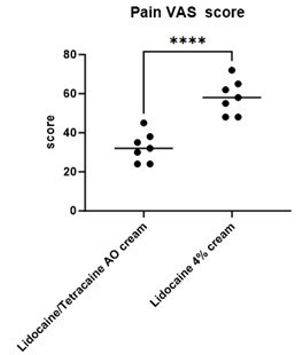
Figure 2: The VAS score for Lidocaine/Tetracaine auto-occlusive (AO) and fir Lidocaine 4% cream **** P=0.0001; Paired T Test
References
- Bergqvist, C., & Ezzedine, K. (2020). Vitiligo: a review.Dermatology, 236(6), 571-592.
- Hedayat, K., Karbakhsh, M., Ghiasi, M., Goodarzi, A., Fakour, Y., Akbari, Z., ... & Ghandi, N. (2016). Quality of life in patients with vitiligo: a cross-sectional study based on Vitiligo Quality of Life index (VitiQoL). Health and quality of life outcomes, 14(1), 1-9.
- Forschner, T., Buchholtz, S., & Stockfleth, E. (2007). Current state of vitiligo therapy–evidence-based analysis of the literature. JDDG: Journal der Deutschen Dermatologischen Gesellschaft, 5(6), 467-475.
- Khunger, N., Kathuria, S. D., & Ramesh, V. (2009). Tissue grafts in vitiligo surgery–past, present, and future. Indian journal of dermatology, 54(2), 150.
- Kahn, A. M., & Cohen, M. J. (1995). Vitiligo: treatment by dermabrasion and epithelial sheet grafting. Journal of the American Academy of Dermatology, 33(4), 646-648.
- Suter, V. G., Sjölund, S., & Bornstein, M. M. (2017). Effect of laser on pain relief and wound healing of recurrent aphthous stomatitis: a systematic review. Lasers in medical science, 32, 953-963.
- Oni, G., Rasko, Y., & Kenkel, J. (2013). Topical lidocaine enhanced by laser pretreatment: a safe and effective method of analgesia for facial rejuvenation. Aesthetic surgery journal, 33(6), 854-861.
- Alster, T. (2013). Review of lidocaine/tetracaine cream as a topical anesthetic for dermatologic laser procedures. Pain and therapy, 2(1), 11-19.
- Alster, T. S. (2007). The lidocaine/tetracaine peel: a novel topical anesthetic for dermatologic procedures in adult patients. Dermatologic surgery, 33(9), 1073-1081.
- Alster, T. S., & Lupton, J. R. (2002). Evaluation of a novel topical anesthetic agent for cutaneous laser resurfacing: a randomized comparison study. Dermatologic surgery, 28(11), 1004-1006.
- Caprari, E., Viciguerra, M. T., & Milani, M. (2022). Assessment of clinical efficacy of lidocaine/tetracaine 7%/7% peel cream in fractional microablative laser procedure-associated pain for facial skin aging treatment. A randomized, controlled, single-blind trial. Journal of Cosmetic Dermatology, 21(1), 254-258.
- Brumana, M. B., Milani, M., & Puviani, M. (2020). Efficacy of lidocaine 7%, tetracaine 7% self-occlusive cream in reducing MAL-cPDT-associated pain in subjects with actinic keratosis: A randomized, single-blind, vehicle-controlled trial (The “3P-Trial”). Photodiagnosis and Photodynamic Therapy, 30, 101758.
- Gordh, T., Gordh, T. E., Lindqvist, K., & Warner, D. S. (2010). Lidocaine: the origin of a modern local anesthetic. The Journal of the American Society of Anesthesiologists, 113(6), 1433-1437.
- Hawker, G. A., Mian, S., Kendzerska, T., & French, M. (2011). Measures of adult pain: Visual analog scale for pain (vas pain), numeric rating scale for pain (nrs pain), mcgill pain questionnaire (mpq), short-form mcgill pain questionnaire (sf-mpq), chronic pain grade scale (cpgs), short form-36 bodily pain scale (sf-36 bps), and measure of intermittent and constant osteoarthritis pain (icoap). Arthritis care & research, 63(S11), S240-S252.
- BERTOLOTTI, A., LEONE, G., TAÏEB, A., SORIANO, E.,PASCAL, M., MAILLARD, H., & Nanja, V. A. N. (2021).Assessment of Non-cultured Autologous Epidermal Cell Grafting Resuspended in Hyaluronic Acid for Repigmenting Vitiligo and Piebaldism Lesions: A Randomized Clinical Trial. Acta Dermato-Venereologica, 101(7).
- ASHCROFT, Richard E., et al. The declaration of Helsinki.The Oxford textbook of clinical research ethics, 2008, 141-148.
- Amer, A. A., & Gao, X. H. (2016). Quality of life in patients with vitiligo: an analysis of the dermatology life quality index outcome over the past two decades. International Journal of Dermatology, 55(6), 608-614.
- Frisoli, M. L., Essien, K., & Harris, J. E. (2020). Vitiligo: mechanisms of pathogenesis and treatment. Annual review of immunology, 38, 621-648.
- Post, N. F., Ezekwe, N., Narayan, V. S., Bekkenk, M. W., Van Geel, N., Hamzavi, I., ... & Wolkerstorfer, A. (2022). The use of lasers in vitiligo, an overview. Journal of the European Academy of Dermatology and Venereology, 36(6), 779-789.
- Kakigi, R., Shibasaki, H., & Ikeda, A. (1989). Pain-related somatosensory evoked potentials following CO2 laser stimulation in man. Electroencephalography and Clinical Neurophysiology/Evoked Potentials Section, 74(2), 139-146.
- Young, K. D. (2014). Topical anaesthetics: What's new?.Archives of Disease in Childhood-Education and Practice.
- Milani, M., & Condorelli, A. G. (2021). Overcoming a Too Painful Conventional Methyl Amino-Levulinic Photo Dynamic Therapy (MAL-Cpdt) Session for Scalp Actinic Keratosis with Topical Anesthesia: A “N Of 1” Trial Case Report. J Clinic Exper Cosme Derma 4: 018.
- Kelly, A. (2001). The minimum clinically significant difference in visual analogue scale pain score does not differ with severity of pain. Emergency medicine journal: EMJ, 18(3), 205.