



Research Article - (2023) Volume 1, Issue 1
Assessing the Sleep Quality and Depression, Anxiety, Stress in Students of Different Medicine Related Fields
2Professor and HOD, Physiology Department, Smt. NHLM- MC, India
3Associate Professor, Pysiology Department, Smt. NHLM- MC, India
Received Date: Apr 12, 2023 / Accepted Date: May 15, 2023 / Published Date: Jul 10, 2023
Copyright: ©Â©2023 Dev Desai, et al. This is an open-access article distributed under the terms of the Creative Commons Attribution License, which permits unrestricted use, distribution, and reproduction in any medium, provided the original author and source are credited.
Citation: Desai, D., Dave, P., Verma, A., Mahajan, N. (2023). Assessing the Sleep Quality and Depression, Anxiety, Stress in Students of Different Medicine Related Fields. Transl Med OA, 1(1), 27- 38.
Abstract
Background: Health care workers are predominantly affected with mental health issues due to increasing workload and less amount of sleep. It is important to note the beginning point of this poor mental health and coping mechanisms should be taught as early as possible.
Aim: Assess Sleep quality, and prevalence of depression, anxiety and stress in medical, physiotherapy and nursing students
Result: Nursing students have the best sleep score followed by Medical students and Physiotherapy students have the worst. In contrast, Physiotherapy students show highest amount of Depression, Anxiety and Stress. This is followed by Medical students and then Nursing students. A significant positive correlation can be seen between sleep and levels of depression, Anxiety ,and Stress.
Conclusion: It was seen that sleep health and mental health of students of Medical, Physiotherapy and Nursing is bad and that there is a correlation between Sleep and these mental health parameters. It can be that poor sleep health is causing a poor mental health or poor mental health is the reason behind poor sleep health.
Keywords
Sleep, Depression, Anxiety, Stress, Medical students, Paramedical Students,
Introduction
Health care workers are the most important aspect of a country’s health system and is also the place where most of the health expenditure is given. The quality of health care workers defines the whole system and the health of the whole country [1]. Health care workers are always understaffed as there are always more patients who need medical attention and this leads to burnout problems in health care workers. It has been observed that Health care workers are one of the most at risk population group who succumb to mental problems mainly depression, anxiety, stress and have problems with their sleep [2]. In recent times of Covid – 19 pandemic has shown us the importance of mental health, especially for those individuals who work day and night in order to contain the pandemic while putting their own lives on the line for the betterment of the society [3].
The functioning of a smooth health facility depends on good health of the staff and workers [4]. The health facilities cannot cater to the population if the health care workers are not well, whether that is physical health or mental health. Good mental health of health care workers is particularly important as it reflects in the quality of health care given by the health facility [5]. The Mental health problems begin from a very young age due to the burden of studies in addition to their daily hospital duties where they treat the patients [3]. It is important to assess and address these issues soon so that the students can be taught ways in which they can prevent mental or physical ill-health.
In order to prevent mental health issues in future, the students should be taught different coping mechanisms early in their careers [6]. But these days due to higher study requirements and marks oriented studies, students are under a lot of stress and the depression in these students is at an all-time high. High study load has in turn lead to improper sleep habits, which has become a major underlying factor affecting the students Not enough sleep has been given as a reason by many students behind the stress or their depression [7]. It is important to assess the level of sleep quality in these students and correlate it with depression, anxiety and stress to understand the pattern and then to employ strategies of teaching coping mechanism and battling issues leading to mental health problems so when these students go in the community as health care workers, they can use the same techniques they have learnt here thereby effectively coping against mental health issues.
Aims
• Assess Sleep quality, and prevalence of depression, anxiety and stress in medical, physiotherapy and nursing students
• Draw a correlation between sleep quality and depression, anxiety and stress.
• Do a comparative analysis between different field of students?
Methods
Students of a well-known medical college, physiotherapy college and nursing students(n=159) were asked to fill a form after gaining their consent. The form contained standardized questionnaires and was used to score their sleep quality and level of depression, anxiety and stress. Used questionnaire “DASS-21” [8], “(modified) Arianna Huffington sleep survey” [9]
Inclusion criteria
• Students who were willing to form with full disclosure
Exclusion criteria
• Students who didn’t give consent
• Students with Pre-existing psychiatric condition or psychiatric medication
The gathered data was digitalized and was analyzed using excel and SPSS20 to achieve the results as mentioned below. The research being survey based was exempted by the IRB. Critrias denoted by the Declaration of Helsinki were strictly followed.
|
Subscale |
Depression |
Anxiety |
Stress |
|
Normal |
0-4 |
0-3 |
0-7 |
|
Mild |
5-6 |
4-5 |
8-9 |
|
Moderate |
7-10 |
6-7 |
10-12 |
|
Severe |
11-13 |
8-9 |
13-16 |
|
Extremely Severe |
14+ |
10+ |
17+ |
Solution of DASS-21 (table 1) (8)
|
Subscale |
Sleep Score |
|
Normal |
>22 |
|
Moderate |
15-22 |
|
Severe |
8-15 |
|
Extreme |
<8 |
Solution of (modified) Arianna Huffington sleep survey (table 2) (9)
Results
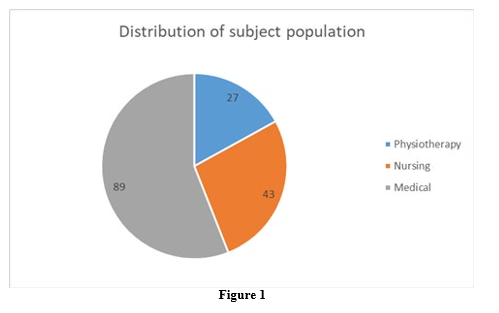
Demographic data: -
|
Physiotherapy |
sleep score |
depression |
anxiety |
stress |
|
Avg |
21.81 |
13.11 |
13.48 |
15.85 |
|
SD |
4.05 |
10.11 |
8.23 |
9.63 |
|
SEM |
0.78 |
1.94 |
1.58 |
1.85 |
|
CI95 |
1.53 |
3.81 |
3.10 |
3.63 |
|
R-Value |
Sleep |
depression |
anxiety |
stress |
|
Sleep |
1 |
|
|
|
|
depression |
-0.21 |
1 |
|
|
|
anxiety |
-0.59 |
0.58 |
1 |
|
|
stress |
-0.58 |
0.61 |
0.83 |
1 |
Table 3
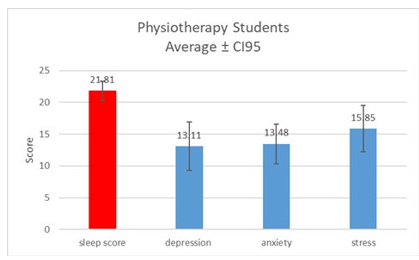
Chart 1
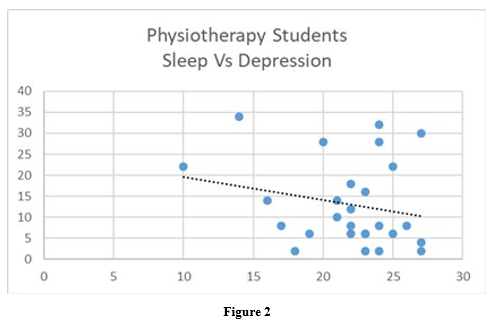

Figure 3
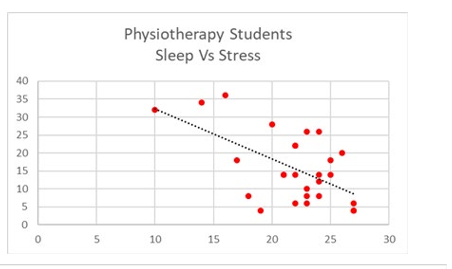
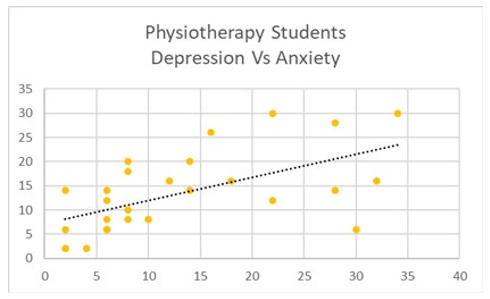
Figure 5

Figure 6
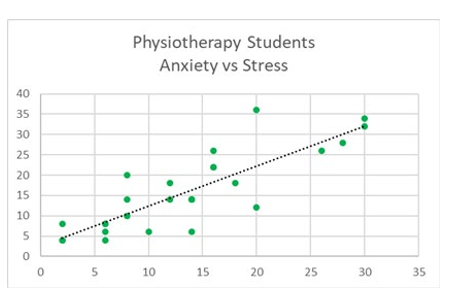
Figure 7
|
Nursing |
sleep score |
depression |
anxiety |
stress |
|
Avg |
23.93 |
5.48 |
7.95 |
7.02 |
|
SD |
3.08 |
5.40 |
6.85 |
6.08 |
|
SEM |
0.46 |
0.82 |
1.04 |
0.92 |
|
CI95 |
0.92 |
1.61 |
2.04 |
1.81 |
|
R-Value |
Sleep |
depression |
anxiety |
stress |
|
Sleep |
1 |
|
|
|
|
depression |
-0.01 |
1 |
|
|
|
anxiety |
-0.12 |
0.43 |
1 |
|
|
stress |
0.10 |
0.68 |
0.54 |
1 |
Chart 2
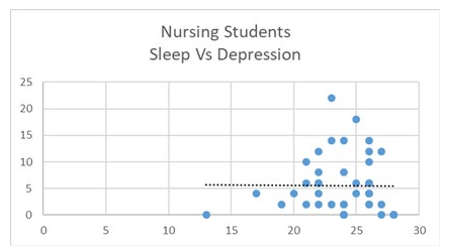
Figure 8
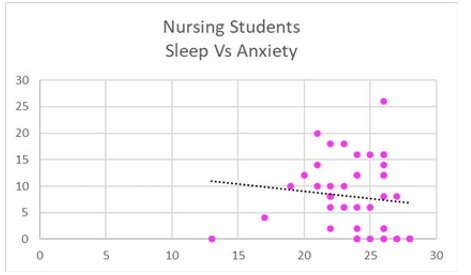
Figure 9

Figure 10
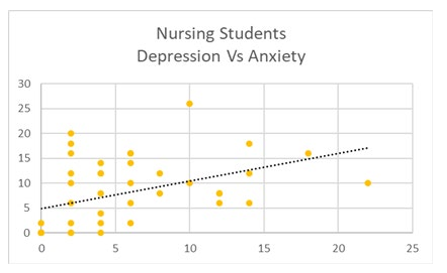
Figure 11
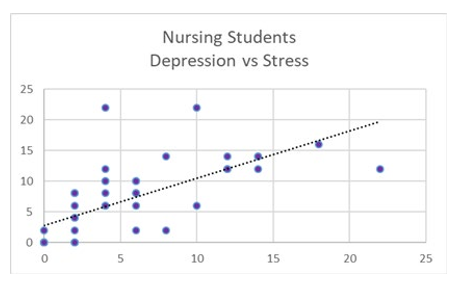
Figure 12

Figure 13
|
Medical |
sleep score |
depression |
anxiety |
stress |
|
Avg |
22.88 |
6.31 |
6.87 |
7.82 |
|
SD |
4.22 |
7.57 |
6.74 |
7.81 |
|
SEM |
0.44 |
0.80 |
0.71 |
0.82 |
|
CI95 |
0.87 |
1.57 |
1.40 |
1.62 |
|
R-Value |
Sleep |
depression |
anxiety |
stress |
|
Sleep |
1 |
|
|
|
|
depression |
-0.47 |
1 |
|
|
|
anxiety |
-0.31 |
0.70 |
1 |
|
|
stress |
-0.50 |
0.83 |
0.73 |
1 |
Table 5
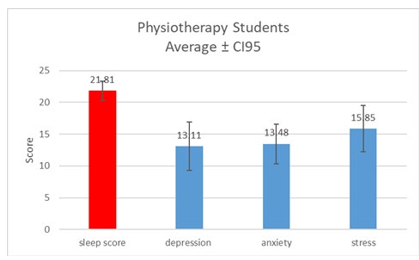
Chart 3

Figure 14.
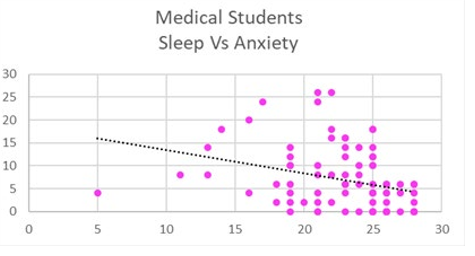
Figure 15
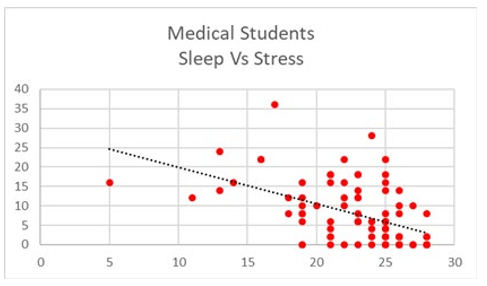
Figure 16

Figure 17
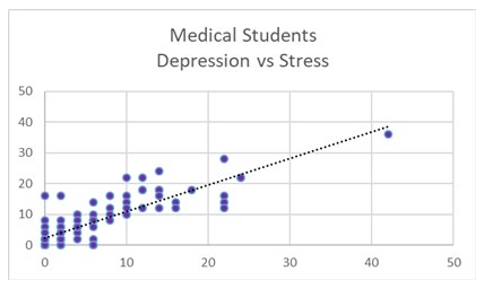
Figure 18
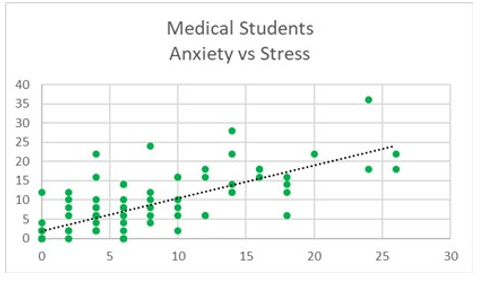
Figure 19
Discussion
1) Table 3,4,5 along with Chart 1,2,3 respectively representing Physiotherapy students, Nursing students and Medical Students demonstrates the following points when compared against Table 1 and 2:
a. Sleep Score is “Borderline Moderate” and almost similar among all subjects of different fields with it being in moderate category for physiotherapy students.
i. Physiotherapy students actually have the lowest sleep score in all the subjects showing a worse sleep health.
ii. Considering the deviation, it can be seen that 40-50% of all participant fall in Moderate Section.
b. Depression level show a further story as
i. The average score for depression in physiotherapy students is extremely high.
• standard deviation and confidence interval showing a wide variety with some individuals showing very high, alarming level of depression.
ii. In contrast to Physiotherapy students, Medical and Nursing students who a mild level of depression.
• In both medical and nursing students, Standard deviation and confidence interval similarly show a wide variety.
• Some students have alarmingly high amount of depression.
c. Anxiety levels
i. The average score for Anxiety in physiotherapy students is extremely high.
• standard deviation and confidence interval showing a wide variety with some individuals showing severely high, alarming levels of anxiety.
ii. Medical students show a severe level of anxiety.
• In medical students, Standard deviation and confidence interval similarly show a wide variety.
• Some students have alarmingly high amount of anxiety.
iii. In contrast to Physiotherapy students and Medical students, Nursing students show a moderate level of anxiety.
• In medical students, Standard deviation and confidence interval similarly show a wide variety.
d. Stress levels
i. The average score for Stress in physiotherapy students is severely high.
• standard deviation and confidence interval showing a wide variety with some individuals showing severely high, alarming level of stress.
ii. In contrast to Physiotherapy students, Nursing and Medical students show a mild level of stress.
• In both, Standard deviation and confidence interval similarly show a wide variety.
• Some students have alarmingly high amount of stress.
2) Relation of Sleep with Depression, Anxiety and Stress with the help of Pearson Correlation in a. In Physiotherapy Students as per Table 3 and Figure 2,3,4
i. It can be seen that as Sleep is a negative indicator with higher score meaning a better sleep, the negative correlation coefficient actually represents that with decreasing sleep score, Depression level increases but the correlation is not that strong.
ii. This is also true for anxiety that with decreasing sleep score, anxiety levels are increasing and the correlation is strong.
iii. Same for stress, there is a strong correlation between decrease of sleep score and increase of stress.
• The amount of correlation is strongest when compared to Medical students and Physiotherapy students.
b. In Nursing students as per Table 4 and Figure 8,9,10 i. It is evident here that there is absolutely no correlation between sleep score and levels of depression, anxiety, stress. It may be because the sleep score is better than both physiotherapy and medical students and levels of depression, anxiety and stress is lower than both.
• The amount of correlation the weakest when compared to medical and physiotherapy students.
c. In medical Students as per Table 5 and figure 14,15,16
i. It is visible that as Sleep is a negative indicator with higher score meaning a better sleep, the negative correlation coefficient actually represents that with decreasing sleep score, Depression level increases but the correlation is not that strong.
ii. This is also true for anxiety that with decreasing sleep score, anxiety levels are increasing and the correlation is strong.
iii. Same for stress, there is a strong correlation between decrease of sleep score and increase of stress.
• The amount of correlation is weaker than physiotherapy students but yet very strong.
3) Interrelation between Depression, Anxiety and stress with the help of Pearson Correlation in
a. In physiotherapy students as per Table 3 and figure 5,6,7 i. There is evidently strong inter correlation between Depression, Anxiety and Stress.
b. In Nursing students as per Table 4 and Figure 11,12,13
i. A similar strong inter correlation between all 3 Depression, anxiety and stress is seen as seen in physiotherapy students.
c. In medical Students as per Table 5 and figure 17,18,19
i. Stronger inter correlation then physiotherapy and nursing students can be seen in medical students between depression, anxiety and stress. When the results achieved here are compared with other studies, it can be found that very similar results are found at many places [10-13]. Studies like show similar results to what we found when it comes to depression whereas for anxiety , studies like show similar results [10,13-17]. Some Studies like show similar results when it comes to stress [10,11,14,15,18,19,20,21].
We also found some articles who does not have actually similar results as ours but show actually no relation which we actually found. Amir et al [22]. found no relation with BMI, whereas Aesha et al. did not find any relation between sleep schedule [23]. Camila et al. also compared different phases of medical course but did not establish any relation [24].
Conclusion
 It can be seen here that there is not much difference between different fields of students when talking about sleep quality and everyone has poor quality.
In our findings, it can be seen that physiotherapy students are under tremendous workload in respect to medical and nursing students which can be due to the fact that in Indian setting, physiotherapy students starts clinical learning and practice from the first year.
We can see that depression, anxiety and stress are interrelated with the help of Pearson correlation tables
It is evident here that, with increase in sleep score meaning increase in quality of sleep, there is a negative effect and hence, depression, stress and anxiety is decreasing. This proves that sleep helps in remaining healthy.
Conflict of interest and ethical consideration;-
The study being survey-based was exempted from IRB. Criterias denoted by the Declaration of Helsinki were strictly followed. we have no conflict of interest and we have not received any funding.
References
- Raghupathi, V., & Raghupathi, W. (2020). Healthcare expenditure and economic performance: insights from the United States data. Frontiers in public health, 8, 156.
- Pappa, S., Ntella, V., Giannakas, T., Giannakoulis, V. G., Papoutsi, E., & Katsaounou, P. (2020). Prevalence of depression, anxiety, and insomnia among healthcare workers during the COVID-19 pandemic: A systematic review and meta-analysis. Brain, behavior, and immunity, 88, 901-907.
- Spoorthy, M. S., Pratapa, S. K., & Mahant, S. (2020). Mental health problems faced by healthcare workers due to the COVID-19 pandemic–A review. Asian journal of psychiatry, 51, 102119.
- Kabene, S. M., Orchard, C., Howard, J. M., Soriano, M. A., & Leduc, R. (2006). The importance of human resources management in health care: a global context. Human resources for health, 4(1), 1-17.
- Søvold, L. E., Naslund, J. A., Kousoulis, A. A., Saxena, S., Qoronfleh, M. W., Grobler, C., & Münter, L. (2021). Prioritizing the mental health and well-being of healthcare workers: an urgent global public health priority. Frontiers in public health, 9, 679397.
- Freire, C., Ferradás, M. D. M., Regueiro, B., Rodríguez, S., Valle, A., & Núñez, J. C. (2020). Coping strategies and self- efficacy in university students: A person-centered approach. Frontiers in psychology, 11, 841.
- Rob Newsom AD. Depression and Sleep 2022 [Available from: https://www.sleepfoundation.org/mental-health/ depression-and-sleep.
- DASS-21 Scale [Available from: https://maic.qld.gov.au/ wp-content/uploads/2016/07/DASS-21.pdf.
- Arianna Huffington. Arianna Huffington Sleep survey [Available from: https://www.ariannahuffington.com/sleep- resources/.
- Al-Khani, A. M., Sarhandi, M. I., Zaghloul, M. S., Ewid, M., & Saquib, N. (2019). A cross-sectional survey on sleep quality, mental health, and academic performance among medical students in Saudi Arabia. BMC research notes, 12(1), 1-5.
- Kongsomboon, K. (2010). Academic achievement correlated to stress, depression, and sleep deprivation in medical students. Srinagarind Medical Journal, 25(2), 109- 114.
- Hirata, F. C., Lima, M. C. O., de Bruin, V. M. S., Nóbrega, P.R., Wenceslau, G. P., & de Bruin, P. F. C. (2007). Depression in medical school: The influence of morningnessâ? eveningness. Chronobiology international, 24(5), 939-946.
- Samaranayake, C. B., Arroll, B., & Fernando, A. T. (2014). Sleep disorders, depression, anxiety and satisfaction with life among young adults: a survey of university students in Auckland, New Zealand. The New Zealand Medical Journal (Online), 127(1399).
- James, B. O., Omoaregba, J. O., & Igberase, O. O. (2011). Prevalence and correlates of poor sleep quality among medical students at a Nigerian university. Ann Nigerian Med, 5(1), 1.
- Azad, M. C., Fraser, K., Rumana, N., Abdullah, A. F., Shahana, N., Hanly, P. J., & Turin, T. C. (2015). Sleep disturbances among medical students: a global perspective. Journal of clinical sleep medicine, 11(1), 69-74.
- Silva, V. M., Magalhaes, J. E. D. M., & Duarte, L. L. (2020). Quality of sleep and anxiety are related to circadian preference in university students. PLoS One, 15(9), e0238514.
- Selvi, Y., Aydin, A., Gulec, M., Boysan, M., Besiroglu, L., Ozdemir, P. G., & Kilic, S. (2012). Comparison of dream anxiety and subjective sleep quality between chronotypes. Sleep and Biological Rhythms, 10, 14-22.
- Almojali, A. I., Almalki, S. A., Alothman, A. S., Masuadi, E. M., & Alaqeel, M. K. (2017). The prevalence and association of stress with sleep quality among medical students. Journal of epidemiology and global health, 7(3), 169-174.
- Gardani, M., Bradford, D. R., Russell, K., Allan, S., Beattie, L., Ellis, J. G., & Akram, U. (2022). A systematic review and meta-analysis of poor sleep, insomnia symptoms and stress in undergraduate students. Sleep medicine reviews, 61, 101565.
- Veldi, M., Aluoja, A., & Vasar, V. (2005). Sleep quality and more common sleep-related problems in medical students. Sleep medicine, 6(3), 269-275.
- Ghoreishi, A., & Aghajani, A. H. (2008). Sleep quality in Zanjan university medical students. Tehran university medical journal TUMS publications, 66(1), 61-67.
- Amir Rezaei, A., Ali, T., Mahdieh Borhani, M., Raheleh, N., Sarah, S., Soosan, S., & Seyyede Azam, H. (2012). Assessment the rules of demographic variables and body mass index in sleep quality among medical students.
- Siddiqui, A. F., Al-Musa, H., Al-Amri, H., Al-Qahtani, A., Al-Shahrani, M., & Al-Qahtani, M. (2016). Sleep patterns and predictors of poor sleep quality among medical students in King Khalid University, Saudi Arabia. The Malaysian journal of medical sciences: MJMS, 23(6), 94.
- Corrêa, C. D. C., Oliveira, F. K. D., Pizzamiglio, D. S., Ortolan, E. V. P., & Weber, S. A. T. (2017). Sleep quality in medical students: a comparison across the various phases of the medical course. Jornal Brasileiro de Pneumologia, 43, 285-289.