

International Journal of Health Policy Planning(IJHPP)
ISSN: 2833-9320 | DOI: 10.33140/IJHPP
Impact Factor: 1.08



Research Article - (2026) Volume 5, Issue 2
Artificial Intelligence in Family Planning- A Policy Framework for Safe, Ethical and Responsible Implementation

Received Date: Jul 14, 2026 / Accepted Date: Aug 05, 2026 / Published Date: Aug 12, 2026
Copyright: ©2026 Sandhya Ahuja. This is an open-access article distributed under the terms of the Creative Commons Attribution License, which permits unrestricted use, distribution, and reproduction in any medium, provided the original author and source are credited.
Citation: Ahuja, S. (2026). Artificial Intelligence in Family Planning- A Policy Framework for Safe, Ethical and Responsible Implementation. Int J Health Policy Plann, 5(2), 01-13.
Abstract
Artificial Intelligence (AI) is increasingly being integrated into healthcare and has the potential to strengthen family planning (FP) programmes by improving counselling, supporting informed decision-making, enhancing follow-up, optimising commodity management and generating timely information for programme planning and monitoring. Despite these opportunities, the application of AI in family planning presents important ethical, legal and operational challenges because contraceptive decisions involve reproductive rights, informed choice, privacy, dignity and individual autonomy. The absence of a dedicated policy framework may result in inconsistent implementation, algorithmic bias, data privacy concerns, reduced transparency and over-reliance on AI-generated recommendations. This paper explores the potential applications of AI across family planning services, covering both spacing and limiting methods, and discusses how AI can support clients, healthcare providers and programme managers throughout the continuum of care. It further examines the need for a national policy framework to ensure that AI is implemented safely, ethically and responsibly while safeguarding human rights and maintaining public trust.
Based on current evidence and public health principles, the paper proposes a comprehensive National Policy Framework for the Responsible Use of Artificial Intelligence in Family Planning. The framework includes governance and leadership, ethical principles, data governance and privacy, validation of AI systems, human oversight, capacity building, equity and inclusion, monitoring and evaluation, accountability, research and continuous learning. A phased implementation roadmap, risk management strategy, monitoring indicators and policy recommendations are also presented to support countries in planning, implementing and evaluating AI-enabled family planning services. The proposed framework is intended to serve as a practical guide for governments, policymakers, programme managers and development partners seeking to integrate AI into family planning programmes. By placing informed choice, privacy, equity and human rights at the centre of implementation, the framework aims to ensure that AI strengthens family planning services while supporting safe, people-centred and evidence-based public health practice.
Keywords
Artificial Intelligence, Family Planning, Contraception, Reproductive Health, Digital Health, Health Policy, Health Governance, Decision-Support Systems, Public Health, Responsible Artificial Intelligence
Introduction
Family planning (FP) is one of the most successful and cost-effective public health interventions. It enables individuals and couples to decide freely and responsibly the number of children they wish to have, the timing of pregnancies, and the spacing between births. Effective family planning improves the health of women, newborns and children, reduces maternal and infant mortality, lowers the incidence of unintended pregnancies and unsafe abortions, and contributes to social and economic development. It also supports women's education, employment and empowerment while helping countries achieve the Sustainable Development Goals (SDGs). Over the past several decades, family planning services have evolved from simple contraceptive distribution to comprehensive reproductive health programmes that include counselling, informed choice, follow-up care, management of side effects, commodity logistics, and programme monitoring. Despite significant progress, many countries continue to face challenges such as unmet need for contraception, discontinuation of contraceptive methods, stock-outs of commodities, shortage of trained healthcare providers, geographical barriers, poor-quality counselling, and inequities in access to services. Recent advances in Artificial Intelligence (AI) provide new opportunities to strengthen family planning programmes. AI has the potential to analyse large volumes of health data, support healthcare providers in clinical decision-making, improve counselling, predict contraceptive demand, optimise supply chains, identify populations with unmet need, and provide personalised information to clients through digital platforms. When used appropriately, AI can improve the efficiency, accessibility and quality of family planning services.
However, family planning is a highly sensitive area of healthcare because it involves reproductive rights, personal choices, privacy, cultural beliefs and ethical considerations. Decisions related to contraception should always remain voluntary and based on informed choice. If AI systems are poorly designed, biased, inaccurate, or inadequately regulated, they may compromise privacy, provide inappropriate recommendations, reinforce inequalities, or undermine individual autonomy. Unlike many other digital health applications, errors in family planning can have lifelong consequences for individuals and families. At present, many countries are introducing AI into healthcare without specific guidance for its use in family planning. While general AI governance principles exist, there is limited guidance on how AI should be applied safely, ethically and responsibly within family planning programmes. A dedicated national policy framework is therefore essential to define appropriate uses of AI, establish standards for privacy and data security, ensure transparency and accountability, protect reproductive rights, and maintain human oversight in all clinical and counselling decisions. This paper explores the potential applications of AI across family planning services, with particular emphasis on spacing and limiting methods. It also proposes a practical national policy framework that can guide governments, programme managers and healthcare providers in adopting AI responsibly while safeguarding the principles of informed choice, equity, privacy and human rights.
Family Planning Methods and Potential Applications of Artificial Intelligence
Family planning services provide individuals and couples with a range of contraceptive options so that they can make informed choices according to their age, health status, reproductive intentions and personal preferences. No single contraceptive method is suitable for everyone. The role of the healthcare provider is to help clients choose the most appropriate method after proper counselling.
Broadly, family planning methods can be classified into spacing methods and limiting (permanent) methods.
|
Category |
Methods |
|
Spacing methods (temporary methods) |
Male condom, Female condom, Combined Oral Contraceptive Pills (COCs), Progestin-only Pills (POPs), Emergency Contraceptive Pills (ECPs), Injectable contraceptives, Intrauterine Contraceptive Device (IUCD/Copper-T), Hormonal IUCD, Contraceptive implants, Fertility Awareness Methods (calendar method, cervical mucus method, basal body temperature method), Lactational Amenorrhoea Method (LAM) In India, we also have Antara injectable contraceptive, Chhaya (Centchroman), Postpartum IUCD (PPIUCD), and Mission Parivar Vikas |
|
Limiting (permanent) methods |
Female sterilization (Tubal ligation/Tubectomy), Male sterilization (Vasectomy/No-scalpel vasectomy) |
Table 1: Classification of Family Planning Methods
Each contraceptive method has specific advantages, limitations, eligibility criteria, contraindications and follow-up requirements. Therefore, counselling is one of the most critical components of family planning services. The objective is not simply to increase contraceptive use but to ensure that every individual receives accurate information, voluntarily selects the most suitable method and continues its use safely and effectively. Artificial Intelligence has the potential to support almost every stage of the family planning programme. Rather than replacing healthcare providers, AI can function as a decision-support tool that improves the quality, efficiency and accessibility of services.
• AI can Support the Following Components of Family Planning Services
|
Family Planning Activity |
Possible Role of AI |
|
Community awareness |
AI chatbots and multilingual virtual assistants to answer common questions and dispel myths. |
|
Registration and risk assessment |
Automated collection and analysis of demographic, medical and reproductive history. |
|
Method selection |
Decision-support tools that suggest suitable contraceptive options based on WHO Medical Eligibility Criteria, while leaving the final decision to the client and healthcare provider. |
|
Counselling |
Personalised counselling materials in local languages, including text, audio and video. |
|
Clinical decision support |
Alerts for contraindications, drug interactions, pregnancy risk and referral need. |
|
Follow-up care |
Automated reminders for pill intake, injectable appointments, IUCD follow-up visits and management of missed appointments. |
|
Side-effect monitoring |
Early identification of adverse effects and referral when necessary. |
|
Supply chain management |
Forecasting demand, preventing stock-outs and reducing wastage of contraceptives. |
|
Programme monitoring |
Identifying areas with low contraceptive uptake, high discontinuation or poor service coverage. |
|
Data quality |
Detecting incomplete, inconsistent or duplicate records in HMIS and family planning databases. |
|
Research and policy |
Analysing programme trends, evaluating interventions and supporting evidence-based planning. |
Table 2: AI can Support the Following Components of Family Planning Services
The potential benefits of AI extend beyond improving operational efficiency. AI can help deliver more personalised counselling, strengthen programme management, optimise resource allocation and improve access to family planning information, particularly in underserved areas. However, because AI influences decisions that affect reproductive health and personal autonomy, its use must always remain transparent, evidence-based and under the supervision of trained healthcare professionals.

Figure 1
Artificial Intelligence in Family Planning Methods
Artificial Intelligence can support family planning services throughout the client journey, from the first contact with the health system to follow-up after adopting a contraceptive method. However, the role of AI should always be supportive rather than decision-making. The final choice of contraceptive method should remain with the client after appropriate counselling by a trained healthcare provider. The application of AI differs according to the contraceptive method because each method has different eligibility criteria, duration of effectiveness, contraindications, follow-up requirements and potential side effects. AI can therefore be used to improve counselling, clinical decision support, follow-up care, programme management and monitoring for both spacing and limiting methods.
AI in Spacing Methods
Spacing methods are temporary contraceptive methods that allow individuals or couples to delay or space pregnancies while preserving future fertility. They require varying levels of user compliance and follow-up, making them well suited for AI-supported reminders, counselling and monitoring.
|
Method |
How AI can help |
Expected benefits |
|
Male and female condoms |
Chatbots to answer common questions, videos demonstrating correct use, reminders for consistent use, myth- |
Improved knowledge, correct use and reduced unintended pregnancies |
|
Oral contraceptive pills (COCs and POPs) |
Daily medication reminders, alerts for missed pills, guidance on what to do after a missed dose, side-effect |
Improved adherence, fewer missed pills and lower discontinuation |
|
Emergency contraceptive pills |
Explain when ECPs are appropriate, calculate the time since unprotected intercourse, advise on follow-up contraception |
Timely and appropriate use |
|
Injectable contraceptives |
Automatic reminders for the next injection, appointment scheduling, alerts for delayed doses |
Better continuation and fewer missed injections |
|
IUCD (Copper-T and Hormonal IUCD) |
Decision-support based on eligibility, post-inserti education, reminders for follow-up visits, symptom monitoring |
Improved counselling, early detection of complications and better continuation |
|
Contraceptive implants |
Eligibility support, follow-up reminders, side-effect monitoring, referral advice |
Improved client confidence and continuation |
|
Fertility Awareness Methods |
Cycle tracking, prediction of fertile days, educational support |
Improved understanding and correct use |
|
Lactational Amenorrhoea Method (LAM) |
Monitor baby's age, breastfeeding frequency and return of menstruation, remind women when LAM is no longer effective |
Smooth transition to another contraceptive method |
Table 3: Potential Applications of AI in Spacing Methods
• Key Message
For spacing methods, AI is particularly useful because many methods depend on correct and consistent use. AI can provide timely reminders, improve adherence, support informed decision-making, and reduce discontinuation. However, AI should never recommend a contraceptive method without confirmation by a trained healthcare provider.
AI in Limiting Methods
Limiting methods are intended for individuals or couples who have completed their desired family size and do not wish to have more children. These methods are permanent and therefore require careful counselling, informed consent, and clinical assessment.
|
Method |
How AI can help |
Expected benefits |
|
Female sterilization (Tubectomy) |
Pre-procedure eligibility checklist, counselling support, informed consent information, appointment scheduling, postoperative follow-up, complication alerts |
Better counselling, safer procedures and improved follow-up |
|
Male sterilization (No-scalpel vasectomy/ Vasectomy) |
Address myths and misconceptions, educational videos, eligibility screening, appointment reminders, postoperative monitoring |
Increased acceptance, reduced fear and improved service uptake |
Table 4: Potential Applications of AI in Limiting Methods
• Key message
For permanent methods, AI should focus primarily on education, counselling and follow-up. It should not determine whether a person should undergo sterilization. Because these methods are irreversible, the final decision must always be voluntary, informed and made after consultation with a qualified healthcare provider.

Figure 2
Why a National Policy Framework is Needed for Artificial Intelligence in Family Planning
Artificial Intelligence has the potential to transform family planning services by improving counselling, supporting healthcare providers, strengthening programme management and making services more accessible. However, family planning differs from many other areas of healthcare because it involves deeply personal decisions related to reproduction, family size and individual rights. These decisions can have lifelong consequences and therefore require the highest standards of safety, ethics and accountability. Unlike routine administrative tasks, family planning decisions are influenced not only by medical factors but also by social, cultural, religious, economic and personal circumstances. The same contraceptive method may be appropriate for one individual but unsuitable for another. Therefore, every client must receive personalized counselling and be able to make a voluntary and informed choice without pressure from healthcare providers, family members or technology.
Artificial Intelligence systems generate recommendations by analyzing large volumes of data. While these recommendations may improve efficiency, they are only as reliable as the data and algorithms on which they are based. If the underlying data are incomplete, inaccurate or biased, the recommendations generated by AI may also be inaccurate. In family planning, such errors may result in inappropriate contraceptive choices, delayed identification of complications or unequal access to services for certain population groups. Another important concern is the protection of privacy. Family planning records contain highly sensitive personal information, including reproductive history, pregnancy intentions, contraceptive use and medical conditions. Unauthorized access to such information may lead to discrimination, social stigma or violation of individual rights. A national policy should therefore establish clear standards for data collection, storage, sharing and protection.
Artificial Intelligence also raises important ethical questions. AI should never influence or pressure an individual towards a particular contraceptive method. The technology should provide accurate information and support informed decision-making, but it should never replace the judgement of trained healthcare providers or the autonomy of the client. Every individual must retain the right to accept, refuse or change a contraceptive method based on personal preferences and informed consent. Another challenge is algorithmic bias. AI systems developed using data from one country or population may not perform equally well in another setting. Differences in disease patterns, nutritional status, reproductive behavior, cultural practices and health service delivery can affect the accuracy of AI recommendations. Before introducing AI into national family planning programmes, its performance should therefore be validated using local data and diverse population groups.
The rapid expansion of digital health technologies has also resulted in the availability of numerous commercial AI applications. Many of these applications have not undergone independent scientific evaluation. Without appropriate regulation, healthcare providers or clients may unknowingly use AI tools that provide inaccurate or misleading information. A national policy framework should therefore define minimum standards for validation, certification and periodic review of AI systems used in family planning. A policy framework is also necessary to clarify roles and responsibilities. Governments, software developers, healthcare providers and programme managers should each understand their responsibilities for maintaining quality, protecting privacy, monitoring performance and responding to errors. Clear accountability will increase public confidence in AI-supported family planning services. Finally, Artificial Intelligence is evolving rapidly. New technologies, algorithms and applications are being developed every year. A national policy should therefore not be viewed as a one-time document but as a living framework that is periodically reviewed and updated in response to scientific evidence, technological advances and programme experience. The purpose of a national policy framework is not to restrict innovation but to ensure that innovation serves the best interests of individuals, families and society. A well-designed policy can encourage responsible use of AI while protecting safety, equity, privacy, human rights and informed choice.
|
Challenge |
Why policy is needed |
|
Protection of privacy |
To safeguard sensitive reproductive health information |
|
Informed choice |
To ensure AI supports voluntary decision-making rather than influencing it |
|
Human oversight |
To keep healthcare providers responsible for clinical decisions |
|
Algorithmic bias |
To prevent unequal recommendations for different population groups |
|
Safety |
To validate AI systems before routine use |
|
Accountability |
To define responsibility when AI-related errors occur |
|
Transparency |
To ensure recommendations can be explained and understood |
|
Equity |
To ensure AI benefits all population groups equally |
|
Monitoring |
To evaluate performance and improve AI systems over time |
Table 5: Why a National Policy Framework is Necessary
• SAFE-AI Framework for Family Planning Where SAFE Stands for:
S – Safe and Secure AI
A – Accountable and Ethical AI
F – Fair and Human-centered AI
E – Evidence-based and Equitable AI
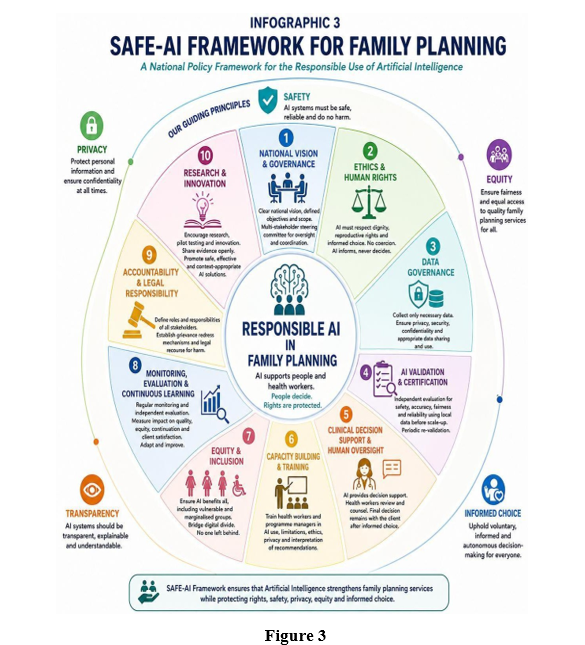
The successful introduction of Artificial Intelligence into family planning programmes requires more than technological innovation. It requires a comprehensive policy framework that ensures AI is used safely, ethically, equitably and responsibly. The framework should provide clear guidance for governments, programme managers, software developers, healthcare providers and other stakeholders involved in the design and implementation of AI-supported family planning services. The proposed framework presented in this paper consists of ten interrelated components. Together, these components provide a systematic approach for planning, implementing, monitoring and continuously improving AI applications in family planning.
a) National Vision and Governance
Every country should begin with a clear national vision for the use of AI in family planning. The purpose of AI should be to strengthen existing services rather than replace healthcare providers. The policy should clearly define the objectives of AI, the scope of its use and the responsibilities of different organisations involved in implementation. A national steering committee should oversee the development and implementation of AI applications. This committee should include experts in family planning, public health, artificial intelligence, digital health, ethics, law, data science and representatives of civil society.
• Why is this Necessary?
Without national leadership, different organisations may develop independent AI systems using different standards. This can result in duplication, poor interoperability and inconsistent quality of services.
b) Ethical Principles and Human Rights
The policy should clearly state that AI must always respect human dignity, reproductive rights and informed choice. Every client should have the freedom to accept or refuse any contraceptive method without coercion. AI should provide information and recommendations, but it should never make decisions on behalf of clients or healthcare providers.
• Why is this Necessary?
Family planning is based on voluntary informed choice. Any technology that influences reproductive decisions without informed consent violates fundamental ethical principles.
c) Data Governance and Privacy
AI systems depend on high-quality data. The policy should establish standards for data collection, storage, sharing and use. Only authorized personnel should have access to personal information, and appropriate cybersecurity measures should be in place to prevent unauthorized access. Whenever possible, data used for research and AI model development should be anonymized.
• Why is this Necessary?
Family planning records contain highly sensitive information. Strong data governance protects privacy, builds public trust and encourages greater acceptance of AI.
d) Validation and Certification of AI Systems
Before any AI application is introduced into routine family planning services, it should undergo independent scientific evaluation. The system should be tested for accuracy, reliability, safety and fairness using local programme data. The evaluation should include women and men from different age groups, geographical areas and socioeconomic backgrounds.
• Why is this Necessary?
An AI system developed using data from another country may not perform accurately in a different population. Local validation helps ensure that recommendations are safe and appropriate.
e) Clinical Decision Support and Human Oversight
AI should function as a decision-support tool rather than an autonomous decision-maker. Healthcare providers should always review AI-generated recommendations before discussing contraceptive options with clients. The final decision should always remain with the client after counselling by a qualified healthcare provider.
• Why is this Necessary?
AI can process information rapidly, but it cannot fully understand personal preferences, cultural beliefs or emotional concerns that often influence family planning decisions.
f) Capacity Building and Training
Healthcare providers should receive regular training on the appropriate use of AI tools. Training should include the strengths and limitations of AI, interpretation of recommendations, privacy protection and ethical use. Programme managers should also be trained to monitor AI performance and use AI-generated information for planning and decision-making.
• Why is this Necessary?
Even the best AI system cannot improve services if users do not understand how to use it correctly.
g) Equity and Digital Inclusion
The policy should ensure that AI benefits all population groups, including people living in rural areas, tribal communities, migrants, adolescents, persons with disabilities and individuals with limited digital literacy. Alternative service delivery methods should always be available for people who cannot use digital technologies.
• Why is this Necessary?
AI should reduce health inequalities, not increase them.
h) Monitoring, Evaluation and Continuous Learning
Regular monitoring should assess whether AI is improving counselling, method continuation, client satisfaction, service quality and programme efficiency. Periodic independent evaluations should identify unintended consequences and recommend improvements.
• Why is this necessary?
Technology evolves continuously. Regular evaluation ensures that AI remains safe, effective and relevant. i) Accountability and Legal Responsibility The policy should clearly define responsibility for AI-related errors. Responsibilities should be shared among software developers, implementing agencies, programme managers and healthcare providers according to their respective roles. Clients should also have a mechanism to report complaints or appeal decisions if they believe AI-supported services have caused harm.
• Why is this necessary?
Clear accountability increases transparency, protects clients and builds confidence in AI-supported services.
j) Research and Innovation
The policy should encourage operational research, pilot testing and independent evaluation of new AI applications before nationwide implementation. Research findings should be shared openly to support continuous learning and evidence-based policymaking.
• Why is this necessary?
AI is evolving rapidly. Continuous research helps countries adopt innovations that improve services while avoiding technologies that ineffective or unsafe.
Implementation Roadmap
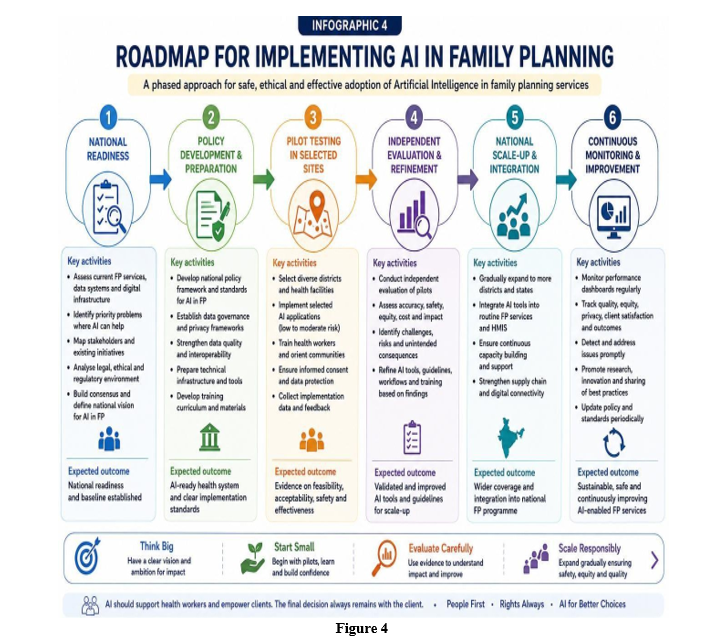
Developing a national policy is only the first step. The real challenge is translating the policy into practice. Successful implementation of Artificial Intelligence in family planning requires careful planning, adequate resources, strong leadership and continuous monitoring. A phased approach is likely to be more effective than introducing AI simultaneously across the entire programme. The first phase should focus on identifying priority areas where AI can provide the greatest benefit. Countries should assess existing family planning services, digital health infrastructure, data quality, internet connectivity, human resources and legal frameworks before selecting AI applications. Early implementation should concentrate on low-risk functions such as client education, appointment reminders, follow-up support, commodity forecasting and data quality improvement rather than clinical decision-making. Once priority areas have been identified, pilot projects should be undertaken in selected districts or health facilities. These pilot sites should represent different geographical regions, urban and rural populations and different levels of healthcare facilities. The objective of pilot implementation is to assess the feasibility, acceptability, safety and effectiveness of AI applications under real programme conditions before expanding to larger populations. Healthcare providers are central to the successful adoption of AI. Comprehensive training should therefore be provided before mplementation begins. Health workers should understand the purpose of AI, its strengths and limitations, how to interpret AI-generated recommendations and how to recognise situations in which clinical judgement should take precedence. Building confidence among healthcare providers will increase acceptance and ensure that AI is used appropriately.
Community engagement is equally important. Clients should be informed about the role of AI in family planning services, the type of information that will be collected and how their personal data will be protected. Public awareness will help build trust and encourage acceptance of AI-supported services. Continuous monitoring should begin from the first day of implementation. Programme managers should regularly assess technical performance, service quality, client satisfaction, method continuation rates, stock availability, data quality and equity of service delivery. Any unintended consequences, including inaccurate recommendations, privacy breaches or increased inequalities, should be identified and addressed immediately. As evidence accumulates from pilot projects, successful AI applications may gradually be expanded to additional districts and eventually integrated into national family planning programmes. Even after nationwide implementation,periodic evaluation and policy revision should continue to ensure that AI remains safe, effective and responsive to changing technologies and programme needs. Implementation should therefore be viewed as a continuous learning process rather than a one-time activity. Countries that adopt AI gradually, evaluate its performance carefully and revise their policies regularly are more likely to achieve sustainable improvements in family planning services.
|
Phase |
Major activities |
Expected outcome |
|
Phase 1 |
National assessment, stakeholder consultation, policy development |
National readiness established |
|
Phase 2 |
Develop standards, strengthen data systems, prepare infrastructure |
AI-ready health system |
|
Phase 3 |
Pilot AI applications in selected districts |
Evidence on feasibility and effectiveness |
|
Phase 4 |
Independent evaluation and refinement |
Improved and validated AI tools |
|
Phase 5 |
Gradual scale-up across the country |
Wider programme implementation |
|
Phase 6 |
Continuous monitoring, research and policy revision |
Sustainable and responsible AI programme |
Table 6: Suggested Phased Implementation of AI in Family Planning
Risk Management, Monitoring and policy recommend-dations
The successful implementation of Artificial Intelligence in family planning does not end with the development of a national policy or the deployment of AI applications. Continuous risk management, regular monitoring and periodic policy review are essential to ensure that AI remains safe, effective and responsive to the needs of individuals and health systems. As AI technologies continue to evolve, countries should establish mechanisms to identify potential risks, monitor programme performance and make evidence-based improvements over time. Although AI offers considerable opportunities to strengthen family planning programmes, it also introduces new technical, ethical and operational challenges. These challenges should be anticipated and addressed through appropriate safeguards before large-scale implementation. Table 7 summarises some of the major risks associated with AI in family planning together with suggested mitigation measures.
|
Potential Risk |
Possible Consequence |
Mitigation / Policy Response |
|
Inaccurate AI recommendations |
Incorrect contraceptive advice or inappropriate method selection |
Validate AI tools before implementation, use high-quality local data and conduct periodic re-validation |
|
Data privacy breach |
Loss of confidentiality, stigma and reduced public trust |
Strong data governance, encryption, informed consent and restrictedaccess |
|
Algorithmic bias |
Unequal recommendations for certain population groups |
Use representative datasets, conduct regular bias testing and equityassessments |
|
Over-reliance on AI |
Reduced clinical judgement |
AI should function only as a decision-support tool with mandatory human oversight |
|
Low digital literacy |
Poor utilisation of AI tools and exclusion of vulnerable populations |
User-friendly interfaces, local language support, training and alternative service options |
|
Cybersecurity threats |
Data theft or disruption of services |
Strong cybersecurity systems, regular security audits and disaster recovery plans |
|
Lack of transparency |
Users may not understand AI recommendations |
Use explainable AI and provide clear documentation |
|
Weak accountability |
Unclear responsibility for AI-related errors |
Clearly define legal and operational responsibilities |
Table 7: Potential Risks of AI in Family Planning and Mitigation Measures
Managing risks alone is not sufficient. Countries also need to determine whether AI is achieving its intended objectives. A monitoring and evaluation framework should therefore be integrated into the national policy from the outset. Regular monitoring helps programme managers identify implementation challenges, measure programme performance and take corrective action when necessary.
|
Domain |
Suggested Indicators |
Purpose |
|
Service quality |
Accuracy of AI recommendations, timeliness of follow-up |
Assess improvement in service quality |
|
Client satisfaction |
Client satisfaction score, confidence in AI-supported services |
Measure user acceptance |
|
Method continuation |
Continuation and discontinuation rates |
Evaluate programme effectiveness |
|
Privacy and security |
Number of privacy breaches and reported incidents |
Monitor protection of client information |
|
Data quality |
Completeness, accuracy and timeliness of records |
Ensure reliable programme information |
|
Equity |
Coverage among rural, urban and vulnerable populations |
Ensure equitable implementation |
|
Supply chain |
Stock-out rate and forecasting accuracy |
Assess logistics performance |
|
AI performance |
Accuracy, uptime and system reliability |
Monitor technical performance |
|
Health worker acceptance |
User satisfaction and percentage of trained staff |
Assess provider readiness |
|
Cost-effectiveness |
Cost savings and efficiency gains |
Evaluate programme value |
Table 8: Suggested Indicators for Monitoring AI Implementation in Family Planning
Monitoring should not focus only on technical performance. It should also assess whether AI is improving counselling, protecting informed choice, reducing inequalities and strengthening public confidence in family planning services. Regular independent evaluations should be undertaken, and findings should be used to update AI systems, implementation strategies and national policies. Finally, governments should translate the findings from monitoring and evaluation into practical policy actions. The recommendations proposed in this paper are intended to support countries in implementing AI responsibly while safeguarding individual rights and maintaining high-quality family planning services.
|
Recommendation |
Expected Outcome |
|
Develop a national AI policy for family planning |
Standardised and responsible implementation |
|
Establish ethical and legal guidelines |
Protection of reproductive rights and informed choice |
|
Validate AI systems before deployment |
Safe and reliable AI recommendations |
|
Ensure mandatory human oversight |
Better clinical judgement and client-centred care |
|
Strengthen data governance and cybersecurity |
Protection of privacy and increased public trust |
|
Train healthcare providers |
Appropriate and effective use of AI |
|
Establish continuous monitoring and evaluation |
Ongoing quality improvement |
|
Promote operational research and innovation |
Evidence-based policy development |
|
Engage communities and stakeholders |
Increased transparency, acceptance and trust |
|
Periodically review and update the policy |
Adaptation to technological advances and emerging evidence |
Table 9: Key Policy Recommendations
Figure 5 provides a graphical summary of the proposed approach. It illustrates how the benefits of AI can be realized only when implementation is supported by a strong policy framework, effective safeguards and continuous monitoring. Together, these components create a responsible AI ecosystem that strengthens family planning programmes while protecting privacy, equity, informed choice and human rights.

Figure 5
Strengths, Limitations and Future Directions
This paper presents a practical policy framework for the responsible use of Artificial Intelligence (AI) in family planning. Unlike many existing publications that primarily discuss the potential applications of AI in healthcare, this paper proposes a comprehensive framework that links AI applications with governance, ethics, implementation, monitoring and policy recommendations. By integrating these components into a single framework, the paper provides a practical roadmap that can assist governments and programme managers in planning and implementing AI-supported family planning services. One of the major strengths of the proposed framework is that it addresses the entire continuum of family planning services rather than focusing on a single component. It considers the role of AI in client education, counselling, contraceptive method selection, follow-up care, supply chain management, programme monitoring and policy development. The framework also recognises the different requirements of both spacing and limiting methods, ensuring that AI applications are considered across the full range of family planning services. Another important strength is its emphasis on a rights-based approach. The framework places informed choice, privacy, equity, transparency, accountability and human oversight at the centre of AI implementation. Rather than promoting AI as a replacement for healthcare providers, it recognises AI as a decision-support tool that should strengthen, rather than replace, clinical judgement and client-provider interaction. The framework is intentionally designed to be adaptable. Although it has been developed from a public health perspective, it is sufficiently flexible to be adopted and modified by countries with different health systems, levels of digital maturity and programme priorities. The phased implementation roadmap also allows countries to introduce AI gradually, evaluate its performance and expand implementation based on local experience and available resources. This paper also has some limitations. The proposed framework is conceptual and has not yet been tested through pilot implementation or large-scale field evaluation. The effectiveness of individual AI applications may vary depending on data quality, digital infrastructure, healthcare capacity and national regulations. In addition, AI technologies continue to evolve rapidly, and future technological developments may require periodic revision of the framework.
Further research is needed to evaluate the effectiveness, safety and acceptability of AI applications across different family planning settings. Future studies should examine the impact of AI on the quality of counselling, informed decision-making, continuation of contraceptive methods, client satisfaction, programme efficiency and equity of service delivery. Research should also explore methods for detecting and reducing algorithmic bias, strengthening data privacy and developing internationally accepted standards for validating AI systems used in reproductive health. Pilot implementation studies in different countries will be particularly valuable in assessing the practicality of the proposed framework under diverse health system conditions. Lessons learnt from these pilot programmes can inform future revisions of national policies and contribute to the development of global guidance on the responsible use of AI in family planning. As Artificial Intelligence continues to evolve, national policies should also remain dynamic. Periodic review, continuous learning and international collaboration will be essential to ensure that AI is implemented safely, ethically and equitably while protecting reproductive rights and strengthening family planning programmes. The framework presented in this paper is intended to serve as a foundation for future policy development, research and innovation, supporting countries in harnessing the benefits of AI while maintaining people-centered, rights-based and evidence-informed family planning services.
Conclusion
Artificial Intelligence has the potential to strengthen family planning programmes by improving counselling, supporting healthcare providers, enhancing follow-up, optimizing supply chain management and generating timely information for programme planning and decision-making. When used appropriately, AI can improve the quality, efficiency and accessibility of family planning services while helping health systems respond more effectively to the diverse needs of individuals and communities. However, family planning is a unique area of healthcare because it is closely linked with reproductive rights, informed choice, privacy, dignity and personal autonomy. Unlike many other health interventions, decisions related to contraception are influenced not only by medical factors but also by social, cultural, religious and personal considerations. For this reason, AI should always remain a decision-support tool rather than a decision-maker. It should assist healthcare providers and empower clients, but it should never replace human judgement or influence an individual's voluntary choice of contraceptive method.
The responsible use of AI therefore requires more than technological advancement. It requires a comprehensive national policy framework that establishes clear standards for governance, ethics, privacy, data quality, validation, human oversight, accountability, equity and continuous monitoring. Such a framework will help ensure that AI is implemented safely, transparently and responsibly while maintaining public trust and protecting the rights of every individual. The framework proposed in this paper provides a practical roadmap for countries that wish to integrate AI into their family planning programmes. It recognizes that successful implementation should begin with careful planning, pilot testing and capacity building, followed by continuous evaluation and gradual scale-up based on evidence. This phased approach allows countries to harness the benefits of AI while minimizing potential risks and adapting implementation to their own health systems and priorities.
As Artificial Intelligence continues to evolve, its role in public health will undoubtedly expand. Countries that invest today in responsible governance, strong digital health systems and evidence-based policies will be better positioned to use AI to improve reproductive health outcomes and strengthen family planning services in the years ahead. The success of AI in family planning will ultimately depend not on the sophistication of the technology itself, but on how responsibly it is designed, implemented and governed. Artificial Intelligence should therefore be viewed as a partner in strengthening family planning services not as a substitute for healthcare providers or for the rights and choices of individuals. The future of family planning lies in combining technological innovation with ethical principles, sound public health practice and a steadfast commitment to protecting informed choice, equity and human rights [1-16].
References
- World Health Organization. Family planning and contraception. Geneva: WHO. Available from: WHO Family Planning and Contraception.
- World Health Organization. Medical Eligibility Criteria for Contraceptive Use. 6th ed. Geneva: World Health Organization.
- World Health Organization. Selected Practice Recommendations for Contraceptive Use. Geneva: World Health Organization.
- World Health Organization. Family Planning: A Global Handbook for Providers. 2022 Edition. Geneva: World Health Organization and Johns Hopkins Bloomberg School of Public Health.
- World Health Organization. Ethics and Governance of Artificial Intelligence for Health. Geneva: World Health Organization.
- World Health Organization. Global Strategy on Digital Health 2020–2027. Geneva: World Health Organization.
- World Health Organization. Digital Adaptation Kit: Family Planning. Geneva: World Health Organization.
- World Health Organization. Toolkit and Content Repository for Digital Client-Facing Platforms: Family Planning. Geneva: World Health Organization, 2025.
- World Health Organization. Implementation Guide for the Medical Eligibility Criteria and Selected Practice Recommendations for Contraceptive Use Guidelines. Geneva: World Health Organization, 2018.
- World Health Organization. Artificial Intelligence and Evidence-Informed Policy: Emerging Challenges and Opportunities. Geneva: World Health Organization, 2026
- United Nations Population Fund. State of World Population.New York: UNFPA.
- United Nations Population Fund. Digital Innovations for Sexual and Reproductive Health. New York: UNFPA.
- United Nations. Transforming Our World: The 2030 Agenda for Sustainable Development. New York: United Nations.
- OECD. OECD Principles on Artificial Intelligence. Paris: Organisation for Economic Co-operation and Development.
- World Health Organization. Digital Health. Geneva: World Health Organization.
- World Health Organization. Health Ethics and Governance: Emerging Technologies. Geneva: World Health Organization.